
George Stevens | 113 mins | TV | 4:3 | USA / English | U
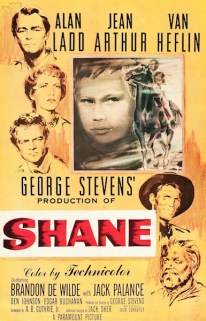 Though not part of my “What Do You Mean You Haven’t Seen…?” project, Shane is exactly the kind of film that could have been: a widely acclaimed classic that therefore comes with all that associated baggage. Like many of those films, that baggage weighs the film down to a point where, on a first viewing, it’s hard to just purely appreciate it.
The general shape of the plot is one familiar to Western fans, though that may well be because the others are based on Shane: a mysterious stranger rides into town, just looking for lodgings and/or work. Turns out the honest good-hearted town-folk are in some way being oppressed by a local gang/landowner/etc. The stranger doesn’t want to intervene, he just wants a quiet life… but eventually something galvanises him and he can’t help it. Cue climactic shoot-out.
I don’t mean to do Shane down by reducing it to these generic elements — as I say, my history of Westerns isn’t so hot, so it may well be the template from which all similar narratives are pressed. But perhaps this is why so many reviews emphasise the film’s subplots, particularly the fondness displayed towards Shane by the wife of the man he’s working for, and the hero-worship adorned on him by the man’s son. This is where the baggage comes into play, however, because while those elements get emphasised in reviews and commentary, I didn’t find them noticeably prominent in the film — calling them subplots is to increase their import.
 The thing with the wife, for instance, is mainly down to a few looks, or the way a line of dialogue is played. I was once taught that if a writer doesn’t put any subtext into a scene the actors will add it themselves — perhaps that’s even what happened here. I was wondering if it was going somewhere, if we were going to learn that Shane and wifey actually knew each other, or if they were going to have A Thing now (this being a ’50s American movie, “almost have a thing but then not quite” is probably nearer the mark). But, without meaning to spoil things, it doesn’t play out like that. At all.
I didn’t dislike Shane, but I’m trying to both work out and explain why I didn’t love it. If I sound overly critical then it’s because of those expectations, for which look to sources like the Radio Times, who state that, “if you’ve never seen it, Shane is a revelation”. It wasn’t, and I kinda blame them.

Shane is on Film4 today at 4:30pm.
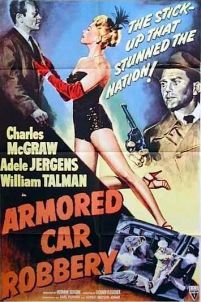 A B-picture from the middle of the classic film noir era, Armored Car Robbery is perhaps most notable today for being one of the first films directed by Richard Fleischer, who would later call the shots on
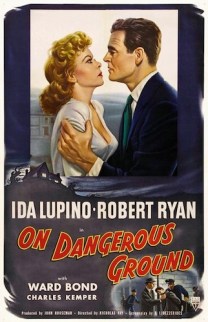 Helmed by acclaimed director Nicholas Ray (
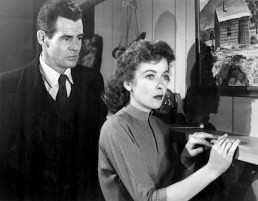 On the plus side, Bernard Herrmann’s score is unequivocally excellent, particularly the pulsating opening theme and the insistent action climax.
 Moonfleet is probably what you’d call a curio. It’s a colour CinemaScope Hollywood adventure movie from a director best known for epic German silents or dark film noirs; it’s not been passed by the BBFC since its original release in the ’50s, meaning it’s never been released here on DVD or (presumably) even VHS; I believe it’s also unavailable in the US; yet despite this dearth of attention in both the country that made it and the country in which it’s set, a
 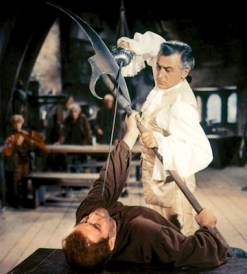 fights and chases of various kinds, a dramatic shoot-out on a beach, midnight escapes, and so on.
 On its release in 1956, The Court Jester was the most expensive comedy ever made, at a cost of $4 million. For that sum you could make precisely 2 minutes & 11 seconds of more recent most-expensive-ever comedy flop
  Rathbone’s character is played by the film’s fight choreographer, the 63-year-old star finding Kaye’s movements a bit fast for him at that age.
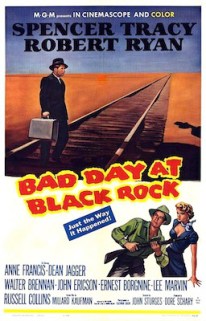 Bad Day at Black Rock comes with an air of the forgotten classic — or, at least, it did to me. I think that’s important to how I ultimately reacted to it. As is that wherever I first heard about it pitched it as a suspenseful mystery with a twist. I forget where that was now, but I remember consciously avoiding finding out the plot’s developments (more so than one naturally would anyway) before viewing.
 I missed the commentary. Indeed, in
  For a film so based in mystery and which has what I’d call a methodical pace (despite its short running time), there are surprisingly good action sequences to look out for: a car chase/battle along a thin path, a one-handed punch-up in a bar, and a climactic shoot-out that’s at its most tense once all the bullets have been fired. It’s not an action movie by any means, but these cinematic sequences stand out nonetheless.
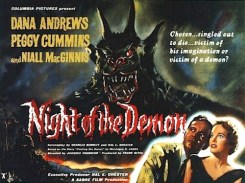 Adapted from an M.R. James story, Night of the Demon sees Dana Andrews as Dr. John Holden, a psychologist arriving in Britain to discredit satanic cult leader Julian Karswell. To cut to the chase, Holden begins to wonder if Karswell has placed a curse on him, and perhaps what he had set out to disprove isn’t such mumbo jumbo after all…
 Tourneur’s film is beloved by some, but I don’t think I quite got it myself. There are some great sequences, but I didn’t always find it hung together in between. Ironically, while many have criticised the actual appearance of the titular beast at the end, I think it works rather well — it’s surprisingly well realised, and you can take it as either a real manifestation or part of one character’s deranged imaginings. It’s an effective climax.
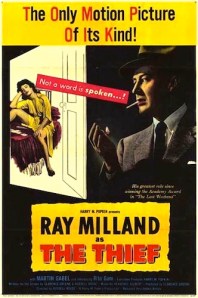 Ray Milland stars as Dr. Allan Fields, a nuclear physicist working at the United States Atomic Energy Commission, who is photographing secret files and passing them to The Other Side, until something goes wrong and the authorities are on his tail. But that’s almost beside the point, because if The Thief is known for anything it’s for its dialogue — as the poster proclaims, “not a word is spoken…!”
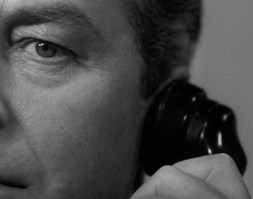 Obviously we can look back to the silent cinema for that kind of thing, but while that era could probably still teach many filmmakers something about visual storytelling, it’s hard to deny that the advent of synchronised sound adds a helluva lot to the ability of film — if it didn’t, it wouldn’t have taken over so fast and remained virtually 100% dominant for the last 80+ years.
 Perhaps this is why the villains are never explicitly named. But they’re definitely not American! Tsk tsk. More crucially, it’s a bit slow at times — it seems to take longer to explain things when stuck doing them through visuals alone. That said, it could probably have survived a speedier approach even doing what it does — perhaps, then, Rouse is playing for time: the film only runs 87 minutes in spite of its pace.
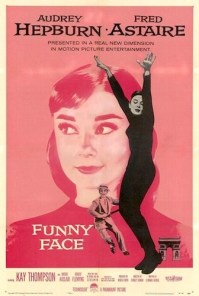 Like
Like 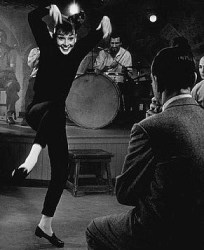 or dismissed the dullness of philosophy for the glamour of couture, but it takes fair jibes at both equally — it’s not mean-spirited or cynical or dismissive, just… quite true.
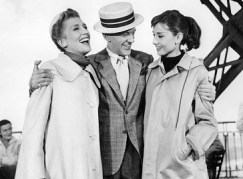 Funny Face seems to have plenty of critics — mainly on the notion that Hepburn could be said to have a funny face. Pretty shallow reason to dismiss a whole film, if you ask me. While there are couple of bits that don’t wash with my appreciation — the age gap; I could take or leave the two scenes at the church — there’s far more to love about the film.
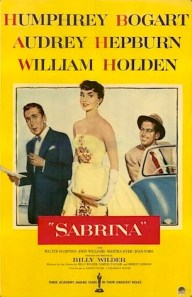 Audrey Hepburn’s next leading role after her star-making turn in
 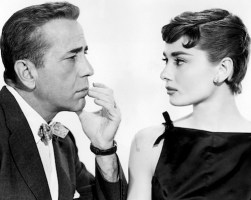 But it actually feels very mean-spirited — Sabrina is likeable enough that we dislike his machinations. Which means that, for me anyway, there’s no truly supportable lead character. And then at the end he genuinely falls for her, which I found an equally implausible development — as well as seeming totally out of character, it did nothing to redeem what had come before. And he’s old enough to be her dad.
 100Films.co.uk