
Akira Kurosawa | 207 mins | Blu-ray | 1.33:1 | Japan / Japanese | PG
 Seven Samurai used to be a striking anomaly amongst the top ten of IMDb’s user-voted Top 250: it’s a three-and-a-half-hour subtitled black-and-white movie. These days it sits at #21, presumably through a mixture of IMDb tweaking the voting rules and it being rated lowly by people keen to see all of the Top 250 but who don’t typically like three-and-a-half-hour subtitled black-and-white films. Nonetheless, it has a claim to wide popularity (alongside its critical renown) that is rarely achieved by three-and-a-half-hour subtitled black-and-white movies.
In 16th Century Japan, rural communities are terrorised by gangs of bandits stealing their crops, raping their women, and all that other nasty to-do. One village has had enough and, knowing they can’t defend themselves, sets out to employ a band of samurai to defend them when the bandits come again the next year. Samurai aren’t cheap, but the villagers have no money, so they’ll have to make do with what they can get. Managing to snag Kambei (Takashi Shimura) to lead the defenders, he assembles a team, including wannabe Kikuchiyuo (Toshiro Mifune) and five others (Daisuke Katō, Isao Kimura, Minoru Chiaki, Seiji Miyaguchi, and Yoshio Inaba), who then set about preparing the villagers for battle…
Despite its epic running time, Seven Samurai isn’t really an epic film — this isn’t the story of a war, or even a battle, but of a skirmish to defend one village. How does it merit such length, then? By going into immense detail, by having plenty of characters to fuel its narrative and its subplots (and if you think there’d be plenty of time to explore seven characters in over three hours, turns out you’d be wrong), and by using the time to familiarise us with these people, so that when the final fight comes — and that’s a fair old chunk of the film too — we care what happens. Plenty of other films make us care in a shorter period of time, of course, but here we feel truly invested in the outcome.
 It’s also unhurried. As Kenneth Turan explains in his essay “The Hours and Times: Kurosawa and the Art of Epic Storytelling” (in the booklet for Criterion’s DVD and Blu-ray releases of the film, and available online here), the film “unrolls naturally and pleasurably… luxuriating in its elongation — it takes an entire hour just for the basic task of choosing the titular seven.” As a viewer, I think you have to be mentally prepared for that pace, in a way. Most other films would use a snappy montage to collate the team, with key scenes or moments later on being used to highlight their personalities — witness any number of Hollywood (and Hollywood-esque) ‘men on a mission’ movies that do exactly that. Kurosawa’s expanded version makes the film more a marathon than a sprint, with only some of the negative connotations describing something as “a marathon” entails.
In truth, this is not the most fascinating portion of the film, but nor is it without merit. As discussed, it’s establishing these characters in full so that we are more attached to them later, but it’s also commenting on, perhaps even deconstructing, the image and role of the samurai. In “A Time of Honor: Seven Samurai and Sixteenth-Century Japan” (again in Criterion’s booklet, and available online here), Philip Kemp explains how Kurosawa’s depiction of the samurai overthrows some simplistic ideals that had become associated with them, and shows them instead as normal human beings, more likely to run away to save their own skin than pointlessly fight to their death. The villagers have indeed managed to employ professional combatants, but they’re not so different to the villagers themselves, just better trained.
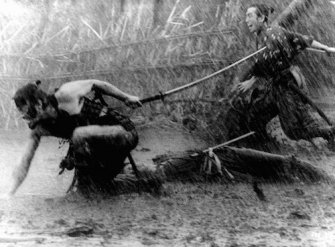 The length ensures our investment in the village, too, just as it does for the samurai. They’re not being paid a fortune — in fact, they’re just being paid food and lodging — so why do they care? Well, food and lodging are better than no food and lodging, for starters; and then, having been in the village so long in preparation, they care for it too. It is, at least for the time being, their home. You can tell an audience this, of course, but one of the few ways to make them feel it is to put them there too — and that’s what the length does. To quote from Turan again,
The film’s length works in its favor in ways both big and small: It allows the samurai leader, whose head is shaved in an opening scene, to gradually grow his hair back. It allows the eternally uneasy bond between the samurai and the villagers, as well as the villagers’ martial confidence, to grow believably over time. … When the bandits finally do attack, our hearts are in our throats — we know the defenders so well, and we can sense that not everyone will survive.
It can seem like a blind alley to go on about a film’s length — many an epic is long just because it has a long, or large, story to tell — but in Seven Samurai, the sheer size, and the way it uses that, are almost part of the point.
The film ends with a melancholic note. That “eternally uneasy bond between the samurai and the villagers” comes to an end — with victory won, the surviving samurai are no longer required. The farmers return to farming, the samurai return to… what? They are not really at home in the village, they were just guests; nor are they rich, because there was no pay — so what have they got out of the conflict? As Alain Silver notes in “The Rains Came: Kurosawa’s Pictorial Approach to Seven Samurai” (in Criterion’s booklet, of course, but not online),  the final scene, the way it’s edited and framed, ties the remaining samurai to their deceased comrades, the living and thriving farmers a distant and separate group. Fighting is the way of the past, perhaps, and peaceful farming the future. Or is the samurai’s only purpose to be found in death, because other than that they are redundant?
Even if you don’t want to get into the film’s philosophical underpinnings, there are plenty of other, more visceral thrills to enjoy. The characters provide humour as well as emotional depth; there are scattered “action sequences” throughout; and the big climax may technically only be a skirmish, but it’s one played out in detail, to epic effect. There’s not the choreography that viewers used to modern blockbusters or Hong Kong fisticuffs might expect, but that doesn’t meant the rough and realistic fighting isn’t exciting or well-constructed. Drenched in rain and covered in mud, it’s messy and, in its own way, beautiful. The whole film is visually stunning, as you’d expect from a Kurosawa picture. You may not realise it at the time, but many a familiar type of shot actually originated here, and then was copied down the ages.
It might seem difficult to credit now, but Seven Samurai was only fairly well received in Japan on its initial release: as Stuart Galbraith IV reveals in “A Magnificent Year” (also in Criterion’s booklet (where else?)), most of the awards for Best Picture went elsewhere, and at the box office it was comedies and romances that were the big crowd-pleasers. 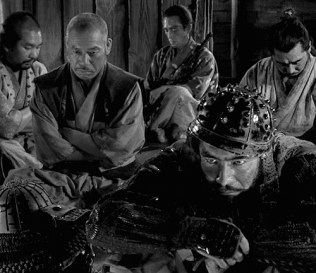 And it wasn’t as if it was overseas viewers who hit on the magic: as Turan reveals, “Toho Studios cut fifty minutes before so much as showing the film to American distributors, fearful that no Westerner would have the stamina for its original length.” The more things change the more they stay the same, I suppose — how many Great Films from Hollywood are ignored by awards bodies and audiences, only to endure in other ways?
Seven Samurai is definitely a case of the latter. Its standing on the IMDb list may have slipped with time (and rule changes, no doubt), but it’s still a trend-bucker — a three-and-a-half-hour subtitled black-and-white film that can appeal, if not to the masses, then to some people who wouldn’t normally go in for that kind of thing. A marathon but not a slog, requiring investment rather than passive absorption, Kurosawa’s epic rewards the viewer with one of cinema’s most enthralling, gorgeous, and vital experiences.

Seven Samurai placed 1st on my list of The Ten Best Films I Saw For the First Time in 2013, which can be read in full here.
It was viewed as part of my What Do You Mean You Haven’t Seen…? 12 for 2013 project, which you can read more about here.
This review is also part of the 100 Films Advent Calendar 2014. Read more here.
 Westerns don’t come more renowned than this Ford-Wayne collaboration about the years-long hunt for a girl kidnapped by Native Americans.
 Box office gross is one of the methods most often used to summarise a film’s success and standing, and yet it’s one of the most useless markers of quality — and quotes like the above, from Terrence Rafferty in his article “Holy Terror” for Criterion’s Blu-ray release of Night of the Hunter (and available online
  In another piece in Criterion’s booklet, “Downriver and Heavenward with James Agee” (online
  And yet, as Rafferty explains, “the most radical aspect of The Night of the Hunter… is its sense of humor. More conventional horror movies overdo the solemnity of evil. The monster in The Night of the Hunter is so bad he’s funny. Laughton and Mitchum treat evil with the indignity it deserves.” I wouldn’t say that humour is one of the film’s defining characteristics, to be honest, but it does undercut its villain. He’s not some unstoppable supernatural creature, but a man who can trip over while chasing you up the stairs, and so on. In some respects it’s this very ordinariness that makes him so scary: however much they creep you out during the film itself, you know there’s no such thing as vampires or werewolves or ghosts. There are Powells in the world, though; an everyday evil that you might not see coming, but can still get you. Brr.
 In
In 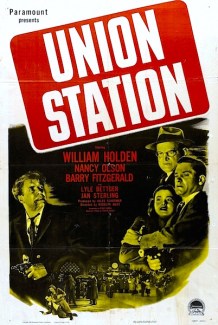 Often noted merely for being filmed in Los Angeles’ busy train station, there are some spirited defences of Union Station to be
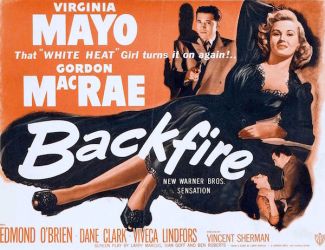 Before he was the romantic male lead in musicals like
  Besides, even if the film seems to forgo the usual gritty noir trappings for a pleasant “English murder mystery”-type tale at first, it actually has its fair share of dark elements and noir-ish features, which only increase as it goes on: secretive gangsters, nightclub singers, revenge shootings… Then there’s the photography which, again, transitions from a fairly ‘regular’ (for want of a better word) style early on, to a world of rain-slicked streets and high-contrast lighting.
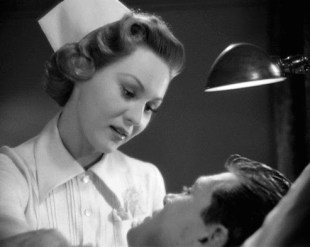 It’s in the latter’s case that the writing gets a chance to shine, too: the chief’s flashback is littered with snappy dialogue that feels kinda like he’s telling you the story himself, not just a matter-of-fact “here’s what happened earlier” objective account. Other flashbacks retain a degree of subjectivity — we only see events the characters could have witnessed, and in some cases the way they witnessed them (like the cleaning lady who only sees customers’ feet, before spying through a keyhole in a shot complete with keyhole matte) — but there’s an idea there, briefly glimpsed in that detective’s flashback, that would’ve made for an even more interesting film.
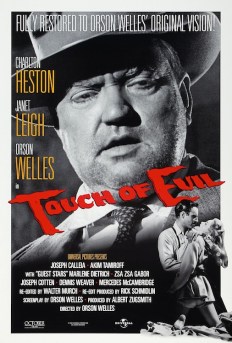 A bomb is stuck to the underside of a car. As the vehicle pulls away, the camera drifts up into the sky, and proceeds to follow the automobile through the streets of a small Mexican border town, until it crosses the border into the US… and explodes. It’s probably the most famous long take in film history, and probably the thing Touch of Evil is most widely known for; that, and it being one of the most commonly-cited points at which the classic film noir era comes to an end.
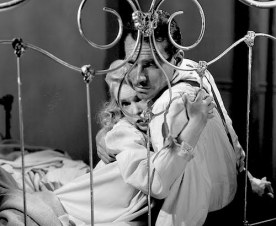 It’s like a terrible fever dream, with events and characters that sometimes seem disconnected, but nonetheless interweave through a dense plot. In this sense Welles puts us quite effectively in the shoes of Vargas and his wife — out of our depth, out of our comfort zone, out of control, struggling to keep up and keep afloat. It might be unpleasant if it wasn’t so engrossing.
 Quinlan at all… there is not the least spark of genius in him; if there does seem to be one, I’ve made a mistake.” You can get pretentious about it all you want, and bring to bear political views that the film doesn’t support (after all, within the film Quinlan is punished for his crimes and the “mediocre” (Truffaut’s word) moral hero triumphs), but sometimes a spade is a spade; sometimes a villain is a villain; sometimes your disgusting moral perspective isn’t being covertly supported by a film that seems to condemn it.
 Notably and obviously absent from that list is Touch of Evil. It was taken away from Welles during the editing process, and though he submitted an infamous 58-page memo of suggestions after seeing a later rough cut, only some were followed in the version ultimately released. Time has brought change, however, and there are now multiple versions of Touch of Evil for the viewer to choose from; but whereas history often resolves one version of a film to be the definitive article, it’s hard to know which that is in this case. Indeed, it’s so contentious that Masters of Cinema went so far as to include five versions on their 2011 Blu-ray (it would’ve been six, but Universal couldn’t/wouldn’t supply the final one in HD.) The version I chose to watch, dubbed the “Reconstructed Version”, tries to recreate Welles’ vision, using footage from the theatrical cut and a preview version discovered in the ’70s to follow his notes. Despite the best intentions of its creators, this can only ever be an attempt at restoring what Welles wanted. Equally, although it was the version originally released, the theatrical cut ignores many of the director’s wishes — so as neither version was finished by Welles, surely the one created by people trying to enact his wishes is preferable to the one assembled by people who only took his ideas on advisement?
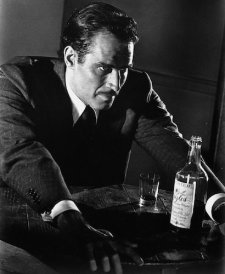 To quote from Master of Cinema’s booklet, “the familiar Wellesian framing appears in 1.37:1: indeed, the “world” of the film setting emerges with little or no empty space at the top and bottom of the frame, almost certainly beyond mere coincidence.” There are things to recommend the widescreen experience (“a more tightly-wound, claustrophobic atmosphere”), and undoubtedly the debate will continue… and such is the wonders of the modern film fan that, rather than having to make do with someone else’s decision on what to put out, all the alternatives are at our fingertips.
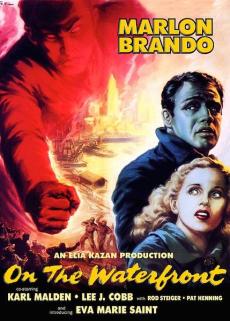 So much more than one famous scene, On the Waterfront is a movie about a magic jacket, which causes anyone who owns it to stand up for what’s morally right even in the face of oppression, but also to suffer badly when they do.
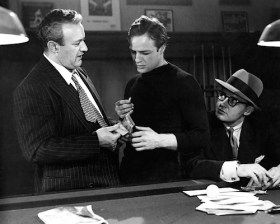 The only potential downside to this comes if you dig behind the scenes. Kazan was one of those who testified before the House Committee on Un-American Activities during its 1940s and ’50s witchhunt for Communists in Hollywood, naming eight men who were later blacklisted. If you consider the film to be Kazan’s answer to critics of his actions (as it “widely” is, according to Wikipedia), then presumably Brando is meant to be Kazan, calling out those who are doing ill to good hardworking Americans. But many a great film has been made with poor motive — just because Kazan thinks what Brando’s character does and what he did are the same thing doesn’t mean we have to. Even then, the issue of Kazan’s testimony is not so straightforward: a former Communist himself, he faced the end of his career if he didn’t testify, and the names he gave up were already known to the committee. The controversy dogged him for the rest of his career, though: when he received an honorary Oscar in 1999, several notable audience members refused to applaud.
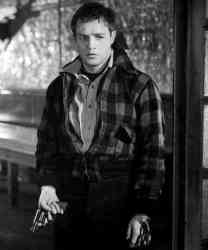 While subtext is undoubtedly a meaningful thing, and using one situation to comment on another is a tried and true way of presenting an argument or criticism, I’m not a proponent of offhandedly dismissing work(s) just because we don’t agree with the actions or beliefs of the person who made it. On the Waterfront is a powerful film, exemplarily made by skilled craftsmen. Whatever Kazan was trying to atone for with its message about standing up to bullies in defence of what’s right, the sentiment is true. And you don’t need a magic coat to do it either.
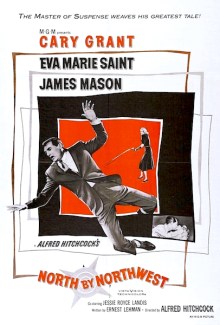 Alfred Hitchcock is famous for a good many movies — I wager most people would jump to
 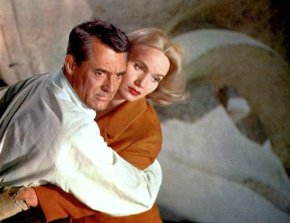 Grant is as wonderful as ever, a perfect ‘everyman’ to guide us through the crazy turns of events, but also finding the appropriate level of humorous edge where it exists. Eva Marie Saint is a textbook ‘Hitchcock Blonde’, attractive but duplicitous — women, eh? James Mason makes for an excellent English-accented villain — today it may be a terrible cliché to use Brits as villains in Hollywood movies, but we’re so damn good at it. That said, Martin Landau makes for a deliciously creepy henchman, so there’s no monopoly. There’s also Leo G. Carroll, who to me will always be best known from
 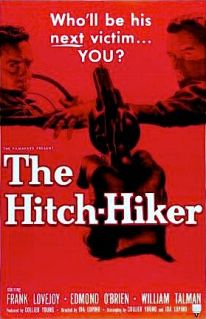 Based on a true story, this film noir sees two chums on the way home from a fishing trip pick up a hitchhiker. As you can tell from the title, he turns out to be rather significant: he’s a murderer on the run, and pulls a gun on the men so they’ll do his bidding, which is take him to Mexico so he can escape justice. Oh dear.
 But does her gender add any different perspective? I think perhaps it does. If you read
  A black and white Swedish movie in which a knight ponders the existence of God while playing chess with Death? Yep, here we have the stereotype of arthouse cinema. Let’s be honest, it lives up to most of those expectations.
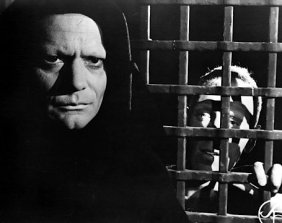 On the more easily-appreciable side, it’s beautifully shot by Gunnar Fischer. It had to be made quickly, on a tight budget, and for that reason Bergman found it imperfect and rough in places. This may be true, but regardless, there are numerous striking compositions, and even more occasions where the rich black-and-white photography looks stick-it-on-your-wall gorgeous. I only watched it on Tartan’s old DVD and, even with mixed feelings about the film itself, I’m sorely tempted to pick up one of the Blu-rays.
 100Films.co.uk