
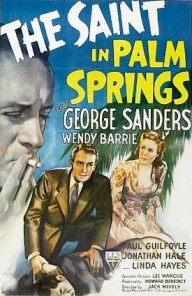
 George Sanders is the Saint for the final time in a film that isn’t the series’ best, nor its worst. It also marks the final appearance by Jonathan Hale as Inspector Fernack, and third-and-final turns from both Wendy Barrie and Paul Guilfoyle. For those keeping track (or not), that’s the same four leads as the last picture! Same director too, as Jack Hively helms his third (and, of course, final) Saint adventure.
By this point Fernack seems to have reconciled himself to Simon Templar being on the side of the angels (he is a Saint after all) and actually offers him a mission. A friend of Fernack’s needs some immensely valuable stamps escorted to Fernack’s friend’s daughter in Palm Springs, but being out of NYC that’s outside Fernack’s jurisdiction — but nowhere is beyond the reach of the Saint. Or something. Anyway, he agrees, but it goes quickly awry when Fernack’s friend’s brother is murdered; but the Saint, being the fundamentally decent adventure-seeker he is, agrees to take the stamps on to Fernack’s friend’s brother’s niece anyway.
Points are scored here for a change of format. Rather than racing back and forth around the same city, here the Saint sees action in New York, on a train, in a holiday resort in Palm Springs, and in the desert surrounding it. Somehow it feels different, more layered. That said, it gets a bit repetitive. The stamps are contained in a locket that is repeatedly stolen, recaptured, stolen-but-empty, recovered, rinse, repeat. Still, there are inventive spots along the way, and for once it manages to pull out a genuine twist — the culprit is obvious throughout, as per usual, but then… well, that would be spoiling it.
 Hale isn’t in it nearly enough unfortunately, especially considering this is his last outing. Guilfoyle has the sidekick role and at least his and Sanders’ relationship is a fun substitute. Barrie is, for once, simply the ingénue and not some form of criminal mastermind. Don’t worry, there’s another girl for that: Linda Hayes, who seems a promising match for the Saint but, though prominent early on, is ultimately disregarded. The highlight for both women comes when they get invited along for a horse ride with the Saint and have a good bitch at each other. It’s a pickle quite unlike the ones Templar usually finds himself in! I have nothing against Barrie, but quite why they sought to use her repeatedly I don’t know. And, to be frank, she worked best in her first appearance.
The Saint in Palm Springs isn’t a grand send-off for this repertory company of Saint series filmmakers, but then I don’t imagine it was ever intended to be. At least it still has most of the fun and charm that characterise this era of the Saint’s adventures, something that is sorely missing as the series continues under new leadership.

Read my thoughts on the four other films to star George Sanders as the Saint here and here.
* As with many of the Saint films, this has apparently not been passed by the BBFC since its release in 1941. Nonetheless, it’s available on DVD, rated PG. ^
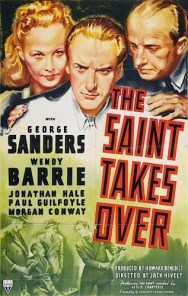 The first RKO Saint film to not be based on a story by the Saint’s creator, Leslie Charteris, is actually one of the better mysteries in the franchise. Sort of. The downside would be that the solution is glaringly obvious. For a mystery you might imagine that would be a major problem, but the process of investigating is nicely done. A bit more work might’ve been done to obscure the culprit, a character who we meet at the beginning and then more or less disappears and so will inevitably return somehow, but I had so much fun I don’t really care.
 One of the highlights of
 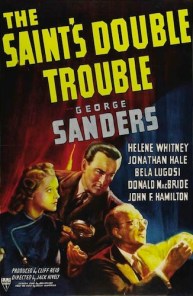 After two fun adventures, here RKO’s series turns in my least favourite film to star George Sanders as the Saint.
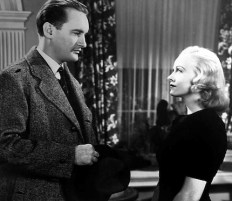 Helene Whitney is fine in this role, but her character’s not a patch on
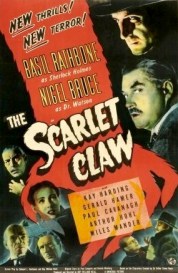 According to
  a properly chilling murder scene, quite out of step with the film’s age and PG certificate.
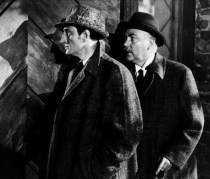 There’s also a hefty dose of coincidence that everyone involved, both on screen and off, conveniently ignores.
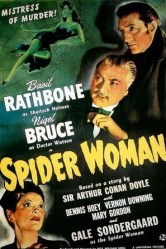 The seventh feature starring Basil Rathbone as Sherlock Holmes and Nigel Bruce as Dr John Watson is the first since
  Gale Sondergaard, is so good that they crafted a sequel around her, albeit Holmes-less. I’ve not seen it and don’t own it, so I’ve no idea what that does for its quality.
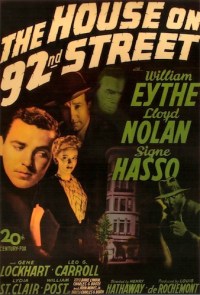 Here’s an unusual one from the pantheon of film noir. These days we’d probably call it a docu-drama, though thankfully there are no talking heads, but there is a factual voiceover narration. The story, we’re told, comes from the FBI’s files and is based on a real case —
  how they really work and investigate a case. At the time I imagine this was a fascinating procedural; now, we’re all a bit more familiar with how such things go, but it still works as an historical document.
 Might be because no one ever knew they were making a film noir, eh? How can you expect something to conform to a set of rules that were only defined after the fact? Hathaway and co didn’t fail at making a noir, they just made a film that doesn’t fit the later-defined template as well as the films used to define said template. I know, four words from some other online critic hardly merit a whole paragraph, but it does bug me when people write daft things like that.
 If The Locket is known for anything, it’s for a plot structure that places flashbacks within flashbacks within flashbacks. There’s always the potential for good fun in that kind of structure, though it’s usually the kind of thing that sounds more complicated than it is — the straightforward ‘concentric circle’ arrangement here makes them a doddle to follow; so straightforward, in fact, that it would be easy to miss how it was so structured.
 It might have been more interesting if the doctor had been making it all up; or if it had been left open ended, with Nancy set to ruin someone else’s life. That could well have worked, leaving the audience to come to its own conclusions, etc. Considering the film’s age, however, I’m sure there were demands we see this thief and murderess brought to justice.
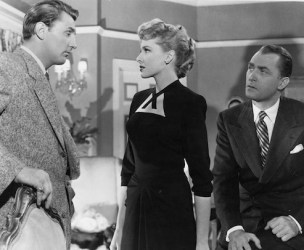 manipulative criminal it seemed all along, but instead a damaged individual doing these things involuntarily. This isn’t the wholly nonsensical part of the film — her apparently-accidental marriage to the son of the house she grew up in would be that bit — but I preferred it when she was just a villain. Psychologically it holds relevance, but at the same time she’s rather taken it to extremes. Or maybe I was just fed up by then.
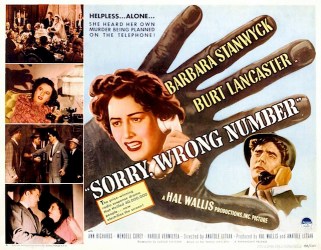 A film noir screenwritten by Lucille Fletcher, “based on her famous radio play” — I love how old movies have credits like that. It sounds like pure hyperbole, but in this case seems to be justified: the original play was broadcast in May 1943 but was so popular they chose to re-stage it with the same lead, Agnes Moorehead, a total of seven times up to 1960. Seven!
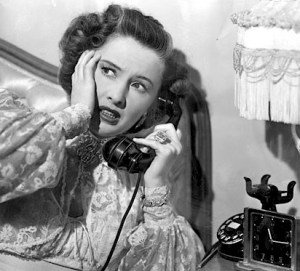 As if keeping us guessing wasn’t enough, our feelings are shifting in this respect too. Arguably it unravels a little late on — when Evans is explaining his part to her, it’s getting a bit implausible — but it’s all redeemed by the finale.
 A World War II espionage thriller about the OSS — spies, basically, and the forerunner to the CIA. Despite all the thrills this should elicit, especially when directed by Fritz Lang, I wasn’t particularly impressed.
 This is probably the benefit of being based on a non-fiction book.
 I saw the Richard Attenborough-starring
 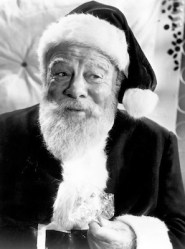 Which, considering the whole story is about a man who thinks he’s Santa Claus, and whether or not he really is, is an impressively underhand piece of marketing.
 100Films.co.uk