2012 #66
Leslie Fenton | 58 mins | TV | 4:3 | UK & USA / English | PG*
 The Saint’s gone on vacation indeed — with the saintly George Sanders nabbed for RKO’s rip-off Falcon series, here we’re treated to fellow Brit Hugh Sinclair’s take on Leslie Charteris’ hero. For “treated” read “subjected”. I’ll come back to him, because sadly he’s not the only thing that makes The Saint’s Vacation the worst film in the entire series.
On paper it should have all gone fairly swimmingly too: not only is this film adapted from a Charteris story, it’s also the first to have the Saint’s creator co-pen the screenplay; plus the character has spiritually come home, as RKO moved filming to the UK to make use of funds frozen by the British government’s Cinematograph Films Act.** But none of that helps; indeed, perhaps it hindered, because the result is a mess.
The adventure is a runaround across Europe. I say “Europe” — it looked broadly Germanic to me, but there’s mention of Paris, and I read online it’s meant it to be Switzerland. Possibly it’s a combination of the above. Considering it’s technically set during the war (not that anyone explicitly mentions that), at least one of those is thoroughly implausible. Having praised the series for its palpable sense of location in earlier entries, that’s all gone here.
The plot itself barely hangs together. The Saint for no apparent reason decides to stick his oar in to someone else’s business, at which point everyone’s racing around the countryside after a mysterious little box that we have no idea why anyone wants. Things are compounded by the regular appearance of local police who will apparently believe whatever they’re told by the first person who tells them something.  Apparently the villains are Nazis, though there’s absolutely nothing to suggest that here (again, that’s something I’ve since read online). The Saint knows both the villain and a Mysterious Woman of old, but it’s never explained how or why or what their relationships are. It’s like a set of stock adventure-story elements assembled without any understanding of how or why they should connect, which makes for an unsatisfying and unenthralling experience.
Matters are compounded by this apparently being a TV-friendly version created in retrospect. The title screen has a badly superimposed TV company credit stuck on it anyway, so I presume that’s why a fight scene halfway through has been butchered. It’s that or it was a complete hash job in the first place, with continuity-destroying jumpy editing and choppy music. It doesn’t even look especially violent, as you’d expect from ’40s filler, and it’s certainly no worse than other bits included later… but then of course I don’t know what was cut.
So we return to Hugh Sinclair, who is not a match for Sanders or The Saint in New York’s Louis Hayward. To be blunt, he’s as stiff as a board — pretty much literally, at least to begin with. Sanders oozed charisma just by appearing on screen; Sinclair doesn’t manage any throughout the entire film.
 The rest of the cast don’t offer much compensation. Arthur Macrae as the Saint’s cowardly friend Monty is no replacement for the parade of ex-cons he formerly hired as manservants, while Sally Gray of The Saint in London (but here a different character) aims again for pluck but somehow isn’t gifted with the same quality of screenplay and/or direction. Cecil Parker is a solid villain, not that the screenplay treats him that well.
This is easily the worst entry in the series to date — and, having seen the final one before writing this, I’m prepared to say the worst overall. The series spluttered to an end after the next film over an argument between RKO and Charteris about the Falcon series, which was essentially a thinly-veiled Saint rip-off, but one wonders if it wouldn’t have tottered to its own end anyway.
Read more of my thoughts on Sinclair’s time as the Saint here.
* As with many of the Saint films, this has apparently not been passed by the BBFC since its release in 1941 (when it was also 20 minutes longer — that’s not just PAL speed-up!). Nonetheless, it’s available on DVD, rated PG. ^
** According to IMDb, The Saint’s Vacation “was the first film made using those frozen funds”. I’m no expert on this era, but the act I presume that bit of IMDb trivia means is the 1938 one discussed in the final paragraph of this section on Wikipedia, so presumably it was just the first RKO film to use that money. As I said, no expert — everything I know about this was gleaned from those two pages. Back to the review: ^

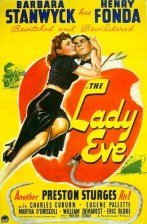 Screwball romantic comedy starring Barbara Stanwyck as a con woman who falls for her latest mark, ale heir Henry Fonda, until he discovers the truth and ditches her — and she vows revenge by conning him again. Packed with wit, Stanwyck shines as a slightly kooky, thoroughly daring con artist. Hers is the role with all the power, but Fonda’s gentler portrayal of her unconfident target is equally vital. It’s only let down by the ending, which rushes a conclusion in two minutes and didn’t seem to quite make sense. It doesn’t ruin the film, but it makes an unfortunate dent.
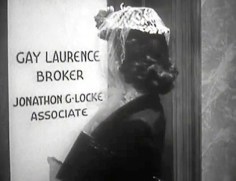 They renamed Gay Falcon’s hero, Gay Falcon, to Gay Lawrence (well, Gay Laurence at first, but I don’t think that really matters), moved his previous surname to be a reasonless Saint-like nickname, and in the lead role cast “Russian-born English film and television actor, singer-songwriter, music composer, and author” (and, later, voice of Shere Khan in
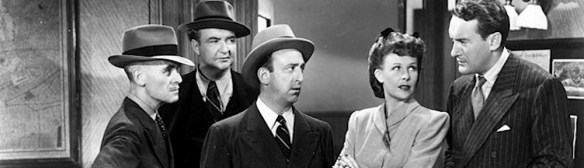
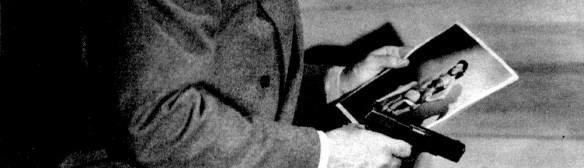
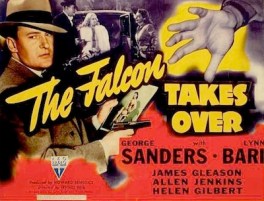 Quite outside of the Falcon film series, this third entry is notable for being the first screen adaptation of a Raymond Chandler novel. Ditching Chandler’s then-unknown Philip Marlowe in favour of the Falcon in the lead role, this is a version of the character’s second mystery, Farewell, My Lovely — which would be
  As usual, it doesn’t have the same je ne sais quoi that makes the Saint films particularly entertaining (yeah, you know I mean wit); and I can well believe it has “
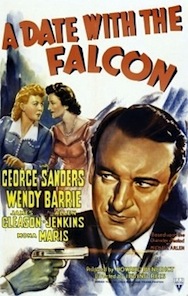 The second Falcon film sees George Sanders’ gentlemen detective investigate the disappearance of a scientist.
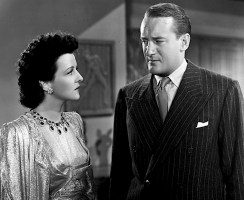 Anyway, aside from him there’s a ‘suicide’ bid and the crowd below’s reaction to it. Again it’s mostly comedy, but unlike some of the series’ DOA running gags it’s actually funny.
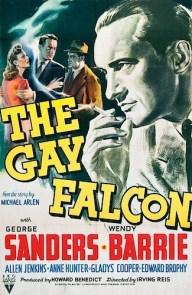 Worried about the cost of renewing the licence to popular hero the Saint, RKO instead acquired Michael Arlen’s the Falcon and essentially modelled him as a replacement, much to the chagrin of Saint creator Leslie Charteris. And who can blame him? They even cast the star of the Saint, George Sanders. Cheeky.
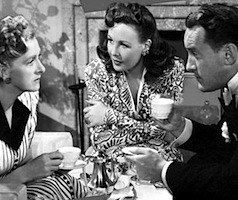 The story (the only one in the series adapted from a work by Arlen) is a solid mystery about jewellery thieves, which doesn’t seem to have quite the scale of the Saint films. Those were often contained to one city, but they felt somehow grander, like the schemes being foiled were of broad significance; here, it’s basically work for the police. To put it another way, if there was always the sensation that the Saint was an anterior James Bond, you could say the Falcon is more like Sherlock Holmes.
 The Gay Falcon makes for solid enough entertainment, mixing thrills with humour to decent effect. But despite attempts to emulate it, not least with the same leading man and woman, it’s no the Saint — they’ve not injected Gay Laurence with quite the same way with words and the supporting cast lacks a Teal or ‘Pearly’ Gates type to really make it click. Whether future entries stray further from Arlen’s original and more into Saint territory, or not, remains to be seen.
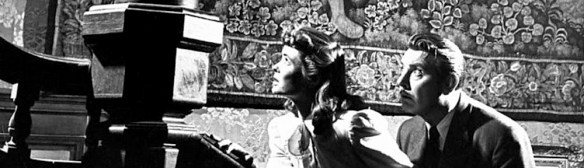


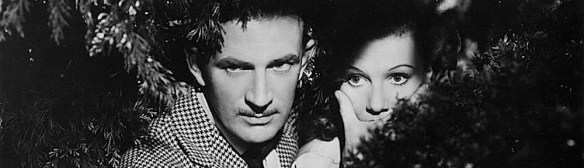
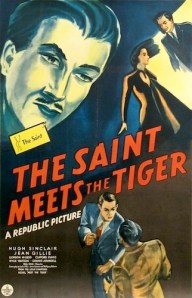 Produced in 1941 but not released until 1943, owing to Saint creator Leslie Charteris’ dispute with RKO over their new Falcon series (which is fairly unashamedly a rip-off of the successful Saint films), The Saint Meets the Tiger is a belated adaptation of Charteris’ first Saint tale, but was to be the series’ final film. Fortunately, it’s quite a good one.
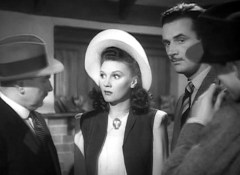 It still lacks the wit and light touch that make the Sanders films so entertaining, with only vague attempts at humour that generally raise little more than a smile. Sinclair doesn’t seem quite as wooden this time out, but he’s a straight-cut hero-type, not the kind of charmer this series really wants. In fact, one moment when he bursts into laughter, only to suddenly cut it short, is actually quite creepy. Perhaps he was trying to emulate Sanders more — the film does feel lighter than Vacation — but he still comes up short.


 100Films.co.uk