
Abel Gance | 333 mins | Blu-ray | 1.33:1 + 4:1 | France / silent (English) | PG / G

At one point in time, arguments over rights made it seem unlikely you’d ever be able to see Abel Gance’s epic biopic of French leader Napoléon Bonaparte if you were a regular person not prone to attending all-day cinema screenings with a live orchestra and multiple intermissions. But a year ago this week things panned out so that the BFI were finally able to release it on Blu-ray. While a theatrical marathon is probably still the best way to see the film (if only for the full effect of the famed triptych finale), this release is certainly more convenient and accessible. Apparently it sold better than expected, too — I guess that’s what happens when you combine years of anticipation with being a worldwide-exclusive release of a film of this stature. It’s also a daunting film to review — for the aforementioned reasons, plus its length and its artistic importance. Nonetheless, here are what thoughts I had.
At 5½ hours, Napoleon is rather like a miniseries from the silent era — a comparison that feels more apt than ever in this age of binge-watching. It’s divided into four acts, each running anywhere from 49 to 114 minutes, but it could even be subdivided into further episodes: Napoleon’s schooldays; his observation of the French Revolution; his opposition to Corsica being sold to England; the siege of Toulon (which takes up all of Act 2 and is the best bit, in my opinion); the reign of terror (a half-hour section that barely features Napoleon); a chunk where he falls for and woos Josephine that plays like a rom-com; the invasion of Italy… Yet despite that length, the film doesn’t even reach the Napoleonic Wars. No wonder Gance wanted to do six movies — or six seasons, as we might interpret it today. (In the end, he went over-schedule and over-budget on this first film, covering just two-thirds of the story he’d intended and spending the budget for the entire series. I imagine I’d outrage some silent film fans/scholars if I called him the Peter Jackson of his day…)

Part of the fourth act is that triptych climax, a 21-minute sequence shot with three cameras side-by-side, and therefore designed to projected on three 1.33:1 screens side-by-side, to create a 4:1 widescreen image. It’s undeniably less powerful when rendered as a thin strip across a 16:9 television, suddenly shrinking the height of the image rather than suddenly tripling its width, but what other choice is there? (Well, if you’ve got three sets of equipment, the three-disc Blu-ray contains each screen full size, one per disc, so you could set it up yourself.) Even shrunk like that, the imagery in the sequence remains stunning. I bet the effect is marvellous when seen as intended. (There’s an alternate single-screen ending, which is quite different. It contains fundamentally the same ‘plot’, but there’s one whole new sequence, and the others are truncated or slightly rearranged. Worst of all, it loses the tricolour-inspired finale.)
Widescreen properly arrived when CinemaScope was invented in 1953, so Gance was about 25 years ahead of his time with that technique. It’s Napoleon’s most striking innovation, but the whole film shows off a surfeit of cinematic techniques: a wide variety of shot lengths (close-ups, medium, long, wide, etc, etc); tracks and pans, many of them fast; handheld photography, including what we’d now call ShakyCam; swaying back and forth, in and out of focus, or swinging over a large crowd; mounted on fast-moving vehicles, including dipping under the waves on a boat; in the thick of the action rather than observing it from a distance; multiple exposures and superimposition; animated maps to indicate Napoleon’s strategising; split screen; split-second impressionistically-fast cutting… and most of that’s found in just the first hour! Some of this is stuff that would still feel revolutionary when filmmakers were doing it 20, 30, even 40 years later. The fast-cut pulse-racing action scenes, like a horseback chase on Corsica, are not what you commonly expect from a silent movie, especially an ‘artistic’ one rather than a swashbuckler, say.

Lest you think a film of this vintage must be in black and white, Napoleon features a lot of tinting and toning, which works very well at times to create striking and meaningful imagery: golden sunlight illuminating the debut of La Marseillaise; the burning red of revolution forged in a furnace; a tumultuous purple ocean… Similarly, Carl Davis’ original score is great, helping to emphasise the emotion and lend the images a storytelling shape. Again, the sequence with La Marseillaise is a good example; a particularly effective tour de force. Davis makes good use of other familiar tunes for shorthand — there are variations on Rule, Britannia whenever the British are involved, for instance.
Making Abel Gance’s Napoleon was an epic undertaking, as was its decades-long reconstruction, as is the viewing experience (it is 5½ hours, after all). It may not be perfect for all of that immense running time (which does not merit adjectives like “indulgent” or “excessive” but is, nonetheless, long), but it is a monumental achievement in cinema that undoubtedly deserves full marks.

That completes my reviews from 2016, finally.
 The word “prequel” was first coined in the ’50s, arguably entered the mainstream in the ’70s, and was firmly established as a term everyone knew and used in the ’90s by the Star Wars prequel trilogy. Works that can be defined as prequels predate their naming, however, and surely one of the earliest examples in the movies must be this silent German horror.
 Regarded as one of the first horror films, The Golem is more of a moderately-dark fantasy, or a fairytale-type myth. There are clear similarities to Frankenstein, though I don’t know if either influenced the other. However, it does feature what I presume is one of first instances of that most daft of horror tropes: running upstairs to escape the monster. It goes as well here as it ever does, i.e. not very. Said monster looks a bit comical by today’s standards. Built by the rabbi to defend the Jewish people, he immediately uses the hulking chap to chop wood and run errands — he doesn’t want a defender, he wants a servant! A terrifying beast nonetheless, it’s ultimately defeated because it picks up a little girl for a cuddle and she casually removes its magic life-giving amulet.
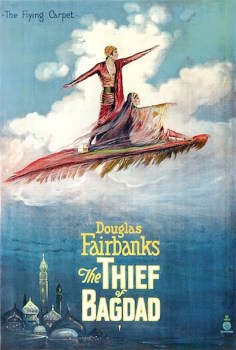 Douglas Fairbanks started out in comedies, where he was so popular he was quickly established as “the King of Hollywood”, which allowed him to attempt something different: an historical adventure film.
 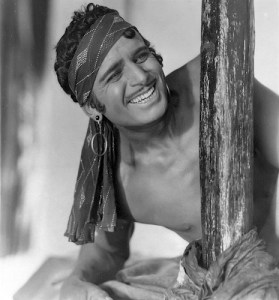 of course, which alerts the Mongol Prince to the attempted deception — though as he’s “the Governor of Wah Hoo and the Island of Wak”, he’s a fine one to talk. The thief manages to make it to see the princess anyway. She instantly falls in love with him, and he realises he loves her too, so can’t just kidnap her. His whole value system is undermined! But now he’ll have to win her hand by more honest means. Well, she already loves him, so he’s halfway there; but he’s an imposter, so there’s that to sort out yet.
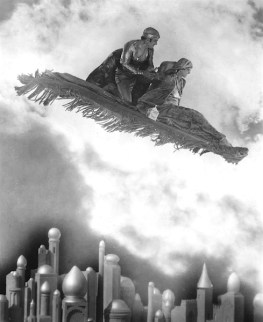 Even more impressive are the sets. The work of famed Hollywood designer William Cameron Menzies, at the time Fairbanks felt Menzies was too inexperienced to work on such a big project. Undeterred, he created a collection of detailed drawings and convinced the star/producer. No surprise that worked, because Menzies’ designs are extraordinary. His complex, detailed, unreal drawings are recreated accurately on screen (examples of this can be seen in the ‘video essay’ included on the film’s Blu-ray releases, for instance), using numerous techniques to create truly fantastical scenes: ginormous sets (they covered six-and-a-half acres), built on a reflective enamel floor (which had to be constantly re-enamelled throughout the shoot) and painted in certain ways to make them appear floaty; or glass matte paintings used to seamlessly extended or enhance shots. Reportedly 20,000 feet of film — that’s hours and hours worth — were shot just to test the lighting and painting of the sets.
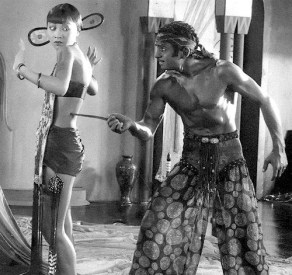 In a star-making supporting role, Anna May Wong is indeed memorable as a traitorous handmaiden. That’s more than can be said of her employer: Johnston is a bit of a non-starter as the princess, which I guess is what happens when you have to re-cast because your original choice departs part way through production. Comedian Snitz Edwards was also a mid-production replacement, drafted in to provide comic relief. It wasn’t necessary: he doesn’t add much, and Fairbanks had it covered.
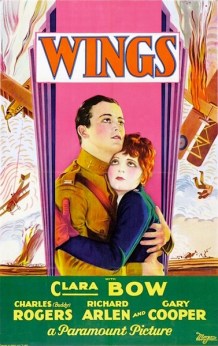 Students of the Oscars well know that, technically speaking, there wasn’t a single “Best Picture” award at the inaugural Academy Awards ceremony in 1929. Instead, there were two awards that covered that ground, seen (at the time) as being of equal significance. One was for “Unique and Artistic Production” — which I’d argue is more or less what most people think Best Picture represents today. That was given to F.W. Murnau’s
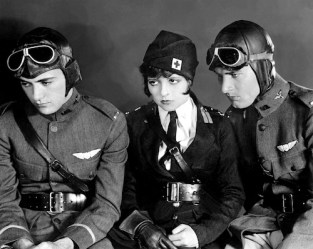
  he learnt to fly just for the film), and, mid-flight, had to film their own close-ups by switching on battery-operated cameras mounted in front of them. You wouldn’t know it from watching the film itself, though: even today, the action sequences carry a palpable air of excitement, aided (perhaps even created) by the knowledge that it was all done for real — including the crashes.
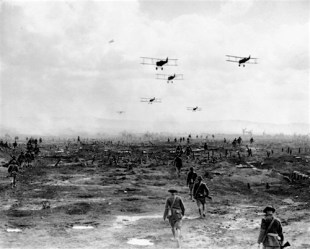 bomb-pockmarked battlefield. Those bomb craters were, in fact, genuine: the military spent a few days before filming using the location for target practice. The climactic battle that occurred on this site was filmed with up to 19 cameras at once, including some mounted on four towers, the highest of which reached 100ft. I know this is a review, not a catalogue of production numbers, but it’s quite incredible.
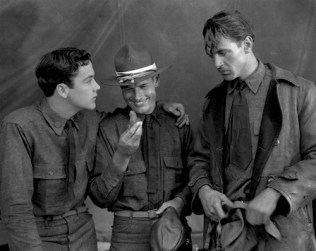 How much these factors affect the film’s quality seems to be very much a personal matter. Wings set the stall for many a Best Picture winner to follow by being not that well regarded by critics; indeed, more time and praise is given to its top-award compatriot, Sunrise. For the most part, I found the personal dramas passable enough, with a few outstanding scenes — David’s farewell to his stoical parents; Cooper’s scene; the bubbles (at first). However, the combat sequences, and in particular the aerial photography, are stunning; so impressive as to easily offset whatever doubts the other elements may engender.
 But I digress. Wings is a film that deserves to be remembered as more than a mere footnote. It’s not just a trivia answer to “what was the first Best Picture?”, but a worthy winner of that prize; a movie that, almost 90 years after it was produced, still has the power to elicit excitement and awe. Wellman’s picture may not have been deemed unique or artistic, even though it’s definitely the former and possibly the latter, but it was deemed outstanding, and it’s definitely that.
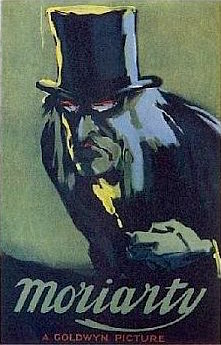 American actor William Gillette was the most iconic portrayer of Sherlock Holmes on stage, penning his own play (with permission from Conan Doyle) that he performed 1,300 times between 1899 and 1923. It was
 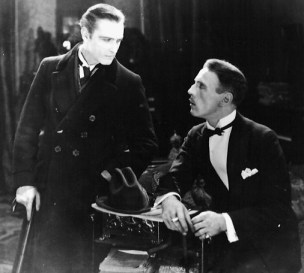 Yes, shades of 1985’s
 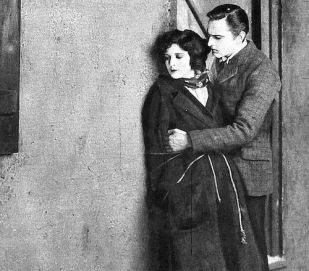 and in many respects they led to the abundance of crime-solving fiction that fills bookstores and TV schedules to this day, but there’s a reason most of Conan Doyle’s stories are prefixed with “The Adventure of” rather than “The Fiendishly Difficult to Solve Mystery of”.
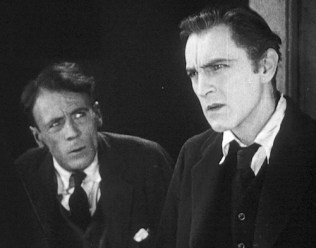 Barrymore makes for a solid, if perhaps unremarkable, Holmes. He has the right look for the role, and makes good use of the same staring-contemplatively-into-the-distance furrowed-brow expression that Basil Rathbone would employ a couple of decades later. He has down the precociousness of student Holmes, which develops into a kind of righteousness when older. He’s not as stand-offish and borderline unlikeable as some interpretations of the character, nor as affable as others. As I say, he sits in the middle, doing nothing wrong but not getting a chance to mark himself out either.
 He crops up in the years-later narrative too, used by Holmes to go undercover in the house where Alice is being held hostage by some of Moriarty’s many villainous associates. A major part of Holmes’ plan hinges on him turning up at these villains’ house, telling them what to do, and them obeying him. That this method succeeds is not due to Holmes’ considerable skill, but more due to the screenwriters’ lack of it.
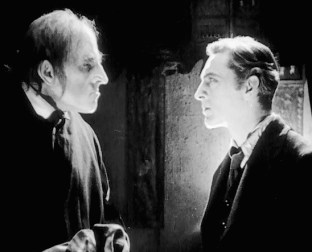 hardly seems worth such devotion except on a purely academic level.” He goes on to say that “it must be one of the blandest misuses of potentially exciting material ever,” that “it literally has no highlights,” that it “has no pictorial style of its own,” that Barrymore “clearly lends his profile to Holmes, and not much more,” that “if it is a major find, it is also a major disappointment.” Ooh, burn. (The
 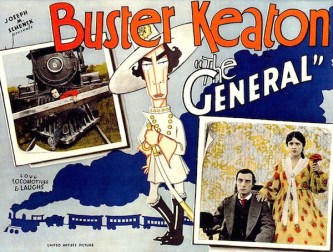 Poorly reviewed and a box office flop on its release, Buster Keaton’s The General has undergone a stark re-evaluation since: the United States National Film Registry deemed it so “culturally, historically, or aesthetically significant” that it was added to the registry in its first year, alongside the likes of
 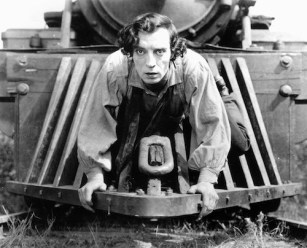 It was reportedly a very expensive film, and it looks it: there are tonnes of extras, not to mention elaborate choreography… of trains! Who knew old steam trains were so agile? There’s impressive physicality on display from Keaton, but the well-timed movements of those big old locomotives are quite extraordinary, especially for the era (I mean, for the past couple of decades you’ve been able to do pretty much anything thanks to a spot of computer-controlled what-have-you. Not much of that going on in the 1920s.)
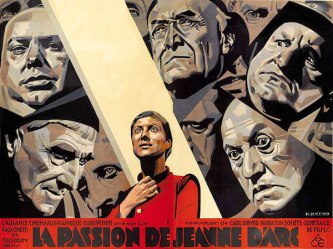 Widely regarded as one of the greatest movies of all time (look at
 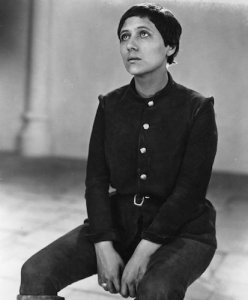 Dreyer based his telling on the written records of Joan’s trial. Although that’s grand for claims of historical accuracy, it’s hard to deny that silent cinema is ill-suited to thoroughly portraying something dialogue-heavy. There are many things silent film can — and, in this case, does — do very well indeed, but representing extensive verbal debate isn’t one of them. Bits where the judges argue amongst themselves — in silence, as far as the viewer is concerned — leave you longing to know what it is they’re so het up about. Sometimes it becomes clear from how events transpire; other times, not so much.
 neutral costumes on sparsely-decorated sets, and are almost entirely shot in close-ups — all elements that avoid the usual grandiosity of historical movies, both in the silent era and since. What we perceive as being ‘grand’ changes over time (things that were once “epic” can become small scale in the face of increasing budgets, for instance); pure simplicity, however, does not age much.
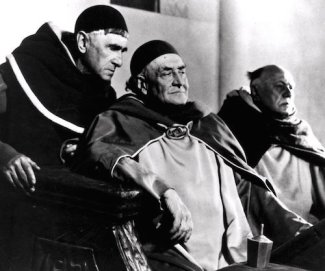 The actors playing the judges may be less individually memorable than Joan, but it’s their conflict — the personal battle between Joan and these men, as Dreyer saw it — that drives the film. Dreyer believed the judges felt genuine sympathy for Joan; that they did what they did not because of politics (they represented England, and she had led several successful campaigns against the Brits) but because of their devout belief in religious dogma. Dreyer says he tried to show this in the film, though it strikes me the judges still aren’t portrayed too kindly: they regularly seem contemptuous of Joan, and are outright duplicitous at times. Maybe that’s just religion for you.
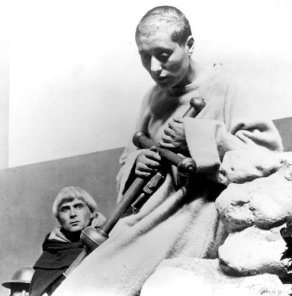 however, so I have no opinion. Instead, they offer two alternatives. On the correct-speed 20fps version, there’s a piano score by silent film composer Mie Yanashita. Apparently this is the only existing score set to 20fps, and Masters of Cinema spent so much restoring the picture that there was no money left to commission an original score. Personally, I don’t think they needed to. Yanashita’s is classically styled, which works best for the style of the film, and it heightens the mood of some sequences without being overly intrusive, by and large. Compared to Dreyer’s preferred viewing method, of course it affects the viewing experience — how could it not, when it marks out scenes (with pauses or a change of tone) and emphasises the feel of sequences (with changes in tempo, for instance). That’s what film music is for, really, so obviously that’s what it does. Would the film be purer in silence? Maybe. Better? That’s a matter of taste. This particular score is very good, though.
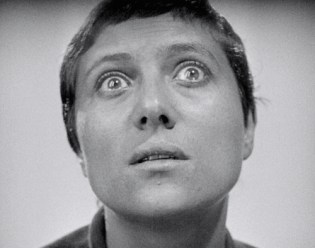 Some viewers describe how they’ve found The Passion of Joan of Arc to be moving, affecting, or life-changing on a par with a religious experience. I wouldn’t go that far, but then I’m not religious so perhaps not so easily swayed. As a dramatic, emotional, film-viewing experience, however, it is highly effective. As Dreyer wrote in 1950, “my film on Joan of Arc has incorrectly been called an avant-garde film, and it absolutely is not. It is not a film just for theoreticians of film, but a film of general interest for everyone and with a message for every open-minded human being.” A feat of visual storytelling unique to cinema, it struck me as an incredible movie, surprisingly accessible, and, nearly 90 years after it was made, timeless.
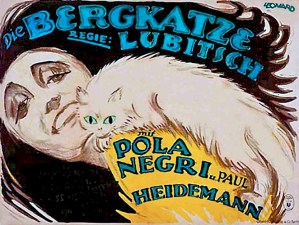 Die Bergkatze apparently rounds off
  In an age where Henry VIII is young, slim and sometimes irritatingly called “Henry 8”, not to mention more interested in shagging every young girl he can find than in, well, anything else, it’s somewhat refreshing to return to a time when he was always older, fatter and more interested in polishing off a huge slab of meat than seeing his wife. OK, so they call him “Heinrich VIII”, but at least that’s because this production team spoke a different language.
 Sumurun seems completely different to any film yet seen in the
  100Films.co.uk