The Past Trisennight on TV #19

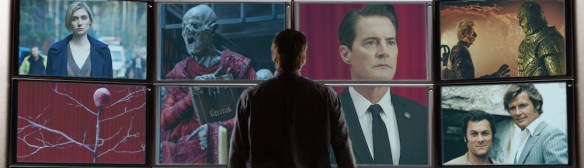
Although I only post my TV overviews once a month, I’m always looking ahead to what’s going to be included in them. That’s what made me realise edition #19, scheduled for July 20th, was going to be insanely busy: new episodes of Doctor Who, Game of Thrones, Preacher, Twin Peaks, and the entire latest season of The Americans — all things I typically review ‘in full’. Whew! So I’ve brought #19 forward a bit, and #20 will be in a fortnight anyway.

So, here’s what I’ve been watching in the past month three weeks (aka trisennight, a word that Google finds two other uses of ever. Cool.)

Doctor Who  Series 10 Episodes 10-12
The Eaters of LightHistory was made left, right and centre in the last three episodes of Doctor Who’s 36th-ever season. For starters, The Eaters of Light marked the first time someone who wrote for the classic series has written for the revived one. Rona Munro penned the last story of old Who, Survival, a personal favourite of mine and one that, stylistically and tonally, connects remarkably well with the first episode of nuWho, Rose, which is quite the coincidence. Anyway, The Eaters of Light was a solid episode with some very likeable parts, but it didn’t seem to quite gel entirely in the final mix. That’s been a recurring theme for the middle of this season, I feel, with every episode since Knock Knock featuring quality ideas and/or characters and/or scenes that aren’t fully developed into a final whole. Nonetheless, I’d certainly welcome Munro returning again in the future, but who knows what Chris Chibnall has planned.

And then we come to the two-part finale, written (of course) by departing showrunner Steven Moffat. The duology, which sadly is called neither Genesis of the Cybermen nor The Two Masters, continues his previously-stated aim of creating two-parters where each half is a distinctly different episode. The first part, World Enough and Time, is an immediate contender for an all-time great episode of the show. There’s a superb real-science setup with the time-dilated spaceship, plus a suitably eerie hospital in which we ‘unknowingly’ witness the birth of the Cybermen — my favourite Who monster, so perhaps I am a little biased.

World Enough and TimeI put “unknowingly” in inverted commas there because that’s the episode’s biggest problem: thanks to the show’s own promotion, we knew the Cybermen were coming back, and we knew John Simm was returning as the Master. In truth, the former isn’t a problem. Sure, the existence of the Cybermen is played as something of a reveal at the end, but it also works as ‘just’ the reveal that Bill has been converted, and there’s dramatic irony in the viewer knowing what those cloth-headed patients are destined to become. The Master spoiler is more of a problem. The prosthetics turning Simm into Razor are impressive, and even fooled some people who knew he was back… for a bit. I’m sure most people must’ve guessed before the episode ended. It therefore becomes a distraction: what’s his plan? When will he reveal himself? And when the big reveal does come, it’s played as a twist, which it isn’t because we were told about Simm three months ago. Moffat has said before that it was entirely his decision to put Simm in the trailer, and it’s clear it was a misstep. Not a fatal one — World Enough and Time is strong enough to withstand it — but a shame. Can you imagine the reaction if we hadn’t known?

So with the Master finally revealed at episode’s end, he teams up with Missy for the first multi-Master story ever in the extended finale, The Doctor Falls. With a lot of business to attend to, this isn’t quite as striking as its first part. Nonetheless, there’s strong material here. Missy and the Master are a hoot, the pairing of Simm and Michelle Gomez working exactly as well as you’d hope. Their storyline comes to a very fitting conclusion, too. The way Moffat handles Bill being a Cyberman, how she feels inside and how people react to her, was an original use of a well-worn villain. Her possible-departure was fitting too, tying appropriately back to her debut episode. Moffat buried a way for her to return in the dialogue, which hopefully Chibnall will pick up because Bill has been absolutely fab. It would be a real shame if this is the last we see of her. The Doctor FallsAs for the other current Capaldi companion, there was an almost touching exit for Nardole, a character Matt Lucas has managed to imbue with much more likability than was promised in his initial appearance a couple of Christmases back. Finally, Peter Capaldi was in as fine fettle as ever, getting to deliver a few more of his iconic speeches, before going out with a heroic last stand.
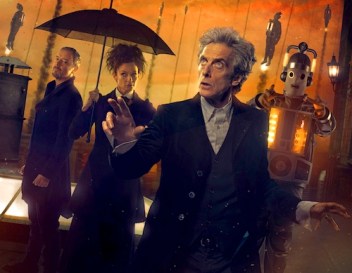
Well, not quite going out, because we have that exciting cliffhanger to lead us into the Christmas special. With such a promising setup, let’s hope Moffat can stick the landing. We’ll find out on December 25th…

The Americans  Season 5
The Americans season 5The best show on television” returns for its penultimate run. It’s currently mid-way through here in the UK (where it’s really, really buried on ITV Encore, more’s the pity — it deserves a bigger audience) so I’ll be extra careful to avoid big spoilers. It’s an interesting run of episodes, though: low-key, in their way; slow-paced, even by the standards of current high-quality TV. That’s not to say it’s without merit, but it’s rewarding of long-term investment more than ever. In truth, it may be the show’s weakest run, but that’s very much a relative assertion. There’s a lot of groundwork being laid here, probably the downside of them getting a two-season to-the-finish recommission — these are episodes 1 to 13 of 23, not 1 to 13 of 13.

Still, as I said, it’s most decidedly not without merit, it’s just that the drama is very much internalised into the characters. A lot of it is about Philip and Elizabeth becoming increasingly tired of their life — the toll that all the killing and lying takes. That’s not exactly something new for Philip, but is he reaching breaking point? And to see Elizabeth beginning to struggle too really rams home how tough it is. Indeed, the detrimental effects of this lifestyle are felt across all the storylines and returning characters, as people on both sides come to doubt the justification of their respective causes. Is someone going to snap and betray their country?

Although the season starts (and, in some cases, resolves) plot lines of its own, ultimately the big underlying thread is (picking up from last season) the debate about how, when, and if they can go home to Russia. The kids are a big factor: Paige is still being initiated into the realities of their cause, but Henry is off building a life of his own, now more than ever. At the same time, we’re shown how difficult it is for other people to adjust in similar circumstances, including Russians who’ve defected to America with their kid. These kind of storylines could be heavy-handed parallels on other shows, but The Americans unfurls them gradually and carefully and subtly enough that you come to see it for yourself rather than the show screaming at you to notice the mirroring.

Not the most dramatic run, then, but this deep in I think it’s earnt our trust that they’re going somewhere with it all. It’s also earnt our investment in the characters to the extent that it can base storylines about their internal struggles rather than just exciting espionage stuff. It’s clearly been a not-for-everyone season (reviews are largely positive still, but there are more dissenting voices) but there’s still quality in spades. And it’s still completely unpredictable how it’s all going to wind up next season.

Twin Peaks  Season 3 Episodes 7-8
In its 7th episode, the new Twin Peaks suddenly delivered a surfeit of story, forging ahead with actual plot developments in several of its disparate storylines. It was almost bizarre. It was good. Heck, some of the scenes were incredible. Laura Dern is perfect here. So did this mark a turning point? Was the series finally getting stuck into the meat of the story? Well, as it turned out, no. Not at all. Indeed, perhaps David Lynch was just pre-trolling us, in his own way, because Part 8…
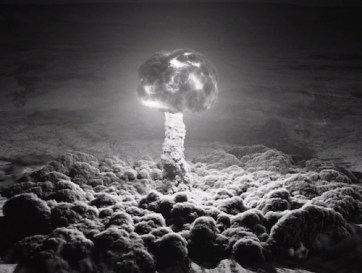
Twin Peaks Part 8I don’t know if it was the reaction across the board, but on Twitter the reception the 8th episode received was adulatory to the nth degree. Having given us massive developments and beloved characters just one episode before, suddenly we were in a different era, in black and white, with mostly unknown characters, and a narrative conveyed through Lynchian visions rather than traditional storytelling. It made some kind of sense… some of it… in the end… but you certainly had to stick with it. Some of it was incredible — the tracking shot into the mushroom cloud is, somehow, almost inexplicably, one of the greatest shots of all time; an instant classic. But other bits… they did go on rather. I’m not one of those people who wishes the new Twin Peaks was a pure nostalgia fest, all repetition of famous lines and quirky goings on in the Double R over cherry pie and coffee, but I also think Lynch’s indulgence has run a little too rampant. Much of his surrealist imagery works if you’re prepared to engage with it, but I also think much of it doesn’t need to go on for as long as it does. There’s a difference between a slow pace and no pace.

So, I don’t really think Part 8 is a total revolution in television and one of the greatest episodes of all time, as some people do. For one thing, the opening stuff with Evil Cooper and the Nine Inch Nails performance felt like it belonged at the end of the previous episode but had to be moved for time. It was certainly an experience, though, I’ll give it that. I just hope it’s one that all makes sense in the end…

Preacher  Season 2 Episodes 1-2
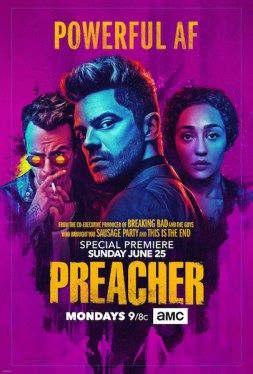
Preacher season 2After a sometimes uncertain but ultimately promising first season that was, really, all prologue to the main story, Preacher returns with a confident bang, filled with unstoppable cowboys, exploding SUVs, Maced testicles, intestinal fuel syphons, baby foreskins, and Come On Eileen — and that was just the opening ten minutes. Shows like Legion, American Gods, and, especially, Twin Peaks may have been duking it out for the title of craziest series on television these past few months, but there’s nothing quite like Preacher.

With our trio of heroes — a Texan preacher with the power to make anyone do what he says, his badass girlfriend with a criminal past, and a rough but charming Irish vampire — now on the road, the series itself also feels free of the shackles of the first season’s small-town setting. We’re let loose into a world that can equal the barminess of the leads. A world where we meet a friend who keeps a girl locked in a cage in his garage (for good reason); where you can see a man cheat death nightly at the Mumbai Sky Tower Resort and Casino; where a drug-fuelled binge of pillow-fighting and reading Archie comics can solve your woes; where God goes to a strip joint for the jazz…

Sadly, you can’t really jump in here — too much was established in season one — but the ongoing unpredictable zaniness makes it worth the investment to reach this point, in my view. And with some fan-favourite characters just around the corner, hopefully it’s gonna be a helluva season.

Also watched…
  • The Persuaders! Series 1 Episodes 6-13 — it’s funny watching this in production order (as it is on the DVDs), because it seems pretty clear they blew the budget sending the cast around Europe for the first few episodes — all the exotic locations are being done with back projection by this point.

    Next fortnight… winter is here.

  • Road Games (1981)

    aka Roadgames

    2016 #132
    Richard Franklin | 100 mins | Blu-ray | 2.35:1 | Australia / English | 15 / PG

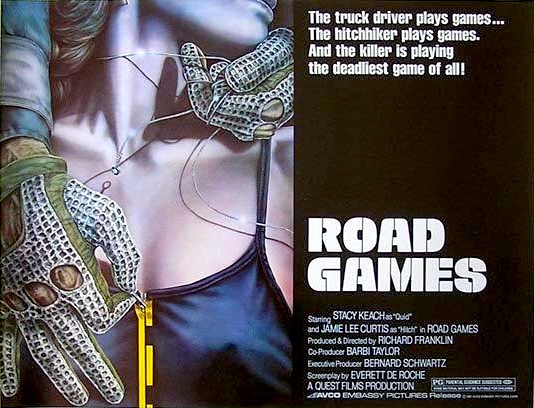
    Road Games

    I hadn’t even heard of Ozploitation thriller Road Games before April last year, when Make Mine Criterion posted an excellent write-up proposing it for release by Arrow Video. That piqued my interest, so when it was announced for release by Australia’s Umbrella Entertainment the very next day, I jumped on a pre-order lickety-split. Just a couple of months later, a film I had only recently found out about was in my hands, in a better-than-it’s-ever-looked remaster, having arrived from literally the other side of the world, for about the same cost as a new release from Masters of Cinema or Arrow, i.e. under £14, including postage. (Makes you wonder how Criterion justify their £17.99 price tag…)

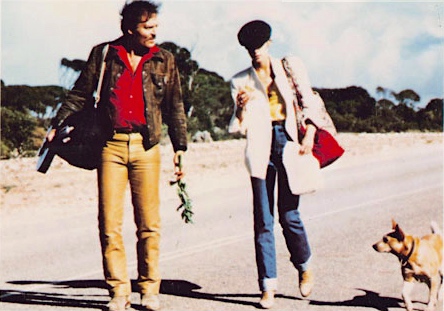
    Leaving aside the wonders of today, the film stars Stacy Keach as lorry driver Pat Quid, who one night happens to witness some shady goings on that may’ve been a murder. The next day he’s given the task of transporting a container full of carcasses to the other side of the country, because there’s a butchers’ strike over there and Aussies need their meat goddammit! On the road, he spots a vehicle connected to the possible-murder, and wonders if he’s on the trail of a killer — or if the killer’s on his. The tension only deepens when he picks up a hitchhiker (Jamie Lee Curtis), who may become the next victim…

    It's impossible to find good quality stills from Road Games

    Road Games’ low-budget roots and exploitation-derived genre tag may give the impression it’s a slasher movie or something, but nothing could be further from the truth (though there is one gory shot — so gory it’s a wonder the film got a PG in the US). Rather, it could best be described as Rear Windscreen, because fundamentally it’s the same story: our hero spies on a guy from a distance because he thinks he saw him commit a murder, but is it all in his head? Where Hitchcock staged that impressively in a single confined location, writer-director Richard Franklin opens it up to the whole Australian outback. In some respects that’s an even more impressive feat — of course neighbours are smooshed up against each other, but long-distance travellers? However, it doesn’t feel like a stretch that Quid keeps bumping into the same people, such is the skill of the construction.

    Keach makes for an affable lead, whether chatting to his dog early on or bonding with Curtis after he picks her up. Their shared ponderings about the possible murderer are just as effective as the Stewart/Kelly interactions from the Hitchcock film, though perhaps more conspiratorial. It’s easy to draw these comparisons and mirrorings with Rear Window, but it does Road Games a bit of a disservice — it’s not simply an off-brand remake or set-in-a-different-location pseudo-sequel. That said, the parallels are equally unavoidable. There’s also some Duel in the mix, as the killer notices he’s been noticed and turns the tables on our hapless trucker — an inversion, of course, as in Spielberg’s film it’s the trucker who’s the villain.

    Seeing red

    Basically, while acknowledging these undoubted similarities, I’m trying not to make Road Games sound too derivative, because I don’t think it is. It’s a masterful mystery, using ever-building tension to create a properly nail-biting thriller, which leads to an unpredictable final act (the benefit of many an independently-produced thriller is that it doesn’t necessarily have to comply with a studio’s view on how it should end). While it may owe a debt to one or both of the aforementioned movies, it’s a gripping work in its own right; one which deserves a bigger audience.

    5 out of 5

    Road Games placed 12th on my list of The 20 Best Films I Saw For the First Time in 2016, which can be read in full here, and also featured on my list of favourite movies from the past decade, which you can read about here.

    Sully: Miracle on the Hudson (2016)

    aka Sully

    2017 #58
    Clint Eastwood | 96 mins | download (HD) | 2.39:1 | USA / English | 12 / PG-13

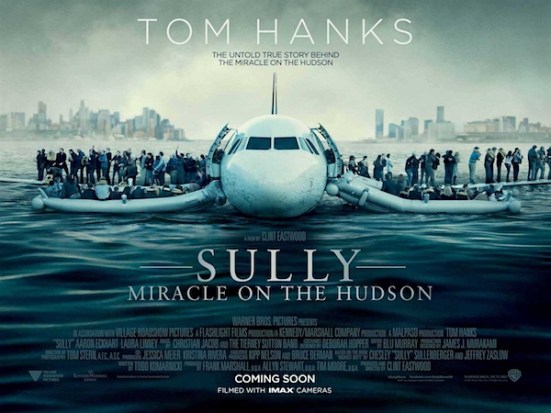
    Sully: Miracle on the Hudson

    You remember that time someone landed a passenger plane on New York City’s Hudson River, right? This is about that. At the time the pilot was widely hailed as a hero… or so we thought! Turns out that, behind closed doors, some investigators seemed keen to put the blame on his poor decision-making (or they did in movieland, anyway — the real world may’ve been a bit different). So rather than just an exciting drama about a guy landing a plane (which does sound like a thin story for an entire movie), Sully is almost a legal drama: was the heroic captain actually heroic, or did he make a stupid decision that lucked out? (I’m sure you can guess which wins.)

    Tom Hanks is perfect for the lead role: he’s the exact right mix of everyman and hero; the unassuming guy who knows the right thing to do, and does it. He even doubts himself after the fact, just so we can be even more sure that he’s a genuinely good guy. The rest of the supporting cast fade into the background a little, with Aaron Eckhart solid as his supportive co-pilot (I assumed he’d turn on Sully, for some reason, so that was nice) and Laura Linney as his wife on the other end of the phone, in a subplot that I suppose is meant to help humanise the hero pilot but really goes nowhere. The same is true for a scattering of flashbacks to Sully’s previous adventures in flight. Even having expanded the film out to the post-landing investigation, it still struggles to find enough material to fill its short 96 minutes.

    Landin', landin', landin' on the river

    I liked Sully a lot while it was on. It’s well made (though sadly not available in its IMAX format for home viewing), Hanks is always watchable, the supporting cast are good too, and the headline incident is effectively staged, including the post-landing rescues. It’s a heartwarming story of real-life drama and heroism, with a punch-the-air-type moment when Sully is vindicated. But as that outcome never seems in doubt, and the film sometimes twiddles its thumbs in getting there, it’s not all it could be. Or, actually, maybe it is all it could be — and that’s fine.

    3 out of 5

    I could tenuously link this review to American Independence Day by talking about Sully being an American hero or somesuch, but… oh wait, I just did.

    The Adventures of Buckaroo Banzai Across the 8th Dimension (1984)

    2016 #134
    W.D. Richter | 103 mins | Blu-ray | 2.35:1 | USA / English | 12 / PG

    The Adventures of Buckaroo Banzai Across the 8th Dimension

    Buckaroo Banzai seems to have quite the cult following in the US, but, as far as I understand, it never made an impression over here; not until the internet enabled such cults to go global, anyway. It has big-name fans (one, Kevin Smith, was developing a remake for Amazon until legal wrangles got in the way), so of course it’s been noticed in more recent times. I’ve been somehow aware of it for ages, but finally got round to seeing it last year after Arrow put it out on Blu-ray.*

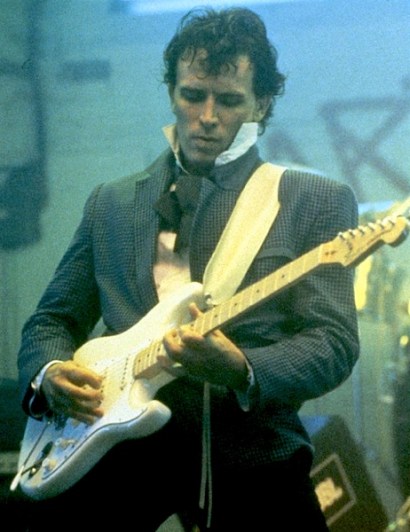
    For those equally unfamiliar with the film, it’s an action-adventure sci-fi satirical comedy (kinda), concerning an adventure (one of many, I imagine) of Dr. Buckaroo Banzai (RoboCop’s Peter Weller), the famous physicist, neurosurgeon, test pilot, and rock musician. While testing a device that allows him to pass through solid matter, Banzai briefly travels to another dimension. This kickstarts a series of events that leads to the escape of evil aliens the Red Lectroids, who Banzai must defeat lest it brings about the end of the world. That’s the streamlined version, anyway.

    To be perfectly honest, I’ve found it quite hard to tell what I thought of Buckaroo Banzai. On the one hand, I can definitely see where it gets its cult appeal, and I appreciate some of the ways it’s being different and boundary pushing. On the other, there’s been a definite backlash to it and I can appreciate where that comes from too — the criticism that some of that “boundary pushing” is merely sloppy storytelling and crazy overacting. There are parts where it’s hard to tell if it was deliberate and quite clever, or just incompetently done. Part of the problem (but also the appeal) is that it’s played so straight. It’s unquestionably a comedy — it’s too ludicrous to be anything else, and the sheer build-up of comedic lines becomes clear as it goes on — but it’s all played with such a straight face that I can see why you’d think everyone involved believed they were making something serious.

    Dr Buckaroo Banzai

    There are ways it could be ‘normal’, too: it contains so many elements that could be used to construct a traditional narrative — a new member being introduced to the gang, a love interest, an inciting incident which kicks off the events of the narrative, and so on — but it chooses to use none of these in a traditional way, instead being batshit crazy and thoroughly unique with it. Interestingly, director W.D. Richter was also one of the writers on Big Trouble in Little China, which is another action-adventure movie featuring a similar loose, crazy, fever-dream style. (Of all things, he also wrote Stealth, the forgotten-as-soon-as-it-was-released jet-pilots-vs-AI action thriller starring Jessica Biel and Jamie Foxx from 2005.) I can see how, after a diet of mainstream adventure cinema, something like this could feel refreshing. It’s almost like counter-culture pulp; like a Rocky Horror for the ’80s, but without the camp. (Or, at least, not the same kind of camp — I mean, have you seen what Jeff Goldblum’s wearing?)

    In the booklet accompanying Arrow’s Blu-ray, James Oliver talks about cult movies and their history. “Cult” is sometimes used nowadays as a catch-all term for anything in the broad sci-fi / fantasy / horror realm, or with a dedicated and eager fanbase. It’s almost mainstream. The term’s roots lie in the opposite direction, of course — films that critics and mass moviegoers disliked but that developed a following of people who appreciate and defended them nonetheless. This is a lot easier and quicker than it used to be since VHS came along, and even more so in the era of DVD and Blu-ray. Banzai was possibly the first cult film to benefit in this way. Oliver concludes by reasoning that the film “resists easy assimilation. It plays too many games to be embraced by everyone and is, accordingly, often patronised or even denigrated, even by some of those who usually like cult movies. But such resistance just makes those who love it love it just that little bit harder. So it is a cult movie and, no matter how much the meaning of that phrase may mutate over time, it likely always will be.” Based on the aforementioned backlash — how it’s had a chance to move in a more widely-known direction but hasn’t done so — I think he’s right.

    Villains

    Personally, I’m still conflicted. I sort of didn’t think it was all that great, but also loved it at the same time. “Loved” might be too strong a word. I admired some of the ways it was different from the norm. Plus there are some very quotable lines, and the music that kicks off the end credits is relentlessly hummable. On balance, I really wanted to like it more than I actually did like it. Maybe I’ll get there on repeat viewings (because we know how good I am at getting round to those…)

    3 out of 5

    * Said Blu-ray was actually released two years ago this month — where does time go?! ^

    The Hum in the Drum Monthly Update for June 2017

    There was so much hummable music in this month’s movies that I considered a music-related category for the Arbies then dropped it because I didn’t want to have to decide.

    So I’ll leave it up to you what track you choose to listen to (I’m going with Mike Relm’s Baby Driver remix) while we reflect on the month that was…


    #76 Space Jam (1996)
    #77 The Muppet Movie (1979)
    #78 Gran Torino (2008)
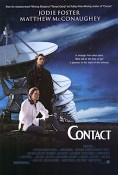
    #79 Contact (1997)
    #80 That’s Entertainment! (1974)
    #81 Wonder Woman (2017)
    #82 The Mummy (2017)
    #83 Moonlight (2016)
    #84 The LEGO Batman Movie 3D (2017)
    #85 Moana 3D (2016)
    #86 John Wick: Chapter 2 (2017)
    #87 The Great Muppet Caper (1981)
    #88 District 9 (2009)
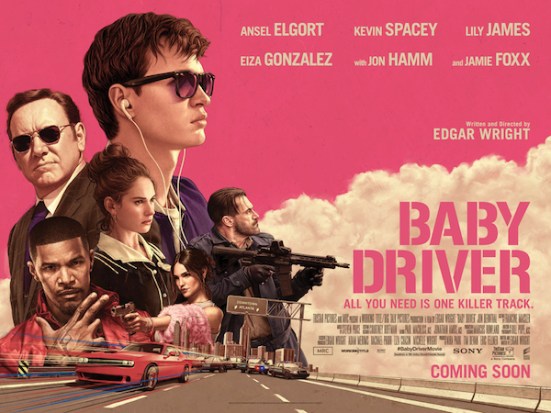
    #89 Baby Driver (2017)
    #90 Transformers: Age of Extinction 3D (2014)
    Contact

    Baby Driver

    .


    • I watched 15 new films this month, exceeding the rolling average of the last 12 months (previously 14.1, now 14.2) and equalling the average for 2017 to date (which was and is bang on 15).
    • At the halfway point of the year, I’ve reached #90, which suggests a final tally of 180. Of course (as I mentioned last month, actually), this time in 2015 I was also at #90 and eventually turned that into 200, while this time in 2016 I was way ahead at #115 but only turned that into 195. So… it’s basically meaningless, is what I’m saying.
    • At the risk of spoiling one of my year-end stats, The Mummy marked the most cinema trips I’ve made in a single year since 2008. And there’s half the year to go yet, with at least the same number of films again earmarked as must-sees.
    • This month’s Blindspot film: Neill Blomkamp’s Oscar-nominated allegorical sci-fi actioner, District 9, which came to Netflix UK this week, I believe for the first time, but I didn’t get round to reviewing it.
    • This month’s WDYMYHS film: Clint Eastwood’s retirement from acting (until it wasn’t) in Gran Torino, which I also haven’t reviewed yet.


    The 25th Monthly Arbitrary Awards

    Favourite Film of the Month

    I haven’t got round to reviewing most of them yet so you wouldn’t know it, but there are a good number of favourite-able movies this month — at least five solid contenders for my year-end top ten, I’d say. But setting aside tales of alien instruction manuals, black boys looking blue, toy superheroes, and musical Polynesians (not to mention wonderful women and gun-toting boogeymen), for my favourite movie this month I have to pick Baby Driver.

    Least Favourite Film of the Month
    Conversely, this was easy. Several movies this month may have underwhelmed me, either in themselves or compared to the hype, but the only one I outright hated was Space Jam.

    Best Serious Drama About First Contact with Aliens of the Month
    It’s taken me 20 years to see Contact and I loved it. I’m not sure if I would’ve loved it as much 20 years ago, mind, so maybe now was the right time.

    The Silicon Valley Producers’ Favourite Movie of the Month
    I wonder if Transformers: Age of Extinction is popular in the Silicon Valley writers’ room right now, considering it features T.J. Miller (spoiler alert!) suffering a horrible demise.

    The Audience Award for Most-Viewed New Post of the Month
    For the third time this award goes to the latest edition of The Past Month on TV, which covered the start of the new Twin Peaks, the “Monk trilogy” on Doctor Who, and more.


    It was another good month for my Rewatchathon. I’m still behind where I should be (we’re halfway through the year, so that’d be at #26), but across the last two months I’ve averaged six rewatches a month — if I keep that up, all will be fine.

    #16 Mamma Mia! (2008)
    #17 John Wick (2014)
    #18 Transformers (2007)
    #19 Transformers: Revenge of the Fallen Big Screen Edition (2009)
    #20 Transformers: Dark of the Moon 3D (2011)

    I didn’t intend to watch Mamma Mia, but the other half put it on and, while I still only half watched it, I paid more attention than I’d expected to. It’s a very daft movie, but it’s so deliberately silly and cheesy that I can’t help but find it amusing. I re-read my nine-year-old review and it pretty much still stands.

    Rewatching the Bayformers films was interesting. I wrote a little about Transformers, Revenge of the Fallen, and Dark of the Moon on Letterboxd if you’re interested, but in summary: I liked the first less than I remembered, enjoyed the second a surprising amount, and completely changed my opinion of the third. I technically watched a different cut of the second one (it’s all of 30 seconds longer), so I’ll probably include a little bit about that in a future review roundup.


    Spider-Man, Spider-Man, does whatever another Marvel Studios character can.

    Baby Driver (2017)

    2017 #89
    Edgar Wright | 113 mins | cinema | 2.35:1 | UK & USA / English & American Sign Language | 15 / R

    Baby Driver

    It felt like half (at least) of the film-loving internet had somehow had a chance to see Baby Driver before its release on Wednesday, but I’m going to throw my two cents into the ring anyhow. Not that it makes a great deal of difference because, like most other folks, I bloody loved it.

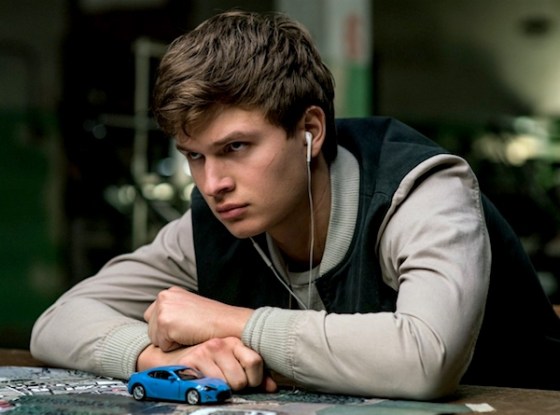
    Written and directed by Edgar Wright, director of the Cornetto trilogy and not of Ant-Man, the story focuses on getaway driver Baby (Ansel Elgort), a fundamentally good kid who has ended up suckered into a life of crime, working for robbery kingpin Doc (Kevin Spacey) and a rotating array of criminal compadres. An accident as a kid left Baby with “a hum in the drum” — tinnitus, if you want to get medical about it — meaning he listens to music all the time to drown it out, and also choreographs his daring drives (not to mention his walks down the street, etc) to the music he hears. One day he bumps into Debbie (Lily James) and falls in love, which happily coincides with his “one last job” for Doc. But once you’re in it’s hard to get out, and Baby again finds himself doing one more “one last job”, with a particularly volatile crew…

    Baby Driver is a movie about three things: driving, music, and love. As Guillermo del Toro put it, it’s a kind of fable, or fairytale, with Baby as the prince and Debbie as the princess. In this respect it’s a change of pace for Wright, ditching the almost-spoof comedy of his previous successful movies for something more emotionally earnest. Not in a bad way, but in a kind of pure way, like a fairytale. This fairytale world isn’t all castles and dragons, of course — instead it’s full of violent criminals and fast cars; but it’s also a world where you can synchronise your getaway driving to the music on your iPod, so it’s hardly mired in gritty realism.

    No little green bags here

    There’s a definite edge of Wright’s buddy Quentin Tarantino to this world: a cast of crooks delivering snappy, quotable dialogue to a near-constant soundtrack of deep cuts selected from the director’s music collection (plus a few familiar tunes for good measure) — the style of QT comes to mind more than once while watching. Fortunately Baby Driver’s style is more than homage or copycatting. Although it’s not a straight-up comedy, Wright does bring his own comedic touch (there are several big laughs), and the purity of emotion — that fairytaleness again — isn’t from Tarantino’s wheelhouse either. Plus, visually it presents a brighter and more colourful space than Tarantino normally inhabits. Most of the action takes place in the golden daylight of Atlanta and is filled with popping primary colours. There’s much great work by DP Bill Pope.

    Though the soundtrack may have a Tarantino feel in its construction, that’s less prevalent in its usage. Characters communicate through song — not by singing them (most of the time — Baby first notices Debbie because she’s singing “B-A-B-Y”), but by connecting through them (that singing is followed by a discussion of songs featuring her name — both of them). The songs Baby chooses for boogieing around his small apartment, or for dancing down the street on a coffee run (in a title sequence that is marvellously choreographed, with dozens of small details timed perfectly to the track), help illuminate his true character — sweet and romantic — which is hidden by the sullen silence he adopts whenever around criminals.

    B-A-B-Y Baby

    Some have criticised the film for a lack of character, reckoning Baby’s silence distances him from the viewer so we never build a connection and don’t root for him. Frankly, I’m not sure what film they were watching. No spoilers, but Baby first opens up with something endearing and ingratiating in scene one. Right at the start. It could barely be any closer to the studio logos (and it kinda wouldn’t work if it were). I’m not arguing he’s the most charismatic lead ever to grace the silver screen, but Elgort makes fine fist of selling Baby as both a quiet, focused driver and a sweet, likeable, cheer-on-able hero.

    And if you want character in general, the rest of the cast has it in spades, with an array of supporting roles that are as colourful as the cinematography. Recognisable faces like Spacey, Jon Hamm, Jamie Foxx, and John Bernthal get to cut loose as crooks who each have their own kooks, while lesser-known names like CJ Jones (as Baby’s foster father) and Eiza González (as the Bonnie to Hamm’s Clyde) make a mark too. Lily James may be placed in a dream-figure damsel role, but that doesn’t mean she can’t hold her own at times too. She’s not Wonder Woman, but she’s not a Manic Pixie Whatever That Phrase Was either.

    Mozart in a go-kart

    So, the one major thing I’ve only touched on fleetingly thus far is the main thing the film has attracted attention for: the driving. Done for real by stunt drivers with not a lick of CGI, that knowledge means it packs a viscerally real punch. But it’s not just snobbery: this is genuinely breathtaking action, slickly planned, masterfully performed, magnificently shot and edited. It’s this year’s Fury Road — a kinetic action spectacle made with skill rather than hand-waiving fast-cuts. Even more impressively, it’s been choreographed to music, but not in a draw-attention-to-itself dance-routine-y way. Perhaps saying it’s been synced to the music would be more accurate. Either way, it only heightens the effect. This extends beyond the car chases, too, including one marvellously musical shootout, the gunfire serving as percussion. The sound design throughout is exemplary. This is a movie that deserves to be remembered come awards season. Perhaps, again like Fury Road, some love will extend beyond the technical categories, too. Wright seems deserving of Best Director recognition, just like George Miller was.

    But such back-patting is for much later in the year. For now, just revel in the gleeful moviemaking verve of a flick that already seems destined to be remembered as one of the greatest car chase movies ever produced.

    5 out of 5

    Baby Driver is in cinemas many places right now, but not everywhere. It’ll be worth the wait, guys.

    It placed 2nd on my list of The 17 Best Films I Saw For the First Time in 2017, which can be read in full here.

    Dragon (2011)

    aka Wu xia

    2016 #190
    Peter Ho-sun Chan | 94 mins | TV (HD) | 2.35:1 | Hong Kong & China / Mandarin | 15 / R

    Dragon (Wu Xia)

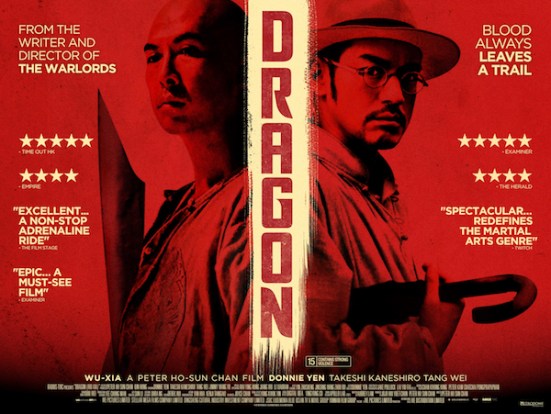
    Donnie Yen is small town paper-maker Jinxi, who incidentally encounters and accidentally defeats two most-wanted criminals. While his village thanks him, detective Baijiu is suspicious — does Jinxi’s story add up? Is he hiding some dark past?

    Takeshi Kaneshiro is expert detective Xu Baijiu, who adheres slavishly to the law after a past mistake cost him dearly. But is he delusional, inventing connections and powers for Jinxi that just aren’t there? Or are his delusions allowing him to see the truth?

    As a Hong Kong production starring Donnie Yen, of course Dragon is an action movie, but there’s more to it than fisticuffs. It engages with themes of justice and redemption, and what it means not only to take the right action, but to have to find the right action to take. Apparently it began life as a remake of One-Armed Swordsman, and while obvious superficial resemblances remain (the Big Bad Boss Man is played by Jimmy Wang Yu, and Yen has to (spoilers!) lop off his own arm), you can definitely see familiar plot points in both films too. But it’s also certainly not a remake anymore. Funny how these things go.

    Can I Baijiu a Jinxi?

    Naturally, when the action does kick in, it’s fantastic. With the combat directed by Yen, these sequences are expertly and inventively choreographed dust-ups. It’s stylishly directed by Peter Chan — classy, but also thrilling, exciting, and sometimes innovative; and the whole is majestically shot by DP Lai Yiu-Fai (who also shot Infernal Affairs, which I still haven’t seen).

    On the downside, at a couple of points I thought the story leapt a little bit or fudged a detail, which is a shame because I don’t think it needed to. This is possibly the effect of watching the international version, which is cut by around 17 minutes (full details here). While it’s a shame, it’s certainly not enough to ruin an excellent martial arts drama.

    4 out of 5

    Fantastic Beasts and Where to Find Them (2016)

    2016 #182
    David Yates | 133 mins | cinema | 2.35:1 | UK & USA / English | 12A / PG-13

    Fantastic Beasts and Where to Find Them

    When J.K. Rowling wrote the seven-book Harry Potter series, she didn’t just make it all up as she went along — it was well planned in advance. And she didn’t just envisage a seven-book story, either — she built a whole world, including a massive history that is only fleetingly referred to in Potter itself. It’s part of that history that the five-film Fantastic Beasts series is setting out to explore. (Despite sharing a title with a short tie-in book Rowling once wrote, Fantastic Beasts isn’t somehow an adaptation of that tiny tome, despite what some pithily moronic internet commenters who think they’re funny would believe.)

    Set many decades before Potter, Fantastic Beasts introduces us to Newt Scamander (Eddie Redmayne), a British wizard who’s travelled to New York while researching his book on magical creatures — or “fantastic beasts”. There, he finds himself embroiled in a conflict between the local magic council and a puritanical group who want to destroy all wizards, while some creature or force is terrorising the city.

    Although labelled by some as a prequel, that’s only technically true — it is set before the Potter stories, but it’s a new story in that universe rather than a tale that leads directly into the existing narrative. As such, it’s pretty newbie friendly. It reuses familiar iconography from Potter, but it does so in neat ways — there are things that are instantly recognisable to fans, but their function is not reliant on familiarity for the sake of newcomers or the less well-versed. It’s also opening up new parts of the Potterverse — or, as they want us to call it now, J.K. Rowling’s Wizarding World — primarily, taking us to the USA for the first time.

    Fantastic Americans and where to find them

    As a new story, it develops its own particular tone and style, distinct from that of the previous movies. That partly comes from the characters we’re following: Potter is about schoolchildren, this is about adults. It’s still a 12A/PG-13, of course, but there’s a lot of wiggle-room within that category. Perhaps this is why some have found it tonally inconsistent, but I enjoyed the mix of whimsy with darkness. The overall effect was good fun, with strong action scenes and some really good — even magical — visuals. The story is bolstered by a couple of well-constructed final act twists. I found at least one to be pretty guessable, but that doesn’t detract from it being put together neatly throughout the film.

    As for the widely discussed fact that this is to be the first of five movies, that fortunately doesn’t define this opening instalment. Seeds for future films are obvious because we recognise actors and, as movie-literate viewers, know how films establish things for future use; but leaving that extra-textual knowledge aside, there’s no reason this doesn’t work as a standalone adventure. People who’ve said otherwise are talking poppycock. Even stuff that initially looks like it’s purely franchise-setup has a purpose within this individual movie.

    Fantastic Beasts has been dismissed in some quarters as no more than a cash-grab attempt to extend a franchise, but I thought it was one of the most enjoyable blockbusters of 2016.

    4 out of 5

    Review Roundup

    In today’s round-up:

  • Snoopy and Charlie Brown: The Peanuts Movie (2015)
  • 13 Hours: The Secret Soldiers of Benghazi (2016)
  • Young Frankenstein (1974)


    Snoopy and Charlie Brown:
    The Peanuts Movie

    (2015)

    aka The Peanuts Movie

    2017 #25
    Steve Martino | 84 mins | streaming (HD) | 1.85:1 | USA / English | U / G

    Snoopy and Charlie Brown: The Peanuts Movie

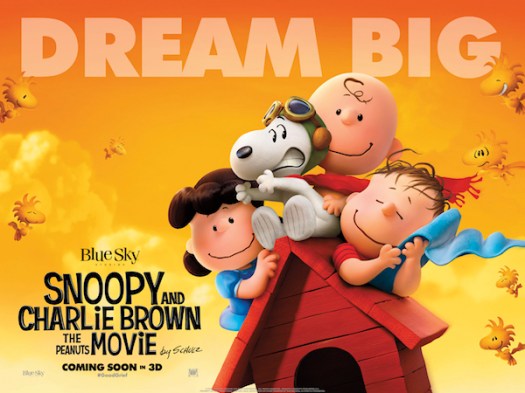
    Charles M. Schulz’s popular comic strip hits the big screen in this likeable but hardly Pixar-level movie. Much of it plays like a series of shorts or sketches with a connected theme rather than a feature-length narrative — kind of like binge-watching a cartoon series — but they’re pleasant enough. There are some good gags (“Leo’s Toy Store by Warren Piece”), though the saccharine ending is a bit much and the pop songs are terrible. One review described Snoopy as “Peanuts’ Tyler Durden”, which is a thought that entertained me even more than the film.

    The most notable aspect is the animation style. Schulz’s strips have a distinct 2D style, but the movie is animated in 3D, presumably because you’re not allowed to make a Western kids’ movie with 2D animation anymore. Nonetheless, most of The Peanuts Movie is composed to emulate Schulz’s original strips, i.e. quite flatly — like, you know, 2D. And yet, somehow… Well, The Telegraph’s Robbie Collin summarised it well in his review: “Written down, [the animation style] just sounds chaotic, like a four-way mash-up of South Park, The Clangers, Wallace & Gromit and a flip book. But in motion, it’s a thing of serious, faux-artisanal beauty”. That might be going a bit far, but I did end up kinda liking the visuals. It’s quite a clever style for 3D, mixing in many 2D-ish touches. It should probably be a mess, but it weirdly works.

    3 out of 5

    13 Hours:
    The Secret Soldiers of Benghazi

    (2016)

    2017 #40
    Michael Bay | 139 mins | streaming (HD) | 2.35:1 | USA / English | 15 / R

    13 Hours: The Secret Soldiers of Benghazi

    The not-at-all-controversial events in the Libyan town of Benghazi on 11th September 2012 are here dramatised by that master of subtlety and understated reality, director Michael Bay, so you know you’re going to get a considered and truthful account of events.

    Yeah, most of that opening paragraph is completely facetious. Bay takes a real-life gunfight, in which a secret mercenary security team went against orders (possibly) to defend an American diplomatic compound that was under assault, and turns it into a blazing action movie that may as well be scored with the theme from Team America: World Police. If it was Bay’s goal to convey the sheer confusion on the ground in the midst of the situation, I guess he’s done a bang-up job. The problem is, that confusion extends to bits where the characters seem to have some idea what’s going on, but we’re left half in the dark.

    Having Bay be reined in after the excess of his Transformers movies is no bad thing, but being completely constrained by reality is not his strong suit either — the heightened reality of something like The Rock is where he excels.

    If you’re interested in a longer read on the film’s adherence (or otherwise) to reality, this article at Vox is interesting.

    3 out of 5

    Young Frankenstein
    (1974)

    2017 #46
    Mel Brooks | 106 mins | streaming (HD) | 16:9 | USA / English | PG* / PG

    Young Frankenstein

    I have mixed feelings about the work of Mel Brooks. I reviewed his Hitchcock spoof, High Anxiety, back in 2009 and found it wanting. I reviewed his Robin Hood spoof, Men in Tights, earlier this year and found it uncomplicated but enjoyable. When I was a kid I liked his Star Wars spoof, Spaceballs, but on a slightly-more-adult rewatch I enjoyed it less. And as for Blazing Saddles, regarded by some as one of the pinnacles of screen comedy… no, I didn’t like it. At all. I so didn’t like it that I really must rewatch it to see if I can see what I didn’t see.

    Young Frankenstein was released the same year as Blazing Saddles, and is placed on a similar pedestal by many — slightly higher, on the whole (Frankenstein edges it by a few points on IMDb, Rotten Tomatoes, and Metacritic). It’s quite remarkable that Brooks managed to produce two such esteemed movies within the same year. At least I liked one of them.

    Young Frankenstein has many funny lines and moments, including a lot of familiar Brooksisms (“walk this way”) and, in the Puttin’ on the Ritz number, perhaps one of the funniest sequences ever committed to film. The films being spoofed (Universal’s classic monster movies) are evoked well, in particular with the potent black and white cinematography, but Brooks also lets things spiral off in their own direction when warranted. On the downside, I’d say it’s a little too long.

    Don’t take that criticism too seriously, though. I enjoyed it very much.

    4 out of 5

    * Hilariously, in 1987 the BBFC thought it should be rated 15. It wasn’t downgraded to the much more sensible PG until 2000. ^

  • 10 Cloverfield Lane (2016)

    2016 #180
    Dan Trachtenberg | 104 mins | Blu-ray | 2.40:1 | USA / English | 12 / PG-13

    10 Cloverfield Lane

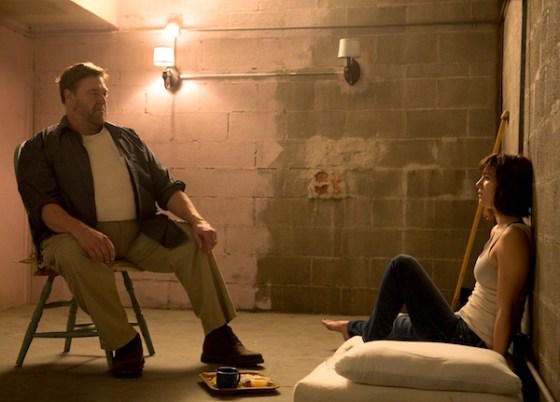
    After Michelle (Mary Elizabeth Winstead) is in a car crash, she awakens in a basement chained to a wall. Her captor, Howard (John Goodman), tells her he’s saved her life: a massive attack has taken place and they, along with an acquaintance of Howard’s called Emmett (John Gallagher, Jr.), are in Howard’s self-built bunker to hide from the deadly fallout. But Michelle only has Howard’s word as evidence these attacks happened at all, or that their aftermath is lethal, and can he be trusted?

    For most of its running time, 10 Cloverfield Lane is a good psychological puzzle. Michelle has little choice but to trust her captor(s) / quarantine-mates and little chance to investigate the truth for herself, try as she might. I must say I never felt a particularly palpable sense of tension, despite the varied and regularly renewed attempts to make Goodman a threat, but it nonetheless works as a characterful mystery-driven single-location thriller. And then…

    We’ve all read reviews where a critic (or blogger!) will write something like, “it would benefit from being 10 minutes shorter”. That sounds very precise and therefore clever, but it’s really a number plucked from thin air. No one who’s written a sentence like that has actually sat down with a film, noted all the bits they’d cut, added them up, and then presented that total in their review. It is, at best, intuition (at worst, it’s random and thoughtless). However, with 10 Cloverfield Lane I can say exactly how much needs to be cut: 9 minutes and 10 seconds. To be exact, those’d be the 9 minutes and 10 seconds between a (spoilery) revelation and the credits rolling.

    Roomies

    There’s no need to go into detail here — if you’ve not seen the film it’s a massive spoiler; if you have, you surely know what I’m talking about. This climax feels wholly unnecessary and like it belongs in a totally different movie. Tonally, and in terms of the main plot points that drive the story, it has absolutely nothing to do with the movie we’ve just watched. If you cut that bit out, it wouldn’t make the rest of the film any less satisfying. And because it’s so unnecessary, I found it intensely irritating.

    The bulk of 10 Cloverfield Lane is a very solid contained psychological thriller, undoubtedly deserving a strong 4-star rating. Then the final ten minutes happens. It’s so misjudged, in my opinion, that it overshadows what’s come before, to the point that I’ve taken a whole star off my rating.

    3 out of 5