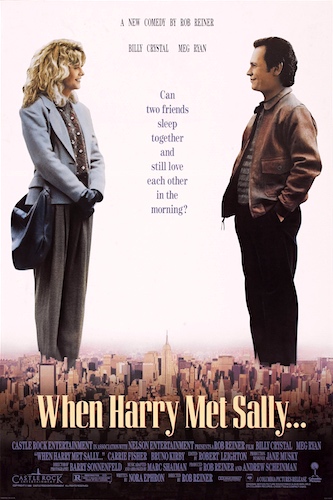
When Harry Met Sally… (1989)

2018 #77
Rob Reiner | 95 mins | streaming (HD) | 1.85:1 | USA / English | 15 / R

When Harry Met Sally...

Written by the queen of the romcom, Nora Ephron, When Harry Met Sally is almost a deconstruction of the genre: its titular protagonists are just friends, but (the film asks) can a man and a woman ever be ‘just friends’? It perhaps feels like a dated question today, when almost 30 more years of gender equality have pushed heavily towards the answer being “yes, of course”, but that doesn’t matter for two very good reasons: first, the film still stands as an insight into the nature of relationships in the ’80s and ’90s; and second, it’s just a really good film.

It begins in 1977, when Harry (Billy Crystal) and Sally (Meg Ryan) are recent graduates who meet through a mutual friend. They soon go their separate ways, and then the film catches up with them in 1982, and again in 1987 — and that’s just act one. It’s an interesting opening gambit to chart the pair’s backstory. It dodges the usual romcom thing of people who’ve just met falling instantly in love, but also does more than introducing us to two friends and telling us “they’ve always been friends” — it shows that friendship. I don’t think I’ve read anyone else talk about this part of the film, I guess because it really ‘gets going’ in the ’87 segment, but I think it’s an interesting way of beginning things, and gives a different grounding to the relationship drama we then see unfold.

It’s an immaculately constructed film all round, both on a macro and a micro scale. For the latter, there’s a single-take four-way phone call between the two protagonists and their respective best friends that is a thing of beauty (and apparently took 60 takes to get right!) It also manages to make New Years and Auld Lang Syne feel relevant to the plot, rather than just an obvious big occasion on which to set the finale. That’s a neat trick to pull off. Even the seemingly-random interludes showing interviews with long-married couples have a pay-off at the end that, once again, reiterates my point about how put-together this is.

Just friends...?

On that macro scale, it again subverts the usual romcom structure simply by having the characters be hyper-aware of the possibility they could sleep together, and regularly discussing whether they should or will. They’re not just bungling through this relationship, happening to fall into all the usual clichés, like so many romcom characters before and since — instead, they’re actually thinking their way through it, aware of the pitfalls. And yet they fall into some anyway, and the film does sometimes follow predictable structure and does hit some of those clichés — but it always manages to make them ring true.

This truthfulness — about male-female friendships, mainly — is probably the film’s biggest asset. Is it still accurate about those dynamics almost three decades later? Despite what I said earlier, maybe it is. And even if it isn’t, I reckon it was bang on point for the ’80s and ’90s, and isn’t that enough? It tells you about the time it was made, even if it doesn’t tell you about today. It all adds up to mean that, when the inevitable happens at the end, it doesn’t feel like an obvious outcome, but something earned and emotional.

4 out of 5

Killing Gunther (2017)

2018 #83
Taran Killam | 93 mins | streaming (HD) | 1.85:1 | USA / English, German & Spanish | 15 / R

Killing Gunther

Do you ever have that feeling where you want to watch a film but you don’t want it to be anything too demanding or important? I do. I’ve watched (and subsequently reviewed) plenty of films with that underlying motivation. Killing Gunther is the latest that absolutely fits that bill. I had paid it absolutely no heed whatsoever until I happened to see a trailer that looked moderately amusing. Bolstered by a Rotten Tomatoes pullquote that described it as “a very affectionate take on the [hitman action] genre, so it’s much easier to overlook its shortcomings if that happens to be a genre that you’re a fan of,” I decided it was worth a punt.

Framed as a mockumentary, it’s the story of a hitman (Taran Killam) who sets out to kill the world’s greatest hitman, Gunther (Arnold Schwarzenegger), and assembles a team of oddball fellow hitman to do so. Unfortunately for them, Gunther is so damn good that he’s always several steps ahead.

As a comedy, I thought it was funny. Not always super original or absolutely hilarious, but ticking enough. As an action movie, some of the single-take assassination scenes are done quite well. It was clearly produced on a low budget, so the action sequences don’t really fulfil on an adrenaline-junkie level, but they work decently in context.

Gunther vs... that other guy

For Arnie fans, it’s worth noting that he doesn’t actually turn up until over an hour into the movie. Put another way, he’s not in 72% of the film. Really, it’s just an extended cameo. It would’ve been a neat surprise if his appearance was a secret, but the whole marketing campaign is based around him (which makes sense, but still).

If you hate mockumentaries, or indie comedies with more ambition than budget, or are coming just to see plenty of Arnie, then Killing Gunther is one to skip. If the concept and style appeals, however, it’s a decent 90 minutes for a lazy evening.

3 out of 5

Review Roundup: 15-Rated Comedies

You don’t have to be an adult to like today’s reviewed movies, but… you do have to be a teenager. Still being a teenager would probably help you enjoy them, too.

In today’s roundup:

  • Airplane II: The Sequel (1982)
  • Hot Tub Time Machine (2010)
  • Sausage Party (2016)


    Airplane II: The Sequel
    (1982)

    2018 #17
    Ken Finkleman | 81 mins | DVD | 16:9 | USA / English | 15* / PG

    Airplane II: The Sequel

    Comedy sequels are a funny business. Generally the first film’s been a big enough hit that people want to cash in, but can lightning strike twice? Well, the number of comedy trilogies (or more) suggests the answer is “yes”… or at least that enough people liked the first one enough that they went to see the second one and, regardless of what they actually thought of it, that persuaded people there should be a third.

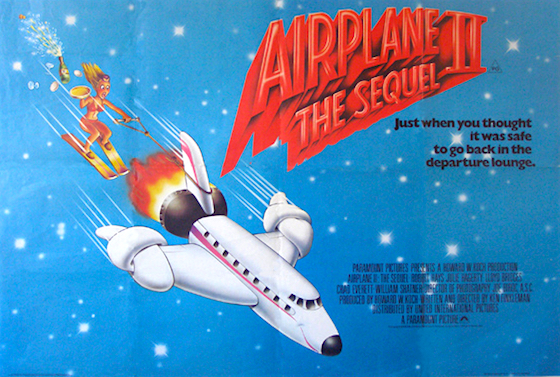
    Airplane is widely regarded as one of the best comedies of all time. There is no Airplane III. Those two facts might suggest something about Airplane II — though it’s a film which even included a gag in its title, so it’s off to a good start.

    Watched now, over 35 years after its release, Airplane II has a certain vein of humour that hasn’t aged well. Ha ha, those two men kissed like they were a couple! Ha ha, that priest was looking at Altar Boy magazine like it was Playboy! Ha ha, everyone has to slap an hysterical woman! At least one of those gags would probably get you fired from a directing job at Disney nowadays… But to focus on those is to pick on the film’s weak points. Another would be that it has a few too many rehashes of jokes from the first one. Well, what comedy sequel doesn’t? That aside, much of the rest is pretty darn funny.

    3 out of 5

    * This was rated PG on its original theatrical release, but that was cut. The uncut version has consistently been rated 15 on video. ^

    Hot Tub Time Machine
    (2010)

    2018 #51
    Steve Pink | 97 mins | streaming (HD) | 1.85:1 | USA / English | 15*

    Hot Tub Time Machine

    I don’t know why I felt the need to watch Hot Tub Time Machine. Maybe just because it found its way onto my 50 Unseen list back in 2010 (I guess people talked about it at the time. Has it lasted? I don’t think so). Maybe because it’s got “time machine” in the title and so the sci-fi implication draws me in, especially as a Doctor Who fan. I don’t know. Whatever, it’s been vaguely on my radar for the past eight years and, when I wanted something undemanding one Friday night, its time finally came.

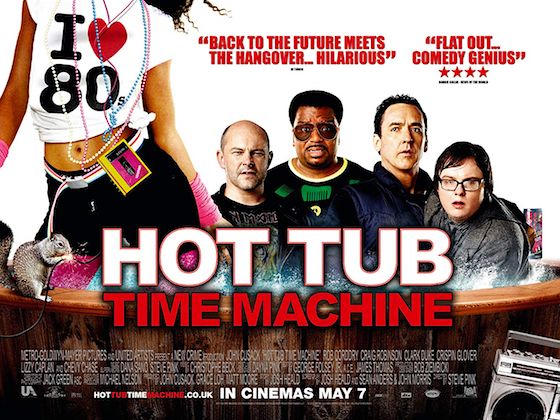
    As the title implies, it’s about a hot tub… that’s a time machine. Four dudes get in it and find themselves in the bodies of their ’80s selves. Except for one who wasn’t born at the time, who just finds himself in the past. Yeah, the logic of it is really shaky.

    Nonetheless, it actually has a couple of solid thematic and plot ideas buried away, to do with fate and second chances and stuff, but those are mired in execution that’s both derivative (of both Back to the Future and stuff like The Hangover — and, I swear, I hadn’t seen the quote on the above poster when I wrote that) and often unfunny (unless you really like that lowest-common-denominator gross-out stuff). There are some genuine laughs, but they’re infrequent enough that they might just’ve been accidents. Another part of the problem is that for the eventual pay-offs to work you need to be invested in the characters. The film makes half an attempt to give us reasons to care about the guys, but they didn’t connect for me. Maybe if that worked better, the later stuff would land too.

    I didn’t hate Hot Tub Time Machine — it was passably amusing for a time-filler — but it wasn’t great either. My score errs on the harsh side, because I definitely liked it less than other movies I’ve recently given 3 stars.

    2 out of 5

    * I watched the extended “unrated” version, hence no MPAA certificate. It’s less than two minutes longer (comparison here), with no material that would challenge an R rating. ^

    Sausage Party
    (2016)

    2018 #37
    Greg Tiernan & Conrad Vernon | 85 mins | streaming (HD) | 1.85:1 | USA & Canada / English | 15 / R

    Sausage Party

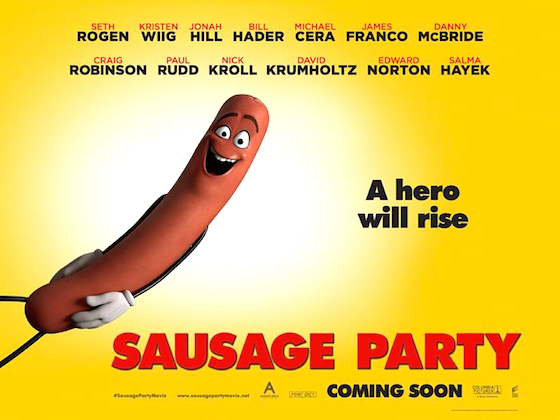
    A movie about sentient food that parodies the inherent stupidity of religion — I mean, what’s not to like? Well, it’s from the minds of Seth Rogen, Evan Goldberg, and co (Jonah Hill as a story co-credit), so if you don’t like their kind of humour…

    Certainly, it’s incredibly rude and crude — even more so than they’d necessarily intended: they were so certain they’d get an NC-17 rating from the MPAA that the version they submitted included some extra extreme material, the hope being that would act as a distraction so that what they actually wanted in the film would pass as an R. However, the MPAA only insisted on one relatively minor change. I imagine that was to the massive, long, graphic orgy scene. There are no words for it. And yet, it only got a 15 over here — you really have to be very extreme to get an 18 these days, huh? Or maybe it’s just because it just involved food…

    For all the eye-watering content, at least the film has the good grace to also be quite witty and clever at times. I guess some of the ‘satire’ is a bit on the nose, but it works for what it is. I mean, no one comes to a film like this expecting subtle social commentary, do they? And if the analogies for religious belief are a bit on the nose, well, maybe that’s what it takes to get through to those people…

    4 out of 5

  • The Mission: Obviously Possible Monthly Update for July 2018

    Dun dun dun-dun-dundun, dun-dun-dundun, dun-dun-dundun, dun-dun… duh-duh-duuun… duh-duh-duuun… duh-duh-duuun… duhdun!

    It just makes you want to go jump out of a plane or something, doesn’t it? Sadly, I think I’d be less Tom Cruise, more James Corden.


    #146 Batman Ninja (2018)
    #147 Muppet Treasure Island (1996)
    #148 Blade of the Immortal (2017), aka Mugen no jûnin
    #149 Red Sparrow (2018)
    #150 True Romance (1993)
    #151 RoboCop (2014)
    #152 Rocky IV (1985)
    #152a Rocky VI (1986), aka Rock’y
    #153 What Ever Happened to Baby Jane? (1962)
    #154 Cash on Demand (1961)
    #155 Despicable Me 2 3D (2013)
    #156 Godzilla: City on the Edge of Battle (2018), aka Gojira: Kessen Kidō Zōshoku Toshi
    #157 Zatoichi and the Doomed Man (1965), aka Zatôichi sakate-giri
    #158 Free Enterprise (1998)
    #158a Friends, Romans and Leo (1917)
    #158b Little Red Riding Hood (1917)
    #158c Quaint Provincetown (1917)
    #158d Microscopic Pond Life (1915)
    #159 Kidnapped (1917)
    #160 Iron Monkey (1993), aka Siu nin Wong Fei Hung chi: Tit ma lau
    #161 Superman III (1983)
    #162 The Navigator: A Medieval Odyssey (1988)
    #163 The Day the Earth Stood Still (2008)
    #164 Mission: Impossible – Fallout (2018)
    #165 Full Metal Jacket (1987)
    #166 Wind River (2017)
    #167 The LEGO Ninjago Movie 3D (2017)
    #168 Body of Lies (2008)
    #169 I Am Sartana, Your Angel of Death (1969), aka Sono Sartana, il vostro becchino
    #170 The Garden of Words (2013), aka Koto no ha no niwa
    #171 The Secret in Their Eyes (2009), aka El secreto de sus ojos
    #172 Paul (Extended Edition) (2011)
    #173 The Way of the Gun (2000)
    Muppet Treasure Island

    Free Enterprise

    The Navigator

    Mission: Impossible - Fallout

    Full Metal Jacket

    .


    Firstly, as usual, stats and numbers…

    • With 28 new feature films watched, July kept up 2018’s run of supersize months — in fact, it’s not only the third best month of the year, but also the fourth best of all time.
    • It’s my 50th consecutive month with 10+ films. It’s also my 6th consecutive month with 20+ films, extending that record-breaking run. It leaves just November and December as the only months that have never reached 20+ films.
    • It’s by far my highest July ever, the previous best being last year’s 17, and is so far beyond the monthly average of 8.1 that it’s dragged it up almost two whole films to 9.9.
    • Continuing with averages, it also surpasses the rolling average of the last 12 months (previously 19.1, now exactly 20) and the average for 2018 to date (previously 24.2, now 24.7).
    • On the 17th I reached the landmark of being 100 films ahead of target. That’s the first time I’ve been 100 ahead since the end of 2015, when I was there for all of three days (29th-31st December) — and that was the only other time I’ve been 100 ahead. As it stands, I end the month a whopping 115 films ahead of where I ‘should’ be by this point.
    • Less auspiciously, this month my backlog of unreviewed films also surpassed 100 titles for the first time. Eesh.
    • Back to brighter news: as I continue to keep track of dates on which I’ve never seen a film (see the last bullet point in Viewing Notes here for background on that), this month I watched films on both the 16th and 19th to reduce the remaining list by a third. Still to come this year: September 2nd and December 22nd.

    Now for something actually about the films themselves…

    • This month’s Blindspot film: plugging a gap in my viewing of both Quentin Tarantino’s and Tony Scott’s filmographies, the Tarantino-written Scott-directed True Romance, which plays exactly like a movie written by Quentin Tarantino and directed by Tony Scott.
    • This month’s WDYMYHS film: plugging a gap in my viewing of Stanley Kubrick’s filmography, as I tend to do about once a year, Full Metal Jacket, which was one of my favourite Kubricks.
    • Somewhat relatedly: Argentinian Oscar-winning thriller The Secret in Their Eyes was a strong contender for one of those must-watch lists this year, but didn’t make it for reasons I forget. I sort of figured it’d be on a list next year. Not anymore, obviously.
    • Finally, earlier this week I posted my Train to Busan review semi-randomly (it was the last review left from 2017 and I wanted those done), only to later discover its UK TV premiere is this Friday. The “likes to make reviews tie into things” part of my brain was not impressed.


    The 38th Monthly Arbitrary Awards

    Favourite Film of the Month
    Tom Cruise learnt to fly a helicopter, performed 106 skydives, and broke his ankle just to entertain us. And by golly, it worked. Some favourites are not a choice — this just is Mission: Impossible – Fallout.

    Least Favourite Film of the Month
    There were a few mediocre options to choose between here, though. While there were definite flaws in certain unnecessary remakes and sequels among this month’s viewing (have a scan through the list above and I’m sure you can pick out the films I mean), the closest any film came to the cardinal sin of boring me was Godzilla: City on the Edge of Battle.

    Most Played Soundtrack of the Month
    As much as I love the Mission: Impossible music (and, having now listened to the soundtrack in full, Lorne Balfe’s score for Fallout is better than I gave it credit for in my review), the soundtrack I’ve most often had on loop this month is Muppet Treasure Island, which has an array of superbly piratical songs (including a scene-stealing turn from Tim Curry), as well as a proto-Pirates of the Caribbean score from Hans Zimmer.

    Most Impressive Spy of the Month
    Oh sure, Ethan Hunt can do all those amazing physical feats, but can he be a pasty white guy wandering around Iraq looking for terrorists and somehow not stand out like a sore thumb to the locals, hm? No, that’s apparently Leo’s special skill as Roger Ferris in Body of Lies.

    The Audience Award for Most-Viewed New Post of the Month
    I reviewed two new releases this month: direct-to-Netflix anime sequel Godzilla: City on the Edge of Battle, and highly anticipated cinematic blockbuster Mission: Impossible – Fallout. Guess which review got the most hits. Yes, as you’ve probably correctly predicted from the way I’m making this point, it was Godzilla: City on the Edge of Battle. Well, I can tell you exactly why that happened: my most-viewed posts are always ones that get a lot of referrals from IMDb, and, despite submitting my Fallout review as soon as I published it on Thursday morning, for some reason they didn’t add it until Monday afternoon, after the pre-release and opening weekend interest had passed. It ended up coming third, behind a very different spy movie, Red Sparrow.


    After a concerted effort, this month I finally finished publishing reviews of my 2017 viewing. Now I’ve just got all those 2018 ones to catch up…


    This month I am mainly rewatching Films That Precede Sequels That Are In Cinemas Now.

    Well, I say “mainly” — from a UK perspective, technically it only applies to two of these…

    #25 Galaxy Quest (1999)
    #26 Never Say Never Again (1983)
    #27 The Incredibles (2004)
    #28 Mission: Impossible – Rogue Nation (2015)
    #29 Ant-Man 3D (2015)

    I’ve been meaning to watch Never Say Never Again, er, again for yonks — I last saw it as a kid and, really, didn’t remember it very well. I happened to catch it starting one night on ITV4 HD and thought, well, why not now? Turns out, it’s not all that bad. I mean, it’s not great, but it was a passably entertaining off-brand Bond film. There are probably some Roger Moore films I’d rank below it — if it counted for such rankings, which it doesn’t. I’ll give it the “Guide To” treatment at some point.

    I bought (and last watched) the special edition DVD of The Incredibles when it first came out in 2005, but I’ve never upgraded it because Disney have given it short shrift over here: first an extras-starved Blu-ray, now no UHD release even scheduled. It was long overdue that I revisit the film (as I said, it’s been 13 years), especially with the sequel coming out (in July here, hence why I wasn’t wittering about this last month), but I didn’t want to watch it in SD. I ended up stumbling across a UHD copy by… “other means”. So, yeah: screw you, Disney — I can’t say I feel too guilty about freely acquiring a film I’ve already bought and they’ve not bothered to treat right on this side of the pond since DVD.

    Anyway, it’s a truly exceptional film — I don’t know why it’s taken me so long to rewatch it, and I wish I had more often. It’s certainly in my top four Pixar movies, alongside the Toy Story trilogy. Plus, I definitely made the right call skipping SD: it looks fantastic in higher definition; almost too good, the crispness showing up the age of the CG animation. Whether there’s an appreciable difference between its HD and UHD versions, I couldn’t say. Based on the comparisons at Caps-a-holic, there’s a slight difference in colour and sometimes in very, very fine detail, but the regular Blu-ray seems to hold its own.

    Finally, Mission: Impossible – Rogue Nation. It’s clearly the best of the first five Missions. Obviously, you’re allowed to have a different opinion. But you’d be incorrect. It’s basically a perfect spy/action movie, and anyone who tries to say otherwise is just wrong.


    I suppose summer, with all its picnics and barbecues and whatnot, is the most appropriate time to release a movie about an ant and a wasp…

    Train to Busan (2016)

    aka Busanhaeng

    2017 #140
    Yeon Sang-ho | 118 mins | streaming (HD) | 1.85:1 | South Korea / Korean | 15

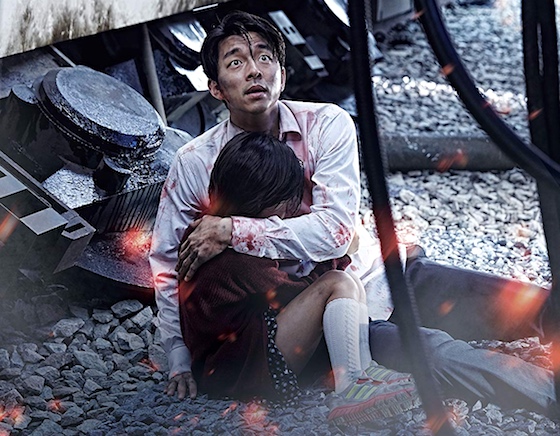
    Train to Busan

    Zombie movies have really risen to prominence this decade, for whatever reason (the success of The Walking Dead is an obvious culprit, though it would seem to have begun slightly before that, with Zombieland coming out in 2009, for example). You’d think that would result in the subgenre feeling played out, and there are certainly plenty of lesser efforts churned out, but films like the exceptional Train to Busan show there’s still quality to be found.

    The film centres on Seok-woo (Gong Yoo), a fund manager living in Seoul with his young daughter, Soo-an (Kim Su-an). Seok-woo’s work-focused attitude has left his relationship with his daughter strained and distant, so he acquiesces when she requests to visit her mother in Busan. As they board the train — alongside other passengers that represent a cross-section of society, natch — a zombie apocalypse breaks out. Initially safe in their carriage, the passengers must hope they can make it to safety.

    The family that fights zombies together...

    As you might expect, the mismatched group of passengers fall prey as much to their own infighting and prejudices as they do to the zombie hordes, and the situation works wonders for the father-daughter relationship of the lead characters. Despite that apparent predictability, co-writer/director Sang-ho Yeon and his cast earn our sympathies and create an attachment to these characters, such that we’re along for the journey with them. Whether or not you guess the letter of the plot is beside the point if you feel it along with the characters — when you’re on edge to see if they can make it, upset by their failures, and cheered by their victories. This also contributes to some effective suspense sequences, and the film is also peppered with intense, pulse-racing action scenes that have been impressively mounted. World War Z may’ve seemed to corner the market for “zombie movie as action epic”, but there are sequences here that give it a run for its money.

    Train to Busan shunts aside any tiredness you may feel about zombie flicks to demonstrate that, however overdone a genre may seem, there’s almost always room for fresh voices and creativity to produce remarkable work.

    5 out of 5

    Train to Busan placed 14th on my list of The 17 Best Films I Saw For the First Time in 2017, which can be read in full here.

    And that completes the reviews of my 2017 viewing (at last!)

    The Past Month on TV #36

    There are schizophrenic superheroes, deconstructed movie genres, Italian thefts, and even some ball-kicking competitions in this month’s TV review…

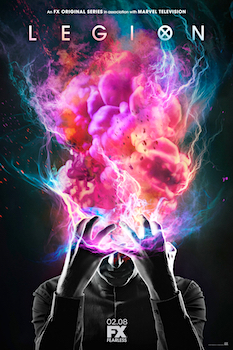
    Legion  Season 1
    Legion season 1The first live-action X-Men TV series is only tangentially connected to either the movies (there are a couple of vague nods) or even the original comic books (apparently the title character is the only thing taken from them), but instead creator Noah Hawley (the man behind the Fargo TV series) has been allowed free rein to do as he pleases. Turns out that’s a massive mindfuck; a series that’s focused on atmosphere over narrative coherence, full of crazy visuals and abstruse plotting. If you’re thinking, “that sounds a bit Lynchian,” then yes, this is probably the nearest thing we’ll ever get to a David Lynch version of the X-Men.

    That’s not just a pithy comment, for two reasons. Firstly, although the series is based around the character of David Haller (Dan Stevens), an exceptionally powerful mutant, by the end of the first episode he’s joined up with a team who are based at an educational facility that teaches mutants how to use their powers, in part so they can fight for their rights against humans who want to oppress them. For those not in the know, that’s more or less the overarching plot of the main X-Men series. Secondly, it’s not just that “this looks a bit weird, let’s reference David Lynch” — the series has a Lynchian attentiveness to dream-like sequences and visuals to convey meaning, and an awareness of the importance of sound design to create an effect or atmosphere. Unlike Lynch, there are some answers to be found; and while they’re often still very weird, at least there’s definite satisfaction in them.

    I watched the eight episodes of the first season over eight days, which I have mixed feelings about. As ever, it makes it easier to connect up the dots of the plot; on the other hand, the show’s style comes so out of leftfield, maybe it would work better spread out at a traditional pace, offering a little hour-long oasis of weirdness in your week. The second season has already concluded, so I’ll have to decide before I approach that one.

    When that will be, I’m not sure. I bought this first season on Blu-ray, so I’d like to do the same for the second, but there’s no sign of a release being scheduled yet. Hopefully this won’t be one of those series that never gets a complete disc release — that happens every so often (and I believe Legion’s network, FX, are regular culprits) but it never pleases anyone.

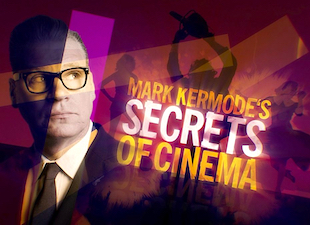
    Mark Kermode’s Secrets of Cinema  Episodes 1-2
    Mark Kermode's Secrets of CinemaMark Kermode is our guide for this BBC Four documentary series that seeks to expose the inner workings of movie genres and what makes them so effective. Co-written by Kermode and encyclopaedically knowledgeable movie guru Kim Newman, the series certainly has the chops to take on such a task. Focusing on one genre per episode, it makes an interesting choice to start with romcoms — a massively and enduringly popular type of movie, unquestionably, but one that’s often ignored by serious film analysis. That makes it the perfect choice for a series such as this, because, as the episode makes clear, the whole point of the genre is to do something very, very hard (produce a funny movie with loveable characters) and make it look easy (and when they succeed, that’s why it gets ignored!) As insightful as the first edition was, I preferred the second one, focusing on heist movies, though that’s purely because it’s a genre I’m more disposed toward.

    Kermode’s teachings are illustrated with superb graphics (the 3D realisation of each film’s timeline is fantastic), examples drawn from the entire history of cinema (the heist episode takes in everything from 1903’s The Great Train Robbery to last month’s Ocean’s Eight), and throws in a few pleasantly unexpected curveballs too (John Carpenter’s The Fly is a romcom? Half-forgotten black-Vietnam-vet drama Dead Presidents is an archetypal heist movie?)

    Future editions will focus on science fiction, horror, and coming of age films. Of course, there are considerably more than five movie genres — maybe if we’re really lucky there’ll be more series in the future…

    Lupin the 3rd: Part IV  Episodes 1-5
    Lupin the 3rd: Part IVAs I mentioned when I reviewed The Secret of Mamo, this is the first main Lupin III series to receive a release in the UK (spin-off The Woman Called Fujiko Mine was released back in 2013. I’ve still not watched it). Part IV, also known as The Italian Adventure, sees Lupin and co in, you guessed it, Italy, where the master thief and lothario is, much to everyone’s surprise, getting married. Naturally, he’s got another plan up his sleeve. It’s the first of many, as these early episodes are mostly standalone adventures; but with Lupin’s thievery attracting the attention of shadowy MI6 agent Nix, there are hints of a bigger story to come. So far it feels somewhat lacking compared to the two Lupin III movies I’ve seen, but it’s still quite fun.

    Also watched…
  • 2018 World Cup — I’m not much of a sports fan, and even when I am it’s not the ball-kicking tournament that floats my boat, but even I got a little swept up in the England hype… for all of two-and-a-half games, anyway. We won the first (hooray!), lost the second (boo!), and the third-place play-off was so mind-numbingly dull that I spent most of the first half updating my database with that week’s Blu-ray purchases, then wandered off entirely before the second. So that’s that.
  • Doctor Who Series 11 Trailers — You wait ages for a Doctor Who trailer to come along, and then you get two in a week. Well, maybe it’s something to do with time travel. Neither the World Cup-themed teaser nor fast-cut clip-fest proper trailer gave us too many details on what to expect from the forthcoming series, but it’s enticing nonetheless.

    Things to Catch Up On
    Picnic at Hanging RockThis month, I have mostly been missing Picnic at Hanging Rock, the new adaptation of Joan Lindsay’s novel (perhaps better known from Peter Weir’s 1975 film adaptation), which is currently halfway through airing here in the UK. It looks up my street, so I intend to binge it at some point. Also, Keeping Faith, the BBC Wales drama that was such a hit on iPlayer they’re finally giving it a run on BBC One proper. Oh, and the third series of Unforgotten is also partway through, and they’ve gone and revived The Bletchley Circle too. Who says summer is a quiet time for TV?

    Next month… I’m intending to finally get lost in Netflix’s space.

  • The LEGO Ninjago Movie (2017)

    2018 #167
    Charlie Bean, Paul Fisher & Bob Logan | 101 mins | Blu-ray (3D) | 2.40:1 | USA & Denmark / English | U / PG

    The LEGO Ninjago Movie

    After the somewhat surprising success of The LEGO Movie, both critically (96% on Rotten Tomatoes) and commercially ($469.2 million worldwide), Warner Bros and LEGO realised they were on to a good thing and so did what any movie studio does in such circumstances: plowed ahead not only with a sequel (out next February), but also spin-offs. The first one, The LEGO Batman Movie, continued the trend (90% Tomatometer; $312 million gross); the next one — this one — …didn’t. With a rotten 55% on the Tomatometer and a worldwide box office take of just $123.1 million (less than either previous film’s domestic gross alone), what went wrong? Did they flood the market with LEGO movies too quickly? Was Ninjago just not as attractive or familiar a brand as Batman or LEGO generally? Or is it just not a very good movie? Well, I’ll come to that.

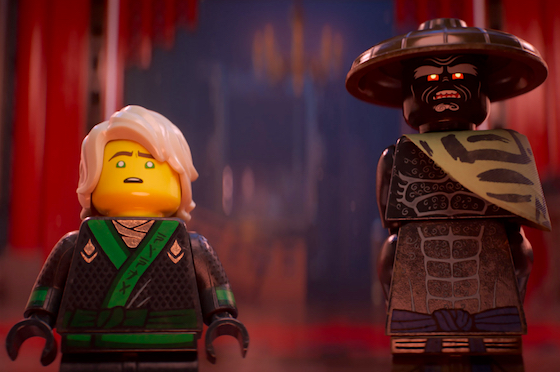
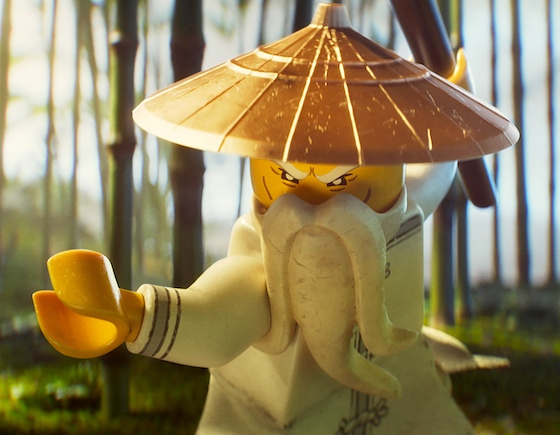
    The film sets its scene in Ninjago City, which is constantly terrorised by villain Garmadon (Justin Theroux) and his armies. Fortunately for the good folk of Ninjago, they have a team of mech-driving colour-coded super-ninjas to protect them. In real life, those ninjas are just high school kids, and not particular popular ones — especially Lloyd (Dave Franco), aka the Green Ninja, who everyone knows is Garmadon’s son. When Lloyd’s daddy issues lead him to slip up, the ninjas have to save the city — and, in the process, Lloyd and Garmadon have to sort out their differences.

    The Garmadons

    The LEGO Ninjago Movie is quite clear that the focus of its story is the relationship between Lloyd and Garmadon, but it’s perhaps a little too focused on that. There are a bunch of other characters thrown into the mix — Lloyd’s five teammates; their master, Wu (Jackie Chan); Lloyd’s mother (Olivia Munn) — but the film doesn’t afford the screen time to do any of them justice. In fact, the film probably would’ve been a lot better if it had cut back on the number of beats in the Lloyd/Garmadon story and devoted a bit more time to giving everyone a little subplot. If it kept busy doing that it might’ve picked up the pace a bit as well, because although Ninjago is more or less the same length as the two previous LEGO movies, it feels much longer.

    Partly this is because it just doesn’t feel as inspired as the other movies — it lacks the spark of ingenuity that ignited their characters, humour, and stories. At times it feels entirely half-hearted. For example, Lloyd’s big mistake makes his teammates all hate him, but they immediately go on a journey with him anyway; Master Wu says the length of that journey will give them time to come back round to Lloyd, but the film never bothers to suggest that’s happening — as soon as they need to all get along again, they do. Clearly this was meant to have some emotional effect on Lloyd (even the handful of people who used to like him don’t anymore), but that’s never really given the emphasis to be felt either — so what was the point of them falling out with him in the first place?

    Even in LEGO, Jackie Chan kicks ass

    That said, it does muster suitable amusement in places, though not as regularly as the other two films. And if you’re a fan of Eastern genre movies — kung fu, giant monsters/mechs, samurai, etc — the whole shape and style of the film is a broad reference to that kind of cinema, which is fun for those in the know. Unfortunately, it comes up somewhat short in the action stakes — the mech sequences seem to be inspired by the Michael Bay school of throw tonnes of visual information at the screen and whizz through it at lightning speed, making some of it hard to distinguish, even with the separation benefits of 3D.

    Despite all these negatives, I didn’t actively dislike The LEGO Ninjago Movie. It’s good in places, most of it ticking along at a level of passable entertainment — but it ticks along for too long, it’s not funny enough, and it can’t bring it all together in the way the other two films did. It suffers most of all from those comparisons, because it’s simply not a patch on the other two LEGO movies.

    3 out of 5

    The LEGO Ninjago Movie is available on Sky Cinema from today.

    Mission: Impossible – Fallout (2018)

    2018 #164
    Christopher McQuarrie | 147 mins | cinema | 2.39:1 | USA & Hong Kong / English & French | 12A / PG-13

    Mission: Impossible - Fallout

    You can keep your Infinity Wars and your Incredibles 2sthis is the movie I’m most hyped for in 2018. I’ve been looking forward to it ever since it was announced we’d be getting another impossible mission from writer-director Christopher McQuarrie, who knocked it out of the park with the superb Rogue Nation. Anticipation only intensified with the fantastic trailers (that first one, scored to a Lalo Schifrined-up version of Imagine Dragons’ Friction, is a work of art in itself), and reached fever pitch with the influx of super-positive reviews in the past couple of weeks. Living up to the hype began to seem like an impossible mission all of its own.

    Well, if there’s one thing Ethan Hunt and his IMF teammates can pull off, it’s… a rubber mask. But if there’s another, it’s the impossible — and how!

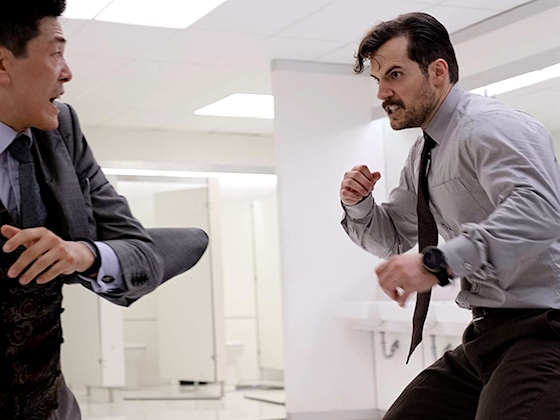
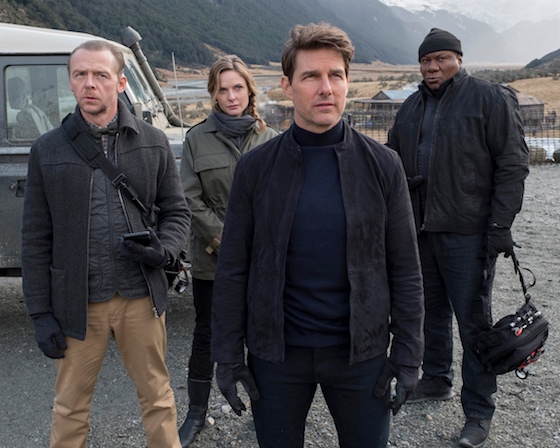
    Two years after the events of Rogue Nation, Hunt (Tom Cruise, obv.) and his regular sidekicks Benji Dunn (Simon Pegg) and Luther Stickell (Ving Rhames) are after three stolen plutonium cores that could be used to make nuclear bombs. They must stop them falling into the hands of The Apostles, a radical group seeking to execute the manifesto of John Lark, a shadowy figure the intelligence services have been unable to identify, who seeks to bring about a seismic change in the world order. When the IMF’s attempt to acquire the plutonium goes sideways, Hunt is assigned a CIA minder, August Walker (Henry Cavill), with orders to let nothing get in his way of finding The Apostles — including Hunt.

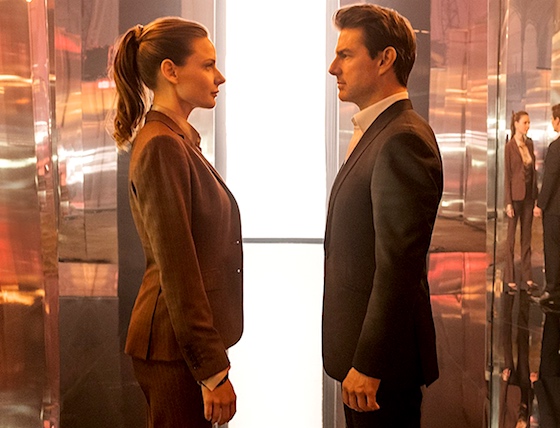
    From there, we’re heading into proper spoiler territory (I already rewrote that last paragraph to avoid giving away an early twist. You’re welcome, readers). However, as the trailers have already revealed, the storyline brings back into action the last film’s antagonist, Solomon Lane (Sean Harris), as well as Ilsa Faust (Rebecca Ferguson), the MI6 agent whose allegiances were constantly under question in Rogue Nation. She was ultimately confirmed to be on the side of good, but was supposed to be leaving the game. Why is she back? And whose side is she on now?

    Faust-Ethan pact (that's a pun, FYI)

    The plot that mixes all of this together gets… complicated. In some respects there’s a clear throughline from one action set piece to the next, but in others it can leave you reeling as it rockets from twist to reveal to counter-twist to counter-reveal. Mostly I think you have to go with the flow and accept whatever’s happening in the moment — if you start to think about the bigger picture (how people knew what when, and how they planned for this, that, and the other), it’ll make your head spin. Naturally, I was trying to do the latter, and got completely lost at one point in the middle when there’s an assault of back-and-forth twists about who has the upper hand. Again, if you just accept it and go with it, it’s fine, but try and unpick the logic of the whole thing in the moment and, well, you’ll be so busy thinking that you’ll probably miss another twist. Personally, I have a lot of faith in McQuarrie as a screenwriter, and I have no doubt the whole thing does make sense (or enough of it, at any rate), but he’s too busy racing along to let the film stop and allow you to confirm it for yourself.

    Fiddly plots are nothing new to the Mission franchise, of course: the very first one was (and often still is) criticised for having a story that’s more impossible to follow than a typical IMF mission is to execute. What is new to Fallout’s story is that it’s a sequel. Obviously, there are four other Mission: Impossible sequels, but they’re all standalone movies really. With the return of Lane and Faust, plus some of the baggage they had with them, a lot of Fallout spins out of Rogue Nation — it’s unquestionably a direct sequel. And, once again without wanting to get spoilery (though, again, this is partially given away in the trailers), it also picks up on hanging threads from movies even further back in the series. In this respect it’s a great film for certified Mission fans: there are a number of payoffs and answers to questions that are only still thought about by such devotees; but it’s also done in such a way that it never obstructs the fun for casual viewers. That goes for the whole sequel thing: although the storyline is grounded in the events of Rogue Nation, Fallout gives you enough info that you could watch it as a standalone.

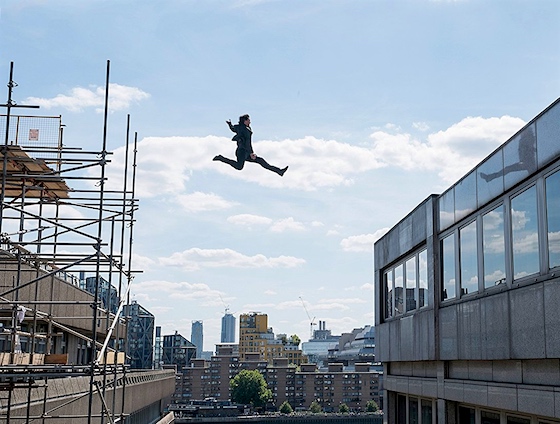
    Long walk off a short aeroplane

    Talking of Rogue Nation, about 24 hours before seeing Fallout I listened to Empire’s legendary three-hour Rogue Nation spoiler podcast, in which McQuarrie talks a lot about the writing process of a Mission movie, and what he learned about that during Rogue Nation. With his observations fresh in my mind, it shed an interesting light on Fallout — how and why it was doing certain things, as well as about when it chose to do them. Perhaps that’s why I was able to spot some of the reveals and stuff, because I knew the (self-imposed) rules McQuarrie was playing by. But there are some fascinating contrasts, too. For one not-really-spoilery example (because I’m going to talk about literally the first scene of the movie now), in the podcast he talks about how Mission films have to begin with a burst of action — no plot, no story, just straight into an action scene. It’s partly about giving the audience an instant thrill, but it’s more about letting them settle into watching the movie before you throw important information at them. But Fallout does literally the opposite: the first scene sees Hunt receive one of the series’ famous briefings (delivered, as always, in a completely different manner to how we’ve seen it done before), and that, as it’s precisely designed to do, delivers a massive infodump of plot. Now, how much of it you need to take in I’m not sure — various bits are explained again later as they become pertinent — but it certainly implies you should be paying attention. I’m in no way criticising this (I really liked everything in the pre-titles), it’s just an interesting contrast to how McQuarrie said things ‘needed’ to be done last time.

    Another thing from the podcast: one rule they set themselves on Rogue Nation, which ended up being a massive thorn in their side, was that there had to be constant escalating tension, meaning the film had to end with the biggest action sequence of all. This was a self-imposed rule, but they struggled with it for ages before they finally realised it just wasn’t what the story demanded, which was when they alighted on the ending that saw Hunt outsmart Lane rather than engage in a massive action scene with him. Clearly McQuarrie came into Fallout more prepared, however, because while there are big stunts and action scenes throughout the film, the finale is the largest, most complicated, most dynamic, and most impressive sequence of the lot.

    Watch that ankle...

    And so we’ve come to the real point of the movie; the thing the trailers and posters and behind-the-scenes videos have all sold it on: the action sequences. Simply, they’re incredible. Cruise’s dedication to giving the audience something new and exciting and awe-inspiring to watch is second to none. He spent literally years preparing for this film, learning to fly a helicopter and perform HALO skydives. That’s him flying the helicopter. That’s him jumping out of a plane. That’s him doing all sorts of other stuff too, like riding against traffic on a speeding motorbike, or jumping across rooftops, or falling off the side of a mountain. The only effects work here is for the odd spot of safety-rig removal or, I presume, one or two moments that would be impossible to achieve safely in real life. And this dedication has paid off: it’s so much more thrilling when you know this has all been performed for real than it is to watch some pixels or someone on a green screen. Those kinds of effects have their place in other movies, and can provide a thrill within the context of the story, but they nonetheless lack the tangibility that doing it for real provides, and the knowledge it’s a genuine feat you’re watching adds a whole extra thrill of its own.

    In filmmaking terms, McQuarrie does all he can to match Cruise’s drive to entertain us with his daring — not by being daring himself, but by showing off Cruise’s efforts in the best way possible. McQuarrie favours going without score for the action scenes, letting the sounds of revving engines, squealing brakes, thumping punches, and all kinds of crunching and smashing and thudding, be the only music you need. The tension and excitement comes purely from the physical feats on display, plus the camerawork and editing that showcase them. It works like a charm. I’ve seen music-less action sequences in the past where you feel the absence on the soundtrack; like something more is required. Early on in Fallout, I noticed the absence of music during these scenes only because I was aware McQuarrie favoured it that way, and because of how much it wasn’t needed. But by the end of the film, I was too hooked to care — I honestly can’t tell you if Fallout’s big finale sequence has music or not, because it grabs the attention so thoroughly that I’d just stopped being aware.

    Arms fully loaded

    Of course, other parts of the movie do have a score, provided by Lorne Balfe. Thanks to where it’s been applied, much of it is atmospheric rather than the pulse-racing theatrics you expect of an action movie score, though he makes nice use of Lalo Schifrin’s original themes — both the main one and The Plan — to provide grace notes where required. Plus there’s the big title sequence to really show off that iconic main number — and, like Rogue Nation, we’re treated to it twice. At my screening the houselights came up and people started walking out during the second one, which kind of bugged me — it’s not just names scrolling, it’s part of the movie, McQuarrie using it as a kind of final hurrah to send you away with (just as he did in Rogue Nation — he’s repeating the ‘trick’ because it works so damn well). Personally I prefer Joe Kraemer’s rendition of the title theme from last time, but Balfe’s is a worthy alternative.

    Also new to the franchise is cinematographer Rob Hardy, who’s delivered some gorgeous photography here. Not in a showy way, but there’s a richness to some shots, plus consistently great choices of angles and camera moves. The entire thing is about forward momentum — from set piece to set piece to set piece — and that’s conveyed by the way the camera moves, too. Even, for example, when cars drive up to buildings: rather than just observe it, the camera’s behind them, low to the ground, speeding along. Rarely has some people arriving at a near-empty airfield to get on a plane felt so exciting. I believe the film was shot mostly on 35mm, and those who care about such things will surely notice the benefit in many sequences. The big exception is the couple of sequences that use an IMAX ratio if you attend such a screening, which were shot in digital 8K (the need for small, light cameras precluded the use of genuine IMAX ones). Long gone are the days when mixing film and digital would make the difference obvious, however, and the switch between formats is entirely unnoticeable.

    IMF class of 2018

    If there’s one disappointment, it’s that the trailers gave too much away. Technically there’s a shedload of plot stuff they didn’t reveal, but honestly, the plot’s not where the real entertainment value lies. For one thing, seasoned viewers will see most or all of the twists coming. Maybe they could’ve kept some returning characters a surprise, but they’re all in the trailer too. No, this film is all about the incredible action, and story context only adds so much to that. What it does add, at least, is tension: the “oh my God, Tom Cruise is doing what?” factor may’ve been burned up by the trailers, but the edge-of-your-seat suspense about whether Ethan Hunt can achieve his goals is still there. And while the mind-boggling-ness of a first impression may be gone, the stunts are still genuinely spectacular — so much so that you can watch them again and again and still be thrilled, which means they do survive being in the trailers. Of course, if you were lucky (or sensible) enough to avoid those advertisements… boy, are you in for a treat!

    Even if you didn’t, I still think it’s a treat — they went and put all the best bits in the trailer and yet it’s still bloody spectacular. I think Rogue Nation may’ve had a better story, but nothing beats Fallout for adrenaline and spectacle. Well, every Mission movie is different in its own way, has its own strengths, and it’s clear what Fallout’s are. Personal preference will therefore dictate where you rank it next to the other movies, but what I’ll say is this: in a series where the level of consistency is so high that my personal favourite is usually whichever one I happen to be watching at the time, Fallout easily stands toe to toe with the rest.

    5 out of 5

    Mission: Impossible – Fallout is in UK cinemas now, and in the US from this evening.

    It placed 1st on my list of The 26 Best Films I Saw For the First Time in 2018.

    Mission: Impossible III (2006)

    The 100 Films Guide to…

    Mission: Impossible III

    The Mission Begins

    Also Known As: M:i:III

    Country: USA, Germany, China & Italy
    Language: English
    Runtime: 126 minutes
    BBFC: 12A
    MPAA: PG-13

    Original Release: 3rd May 2006 (11 countries)
    UK Release: 4th May 2006
    US Release: 5th May 2006
    Budget: $150 million
    Worldwide Gross: $397.85 million

    Stars
    Tom Cruise (A Few Good Men, Edge of Tomorrow)
    Philip Seymour Hoffman (Capote, The Master)
    Ving Rhames (Con Air, Piranha 3D)
    Michelle Monaghan (Kiss Kiss Bang Bang, Source Code)
    Billy Crudup (Almost Famous, Watchmen)
    Laurence Fishburne (The Matrix, John Wick: Chapter 2)

    Director
    J.J. Abrams (Star Trek, Star Wars: The Force Awakens)

    Screenwriters
    J.J. Abrams (Armageddon, Super 8)
    Alex Kurtzman (The Island, Transformers)
    Roberto Orci (The Legend of Zorro, Star Trek)

    Based on
    Mission: Impossible, a TV series created by Bruce Geller.


    The Story
    Ethan Hunt and his IMF team must track down ruthless arms dealer Owen Davian before he can get his hands on the Rabbit’s Foot, a potentially catastrophic weapon.

    Our Heroes
    Ethan Hunt has semi-retired to a life of (to-be-)wedded bliss and training new recruits, until his protégé, Lindsey Farris, goes missing on an undercover op and Ethan is persuaded back into active duty to rescue her. For that he’ll need a team, including his regular partner, hacker Luther Stickell, plus pilot Declan Gormley, and Zhen Lei, whose particular skillset I’m not sure is clarified beyond being kick-ass and looking good in a dress. Back at IMF HQ, there’s also a helping hand from funny British tech whizz Benji Dunn.

    Our Villain
    Owen Davian is not a man to be messed with — and when Hunt and his team do, Davian is hellbent on revenge. As portrayed by the peerless Philip Seymour Hoffman, he’s the most genuinely threatening villain of the entire series.

    Best Supporting Character
    The head of the IMF, Theodore Brassel, is a superb turn from Laurence Fishburne — commanding and imposing, but also drily hilarious. It’s a shame they never had him back. Alec Baldwin has taken over basically the same role in Rogue Nation and Fallout, and he’s good, but Fishburne was really good too.

    Memorable Quote
    “It’s unacceptable that chocolate makes you fat, but I’ve eaten my share and guess what?” — Brassel

    Memorable Scene
    The IMF team’s unofficial mission to capture Davian from a party in Vatican City, which involves stopping traffic in central Rome, overleaping security walls, blowing up sports cars, and, most fundamentally, switching out Davian for Hunt — wearing one of the series’ trademark masks, natch.

    Memorable Music
    Nothing against Michael Giacchino’s original score, but there’s no besting Lalo Schifrin’s fantastic main theme.

    Truly Special Effect
    The movie actually has loads of model work and CGI, as the special features attest, but the vast majority of it is totally invisible — as is the single greatest effects moment. It comes when Hunt puts on a mask of Davian: as he slips the mask over his head, the camera tracks around behind Luther, briefly hiding Hunt from our view — we assume it’s for the sake of an invisible cut to switch Cruise for Hoffman, but no: as the camera emerges out the other side, it’s still Cruise + latex. Only then, as Luther attaches the mask properly, is there a completely unnoticeable transition to the real Hoffman. Not only is it a superb bit of work, but it helps sell the idea that these masks are plausible — we’ve just seen him put one on, so they must be!

    Previously on…
    Starting out as a ’60s TV series created in the wake of James Bond’s success, Mission: Impossible’s own popularity saw it run for seven seasons into the ’70s, before being revived in the ’80s for two more seasons, and then relaunched as a Tom Cruise film franchise in the ’90s. As this one has “III” in the title, you can probably deduce that it was preceded by two others.

    Next time…
    Ditching the numbering, the M:I films have continued with Ghost Protocol, Rogue Nation, and this week’s new release, Fallout. Already a huge critical success (scoring 97% on Rotten Tomatoes), there’s no reason to think we won’t be seeing more in the future.

    Awards
    1 Empire Award (Scene of the Year (the bridge attack))
    1 Empire Award nomination (Best Thriller)
    5 Saturn Award nominations (Action/Adventure/Thriller Film, Actor (Tom Cruise), Supporting Actor (Philip Seymour Hoffman), Director, Special Effects)
    3 Teen Choice Awards nominations (Action Adventure, Actor: Drama/Action Adventure (Tom Cruise), Actress: Drama/Action Adventure (Keri Russell))
    1 World Stunt Awards nomination (Best High Work)

    Verdict

    This is where the Mission: Impossible series as we know it today begins, both stylistically (although the series never adopts a house style, the pure individuality of Brian De Palma or John Woo won’t be seen again) and narratively (while most of the plot points from 1 and 2 are never referenced again (bar an Easter egg or two), there’s stuff introduced here that’s still a major part of the series in Fallout). That said, it’s still very much a standalone movie (the series has never become reliant on continuity, though it looks like Fallout may change that somewhat).

    And what of it as a film in itself, then? Well, kind of ironically, it has more action than the John Woo movie — there’s set piece after set piece after set piece. And I don’t mean that in a bad way, because they’re almost all phenomenal examples of suspense or action filmmaking. Though, it must be said, a mite too much of it is enabled by green screen, lacking the done-for-real extravagance of the films that follow. And there are a couple of exceptions to that “phenomenal” assessment: the Shanghai skyscraper heist, which feels like they knew the film was going on too long and so what should be a huge section is rushed, with the middle chopped out; and the climax, which has its moments but is rather underpowered, just a runaround in some houses.

    That said, the finale does keep the focus on Hunt and his new wife, which is only fitting. This is the series’ most emotional and human film — all the stuff with Ethan and his home life/relationship is absolutely central to the movie; and the villain chooses specifically to mess with both Ethan’s protégé and his missus, making this the most “this time it’s personal” of the Missions. It isn’t even that concerned about its own big threat, making the Rabbit’s Foot the most MacGuffin-y MacGuffin ever. It’s never explained what it is — in fact, that’s even made into a bit of a joke in the penultimate scene. But we get the stakes because they have Benji give a theory about what it could be, so we know its potential. It’s neatly managed so that we believe this thing matters, but we remain focused on the characters instead of “what happens if they use the Rabbit’s Foot?” (Well, some of us do: according to Christopher McQuarrie, the lack of explanation didn’t go down well with test audiences, since when Cruise has taken it to heart that audiences like things to be explained.)

    All in all, whenever I watch M:i:III I end up loving it more than I think I will — it’s an incredibly proficient, entertaining action-thriller. That I’d still rank it near the bottom of the franchise says more about the quality of the other instalments than it does the film itself.

    The new Mission: Impossible, Fallout, is released in the UK today and in the US on Friday.

    The Navigator: A Medieval Odyssey (1988)

    2018 #162
    Vincent Ward | 92 mins | Blu-ray | 1.85:1 | Australia & New Zealand / English | 12* / PG

    The Navigator: A Medieval Odyssey

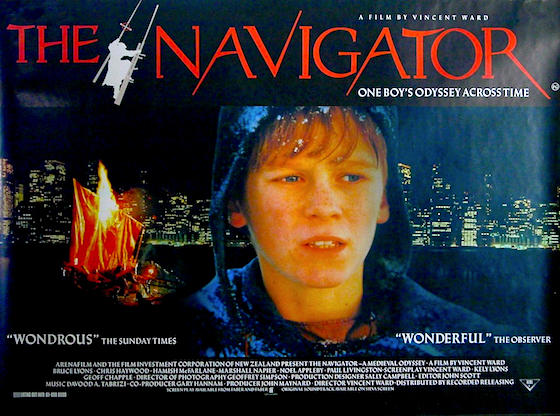
    1348: the Black Death is sweeping across Europe. A remote mining village in Cumbria is yet to be afflicted, but they fear the disease is close at hand. When young Griffin (Hamish McFarlane) reveals he’s been having visions of a quest to a great cathedral, they decide this is their best hope for salvation: a band of brave men will follow Griffin’s vision and make an offering to God so he will protect the village. The journey begins by travelling down a pit so deep it’s rumoured to lead to the other side of the world. As they emerge, they’ve unwittingly travelled not only across the world, but also forward in time some 640 years, to New Zealand, 1988.

    If that sounds like an adventure movie but also a bit, well, weird, then you’ve probably got a handle on The Navigator already. It’s a men-on-a-mission time travel adventure quest filtered through an arthouse sensibility — writer-director Vincent Ward trained at a school of fine art, intending to become a sculptor and painter, before getting sidetracked into moviemaking; and he’d previously helmed the first New Zealand film to screen in competition at Cannes, Vigil. (I didn’t realise until after viewing that he’d gone on to direct What Dreams May Come and also did a lot of development on Alien³ (the “wooden planet populated by monks” version), but once you know that, the aesthetic similarities seem obvious.) The Navigator has thus been likened to the work of Werner Herzog and Terrence Malick, but also Terry Gilliam.

    So, on the one hand, it can play as a straightforward heroic quest, but the sometimes slow pace and occasional presence of symbolism suggest, on the other, a film with greater depths. Primarily, I think, this is the way the villagers’ fear of the plague is reflected by our modern-day fears — or, as the film’s press book rather nicely puts it, in the present day the adventurers are “surrounded by echoes of the fear which haunted medieval England”. So, for example, their journey is disrupted by the rise of a monolithic submarine, presumably a nuclear one; the issue of nuclear deterrence is also brought up on a TV broadcast; and that’s followed by a famous Australian AIDS commercial, perhaps the most obvious mirror of the plague there could be for an ’80s movie.

    Plagued by the, er, plague

    It’s also a somewhat spiritual film, though not in a heavy-handed, pro-religion kind of way. After all, the men are on a quest to seek protection from God, and the climax revolves around placing a spire atop a church. Naturally, the reliance of medieval folk on their belief in God is counterposed with the modern world’s disregard for such values — though, again, the comparison isn’t made in too forceful a manner. For example, when they first arrive in the present they look out over the city to find the cathedral, because a church is always the tallest building, but, to their confusion, they can’t see it because of all the skyscrapers. The point is subtly put: we worship different gods today.

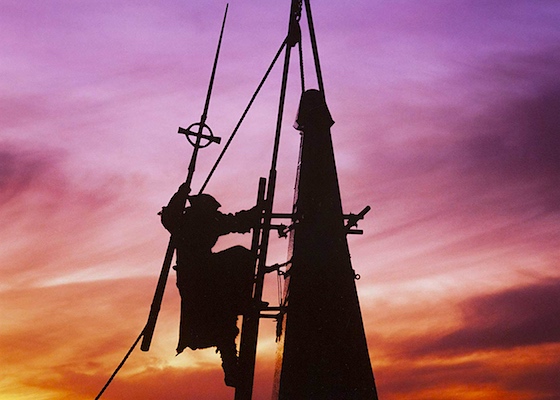
    But aside from all these nods to philosophising, the film does work as an adventure movie, with certain sequences relying on the gang overcoming obstacles rather than musing on the state of the world. Standout set pieces include crossing a four-lane motorway (it was Ward trying to do exactly that in Germany that first gave him the idea for the film!), and the climax atop the church, which — between John Scott’s superb editing and Griffin’s premonition that one of them will die there — is as suspenseful a finale as you could ask for. Scott’s editing also shines in the sequences depicting Griffin’s visions, which become cleverly sprinkled in so that at times you’re wrong-footed about whether what you’re seeing is happening or another premonition. Although the film never chooses to play this for a big twist, it keeps things dynamic.

    The real star from the crew, however, is probably cinematographer Geoff Simpson. The entire movie is gorgeously shot in a couple of styles: the medieval stuff is presented in high-contrast black & white, which combines with the snowbound setting to create a stark, gritty beauty; then the present day stuff is in colour, mostly lit in rich oranges and blues so that it feels almost opulent, with the choice of colours drawing inspiration from medieval art. Ward’s reasoning for this delineation was to emphasise how striking the modern world would feel to someone coming from the grimness of the plague years, and it works. A word too for composer Davood A. Tabrizi, an Iranian émigré here charged with writing Celtic-esque music. Inspiration was taken from genuine ethnic music that was specially researched in Britain, Italy, New Zealand, and Australia, and the score was performed entirely with traditional instruments. The resulting folksy sound is wholly fitting and very atmospheric.

    Steeple chase

    The film doesn’t devote much time to fleshing out the characters of its band of heroes, but they’re succinctly delineated nonetheless. Standouts include Bruce Lyons as Connor, Griffin’s admired older brother, an experienced adventurer, but that also leaves him prone to thinking he knows best; and Marshall Napier as Searle, a likeable but pragmatic and sceptical man, with a tragic backstory. Young Hamish McFarlane also acquits himself well as Griffin, a young lad whose unexplained gift leaves him with the weight of the world on his shoulders, but a determination to live up to what’s needed of him. (Incidentally, although he did act a couple more times, during filming of The Navigator McFarlane apparently became fascinated by the process of filmmaking, and he’s gone on to have a career behind the scenes — his most recent credits as first AD include episodes of Ash vs Evil Dead, Supergirl, and forthcoming giant shark movie The Meg).

    All of the above mixes together to create a film that both has familiar elements, but also feels strangely unique. It’s at once a straightforward heroic quest, with sequences of adventure, tension, and humour, and also a thoughtful, spiritual, philosophical musing on communal fears, how we deal with them, and how they resurface. Or, you know, something. It’s a marvellously idiosyncratic film in that regard, and while I wouldn’t say I loved it, it’s an experience I’d definitely take again.

    4 out of 5

    The Navigator is released on Blu-ray this week by Arrow Video in both the UK and US.

    * It used to be rated PG in the UK too, until Arrow had it reclassified for the Blu-ray. The higher certificate is due to a man stuck on a speeding train, a boy climbing a church spire, and the “unsettling” psychic visions. Frankly, it strikes me as needlessly excessive — the PG was fine. ^