
Richard Press | 81 mins | TV | 16:9 | France & USA / English | 12A
 Bill Cunningham is 80. He lives in a small rent-controlled apartment in New York City that is filled with filing cabinets. His bed is little more than a mattress on some boxes. Each day, he dresses in the same distinctively simple blue smock and sets out on his bicycle. He eats at the same places each day; simple cheap food, cheap coffee. He doesn’t have a partner or kids; he may never have had a romantic relationship. He doesn’t watch TV or listen to music. It sounds like some kind of life of poverty or religious devotion. It’s neither, although you could make an argument for the latter, because all Bill does all day is photograph what people wear.
I confess, I’ve succumbed to what seems to be the standard way of describing Bill Cunningham New York, which is to big up the simplicity of his life, because that’s the striking element of the story. I don’t think it’s actually a very good representation of the film, or even the man. He’s far from friendless or starving, and the photography is his job — though I imagine he would continue it even if he wasn’t paid.
 Bill is, technically, a fashion and society photographer. His real passion, however, is clothes. Real clothes. The clothes people actually wear and how they wear them. His newspaper column — a collection of photos from the streets — is essential reading as far up the chain as Anna Wintour. He doesn’t set trends, he observes them. Exposes them, you might say, because in the past he’s used his work to call fashion designers on where they’ve copied (consciously or not) the work of another from years before, and that has sparked arguments.
He photographs society events apparently because the paper just wants him to, and because he’s known — he gets more invites than he could ever hope to attend. He’s more interested in finding those with interesting people and interesting clothes, or good causes, than he is seeing where the celebrities are — when a guest list is provided, he doesn’t read it. He also photographs fashion shows, but not at the end of the catwalk with the massed bank of photographers. Instead he’s in the front row along the side, with all those Anna Wintours and half-interested celebrities of the world, taking photos from more interesting angles, and only of the outfits that interest him.
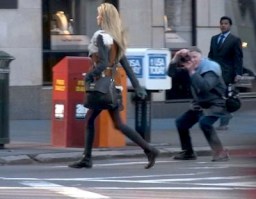 What he actually is, more than a “fashion photographer”, is a documentarian, recording how people choose to present themselves to the world, both as individuals and how that translates en masse. Fashion may seem like a meaningless, arbitrary, frivolous thing to afford such time to, and I’d have no argument against Fashion being called exactly that. But fashion — the actual clothes we wear in our actual lives — is something a good many people spend a good amount of time obsessing over; it’s how they choose to represent themselves in the world, how they indicate what they’re like as a person, how they show which groups or types of people they align with. We all do it, even if it’s not a conscious choice. Surely that’s worth recording?
That might all sound pretentious, and I’m certain Bill Cunningham doesn’t view himself in such grandiose a light, but that’s part of the charm, and perhaps part of the importance.
If this review seems to be more about the man than the film then that’s because the film is the man — it’s in the title. Perhaps I should write about the construction of the film — following Bill around on his business, interviewing his friends and colleagues and those he’s influenced; a slightly loose style, with no specific story.  But that’s all an aside, probably because it’s so well done. What might be worth picking up on is that there’s no specific story. There are stories in there — like how Carnegie Hall is kicking out its handful of 80- and 90-something resident artists to make way for more office space — but the film doesn’t have an overarching tale. It’s a portrait; one of a fascinating, unusual, but likeable, and certainly unique, individual.

Bill Cunningham New York is on Sky Arts 1 tonight at 8pm and 1:50am, and tomorrow at 2:30pm.
It placed 9th on my list of The Ten Best Films I Saw For the First Time in 2012, which can be read in full here.
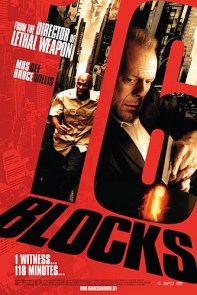 A Bruce Willis action movie? You know what you’re in for here, don’t you? Well, not quite. 16 Blocks casts Willis as less John McClane and more John McCane: old, fat, drunk, limping. He’s a copper still, but the kind of detective whose primary duties are being left to watch over an apartment full of bodies until uniform can show up.
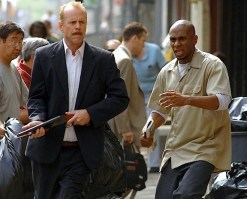 For me, it really lost its way just over an hour in, when our heroes (spoilers!) end up in a hostage situation on a bus. It’s not bad, but it feels like writer Richard Wenk (who’s gone on to co-write heights of culture like
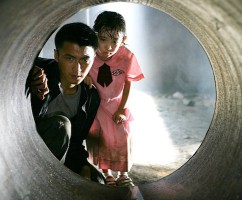
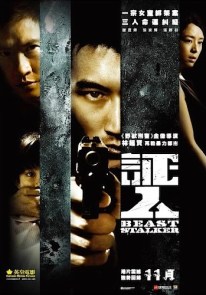 While in pursuit of an accused murderer, a cop (Nicholas Tse) accidentally kills the daughter of said murderer’s prosecutor (Jingchu Zhang). Three months later, just days before his trial, the accused has the prosecutor’s other daughter kidnapped, to persuade her to destroy the evidence proving his guilt. Despite having spent the intervening time in reclusive self doubt, the cop sets out to rescue the kidnapped little girl.
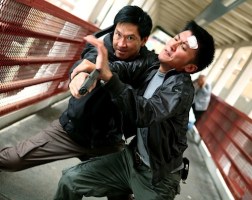 making them a little perfunctory — the real meat actually lies in the plot’s twists and turns. This is more one for fans of thrillers than beat-’em-ups.
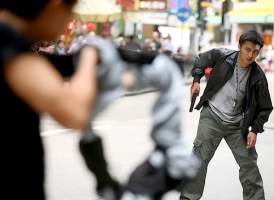 The top performance comes from Nick Cheung as a for-hire kidnapper with the Bondian trait of being blinded in one eye while the other only has black-and-white vision. He gets added complexity thanks to an invalided wife he tenderly cares for — he’s only in this life of crime to pay off his debts and medical bills, y’know. Cheung’s largely silent turn manages a fine balance of menace and sympathy. He won a couple of HK awards for it,
  A brief couple of scenes with a bullied colleague play out nicely, though unfortunately they contrast with a painfully written bit in which another colleague tells Tse’s character what people think of him. “They said you were horrible, but I like working for you,” she tells him (I paraphrase), for no discernible reason. It doesn’t even matter that we’re told that, because we’ve already seen it. I just don’t get it.
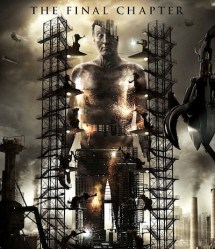 Talking of Halloween, you may have noticed that I’ve been re-posting all of my Saw reviews. Now seemed as good a time as any. To accompany that, I wrote some new words on my opinion of the franchise as a whole. If you missed it, you can read those
  #81a Dr. No (1962)
 #83 Prometheus (2012)
 Before
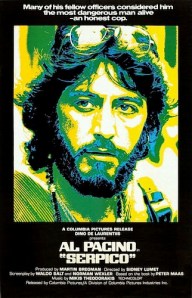
  As the titular copper, it’s a typically strong performance from Al Pacino. Not his best work — I don’t think the part really gives him enough to deliver that — but he’s more often than not the most engaging element of the film. This was his fifth film; considering
 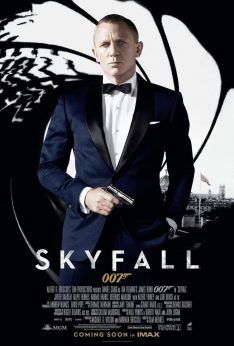 Bond is back, and you’ve surely seen the torrent of 4- and 5-star reviews (and the insignificant handful of dissenting voices). I’m pleased to report that the consensus is correct: Skyfall is Bond at his best.
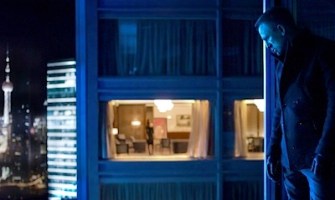 Technically speaking, the film looks gorgeous thanks to Roger Deakins’ cinematography. Best looking Bond ever? There’s little I can think of to dispute that. Obviously it could be said to lack some of that ’60s glamour, but from a purely photographic perspective, it shines. (Incidentally, this shot isn’t actually in the film.) I’m less sold on Thomas Newman’s score. While in no way bad, and with undoubted sparing but precise use of the Bond theme, it didn’t always click for me. The fact I at times felt like I was listening to cues from
 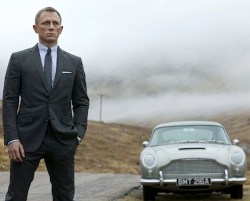 honestly, there perhaps aren’t as many twists as you might expect in that department, but the ways they’ve nodded to the franchise’s history are sublime.
  Lewis Gilbert is the director of
 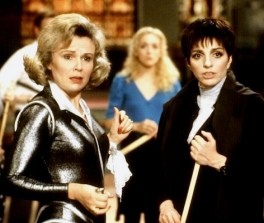 The standout from the cast is probably Julie Walters, in a relatively early big-screen role. Considering how well-known she is now she seems quite lowly billed and little-featured, but bearing in mind this is a US production from the early ’90s, it’s less surprising. She’s very good (isn’t she always?) as the group’s newest member, a posh English lady who sticks her oar in and is a bit too blunt with her comments. I seem to remember her generating most of the laughs in this comedy-drama, although that’s not to disparage anyone else’s work.
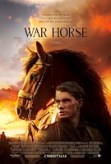
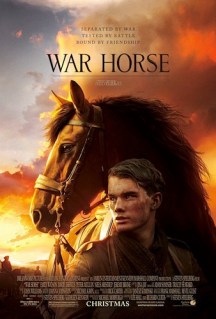 After decades telling tales from the Second World War, Spielberg moves back a conflict. That said, the BD’s special features make sure to point out this “is not his First World War movie” — it’s just a good tale about a boy and his horse.
 It can’t be denied that there’s factual inaccuracy here (the climax takes place at the Somme in the lead up to Armistice Day in 1918, but that battle was actually fought in 1916), or the occasional heavy dose of sentimentality (it’s directed by Spielberg and co-penned by Richard Curtis — what did you expect?), but I think it carries through these with a scale and heart that is, primarily, entertaining. It is based on a children’s novel and I think aims to be a family film (it should by rights be a PG; my twitter rant on that subject is
  Aiding the sense of the epic is Janusz Kaminski’s cinematography, which is regularly stunning and definitely one of the film’s standout achievements. The beauty of some shots is immediately obvious — he lenses the countryside idyll of Dartmoor in a sweeping fashion, bathed in summer sunlight — but there are striking compositions to be found throughout, be they in close-ups, cavalry charges, horse auctions, battlefield hospitals… There’s often a lovely texture to things too, from the likes of drifting snow or chaff, or the way light streaks across a room. The final scene, fully tinted orange, calls to mind the likes of
 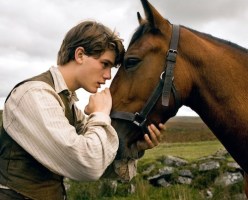 one that isn’t afraid to depict some of the nastier realities of the world, but in a way that makes them relatable for a younger audience. I think that’s important; but this isn’t a Worthy Film for that, it’s just something it does well. I think it also nails sensations of adventure and, yes, sentimentality.
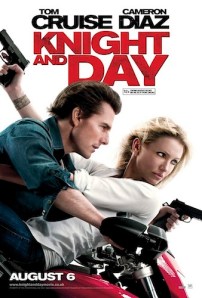 James Mangold is one of those filmmakers with a thoroughly eclectic CV, taking in crime thriller
  Knight and Day is nothing deep or revelatory or groundbreaking, but if you were expecting it to be then more fool you. If you can’t abide Cruise or Diaz (and I know some people really can’t) then it should certainly be avoided, but those caveats aside I thought it was good fun. No classic, and far from destined to be a standout on Mangold’s multi-Oscar-winning filmography, but an appropriately entertaining couple of hours.
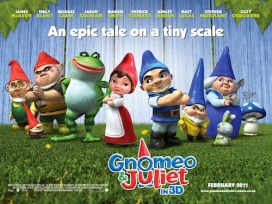 Gnomeo & Juliet is the latest British attempt to crack the lucrative CGI animated kids’ movie market, after the lack of success (or, alternatively, failure) from the likes of
  My only other note is that it ends with a truly awful cover of Crocodile Rock by Nelly Furtado. A storyboarded “all’s well that ends well” ending (included on the BD, and the DVD for all I know) looks much better.
 100Films.co.uk