
2012, eh? What a year: the Jubilee, the Olympics (I still call it the Jubilympics); the Paralympics; the highest-grossing film in Britain ever; the most-watched video on YouTube ever; the world not ending… it was certainly a year to remember.
Not so much for 100 Films, unfortunately: as we know, I fell just a trilogy box set short of reaching my titular goal. Not the first time, and as we’ll see later it may even have been predictable (except not really). Nonetheless, there are lists to be reeled off and statistics to be over-analysed. And this year there are more statistics than ever! If you’re like me, you’ll be excited by that; regular folk may just skip to the end.
Before those, there’s The List itself. After two years (is that all?) of presenting it in numbered order, I’m switching back to alphabetical. Why? Well, as you’ll see just before said full list, there’s my monthly updates. They cover the year in order, as it happens, and now that I’m linking to them from this post there’s no real need for a numbered list here too. Indeed, for those who like to cut up facts and statistics and lists in multiple different ways (as I do), this means that a year of 100 Films is presented as both numbered and alphabetical lists for the first time — exciting!
And as this post is now longer than ever, here’s a quick contents list, so you can just skip straight to the stuff you prefer…
- As It Happened, being the monthly updates for 2012, containing the numbered list;
- The List, being an alphabetical list of everything I watched;
- Alternate Cuts, Other Reviews, and Shorts, being lists of those;
- The Statistics, being the best bit of the post;
- Coming Next, being a quick reminder that I’m not done yet.
So without further ado…
Below is a graphical representation of my viewing, month by month. More importantly, each of the twelve images links to the relevant monthly update — as noted (three times now?), this is where you’ll find the numbered list of everything I watched this year.




- 102 Dalmatians (2000)
- 16 Blocks (2006)
- 2 Fast 2 Furious (2003)
- 2000 AD, aka Gong yuan 2000 AD (2000)
- Avengers Assemble, aka Marvel’s The Avengers (2012)
- Bad Day at Black Rock (1955)
- Batman: Mask of the Phantasm (1993)
- Batman: The Dark Knight Returns, Part I (2012)
- The Beast Stalker, aka Ching yan (2008)
- Bill Cunningham New York (2010)
- Birth (2004)
- The Book of Eli (2010)
- Burke & Hare (2010)
- The Call of Cthulhu (2005)
- Captain America: The First Avenger (2011)
- Cars 2 (2011)
- Chatroom (2010)
- Conan the Barbarian (2011)
- The Court Jester (1956)
- Cowboys & Aliens: Extended Director’s Cut (2011)
- The Dark Knight Rises (2012)
- A Date with the Falcon (1942)

- Despicable Me (2010)
- Detective Dee and the Mystery of the Phantom Flame, aka Di Renjie (2010)
- Devil (2010)
- Drive Angry (2011)
- The Expendables (2010)
- The Falcon in Danger (1943)

- The Falcon Strikes Back (1943)
- The Falcon Takes Over (1942)
- The Falcon’s Brother (1942)
- Fantastic Four (2005)
- The Final Destination (2009)
- The Gay Falcon (1941)
- Gnomeo & Juliet (2011)
- Green Lantern: Extended Cut (2011)
- Harry Potter and the Deathly Hallows: Part 2 (2011)
- The Hunger Games (2012)
- Ip Man 2, aka Yip Man 2 (2010)
- Iron Sky (2012)
- Ironclad (2011)
- The Keep (1983)
- Knight and Day (2010)
- Kung Fu Panda 2 (2011)
- The Lady Eve (1941)
- The Last Airbender (2010)
- Legion (2010)
- The Lincoln Lawyer (2011)
- The Lost Weekend (1945)
- Love and Other Impossible Pursuits, aka The Other Woman (2009)

- Master and Commander: The Far Side of the World (2003)
- Megamind (2010)
- Moonfleet (1955)
- The Negotiator (1998)
- The Other Guys (2010)
- Outland (1981)
- Passchendaele (2008)

- The Plank (1967)
- Predators (2010)
- Priest (2011)
- Prometheus (2012)
- Rango: Extended Cut (2011)
- Repo Chick (2009)
- The Return of the Musketeers (1989)
- Rise of the Planet of the Apes (2011)
- RoboCop (1987)
- RoboCop 2 (1990)
- Rules of Engagement (2000)
- Rush Hour 3 (2007)
- The Saint in London (1939)
- The Saint in New York (1938)

- The Saint in Palm Springs (1941)
- The Saint Meets the Tiger (1943)
- The Saint Strikes Back (1939)
- The Saint Takes Over (1940)
- The Saint’s Double Trouble (1940)
- The Saint’s Vacation (1941)
- The Scarlet Claw (1944)
- Scre4m (2011)
- Serpico (1973)
- Sherlock Holmes: A Game of Shadows (2011)
- Skyfall (2012)
- Special (2006)
- The Spiral Staircase (2000)
- Stepping Out (1991)

- Stiff Upper Lips (1998)
- The Sum of All Fears (2002)
- Thor (2011)
- Tinker Tailor Soldier Spy (2011)
- Tiny Furniture (2010)
- Tombstone (1993)
- Unauthorized: The Harvey Weinstein Project (2011)

- Underworld: Rise of the Lycans (2009)
- Unknown (2011)
- Unstoppable (2010)
- War Horse (2011)
- With Great Power: The Stan Lee Story (2010)
- M (British version) (1931/1932)
- Batman (1989)
- Batman Returns (1992)
- Batman Forever (1995)
- Batman & Robin (1997)
- Batman Begins (2005)
- The Dark Knight (2008)
- Dr. No (1962)
- From Russia With Love (1963)
- Goldfinger (1964)
- Thunderball (1965)
- Dirty Laundry (2012)
- Marvel One-Shot: The Consultant (2011)
- Marvel One-Shot: A Funny Thing Happened on the Way to Thor’s Hammer (2011)
- Room on the Broom (2012)
- Toy Story Toons: Hawaiian Vacation (2011)
For only the second time ever I fell short of my goal, watching just 97 new feature films in 2012. (All are included in the stats that follow, even if there’s no review yet.) What’s perhaps more interesting is the pattern that I’m forming: in the six years I’ve been doing this blog, I’ve repeated a run of 120-something (2007, 2010), 100-exactly (2008, 2011), and under-100 (2009, 2012). Weird.
I also watched one feature I’d seen before that was extended or altered in some way, as well as reviewing 10 others that I’d seen before (easily the most ever). All 108 films are included in the statistics that follow, unless otherwise indicated. (Despite not making it to 100 on the main list, that’s more films in the stats than either of the two years I made it to 100.)
I also watched five shorts (none of which shall be counted in any statistics). As noted last year, I own quite a few DVDs of shorts (my database informs me that it’s nearly 400 individual short films), so I really should make more of an effort in this area.
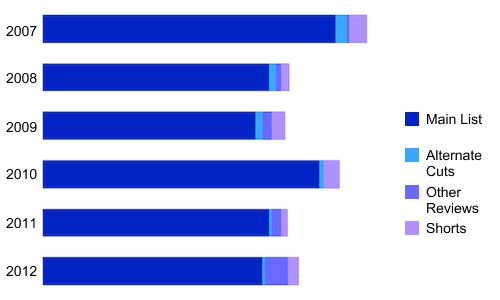
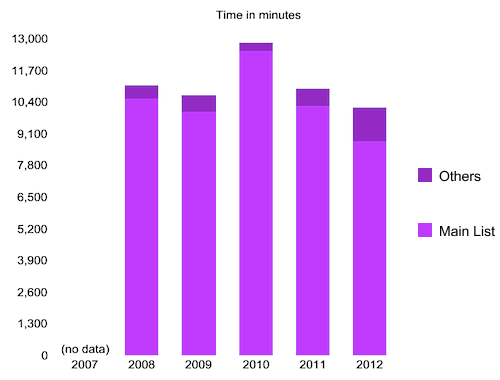
The total running time of new features was 146 hours and 17 minutes. That’s the lowest ever, in part thanks to a lot of Saint and Falcon films that only run around an hour each. The total running time of all films (including, for this stat only, shorts) was 169 hours and 35 minutes. That means that the shorts, alternate cuts and other reviews run nearly 24 hours — over double the next nearest (which was last year, at nearly 12 hours). You may like to compare the following graph to the number-of-features one above — does the total number watched tarry with their total length? (As it turns out, yes, yes it does.)
I saw two films at the cinema this year. That’s the same as last year, and so the joint lowest-ever. Cinemas are so pricey and time-consuming these days. Still, there were near misses for The Avengers and The Hobbit, which would have made it my best year at the box office since 2009. But alas, no.
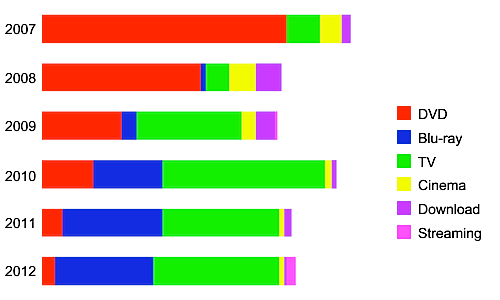
The highest format is once again TV, this year totalling 53 films. After accounting for hardly any of my viewing in the first two years, TV surged to dominance in 2009 and has remained there ever since. Considering the size of my unwatched disc collection, that really shouldn’t be the case. Second place this year again went to Blu-ray (third year running). With 41 films it’s about the same as last year. DVD, however, sinks further into the doldrums: just six SD discs graced my player this year. Again, considering I have literally hundreds of the things I’ve not got round to, that’s a disgrace. There was also a single download (one of the Falcon films that I missed on TV and had to retrieve from iPlayer, as will be the case with all of them when I get on with the rest of the series).
Much to everyone’s surprise, streaming has undergone a resurgence and so makes a moderately significant appearance on the list this year. Whoever thought (even in the comparatively-recent early days of dedicated services like YouTube) that streaming would be a viable way to watch films in a reasonable quality? But that’s where we’re at now, thanks to increasingly fast broadband and a preponderance of rental services looking to make it easy to view films for those punters not all that concerned with image quality. All my streaming films this year were watched on a Wii, via either Netflix or LOVEFiLM. The former seemed to provide DVD-like quality; the latter looks more like an over-compressed downloaded pirate copy. In spite of that, I’m not going with Netflix — I have LOVEFiLM for DVDs/BDs by post, and my package comes with free unlimited streaming (it’s an old one that’s no longer available, haha!) If only they could step up the picture quality… Anyway, four films came down the pipes to me this year — it may not sound like much, but the previous average was 0.2. At this point I wouldn’t like to predict if that will be higher or lower next year.
This year the most popular decade was the 2010s, with 46 films (42.6%). That’s the first time it’s topped the list, just losing out to the ’00s last year. It’s a solid victory: though the first decade of the new millennium still comes in second, it’s with just 21 films (19.4%). It would be an even wider percentage gap were it not for the other reviews (adding a pair of Batmans to the ’00s) — indeed, looking at the main list alone, the three years of this decade account for over 47%. Clearly I err towards the modern.
That said, third place this year goes to the ’40s: buoyed by the Saint and Falcon films, it totals 14 (13%). Of the rest, the ’90s managed a respectable nine (up on last year’s low of five); both the ’80s and the ’60s reached five; the ’30s achieved four; the ’50s made it to three; and the ’70s had just one. That’s every decade since the 1930s covered, the same as last year — oops! I have a moderate collection of silent films that I really should get stuck into. (I’d do a graph for this section, but with all those decades to factor in it’d just be a mess.)
This is also the first full year to feature my new top information line (I say “new” — I was surprised to find this was the first whole year of it, so I guess I started in mid-2011). That means lots of opportunities for new statistics, and so that opportunity shall be seized! The main area this can be applied are the countries and languages info, which reveal I watched 106 films that were either wholly or significantly in English. 106, out of 108. Diverse. Some of those did share languages — Iron Sky, for instance, has a lot of German; and there were a couple of Hong Kong films that also rated English as a listed language. Cantonese and Mandarin chalked up three films apiece, one way or another. And that’s it.
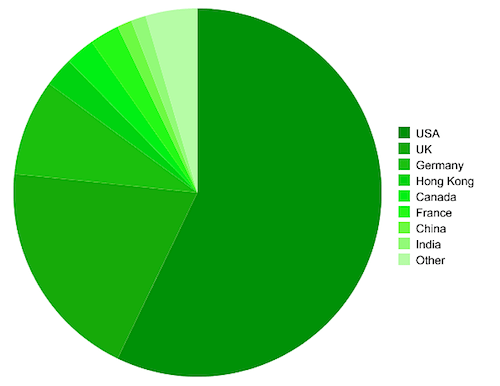
Country-wise, the USA dominate with a massive 88 films (81.5%). No surprise really. Second goes to jolly old Blighty with 30 (27.8%), a mixture of co-productions and… not co-productions. Indeed, it’s the former that gives third place to Germany (13) and accounts for many others, which I’ll list in a minute. Some films could easily be narrowed down to a specific country of origin (several of those German films are definitely US productions with co-funding), but others are truly multi-national — how do you decide where to draw the line? I’ve taken to just listing every country IMDb offers. So some of the following ‘genuinely’ produced films I watched — Hong Kong, Canada (both 4) — while many others were just somehow in on it — France (4), China (2), India (2), and one each for Australia, Finland, Italy, Japan, New Zealand, Singapore, and Spain.
A minuscule three films from the main list appear on IMDb’s Top 250 Films as of New Year’s Day 2013. To put that in perspective, the previous low was seven, and that was half of some years’ total, and a third of the first’s. It’s not as if I’ve seen most of the IMDb Top 250 either — I’m missing about 119. To rub it in, the three I did see are all from the past 18 months. Main lesson: try to watch more classics next year. Nonetheless, the positions of those present range from 38th (The Dark Knight Rises) to 220th (Harry Potter and the Deathly Hallows: Part 2), via 130th (Avengers Assemble). I know, Skyfall isn’t on there! Positively shocking.
As ever, there are too many other similar lists to consider checking them all. And based on those results, I wouldn’t be able to tick much off any of them anyway.
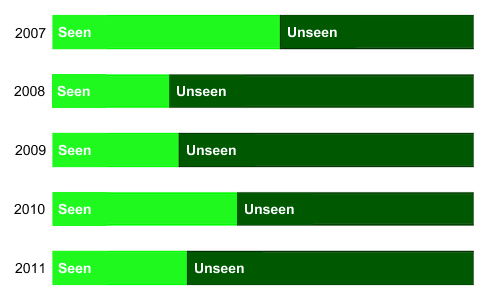
I’ve yet to re-watch any of the films from this list, only the second time that’s happened — and the last was the other year I failed to make 100. Weird coincidence. Not a surprise when one doesn’t see much at the cinema, really — I’ve got more than enough to catch for the first time without re-watching things in under 12 months. That said, a good few of the remaining reviews (especially the lower numbers) will likely require a re-watch before I cover them. Films like Tinker Tailor deserve thought in their review, not a quick dashed-off-from-11-month-old-memories comment or two.
At the end of all five previous years’ summaries I’ve included a list of 50 notable films I’d missed from that year’s releases. With 2012 over, I’ve managed to see (deep breath) one more from 2007 (bringing the total for that 50 to 27), no more from 2008’s list (leaving it at 14), two more from 2009’s (bringing that to 15), and six more from 2010’s (bringing it to 22). Finally, in the year since listing 2011’s 50, I’ve managed to see 16 of them. As that beats all I’ve seen in four years of 2008’s list and three years of 2009’s, it’s not a bad start. Still a lot of viewing to do, mind, and I’ll be adding another 50 from 2012 in my next post.
A total of 85 solo directors and seven directing partnerships appear on the main list. A record low have multiple films on the main list, with just Jack Hively and Irving Reis scoring three (all Saint and Falcon films, respectively) and Scott Stewart claiming a risible pair (Priest and Legion). However, Tim Burton, Joel Schumacher and Christopher Nolan each put in two appearances thanks to my retrospective on the Batman series — which actually makes three for Nolan, as I also saw The Dark Knight Rises. Matching that is Terence Young, director of three of the first four Bond films; and, like Nolan, Fritz Lang features in both the main list and the ‘other’ list, making two for him too. Numbers are rounded out by Guy Hamilton, director of Goldfinger, bringing the overall total of feature directors to 96. (I should also mention Leythum, director of the first two Marvel One-Shot shorts.)
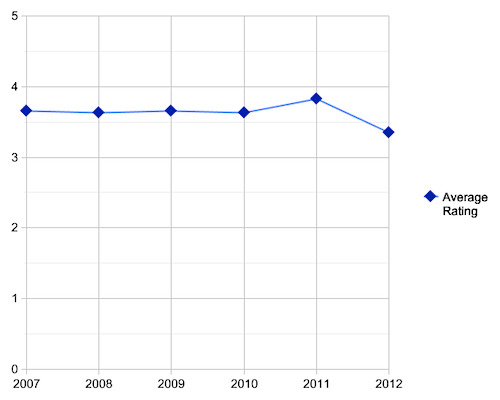
This year’s star ratings kick off with 14 five-star films — the lowest ever (and five of those weren’t in the main list). Conversely, there were five one-star films — the highest ever. Oh dear. Plus, for the first time ever, the majority of films (41 of them) scored three stars. That’s well above average, and the most ever by nine. Consequently, four-star films were well below average, just 34 of them, the lowest ever by eight. Normally they account for around 50% of my scores, but this year it’s just 32%. The only bit of sanity came from the two-star films, back to their regular ballpark with 14 after last year’s record-low-by-half.

That gives an average score of 3.4 — easily the lowest ever. No surprise, considering the low 5s, high 1s, and uncommonly dominant 3s. The first four years’ average score alternated between 3.6 and 3.7, but they were all actually even closer, ranging just 3.63 to 3.66. Last year saw an extraordinary leap up to 3.83, while this year it sinks to 3.35 — a whole half mark lower. No wonder it’s been awkward compiling my top ten (but more on that next time).
Finally, a record-low 26 of the films (plus three of the shorts and all the other reviews) are currently in my DVD/Blu-ray collection.
Nearly done! Later this weekend I’ll look back over the 97 new films I saw to pick out my worst five and best ten, and remind you of 50 new releases from the past 12 months that I’ve yet to see.

 Oh Skyfall, how the world loves thee, let me count the ways!
 So, in short, people love it. But people don’t matter — I matter (well, I do to me), and what did I think?
 The pre-titles sequence is an exciting chase through — and over — Istanbul. As well as being a thrilling action sequence in its own right, here Mendes really establishes where he’s going with the film. There’s no close-up fast-cut Bourne-inspired shooting and editing here, instantly distancing Skyfall from the unpopular style adopted by Marc Forster for Bond’s previous outing, Quantum of Solace. It also firmly continues the Bond tradition of doing stunts ‘for real’, including some quite spectacular stuff with a digger and a train. I’m sure CGI has come sufficiently far since
  Cue Daniel Kleinman’s title sequence. And hurrah for the return of Kleinman, because the effort Forster’s favourite effects company MK12 offered on Quantum of Solace was a little bit pathetic. Kleinman is the master of the Bond title sequence now, and while he clearly owes a debt to the work of Maurice Binder (he more or less invented the form, after all), modern technology and the responsibility now heaped on this part of the film by audience expectation means he is, arguably, the best creator of Bond title sequences ever. Skyfall is another tour de force, loaded with inventive imagery that is even more rewarding when viewed a second time, knowing the full story. How often can you say that about Binder’s naked girls on trampolines?
 She is the co-lead, the film’s real Bond girl, and she is marvellous throughout — doing what is necessary as the boss of MI6, facing up to a hostile parliamentary inquiry, and showing both vulnerability and resourcefulness in the Scotland-set climax, the film is a showcase for Dench. That she is gone is a huge loss to the franchise; that she went with such a meaty role is a credit to the film and the series.
 Daniel Craig is more than up to this task. Much like Dench, the series has landed on its feet by casting an actor altogether better than you’d typically find in such blockbuster fare. The arc for Bond is perhaps more understated than M’s, even if, as the lead character, it’s even more central; but Craig can convey what’s necessary with a wince or a change in movement. And though Bond is physically debilitated, his mind is there, playing detective as he follows a trail to the villain’s lair, and plotting how best to defeat the always-one-step-ahead nemesis. More on whom later.
 From Shanghai Bond travels to a casino in Macau, where he’s reunited with Eve — who, as you’ll remember, shot him. We won’t learn it until much later, but Eve is of course Moneypenny. Providing such an iconic character with an origin story is an interesting move for the series, though perhaps unsurprising within the overall ethos of the Craig era. In retrospect, knowing who Eve will turn out to be, the way the film uses her is quite clever. For instance, she and Bond are clearly close, but it’s left deliberately unclear whether they sleep together — some viewers have assumed it’s implied they do, others the opposite, which just goes to prove it’s left up in the air. And when it turns out she’s Moneypenny, that’s kind of important — not only can there be the usual “will they/won’t they”, there’s also “have they/haven’t they”. The familiar Bond-Moneypenny relationship would be very different if we knew they’d already done it.
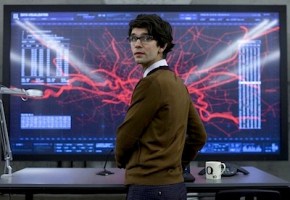 Q also serves as part of another major discussion in the film, that being the role of the secret service in the modern world. So much can be done with the internet and related technology these days that perhaps the real heroes are the Q-types who sit at keyboards and process data; but, as Q himself says, sometimes a trigger must be pulled. There’s also a lot of talk about operating in the shadows — who does and who does not, and whether the secret service as we know it is an outdated way to combat modern threats, particularly nation-less terrorism. For a mainstream action movie there’s an awful lot of thoughtfulness about the state of our world, without making it too blatant that it’s discussing the current political climate. It’s another feat to the film’s credit that it can smuggle this intelligent discourse into an action-thriller format. It’s obvious which side of the line the film will come down on, and of course it’s as much a plot point as a considered debate (more so, even), but it adds welcome layers.
 What we get instead, however, is a more subtle use of familiarity and nostalgia. For one thing, the finalisation of the reconstruction of Bond’s character is a good way to mark 50 years; as is re-introducing Q, Moneypenny and the traditional Bond setup. Additionally, there’s things like the Komodo dragons, a conscious nod to Craig and Mendes’ first Bond experience,
  But the thing is, it doesn’t matter, because it’s fun. On the whole Skyfall may be part of the newer, more serious era of Bond movies, but it has room for humour and heart, and the use of the DB5 has those in spades. And if you really want an in-universe explanation, you can come up with one. So does it sit uneasily with the rest of the film? Maybe a little. For some, I imagine it’s a deal breaker. But I think it works, and how.
 Coupled with a plot that makes him exceedingly clever and capable, he’s the most Bondian Bond villain since the Moore era. And he even has a physical grotesquery, which some hold as essential for Bond villain… and it’s a CGI-aided doozy too. They say a hero is as only as good as his villain, and while that’s not always true, it is almost always, and actor, writers, director and co have all nailed the nemesis here.
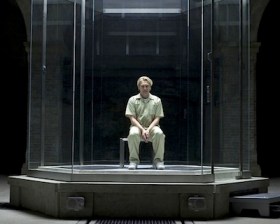 Some, especially tech-geeks of course, have criticised this element of the film for its lack of realism. I assume no one told them they were watching A James Bond Film. Actually, I assume no one told them they were watching a mainstream action-thriller full stop. Real-life hacking involves a lot of boring windows and just the command line and more resolutely uncinematic stuff like that. But here we’re in a fantasy world — it’s a more grounded fantasy world than the ones of Moore and Brosnan, or even Lazenby, but it’s still not Our World exactly. And this is not a film about hacking either — it’s a film in which cyber-terrorism is used as a plot point. So why not make it more visually arresting for the sake of the audience? The point is not “here’s what a hacker would do”, it’s “where the hell did Silva go? Now I must track him down and try to shoot him”. The way the film handles that side of things fits the bill. Sure, the server room on Silva’s island is similarly beyond daft (oh, the dust!), but it makes the right kind of visual impact. I have sympathy for the articles deconstructing this as unrealistic — everything in a film this popular must be broken down and thoroughly analysed for the sake of internet hits, after all — but if it ruined your enjoyment of the film… lighten up, it’s not a documentary. Do you think the depiction of how MI6 functions is any more realistic?
 compare and contrast Die Another Day, where they go off for a car chase on the ice for no good reason before returning to where they started, with Casino Royale, where the biggest sequence is immediately post-titles, or Quantum, which has a relentless first half (ish) before settling down to a story. Skyfall is more balanced, particularly than Quantum, but nothing feels shoehorned in.
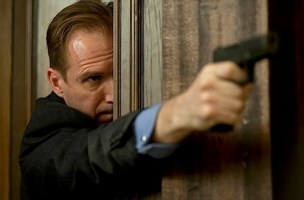 And then there’s an action sequence, a shoot-out at the inquiry, which is relatively low-key and yet one of the best bits of the movie. Mallory gets stuck in, earning Bond’s respect in the process, and as you’ve seen the film you’ll know where that goes, and because of where that goes Mallory having Bond’s respect is absolutely vital.
 crisply directed by Mendes (readily followable action, building tension and suspense); stunningly shot by Deakins (dark but for the flames); beautifully performed by Craig, Dench, Bardem and Finney (particularly in the lead-up to the assault)… it’s a climax that does indeed tie together much of what makes the film.
 This is where they say, after fifty years of Bond movies, everything is the same… only different. This is where the dialogue is a bit clunky and I wish someone had thought it through some more because it could have been perfect and instead it’s somewhere between awesome and cringe-inducing. “We haven’t been formally introduced” — seriously? You can do better than that!
 Skyfall is, perhaps, a flawed film in places. It’s certainly not perfect. Thomas Newman’s score is adequate but rarely exceptional, and at times reminded me too much of his work for
  That’s some kind of glorious contradiction — one of many in the film and its characters, I’m sure, should you care to take a run at analysing it that way. After the last 4,800 words, this may not be the place.
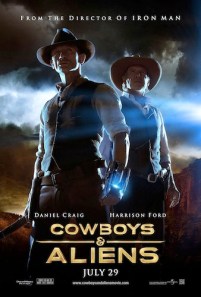 We all know the saying “too many cooks spoil the broth”, and it can’t help pop into one’s mind during the 85 seconds of company logos that kick off this genre mashup. Here the “cooks” are Paramount (serving non-US distribution only), Dreamworks, Universal and Imagine Entertainment — I can’t remember the last time I saw a Hollywood blockbuster begin with so many individual logo animations. It’s unsurprising that no one wanted to take a solo punt on a Western-with-a-twist after the failure of
  Thing is, what the film gives us doesn’t quite sit right, even if you’re expecting it to be non-pulpy. It’s still an action-adventure summer blockbuster, but with pretensions at times to be a Western drama. I think that’s the fundamental problem with the entire film, and probably why it feels slow, especially in the middle. A lot of that is character scenes, despite which the characters feel underdeveloped and under explored. One wonders if these particular writers, versed in the art of the blockbuster, don’t really know what they’re doing. Sometimes you can see what they were going for, for instance in how they set things up and pay them off (like the alien with a grudge against Craig), but somehow it doesn’t come off.
 Also note that this climax lasts a full 25 minutes. It may not sound a lot for the big finish — it’s the whole third act after all — but it felt it (especially as the build-up begins 40 minutes out), with constantly shifting goal posts and Favreau’s attempts at making a skirmish feel like an epic battle. Other parts are just straight wasted opportunities, like the extended sequence in an upturned riverboat. For one thing, no effort is made to explain its presence. For another, it’s all so darkly shot that you can’t get a real sense of it. Could have made for some impressive sets — heck, maybe they were impressive sets — but it’s not well utilised. Makes it harder to work out just what’s going on at times too. Thank goodness it wasn’t in 3D!
 I could go on. For example, Craig loses the love of his life to the aliens, then loses the new woman he seems to have quickly fallen for to them too… but it’s OK because he saw a hummingbird at the end, so he’s happy. Or there’s the fact that the town is called Absolution — I believe, anyway, because I think one of the three guys at the beginning mentions it and it’s the title of a featurette on the BD. Other than that, no mention is made in the film, despite it arguably being one of the key themes. We don’t need to be battered around the head with symbolism, but a bit more effort might’ve been nice.
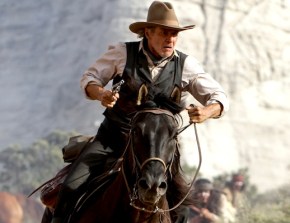 so maybe the theatrical version wouldn’t be much better pacing-wise after all. On balance this feels like an extended cut where someone decided to save a work-in-progress edit and later deem it an “extended cut”, then kept trimming to craft a more streamlined theatrical cut, as opposed to the filmmakers dropping missed elements back in post-release.
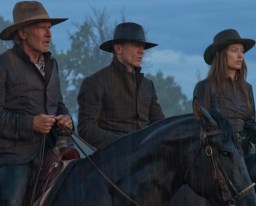 Sad, but true.
 On its release in 1956, The Court Jester was the most expensive comedy ever made, at a cost of $4 million. For that sum you could make precisely 2 minutes & 11 seconds of more recent most-expensive-ever comedy flop
  Rathbone’s character is played by the film’s fight choreographer, the 63-year-old star finding Kaye’s movements a bit fast for him at that age.
 16 years after they
  Conan was created by Robert E. Howard in 1932, but is probably best known to most thanks to
  or the filmmakers ignored his work in favour of familiar bits and bobs from other sources. Visually it’s just as non-inventive, which is what you get when you hire the director of
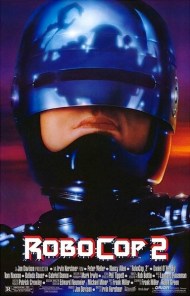 The consensus opinion seems to be that the RoboCop films exist on a steep downward trajectory of quality, starting with the pretty-good
 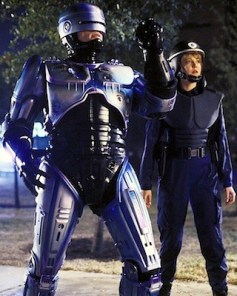 and though it was reportedly massively re-written after his work was done (to the extent that, decades later, there was a comic book miniseries that adapted his original version) I think his touch can still be felt at times.
 In a crime-addled future Detroit, cop Alex Murphy is gunned down by a gang of crooks, only to be resurrected by evil megacorporation OCP as the future of law enforcement: RoboCop. Obviously — that’s the title.
 100Films.co.uk