2012 #83
Ridley Scott | 124 mins | Blu-ray | 2.40:1 | UK & USA / English | 15 / R
With all the furore this week over the (supposed) behind-the-scenes problems with attempts to launch Prometheus 2, it’s about time I posted my review of last year’s intended franchise-starter…
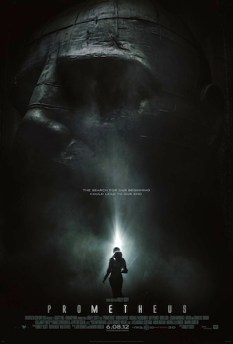 Ridley Scott’s not-an-Alien-prequel-honest Alien prequel is nothing if not divisive, with critics and fans alike declaring it to be a revelatory masterpiece, irredeemable faux-profound slop, and every point on the spectrum in between. I did my best to remain spoiler-free throughout the four months between its theatrical release and disc debut (crikey things reach DVD quickly these days!), though I did read a leaked plot description in advance that was reportedly decried as rubbish. I wish I could remember where I found it because I’d love to know if it matches up. Sadly I can’t remember the details, but obviously something stuck — and therefore it was right — because I was singularly unsurprised by the majority of Prometheus’ story. But that doesn’t necessarily matter if the film is any good, and Prometheus… well…
The first half is quite good, in a slow, meaningful kind of way. Even at that point there’s doubts: some of what occurs is just unnecessary detail; shots and scenes that seem consciously designed to give it a slow pace rather than stuff we actually need to see.
The second half is batshit crazy. It abandons the thoughtful Serious Science Fiction trappings for schlocky body/creature horror, and in the process abandons the semblance of making sense. Plot holes glare at you. Characters make unfounded leaps of logic. It feels like whole scenes or sequences are missing. Indeed, quickly scanning through the disc’s description of some of the deleted scenes, it looks like they might explain some of the film’s gaps. I presume there’s a good reason they were cut though… right…?
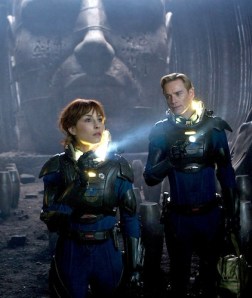 And then, to top it off, it doesn’t have a real ending! They may as well slap “to be continued” on screen, such is the obvious lack of conclusion. It’s immensely frustrating, only to be topped off with a “in case we don’t get the sequel” bit of connective tissue to the Alien series. Mysteries and unanswered questions aren’t a problem in and of themselves — there are plenty in Prometheus’ franchise forbears, the first in particular — but they’re not the kind that require answers: their stories work as a discrete unit; who the Space Jockey is, or how the aliens came to be, and so on, are set dressing. Conversely, the gaps in Prometheus are in the primary narrative. There would be an argument for it being a thematic point — a Bergman-esque ‘silence from the Gods’ — but the starkness of that ending, as clear a cliffhanger as either of the first two Lord of the Ringses, undermines that. It fairly screams, “there’s more to come! See the next film for the answers!” And that isn’t on, because that isn’t what we were promised — this isn’t Prometheus: The Fellowship of the Prometheus, with Prometheus: The Two Planets already shot and scheduled for next year, and the trilogy-forming conclusion Prometheus: The Return of the Alien for the year after that; it’s just Prometheus, full stop, the sole definitive article. But it isn’t.
The sense that everything’s been cobbled together in the current blockbuster fashion of “keep writing even while shooting” extends right down to things like character development; even to individual scenes. Take Holloway (Logan Marshall-Green), for instance. He’s a dick. I’ve no sympathy when it all goes wrong for him because he’s not at all likeable. What’s somewhat ironic is that the deleted scenes note at least one sequence was re-shot to try to make him more sympathetic. And, funnily enough, I remember during that scene in the film thinking it was about the only time he seemed even vaguely appealing (even then, only relatively). Just one of many such apparently-bungled elements in the film.
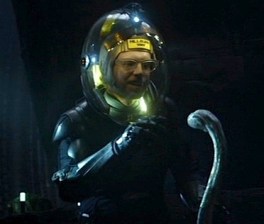 No character is fully developed. Some barely register, suggesting too big a cast, while others suffer from being plain stupid, or doing inexplicably stupid things, or just piss-poor acting. There’s some thing made about Shaw (Noomi Rapace) being religious or a true believer or something, but it’s not properly explained and doesn’t go anywhere. David (Michael Fassbender) and the way he’s treated by the other characters are both very interesting areas, and clearly of huge thematic resonance, but he acts inconsistently for no obvious reason, and despite the horrendous things he does to Shaw at one point, she just gets on with him again in the next scene, and… well, that’s far from being the film’s only plot hole or inconsistency.
At one point a character escapes a situation only to be killed off in a different one. If that sounds like a reasonable thing to do, that’s because I’m trying to avoid spoiling parts of the climax. It’s not a particularly reasonable thing to do, though; it plays as “here’s a cool death”. I’ve not read multiple versions of the script or read interviews with the writers or listened to their commentary (yet), but one does wonder if Damon Lindelof was brought in to pull back on some of the Science Fiction (with a capital SF) and build up the blockbuster-y elements, because that’s what said cool death feels like: a film constructed from “what would look cool? What haven’t we seen?” rather than “what are we trying to say?” I have no problem with the former in its rightful place (Tomorrow Never Dies has the awesome bike chase because it was the antithesis of GoldenEye’s tank chase, for one ready example), but a film that sets out its stall around Concepts is not the right place.
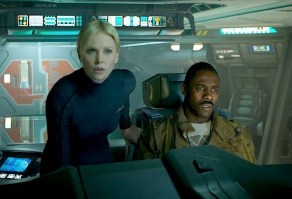 The daft thing is, I think a lot of people would’ve been happy if it had chosen to just go all-out as a schlocky alien horror movie. That’s what Alien is: an exceptionally well-made haunted house movie in space. There’s no shame in that (well, maybe in cinéaste circles, but pish.) But that’s not where Prometheus pitches itself. There’s too much other stuff for it to be just that; stuff that’s apparently aiming to be Profound. So when the horror does turn up, it doesn’t belong.
It does all look bloody gorgeous, from the real landscapes to the CGI. It was shot by Dariusz Wolski, whose previous credits include all four Pirateses and not much else that would suggest a remarkable skill. But sod a pixel-generated tiger, these vistas surely deserved recognition. (But then I’ve not seen the tiger movie, so…) I didn’t see it in 3D, obviously, but it certainly looks like it was shot for the format. Not because there’s stuff poking out at you, thank goodness, but look how light it all is, especially compared to the original Alien. I’m sure the scenery had lovely depth.
A side effect of such format-hopping is a debate on the correct aspect ratio: it was reportedly shown at 1.66:1 on IMAX, 2.00:1 on IMAX Digital, and 2.35:1 otherwise (the Blu-ray remains at 2.4:1 throughout). I have no idea whether the IMAX was opened out or cropped, though I’d imagine the former, which does make you ponder why they didn’t just use that everywhere, especially on home formats. I guess 2.4:1 must be Scott’s preferred ratio… but is that OK? Should we lament the missing top and bottom? I dunno. More interested parties than I have debated this at length, if you fancy scouring the web for it.
 Prometheus is a funny old beast, then. There’s lots of good stuff in there, but also lots of baffling decisions and confusing shifts of tone, emphasis, style… Considering it was made by an experienced master-filmmaker, who was presumably granted all the time, freedom and money he wanted to craft the film he desired, it’s baffling how it ended up feeling like such a hodge-podge. Many fans have blamed Lindelof, brought in late on to re-write the screenplay; but considering Scott ruined Robin Hood by ditching an innovative, exciting screenplay for a stock this-is-real-history re-telling of the legend, perhaps the blame lies at his door. He’s reached a point where he can order anyone to change anything and it will be done (writers have no power in Hollywood, after all). Perhaps, at 75 now, he’s lost the ability to spot a good script; or perhaps he just tinkers because he feels he must, because he’s the director and he’s in charge.
Whatever. Here he’s turned in a scrappy, confusing, but not meritless movie; one that will probably endure thanks to its franchise connections, its moments of clarity, and its intense controversy. It’s not a good film, but it’s kind of a fascinating one.

 Spoof of British ‘Heritage’ films and TV series, particularly the work of Merchant Ivory. It was probably a bit belated: released in 1998, you’ll note most targets are from the ’80s. It only even made it to TV recently (I watched on Radio Times’ recommendation). Specific targets include Brideshead Revisited and A Room with a View, with individual sequences riffing off the likes of Chariots of Fire and Orlando.
 (described by no less than Terry Pratchett as “the funniest science fiction book ever written”), and he’s trying to fund it through
  What’s on offer varies from project to project, of course. In
  Kurt Russell gets embroiled in a fever dream of mystical Chinese tomfoolery in San Francisco’s Chinatown in this cult ’80s adventure from writer/director John Carpenter.
 Of course. Some would argue it’s cheating to include an entire trilogy as one film, but Jackson made it as one film and it’s really a single tale that has to be divided to make it possible in cinemas, both financially and for the sake of the audience’s posteriors. But I’ve watched it in a single sitting, something I’ve not managed with some much shorter works, so that makes it OK by me. And I’ve spent all my words here saying that because, really, do you need me to tell you why this tops the list? (Not that this is a ranked list. But if it were, this would top it.)
 I did think my main rule for this list would be “set at least partly in an alternate world” (see things like Narnia and Stardust), but that would rule out Harry Potter (which is clearly Fantasy) and this. If we’re talking swords-and-sorcery, this definitely has swords and it probably has sorcery too. How else do you explain immortality? Except with some BS sci-fi claptrap in the sequels that no one, not even their makers, wants to remember. It may be campy and ever so ’80s, with the most hilarious array of mismatched accents ever committed to film, but goodness me do I love it.
 A modern, British-tinged take on the tone of The Princess Bride — two elements that give this the edge, for me. It’s also less of a spoof, more of a straight take on a fantasy adventure with an awareness of the comical and a resolute lack of po-faced-ness. There’s a reason Neil Gaiman’s a beloved author, and there’s a reason Matthew Vaughn is a mainstream filmmaker we should all keep a very close eye on.
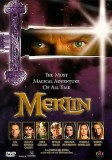 This is a bit of a cheat, because it’s actually a two-part miniseries… but in its entirety it’s shorter than Return of the King, and for some inexplicable reason is
 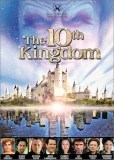 If Merlin was a bit of a cheat, this is a great big one, because The 10th Kingdom is actually a seven-hour miniseries. But tough, because I love it and it’s not well enough known. Here in the UK it aired on Sky back in the days before I had said channel, and so my first encounter was through
 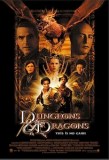 Quite what inspired this turn-of-the-millennium wannabe-blockbuster I don’t know — it came out the year before the double-whammy genre kick-start of Lord of the Rings and Harry Potter… but it feels much more than a single year older. It’s not all bad — some of the scenic effects shots are quite good, and there’s a certain joy in Jeremy Irons’ ludicrously campy performance — but, mostly, it is. The CGI is dreadful, the acting isn’t any better, and the location work makes it look like Power Rangers. If it wasn’t bad enough in itself (which it was), the glossy quality of Rings and Potter just 12 months later revitalised the genre to the point that this was blissfully consigned to ignominious oblivion.
 Most films have a reputation of one kind or another, even if it’s only in certain circles and you have to go searching to find it. I suppose Conan’s is best summed up by
  The guy doing the voiceover narration is godawful though, and there’s far too much of him. It’s never made clear why he’s the one telling the story either, unless I missed it.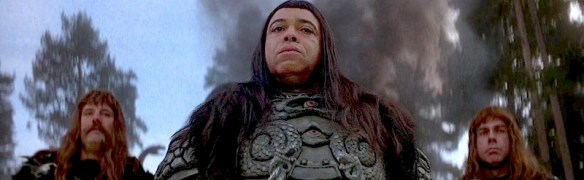
 Time flies: this is 13 years old! Originally a Jim Carrey vehicle (feels obvious once you know), Ben Stiller is the prospective son-in-law meeting Teri Polo’s parents (Robert De Niro, Blythe Danner) for the first time. Disaster ensues in a riot of unfortunate events targeting our hapless hero.
 John Cusack stars as literary giant (figuratively) Edgar Allan Poe in this wannabe-Victorian-
 That they didn’t tone it all down just a smidge to match, and so go for the box office-friendly PG-13, is a surprise in these days.
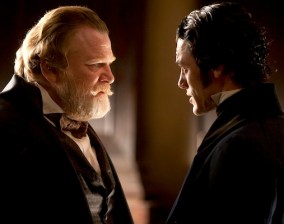 The rest of the cast are from Hollywood’s usual go-to for period tales: Brits; if not entirely then mostly so. (The film was shot in Hungary and Serbia, so I suppose our thesps have the additional advantage of being geographically favourable to Americans.) You know you’re getting a level of quality there, then, though for me Kevin R. McNally lets the side down (again). He’s only a supporting character and is fine most of the time, but there’s one bit when he’s talking to the lead detective and just rattles off his line… It’s not the world’s greatest speech, but you can hear there was meant to be more nuance and quiet in there.
 Se7en is probably my favourite film ever made, but criticisms that it’s quite a standard detective mystery are not invalid. It’s enlivened by Andrew Kevin Walker’s writing (great dialogue, engrossing structure, etc), some top-drawer performances (Freeman, Pitt, a loopy-calm Spacey), and, probably most of all, David Fincher’s inestimable touch. In making such a comparison it’s easy to see that The Raven lacks any of these, which renders it a solid period mystery, but no more.
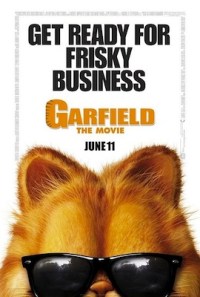 Bill Murray presumably needed some money, otherwise why else voice the titular food-loving sort-of-fourth-wall-breaking moggy in this juvenile adaptation of the long-running newspaper strip? Offering little in the way of laughs, the film’s main success is the cute (real) dog who co-stars as Garfield’s competriot, Odie. The real wonder is how they got him to interact with the CGI cat. Elsewhere, animals are live-action with CG mouths, giving an unsettled presentation of the film’s four-legged characters. Meanwhile, humans Breckin Meyer and Jennifer Love Hewitt engage in a charmless romantic subplot. Oddly, one for dog lovers (with fast-forward to hand) only.
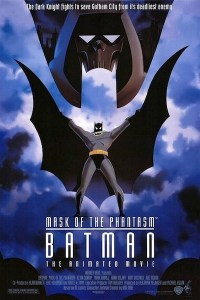 Batman movies have a habit of provoking strong reactions.
 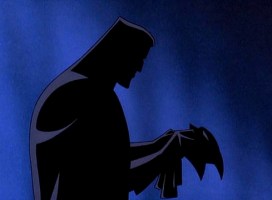 One of the main reasons the film succeeds is that look back at Bruce Wayne’s early days as a crime fighter. Batman’s origin is oft told — too oft, truth be told — but they thankfully don’t rehash it here. Instead, early in Batman’s career Bruce falls in love and finds happiness, causing him to question whether to continue down the path he’s already dedicated his life to. The scene where he talks to his parents’ grave, expressing his guilt at potentially finding happiness after so much mourning, is one of the most powerful, emotional moments in all of Batman’s many iterations.
 But instead of falling in some nasty halfway-house, Phantasm turns up trumps on all fronts.
 100Films.co.uk