
David Lynch | 116 mins | DVD | 2.35:1 | USA / English | 18 / R
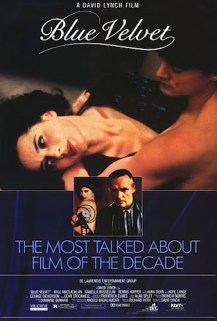 Before he brought the disquieting underbelly of small-town America to television audiences with Twin Peaks — and revolutionised the medium in the process — auteur David Lynch subjected cinemagoers to its perversions in this 1986 cult masterpiece, the first cohesive expression of concepts, themes and motifs (and cast members) that would inform the rest of his career.
Twin Peaks’ Kyle MacLachlan plays Jeffrey Beaumont, home from college to visit his hospitalised father when he discovers a severed human ear in a field (as you do) and, unable to resist playing private eye, gets drawn into a bizarre web that includes a burgeoning romance with Laura Dern’s high school student, a twisted sexual relationship with Isabella Rosselini’s trapped nightclub singer, and, most famously, Dennis Hopper, whose character and performance invites descriptors like “creepy” and “perverted” but transcends such notions to the point of their obsolescence.
There’s a mystery plot to tie things together, but it’s not really Lynch’s point: by the end, things that would be The Big Twist in other movies are almost glossed over; present because they’re needed for clarity, but not what Lynch wants to focus on. The film is heavy with symbolism, although for once you don’t need to be a genius to spot the major signifiers: it opens with a shot of a lovely suburban lawn, but moves closer until underneath it we see a swarming nest of nasty bugs. I was always led to believe Blue Velvet was about the secrets lurking behind small-town America’s white picket fences, and parts like that opener suggest such a reading.
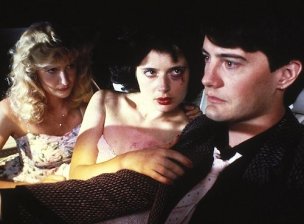 But… is it, really? The white-picket-fence-dwellers are pretty clean; it’s the people inhabiting the scuzzy apartment blocks and industrial estates nearby who are the problem. Those characters are as corrupt and degenerate as their abodes might lead those with regular prejudices to suspect. It’s a less subversive point of view, and I don’t think it’s what Lynch was actually going for. Anyway, the entirety of his moviemaking technique is so outré that you can’t help but find the whole twisted nonetheless.
Exposing the (sometimes-)reality behind the perfect veneer of American suburbia was not something all audiences at the time were prepared to embrace, though a couple of decades or so of emulation — not to mention the odd news story exposing reality — have led such a perspective to be less controversial. Yet the extreme ways Lynch employs to depict this nastiness mean the film hasn’t lost any of its impact. Back in 2001, critic Philip French wrote that “the film is wearing well and has attained a classic status without becoming respectable or losing its sense of danger.” Another 13 years on and I think that quote is still on the money. Blue Velvet is a film that features on respectable “Best Ever” lists (it’s in the top 100 of Sight & Sound’s latest, for instance, tied with Blade Runner (amongst others)), but is still quite shocking to watch. It’s not so much that it’s sexually or violently graphic — though, in places, it is a little — but the mood and feeling Lynch evokes is so darn unsettling and weird.
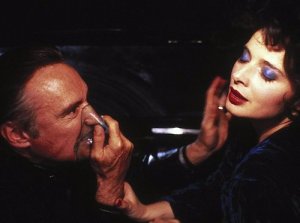 “It’s not a movie for everybody,” Lynch himself said (to Chris Rodley for the book Lynch on Lynch). “Some people really dug it. Others thought it was disgusting and sick. And of course it is, but it has two sides. The power of good and the power of darkness.” He’s not wrong. Despite the acceptance of it in some mainstream circles (arguably, you don’t get much more “mainstream” than the Best Director Oscar nomination Lynch received), Blue Velvet remains the very definition of a cult film: some will (and do) love it unreservedly; some will (and do) hate it with a passion; and some, like me, will look it and kind of go, “…hm.” The more I read about it, though, the more I warm to what Lynch was tilting at. Given time, and inevitable (though, knowing me, a long time coming) re-views, I can only see my appreciation growing.

Blue Velvet was viewed as part of my What Do You Mean You Haven’t Seen…? 2014 project, which you can read more about here.
The Twin Peaks: The Entire Mystery and the Missing Pieces Blu-ray box set is a surefire contender for “release of the year” even before it is released — which is tomorrow, Tuesday 29th July, pretty much worldwide.
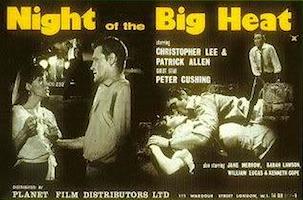 These days largely sold as a horror movie (the old Collector’s Edition DVD is branded as part of a “Masters of Horror” series), probably thanks to its cast (Christopher Lee and Peter Cushing), director (Terence Fisher, of many a Hammer Horror, including five with Cushing and Lee), and rating (an X originally, a 15 now), Night of the Big Heat is not really anything of the sort. Well, maybe a little; but you’re more likely to get scared by a contemporaneous episode of
 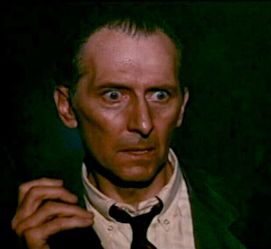 the pair were brought in to redraft because the original screenplay’s dialogue was “unsayable”. Anyone familiar with their ’80s work on Doctor Who, and their associated reputation, will find that highly ironic.) However, when the sci-fi stuff does roll in it’s a bit of a damp squib, leaving the scenes relating to the affair, whether it will be discovered, and what various characters do about their various feelings, as some of the more unique and interesting elements.
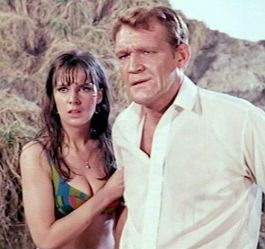 which considering it was shot in February and March is a real achievement. During night shoots the cast had to suck ice to stop their breath being visible, while running around in wet clothing to look like they were drenched in sweat. Poor sods. Said night scenes are a mess of genuine and atmospheric nighttime shooting, alongside the kind of day-for-night filming where everything’s extremely dark except for the sky, and also the kind of day-for-night filming where it’s day and… um… shh!
 Originally produced for the 2010 FrightFest film festival, horror director Jake West’s feature-length documentary with the unwieldy title explores the ‘video nasty’ scare that gripped early-VHS-era Britain. Starting with a primer on the birth of home video, and what it was like to watch movies in those days (because, ladies and gents, we’ve now reached a point where even fans of that (second-)most adults-only of genres, the gory horror flick, are young enough to not recall a time before DVD), West uses archive news clips and a wide array of new talking head interviews to take the story from the UK’s first video recorders in 1978, through a newspaper-led panic, up to the infamous Video Recordings Act of 1984, which irrevocably (thus far, anyway) changed the face of home entertainment releasing in the UK.
 Focusing on the scare rather than the films embroiled in it makes this less a “horror documentary” and more a social history/pop culture one, though the liberal use of extreme clips from the movies in question shuts out anyone without a hardened stomach. (If you did want more on the films themselves, the DVD set that contains the documentary — Video Nasties: The Definitive Guide — includes 7½ hours of special features discussing all 72 ‘official’ video nasties alongside their trailers.) There’s room for little asides amongst the main narrative, though. One of the highlights is the story of an interviewee who was invited on to Sky News in the wake of the James Bulger murder and asked if the film many were holding responsible,
  There was some counterargument, however, which leads us to the film’s best interviewee, and surely a new hero to many: Martin Baker. Baker was one of a few (certainly the first, and for a time the only) critical/intellectual-type voices to speak out in defence of the films that were outraging so many. He’s to be commended not only for his valiant defence of, essentially, free speech at a time when his views were immensely unpopular; but also because he remains one of the most lucid and fascinating commenters in the documentary. He makes the clearest points about the need to not forget both what happened and how it was allowed to happen, lest it occur again.
 that force ISPs to attempt to censor what we can and can’t see on the internet, and just yesterday rushed through anti-privacy legislation without proper debate. Sad to say, many of the valuable lessons of the ‘video nasties’ brouhaha — lessons made explicit with superb clarity in Jake West’s excellent documentary — have not been heeded.
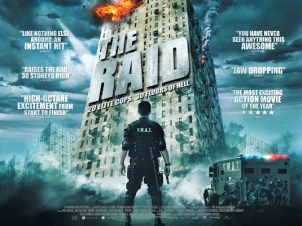 “20 Elite Cops. 30 Floors of Hell.”
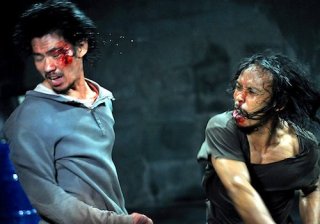 instead of ending with our hero duelling our villain, a fight with the top henchman is followed by a bit of plot clean-up between the villain and a supporting character. It’s the very definition of anti-climactic.
 Another way it’s pleasingly unlike its current American counterparts is the lack of focus on gore. There are plenty of stabbings (of a blood-stain-on-shirt variety), and a couple of sliced necks, but none are lingered on. Things like a hammer beating or repeated machete strikes take place either just off screen or just after we cut away. It’s unquestionably a violent film, but it doesn’t revel in the gory aftermath of that violence in the way many US films increasingly seem to.
 to make for a much more rounded experience. The fights in The Raid may have blown the minds of people who haven’t seen enough Asian action flicks, but I’d argue Dredd is the better film as a whole. And if you still insist on accusing one of plagiarising the other… well, let’s put it this way: Dredd had finished shooting, and its screenplay had leaked online, before The Raid even entered production.
 Remembered largely thanks to the involvement of Orson Welles (he has a supporting role, produced it, co-wrote it, and reportedly directed a fair bit too, though he denied that), Journey into Fear is an adequate if unsuspenseful World War 2 espionage thriller, redeemed by a strikingly-shot climax. The latter — a rain-drenched shoot-out between opponents edging their way around the outside of a hotel’s upper storey — was surely conducted by Welles; so too several striking compositions earlier in the movie.
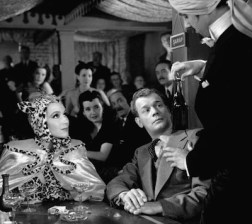 all added by Welles after the studio had their way, which seems to be the one US viewers know. The version without those seems to be the only one shown on UK TV, however.)
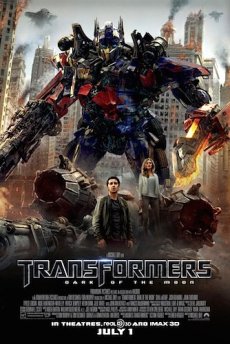 In an era where sequels seem to improve on their predecessors more often than not — building on established characters and mythology for a deeper experience, rather than rehashing the same plot/jokes/action sequences for a second-go-round money-grab — this Michael Bay-helmed series based on ’80s action figures is a throwback to… well, the ’80s. It’s almost appropriate.
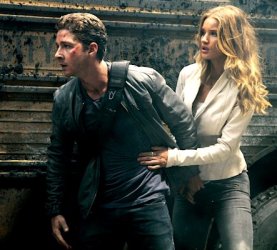 There are impressive visuals, it’s true, but that’s all they are: dramatic pictures. The characters, their motivations and actions that lead to these visuals often make no sense. And to say they “lead” there at all is generous, because just as often things begin to happen for no apparent reason. I swear no one’s thought any of it through — like the moment when the big honourable hero is offered a truce by the villain and, instead of accepting it, immediately executes him. Stay classy, Optimus Prime.
 #45
#45  #49
#49  The General
 The Gold Rush
 The Passion of Joan of Arc
 Intolerance
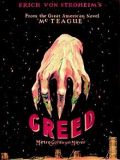 Empire readers considered this the 399th best film ever. TSPDT treated it more kindly, slipping into the top 100 at #94; the Top 300 Silents rank it among their top ten, however, at #10. The original (now lost) cut ran eight hours; the version released was merely two. In 1999 a four-hour version was created using stills from the deleted scenes, which seems to be the only one readily available, though I’ve heard the shorter cut is superior.
 Ever since I read
  naturalistic to the point of being almost documentarian, with half-caught snatches of dialogue and sequences that seem trimmed to (almost) the relevant moments from much longer filming — still begs that you pay attention, but it seems this cut gives you more of a hand: it gets to the killing quicker (“63 vs 82 minutes”), a meeting with gangsters is “longer, more coherent and explicit”, and so on.
 The Killing of a Chinese Bookie is not a neat little thriller in any respect. As Tom Charity puts it (in the BFI booklet again), “if the scenario sounds generic, the film is something else”. It reminded me of Martin Scorsese’s
  Krister Henriksson returns as the Swedish detective for a third and final series of mysteries, starting with this final theatrically-released episode, based on the final Wallander novel. Yes, there is a sense of finality here — albeit one not reached just yet.
 It’s here that Henriksson gets to show off his acting chops the most. At a dinner party with his family, Wallander largely sits quietly with a drink rather than interact with others, occasionally staring aimlessly into the distance, or only remotely engaging with what the others are doing. He witters about a painting of a goat. Later, he has a disproportionately angry response when his friend brings news that he’s been suspended. He dotes on his granddaughter, but one day loses her and her buggy when he pops into a shop — but finds her quickly enough that no one will be any the wiser. Little signs like this are scattered around, clueing us in to where Wallander will presumably end up: retired from the force, and possibly retired from his life. Whether Mankell brought the issues to a head in his novel or not, I don’t know, but here I can only imagine it will build throughout the series.
 The one thing that really cuts through Kurt’s newfound confusedness is when he gets a nose for a case. Quietly, by himself, he sets about digging in to what’s going on, unearthing evidence that’s been missed by others, piecing it together to complete a picture of long-kept secrets and new crimes committed in the name of keeping them. It resolves into a complex conspiracy, one that touches the lives of altogether innocent people. Is there justice at the end of it? Of a sort, but how satisfying that justice is… well…
 Part of Leone’s intended trilogy about the history of violence in the USA, Once Upon a Time in America is the life story of four friends and gangsters in Noo Yoik during a large chunk of the 20th Century. So it’s a gangster film focusing on violence, then? Well, no… not at all, really. Indeed, saying Once Upon a Time in America is a film about gangsters is a bit like saying
  Leaving aside the less savoury aspects (as, it seems,
  Once Upon a Time in America falls somewhere between these two stools. It’s a film that is, I think, easy to instantly admire — if not wholly, then for its majority; but also one I found difficult to process a full personal reaction to. With the recently-extended version set to arrive on DVD/Blu-ray/download later this year (in the US, at any rate), an ultra-convenient chance for a second evaluation looms.
 100Films.co.uk