The Limey (1999)

2016 #72
Steven Soderbergh | 89 mins | streaming (HD) | 16:9 | USA / English | 18 / R
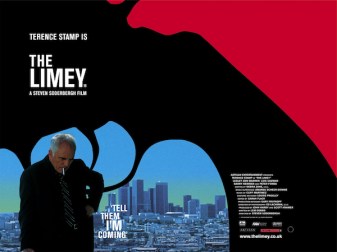
There’s an argument to be made that, from a cinematic perspective, mainstream US cinema these days is boring. Look at the kind of films American auteurs were producing in and around the studio system in the ’90s and early ’00s: Pulp Fiction, Fight Club, Memento, Requiem for a Dream; films that experimented with how they told their stories, the shots they used, how they were edited. Does anyone do that now? Or does anyone do it successfully?

Personally, I’ll be adding Steven Soderbergh’s The Limey to that list. At its most basic it’s a straightforward thriller, in which a British crook played by Terence Stamp is released from prison and travels to L.A. to find out the truth behind the death of his daughter (played in flashbacks by Melissa George, which is kinda weird because she has little to do and no dialogue), and probably take revenge on those responsible. By all accounts, the screenplay by Lem Dobbs was indeed that run-of-the-mill. In the hands of Soderbergh, however, it becomes an arthouse-ish experience, mainly thanks to the editing.

It’s the kind of cutting that’s hard to accurately describe on the page without overdoing it. The movie jumps back and forth in time — not from scene to scene, but from shot to shot. For instance, Stamp’s arrival at the home of his daughter’s friend, and the conversation that follows, is jumbled up with shots of him on the plane, driving in the city, the people his daughter was associating with, and even within the conversation itself, sometimes speech continues on the soundtrack while we watch the characters not talking, or doing something else. This isn’t a conceit Soderbergh uses for one scene, or wheels out now and then, but an overall approach. Some sequences are more thick with it than others, but it’s always right around the corner. It creates a unique sensation. Not disconcerting, exactly, but mysterious and querying. It has you constantly question what you’re watching — is it a memory? A plan? A fantasy? A delusion? It draws connections back and forth across the timeline of the story, bringing out thematic angles. At its most key, it helps explain what happens at the end (too bluntly for some reviewers, I should add). This collage-like style — which unlike, say, Memento’s back-to-front narrative has no obvious in-story point — will certainly not be to everyone’s taste, but it presents an interesting challenge to our usual ideas of how a film should be constructed.

This led to a somewhat infamous commentary track on the film’s DVD release. The A.V. Club even included it in their New Cult Canon series — not The Limey, that is, but The Limey’s commentary track. In it, Soderbergh and Dobbs discuss the filmmaking process, understandably focusing on how screenplays get transformed, and how screenwriters get screwed over. The Limey that ended up on screen is very different to Dobbs’ screenplay, having been aggressively filtered by Soderbergh. This isn’t hard to believe — the film on screen is a very film-y film; how would you go about conveying the crazy editing style on the page, even if you wanted to? By the sounds of things the whole track is basically a friendly argument, and makes me wish someone somewhere would get round to releasing this on Blu-ray so I could hear it (the film looks great in HD, so I don’t much fancy settling for a DVD, thanks).
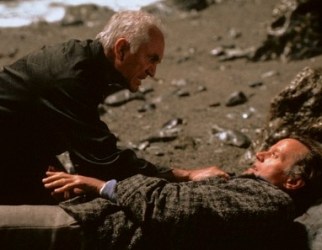
Despite the visual trickery, The Limey still works pretty well as a straightforward thriller. You have to be prepared to accept the slippery editing, because there’s no avoiding it, but the throughline of Stamp tracking down bad men and how he deals with them is still here. Personally, I’ve never much rated Stamp as an actor, but somehow he fits here. He’s a fish out of water, a man out of place — way out of place — and possibly out of time, too, seeming like a ’60s or ’70s British gangster transported to turn-of-the-millennium L.A. It’s no discredit to the supporting cast that they mainly exist to bob around in his wake.

At a guess, I’d say some would criticise The Limey for being a basic revenge thriller with a veneer of artistry applied in the form of its editing, while others would be turned away from its basic revenge thrills thanks to that editorial veneer. I’m always up for mashing together arthouse and mainstream, though, and here Soderbergh does just that, and in a way I found consistently thought-provoking, too. It’s discoveries like this that are the reward for digging into less-heralded corners of interesting filmmakers’ back catalogues.

5 out of 5

This review is part of 1999 Week.

The Limey placed 7th on my list of The 20 Best Films I Saw For the First Time in 2016, which can be read in full here.

Election (1999)

2016 #74
Alexander Payne | 103 mins | streaming (HD) | 2.35:1 | USA / English | 15 / R

The third feature (but first you’re likely to have heard of) by writer-director Alexander Payne (Sideways, The Descendants, Nebraska; he also co-wrote Jurassic Park III, did you know that? I didn’t know that) stars Matthew Broderick as a high school teacher who tries to stop Reese Witherspoon’s perfect student from becoming president of the school council.

With Witherspoon largest on the poster, and the title being Election, you’d naturally assume that’s where the film’s focus lies. Really, it’s about Broderick and the disintegration of his life, from a happily married man and dedicated teacher beloved by his students, to… well, where he ends up (no spoilers!) The poor guy’s really put through the ringer, though a lot of it is of his own making, so how much we sympathise is questionable.

Indeed, the whole film has a conflicted idea of identification. It has you side with a teacher who wants to tear down the dreams of a bright, dedicated, enthusiastic young student. And I don’t mean it tries to get you to side with him — you do side with him. But then it proceeds to tear his whole life apart, as if in punishment for what he wanted to do; and, by extension, it punishes you for wanting him to do it. So maybe those ideas of identification aren’t actually conflicted — which might imply it doesn’t know where it wants you to lay your support — but, rather, it knows exactly who you’re going to support, and thinks you’re a bad, bad person for doing so.

Broderick is suitably exasperated as the man whose life slowly falls apart, and Witherspoon is primly perfect as the overly-chirpy student — I’m sure she must remind everyone of someone they knew at school, and that’ll just make you dislike her all the more. (If there wasn’t someone like that in your class… are you sure it wasn’t you? Just sayin’.) It’s also the debut of Chris Klein (who went on to quality cinema like American Pie, the Rollerball remake, and Street Fighter: The Legend of Chun-Li), as the nice-but-dim jock who Broderick taps to stand against Witherspoon in the election. His younger sister, played by Jessica Campbell (who stopped acting a couple of years later, it seems), is a jilted lesbian rebel who also stands in the election on a platform of wanting to destroy the system, and is clearly the film’s most likeable character. Or maybe that’s just me.

A bit like Office Space, Election is the kind of indie comedy that is more wryly amusing than laugh-out-loud hilarious (though it has its moments), and is no doubt more appealing the more you feel like you know the characters. I think Payne has matured into more interesting (and, sometimes, funnier) work, but this was clearly a strong starting point.

4 out of 5

This review is part of 1999 Week.

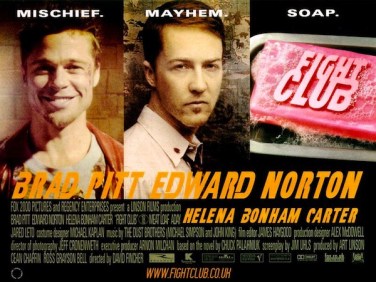
Fight Club (1999)

100 Films’ 100 Favourites #29

Mischief. Mayhem. Soap.

Country: USA & Germany
Language: English
Runtime: 139 minutes
BBFC: 18 (cut, 1999) | 18 (uncut, 2005)
MPAA: R

Original Release: 15th October 1999 (USA)
UK Release: 12th November 1999
First Seen: TV, c.2001

Stars
Edward Norton (American History X, 25th Hour)
Brad Pitt (Interview with the Vampire, World War Z)
Helena Bonham Carter (Room with a View, The King’s Speech)
Meat Loaf (The Rocky Horror Picture Show, Tenacious D in The Pick of Destiny)

Director
David Fincher (Se7en, The Social Network)

Screenwriter
Jim Urls (Sweet Talk, Jumper)

Based on
Fight Club, a novel by Chuck Palahniuk.

The Story
The film’s nameless narrator is growing increasingly disillusioned with his mundane consumerist lifestyle, when he bumps into Tyler Durden. A free-spirited soap salesman, the pair have a fight for the heck of it. Finally experiencing some kind of genuine feeling, they set up an underground club for fighting, but it gradually becomes clear that Tyler may have bigger ideas…

Our Heroes
I am Jack’s nameless narrator. I am also Jack’s friend, Tyler Durden. Yes, just his friend…

Our Villains
The establishment! Capitalism! What’ve you got?

Best Supporting Character
Helena Bonham Carter hasn’t been fucked like that since grade school.

Memorable Quote
“The first rule of Fight Club is: you do not talk about Fight Club. The second rule of Fight Club is: you do not talk about Fight Club! ” — Tyler Durden

Quote Most Likely To Be Used in Everyday Conversation
“You are not special. You are not a beautiful or unique snowflake. You’re the same decaying organic matter as everything else.” — Tyler Durden

Memorable Scene
Called into his manager’s office to discuss his bad behaviour, the Narrator decides the best method of getting his own way is by enacting physical violence… on himself.

Technical Wizardry / Truly Special Effect
For what’s essentially a drama, Fight Club is overloaded with special effects and visual trickery. I don’t know if any are particularly groundbreaking in and of themselves, but several are particularly striking. A personal favourite, thanks to the perfect execution of the idea, is the shot where the Narrator’s condo is transformed into a living IKEA catalogue.

Making of
Marla’s original post-coital line was, “I want to have your abortion.” The studio objected to such an offensive line, so Fincher agreed to change it on the condition that the new line had to be used. The studio agreed, apparently unaware that such an agreement was never going to end well. Fincher wrote the replacement line, “I haven’t been fucked like that since grade school.” The studio asked for the original line back; Fincher refused. (It must say something about American values that abortion is considered more shocking than underage sex.)

Next time…
Nothing from the film, but Chuck Palahniuk has continued his novel in 10-issue comic book series Fight Club 2. A second comic series, Fight Club 3, is planned.

Awards
1 Oscar nomination (Sound Effects Editing)
1 MTV Movie Awards nominations (Best Fight for Edward Norton fighting himself)
1 BRIT Award nomination (Best Soundtrack — it lost to Notting Hill)

What the Critics Said
“Three factors elevate Fincher’s apocalyptic stew to something approaching art. First is Norton’s performance, as sneaky and shocking as that in his film debut Primal Fear. Second is Palahniuk’s story, which dances on a razor’s edge between life and death, expression and repression, ecstasy and agony. Third is Fincher’s dedication to making a film that looks and sound likes no other, one that powerfully illustrates what dementia looks like from inside and out.” — Carrie Rickey, Philadelphia Inquirer

Score: 79%

What the Public Say
“it’s hard to believe Fight Club is now 15 years old. As I was watching the film last night I found it hard to review because it is so ingrained in pop culture now it would be almost sacrilegious to say something bad about it. […] The first time I saw Fight Club I did not see the twist of [REDACTED] coming. I remember being surprised, but also very confused. I didn’t really understand how it worked then. On the second viewing it is easy to see a million clues pointing to this from the very beginning. Director David Fincher is very clever in how he orchestrates the film by giving you all these hints. He’s very good at walking that tight rope of not giving away too much. The twist is definitely one of the highlights of the film and why it is so memorable. It doesn’t feel cheap to me as some of these things normally do.” — Sherise, The Girl that Loved to Review

Elsewhere on 100 Films
I reviewed Fight Club as part of a retrospective on Fincher’s films back in 2011, saying “Fincher’s films often look great, but Fight Club is surely the most visually inventive. A list of exciting spectacles could be endless […] To top it off, the ‘regular’ cinematography is grounded in Fincher’s trademark darkness, as if every shot was conceived as just black and he added only what light was necessary.”

Verdict

A controversial film to this day, Fight Club is a violent, explicit exploration of the turn-of-the-millennium Western male psyche, which hasn’t necessarily lost its relevance in the ensuing decade-and-a-half. Criticised by some for endorsing the anarchic lifestyle it depicts, praised by others for satirising that mode of thinking, and criticised by other others for not satirising it well enough, the film can certainly provoke a spread of views. There’s little doubt that David Fincher’s direction is memorably slick and inspired, however, and it has one of the most talked-about twists in movie history.

#33 will… boldly go where no comedy has gone before.

The Thomas Crown Affair (1999)

2016 #73
John McTiernan | 113 mins | streaming (HD) | 2.35:1 | USA / English | 15 / R

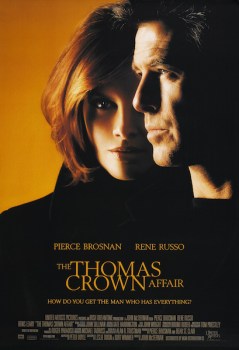
Once upon a time, John McTiernan was an action auteur, known for films that sat comfortably on the “mainstream modern classics” scale, like Predator, The Hunt for Red October, and, most of all, Die Hard. Then he made a couple of bombs (Rollerball and Basic), before ending up in a career hell of his own making thanks to some protracted legal battles. This thriller remake, starring Pierce Brosnan at the height of his Bond tenure (it was made between Tomorrow Never Dies and The World is Not Enough), is the once-eminent director’s last well-regarded film.
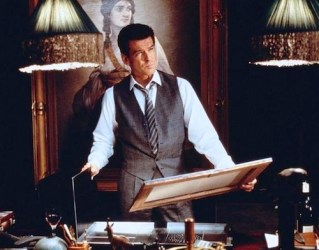
Brosnan plays the titular Thomas Crown, an ultra-wealthy New York entrepreneur whose hobby is stealing art from museums. His latest theft attracts the attention of the insurance company’s investigator, Catherine Banning (Rene Russo), who is clever enough to see past the fancy gadgets and gang of Eastern European crooks placed to take the fall. So begins a game of cat and mouse, as Banning tries to catch the thief, while he tries to woo her, and she tries to resist his charms — while also using her womanly wiles to try to ensnare him.

It’s the latter that practically kicks The Thomas Crown Affair into the realms of the ‘erotic thriller’. Throw in a couple more sex scenes (and a few less high-profile contributors) and you’d have late-night TV filler. There’s virtually no swearing and certainly no violence, but with some gratuitous boobs you’ve got a 15/R-rated flick. The film doesn’t really need such titillation to attract attention, because it’s a strong cat-and-mouse thriller in its own right. On the other hand, it doesn’t shy away from sexuality and the part that could play in such a ‘game’, so in that respect it’s more plausible than a million other neutered movies.

McTiernan’s action background comes to the fore in a pair of extended heist scenes at either end of the movie, which are surely the standout parts. The seductions and plot twists in between these bookends are certainly entertaining and may even keep you guessing, but it’s the heists that pack the most entertainment. They’re the kind of thing we don’t see so much nowadays, at least not in mainstream movies, because any sequence designed to provide excitement is a fight of some kind, and most of those are shot in the shaky-cam style. There’s none of that palaver here, just perfectly choreographed cutting between the various players in each heist, and some well-chosen music — as if being ably to do awesome stuff accompanied by the James Bond Theme wasn’t cool enough, here Brosnan gets to do the same to Nina Simone’s Sinnerman.

Those scenes are reason enough to watch the film, in my opinion, but that’s not to denigrate what comes in between. Brosnan is mainly just charm personified as Crown, a kind of “Bond gone naughty” playboy (without the, y’know, murdering), while Russo makes Banning’s back-and-forth umming-and-ahing seem largely plausible, whereas in other hands it might’ve just come across as inconsistent character writing. Denis Leary and Frankie Faison bolster the entertainment as the pair of NYPD cops forced to work with Branning, while Faye Dunaway (star of the original film) appears in a handful of tacked-on cameo scenes as Crown’s psychiatrist.

The Thomas Crown Affair may not be the best film on any of its principals’ CVs (well, except perhaps for Russo’s), but it’s a consistently enjoyable light thriller with a couple of particularly memorable sequences and a fun central dynamic. Apparently it’s better than the original, too. There’s long been talk of a sequel, but it seems to have gone the way of McTiernan’s career, which is a shame.
4 out of 5

This review is part of 1999 Week.

Office Space (1999)

2016 #54
Mike Judge | 86 mins | streaming (HD) | 1.85:1 | USA / English | 15 / R

“From the creator of Beavis and Butt-Head” is not a designation that’s going to help sell a film to many people anymore. That the same fella also went on to write and direct the mediocre Idiocracy does it no favour in my eyes, either. The man in question is Mike Judge, and his first live-action feature — this — quickly became a cult favourite, apparently beloved of IT guys and office workers in general everywhere. Well, one has to see what all the fuss is about, doesn’t one?
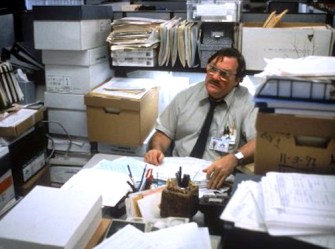
Office Space is, in its way, the story of Peter Gibbons (Ron Livingston), a frustrated office drone. He agrees to go to a hypnotism session with his girlfriend to try to alleviate his stress. While under, he reaches a state of relaxation… so relaxed, he doesn’t even register when the hypnotherapist dies before bringing Peter out of his trance. In his state of newfound enlightenment, his honesty gets him a promotion at work, he finally asks out the girl at the local restaurant (Jennifer Aniston), and, when his IT friends are laid off, sets about scamming the company he works for.

So, there’s sort of a wish-fulfilment thing going on here, which must partly explain its popularity. It’s a film about low-level white collar workers, stuck in unfulfilling office jobs, having to do the repetitious and sometimes stupid bidding of the higher-ups — guys who don’t actually do anything, really, but will certainly get to keep their jobs when lay-offs are needed, even as the little guys who actually do the work get the sack. Wouldn’t it be great to find yourself in a position where you could stick it to Management?

In truth, the plot doesn’t quite fill the slight running time, and Judge doesn’t seem to quite know how to end it — clearly he doesn’t want his hero figure getting caught out, but it can’t just go on forever. Fortunately, this is a comedy, and so plot matters only so much if the rest is funny. In some respects it’s a story of “first world problems” — these guys have decent jobs, making decent money, but it’s boring — but at least it finds the humour in this. Little vignettes of office life, a mix of light satire and gentle surrealism, keep the amusement ticking over too.

I’m not about to sign up for the cult of Office Space, but it is a funny way to spend a brisk under-90-minutes — more “quite amusing” than “laugh-out-loud funny”, though. As it’s now 17 years old, you also have to wonder if it’s a bit of a time-capsule for a passed era.

4 out of 5

This review is part of 1999 Week.

1999 Week

This week on 100 Films, I shall be partying like it’s 1999.

“Why?” Well, I’m glad you asked. It’s all thanks to a confounding confluence of coincidence, whereby I happened to watch three films from that momentous year back to back, then noticed I had two 100 Favourites posts very close together from that year coming up around this week, a week that ends with my birthday. And how do you celebrate a birthday? With a party. And how do you party? Like it’s 1999.

Then Prince died and now it feels kinda disrespectful.

RIP Prince

I could be worse.

Moving on…

On Monday, Tuesday, Thursday, Friday, and Saturday there’ll be reviews of films from 1999 I happen to have watched recently, including one of my Blindspot / WDYMYHS films; on Wednesday and Sunday, as usual, a pair of 100 Favourites from 1999; and, because it’s a Bank Holiday next Monday, the week will last 8 days, and end with my thoughts on the best films of 1999.

Now, imagine your picture going all wobbly and the soundtrack going tinkly (or, if you prefer, roll-back-and-mix with a “vworp vworp” noise) as we travel back 16 years…

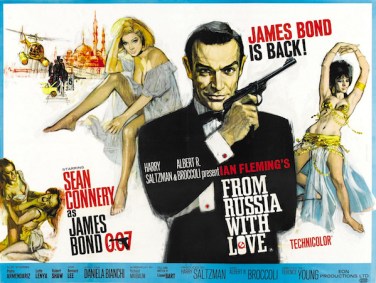
From Russia with Love (1963)

100 Films’ 100 Favourites #32

James Bond is back!
His new incredible women!
His new incredible enemies!
His new incredible adventures!

Country: UK
Language: English, Russian, Turkish & Romany
Runtime: 115 minutes
BBFC: A (1963) | PG (1987)
MPAA: GP (1971) | PG (1994)

Original Release: 11th October 1963 (UK)
US Release: 8th April 1964
First Seen: TV, c.1995

Stars
Sean Connery (Darby O’Gill and the Little People, Zardoz)
Daniela Bianchi (Special Mission Lady Chaplin, Operation Kid Brother)
Pedro Armendariz (Fort Apache, 3 Godfathers)
Lotte Lenya (The Threepenny Opera, The Roman Spring of Mrs. Stone)
Robert Shaw (A Man for All Seasons, Jaws)

Director
Terence Young (Dr. No, Wait Until Dark)

Screenwriter
Richard Maibaum (Bigger Than Life, Licence to Kill)

Adapted by
Johanna Harwood (Dr. No, Call Me Bwana)

Based on
From Russia with Love, the fifth James Bond novel by Ian Fleming — one of John F. Kennedy’s favourite novels.

The Story
When Soviet consulate clerk Tatiana Romanova offers to defect, she has one condition: that she is extracted by James Bond. Although M smells a trap, as collateral Tatiana offers a Lektor, a decoding machine MI6 have wanted for years. Bond travels to Istanbul to steal the Lektor, unaware he’s being manipulated by the criminal organisation SPECTRE…

Our Hero
The name’s Bond, James Bond. In only his second big-screen outing, so Connery is still establishing the character here — considering all the ‘fun’ antics that came since, Bond is quite a hard bastard in Dr. No and From Russia with Love (which is only appropriate for a government-sponsored killer, of course).

Our Villains
They may not be as grandiose as the volcano-dwelling types that came later in the series, but From Russia with Love has two of Bond’s most memorable adversaries: the hard former KGB officer Rosa Klebb, with her deadly shoe (well, it sounds silly when you put it like that), and assassin Red Grant, who may not know what wine to have with fish but could certainly gut you like one. A fish, that is. Not wine. You can’t gut wine.

Best Supporting Character
Kerim Bey, British Intelligence’s man in Turkey. An affable, witty soul, he’s also an invaluable ally during Bond’s time in Istanbul.

Memorable Quote
Tatiana: “I think my mouth is too big.”
Bond: “I think it’s a very lovely mouth. It’s just the right size… for me, anyway.”

Memorable Scene
On the Orient Express, SPECTRE assassin Red Grant manages to corner Bond in his compartment. Although he has Bond at gunpoint, Grant is distracted by the offer of gold coins hidden in Bond’s case. Bond tricks Grant into setting off the case’s booby trap, allowing Bond to tackle him. A rough close-quarters fight ensues.

Write the Theme Tune…
Having arranged and performed Monty Norman’s James Bond Theme for Dr. No (for which he didn’t receive a credit), John Barry was the main composer for Bond’s second adventure. However, the producers tapped Lionel Bart — then popular from Oliver! — to write the title song. Barry didn’t like that Bart’s lyrics had nothing to do with the film’s story, a point he set out to rectify when given full control of the soundtrack to Goldfinger.

Sing the Theme Tune…
A good answer if you’re ever faced with a trivia question about James Bond theme singers, Matt Monro was — so Wikipedia tells me — known as “The Man With The Golden Voice” and “became one of the most popular entertainers on the international music scene during the 1960s and 1970s.” With the Bond formula not yet fully established, a snippet of his song is heard on a radio early in the film, but not played in full until the end credits. (The title credits are scored with an instrumental version of the song, plus the James Bond Theme.)

Technical Wizardry
Projecting the title credits on writhing half-naked girls? It’ll never catch on.

Making of
Although Red Grant is presented as a physically-imposing male specimen, including showing off his half-naked physique the first time he appears, in reality actor Robert Shaw had to stand on a box when opposite Sean Connery because he was so much shorter than the Scot. (4 inches shorter, according to CelebHeights.com. Yes, that’s a real website.)

Previously on…
This is the second film about the adventures of James Bond, after the previous year’s Dr. No.

Next time…
The next film, Goldfinger, set the template for much of the rest of the Bond series. To date, that has encompassed a further 22 canonical movies, with the series’ 25th already in development. From Russia with Love was adapted for radio in 2012, the third of (to date) five Bond radio adaptations starring Toby Stephens as 007.

Awards
1 BAFTA nomination (British Cinematography (Colour))

What the Critics Said
“Don’t miss it! This is to say, don’t miss it if you can still get the least bit of fun out of lurid adventure fiction and pseudo-realistic fantasy. For this mad melodramatization of a desperate adventure of Bond with sinister characters in Istanbul and on the Orient Express is fictional exaggeration on a grand scale and in a dashing style, thoroughly illogical and improbable, but with tongue blithely wedged in cheek.” — Bosley Crowther, The New York Times

Score: 96%

What the Public Say
From Russia with Love turned out to be amongst the best of the Bonds. Distinctly low key, and relying on the strength of its cast over the spectacular thrills and gadgetry that would come to define the series, it’s a great couple of hours’ cinema that may delight viewers who come to it expecting the same old nonsense from 007.” — Mike, Films on the Box

Elsewhere on 100 Films
I reviewed From Russia with Love as part of a retrospective on Connery’s Bond back in 2012, when I noted it was “a very faithful rendition of the book. That makes it a Cold War spy thriller, albeit one with fantastical touches […] Mostly, though, it feels remarkably plausible. Sequences like the theft of a decoding machine from the Russian consulate, or the famous confined train carriage fight with Red Grant, have real-world heft rather than typical Bond action sequence fantasticism.”

Verdict

It’s only the second Bond movie, so there’s no template yet, but in retrospect From Russia with Love is an oddity among the Bond flicks of the ’60s and ’70s. Although it has many of the series’ regular trappings — exciting action, exotic locations, beautiful women, grotesque villains, nifty gadgets — it also functions as a straight-up ’60s Cold War spy thriller, with few of the fantastical touches the Bond films would become known for. Such atypicality means anyone looking for a “Bond formula” movie will be disappointed, but otherwise it’s an accomplished thriller, and one of the series’ finest instalments.

The first rule of #29 is… don’t talk about #29.

Veronica Mars (2014)

2014 #22
Rob Thomas | 108 mins | download (HD) | 2.35:1 | USA / English | 12 / PG-13

If you hadn’t heard of Veronica Mars before 13th March 2013, you almost certainly did soon after. That’s the date Rob Thomas, creator of the six-years-dead TV series of the same name, launched a Kickstarter crowdfunding campaign to pay for the long-mooted continuation movie. Aiming for a whopping $2 million, it raised that in just 11 hours, going on to bag $5.7 million by the end of its 30-day campaign. In the process it became the fastest Kickstarter project to reach $1 million (and $2 million), the highest-funded film project ever on the site, with the most number of backers for any campaign, and inspired countless think-pieces on how it was ruining/saving the movie industry, or at least completely changing it forever. In reality, very few (if any) big-name Kickstarter movies have come along since, and those that have haven’t inspired the same fervour as Veronica did three years ago.

The film itself picks up nine years after the end of the TV series. A quick opening montage reminds/informs us that Veronica (Kristen Bell) moonlighted as a private investigator while she was in high school, making plenty of enemies in the process and enduring more than a few tragedies, but she eventually managed to drag herself out of that life and start afresh. Just as she’s about to begin a career as a high-flying lawyer in New York, she sees on the news that her one-time on-off love interest Logan Echolls (Jason Dohring) has been arrested for murder. Then he phones asking for her help. Just when she thought she was out, etc. So Miss Mars heads back to little old Neptune, California, just in time for her ten-year high school reunion and a murder investigation involving all (well, most of) the familiar faces from the TV show.

There’s no denying that this is primarily a film for fans of the TV series — well, they did fund it, after all. The best way to get the most out of the film is to have watched all 64 episodes of the show first; preferably soon before, in fact, so you can remember who all the minor characters are. However, creator-cowriter-director Rob Thomas is no fool: you don’t produce a successful movie that continues a little-watched TV show by making it a requirement that you’ve watched 64 hours of TV first. (I mean, Joss Whedon knew that with Serenity, and there’s only 14 hours of Firefly.) So Veronica Mars: The Movie is accessible to neophyte viewers. You might sense there’s references and whatnot that are passing you by, but everything that’s relevant is explained.

The long gap between series and continuation actually works to the film’s advantage, too, because this plays as the story of someone revisiting an old life, in a place that’s in some ways different and in others exactly, depressingly the same. The hook here is of Veronica as a kind of addict, but instead of being addicted to booze or drugs, it’s private investigating — she may be nine years ‘sober’, but now she’s being tempted to indulge. Again, this makes even more sense if you’ve watched the TV show, where a subplot deals with Veronica’s mother’s alcoholism, but the general conceit works standalone.

Plus, this is a crime drama — there’s a case to be solved, and that’s self-contained within the film. Okay, most of the players are characters from the series, but everything is introduced and explained within the film. Heck, there are even characters Veronica knew in school who weren’t actually in the TV series, which might give you a flavour of how it works both for fans and newcomers. The case itself isn’t a bad mystery, but at the same time it’s a little subservient to the other goings-on. I suppose you could argue this is really a comedy-drama about a woman reconnecting with her past life and past friends, and she just happens to have a murder to investigate at the same time.

For fans (who will have watched this years ago, hence why I’m focusing on the newbie experience), the film is immensely rewarding. Obviously, because it finally gives some closure to the cancelled series’ dangling elements; but also, it feels like Veronica Mars, not like something from older people that’s only claiming to be what it once was. There’s the sparky characters, the funny repartee, the raft of neo-noir allusions. As cheesy as “teenage private eye” sounds, one of the reasons Veronica worked was because it really used those noir elements, just grafted on to the high school experience. The town of Neptune is practically a throwback in this regard, with rich kids and businessmen who can buy their way out of trouble thanks to a thoroughly corrupt police department, while the poor schmucks at the bottom of the pile get by as best they can, which often is not well. It didn’t even cave to the usual youthification of adding happy endings; in fact, more often than not, things didn’t end well. The movie isn’t quite as bleak as the TV series often was — there’s clearly an awareness this might be a one-time deal, so Thomas wants to leave things suitably wrapped up — but not everything comes up roses. (Where’s the sequel at?!) And to pay things off fully, there’s a tonne of fun references, not just to the show but also to real life (not least the Kickstarter campaign).

To bring up Firefly/Serenity again, I think there’s a reasonable parallel between how those relate to each other, and how they can work for newbies, and how Veronica Mars the TV series and Veronica Mars the movie relate. To wit: in an ideal world, you’d watch all of the series and then the film; but TV series can be long commitments, and for a spot of ‘dipping your toe in the water’, you can also start with the movie and go back to the series for the full picture. Sure, some things are going to be spoiled doing it that way round — but hey, not everyone who’s in the series but not the film ends up dead, I promise.

When I first watched the movie, it was at the end of a first-time binge through the TV series, where it sat very happily. To finally write this review, I watched the film again in isolation. I have a memory, so obviously I’m not coming at it from a totally fresh perspective, but it was as entertaining in isolation as it had been as “one more episode”. Fans will get the biggest kick out of seeing old characters resurface, out of learning what’s happened to them in the past decade, out of seeing big-name cameos alongside familiar faces, out of all the callbacks and nods, out of certain things finally being resolved. But that doesn’t mean newcomers can’t get joy from meeting these characters for the first time, from the self-contained mystery and storylines, from the fresh gags — indeed, from all the things that make the TV show entertaining if you started there. And then, if they like it, there’s the joy of there being 64 more instalments to discover.

More than just a nostalgia trip for people who were there first time round, the movie is a strong addition to the Veronica Mars canon — as someone who didn’t discover the series until the Kickstarter campaign, I thought the film was a heck of a lot of fun, and a wonderful capstone to a mostly-great series. That said, there’s plenty of room for further cases… someday… hopefully…
4 out of 5

Veronica Mars is available on Amazon Prime Instant Video in the UK from tomorrow.

Maleficent (2014)

2016 #84
Robert Stromberg | 93 mins | streaming (HD) | 2.35:1 | USA & UK / English | PG / PG

Disney seem to be embarking on a project to remake all of their most beloved animated movies in live action,* with Cinderella being one of the highest grossing movies of last year, The Jungle Book currently doing gangbusters at the box office worldwide, an all-star Beauty and the Beast hotly anticipated for next year, and others in the pipeline that include Mulan, Pinocchio, The Sword in the Stone, both Peter Pan and Tinkerbell, another 101 Dalmatians, an Aladdin prequel, Winnie the Pooh, and Tim Burton’s Dumbo. (No, I did not make those last two up.)
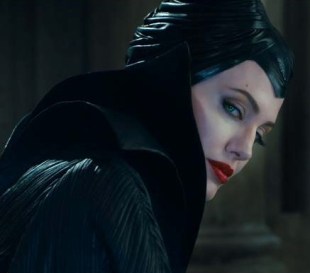
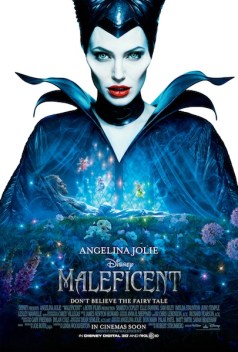
But it all started… back in 2010, when Tim Burton’s Alice in Wonderland was an unexpectedly ginormous hit. But then there were a couple of years off, so you could argue the current wave started here: a revisionist re-telling of Sleeping Beauty from the point of view of its villainess. In this version, we meet Maleficent as a child, protector of some fairy kingdom that borders the human kingdom. One day she meets a trespassing human boy, Stefan; they fall in love; eventually, he stops visiting, set on making his fortune in the king’s castle. After Maleficent has grown up to be Angelina Jolie doing an English accent and Stefan has grown up to be Sharlto Copley doing a Scottish accent (goodness knows why), the human king decides to invade the fairy land. Maleficent repels his forces, and the dying king vows whoever can defeat her will be named heir. So power-hungry Stefan does something terrible, and we’re on the road to the story we know… more or less.

It’s an interesting idea to take an archetypal villain who’s evil for evil’s sake and try to give her motivation, to understand why she did terrible things. Maleficent makes a fair fist of this, beginning long before the familiar tale to establish a run of events that tip the titular character to the dark side. What Stefan does to her to win power is pretty dark, and a clear analogy to a real-world crime that you wouldn’t expect from a PG-rated Disney movie. Our sympathies, at this point, lie with Maleficent. Of course, then she goes and condemns an innocent child to eternal slumber, so that’s less nice.

However, this is a Disney movie — you don’t get to turn a villain into the central character and have her be evil throughout. This is where the film gets really revisionist, because Maleficent keeps an eye on cursed Princess Aurora (Elle Fanning) as she grows, doing more to keep her alive than the trio of fairies she’s supposedly in the care of, and her heart is gradually warmed to the girl. Unfortunately, Maleficent was too good at the cursing malarkey: unable to lift her own spell, it plays out regardless, and the film serves us new renditions of the impassable thorns, giant dragon, and true love’s first kiss. It’s in the last where Maleficent is thematically revisionist rather than just a massive rewrite. Your mileage may vary on whether this version is obvious and cheesy, or actually more meaningful and (for the primary audience of little kiddies) more thought-provoking than the original’s — I’d go with the latter.
So in some respects, Maleficent is a success. In others, it’s a bit of a mess. For all the additional character development given to Maleficent herself, the rest of the characters are two-dimensional at best. It’s ironic that, in a movie all about fleshing out and understanding the villain, the new villain (i.e. Stefan) is so flat. Other elements are just pointless or nonsensical, like the corridor of iron spikes Maleficent & co briefly have to squeeze along. It’s not a bad idea per se — it’s been established that iron hurts fairies (goodness knows why, but there you go), so it’s a reasonable concept for a physical obstacle — but it’s really poorly integrated into the story, and it’s bested by… walking through it carefully. Thrilling.

Parts of the film test-screened poorly — mainly the first act, with audiences wondering why it took so long for Jolie to turn up. Consequently, the whole thing was thrown out and reshot; in the process, Peter Capaldi and Miranda Richardson were deleted (and after they’d had to endure hours of transformative prosthetics for their roles, too), and Maleficent was given a new backstory. How far this extended into the rest of the movie, I’m not sure, but at times it feels like stuff has been cut or rearranged. Certainly the story flies past — if it wasn’t trimmed down in the edit, it needed expanding back at the screenplay stage.

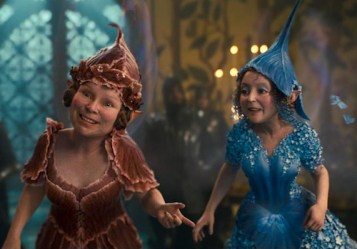
Then there’s the uncanny-valley-tastic rendition of the three fairies, with mini plasticky-CGI versions of Imelda Staunton, Juno Temple and Lesley Manville floating around until they jarringly turn into live action; the unintentional hilarity of the Prince Charming-type apparently being from the kingdom of Ofsted (it’s actually Ulfstead, but still); and the original film’s famous song, Once Upon a Dream, being slowly murdered by Lana Del Rey. Perhaps surprisingly, the work of production-designer-turned-director Robert Stromberg is pretty decent, though over-fond of crash zooms during action sequences, and an overall visual style that’s reminiscent of the likes of Burton’s Alice in Wonderland and Sam Raimi’s Oz the Great and Powerful — both of which Stromberg designed, funnily enough.

For all its faults, Maleficent was still the fourth highest grossing movie of 2014 — though the top grosser was Transformers: Age of Extinction and second was The Hobbit: The Battle of the Five Armies, so that shows what quality matters to the box office. Nonetheless, it’s no wonder Disney have kicked into gear with the live-action remakes, and even a Maleficent sequel is in development. (No idea how that’ll work — Sleepier Beauty?) On the bright side, there is something more interesting going on here than just an animated film being re-done with real people (and copious CGI). Certainly, anyone interested in fairytales being deconstructed and/or reconstructed should be sure to check it out.

3 out of 5

Maleficent is available on Netflix UK as of this week.

* At least they’re not trying to tie them together as another shared universe! ^

The Past Month on TV #3

Superheroes, spies and Sherlock in this month’s spoiler-free TV round-up.

Daredevil (Season 2)
DaredevilIt’s certainly the summer of good-guy-on-good-guy dust-ups in the superhero subgenre this year, with Batman v Superman lighting up the box office last month and Captain America v Iron Man set to do the same next week (in the UK and 41 other countries, anyway; “next month” everywhere else). First out of the gate, however, was Daredevil v Punisher, in the second season of Netflix’s initial Marvel-derived success. Also throwing love-of-his-life Elektra into the mix, plus some additional plot elements teased in season one, meant Daredevil had more to do this year. However, far from feeling overstuffed (like so many a weak superhero sequel), it rose to the occasion, with a second run that was arguably even better than the first. Charlie Cox continues to be a real star as Matt Murdock, Jon Bernthal gave an excellent rendition of Frank Castle as a genuine human being, and supporting players like Deborah Ann Woll and Rosario Dawson shine too. Also, less widely praised but one of the season’s subtle successes for me, was Geoffrey Cantor stepping ably into the series’ Ben-Urich-shaped hole. And the fights were both plentiful and eye-poppingly choreographed, even more so than the first season’s. Exciting stuff all round.
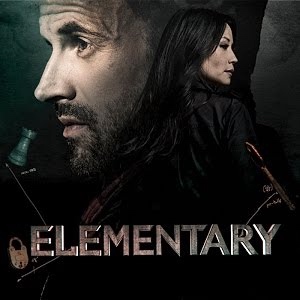
Elementary (Season 4 Episodes 14-16)
ElementaryI’m a little surprised I’m still with this “Sherlock Holmes in modern day America with a female Dr Watson” series, because it was never a particularly good version of Sherlock Holmes and it still isn’t. What it has turned out to be is a decent show in its own right (for a US network procedural, anyway), with sometimes-interesting characters who happen to share the names and the odd characteristic of Sir Arthur Conan Doyle’s famed creations. It’s so much its own show that it’s never really bothered adapting the canon, so it was very odd when episode 16, Hounded, didn’t just use a few names from The Hound of the Baskervilles (as the series has in the past), but actually had a passable swing at modernising the entire plot. It doesn’t seem to have gone down too well with critics and viewers, though for my money it did a much better job than Sherlock’s disappointing attempt.
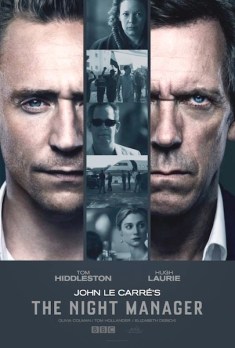
The Night Manager
The Night ManagerA lavish, all-star, ultra-hyped John le Carré adaptation that, thank goodness, lives up to its reputation. Although it wrapped up in the UK a couple of weeks ago, it only started in the US last night, and I recommend any America-based readers who enjoy a good thriller to get on board tout suite. The Night Manager doesn’t have a Tinker Tailor-style twisty-turny plot, but fills that gap with tension and suspense. Tom Hiddleston is a likeable hero, dragged in to something that might seem over his head, but which it emerges he has an affinity for. Hugh Laurie is a personably chilling villain, Olivia Colman kicks Whitehall ass, Tom Hollander perfectly judges a part that could’ve been caricature, and Elizabeth Debicki shows a very different side after her ice-cold villainess in The Man from U.N.C.L.E. As for talk of Hiddleston being the next Bond… initially his character here couldn’t seem further away from 007, lending credence to my presumption that everyone declared “he could be Bond!” just because he was in a spy series. But as it goes on, he gets to be suave, cunning, and sleep with pretty much every female character that isn’t his boss. So, yes, he could be Bond. At this point he’s certainly a better pick than too-old-for-it-now Idris Elba.
Also watched…
  • Gilmore Girls Season 4 Episode 18-Season 6 Episode 9Paul Anka, aww!
  • The People v. OJ Simpson: American Crime Story Season 1 Episodes 3-5 — aka The “22 Years Ago No One Knew Who the Kardashians Were, Isn’t That Funny?” Show.
  • Person of Interest Season 4 Episodes 4-15 — I know I moaned about this last month, but I’m actually rather enjoying this season now. Just as they cancel it. Typical.

    Things to Catch Up On
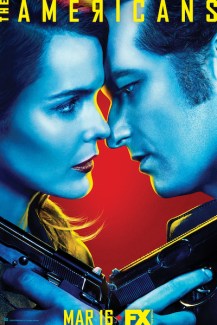
    The AmericansThis month, I have mostly been missing season four of The Americans, aka the most underrated drama on television. Well, apart from with critics, that is, who’ve given this run 100% on Rotten Tomatoes. I don’t know if anyone bothers to air it over here anymore (ITV ditched it after the second season), but I’ve always got it via other means anyhow, so it’s a moot point for me. I also save it all up and binge over a couple of weeks, because it really suits it — in the same way it suits, say, Game of Thrones, but as no one watches The Americans it’s much easier to avoid spoilers. This year, that means I won’t get stuck into it until sometime in June. Can’t wait. Well, I can, because I am. But you know what I mean.

    Next month… Game of F***ing Thrones returns!