Silent Shorts Summary

As well as all the unreviewed feature films in my ridiculously-large backlog (see the Archive 5 series for more on that), there are also a load of short films from the past few years that I haven’t reviewed.

Today, I’m taking a step towards putting that right, by bundling together all the silent shorts I watched between 2020 and today. In original chronological order, they are…

  • Sherlock Holmes Baffled (1900)
  • The One-Man Band (1900)
  • The Infernal Cauldron (1903)
  • Life of an American Fireman (1903)
  • The Consequences of Feminism (1906)
  • The Dancing Pig (1907)
  • Frankenstein (1910)
  • What! No Spinach? (1926)


    Sherlock Holmes Baffled

    (1900)

    Arthur Marvin | 1 min | digital (SD) | 4:3 | USA / silent

    Sherlock Holmes Baffled

    This is noteworthy for being the first film to star Arthur Conan Doyle’s immensely popular sleuth, but it’s an “in name only” appearance by the Great Detective. In fact, he’s not named on screen, so maybe “in costume only” (a dressing gown and pipe) would be more accurate. The actual film is nothing to write home about, either: it’s a 30-second skit, built around showing off then-cutting-edge filmmaking tricks, i.e. using editing to allow a burglar to disappear and reappear out of thin air. No wonder Holmes is baffled.

    It’s only really of interest as a curio to fans of early cinema or Sherlock Holmes on screen, even if the latter is only invoked as a hook to attract viewers. Although, I feel like the fact the first Sherlock Holmes film was basically a spoof is somehow significant…

    2 out of 5


    The One-Man Band

    (1900)

    aka L’Homme orchestre

    Georges Méliès | 2 mins | digital (SD) | 4:3 | France / silent

    The One-Man Band

    Using the magic of cinema to take the title literally, in this short director Georges Méliès clones himself seven times over to create a musical septet (plus conductor).

    Even having the idea to do this kind of visual stunt for the first time is obviously impressive — there’s no doubt that Méliès was an extraordinary innovator — but pulling it off with such technical competency… that could be tricky today, never mind in 1900, when you couldn’t check your footage lined up, nor just do another take if it didn’t, never mind the array of computer tricks (split screen, time ramping, reframing, etc) that could be deployed to make it work nowadays. Here, Méliès was doing multiple exposures on the same strip of film; the original negative — imagine if you messed up on the seventh go-round!

    And even with all that, it’s not just an exercise in technique; not just a technical demonstration for those interested in the possibilities of motion pictures. You can set all that aside and still find an entertaining and amusing short — with a couple of extra gags thrown in at the end for good measure. Genius.

    4 out of 5


    The Infernal Cauldron

    (1903)

    aka Le chaudron infernal

    Georges Méliès | 2 mins | digital (SD) | 4:3 | France / silent

    The Infernal Cauldron

    A few years later, and Méliès’s work is looking more extravagant — there are sets! Costumes! Props! Colour! Hand-coloured, of course, and the result is glorious. The colours are not only incredibly stable (you’d expect some flicker or judder on static elements from frame to frame, but nope), but they really add to the atmosphere. The sickly green demons and burning red & orange flames really leap off the screen, making the unreality of it that bit more tangible. This would be so much less effective in pure black-and-white. It’s less like a flickering clearly-fake old film, more like a nightmare. You can kinda see how people at the time might’ve believed stuff like this was real. I mean, how else do you explain those ghosts, hmm? (Okay, obviously they’re a double-exposure effect; but it holds up well. Certainly better than the cardboard-cut-out props.)

    Intriguingly, there’s a 3D version of the film — a real, authentic one! To quote wholesale from Wikipedia: “In order to combat piracy, Méliès … began producing two negatives of each film he made: one for domestic markets, and one for foreign release. To produce the two separate negatives, Méliès built a special camera that used two lenses and two reels of film simultaneously. In the 2000s, researchers at the French film company Lobster Films noticed that Méliès’s two-lens system was in effect an unintentional, but fully functional, stereo film camera, and therefore that 3D versions of Méliès films could be made simply by combining the domestic and foreign prints of the film. Serge Bromberg, the founder of Lobster Films, presented 3D versions of The Infernal Cauldron and another 1903 Méliès film, The Oracle of Delphi, in January 2010 at the Cinémathèque Française. According to film critic Kristin Thompson, ‘the effect of 3D was delightful … the films as synchronized by Lobster looked exactly as if Méliès had designed them for 3D.'” They were screened again in 2011 and, at least as far as Wikipedia can explain, that was the end of it. To which I say: argh! I really want to see them! A 3D Blu-ray release would be lovely; but, as these screenings happened over a decade ago, I can’t say I’m holding out much hope…

    4 out of 5


    Life of an American Fireman

    (1903)

    Edwin S. Porter | 6 mins | digital (SD) | 4:3 | USA / silent

    Life of an American Fireman

    Although fundamentally a remake (or ripoff, depending how you look at it) of the earlier British film Fire!, Life of an American Fireman has found a place in film history (it even merited coverage in Mark Cousins’s The Story of Film: An Odyssey) for two reasons: firstly, for pioneering the technique of cross-cutting, a major and significant development in film editing; secondly, for not actually having done that at all.

    “Huh?”, you may well exclaim. Well, although for a long time the short was admired for its innovation, research by the Library of Congress eventually revealed that the film was re-edited sometime after its release (possibly in the 1930s or ’40s), and the original version actually played the action out twice, without the all-important cutting back and forth. Viewed in that original version, I’d argue to a modern audience it’s more confusing having the same sequence twice back to back — nowadays we expect intercutting of action, so it’s initially disorientating when the film cuts to outside the house and starts the same sequence of events over again. Perhaps more importantly, watching it twice over feels redundant: the second version adds no new information; and, being outside the house, thus distanced from the threat of encroaching fire, it’s less dramatic than the inside sequence. And that’s not to mention that the timeline doesn’t add up: the fireman is in and out of the window much more quickly during the inside version than the outside version.

    Despite all that, this does remain one of the earliest American narrative films, bringing together various innovations that had occurred in the early years of film — primarily, constructing a continuous narrative across multiple shots and scenes. It just wasn’t the first film to do, well, anything.

    3 out of 5


    The Consequences of Feminism

    (1906)

    aka Les Résultats du féminisme

    Alice Guy | 7 mins | digital (SD) | 4:3 | France / silent

    The Consequences of Feminism

    Imagine a crazy world where men did housework and looked after the children, while women lazed around drinking, smoking, and cajoling innocent young men into the bedroom. What larks! But such horrors might come to pass if we let those pesky women have their way.

    Such once-implausible things are depicted in Alice Guy’s 1906 short. Consequently, this is the kind of film that might be described as “of it’s era” — although, said era probably extended another six or seven decades. I can’t cite any specific examples, but I feel like “wouldn’t it be hilarious if men behaved like women?” sketches were still being done in the ’60s and ’70s, if not even more recently. So, it’s less that it’s dated, more that it shows Guy was ahead of her time. I mean, the film dates from before women even had the vote, yet she has the chutzpah to imagine men taking on women’s roles and women enjoying leisure time. Scandalous!

    Considering the short was made by a pioneering female filmmaker, we can but assume it’s all satirical; that its very point is “the consequences of feminism” would not, in fact, be the ridiculous role-reversal presented here. But, in that context, the ending is quite interesting: the men force the women out of the bar and raise a toast. Are we supposed to read that as the natural order being restored? More likely, it’s meant to signify these men achieving equality with women; that Guy’s point is, “if men were in women’s situation, they’d want to change it, too.”

    4 out of 5


    The Dancing Pig

    (1907)

    aka Le cochon danseur

    4 mins | digital (HD) | 4:3 | France / silent
    The Dancing Pig

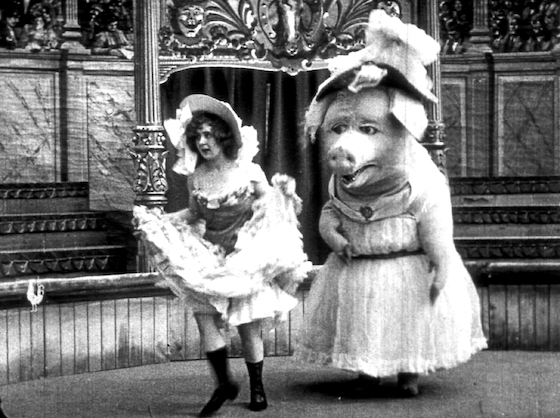
    Apparently this had fallen into obscurity for a century or so, when it was revived as an internet meme because of “its creepy atmosphere”. Certainly, stills from the final scene (a closeup of the pig’s head, with vicious teeth and an oscillating tongue) look weird and freaky; and I guess if you slapped an ominous horror-movie-esque score across the whole short then it would become freakish in its entirety. But it was originally a vaudeville act, and with the jaunty score that usually accompanies it, it remains just that: a couple of minutes of daftness.

    As such, I can hardly recommend it. It’s a curio of a past era, and while there’s undoubtedly value in preserving such things for historical interest, that’s still all it is.

    2 out of 5


    Frankenstein

    (1910)

    J. Searle Dawley | 13 mins | digital (HD) | 4:3 | USA / silent

    Frankenstein

    The first screen adaptation of Mary Shelley’s novel is such a thorough retelling in just 12 minutes, it almost makes you wonder what takes other versions so long. But what it gains in brevity, it loses somewhat in filmmaking craft: every scene is shown only in a theatrical static wide shot. It’s not entirely without interest, though: one setting places a full-height mirror screen right to enlarge the set by showing us what’s behind the camera to the left, and it’s surprisingly effective, especially when it’s used for a bit of fun cinematic trickery.

    The film’s big set piece is the creation of the Monster; not from stitched-together body parts, as is usually the case, but some kind of ‘magic potion’ that makes it emerge from a cauldron, growing and forming before our eyes. The effect was achieved by burning a puppet and then reversing the film, but, rather than presenting an unbroken take, instead the film cuts back and forth to Frankenstein observing and, frankly, skips over what I imagine were the most effective bits. For example, we see the vague outline of a human figure emerge, then cut to Frankenstein, then cut back to see it fully-formed. Would it not have been better to see the Monster’s features ‘melt’ into being amongst the flames? Oh well.

    Frankenstein was thought lost for decades, until a single print was found in the ’70s. Imperfect it may be, but it remains a significant milestone in the history of horror cinema.

    3 out of 5


    What! No Spinach?

    (1926)

    Harry Sweet | 19 mins | Blu-ray | 1.33 | USA / silent

    What! No Spinach?

    Included as a special feature on the Masters of Cinema Blu-ray of Buster Keaton’s Seven Chances, this little-seen* comedy short, directed by and starring Harry Sweet, “riffs on a number of elements from Seven Chances”, to quote MoC’s blurb. I’d say it’s less a riff on Seven Chances, more a brazen rip-off. It has moments of amusing physical comedy, but it lacks Keaton’s originality or heart. At least it’s brief, although that doesn’t mean it feels whole: rather than ending, per se, Sweet seems to run out of ideas and the film just stops.

    Also, it has nothing to do with spinach.

    3 out of 5

    * I couldn’t find a single photo or image from this short online. That there now are some on certain movie databases is because I uploaded screen grabs I took for this review (even editing some into a ‘poster’ for the sake of TMDB/Letterboxd). ^

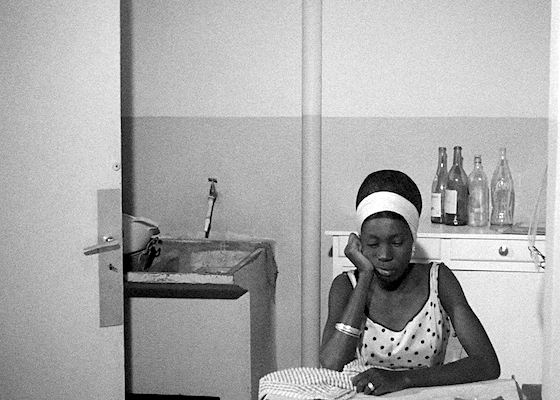
  • Black Girl (1966)

    aka La Noire de…

    Ousmane Sembène | 59 mins | Blu-ray | 1.33:1 | Senegal & France / French | 15

    Black Girl

    Let’s be upfront about this: I’m a middle-class Western white man who herein will be critiquing a film made by a black African filmmaker about the life of a black African character. I’m stating this baldly because I wouldn’t want anyone to think I wasn’t aware of the potential connotations and pitfalls of that situation, especially as I’m about to challenge (what seems to me to be) the accepted reading of the work in question. Spoilers follow.

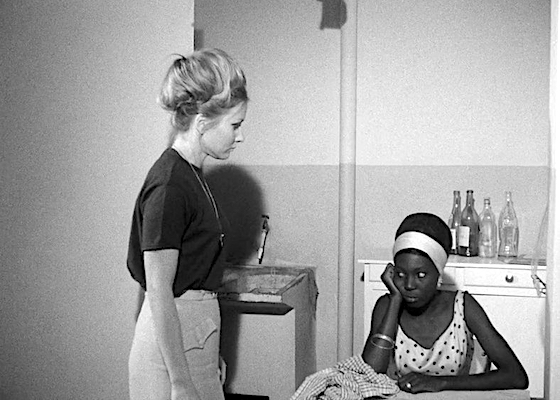
    Believed to be the first feature film made by an indigenous black person from sub-Saharan Africa, Black Girl is the story of Diouana (Mbissine Thérèse Diop), a Senegalese women who is looking for work as a maid and finds employment babysitting the children of a French family. When they return to France, she is the only servant to travel with them; but the glamorous life on the Riviera that she’d imagined turns out to be one of drudgery, confined to the couple’s apartment, the children now nowhere to be seen.

    What little I’d read about Black Girl beforehand led me to expect something about modern slavery; the eponymous black girl being mistreated by her white employers in such a way that, even though it’s the 1960s, she’s still basically a slave. Most of what I’ve read since viewing has confirmed that as the standard reading of the film. I’m not going to dispute that that’s one aspect of what’s there, but only the sum total of it if we take Diouana’s reactions and narration at face value. I mean, life in France is clearly not all she was promised; but she was looking for work as a maid and, while that wasn’t what she was doing for the family initially, the tasks they’re now asking of her don’t seem that out of step with a maid’s duties. And she gets paid for doing them. There is a period when Diouana complains (in her internal monologue) that she’s not getting paid, but the film is a little unclear on timescale — when the husband eventually gives Diouana her wages, it feels like payday has finally arrived, rather than that she’s been denied them for an unfair period of time.

    Equally, there’s no denying that the wife is a demanding and demeaning bitch; and when they have some guests round for a meal, there’s the kind of casual racism that white people like to dismiss as “fun and games”, but is still degrading in its own way. So, I’m not saying Diouana is wrong to be upset with how things have turned out, but I do think the interpretation that she’s subjected to modern slavery — as opposed to just unfavourable employment — is taking things a little too far.

    White bitch

    The key to how I interpreted the film is to realise that Diouana is more than upset — she’s depressed. Taken as a portrait of Diouana’s failing mental health, the film makes much more sense to me. Stranded in France with no one but her employers — thus, no one she can talk to honestly — her thoughts spiral round and round in her head, sinking lower, like some kind of self-fulfilling negative prophecy. It also made me wonder if we should consider Diouana an unreliable narrator. Almost the whole film is presented from her perspective, much of it via her thoughts in voiceover. So, for example, we’re told a lot about how bad her employer is before we see any sign of it; and we’re told what she was promised about France, but we never see those promises being made. Could it be she was offered to go to France, which she interpreted it as “you’ll get to see France”, but her employer never actually promised that? We don’t see the offer being made; we only have Diouana’s word for what she was promised.

    Going back to my opening clarification, I appreciate that this kind of analysis might lead some to accuse me of unconscious racism — as a white person, thinking the black character might be lying and the white people are alright really, despite the evidence. But I’m not saying they are alright — they’re clearly not treating Diouana with as much humanity as she deserves — and I’m not saying she is lying, just that the film doesn’t give us hard evidence to confirm it; we only hear her memory of events. Even then, I wouldn’t say she was “lying”, just that she’d misinterpreted the situation.

    Personally, that’s the only way what unfolds makes sense to me: that Diouana is misunderstanding things due to being mentally unwell. This is most relevant in how the story ends, with Diuoana taking her own life as her only route of escape — but, also, it’s the first route she takes. She doesn’t try to speak to her employers and improve her situation. Okay, maybe they wouldn’t listen, or she thinks they wouldn’t — it’s understandable not to even try under those circumstances. But she also doesn’t ask to be sent home. There’s no reason to think they wouldn’t agree to that — they’re not actually imprisoning her. They might not be pleased about it — they’ve brought her with them to do a job she was employed to do, after all — but that doesn’t mean they wouldn’t agree. Even if she thought they were holding her captive, she doesn’t attempt to escape. Sure, she’s in a foreign country and doesn’t know who to turn to — escape might not be easy — but it’s an option that doesn’t seem to cross her mind.

    Just upset, or clinically depressed?

    No, instead of any of that, she turns straight to death. As I see it, that’s the ‘logic’ of someone who’s mentally ill. That’s not someone who is merely unhappy with their situation and decides it needs to change; that’s someone who is mentally unstable and makes a bad choice. If she was genuinely enslaved — if her life was abusive and miserable and there was genuinely no other way out— then you could make an argument that, in those circumstances, taking your own life is a viable choice for escape. But that’s not the situation she’s in. Her life is not nice — it’s certainly not what she was hoping it would be — but it’s… fine? Like, other people might be content with that setup, especially if it was only temporary (we don’t know how long they’ve been in France, but the implication is weeks or a couple of months, at most; and it comes up that they might just go back to Dakar soon anyway). But instead of waiting it out, or asking to change it, or asking to leave, or running away from it, Diouana goes directly to the most final option.

    Now, maybe I’m projecting a modern understanding of mental health onto the film; but the alternative (that we’re supposed to think Diouana is wholly in the right and her actions are reasonable given the circumstances) doesn’t add up for me. This also raises the question of authorial intent: was Sembène intending to explore mental health, or was he focused on racism and colonialism? I haven’t read any direct statements from him, but certainly most critics assume the latter. Normally I’m happy to write off authorial intent (“death of the author” ‘n’ all that), but I think authorship is particularly important in this case (being that it’s the first film by a black African director about the black African experience). To be honest, I don’t know for sure what he was intending — I haven’t seen any direct statements by Sembène — but the film as a whole is well-made, nicely shot and intelligently constructed (for example, using flashbacks for a nonlinear narrative), with characters who seem plausible rather than caricatures in aid of a political point. All of which is a roundabout way of saying that I think it stacks up as a psychologically-accurate depiction of someone in that situation, whether it was consciously made to be about mental health or not.

    4 out of 5

    Black Girl is the 7th film in my 100 Films in a Year Challenge 2023. It was viewed as part of Blindspot 2023.

    2023 | Weeks 3–4

    “Wait, did I miss Weeks 1 and 2?”, you may have asked yourself upon seeing this post pop up wherever you see my posts. And the answer is: no, I missed them, because I failed to watch a single film in either Week 1 or Week 2 of 2023. Most extraordinary.

    Anyway, I wrote about that in January’s monthly review, so let’s get on with reviewing. I will note that I’ve skipped a couple of films from these weeks. Normally I only do that when I’ve already written their review and it’s long enough I feel it should be posted solo. I haven’t formally started writing about either The Girl Who Knew Too Much or Black Girl yet, but I have an inkling they’re both going to be quite long (the latter, definitely), so I’ve set them aside for the time being. Which leaves us with…

  • The Magician (1926)
  • Glass Onion (2022)
  • My Year of Dicks (2022)
  • Shotgun Wedding (2022)
  • The Banshees of Inisherin (2022)


    The Magician

    (1926)

    Rex Ingram | 80 mins | Blu-ray | 1.33:1 | USA / silent

    The Magician

    Based on W. Somerset Maugham’s novel, itself inspired by the antics of real-life occultist Aleister Crowley, The Magician concerns a mad scientist, Oliver Haddo (Paul Wegener), trying to complete an alchemical spell to create life by kidnapping a pretty virginal sculptor, Margaret (Alice Terry), so he can cut out her heart and use her blood. But why just kidnap a young woman when you can hypnotise her into marrying you? And why just kill her when you can use your hypnotic control to, er, take her gambling in Monte Carlo and make lots of money?

    Wait, what?

    Yeah, The Magician is kind of an odd film. Whether that’s due to Maugham’s original work and his desire to write a takedown of Crawley, or if it was the impetus of director Rex Ingram fancying a jolly around Europe with his wife, who he’d cast in the lead female role, I don’t know. Either way, the varied asides (before the eponymous Haddo even turns up, Margaret is paralysed in a sculpting accident and goes for experimental surgery to get it fixed) slow the pace, possibly to pad out what is really quite a slight story. On the other hand, there are some atmospheric sequences scatted throughout, like a demonstration of Haddo’s powers at a snake charming show, or a devilish orgy (yes, you read that right; no, it’s not at all shocking by modern standards). Plus, as if to balance out all the stuff with dark magic, Ingram finds room for dashes of humour, giving a bit of texture and stopping the film from becoming too self-serious.

    However, The Magician remains most noteworthy today as a stylistic precursor to Universal’s initial run of horror movies in the early ’30s — James Whale’s Frankenstein, in particular, seems to have taken some cues from this film’s climax. It’s a fairly entertaining melodramatic fantasy-horror in its own right, but is primarily worth a look for those interested in the early development of the horror genre in Hollywood, or for silent movie fans who’d like something with a supernatural edge. General audiences are probably fine sticking to the established classics it influenced.

    3 out of 5

    The Magician is the 1st film in my 100 Films in a Year Challenge 2023.


    Glass Onion

    (2022)

    aka Glass Onion: A Knives Out Mystery

    Rian Johnson | 139 mins | digital (UHD) | 1.85:1 | USA / English | 12 / PG-13

    Glass Onion

    In some respects, Glass Onion delivered a movie closer to what I’d been expecting from the first Benoit Blanc mystery, Knives Out; that is to say, a proper murder mystery that is also unabashedly a comedy. Don’t get me wrong, I found Knives Out amusing — even more so with subsequent rewatches — but it has a kind of dry humour, with a wit more likely to raise a wry smile of acknowledgement than a guffaw. Glass Onion surely has such moments too, but it also has big, broad laughs that stand out more on a first viewing.

    The mystery at its core remains a true Christie-style puzzler, with enough about-turn twists to keep you off balance — you can try and guess what’s going on if you want, but it’s just as much fun to be swept along for the ride — but the surrounding material is satirical almost to the point of parody. Kate Hudson’s airhead influencer is more caricature than character, for example, while there’s no doubt that Edward Norton’s billionaire is a merciless pisstake of Elon Musk. That’s annoyed certain right-wing commentators. The rest of us can just enjoy the accurate pillorying.

    This overall shift in tone will, I think, dictate which of the two movies viewers prefer — i.e. whichever one hews closer to your personal taste. On the other hand, maybe you’ll be like me, and enjoy them both for their own particular quirks. I’ve already watched Knives Out three times, so I’ll have to watch Glass Onion a couple more to make any kind of fair comparison. Fortunately, I intend to.

    5 out of 5

    Glass Onion placed 1st on my list of The Best Films I Saw in 2023.


    My Year of Dicks

    (2022)

    Sara Gunnarsdóttir | 26 mins | digital (HD) | 1.78:1 | USA & Iceland / English

    My Year of Dicks

    One of the standout moments of this year’s Oscars nominations announcement was when Riz Ahmed read out the Best Short Animation nominees, thus having to proclaim “My Year of Dicks” to the world — especially as it was immediately followed by “An Ostrich Told Me the World Is Fake and I Think I Believe It”. Only one of those is currently available to watch online, so I did.

    The autobiographical story of screenwriter Pamela Ribon trying to lose her virginity in early-’90s Texas, My Year of Dicks unfolds across five vignettes, each telling a different (but connected) story of sexual misadventure. The chaptered structure gives away that this is kinda five short films strung together; but they’re also a series, with a definite through-narrative (if you’ve ever watched any narrative film before, you’ll easily spot the early supporting character who’s destined to have greater significance). So, while it doesn’t fully work as a single ‘film’ (it feels like binge-watching a series of short episodes), there is at least a reason to lump them all together as a unit.

    The parts are further differentiated by employing a variety of animation styles to depict Pam’s fantasies and inner feelings. It’s an effective use of the medium to help overcome the fact that the actual stories are relatively rote “coming of age” tales. The most successful of all is the excruciating “sex talk” with Pam’s dad, in which a bombardment of animated self destruction reflects the desire for escape we’re all feeling at that point.

    As a story based around female sexuality, My Year of Dicks has an air of timeliness about it. Equally, it feels like such barriers have been continually been being broken down for the past 20 or 30 years now; in which case, one does wonder if its success has as much to do with the amusement value in seeing that title on the Oscar short list as it does the film itself.

    3 out of 5

    You can watch My Year of Dicks for free on Vimeo.


    Shotgun Wedding

    (2022)

    Jason Moore | 101 mins | digital (UHD) | 2.39:1 | USA / English | 15 / R

    Shotgun Wedding

    Jennifer Lopez and Josh Duhamel are about to get married in front of their family and friends at a remote tropical resort when pirates turn up demanding a ransom. Action and hilarity ensue. How exciting the action and how hilarious the hilarity is where opinions may differ.

    For my money, the end result is a perfectly serviceable star-driven action-comedy. It’s the kind of middle-of-the-road, made-for-date-night fare that people keep bemoaning we’re losing thanks to Marvel’s box office dominance, even though Hollywood actually seems to keep making them (for another example from just last year, see The Lost City), and they get fairly widely slated every time one actually comes out.

    Okay, the vast majority of the film’s funniest ideas and moments were in the trailer (heck, the way the first promo was edited to make the film look like a rom-com, only to about-turn into an action movie, is probably the best gag associated with the entire project), but the film itself has held back a couple of laugh-worthy moments, and even a few plot twists. No wheels are reinvented, but it’s fine as bit of non-demanding, Friday-night, never-going-to-watch-it-again, easy viewing.

    3 out of 5

    Shotgun Wedding is the 5th film in my 100 Films in a Year Challenge 2023.


    The Banshees of Inisherin

    (2022)

    Martin McDonagh | 114 mins | digital (UHD) | 2.39:1 | Ireland, UK & USA / English | 15 / R

    The Banshees of Inisherin

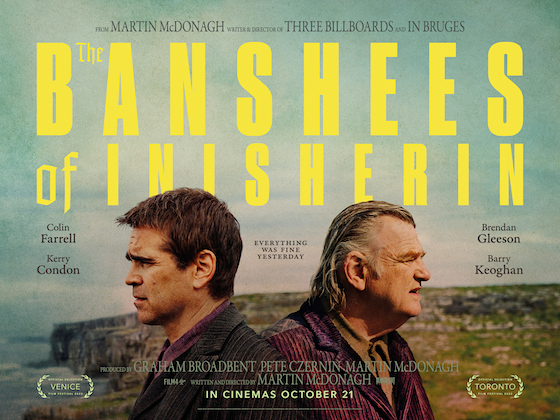
    The new film from the writer-director of Three Billboards reunites the star pairing from his first movie, In Bruges, for an altogether different — but equally as hilarious — tale of two Irishmen. Here, Colin Farrell and Brendan Gleeson play lifelong friends on a small island off the coast of Ireland in the 1920s; that is until one day Gleeson decides he just doesn’t like Farrell anymore. Cue a serious of escalating encounters as Gleeson tries to get his former mate to just leave him be.

    After the quite heavy, discourse-provoking narrative of Three Billboards, Banshees feels somewhat like McDonagh heading for smaller-scale, less contentious waters. Not that I think he’s running in fear — he doesn’t seem like one to avoid confrontation or provocation around his art — but I think that Banshees feels more of a piece with Bruges, in that it’s focused on just a handful of characters and their fairly everyday lives. That said, things do get a bit… outrageous; and the Irish civil war is ticking away on the mainland, suggesting at least one thematic interpretation of the friends’ fallout. That’s not to mention the subplots involving Farrell’s sister outgrowing her place on the island, or the woes of the local village idiot (played superbly by Barry Keoghan) and his abusive father, who happens to be the island’s policeman.

    All of which might begin to sound a bit serious. But then, juggling life-and-death issues and hilarity is almost McDonagh’s trademark. Indeed, the film’s biggest laugh is related to the story of a woman’s death; meanwhile, its saddest moment involves not the abuse or self-mutilation of any of the human characters, but rather the fate of a beloved animal (that might read as a spoiler, but I consider it fair warning for animal lovers). In viewing, it’s consistently very funny, but creeps up on you with Stuff To Think About, too. I enjoyed it a lot; maybe not as much has In Bruges or Glass Onion (no relatable comparison there other than I watched them both this month), but enough that my score rounds up.

    5 out of 5

    The Banshees of Inisherin is the 6th film in my 100 Films in a Year Challenge 2023.


  • January’s Failures

    I can’t speak for the whole country, but Avatar: The Way of Water seems to have still been the big title at the cinema here throughout January. By which I mean, my local still had it on their largest screen in most of the prime time-slots. But then, there’s been nothing else truly “blockbustery” to challenge its need for the grandest scale possible. There have been significant releases, sure; and there’s always the “every film should be seen on the biggest screen possible” argument; but nothing else came out in January that’s so expressly about visual spectacle. Any crowdpleasers that have turned up — horror M3GAN; Gerard Butler vehicle Plane; Tom Hanks comedy A Man Called Otto — hardly feel of the same scale.

    I use the term “crowdpleasers” to differentiate those films from most of the UK’s January release slate, which is, as usual, dominated by awards season stuff that we’ve had to wait for: Babylon, Empire of Light, The Fabelmans, Tár, Till… Plus, limited releases that caught my eye included the new one from Mark “Bait” Jenkin, Enys Men (out on Blu-ray from the BFI in June), and Iranian thriller Holy Spider (which will be on MUBI in March and Blu-ray in April).

    The streamers also seemed to be mainly trading in hangovers from last year, with Netflix releasing starry period mystery-thriller The Pale Blue Eye (reaction seems to have been mixed, but it looks really good), Amazon Prime offering Emma Thompson sex drama Good Luck to You, Leo Grande, Disney+ generating plenty of discourse with The Menu, and even MUBI getting in on the act with awards contender Aftersun. Netflix did premiere a few brand-new things, though I’ve not come across a single mention of Bank of Dave, word has been poor about race/generation-based comedy You People, and the new sci-fi from Train to Busan writer-director Yeon Sang-Ho, JUNG_E, didn’t receive strong notices either. This is why I ended up watching Shotgun Wedding as my new film for January…

    There was the usual mass of catalogue additions across all the streamers to bulk out my never-ending watchlists. Particular titles of note included, believe it or not, Rob Zombie’s 2007 remake of Halloween, which I only note because it was on my first-ever list of 50 missed films but, in the intervening decade-and-a-half, I’m not sure I’ve ever seen it on a streaming service before. Maybe it’s a sign I should give it a go. Maybe not. That’s on Netflix, along with The Man with the Iron Fists 2 (I liked the first one enough to put the second my watchlist, but not enough to rush to see it, clearly), Mars One (I’ve actually no idea what this is, but it keeps coming up on my Letterboxd under “popular films you’ve not seen”), and Vesper (a low-budget British young-adult sci-fi that I heard about somewhere and sounded quite good). Moving on to Amazon Prime were Judas and the Black Messiah and Mortal Kombat (the recent one), while I was surprised that Sky Cinema became home to David Cronenberg’s Crimes of the Future. I think I’ll wait for Second Sight’s 4K disc release, thanks.

    A couple of the streamers boasted themed seasons this month. MUBI had a run of debuts, featuring filmmakers as diverse as Rainer Werner Fassbinder (Love Is Colder Than Death, an awesome title) and Paul W.S. Anderson (Shopping). All 4 have had a run of Steven Spielberg’s major works, all of which I’ve seen, but it did remind me that I bought his brilliant The Adventures of Tintin in 3D yonks ago and still haven’t got round to watching it. Plus I loved it, so it’s long overdue a rewatch anyway.

    Talking of purchases, of course my habit continued unabated throughout January. It began with some hangovers from last year — orders from the US and Australia that took longer than expected to turn up, thanks to postal strikes and general season delays. From Oz, some new Imprint titles, including the second volume of their After Dark: Neo-Noir Cinema series, ’50s post-apocalyptic sci-fi On the Beach, and Akira Kurosawa’s Russian feature, Dersu Uzala. My order from the US was an even more ragtag bunch, starting with a few recent classic 3D releases: The Diamond Wizard and I, the Jury, the latter of which also comes with an apparently-underwhelming 4K copy. Also on 4K were George Miller’s latest, Three Thousand Years of Longing, Kino’s release of The Usual Suspects (which I never bought on Blu, so that’s a healthy upgrade), and, on something of a whim, Shout’s The Company of Wolves. Also in the box were a couple of titles I’ve had on standby for a while ready to bulk out a US order: Criterion’s edition of Harold Lloyd’s The Freshman and Warner Archive’s release of A Night at the Opera. Finally, the US-only “yellow” set from Arrow’s Giallo Essentials range, which includes Strip Nude for Your Killer, Torso, and What Have They Done to Your Daughters?

    I was buying that anyway, but after deciding to make gialli a category in my 2023 Challenge, I also picked up a couple more titles that caught my eye while going through lists of the genre; namely, Death Laid an Egg and The Strange Vice of Mrs Wardh. Those were both UK releases; I’ve got my eye on a couple more next time I do a US bulk order. I also upgraded my copy of Arrow’s Phenomena to the 4K version, having noticed that some of their Argento 4K sets are beginning to go out of print (replaced by standard editions, at least) and this one did look like a noticeable upgrade (I didn’t bother with Bird with a Crystal Plumage because it didn’t seem that big a jump from the existing Blu-ray).

    There’s normally a trickle of 4K titles in these failure posts, and I’ve already mentioned six, but there were even more this month: Arrow’s recent-ish reissue of Silent Running; Jordan Peele’s Nope on offer; similarly, the Bad Boys trilogy and Ridley Scott’s Robin Hood all in a 2-for-1 type deal; plus nice editions of The Green Mile and Reservoir Dogs (the Steelbook with the slipcover that makes his ear come off. Hilarity). Finally, the second volume of the Alfred Hitchcock Classics Collection, which I’d intended to get at some point anyway, but was on a reasonable offer and includes Shadow of a Doubt, which I’ll be watching sometime this year for WDYMYHS.

    All those titles — so, so many titles — and I don’t think I’ve mentioned a single brand-new release yet. Most notable there is my first batch of titles from new label Radiance, all of which are blind-buy punts (well, so is an awful lot of what I buy, to be fair, but I don’t think I’d even heard of any of these before I dived in). They include yakuza classic Big Time Gambling Boss, Palme d’Or-winning social drama The Working Class Goes to Heaven, ‘lost’ ’60s serial killer thriller A Woman Kills, and a crime comedy from the director of the brilliant Grosse Pointe Blank, Miami Blues. They’re all very handsome editions, so hopefully the content lives up to the thoughtful packaging. I’ve already got a few more of their releases on preorder.

    Talking of preorders turning up, I spent far too much money in All the Anime’s pre-Christmas preorder announcements/sale, but its finally beginning to bear fruit, with Liz and the Blue Bird and The Deer King both turning up (weeks before their official dates) this month. I didn’t realise the former was a spinoff from the series Sound! Euphonium — I’ve heard of it (and decided to buy it) because it’s a staple of the mid-range on Letterboxd’s official list of the 100 highest-rated feature-length animated films. I was briefly worried (“will I need to have seen other stuff to ‘get’ it?”), until I remembered the Letterbox list explicitly excludes “sequels to shows or anime series […] that need greater context before watching are not included”. Phew!

    Finally, in the new-new pile we can also find Eureka’s editions of Sergio Sollima Spaghetti Western Run, Man, Run and — last but not least, one of the film’s in this month’s header image — Michelle Yeoh actioner Royal Warriors.

    The Late-Blooming Monthly Review of January 2023

    Ladies, gents, and everyone else, even in my 17th year, 100 Films continues to break records. I mean, they’re my own records — hardly anything that’s going to end up in that famous alcohol-branded tome of achievements — but you might think that, after a decade and a half of doing this, everything would be in some kind of rhythm, and/or that the extremes had already been explored and set. Not so!

    So, what is January 2023’s claim to fame? It’s… my latest start ever! That is to say, the furthest into the year that I’ve watched my first film.

    Okay, not a particularly auspicious accolade. Nor a “good” one, really. And certainly not a difficult one to beat, if I so choose — if there’s anything easier to do than “watching films”, it’s “not watching films”. But still, it’s something different to witter about in an introduction, so why not?

    And it wasn’t one of those “technically a new record” where it goes just a little beyond the old one, either. My previous latest start was back in 2011, when I didn’t watch my first film of the year until January 10th. This year, it took all the way until the 19th. What happened? A mix of things. Focusing on getting 2022 wrapped up, first of all. Then planning out my 2023 Challenge and associated lists (Blindspot, WDYMYHS). The start of January turned out to be a busy period at my day job, too. And then my first few weekends of the year got eaten up by family commitments, to boot.

    Anyway, all that’s behind me and I’m underway now — although the late start did hamper at least one of my viewing goals…


    This month’s viewing towards my yearly challenge

    #1 The Magician (1926) — Failures #1
    #2 Streets of Fire (1984) — Rewatch #1
    #3 7500 (2019) — Wildcard #1
    #4 The Girl Who Knew Too Much (1963) — Genre #1
    #5 Shotgun Wedding (2022) — New Film #1
    #6 The Banshees of Inisherin (2022) — Wildcard #2
    #7 Black Girl (1966) — Blindspot #1
    #8 The Goddess (1934) — Physical Media #1
    #9 Gun Crazy (1950) — WDYMYHS #1


    • I watched eight feature films I’d never seen before in January.
    • For years now, I’ve aimed for at least ten first-time watches each month. 2022 was a failure in that respect (seven months didn’t make it), and now 2023 isn’t off to a great start either.
    • Seven of those counted towards my 100 Films in a Year Challenge, along with two rewatches. That’s more positive, as it means I’m slightly ahead of target.
    • I also watched one short film: freshly Oscar-nominated My Year of Dicks. *schoolboygiggle*
    • This year’s Challenge is made up of nine categories, and I thought I’d got them all underway… until I released I’d forgotten Series Progression. Never mind.
    • The one new first-time-watch that didn’t count towards my Challenge was Glass Onion. I could’ve put it down as a Wildcard — an additional Failure — but I’m fairly certain I’m going to rewatch it before too long, so I’ve saved it for whenever that happens.
    • Instead, my first Wildcard of 2023 became a different rewatch: 7500. I wasn’t planning it, but I started the film to check something for my review (see the Reviews section) and ended up sucked in enough that I kept going. It’s a good film.
    • Updated rules mean I’ve also already logged my second Wildcard, and that was an additional Failure from December 2022: The Banshees of Inisherin.
    • This month’s Blindspot film was the first feature film made by an indigenous person from sub-Saharan Africa, Ousmane Sembène’s Black Girl.
    • This month’s WDYMYHS film was Bonnie and Clyde-esque noir Gun Crazy.
    • From last month’s “failures” I watched The Banshees of Inisherin, Glass Onion, and The Magician.


    The 92nd Monthly Arbitrary Awards

    Favourite Film of the Month

    The one film that didn’t count towards my Challenge was also my favourite of the month: the second Benoit Blanc mystery, Glass Onion. Note how I’m not using its “subtitle”. That’s because it’s not used in the film itself (only in the marketing), so doesn’t really count as part of the title. Some sites are coming round to this. Others… well, it’s provoked the usual kind of circular arguments in the Talk section of Wiki-bloody-pedia.

    Least Favourite Film of the Month

    No outright duds this month, in my opinion (others would disagree about Shotgun Wedding, but I thought it was fun lightweight Friday night fare). By a pip I give this to The Magician — as I say, not a bad film, and interesting for its influence on films that followed (James Whale was a fan and drew on parts of it for Frankenstein), but simply not as entertaining as everything else I watched.

    The Audience Award for Most-Viewed New Post of the Month

    Although by no means a big hit in itself (taking all posts into account, it came 46th), the most successful new post this month was my Best of 2022 list.


    Every review posted this month, including new titles and the Archive 5


    The shortest month of the year, and therefore the de facto most challenging to hit all my targets.

    What Do You Mean You Haven’t Seen These Films Noirs?

    My name for Blindspot before someone else created Blindspot, “What Do You Mean You Haven’t Seen…?” (WDYMYHS for short) works in the same way: 12 films I should have seen but haven’t, watched one a month throughout the year. (And these, too, contribute to my 100 Films in a Year Challenge.) To differentiate the pair, I now use Blindspot to focus on Great Movies™ I should have seen, whereas WDYMYHS takes a particular ‘theme’ each year. Last year, it was 1986. This year, it’s film noir.

    If you’re getting déjà vu, it’s because in 2022 film noir was the theme of my Challenge’s ‘Genre’ category. Why the jump from Genre to WDYMYHS? What makes that different? Well, when it was just a genre I was free to watch any noirs, and so I tended towards ones that were short or to hand, to facilitate easy viewing. That meant I didn’t make significant headway into the many highly-acclaimed noirs I’ve not seen. So, this year’s selection redresses the balance by being a list of some of the most important noirs I’ve never seen.

    First, the 12 films I’ve chosen, in alphabetical order. Afterwards, I’ll write a little about how and why I decided these are “important” noirs.


    Ace in the Hole

    Ace in the Hole

    The Asphalt Jungle

    The Asphalt Jungle

    Gun Crazy

    Gun Crazy

    In a Lonely Place

    In a Lonely Place

    The Killers

    The Killers

    Mildred Pierce

    Night and the City

    Night and the City

    Nightmare Alley

    Nightmare Alley

    Out of the Past

    Out of the Past

    Scarlet Street

    Scarlet Street

    Shadow of a Doubt

    Shadow of a Doubt

    Sweet Smell of Success

    Sweet Smell of Success


    Normally it’s Blindspot’s selection process that gets very technical while WDYMYHS is a bit more intuitive, but this year it’s the latter that has used various lists in an attempt to define its 12 films. Not that I got insanely technical with it — no need for Excel spreadsheets and formulae here. Instead, I cross-referenced a handful of key lists, and that got me results I was happy enough with.

    First, long-time readers of this blog may remember me referencing the book Pocket Essentials: Film Noir at one time or another in the past. It was the first book I bought after my interest in noir was piqued; a small, slim volume that’s mostly made up of a massive list of noir films. It’s still my go-to reference after watching a noir — to see if it’s in there, and see if there’s a rating (you can’t blame the book’s sole author for not having seen them all). Indeed, even though I now own some large and beautiful noir-related books (Taschen’s Film Noir: 100 All-Time Favorites immediately comes to mind, a book I really should spend more time with), Pocket Essentials is the only book I’ve referred to in forming this list. Before beginning that exhaustive list of every noir they could manage, the book highlights seven key titles for analysis. I’ve seen six of them, meaning the seventh — Alfred Hitchcock’s Shadow of a Doubt — went straight into my WDYMYHS selection.

    For the remaining 11, I looked to four lists. First up was TSPDT’s 100 Essential Noirs. (On TSPDT’s site, these 100 have been subsumed into the ongoing 1,000 Noir Films project. You can find lists of just the initial 100 on iCheckMovies and Letterboxd.) With a whopping 72 films I’d never seen (thus proving my point that there are many “essential” noirs I still need to see), I made it a requirement that a film had to be on this list to be included.

    The next two lists, which I considered equally, were IMDb’s Film-Noir Top 50 and the top 25 noirs of the ‘Czar of Noir’, Eddie Muller. Although both those lists are ranked, I ignored that in favour of which films were on both lists. Despite not having seen 30 films on the IMDb list and 20 on Muller’s, there were, as it turned out, just nine overlaps. They included the #1 film on Muller’s list, In a Lonely Place, but not my highest-ranked unseen film on IMDb’s, 6th placed White Heat; nor, indeed, the film ranked 2nd by Muller, Criss Cross. Funny stuff like that happens when you use multiple lists, which is part of why I do it so often.

    Anyway, adding those nine got me to ten. This is where the fourth and final list came in — though it wasn’t a list as such, more using other opinions as a decider. Going back to the 100 Essential Noirs, I sorted it by the ratings of Letterboxd users, and included the top two that weren’t already in. Those were Ace in the Hole (the 2nd highest that I hadn’t seen on both IMDb’s list and by Letterboxd ratings, but not on Muller’s list) and Mildred Pierce. The aforementioned White Heat missed out by one place.

    Or maybe it didn’t. Well, I mean, it did; but I also mean, maybe it will still end up included. I say that because, while normally Blindspot and WDYMYHS wouldn’t qualify for wildcards in my 100 Films Challenge (they’re lists of 12 films taking up 12 slots — there aren’t any to be wildcards), this year there sort of are spare films. In the case of Blindspot 2023, because it’s entirely based around the Sight & Sound poll, films from the rest of the list are allowed as wildcards. For WDYMYHS, as being on the 100 Essential Noirs was an entry requirement, I think the rest of that list should be eligible for wildcards. That’s quite a lot of possibilities (60, to be precise), but I probably won’t actually get round to any of them, so hey, why not?


    Blindspot 2023

    This is my 11th year doing a version of Blindspot (not to mention that various other bloggers do it too… or used to. Do other people still do this? Is there a whole world of it going on that I’m somehow cut off from? Or am I a lone proponent, still plugging ahead with a near-decade-old fad, because I really like it? I don’t know…)

    Anyway, if you somehow still don’t know what it is or how it works, the premise is simple: choose 12 films you should have seen but haven’t, then watch one a month throughout the year. (My 12 also contribute to my 100 Films in a Year Challenge.)

    Some people just choose their 12 films. I normally do it via an elaborate system of compiling “great movies” lists in various configurations to spit out some general consensus of which 12 well-regarded films I should watch next, rejigging which lists are included and how they’re factored in to provide new results each year. But 2023 is a bit different, thanks to a significant event last month: the publication of a new edition of Sight & Sound’s decennial 100 Greatest Movies poll, one of — nay, the most widely respected list of its kind among cinephiles. There were 27 films I hadn’t seen on the latest edition of the list — more than enough to fuel my Blindspot selections for this year.

    I’ll explain how I whittled those 27 down (it wasn’t a long process, but it’s more than just “the top 12”) after listing the films themselves. In the order they ranked in Sight & Sound’s poll, this year I must watch…


    Jeanne Dielman…

    Jeanne Dielman, 23, quai du Commerce, 1080 Bruxelles

    Beau Travail

    Beau Travail

    Cléo from 5 to 7

    Cléo from 5 to 7

    Close-Up

    Close-Up

    Au hasard Balthazar

    Au hasard Balthazar

    Shoah

    Shoah

    Killer of Sheep

    Killer of Sheep

    Fear Eats the Soul

    Fear Eats the Soul

    A Brighter Summer Day

    A Brighter Summer Day

    Pierrot le Fou

    Pierrot le Fou

    Tropical Malady

    Tropical Malady

    Black Girl

    Black Girl


    With just 12 slots but 27 films I hadn’t seen, obviously I had to pare the list down somehow. One method would’ve been to just take the 12 highest ranked — they’re meant to be the best of the best, after all. But that didn’t allow for the fact that, to be blunt, there were films further down the list that I was more interested in seeing. Another method would’ve been to run the 27 films through one of my usual list-of-lists calculations and see which 12 emerged victorious. But in a year where I’d simplified the selection process, it seemed silly to overcomplicated it again.

    So, here’s what happened: I already owned some of the films on disc; when the list came out, after I had a look at it, there were a couple of highly-ranked films that I’d already been considering purchasing, so I ordered them; and there were a few more that, for whatever reason, I felt compelled to, um, download. When I stopped to take stock of this flurry of activity, the number of films in my possession added up to 13. They weren’t necessarily the films I had envisioned being in my final 12 (for starters, two from the top 50 were missing), but there we were.

    The only remaining question: which to ditch? It was nearly Au hasard Balthazar. I wasn’t sure I’m ready for the “a donkey’s miserable life” movie. I’m still not. But this seemed as good a time as any to bite the bullet and get it seen. What about approaching it from the other angle — which had to be included? Well, I don’t think I’m going to like Jeanne Dielman, but I’ve felt I should watch it for some time now… and, more importantly, it’s #1 — of course #1 had to go in! Then there’s the ones I already owned on disc: Shoah, A Brighter Summer Day, and Black Girl (also Yi Yi, but that was on last year’s list, so I ruled it out on the presumption I’d watch it in December. Oops). Then, the ones I’d freshly ordered: Beau Travail and Close-Up. Even if I hadn’t bought them, both are among the top four I hadn’t seen.

    That just left narrowing the remaining seven downloads to six. I could talk you through my process, such as it was, on a film by film basis, but in the end it came down to a gut feeling. You can already see which films made it in — the loser, for what it’s worth, was Douglas Sirk’s Imitation of Life. I couldn’t really tell you why; it’s just what I decided.

    One other thing: I can’t usually have wildcards from Blindspot — it’s a list of 12 films taking up 12 slots; there aren’t any to be wildcards. But this year is an exception in that respect, too: I figure that, as the entire list is chosen from Sight & Sound’s list, then the 15 unchosen films were the only other eligible options, and therefore they could be eligible for wildcard slots. Disagree? Tough, it’s my game. Will I actually watch any of them, when getting through the 12 actual picks can be challenge enough some years? Maybe not. But the possibility is there.


    Before we leave Blindspot behind and head to “What Do You Mean You Haven’t Seen…?” (or, if you’ve come to this post second, before you head back to your life), here’s a dash of additional info. You see, just because these 12 films were all taken from the Sight & Sound list, that doesn’t mean they don’t contribute towards my completion of other lists — unsurprisingly, there’s some degree of overlap between different “great films” lists. So, in case you were curious (because I was), other key lists that some of these films appear on (at time of writing) include…

    TSPDT’s The 1,000 Greatest Films (16th edition) — all 12, ranging from 34th (Au hasard Balthazar) to 869th (Black Girl).

    BBC’s The 100 Greatest Foreign-Language FilmsJeanne Dielman; Beau Travail; Cléo from 5 to 7; Close-Up; Au hasard Balthazar; Shoah; Fear Eats the Soul; A Brighter Summer Day; Pierrot le Fou.

    BBC’s The 100 Greatest Films Directed by WomenJeanne Dielman; Beau Travail; Cléo from 5 to 7.

    iCheckMovies’s Most FavoritedJeanne Dielman; Close-Up; A Brighter Summer Day.

    Letterboxd’s Top 250 Narrative Feature FilmsJeanne Dielman; A Brighter Summer Day.

    IMDb’s Top 250 — nothing (can’t say I’m surprised).


    The All-New 100 Films in a Year Challenge, Mk.II

    Alright, here we go: after spending the first week of 2023 wrapping up 2022, it’s finally time to move on to the new year.

    For the 17th year in a row, I’m going to attempt to watch 100 films in a year. But, for the second year in a row, that’s not just any old 100 films: following on from last year’s grand re-envisioning of the challenge, it’s 100 films that fulfil certain categories and criteria. Those categories and criteria have undergone some changes, however — hence Mk.II.

    When I conceived of this new-style challenge, it was always my intention to vary the categories somewhat year by year (there was a reason last year’s goal of watching 12 film noirs came in a category called “Genre”, not “Film Noir”), but actually undertaking it for a year has thrown up a few pointers about how it could work better, or cases in which the rules needed to be clearer. Consequently, some of this year’s categories are mere refinements on what went before, while others are the same but with new contents, and a couple have been replaced wholesale for the sake of variety.


    The one rule that applies across all categories: a film can only count once. Sounds kinda obvious, but the categories are not mutually exclusive — I could watch a DVD of a film in this year’s genre that’s also part of a series, and technically that could count in any one of three categories. Similarly, if I rewatch a film that I’ve already counted, the rewatch can’t count. As a separate viewing, it sort of still fulfils the criteria, but I feel it’s better to have 100 totally unique films. (It also means I can accurately track my progress in a list on Letterboxd, whereas I couldn’t if repeats were allowed.)

    With that said, this year’s categories are…

    New Films

    x12. Any film that’s general release date (i.e. not festival screenings, etc) in the UK (i.e. not in the US, nor any other country) is between 1st January 2023 and 31st December 2023. Maximum one per month (but rolls over if I fail to watch one).

    Rewatches

    x12. Any film I’ve seen before (unless it’s already been counted in 2023’s Challenge). Maximum one per month (with rollovers, as above).

    Blindspot

    x12. Films I feel I should have seen, or that “great movies” lists tell me I should have seen. Not just any old films, but 12 films specifically chosen and named in advance. Designed to be watched one per month, but doesn’t have to be. I’ll name this year’s 12 in their own post soon. Teaser: the recent publication of Sight & Sound’s once-a-decade poll has had a significant bearing on this year’s choices…

    What Do You Mean You Haven’t Seen…?

    x12. Similar to Blindspot, in that they’re 12 specifically chosen films to be watched one per month, but these are all based around a theme. This year’s theme: film noir. “Hold up,” I hear you say, “wasn’t film noir a different category last year?” Why yes, it was 2022’s Genre. What’s different about it being 2023’s WDYMYHS theme? I’ll explain when I name the 12 specific films in their own post, soon.

    Failures

    x12. Every month, I list my “failures” — new releases or purchases that I failed to watch in the previous month. Sometimes, I catch up on some of them. Often, I don’t. Making it a Challenge category will hopefully force my hand. As with new films and rewatches, it’s a maximum of one per month, but rolls over if necessary.

    Genre

    x10. Any films from within a specified genre. Unlike most of the above categories, these can be watched at any time — maybe I’ll spread them throughout the year; maybe I’ll binge them all back to back. Most likely it’ll be somewhere between the two. This year’s genre: giallo.

    Series Progression

    x10. Any instalment in a film series I’m already watching (there’s a Letterboxd list of them here). If I start a new series, either by accident or choice, the first film can’t count, but any further films can. I thought about replacing this category, but while I’ve still got so many series on the go, I wanted to keep the incentive to push on with them.

    Physical Media

    x10. Last year, I had a whole category dedicated to DVDs, because I’ve got so many of them that I’ve never watched. Frankly, it’s a category I thought I’d change — but I have so many unwatched discs, it needs to stick around if it’s to make any serious dent in its purpose. However, I’ve widened it this year, because I also have a massive pile of unwatched 3D and UHD Blu-rays. So, not any physical media counts, just those three formats. I know that makes the category title inaccurate, but “DVDs and 3D Blu-rays and 4K Ultra HD Blu-rays” seemed unwieldy. As with genre and series films, these can be watched at any time.

    Wildcards

    x10. Last year, every category had 12 films, leaving an awkward four spare. My solution was to make them ‘wildcards’ that could be added to any category, thus turning a bug into a feature. That feature had the potential to be so useful that I’ve expanded it.

    You see, towards the end of 2022, the Challenge was dictating my viewing more than I would like. I wanted to catch up on recent releases, and also watch some Christmassy fare, but none of those films would have qualified for the Challenge, and I still had a couple of dozen films left to complete it, so I felt forced to watch DVDs and film noirs and so on instead. Okay, that’s partly my own fault for not getting on with them earlier in the year; but this new-style Challenge was always going to be a work in progress, so I thought that, for Year Two, I’d build in a potential fix. Hence: the revised wildcard category.

    As you can see, I’ve more than doubled the quotient, and I’m removing the limit of one wildcard per category (as there are only eight other categories, that wouldn’t work anyway). These ‘new’ wildcards still need to be attached to an existing category, but it can happen as often per category as I want (provided the category’s requirements have already been met, e.g. no 11th Genre film until I’ve filled the original ten). I imagine, therefore, that these will mostly get used on additional new films, perhaps rewatches and failures, but who knows? We’ll see how it goes… and change it again for 2024, if needs be.


    All that make sense? If not, let me remind you that you don’t really need to worry about any of this — it’s only me who has to work it out.

    As the year goes on, you can follow my progress on the Challenge Tracker page, and also via my monthly reviews; or there’s always my Letterboxd for the guaranteed most up-to-date status of my film logging.