The Header-Image-Forthcoming Monthly Update for June 2018

I’ve been an unexpectedly busy bee today, so I’ve only just finished putting together June’s monthly progress report this evening, without yet embarking on the header image — which take a surprisingly long time to create, so I’ll do that tomorrow.

[Edit: That lasted for five hours (during which the front page looked like this, fact fans) before I finished the usual style of header image. Much prettier.]

Anyway, here’s all the exciting lists and facts and stuff:


#125 The Post (2017)
#126 Power Rangers (2017)
#127 Three Billboards Outside Ebbing, Missouri (2017)
#128 Superman II (1980)
#129 A Monster Calls (2016)
#130 Nausicaä of the Valley of the Wind (1984), aka Kaze no tani no Naushika
#131 Rocky II (1979)
#132 Shrek Forever After (2010)
#133 Doubt (2008)
#134 Gaslight (1944)
#135 Zatoichi’s Revenge (1965), aka Zatôichi nidan-giri
#136 The Florida Project (2017)
#137 A Thousand and One Nights (1969), aka Senya ichiya monogatari
#138 Rocky III (1982)
#139 Sanjuro (1962), aka Tsubaki Sanjûrô
#140 National Lampoon’s Vacation (1983)
#141 Swingers (1996)
#142 Amadeus: Director’s Cut (1984/2002)
#143 If You Meet Sartana… Pray for Your Death (1968), aka Se incontri Sartana prega per la tua morte
#144 Becoming Bond (2017)
#145 Dudes & Dragons (2015), aka Dragon Warriors

Three Billboards Outside Ebbing, Missouri

A Monster Calls

Sanjuro

.


  • I watched 21 new films this month. A step down from the last couple, but by any other measure a very good month indeed — that puts it in the top 10% of all months in 100 Films history. Some of those other measures follow…
  • For starters, it’s the best June ever, easily passing 2015’s 16 to become the first June with 20+ films. Only July, November, and December now haven’t had a 20+ month.
  • That’s the fifth month in a row with 20+ films, a new record. The previous best was four (obviously) from January to April 2016.
  • It also more than doubles the June average of 9.5, pulling it up to 10.5. That leaves just July and August with all-time averages below 10.
  • It passes the rolling average of the last 12 months too (previously 18.5, now 19.1), but not the average for 2018 to date (previously 24.8, now 24.2).
  • Plus, as mentioned last month, I watched a film on June 29th, leaving just half-a-dozen dates on which I’ve ‘never’ watched a film.
  • This month’s Blindspot film: Hayao Miyazaki’s environmentalist sci-fi Nausicaä of the Valley of the Wind, which I liked, but not as much as the thematically-similar Princess Mononoke.
  • This month’s WDYMYHS film: epic music biopic Amadeus, which, again, I liked, but not as much as everyone else seems to.
  • This month I finally achieved my first Platinum Award on iCheckMovies — that’s the level you get when you complete a list. The list in question was IMDb’s Sci-Fi one, which I finished off by watching Stalker last month and Nausicaa this month. That means I have now seen the 50 greatest sci-fi movies of all time… according to IMDb voters.
  • Because I don’t already have enough film series on the go, this month I added a couple more — namely, the Animerama trilogy and the Sartana series of spaghetti Westerns. Both came out on Blu-ray this month and I thought for once I ought to make an effort to actually watch stuff I was buying.


The 37th Monthly Arbitrary Awards

Favourite Film of the Month
Plenty of strong films this month, including multiple Best Picture nominees and winners, but my personal favourite was a sequel. Kneel before… no, not Zod (I’m afraid to say I found Superman II a disappointment), but Sanjuro, Akira Kurosawa’s entertaining follow-up to Yojimbo. (And if you want my pick of all those Best Pics, Three Billboards is a close runner-up for this category.)

Least Favourite Film of the Month
I’ve never been a fan of the Power Rangers franchise, but the reboot had some degree of promise with its Chronicle-esque setup. It doesn’t deliver, though: it takes too long for the superheroic-type stuff to turn up, and when it does it’s a cheesy cheap-CGI mess.

Most Initially Irritating But Then Surprisingly Addictive Song of the Month
This month’s comical earworms have included Rock Me Amadeus (sadly not included on Amadeus’s soundtrack) and Fanfare Ciocarlia’s version of the James Bond theme (which plays over Becoming Bond’s end credits). But the song I keep coming back to is Holiday Road by Lindsey Buckingham of Fleetwood Mac fame. It’s only two minutes long, which felt like forever when it played during Vacation’s opening credits, but now I can’t stop listening to it.

Best Title of the Month
I’ll come clean with you, dear reader: half the reason I bought Arrow’s Sartana box set was because the film’s titles are so good. If You Meet Sartana… Pray for Your Death is, literally, just the start.

The Audience Award for Most-Viewed New Post of the Month
I guess I haven’t been the most interesting blogger this month: the hit count for June was my lowest since November, and some 23% less than the average for the rest of 2018. Ah well. However, one post that wasn’t so afflicted was this month’s winner, whose view count within the month is second only to Avengers: Infinity War’s straight-into-my-all-time-top-ten tally from April. Said winner was my 34th TV review, which covered The Americans season 6, a few midseason episodes of Westworld, a bit of Archer, and the Car Share finale. (In a very, very, very distant second place was The Snowman.)



This month: a superhero movie that’s a bit like James Bond, a spy actioner that wishes it was James Bond, and a James Bond that’s a bit like James Bond but many people wish was proper James Bond.

#21 Black Panther 3D (2018)
#22 Mission: Impossible – Ghost Protocol (2011)
#23 What We Did on Our Holiday (2014)
#24 On Her Majesty’s Secret Service (1969)

I enjoyed Black Panther just as much on a rewatch. The 3D is quite mild, with only occasional moments or scenes that pop, but it was worth it for the scenes in the IMAX ratio, which often come with the appropriate grandeur. When they enter Wakanda for the first time and the image smoothly enlarges from 2.39:1 to 1.90:1… gorgeous.

Ghost Protocol remains a great action blockbuster. Previously I’d always thought the “different directors bring a different style” ethos of the M:I movies went out the window from M:i:III onwards, but, rewatching them all, I’m getting a much better feel for the stylistic differences between Abrams, Bird, and McQuarrie’s contributions. And talking of IMAX ratios on Blu-ray, I’m still cross at Bird for not including them here. The forthcoming Fallout will also have scenes with an expanded aspect ratio for IMAX screenings, and McQuarrie recently stated on Twitter that he intends for those to be retained on the Blu-ray. Fingers crossed.

Finally, On Her Majesty’s Secret Service is the first Bond film I’ve watched since seeing Spectre at the cinema, almost three years ago now! And the last one before that was a rewatch of Skyfall in February 2013, almost five-and-a-half years ago. Wow. Seems it’s long overdue that I reengage with a franchise that I love — and a Blu-ray boxset that’s 68% unwatched. In that respect, you could argue OHMSS resumes a chronological rewatch that I started in October 2012 and left off in January 2013, but I’m not sure five-and-a-half years counts as “a pause”, really.


“Your mission, should you choose to accept it — I wonder, did you ever choose not to?”
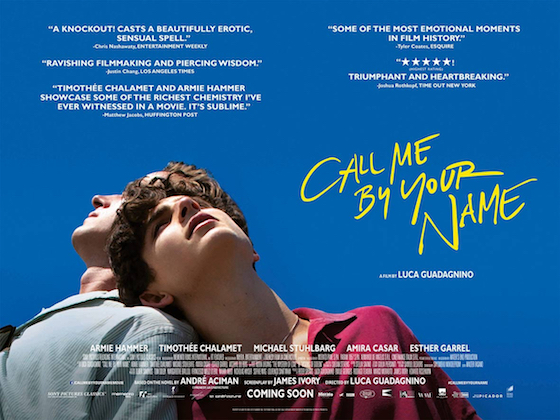
Call Me by Your Name (2017)

2018 #80
Luca Guadagnino | 132 mins | streaming (HD) | 1.85:1 | Italy, France, Brazil & USA / English, Italian, French, German & Hebrew | 15 / R

Call Me by Your Name

Call Me by Your Name was the lowest grossing film among 2017’s Oscar Best Picture nominees, but it felt like it was one of the most talked about films on the ballot — though, being part of a list that also includes Get Out and “the fish sex movie”, obviously there’s stiff competition.

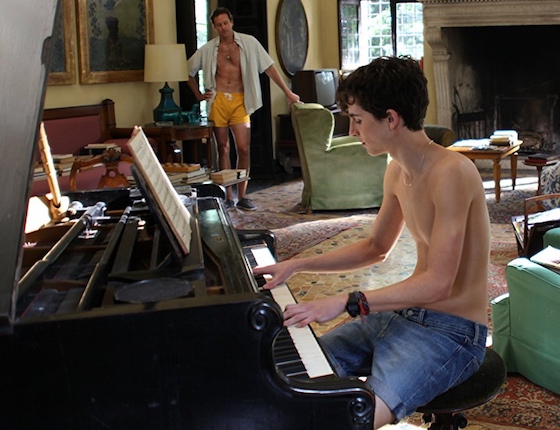
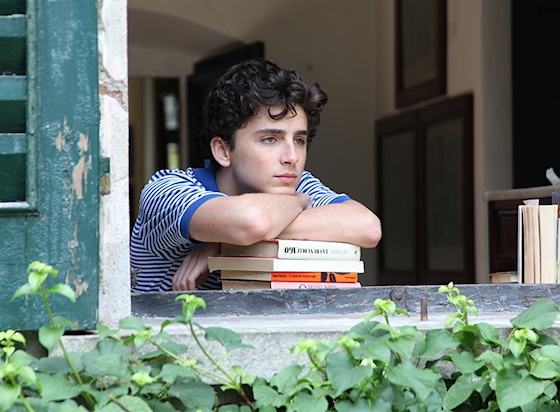
Set in Italy during the summer of 1983, it centres around 17-year-old Elio (Timothée Chalamet), the son of a pair of well-to-do intellectuals (Michael Stuhlbarg and Amira Casar) who spends his days lazing around their countryside villa — reading books, noodling about on the piano, and flirting with the local girls — and his evenings chasing skirt. He’s smart and talented, but still young and developing. Into his life comes Oliver (Armie Hammer), an American grad student who’s to be his professor father’s annual research assistant. Initially Elio is standoffish around the free-spirited Oliver, and yet seems fascinated by him. As they begin to spend more time together, a mutual attraction tentatively develops into a passionate love affair, a new experience for them both.

Sorry to rush you through the plot like that, but the gay romance between Elio and Oliver is what the film’s, y’know, about. It’s an effective and truthful depiction of young love — falteringly, unassured, but driven by powerful emotions and burning lust. Although Oliver initially seems hyper-confident, as he opens up to Elio it becomes clear that this is new for him too, and of course Elio’s only young, inexperienced even with girls at the film’s start, so of course love is a new thing to him. So, in some respects it doesn’t matter that the film’s about a gay relationship — the feeling it conjures of young love is universal. Of course, there are many reasons why it matters immensely that it’s about a gay relationship, but those concerns are largely external to the film itself. They intrude only in the sense that Elio and Oliver keep their affair a secret, though given Elio’s bohemian-ish family, he eventually finds more support than he might’ve expected.

Flesh

It’s not all sweetness and uncertainty, mind. I used the word “lust” for a reason: there’s some fairly sexually explicit stuff, so be warned if you’re of a sensitive disposition, or are particularly fond of peaches. Well, I say that — if you’re really fond of peaches, this will be your new favourite film. It’s not Stranger by the Lake graphic, despite what screenwriter James Ivory had in mind (i.e. there’s no explicit male nudity; Elio’s girlfriend gets her kit off though, which could spark a whole other debate about gender equality), but there’s still no doubting what the young couple get up to.

Talking of which, there was apparently some controversy about Elio and Oliver’s ages in regards to their relationship — Elio, as I said, is 17, and Oliver is 24. Some Americans seem to have a monomaniacal obsession with the age of consent being 18, which they then apply universally. I mean, it’s not even close to universal in the US (it’s 16 in 31 states and 18 in only 11), never mind worldwide. So, some people apparently have a major problem with that age difference between Elio and Oliver, whereas others won’t even think about it. For what it’s worth, the age of consent in Italy is 14 — imagine the reaction if they’d made Elio that young! For another perspective, in the UK in 1983 the age of consent for heterosexual couples was 16, but for gay people it was 21 — so, what, if this was set in the UK and Elio was female it would be okay, but because he’s male we’d have to be appalled? I guess my point is: think this shit through, and stop being “outraged” that people under the legal age of consent have romantic and sexual feelings.

Pining

But I guess there are fans of the film who’d know all about that, considering pretty young Timothée Chalamet has apparently become a favourite of the Tumblr crowd (who I’m basically assuming are all kids, which I’m sure is unfair). He’s not just young and beautiful though, but an extraordinarily competent actor too, all unearned confidence undercut by youthful vulnerability. His Oscar nomination was deserved. Armie Hammer went overlooked, but he gives a more nuanced performance than you might expect. From the supporting cast, the reliably excellent Michael Stuhlbarg stands out. Initially just an amiable dad, the film gradually peels back the layers to reveal what a fantastic father he is, including one heart-to-heart scene that alone (and even more than Hammer) should’ve seen him scooping awards.

The film was also overlooked in the cinematography category, which is a shame too. Shot on 35mm with a single lens by DP Sayombhu Mukdeeprom, it ably recreates the hazy feel of a long-ago summer. That sensation extends across Guadagnino’s direction, the gentle pacing reminiscent of a time when six weeks was forever, when the world was full of possibilities and there was time enough to explore them all and still have some left over.

Call Me by Your Name manages to resolve a striking array of contrasts — it’s both universal and specific, nostalgic and timely, powerful and gentle. The sum is a beautiful film in most every respect.

5 out of 5

Call Me by Your Name is available on Sky Cinema from midnight tonight.

It placed 18th on my list of The 26 Best Films I Saw For the First Time in 2018.

The Past Month on TV #35

In this month’s TV review: wah gwaan in Luke Cage season two, and “what’s going on?!” in Westworld’s finale.

Luke Cage  Season 2
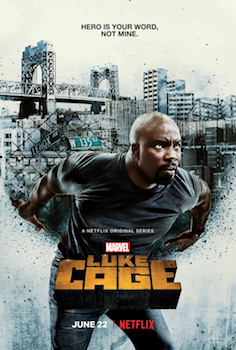
Luke Cage season 2The ninth season of the MCU on Netflix takes us back to Harlem for the continuing adventures of the eponymous bulletproof black man. It’s hard to imagine a more timely superhero for America (maybe if he was an immigrant too), not that the series’ is actually all that concerned with such issues, aside from passing nods and references. Instead, it’s more of a gangster crime drama: the still-standing season one villains, underworld power couple Mariah and Shades, intend to go legit by selling their illegal gun business, using the profits to invest in social projects for Mariah’s beloved Harlem. Standing in their way is Bushmaster, a superpowered patois-speaking Jamaican gang leader, who has a long-held grudge against Mariah’s family — and he’s come for retribution.
This focus on the conflicts between the villains has led some critics to reckon that Luke Cage has been sidelined in his own show. That’s true to an extent: because we’re privy to Mariah, Shades, and Bushmaster cooking up and executing their separate schemes, Luke is left to kind of wander around, trying to figure out stuff we already know. At the very least, the series is as interested in its villains as in its heroes — I reckon if you totted it up, Luke and Marian’s screentime would be pretty comparable. On the bright side, this is a very character-driven season — it’s as concerned with who these people are and how they’re changed by events, rather than just the mechanics of the plot — and Luke is certainly no exception. For one, his estranged father is in town — a superbly nuanced turn from the late Reg E. Carney (who the season is dedicated to, appropriately), which lends a different perspective again.

Plus, picking up and running with a theme from the first season, Luke is now famous as “Harlem’s hero”, but this is going to his head a bit, negatively affecting his relationship with Claire. The series does a good job of reflecting the celebrity status of superheroes, something the other Marvel films and series haven’t really touched on. If these events were even vaguely real, there’s no way Luke Cage could hang out in Harlem without being noticed. So now there’s an app to track his whereabouts, merchandise, sponsorship offers, his actions make headlines, and wealthy fans are willing to pay for him to make personal appearances. Luke espouses an ambivalent relationship to all this: he’d rather it wasn’t happening, but it does have its uses — and those prove seductive.

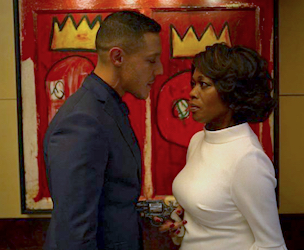
Rulers of HarlemMike Colter remains a likeable lead, but, again, it’s a villain who steals the show: as Mariah, the brilliant Alfre Woodard is perhaps the best thing about the whole series. Her performance is consistently fantastic, selling every twist and turn of character the writers throw at her. The season is as much about what events do to her as it is about Luke. She isn’t entirely alone, though: there are plenty of great performances, and scenes to showcase them, throughout the season. Occasionally there are some really bloody terrible ones though, like the time detective Misty Knight and her captain argue loudly about a shared secret while they’re in a room full of other cops. Is that bad writing, bad acting, bad direction, or all of the above?

And sometimes the good stuff is spread a bit thin. There are points, especially midseason, where it feels so goddamn slow. Or maybe not slow, but long. Episodes seem to just keep going. One is called On and On, like some kind of joke at our expense. This is the case with so many of these streaming shows, though — most of them need more plot and/or tighter storytelling. I guess part of the problem is the 13-episode diktat, which presumably the showrunners have no say over. It’d be better if they could make the season the length it needed to be, rather than spin wheels to make it last as long as it has to. That said, most Luke Cage episodes use the full hour “time slot”, and a couple run over it, so if maybe they’ve kind of reclaimed the padding…

Talking of other shows, the last time we saw Luke Cage in Luke Cage he was headed off to jail, but he starts this season free as a bird. Oh, and another major character is missing an arm. MCU fans will know that, since the last season, The Defenders happened, in which we saw these major changes to these characters’ status quo. There are vague nods at explaining some of that for anyone who skipped the team-up miniseries, but, really, it assumes you’ve watched it; and that ‘issue’ crops up again later in the season, with a couple of guest appearances by characters from Iron Fist. If you’re not interested in any of the other Marvel/Netflix series and don’t want to invest eight hours to find out a couple of linking story points (because The Defenders’ main plot has nothing to do with Luke Cage’s storylines), then maybe you need to read a plot summary on Wikipedia or something.

Heroes for hireThe flip side to all that is that this interconnectedness will perhaps be comic book fans’ favourite thing about the show — the way it casually references other series, or suddenly brings their characters in for a guest spot, is just like how comic books operate. It’s pretty constant too: barely an episode goes by without a significant reference to or cameo appearance by someone from another Marvel/Netflix show; and these aren’t all mere Easter eggs, but sometimes quite important or vital pieces of plot or character development.

For all its variability, Luke Cage finds its groove as the season goes on, and the final few episodes feel like an improvement (though I’d still contend they’re longer than they need to be). It all builds to a finale that feels almost low-key — I mean, there’s war on the streets and a lot of minor characters die, but that’s almost incidental, because it’s all about the characters, their relationships to each other, and how those find (or fail to find) closure. No spoilers, but it ends in a really intriguing place for season three. That’s not been officially commissioned yet, but surely it’s inevitable. It’ll be interesting to see where they take things next.

Westworld  Season 2 Episodes 8-10
Riding into the sunset (metaphorically)And so Westworld’s sophomore run rides into the sunset, and I think it’s left behind more questions than answers.

When the show’s first season finally came to expose its secrets, there was a lot of oohing and ahhing — the twists and reveals, whether you’d guessed them or not, retroactively made a lot of sense, and suggested a good deal of cleverness on the part of the writers. Season two’s finale, on the other hand, seems to have been met with a collective “…huh?” Even plenty of people who enjoyed it confess to not understanding everything that was going on, while others have just given up at this point.

Personally, I’m somewhere in between. There’s a lot to like and admire about the closing hours of season two, not least the production values: the show looks fantastic, and the acting is top notch. But I won’t dismiss the argument that the writers have disappeared up their collective arse, because there’s a lot of tricksiness and jiggery-pokery going on here that is sometimes hard to unravel — a stark contrast to the end of season one, I think, which managed to make the games it had been playing clear. Perhaps in their bid to outwit Reddit users, Westworld’s second season seems to have been jumping through hoops merely to be cleverer than its viewers, and I’m not sure that’s paid off.

Dark DoloresExhibit A is the “Hale was Dolores all along” revelation. It’s a neat twist, almost up to season one levels, were it not undermined by the season’s own structure: Hale hasn’t been Dolores all along, and the muddled timelines make it hard to recall how many scenes we’ve had with “Halelores” (as the writers apparently dubbed her). In fact, one of the ways they hid her in plain sight was to limit her screen time: apparently she only popped up in episodes three and seven. Those scenes are littered with subtle clues to her identity, however, though I guess the Redditors missed them — probably because they couldn’t keep track of which timeline we were in either.

There’s so much else going on here that I don’t even know which bits to pick out. I guess that’s part of the problem: with so many conclusions saved up until the finale and then all stuffed in at once, there’s just too much to digest and process in one almighty hit. One of my long-held suspicions has definitely been confirmed though: despite the plot of the series’ movie inspiration, co-creator Jonathan Nolan isn’t really interested in making a thriller about a robot rebellion at a technologically-advanced theme park, but instead has set out to make Person of Interest 2.0, for good or ill. That’s only going to become more apparent next season, I think, which is set to leave the titular park behind entirely. It’ll be interesting to see how many viewers it takes along with it…

Things to Catch Up On
Preacher season 3This month, I have mostly been missing Preacher’s third season, which started this week. Well, I only watched the first two episodes of season two in the end, so I’m very far behind. There’s also another Marvel TV series, Cloak & Dagger (which is passingly referenced in Luke Cage, apparently). That’s releasing new episodes weekly (on Amazon Prime this side of the pond). So many of these weekly shows I now wait to be complete before I binge them, but then I don’t get round to it (cf. Star Trek: Discovery, Black Lightning, etc). Finally, I happened to spot there had been a French sci-fi series called Missions on BBC Four, just before it disappeared from iPlayer, so now I’ve got all of that downloaded too.

Next month… you know, I have no idea. I know it’s the summer, but there must be something coming up? Maybe I’ll finally take the chance to dig into my massive backlog.

The Snowman (2017)

2018 #84
Tomas Alfredson | 119 mins | streaming (UHD) | 1.85:1 | UK, USA & Sweden / English | 15 / R

The Snowman

I read a comment somewhere that said Tommy Wiseau’s notorious film The Room is like a movie made by someone who’s never seen one but has had the concept thoroughly explained. The Snowman is like that but with crime thrillers.

Michael Fassbender stars as Norwegian detective Harry Hole — I presume there’s been some kind of fault of culture or translation there because, in English, that’s pretty much the worst name for a detective ever conceived without deliberately trying to be awful. He’s kind of washed up, with a terrible private life, but he’s also an unassailably brilliant detective — oh yeah, the originality keeps on coming. Anyway, after a woman disappears, an ominous snowman built near the crime sets Hole and a younger cop (Rebecca Ferguson) on the trail of a serial killer who’s been active for decades.

All of which should make for at least a solid crime thriller, but it just doesn’t quite work. It’s like the whole thing has been almost-correctly-but-not-quite translated from another language. I’m not just talking about the dialogue (though that’s sometimes that way too), but the very essence of the movie — the character arcs, the storylines, even the construction of individual scenes. Like many a Google Translate offering, you can kinda tell what it’s meant to be, but it doesn’t actually make sense in itself. According to the director, around 15% of the screenplay was never even filmed due to a rushed production schedule, which perhaps explains some of these problems.

Mr and Ms Police

Said director is Tomas Alfredson, the man who gave us Let the Right One In and Tinker Tailor Soldier Spy, so you’d expect a lot better of him. Even the technical elements are mixed: there’s some stunning photography and scenery, contrasted with occasional bad green screen; and all of Val Kilmer’s lines had to be dubbed (due to his tongue being swollen from cancer, apparently), but it sounds like it. His performance on the whole is weird, just one more part of the film that doesn’t sit right. It all builds to a massively stupid, unremittingly nonsensical finale. It’s during the final act where things finally goes overboard from “not very good” to “irredeemably bad”.

Indeed, some of the The Snowman is so shockingly awful that I considered if it merited my rare one-star rating. It’s close, but a lot of the film is fine — it actually toddles along at a reasonable three-star level most of the time, before falling apart entirely towards the end. “It could be worse” may be the faintest of praise, but it certainly doesn’t deserve any more.

2 out of 5

The Snowman is available on Sky Cinema from midnight tonight.

Game Night (2018)

2018 #111
John Francis Daley & Jonathan Goldstein | 100 mins | download (HD) | 2.39:1 | USA / English | 15 / R

Game Night

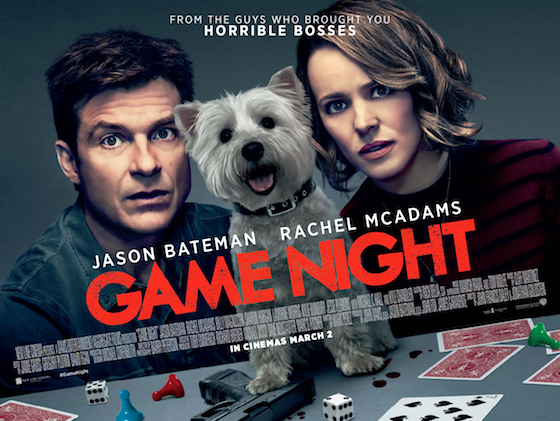
Despite what the poster suggests, the cute dog is not in fact one of the three leads.

1 out of 5

Okay, okay — let’s put the Westie-based bait-and-switch advertising aside and give the film a fair hearing, because it’s actually surprisingly brilliant.

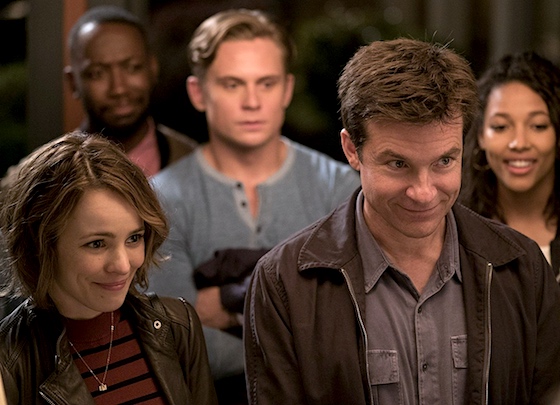
The other poster stars, Jason Bateman and Rachel McAdams, play hyper-competitive couple Max and Annie, who love nothing more than the weekly game night they host with their best friends, from which they exclude their odd next-door neighbour, Westie-loving cop Gary (Jesse Plemons). One week, Max’s super-successful older brother Brooks (Kyle Chandler) unexpectedly shows up and gatecrashes game night, then offers to host an even better one. For that he arranges a real-life mystery game, where he gets kidnapped and the others have to track him down… except then he gets kidnapped for real, and they only have the rest of the night to rescue him.

If you’ve ever wondered “what if someone reimagined David Fincher’s The Game as a comedy?”, Game Night is probably the answer. Personally, I’ve never wondered that, but I’m up for it. That said, I was all prepared to let it wait until it popped up on Netflix or something, until the film’s home release in the US a couple of months back prompted a wave of praise from critics I follow on Twitter. Now I’m adding my small voice to those urging you to check this movie out.

Wanna play a game?

It’s the kind of film where I don’t want to say much more than I already have, because obviously the joy lies in the jokes (and jokes are a lot less funny if you spoil them) and the plot developments. At the risk of just reeling off a list of superlatives, I’ll say that what unfolds is fast, inventive, clever (after you’ve seen the film, check out this spoilersome bit of trivia. I mean, that’s superb!), and, above all, hilariously funny. There are more laughs in its opening montage than many modern comedies manage in a whole film. Jesse Plemons transcends the “budget Matt Damon” jibes (but, c’mon, he really looks like an own-brand Matt Damon) to all but steal the film with his hysterical straight-faced supporting role. I only say “all but” because everyone else is firing on all cylinders too: it’s a cast full of likeable, well-performed characters, not least Max and Annie. McAdams, in particular, gets to give a line delivery that’s an all-timer. If there’s a criticism in this regard it’s that, with so many characters competing for screen time, I’m not sure how well their individual arcs really work, but that’s a minor distraction.

One other thing I will criticise — which is nothing to do with the quality of the film itself, but bugged me enough that here’s a whole paragraph about it — is the scarcity of extras on the Blu-ray, which total just ten minutes. Seriously? Put some effort in! All the praise from American Twitter led me to acquire the film via Alternative Means, but, being the good honest film consumer I am, I was going to rent it when it came out here as retrospective payment. But then I loved it so much I thought I’d just go ahead and buy the disc. But a full-price new release of a film I’ve already seen with a grand total of ten minutes of special features? You’re having a laugh. Were there no deleted scenes? Could they not stump up for a commentary? Surely they filmed longer interviews than that just for the EPK? But no, all we get is a 6½-minute gag reel and a 3½-minute “featurette” (I’m being kind — at that length it can’t be much more than a trailer). I’m going to buy it eventually, in a sale, because I enjoyed the film enough to add it to my collection, but you cost yourself a day-one purchase there, Warners. I don’t know how much the general film-viewing populace still care about special features, but us aficionados do, and I know I’m not alone in feeling this way about this particular title. Anyway, rant over.

Who's stealing the film now, eh?

For pure enjoyment, I came very close to giving Game Night the full five stars — when it works, it absolutely sings — but there are just a few bits, here and there, that fell a little short. Nonetheless, it’s certainly the kind of film I loved in spite of its flaws. If only the adorable dog had been in it more, maybe this’d be a five anyway…

4 out of 5

Game Night is available to own digitally in the UK from today, and on that disappointing DVD & Blu-ray from next week.

It placed 15th on my list of The 26 Best Films I Saw For the First Time in 2018.

Rocky II (1979)

2018 #131
Sylvester Stallone | 119 mins | Blu-ray | 1.85:1 | USA / English | PG / PG

Rocky II

This first sequel could fairly have been titled Rocky Part II: picking up where the first film left off (literally — the first six minutes are just a replay of Rocky’s final fight), it goes on to detail what happens next for both Rocky (Sylvester Stallone) and his world-champion opponent, Apollo Creed (Carl Weathers). For the former, his childlike naïveté and heart of gold sees him carelessly burn through his newfound wealth as he tries to give the love of his life (Talia Shire) everything he thinks she wants. For the latter, it means an ongoing niggle that he didn’t really win the fight, so he tries to goad Rocky into a rematch.

Like the first movie, a lot of Rocky II is more of a character-based drama than a sport-driven movie, this time about someone who had a taste of the big time struggling to re-adapt to normal life. It’s not that Rocky’s ego has outgrown his means — he doesn’t seem to mind going back to working menial jobs when the money runs out — but his overestimation of his success means that he does indeed find himself in that position. It’s not bad as a dramatic work — it’s got the same writer as the first movie, after all, here also stepping up to direct (and did you know he wrote a novelisation too?) — but we know where it’s all headed, and so the second half is better than the first.

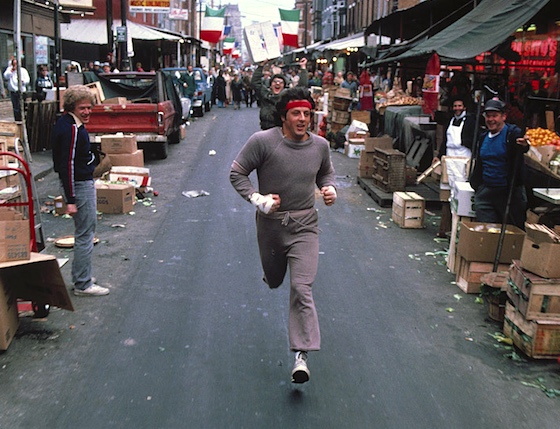
Run, Rocky, run!

Again, Stallone doesn’t lose sight of keeping events moderately grounded: Rocky struggles to focus on his training regime, and it begins to look like Creed may be right that his success in their first bout was all fluke. Of course, this is as much an underdog fairytale as the first movie was, and so events transpire to finally give Rocky his motivation, culminating in a triumphant revisit to the first film’s famous running-up-the-steps bit. The finale is, naturally, the big boxing rematch, where Stallone really shows off his directing chops: it’s a tense, drag-out duel that easily exceeds the first film’s for visceral impact.

On the whole, I wouldn’t say Rocky II is better than its predecessor — indeed, maybe it’s not quite as good — but I enjoyed it about the same; maybe even slightly more by the end. The Rocky sequels have a collectively poor rep, but I think this is a worthy follow-up.

4 out of 5

The UK network TV premiere of the latest Rocky sequel, Creed, is on ITV tonight at 9:30pm.

Victoria & Abdul (2017)

2018 #52
Stephen Frears | 112 mins | streaming (HD) | 2.35:1 | UK & USA / English, Urdu & Hindi | 12 / PG-13

Victoria & Abdul

Returning to the role that earnt her first Oscar nomination, Dame Judi Dench stars as an even older Queen Victoria, who once again gets involved in a friendship with a foreign servant to the exasperation of those around her. If it wasn’t based on a true story, the similarities to Mrs Brown would make Victoria & Abdul look like a slipshod copycat sequel. Okay, this isn’t technically a sequel, but the similarities can’t be ignored.

Where the earlier film aimed for dramatic weight as a portrait of a grieving and isolated monarch finding human connection again, here the goal seems to be more comedic. Perhaps. I mean, if often shoots for funny, but it’s not funny enough to be an outright comedy. At other times it’s more straightforwardly dramatic, especially as it gets towards the end, but there’s a nagging sensation that the facts have been bent to fit the expected shape of the narrative. The film begins with a card that says it’s “based on real events… mostly”, which feels a little too comical for a heritage drama such as this, and was perhaps more intended it as a “get out of jail free” card for its historical accuracy. (I don’t know what the facts are, mind, so I can’t vouch for or condemn the film’s faithfulness to them.)

Turns out we are very much amused

Dench is very good, as you’d expect. The rest of the cast don’t get to deliver as much range, but they’re a quality bunch of performers and so are easily up to what they’re given. It’s also as pretty a production as you’d expect, with Oscar-nominated makeup and costumes, plus opulent production design and grand location choices, all shown off by Danny Cohen’s pleasant cinematography.

I read someone else assess that it’s not as good as its individual parts, and I think that’s fair. Most of the scenes, moments, and performances are strong — there are notably funny bits, dramatic bits, emotional bits; even unexpected complications in how it handles some of the characters — but when it’s all put together, it doesn’t quite coalesce. If you think you’re the kind of person who’d enjoy this movie, there’s every chance it will please you no end. Otherwise, while it does have definite qualities, it doesn’t do quite enough to transcend its trappings.

3 out of 5

Victoria & Abdul is available on Sky Cinema from today.

The Death of Stalin (2017)

2018 #85
Armando Iannucci | 107 mins | streaming (HD) | 1.85:1 | France, UK & Belgium / English | 15 / R

The Death of Stalin

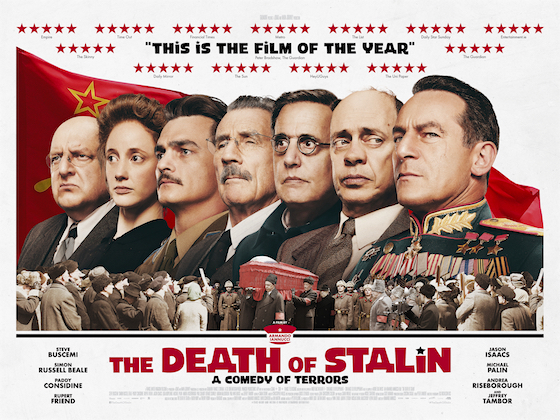
Armando Iannucci, the writer-director-creator behind political comedies like Veep, The Thick of It, and the latter’s Oscar-nominated movie spin-off, In the Loop, here turns his attention away from fictional present-day politics to real-life historical ones — as the title suggests, the death of Soviet dictator Josef Stalin and the power struggle that followed. Sounds like a laugh riot, don’t it? Dark comedies don’t get much darker than this!

It plays a bit like Horrible Histories for grown-ups, teaching you the facts of an interesting period of history, containing very serious events, while also sending up the objective ludicrousness of what went on. The flip side to that is one has to wonder about its accuracy. It’s officially adapted from some French comic books, rather than, say, an academic work, and various historians have commented on its veracity with regards to historical fact — some have said it’s littered with minor errors that can be excused as cinematic licence, others that it misses the mark entirely. For his part, Iannucci claims he actually “chose to tone down the real-life absurdity” because audience’s wouldn’t’ve found it believable.

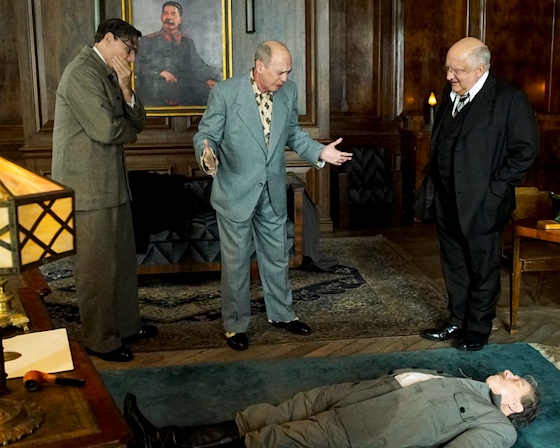
Over Stalin's dead body!

The Death of Stalin probably isn’t the best text to cite in a history essay, then, nor a valuable piece of work for anyone interested in a proper understanding of what went on. As a comedy about the ridiculousness of dark times, however, it functions in a similar way to Iannucci’s other work. Functionally it’s very like The Thick of It, in that it’s about a group of semi-confident politicians trying to scheme against each other. Of course, the results of their machinations are a bit more serious and murderous than any of the problems Malcolm Tucker ever faced.

I’m sure some viewers must find the irreverence with which the film treats such matters to be a turn-off. Personally, I think its perspective is more profound: these are silly men playing silly power games, but the end results are often unthinkable and horrific. You only have to look at the recent news headlines — in which the gibbering orange blob who is the supposed “leader of the free world” has enacted a Hitlerian policy of tearing small children away from their parents and locking them up in cages at concentration camps, only to serve his own futile political ends — to see similar situations playing out to this day.

Perhaps, in this climate, The Death of Stalin is a reminder that we need to laugh at the preposterousness of monsters in power. It’s not quite as laugh-out-loud funny as the best of The Thick of It or In the Loop for me, but that point is, unfortunately, as relevant as ever.

4 out of 5

The Death of Stalin is available on Prime Video UK as of yesterday.

Gangster Review Roundup

In today’s roundup:

  • City of God (2002)
  • RocknRolla (2008)
  • Scarface (1983)


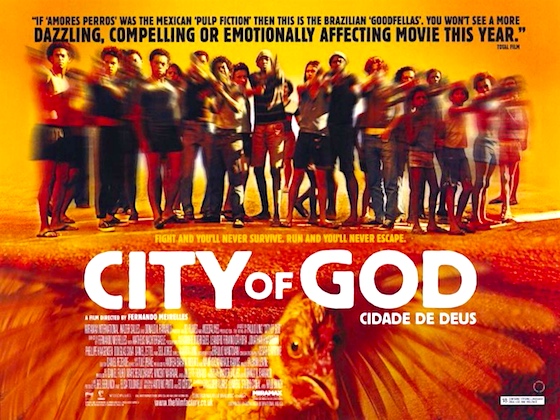
    City of God
    (2002)

    aka Cidade de Deus

    2017 #100
    Fernando Meirelles | 129 mins | DVD + download* | 1.85:1 | Brazil & France / Portuguese | 18 / R

    City of God

    What better insight into my film watching habits than this, a movie I’d been meaning to get round to for the best part of 14 years (ever since it topped Empire’s list of the best films of 2003, around the same time as I was getting into film ‘seriously’, i.e. as more than just “movies I like to watch”). Plus, it was one of my Blindspot picks back in 2015 (but didn’t get watched, obv), and it was the highest ranked film on the IMDb Top 250 that I’d not seen — all good reasons why I made it 2017’s #100.

    Adapted from a novel that was based on real events, it tells the story of how organised crime grew in Rio de Janeiro’s Cidade de Deus favela — the “City of God” of the title — from the late ’60s to the early ’80s. The main thing that struck me watching it now is how much it reminded me of the TV series Romanzo Criminale — both are basically about young people taking over and running all the crime in a city. The fact that they’re also both inspired by true stories (the series depicts a criminal gang in Rome through the ’70s and ’80s) is intriguing for different reasons. They also share certain stylistic similarities, I think, in particular the almost documentary-like visuals. The series came later, of course, so if one did inspire the other then this isn’t the copycat.

    At the risk of turning this into a review of something else, I must say that, while Romanzo Criminale is a favourite of mine (I included it in my 2017 list of Favourite TV Series of the Last 10 Years), City of God was a work I admired more than loved. Nonetheless, for anyone who likes crime epics, this is a must-see (but, uh, so is Romanzo Criminale).

    5 out of 5

    * Possibly because it’s just been sat on a shelf for over a decade (possibly just through sheer bad luck), my DVD was corrupted about halfway through and I had to, uh, source another copy. ^

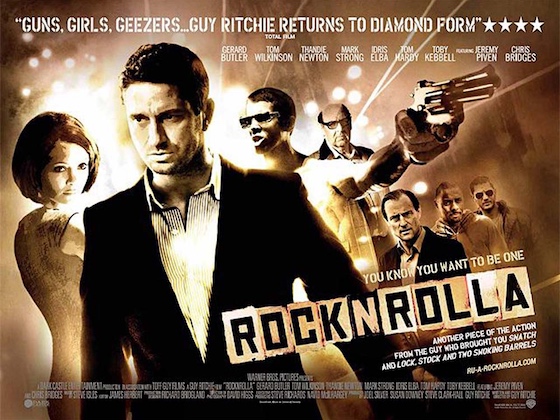
    RocknRolla
    (2008)

    2017 #146
    Guy Ritchie | 110 mins | streaming (HD) | 16:9 | UK, USA & France / English & Russian | 15 / R

    RocknRolla

    In my review of Snatch I commented that its contemporary reviews were along the lines of “oh, Lock Stock again”, and yet now it’s pretty well regarded. My memories of RocknRolla’s contemporary reviews are “oh, another Guy Ritchie London gangster film — isn’t it time he did something new?” And yet, it now seems to be pretty well regarded. Not as much as Lock Stock and Snatch, but better than you’d think “Guy Ritchie does the same schtick for a fourth time” would merit.

    Well, it is a case of Ritchie doing his usual schtick (thank God he did eventually move on, at least applying the same broad MO to some new genres), but a cast that includes the likes of Idris Elba, Tom Hardy, Mark Strong, Tom Wilkinson, and Thandie Newton can’t help but elevate the material. Gerard Butler is ostensibly the lead, front-and-centre on the poster, but the movie follows the standard Ritchie template: an ensemble cast in a variety of story threads that bump into each other and overlap in different ways at different times. Even if the specifics aren’t the same as his other films, and the cinematography is more slick and big-budget than the grimy ’90s indie visuals of his debut and sophomore flick, the general style feels very familiar.

    Ultimately, I enjoyed it more than Snatch, but maybe I was just in the right mood — I mean, like I said, they’re all fundamentally the same kind of thing.

    4 out of 5

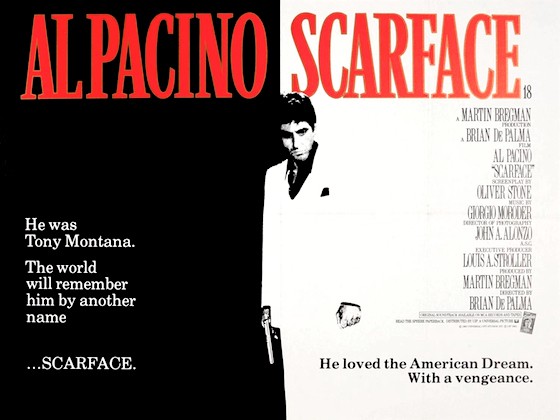
    Scarface
    (1983)

    2018 #14
    Brian De Palma | 170 mins | Blu-ray | 2.35:1 | USA / English & Spanish | 18 / R

    Scarface

    Brian De Palma’s in-name-only remake of 1932 gangster classic Scarface follows Al Pacino’s Cuban immigrant Tony Montana as he rises up the ranks of organised crime in ’80s Miami. As it turns out, it’s not easy being at the top.

    A near-three-hour epic (what is it with gangster movies being three hours long?), interest is sustained through Pacino’s wild-eyed performance, De Palma’s slick direction, and a story that at least has enough incident to merit that length. Also, early-career Michelle Pfeiffer, who gives a good performance as Montana’s increasingly miserable gal but, frankly, could just stand there and still keep half the population interested.

    Apparently a favourite movie among rappers, I guess some people get the wrong message from Scarface. I suppose the stylishness with which it’s produced has the side effect of idolising the lifestyle Montana and co lead, but the way it gradually crumbles and destroys everything should be a pretty clear indicator of how such things actually go. Still, it all makes for a heady mix.

    5 out of 5

    Scarface was viewed as part of What Do You Mean You Haven’t Seen…? 2018.

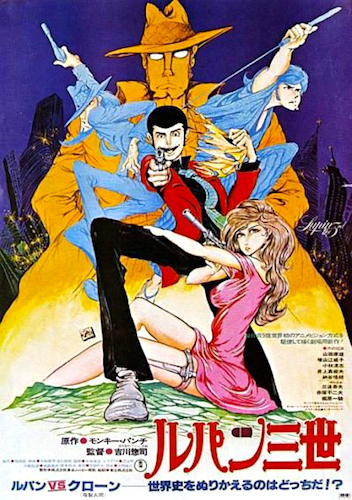
  • Lupin the Third: The Secret of Mamo (1978)

    aka The Mystery of Mamo / Rupan Sansei / Rupan Sansei: Rupan tai Kurōn

    2018 #112
    Sôji Yoshikawa | 102 mins | DVD | 16:9 | Japan / English | 15 / PG-13

    Lupin the Third: The Secret of Mamo

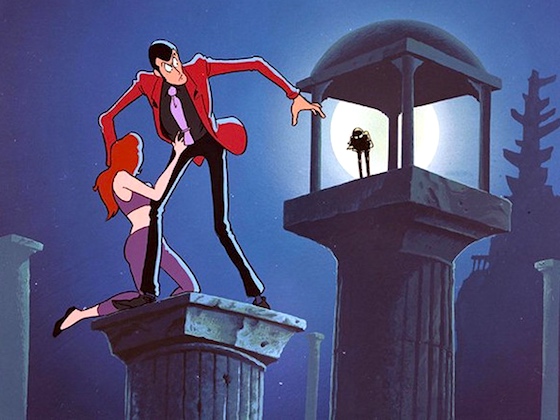
    Best known to Western audiences thanks to Hayao Miyazaki’s feature debut The Castle of Cagliostro, Lupin the 3rd is more than just one film in the Studio Ghibli co-founder’s illustrious career — it’s a popular and long-running franchise in Japan, with almost innumerable iterations: starting life as a manga which has run on and off since 1967, it has so far been adapted into six TV series, seven animated films, 26 feature-length TV specials, two live-action movies, and sundry other bits and bobs. Despite all that, this is one of only three Lupin III productions that has been available in the UK since the DVD era (the others being the fourth TV series, titled The Woman Called Fujiko Mine, and Cagliostro, natch), though that increases by one today with the Blu-ray release of the latest complete TV series, Lupin the 3rd: Part IV.

    The Secret of Mamo (more commonly known in English as The Mystery of Mamo, or in Japan as Lupin vs. the Clone) was the first big-screen outing for Lupin III. It was produced while the second TV series was being broadcast, with the intention of making a film that was more similar to the original manga, something Japanese censorship standards prevented the TV series from being. So, the tone is kids’ comedic adventure, but there’s nudity, moderately graphic violence, and a scene of sexy torture. Well, it’s not that graphic really… though it depends on your position on these things, I guess. Anyway, I’m certainly surprised the Americans let it pass as a PG-13, just because of the nudity. She may be a cartoon, but it’s not subtle.

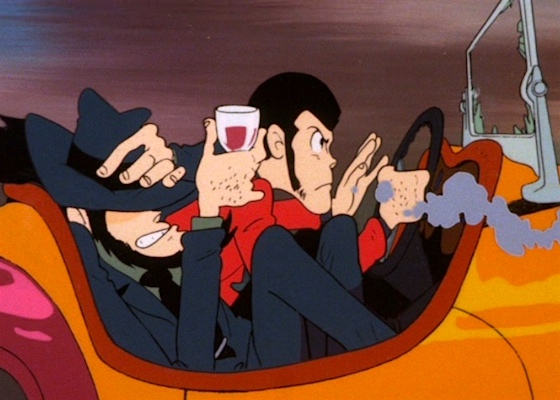
    Car chase!

    Anyhow, the plot sees master thief Lupin III, along with his regular sidekicks Jigen and Goemon, pilfering the Philosopher’s Stone (I guess Americans would need to call it the Sorcerers Stone) at the request of his on-off love interest Fujiko Mine, who actually wants it for the mysterious Mamo. His nefarious schemes draw Lupin and co into a web that sees them pursued not only by Mamo’s forces, but also the Americans, and Lupin’s regular nemesis, Interpol Inspector Zenigata.

    One of the major inspirations behind Lupin the 3rd’s creation was James Bond, and so, appropriately enough, this is a globetrotting adventure that takes in Transylvania, Egypt, France, Spain, the Caribbean, and Colombia. Similarly, it also showcases some great action scenes, particularly an extended car chase through Paris and then the mountains. Unlike Bond, there’s a definite cartoonishness to many of the antics, and the third act takes a turn into outright science-fiction that gets a bit crazy. It’s also not entirely similar to The Castle of Cagliostro, therefore, showing how much Miyazaki brought his own tone and style to that film.

    That said, I thought the lead characters’ relationships felt clearer from the start here than they did in Cagliostro, which very much felt like a sequel or spin-off where you were meant to know who everyone was (as I noted in my review). It could just be I’m a little more familiar with them all now, but perhaps the film was indeed made to be more newcomer-friendly — it was the first movie, after all; though it is spun off from a TV series… Well, it’s quite neatly done, nonetheless — this isn’t “Lupin III Begins” with them all meeting for the first time, nor is there a viewer-surrogate being introduced to them all, but it handles how and when each character arrives into the narrative in such a way that it’s kept fairly clear how they relate to one another. It’s subtly done, so, as I say, it could be serendipitous or my own improved awareness.

    The mysterious Mamo

    It’s also perhaps worthy of note that the film is available with four different English dubs. The 2013 US DVD from Discotek Media includes them all, so lucky you if you have that. Everywhere online will tell you that Manga UK’s 2008 DVD includes the dub Manga produced in 1996, which seems logical, but, being the inquisitive soul that I am, I read up on it myself, and I’m 99% certain it’s actually the 2003 Geneon dub. According to Wikipedia, the Geneon dub “took a liberal approach with translating the Japanese dialogue,” so I compared the dub to the subtitles included for the Japanese audio, and they were totally different. You can see why anime fans hate it when discs only include “dubtitles”. Maybe I should’ve watched it in its original language…

    Anyway, the film itself is a very fun adventure, with an entertaining anarchism as well as exciting action and mostly amusing humour. Ever since I watched Cagliostro I’ve been meaning to watch some more Lupin the 3rd because I always hoped I’d enjoy it, and so far I’m being proven right. At least I’ve got the two Blu-ray-released TV series to tuck into next, but I’d like to see more of the extensive back catalogue make it to the UK. I guess that probably depends on how the Part IV release sells…

    4 out of 5

    Lupin the 3rd: Part IV is released on Blu-ray in the UK today by All the Anime.