Gangster Review Roundup

In today’s roundup:

  • City of God (2002)
  • RocknRolla (2008)
  • Scarface (1983)


    City of God
    (2002)

    aka Cidade de Deus

    2017 #100
    Fernando Meirelles | 129 mins | DVD + download* | 1.85:1 | Brazil & France / Portuguese | 18 / R
    City of God

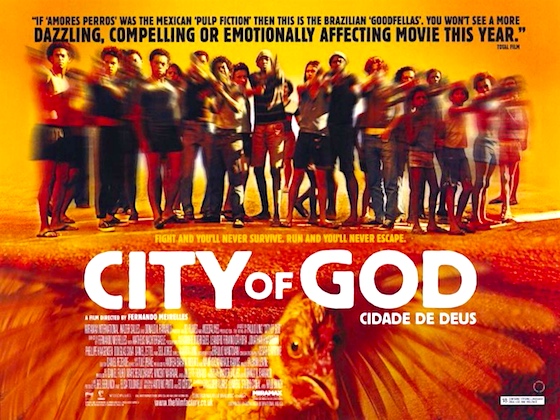
    What better insight into my film watching habits than this, a movie I’d been meaning to get round to for the best part of 14 years (ever since it topped Empire’s list of the best films of 2003, around the same time as I was getting into film ‘seriously’, i.e. as more than just “movies I like to watch”). Plus, it was one of my Blindspot picks back in 2015 (but didn’t get watched, obv), and it was the highest ranked film on the IMDb Top 250 that I’d not seen — all good reasons why I made it 2017’s #100.

    Adapted from a novel that was based on real events, it tells the story of how organised crime grew in Rio de Janeiro’s Cidade de Deus favela — the “City of God” of the title — from the late ’60s to the early ’80s. The main thing that struck me watching it now is how much it reminded me of the TV series Romanzo Criminale — both are basically about young people taking over and running all the crime in a city. The fact that they’re also both inspired by true stories (the series depicts a criminal gang in Rome through the ’70s and ’80s) is intriguing for different reasons. They also share certain stylistic similarities, I think, in particular the almost documentary-like visuals. The series came later, of course, so if one did inspire the other then this isn’t the copycat.

    At the risk of turning this into a review of something else, I must say that, while Romanzo Criminale is a favourite of mine (I included it in my 2017 list of Favourite TV Series of the Last 10 Years), City of God was a work I admired more than loved. Nonetheless, for anyone who likes crime epics, this is a must-see (but, uh, so is Romanzo Criminale).

    5 out of 5

    * Possibly because it’s just been sat on a shelf for over a decade (possibly just through sheer bad luck), my DVD was corrupted about halfway through and I had to, uh, source another copy. ^

    RocknRolla
    (2008)

    2017 #146
    Guy Ritchie | 110 mins | streaming (HD) | 16:9 | UK, USA & France / English & Russian | 15 / R
    RocknRolla

    In my review of Snatch I commented that its contemporary reviews were along the lines of “oh, Lock Stock again”, and yet now it’s pretty well regarded. My memories of RocknRolla’s contemporary reviews are “oh, another Guy Ritchie London gangster film — isn’t it time he did something new?” And yet, it now seems to be pretty well regarded. Not as much as Lock Stock and Snatch, but better than you’d think “Guy Ritchie does the same schtick for a fourth time” would merit.

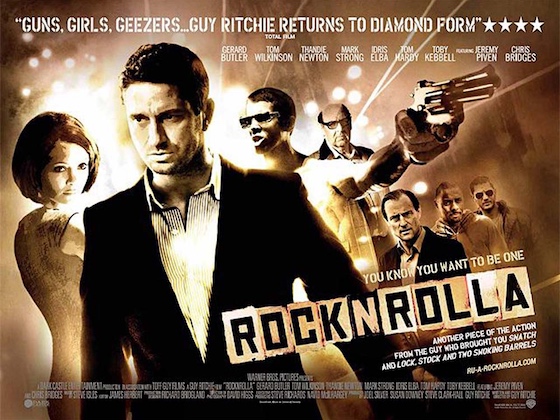
    Well, it is a case of Ritchie doing his usual schtick (thank God he did eventually move on, at least applying the same broad MO to some new genres), but a cast that includes the likes of Idris Elba, Tom Hardy, Mark Strong, Tom Wilkinson, and Thandie Newton can’t help but elevate the material. Gerard Butler is ostensibly the lead, front-and-centre on the poster, but the movie follows the standard Ritchie template: an ensemble cast in a variety of story threads that bump into each other and overlap in different ways at different times. Even if the specifics aren’t the same as his other films, and the cinematography is more slick and big-budget than the grimy ’90s indie visuals of his debut and sophomore flick, the general style feels very familiar.

    Ultimately, I enjoyed it more than Snatch, but maybe I was just in the right mood — I mean, like I said, they’re all fundamentally the same kind of thing.

    4 out of 5

    Scarface
    (1983)

    2018 #14
    Brian De Palma | 170 mins | Blu-ray | 2.35:1 | USA / English & Spanish | 18 / R
    Scarface

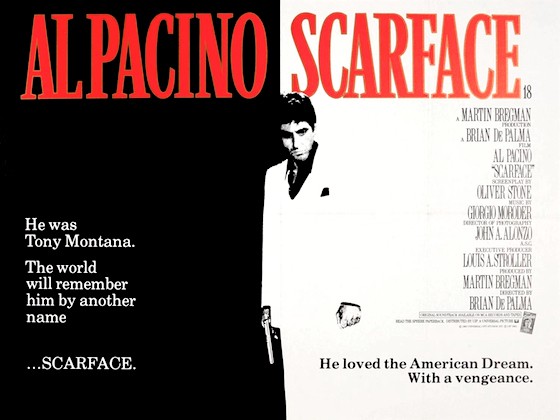
    Brian De Palma’s in-name-only remake of 1932 gangster classic Scarface follows Al Pacino’s Cuban immigrant Tony Montana as he rises up the ranks of organised crime in ’80s Miami. As it turns out, it’s not easy being at the top.

    A near-three-hour epic (what is it with gangster movies being three hours long?), interest is sustained through Pacino’s wild-eyed performance, De Palma’s slick direction, and a story that at least has enough incident to merit that length. Also, early-career Michelle Pfeiffer, who gives a good performance as Montana’s increasingly miserable gal but, frankly, could just stand there and still keep half the population interested.

    Apparently a favourite movie among rappers, I guess some people get the wrong message from Scarface. I suppose the stylishness with which it’s produced has the side effect of idolising the lifestyle Montana and co lead, but the way it gradually crumbles and destroys everything should be a pretty clear indicator of how such things actually go. Still, it all makes for a heady mix.

    5 out of 5

    Scarface was viewed as part of What Do You Mean You Haven’t Seen…? 2018.

  • Men in Black 3 (2012)

    2017 #167
    Barry Sonnenfeld | 106 mins | Blu-ray | 1.85:1 | USA / English | PG / PG-13

    Men in Black 3

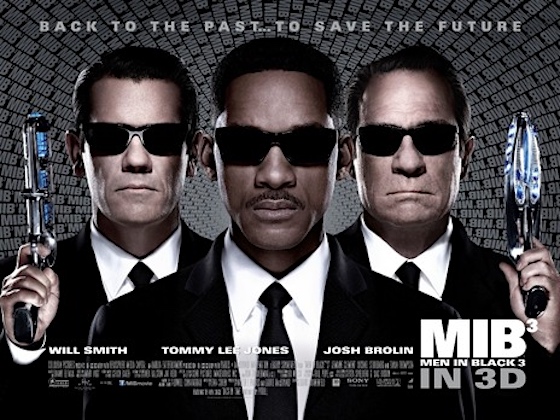
    Maybe it’s something to do with my age, but when Men in Black II came out it felt like a bit of a belated sequel to the mega-hit Men in Black — it had been five years, after all, which is quite a long time for a comedy sequel. Well, Men in Black 3 was another ten years after that… As it turns out, MIB2 is a kind of typical first sequel: memorable-but-small characters get massively increased roles; things are referenced just for the sake of referencing them; jokes are repeated or amped up. MIB3 is more like the typical belated sequel: it stands somewhat divorced from the first two, with the minor stuff all gone, and some more significant changes necessitated by the passing of time.

    What hasn’t changed are the leads, Agents J (Will Smith) and K (Tommy Lee Jones) — although the latter’s about to, because when an alien criminal he locked up in the ’60s escapes from prison and travels back in time, K is wiped from existence. As the only one who can remember K, it’s up to J to also travel back to the ’60s, rescue the younger K (Josh Brolin), and also save the Earth.

    MIB3’s biggest problem is that it’s not funny enough. The first two were sci-fi comedies with the emphasis on the comedy, whereas this is more of a light sci-fi adventure. In some respects it tries to substitute emotional weight for the lack of laughs, aiming for a pay-off that’s designed to put a cap on the whole trilogy. It kind of works, I suppose, but it also feels like a bit of an ill fit. It’s nice that the film’s trying something different, I suppose, but I’d rather the tone was closer to the other movies — more humour, tighter pacing. Director Barry Sonnenfeld used to have an obsession with making his movies shorter (I remember he once said he’d be the only director where a “director’s cut” would actually mean a truncated version of the movie). I don’t know if he’d given up on that notion by 2012, but trimming ten minutes out of this likely wouldn’t hurt.

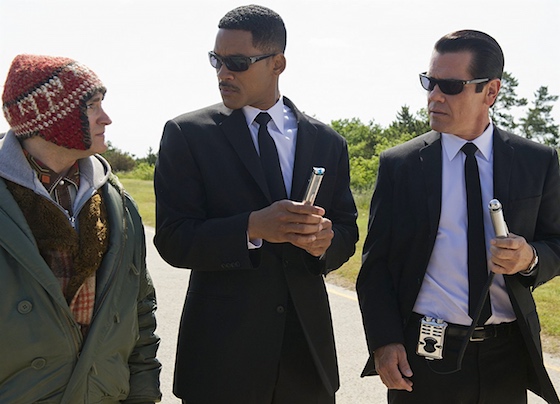
    Someone forgot the dress code...

    The best bit is definitely Brolin as Young K, doing a bang-on impression of Tommy Lee Jones while also adding enough to make the part his own. As for the rest of the new cast members, Emma Thompson’s role is fine if you consider her appearance no more than a cameo, but Alice Eve is underused as her younger self. Jemaine Clement chews the scenery double-time as the villain, while the always excellent Michael Stuhlbarg has a fun supporting role as a character who can see all possible futures.

    MIB3 is not as weak as the much-maligned first sequel (which I don’t hate as much as some, but it isn’t great), but it can’t equal the freshness of the original, either. Little surprise it didn’t lead to a full-blown revival of the franchise… though, as it still did well at the box office and the series’ popularity endures, it’s also no surprise we’ll be getting a spin-off-ish fourth movie next summer.

    3 out of 5

    Babe: Pig in the City (1998)

    2017 #42
    George Miller | 92 mins | streaming (HD) | 1.85:1 | Australia / English | U / G

    Babe: Pig in the City

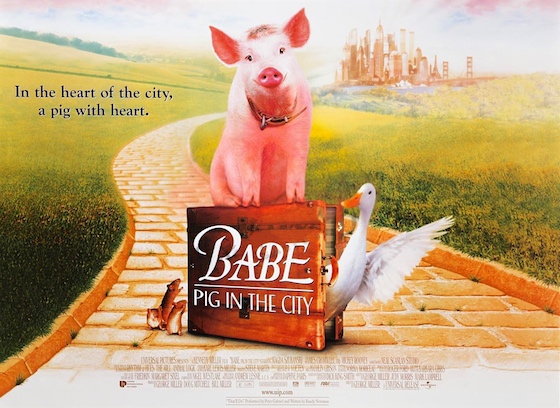
    Between making the first Mad Max trilogy and winning an Oscar with kids’ animation Happy Feet, George Miller produced beloved family flick Babe, which was such a success he took the directing reins for this follow-up. I remember it going down very poorly at the time — Rotten Tomatoes doesn’t quite support that, but a quick scan reveals many of the reviews to be retrospective. Some were wise to it from the off, however: Roger Ebert gave it full marks and his presenting partner Gene Siskel chose it as the best movie of the year! Not everyone’s got on that bandwagon (it still has a low rating on IMDb), but it’s definitely developed a cult following. Sign me up, because I too thought it was rather brilliant.

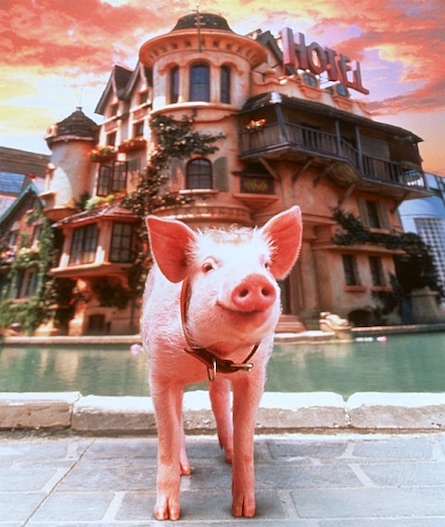
    Set immediately after the events of the first film, it sees everyone’s favourite sheep-pig travelling to the big city to raise money to save his farm. There, he ends up staying at a kind of hotel for animals, and winds up in all kinds of hijinks. There’s no point trying to describing it — the movie is barking. Also oinking, and quacking, and… yeah, you get the joke.

    In some ways it feels like a kids’ movie made for adults. Sure, it’s about cute talking animals, but a lot of the jokes are squarely aimed at knowing grown-ups, as is some of the emotional stuff, such as a scene where the Jack Russell is clearly running off to Heaven, which probably (hopefully, even) goes over younger children’s heads. As that may suggest, it’s also a very dark movie. Most of the darkness is eventually undercut, subverted, or rescued, but not always immediately — the situations are allowed to get bleak first.

    Pig in a hotel

    There’s an above-the-call-of-duty quality to the filmmaking, too. It’s lovelily designed, in a hyper-real cartoon-strip way, and beautifully shot, by Andrew “Lord of the Rings” Lesnie no less. Plus there’s a credits song written by Randy Newman and performed by, of all people, Peter Gabriel. And that’s not some kind of “they used a song by them” coincidence — its lyrics are based around the famous “that’ll do, Pig” catchphrase. Barmy.

    Pig in the City made me really made me want to rewatch the original — I enjoyed it as a kid, but as an adult would I see all sorts of extra stuff that I missed before? Or was it the success of the “cute talking pig movie” original that gave Miller & co the freedom to cut loose in the sequel? Comments I’ve read suggest the latter. Well, even if Babe doesn’t merit revisiting as an adult, this sequel certainly does. I’m not sure I’ve ever seen anything else quite like it.

    4 out of 5

    The Conversation (1974)

    2017 #10
    Francis Ford Coppola | 114 mins | Blu-ray | 1.85:1 | USA / English | 12 / PG

    The Conversation

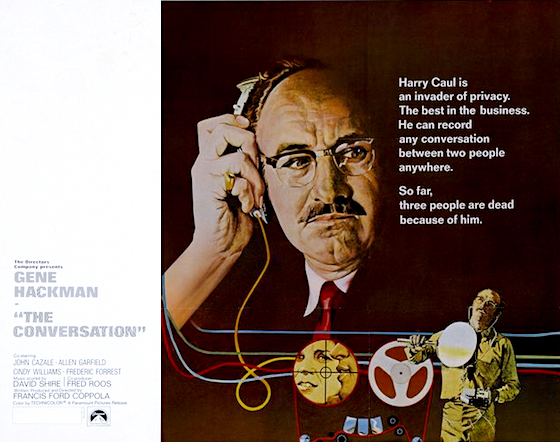
    In the mind of writer-director Francis Ford Coppola, the concept for The Conversation started out as a puzzle, a story that used repetition to make the audience reconsider what they thought they knew — “not like Rashomon where you present it in different ways each time,” Coppola told Brian De Palma (in this interview, which is a must-read for anyone interested in the genesis and making of The Conversation). “Let them be the exact lines but have new meanings in context. In other words, as the film goes along, the audience goes with it because you are constantly giving them the same lines they’ve already heard, yet as they learn a little bit more about the situation they will interpret things differently.” That element is unquestionably still in the film — it propels its plot and generates its twist — but Coppola was a very character-driven filmmaker, and so he couldn’t help but flesh out the man who was listening to those lines over and over again.

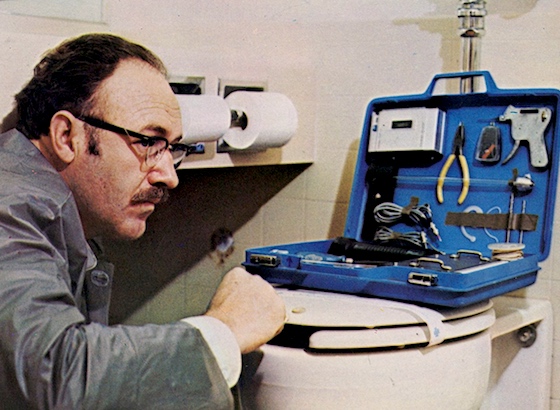
    That man is Harry Caul (Gene Hackman), a professional eavesdropper — people pay him to record what other people are saying in private. When Coppola conceived the film, this was just an interesting world to play around in. By the time it was produced and released, Watergate had recently happened and the film could not have been more timely. Nonetheless, the end result is not merely an espionage mystery, but also a character study about what kind of man would perform this work. So we do see how Harry goes about his job, but these scenes are almost as much about telling us who this man is (methodical, thorough, clever, inventive) as they are about furthering the plot (which, naturally, they’re central to).

    Here he just looks like a toilet repair man...

    It’s also about how the job affects him. One part of that is paranoia — an obvious reaction when you think about it. Harry has multiple locks on his apartment door, and one major early sequence is based around him trying to establish how a kindly neighbour had got in to leave him a gift — a seemingly innocuous thing, but the potential it holds has him terrified. Come the end of the film, such behaviour takes on a maddening new dimension. But perhaps an even bigger problem is conscience. Harry lies to himself about the nature of his work, because once upon a time a trio of deaths resulted from it. He says they weren’t his fault because he was just doing his job, but he still clearly carries the guilt of it, and that is what ultimately leads him into a new predicament. Not that that ends well either. Yes, it all comes to a very ’70s conclusion: bleak.

    Coppola’s original vision for the film, as a puzzle for the viewer to be solved, survives into the final cut, though anyone watching it just to solve the riddle may find it slow going at times. That’s because Coppola’s other filmmaking instinct, to explore character, has naturally taken hold, and so the movie is as much about the bugger as the bugging. And so it’s very much two things hand in hand: the mystery of what’s going on in the recording, and a study of the psychology of a man who does this for a living. It’s all the richer for being both.

    5 out of 5

    The Conversation was viewed as part of my Blindspot 2017 project, which you can read more about here.

    Vehicular Review Roundup

    Get in Vehicle 19 to go for a Drive with The Driver in today’s roundup, featuring:

  • The Driver (1978)
  • Drive (2011)
  • Vehicle 19 (2013)


    The Driver
    (1978)

    2017 #101
    Walter Hill | 92 mins | Blu-ray | 1.85:1 | USA & UK / English | 15 / PG

    The Driver

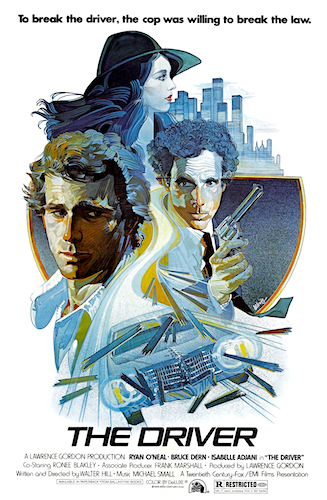
    Walter Hill’s stripped-back neo-noir car chase thriller stars Ryan O’Neal as The Driver, a getaway man for hire and the best at what he does. Out to get him is Bruce Dern as The Detective, who’ll go to any lengths to catch him — including illegal ones. Almost cornered, the Driver enlists the help of The Player (Isabelle Adjani) to thwart the Detective.

    The film’s influence on the likes of Baby Driver and Drive is clear (Nicolas Winding Refn claims not to have seen it before making his film, but it must’ve been seen by someone somewhere down the line, whether that’s original novelist James Sallis or screenwriter Hossein Amini, because the DNA is right there). Both those later efforts burnished and perfected the formula in different ways, but the original has a gritty, low-rent charm of its own. The archetypal characters and straightforward noir plot are delightful almost because of their simplicity, while the few action scenes are handled with the panache, not of a slick blockbuster, but of a filmmaker who knows how to create something effective even within his limitations.

    The Driver maybe doesn’t transcend those to the level of being a classic, but, for fans of the genres it crosses, it’s deservingly a cult favourite.

    4 out of 5

    Drive
    (2011)

    2017 #106
    Nicolas Winding Refn | 101 mins | Blu-ray | 2.35:1 | USA / English | 18 / R

    Drive

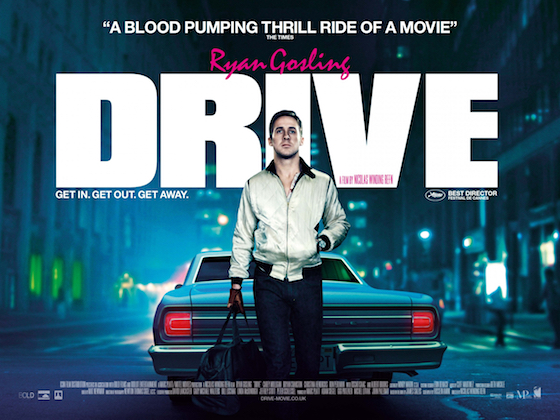
    Iconoclastic Danish director Nicolas Winding Refn had made noteworthy films before Drive, but it felt like this was where he really hit home. It stars Ryan Gosling as a mechanic and part-time movie stunt driver who also moonlights as a getaway man, but when he tries to help out his attractive neighbour (Carey Mulligan) and her husband (Oscar Isaac) he gets embroiled in a crime with deadly consequences.

    It’s a noir storyline with a familiar shape, but as with many of the best examples of that not-quite-a-genre it’s the stylish filmmaking that elevates the material. Refn was influenced by the likes of Jean-Pierre Melville and Sergio Leone to take a very American genre and give it a European influence, and the result is a movie that’s as much about its mood and feel as it is the intricacies of plot or character. Despite the title and theme it’s not even a car chase movie, really, though the handful of well-created driving sequences do pack a greater punch thanks to their scarcity.

    5 out of 5

    Drive was viewed as part of my What Do You Mean You Haven’t Seen…? 2017 project.

    Vehicle 19
    (2013)

    2017 #151
    Mukunda Michael Dewil | 82 mins | TV | 2.35:1 | USA / English | 12 / R

    Vehicle 19

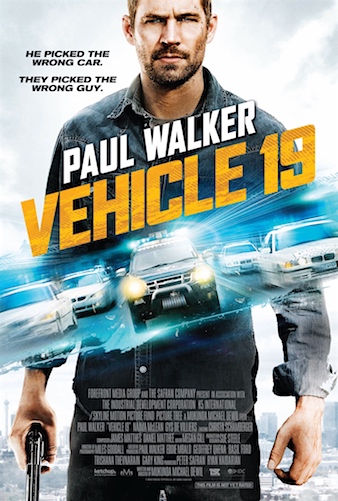
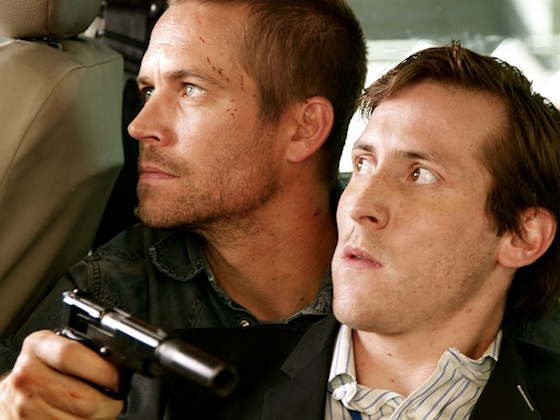
    One of the last films Paul Walker completed before his untimely death, Vehicle 19 sees the Fast & Furious star doing what he will always be remembered for: driving a car, sometimes fast. Here he’s Michael Woods, a recent parolee who arrives in Johannesburg intending to reunite with his partner. Unfortunately he picks up the wrong rental car and finds himself the subject of a manhunt, because in the car is evidence relating to a political conspiracy. Unfortunately for the bad guys who want said evidence, Michael is, like, an honourable chap — and also a criminal, so he totally knows how to drive a car like he’s escaping a crime. The main conceit is: the whole film’s shot from within the car.

    Yep, that’s why I watched it. I wish I hadn’t. Vehicle 19 is a deeply stupid movie. Like, Michael’s phone is all-important — it’s the only way he can contact other people; later, it contains vital evidence — but when he notices the battery is low he does nothing about it, despite having a charger in his bag, until the battery literally runs out mid-call. And that’s just one of innumerable nonsensical contrivances throughout the film.

    It lacks pace, and therefore lacks tension. Michael just pootles around the city from the very start. Apparently everywhere is reachable within 20 minutes, or Michael — who’s never been to this city before — thinks it is. Whenever he asks for directions, everywhere he’s going is either just a block away or down the road, third right. At one point the police say they just received a call to 911. From what I can tell, the emergency number in South Africa is not 911. And I could probably go on — the film is absolutely littered with things that just don’t quite hang together.

    Fast and/or furious

    It can’t satisfy as a dumb action flick either. I presume it was a low-budget production with ambitions beyond its scale in the chase scenes. Understandably, the trailer foregrounds these to help sell the movie. Unfortunately for the film, it’s a bit of a bait-and-switch: the clips in the trailer are near-as-dammit the entirety of the film’s action. These sequences are few, far between, short, and, even then, poorly staged. The problem isn’t that they’re all limited to only being seen from within the car (the opening sequence of The Driver does exactly that to marvellous effect, for example), it’s that they lack both adrenaline and plausibility. For example, at one point Michael manages to make the chasing car flip over, but I watched that bit three times to try to decipher it and I still have absolutely no idea how he’s supposed to have done it. Oh, and then the car explodes. And Michael and his passenger seem to react like “oh, that’s that then” and just drive on.

    They’ve got the right idea, though: if you’re thinking of watching Vehicle 19, no, just drive on. Or just put Drive on — it’s a totally different movie, but at least it’s a good one.

    1 out of 5

    Vehicle 19 featured on my list of The Five Worst Films I Saw For the First Time in 2017, which can be read in full here.

  • Review Roundup

    This may look like a pretty random selection for a review roundup… and it is. But they do have two things in common: I watched them all in 2017, and I gave them all 3 stars.

    Yeah, not much, is it?

    Anyway, in today’s roundup:

  • The Girl on the Train (2016)
  • Lions for Lambs (2007)
  • Tea for Two (1950)


    The Girl on the Train
    (2016)

    2017 #113
    Tate Taylor | 112 mins | streaming (HD) | 1.85:1 | USA / English | 15 / R

    The Girl on the Train

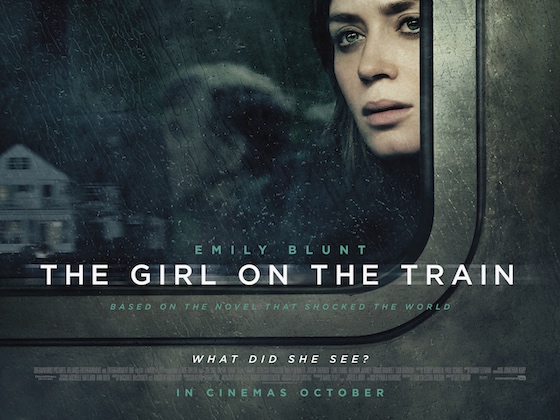
    Based on a bestselling novel, The Girl on the Train stars Emily Blunt as Rachel, an alcoholic divorcee whose commuter train passes her old home every day. She tortures herself by observing her ex (Justin Theroux), his new wife (Rebecca Ferguson) and their child, as well as her former neighbours Scott (Luke Evans) and Megan (Haley Bennett), who she imagines living a perfect life. But after Rachel sees something that shatters the image she’s created, she wakes up from a black out, with mysterious injuries, and to the news that Megan has gone missing…

    The whole story unfurls with a good deal of histrionics and a questionable level of psychological realism, but as a straightforward potboiler it has some degree of entertainment value. In fact, if it had been made with a little more panache then it may even have been seen as a throwback to the kind of melodramas they produced in the ’40s and ’50s. Because it doesn’t seem to have that level of self-awareness, I guess it’s just the modern-day equivalent.

    3 out of 5

    Lions for Lambs
    (2007)

    2017 #121
    Robert Redford | 92 mins | streaming (HD) | 2.35:1 | USA / English | 15 / R

    Lions for Lambs

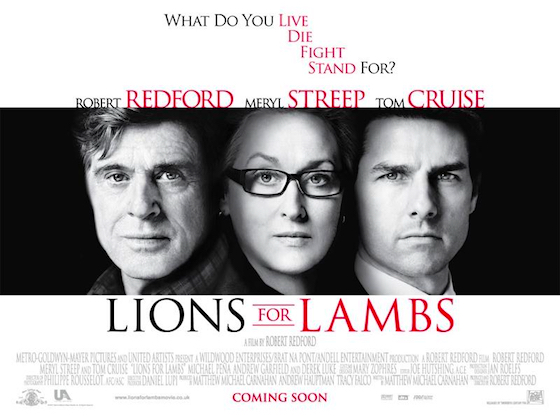
    The US intervention in the Middle East is obviously one of the most significant geopolitical events of our age, but how many films have really got to grips with it? Some, like The Hurt Locker, have given a sense of its impact to those on the ground. Lions for Lambs tried to take a more intellectual standpoint, with three interconnected storylines: a young and ambitious US senator (Tom Cruise) details a new military strategy to an experienced and sceptical journalist (Meryl Streep); a college professor (Robert Redford) tries to engage a talented but apathetic student (Andrew Garfield); and two soldiers become stranded in Afghanistan (Michael Peña and Derek Luke), providing a link between the other two stories.

    Screenwriter Matthew Michael Carnahan originally conceived the work as a play, before realising the Afghanistan section needed the scale of a movie. Nonetheless, his original conception shows through: the film is very talky and stagey, and the other two storylines could certainly be performed on stage with no changes necessary. You can also tell it’s driven by disillusionment in the US’s actions, and it has everyone in its critical sights: the government, the media, the education system… It feels more like a polemic than a movie, lecturing the viewer; although, like everyone else, it doesn’t seem to offer any firm answers.

    Streep and Cruise both give excellent performances. I suppose being a smarmy senator isn’t much of a stretch for the latter, but Streep’s turn as an insecure journalist is the highlight of the film. You need acting of that calibre to keep you invested in a movie like this, and it almost works, but ultimately the film has too little to say.

    3 out of 5

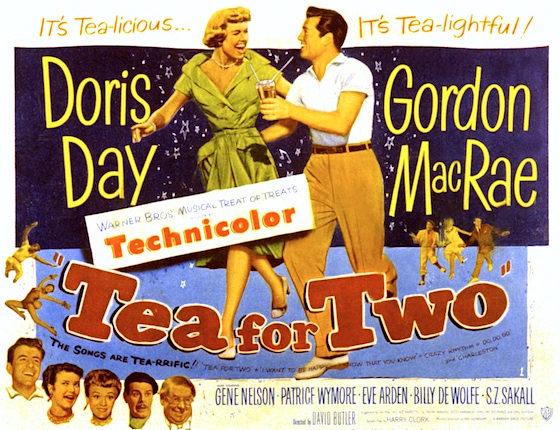
    Tea for Two
    (1950)

    2017 #162
    David Butler | 94 mins | DVD | 4:3 | USA / English | U

    Tea for Two

    Musical comedy starring Doris Day (radiant as ever) and Gordon MacRae (given little to do as her love interest).

    The songs are largely forgettable, with a couple of sweet exceptions, but at least there are other things to recommend it, like some impressive dancing from Gene Nelson, particularly during a routine on a flight of stairs. There’s a solid helping of amusing one-liners too, most of them claimed by Eve Arden as Day’s wry assistant Pauline, the rest by S.Z. Sakall as her embattled uncle. Said uncle is, by turns, a bumbling old codger and an underhanded schemer who uses tricks to try to ruin his niece’s happiness just so he can win a bet. Best not to dwell on that too much…

    The same goes for the rushed ending, in which our heroine is in financial ruin, so her assistant basically whores herself out to a rich lawyer so they can still put on the show. Hurrah! And talking of things not to dwell on, there’s also the title, which has absolutely nothing to do with the story (other than it being probably the best song). Conversely, the name of the play it’s based on — No, No, Nanette — is bang on. Ah well.

    Nonetheless, Tea for Two is all-round likeable entertainment; the kind of movie you put on for a pleasantly gentle Sunday afternoon.

    3 out of 5

  • Vintage Tomorrows (2015)

    2017 #120
    Byrd McDonald | 67 mins | streaming (HD) | 16:9 | USA, Canada, Czech Republic & UK / English

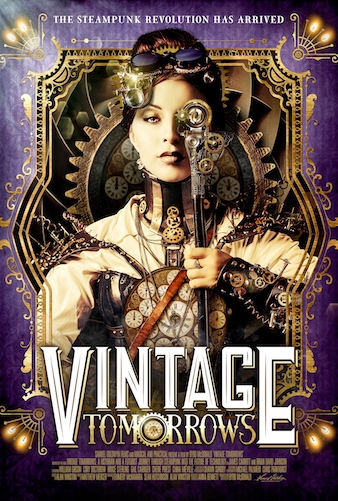
    Vintage Tomorrows

    Heard the term “steampunk” but don’t really know what it is? Or have an idea, but you’d like a fuller picture of the whole subculture? Then this is the film for you, my friend, because Vintage Tomorrows is basically Steampunk 101.

    For those that don’t know, steampunk is a kind of alternate history, where Victorian-esque technology and fashion rub against advanced technology — think steam-powered cars; clockwork machinery; and cogs. Lots of cogs. Although little more than an hour long, Vintage Tomorrows does a good job of providing an overview of the movement, encompassing the cool literature, fun costumes, impressive self-built gizmos, and so on. It also doesn’t ignore the political dimension: how steampunk does — or, frequently, doesn’t — deal with the dark side of the Victorian era: the poverty, oppression, racism, colonialism, misogyny, and so forth. Mainly, the subculture still needs to “grow up” and tackle that stuff. With plenty of featured interviewees, it’s also interesting to hear the different ideas that different people have about what exactly steampunk is and should be — there are clearly dissenting voices, rather than a homogenous whole. I guess that’s probably true of any subculture, but I imagine particularly one that’s quite counter-cultural.

    That said, when some people start placing steampunk in the context of widespread movements like the Beat Generation, hippies, punk, hip-hop — asserting that it’s following in their footsteps — I think they’re possibly going a bit far. It may be inspired by the same mentality (the rejection of the mainstream, the desire to create something different, the search for your own identity and people who share it), but to imply steampunk is having the same influence on wider culture that those earlier movements did… I don’t think so. Not yet, anyway. In the future? Who knows.

    Fire!

    Indeed, some pretentious assumptions come to the fore when the interviewees get on to the subject of modern technology. They don’t like sleek, minimalist, Apple-esque design — it’s not complicated or tactile enough for them. Fine, if that’s your taste — but it is just your taste. A lot of people love that stuff. And, actually, it’s not a different subculture that loves it, it’s the mainstream. If the mainstream didn’t like it, something else would’ve swept it aside by now. But a level of self-absorption seems to go hand-in-hand with those at the forefront of niche movements, so I guess we should expect such attitudes.

    Set aside those occasionally presumptive attitudes, and there’s a lot to like about steampunk. Well, if it meshes with your sensibilities, anyway. It’s not something I’d want to partake in myself, but it looks like a fun alternate reality to be a part of. And if Hollywood saw fit to give us a few more movies that fit into the genre (because there haven’t been many, I believe), I certainly wouldn’t complain.

    4 out of 5

    Atomic Blonde (2017)

    2017 #166
    David Leitch | 115 mins | Blu-ray | 2.40:1 | USA, Germany & Sweden / English, German, Russian & Swedish | 15 / R

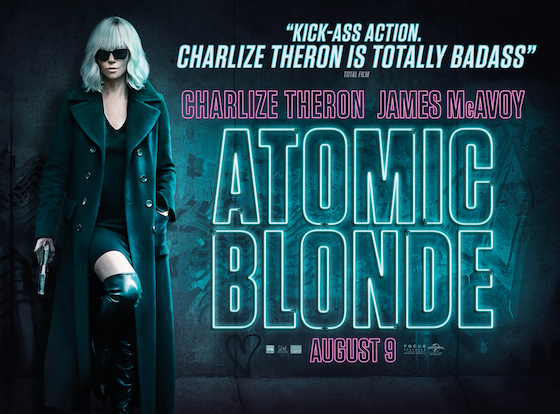
    Atomic Blonde

    The uncredited co-director of John Wick takes sole charge for this action thriller set at the tail-end of the Cold War, which sees Charlize Theron’s British spy dispatched to Berlin to find “The List”, a document naming all the active intelligence agents in the city, which has fallen into the hands of the KGB.

    It’s based on The Coldest City, a graphic novel that came out during my relatively brief flirtation with being a proper comic book reader a few years ago. Back then it caught my eye (though I never got round to buying it) because I got the impression it was a Le Carré-style thriller, so I was very surprised to eventually learn it was the basis for this film, the trailers for which promised a hyper-stylised actioner from the director of combat-focused John Wick. Watching the film, however, it’s easier to see how I might not’ve been wrong about the novel after all — take out the elaborate fight scenes and shoot it more like Tinker Tailor Solider Spy than The Guest, and this could indeed be a Le Carré-esque Cold War thriller.

    Lots of style, little substance

    Or maybe that should be “Le Carré wannabe”. The filmmakers were probably right to shift the focus in that way, because the plotting here isn’t up to that standard, particularly in a bevy of last-minute twists that bog down the final ten minutes, especially with their burst of misplaced patriotism (though I won’t say for which country lest it spoil something). Le Carré’s plots feel almost like the definition of substance being more important style (I’ve never actually read one of his books so certainly don’t mean that to be an insult), whereas Atomic Blonde is good ol’ style over substance. The best stuff here lies not in the intricacies of its spy-vs-spy storyline, but in the starkly coloured visuals, the cool ‘80s soundtrack, and (as you’d expect from the stuntman-turned-director behind 50% of John Wick) the expertly realised fight scenes.

    Chief among these is an incredible single-take action sequence that goes from a sniper-beset protest march, into a building, up in the elevator, back down the stairwell — all in a series of bruising hand-to-hand fights — and then, for good measure, continues back outside and into a car chase shootout. Obviously the single take aspect must be as faked as Birdman (according to IMDb, it actually includes almost 40 different shots, many stitched together with the aid of CGI — I’d wager mostly during the car chase, which feels less smooth than the rest), but it’s still impressively crafted. The choreography of it all — both the fight moves and the camerawork — really is something else.

    Fight!

    Despite the flashiness of that one long section, what’s really effective about all the fight scenes is the level of groundedness. I’m sure they’re not what a real fight is like — they’re still choreographed brawls between trained combatants — but Theron doesn’t take down an army singlehanded, she fights a couple of guys, it’s hard work, and she ends up battered, bruised, and exhausted.

    Sadly, between the confused plot and the irritating ending, Atomic Blonde ultimately rubbed me up the wrong way. Still, it’s worth watching for the style and the impressive action scenes. If only they’d managed to combine those with a better story, then this would’ve been something really special.

    3 out of 5

    Atomic Blonde is available on Sky Cinema from today.
    David Leitch’s new film,
    Deadpool 2, is in cinemas everywhere now.

    The Cabinet of Dr. Caligari (1920)

    aka Das Cabinet des Dr. Caligari

    2017 #163
    Robert Wiene | 77 mins | Blu-ray | 1.33:1 | Germany / silent (German) | U

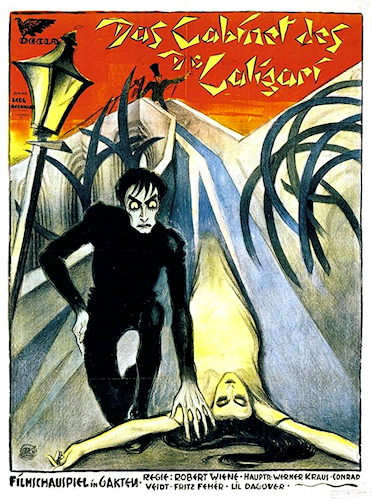
    The Cabinet of Dr. Caligari

    The poster child for German Expressionist cinema, as well as featuring “cinema’s first true mad doctor” and “cinema’s first unreliable narrator” (at least according to David Cairns on the Masters of Cinema Blu-ray — I haven’t verified those statements for myself), The Cabinet of Dr. Caligari certainly has a lot to unpack for a film that’s barely an hour-and-a-quarter long. Or does it? Because one has to wonder if there’s an element of style over substance here.

    “A mystery story told in the Poe manner,” according to the original Variety review, the titular Dr Caligari (Werner Krauss) is the host of a fairground attraction, and his eponymous cabinet contains Cesare (Conrad Veidt), a somnambulist who Caligari controls — at the fair, to answer questions from the audience; and at night, to do his evil bidding, including murder. Caligari’s activities come to the attention of young Franzis (Friedrich Feher), who attempts to uncover the truth about the doctor and expose him.

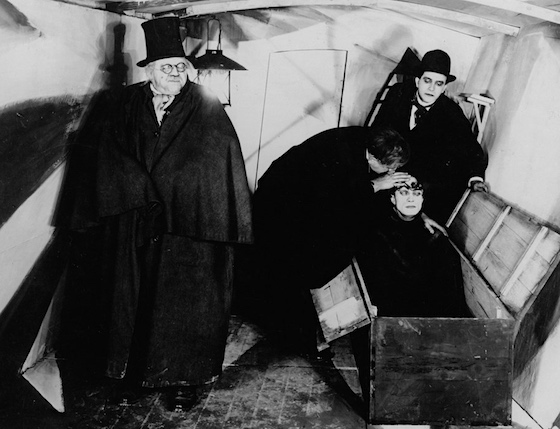
    But the most famous thing about Caligari by far is not the storyline or the characters, but the visual style. Painted backdrops evoke a landscape straight out of a nightmare: jagged lines and stark monochromatic shapes (this isn’t just a film that happens to be filmed without colour, it feels black and white), they give the impression of the winding streets of a town and its locales without actually being one. The implied structures tower over the characters, leaning in above, creating an oppressive and unnerving atmosphere, while their total lack of reality evoke theatre more than the literalism we’re now used to from film. The make-up and performances are the same: heightened; dreamlike — or nightmarish.

    Impractical architecture

    Which may be entirely appropriate given the film’s framing narrative, which (spoilers!) introduce an ending that’s a little bit “and it was all a dream”. Or was it? Well, that depends how you interpret what happens. The bookends were apparently added to help sell the film to the public, framing its fantastical narrative in something more grounded. The screenwriters weren’t happy — as Lotte H. Eisner writes (in the MoC booklet), “the result of these modifications was to falsify the action and ultimately to reduce it to the ravings of a madman. The film’s [screenwriters], Carl Mayer and Hans Janowitz, had had the very different intention of unmasking the absurdity of asocial authority, represented by Dr. Caligari.” Well, the tacked-on ending doesn’t necessarily negate such an interpretation, you just need to fill in the blanks to get there yourself.

    For example, there’s what Cairns calls his “Mulholland Drive theory”: that what we witness is all true, until the point that Franzis sees the asylum director is Caligari; from there until the reveal that Franzis is an asylum patient is a fantasy. Evidence in favour of this: everything goes implausibly swimmingly for our hero in that section, from easily recruiting the asylum staff to finding (as Cairns puts it) “Caligari’s second cabinet, in which he keeps his entire backstory.” It’s a fun reading, even though it’s clearly a case of projecting an interpretation onto the film that wasn’t intended by the makers.

    One that fits better, perhaps, is that Franzis’ flashbacks aren’t merely “the ravings of a madman”, but he’s telling the truth, and that somehow between the end of his flashbacks (which see Caligari locked up in his own asylum) and where we join the framing narrative (with Franzis locked in the asylum and Caligari in charge), the evil doctor has reasserted his authority and captured his accuser. Of course, that requires a leap — how does Caligari regain control? Why don’t we see it happen? Well, we don’t see it happen because that wasn’t what the makers intended.

    Suspicious activity

    And so we come back to “it was all a dream”. Maybe that’s the best explanation — the writers may’ve hated it, but in some respects it saves them from themselves: Cairns’ visual essay highlights a bunch of plot holes, inconsistencies, and confusions, not to mention issues of character motivations and actions (“in a way it makes no sense to speak of character motivation in a mad man’s fantasy”), all of which you can hand-wave away if “it was all a dream”. This is why I wondered if it was style over substance. The sets, the make-up, the performances — all fantastically atmospheric. The story, the characters, their actions — not such great shakes.

    But maybe that’s okay. After all, why not? Director Robert Wiene and his crew did a fantastic job of bringing a surreal nightmare to life, and nightmares seldom feature plausible storylines.

    4 out of 5

    The Cabinet of Dr. Caligari was viewed as part of my Blindspot 2017 project, which you can read more about here.

    Review Roundup: 3 Long Films That I Didn’t Enjoy Directed by Martin Scorsese

    The title’s pretty self-explanatory, isn’t it?

    Those films were:

  • Silence (2016)
  • Casino (1995)
  • New York, New York (1977)


    Silence
    (2016)

    2017 #141
    Martin Scorsese | 161 mins | streaming (HD) | 2.35:1 | USA, Taiwan & Mexico / English, Japanese & Latin | 15 / R

    Silence

    A re-adaptation of Shūsaku Endō’s novel (previously filmed in 1971), Silence is gorgeously produced but torturously dull Christian propaganda. The plot is about two priests travelling to anti-Christian Japan to find their mentor, who’s rumoured to have renounced the Church, but really it’s about faith and the testing of it.

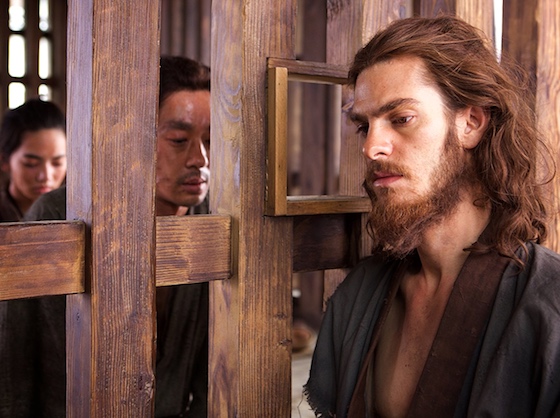
    The foremost of the two priests is Rodrigues (Andrew Garfield), the kind of Christian who lets others die for his faith even as he doubts it. Like many a preacher before him, Rodrigues’ sin is pride — too proud of his faith, his culture, his rightness, his superiority, to consider another point of view; to bend to help others. Conversely, his accusers and persecutors lack compassion or fairness, torturing and killing from exactly the same position as Rodrigues: that their beliefs are correct, all others be damned. Well, of such things are all religious wars made, I guess. At least the Horrible Japanese are better than the Christians’ own Inquisition was: if people renounce Christianity the Japanese sometimes set them free; the Inquisition just used it as another reason to murder them. God, religious people can be shits.

    There are no good people here. The Christians are colonialists with a monomaniacal belief in their own faith. The Japanese are so set against it that they’ll torture and murder their own people just to get back at the Christians. It’s a world full of hatred. So much for the love of God. All this intolerance is as pointless then as it ever was before or has been since. If we just let others go on how they want to go on — live and let live — then the world would be such a nicer place.

    Rodrigues in prison

    For all the violent torture depicted on screen, the hardest thing to take is the film’s slow, slow, slow pace. It does have some theological points to make, but they’re thin gruel for the time it takes to make them — or, rather, the time it wastes before it really starts to consider them. If the first hour was a lot shorter it would improve the whole film; indeed, it would’ve made me better disposed to the rest. It does improve, but by the time it improved I was already bored and annoyed with it. Its best qualities by far are visual: as well as stunning cinematography by Rodrigo Prieto, the whole production is beautifully mounted — the locations, sets, costumes, make-up, and so on, are all very well realised.

    To say Silence was not a box office success is an understatement: off a budget of $46 million, it took just $23.7 million worldwide, and only $7.1 million of that in America. I think it must’ve been promoted badly — I’m sure it’d appeal to the Bible Belt crowds who flock to that niche Christian shit that’s always turning up nowadays. And if you’re in any doubt that it’s meant to be a pro-Christian film: the premiere was held at the Vatican and it was screened early for 400 priests.

    2 out of 5

    Casino
    (1995)

    2018 #19
    Martin Scorsese | 178 mins | download (HD) | 2.35:1 | USA & France / English | 18 / R

    Casino

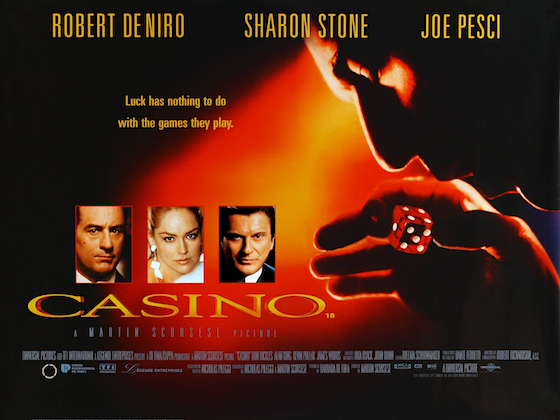
    “A fictional story with fictional characters adapted from a true story,” as the film’s own credits describe it, Casino tells of the rise of Sam ‘Ace’ Rothstein (Robert De Niro, of course) in Mob-controlled Las Vegas, whose life is made awkward by his loose-cannon Mob-enforcer best friend Nicky Santoro (Joe Pesci, of course) and his tumultuous marriage to hustler Ginger (Sharon Stone).

    “There’s no plot at all”, says Martin Scorsese in an interview included on Casino’s Blu-ray (per IMDb). “It’s three hours, no plot. […] There’s a lot of action, a lot of story, but no plot.” Well, er, he’s not wrong. Casino seems to skip around at random, devoid of a throughline to guide its narrative. It flies off on so many different tangents, it takes a while to get a handle on what it’s about — if it’s about anything. Or possibly it’s about too much. For example, there’s a lot of “how the casino business works” stuff early on, which is quite interesting in itself but only some of it has any relevance later on; and eventually the film gets sidetracked wholesale into De Niro and Stone’s marriage woes, which are at best a subplot earlier on. Whatever it was supposed to be, I was never hooked and never engaged.

    De Niro blows

    Part of this is the film’s storytelling style — I didn’t know Scorsese was in the business of making visuals to accompany audiobooks. Well, that’s what Casino felt like. Naturally there’s skill on display (they’re very, very good visuals to accompany an audiobook), but the voiceover-driven style really alienated me. It makes the characters feel at arm’s length: despite De Niro and Pesci constantly taking directly to us, I didn’t feel like I was getting to know or connect with them, I was just being told about them. The endless narration constantly skims through events too, making it feel like a summary rather than an actual story. You might think that would give it pace, but it does the opposite: the first hour drags and drags, and then drags some more, and eventually this three-hour film feels every minute of it.

    I read one review of Casino that concluded, “I don’t feel like watching it again, but it certainly made me want to watch Goodfellas again.” I know the feeling.

    3 out of 5

    Casino was viewed as part of my What Do You Mean You Haven’t Seen…? 2018 project.

    New York, New York
    (1977)

    2018 #88
    Martin Scorsese | 156 mins | DVD | 16:9 | USA / English | PG / PG

    New York, New York

    Once again, this is a lengthy Martin Scorsese movie that seemed terribly unfocused for so long that it lost me ages before it found what it wanted to be about. (Well, it predates the other two, but whichever order you put them in it’s looking like a definite pattern.)

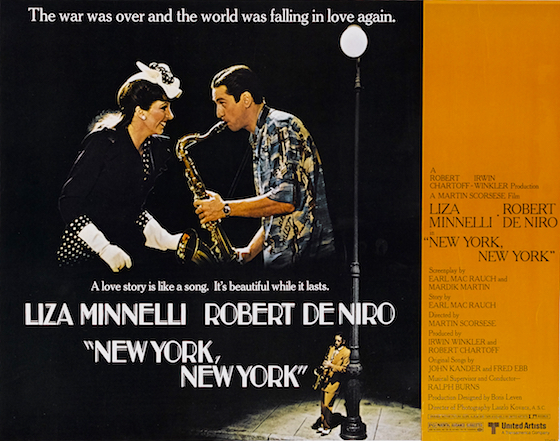
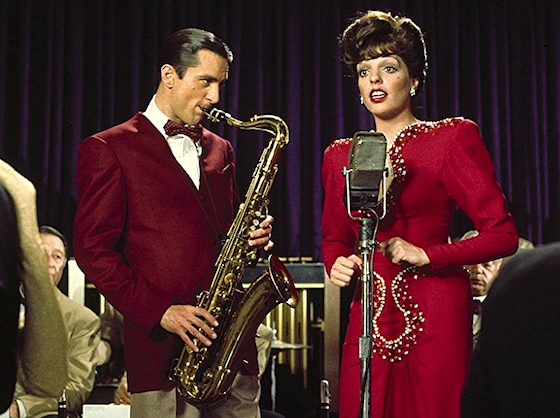
    Starting on VJ Day in New York, it stars Robert De Niro as a wannabe musician and Liza Minnelli as a wannabe singer who wind up in a romance and co-dependent career, until one outshines the other. De Niro is playing an angry young man who has talent but whose temperamental nature may well get in the way of success — yes, it’s Any Robert De Niro Movie. But, wow, his character is annoying, and I imagine his actions are only getting more distasteful with time — the way he badgers and cajoles Liza into going out with him (something she eventually agrees to) is the kind of behaviour that gets regularly criticised nowadays (rightly). Well, I don’t think he’s meant to be a nice guy — the film seems to be about their tempestuous relationship and how that helps and hinders their careers — but I wasn’t sure the film knew how unlikeable he was.

    I wasn’t sure the film knew much of anything, really. Apparently much of the dialogue was improvised, which in turn made it a nightmare to edit into a coherent narrative, which would explain the messiness — everything feels overlong, unfocused, and increasingly dull. Consequently there have been several cuts of the film, with this being the longest “director’s cut” released in 1981. It has some good bits, foremost being the extended Happy Endings musical interlude, which at one point was ditched to create one of the shorter versions. I like the idea of this film being less long, but don’t lose the only really good bit!

    So good they named it irrelevantly

    Just to wind me up further, the content has fundamentally nothing to do with the title. I mean, it begins in New York, and when the characters go on tour they’d like to get back there, and eventually they do and so some more of it’s set there, and occasionally they’re writing the titular song (which, I confess, I was unaware hailed from this film — I assumed the movie was named after the famous standard, not that it spawned it), and in the epilogue Liza performs said song (post-2016 observation: said epilogue is gosh-darn similar to La La Land’s!) Anyway, my point is: this film could’ve been set almost anywhere and not affected anything much, so why the title?

    2 out of 5