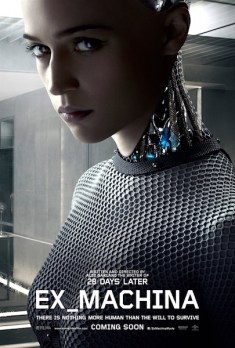
Ex Machina (2015)

2016 #26
Alex Garland | 108 mins | Blu-ray | 2.40:1 | UK / English | 15 / R

BAFTABritish Academy Film Awards 2016
5 nominations

Nominated: Best British Film; Best Supporting Actress (Alicia Vikander); Best Original Screenplay; Best Special Visual Effects; Outstanding Debut by a British Writer, Director or Producer.

A British sci-fi movie from a first-time director will tomorrow take a place at the table (well, in the auditorium) alongside 2015’s biggest awards contenders, as it vies for multiple gongs at this year’s BAFTAs — and it stands a very plausible chance of walking away with several of them, too. I hope it does, because, after a year that brought us awards-quality sci-fi bombast (Mad Max, Star Wars), it’s fantastic that a small film about three people sat in rooms talking can stand toe-to-toe with them as one of the year’s best.

The increasingly ubiquitous (and deservedly so) Domhnall Gleeson stars as Caleb, a programmer at search engine giant Google Bluebook who wins a staff lottery to spend a week with the company’s reclusive founder, Nathan, played by the increasingly ubiquitous (and deservedly so) Oscar Isaac. However, on his arrival he learns he’s not just there to hang out: Nathan wants him to perform a Turing test on an AI he’s built. The point of the Turing test (as I’m sure you know) is for a human to interact with an AI but not realise it’s an AI, so Caleb’s surprised when said AI — Ava, played by the increasingly ubiquitous (and deservedly so) Alicia Vikander — comes in the form of a robot that’s obviously a robot. The real test is whether Caleb can know he’s talking to something non-human and still come to be convinced it’s human. As Caleb begins his interviews with Ava, it becomes apparent that there’s something else going on at this remote facility, where regular power cuts mean they’re all locked in…

As is probably clear, Ex Machina is a sci-fi movie of the thoughtful variety. It’s a film that considers ideas of artificial life, how we test it and what it means to create it, and only gradually builds in thriller elements that pay off in its final twenty-or-so minutes. In truth, it’s not the most thorough deconstruction of what it means to be human and whether artificial intelligence can have that right, but it does touch on these issues and, in so doing, leaves them open for the viewer to mull over for themselves, or debate with friends, or however else one likes to consider their movies post-viewing (like, I dunno, writing about them on the internet or something).

There are thematic similarities to Blade Runner, which (in case you’ve not seen it) also deals with the humanity or otherwise of man-made intelligence. Mulling on that comparison, I’m tempted to say Ex Machina is almost the inverse of Blade Runner, in this regard: Ridley Scott’s classic is ostensibly an SF-noir thriller (Harrison Ford is a cop hunting down some rogue robots), but by its end has revealed a considered exploration of what it means to be human, and whether these artificial creatures can lay claim to that. Conversely, Alex Garland’s film seems like it’s sitting us down to consider those same issues, but is actually laying the groundwork for revelations and twists that build to an edge-of-your-seat climax. I’m not saying one’s better than the other in this respect, just that they’re approaching the same topics almost from opposite ends.

Also like Blade Runner, Ex Machina is an exceptionally well made and performed film. Not in the same way as Blade Runner — it’s bright and clean and modern, in a Google-y, Apple-y kind of way — but to a similar level of internal consistency and accomplishment. Gleeson’s Caleb may seem a little plain, a blank page for the other characters to write on, but as his insecurities begin to come to the fore you realise that’s almost the point. Isaac is suitably overbearing as the alcohol-dependent genius behind Bluebook and Ava, an initially affable but quickly disquieting presence — he may be a threat, or may just be a bit odd. And his dance scene is surely one of 2015’s highlights (there’s an extended version hidden on the US Blu-ray, which is a treat). Garnering the most praise (and awards) is Alicia Vikander’s take on an AI. It’s a tricky role to tackle, because she’s not just a robot — that would defeat the point of Nathan’s exercise — but nor is she fully human. It’s a tightrope of a role, a fine line to walk, and Vikander negotiates it with aplomb. To say too much more would be to spoil it.
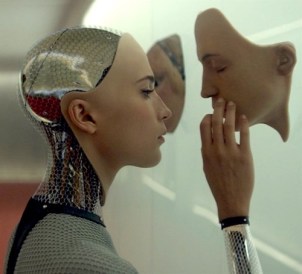
Aside from the acting, the film’s most striking element is surely the design of Ava. Her face and hands appear to be human, but everything else is robotic, and much of it transparent. This isn’t a case of slipping an actor into a suit painted with circuitboards — you can see the metal limbs and motors in her arms and legs, the metal spine in her back, the various computers or power sources or whatever glowing and spinning inside her. Occasionally she dresses in clothes and her workings are covered, but she spends most of the film with them on display. The CGI is literally flawless, which for a relatively-low-budget little British sci-fi-drama is all the more remarkable. I guess the visual effects awards are going to go to the big films, Star Wars or Mad Max or The Revenant (the bear seems to be very popular), but I do wonder if the work here is more deserving. You know how it must’ve been done — mo-cap suits and CGI — but there’s still a feeling of “how did they do that?”, because it’s so faultless. In fact, you don’t even wonder how they did it, because you just accept it; it’s only if you actively stop to consider it that you realise it’s physically impossible and must be CGI.

Those after a dissertation-like hard-science deconstruction of the meaning and possibilities of AI will likely find Ex Machina slightly lacking, as will anyone after the crash-bang thrills most mainstream sci-fi provides. Viewers prepared for a decently thought-provoking dramatic thriller about near-future tech, however, should be both engrossed, and grateful that movies like this are (for the time being) still getting made.

5 out of 5

The British Academy Film Awards are tomorrow night, televised on BBC One from 9pm.

Ex Machina placed 20th on my list of The 20 Best Films I Saw For the First Time in 2016, which can be read in full here.
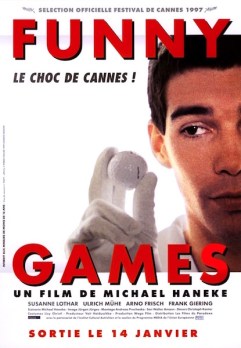
Funny Games (1997)

2016 #4
Michael Haneke | 104 mins | TV | 16:9 | Austria / German | 18

Arthouse favourite Michael Haneke criticises audience’s enjoyment of screen violence. It certainly achieves its aim of being a grim, brutal depiction of violence in real-life, creating a situation that feels inescapable not only for the characters but the audience too. Some cinematic trickery is also deployed to striking, if divisive, effect.

However, it’s more shocking that, as recently as the mid-’90s, Austria doesn’t seem to have a universal emergency services phone number.

The entire message is, “real-life violence is bad and you shouldn’t enjoy it in fiction, okay?” You don’t need to sit through a tough hour-and-a-half to know that.

3 out of 5

The Martian (2015)

2016 #25
Ridley Scott | 142 mins | Blu-ray | 2.40:1 | USA & UK / English | 12 / PG-13

Oscar statue2016 Academy Awards
7 nominations

Nominated: Best Picture, Best Actor (Matt Damon), Best Adapted Screenplay, Best Sound Mixing, Best Sound Editing, Best Visual Effects, Best Production Design.


Ridley Scott’s latest arrives on Blu-ray in the UK today, with a disappointing dearth of special features (disliked Exodus gets a 2½-hour making-of, four hours of additional features, plus a commentary; award-winning The Martian gets 24 minutes plus a few in-universe documentaries — what?!) Never mind that, though: how good is the film deemed the best comedy or musical of 2015? (If you somehow missed that news, you’ll appreciate the addition of a “seriously” here.)

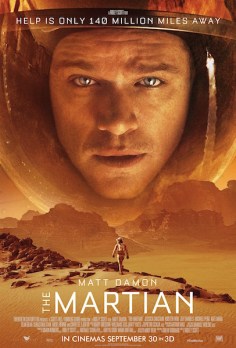
In the relatively near future, mankind is on its third manned mission to Mars. When a colossal storm rolls in, the decision to made to evacuate the Mars base. During the escape, biologist Mark Watney (Matt Damon) is struck by debris and apparently killed, and his crew mates are forced to leave him for dead. He isn’t dead, though, but he is injured and alone on a planet 140 million miles from home, with no way to communicate with Earth, and not enough energy, oxygen, or food to see him through the four years until the next Mars mission is scheduled to arrive. Refusing to give in to inevitable death, Watney only has one choice: science the shit out of this.

That sounds like a laugh-a-minute premise, right? And there’s a major subplot about disco music, so it’s practically a musical too!

No, the HFPA are just idiots — The Martian is neither a comedy nor a musical. It is the latest in a growing subgenre of serious-minded near-future sci-fi adventures, though, following in the footsteps of 2013 Oscar winner Gravity and 2014 Oscar washout Interstellar. Where The Martian differs is in the element that tricked Golden Globes voters into thinking they could get away with giving it a comedy nomination (and win): rather than being stuffed to bursting with po-faced peril, it has a lightness of touch and regular doses of humour, making it probably the most feel-good serious sci-fi movie since ever.

Whether that’s appropriate or not is another matter. A well-argued review by the ghost of 82 assesses that the film has none of the darkness or loneliness you should expect of a man stranded alone on an alien world with a slim chance of survival or rescue. I don’t disagree that the film doesn’t contain much of that feeling, nor would I argue that such a tone isn’t a viable way to frame this narrative, but I don’t think that’s what Scott was aiming to convey. This telling of the story (I haven’t read the original novel, so can’t say how it compares tonally) is an adventure; a feel-good tale of hope and survival against the odds. The film doesn’t offer us despair because Watney doesn’t despair — he just gets on with trying to fix it. On the couple of occasions when his fixes go wrong, his chirpiness breaks down, his frustration comes out, and in some respects it’s all the more effective for being limited to those handful of occasions — we’re suddenly reminded that, in spite of his optimism and his success and all the fun we’re having watching it, he’s stranded 140 million miles away and even the slightest mistake can spell total disaster.
Matt Damon is a talented enough actor to lead us through all of this. Best remembered in recent years for serious fare like the Bourne films (“serious” in the sense of “not comedic” as opposed to “realistic”), Damon has done his fair share of comedies before now, and skits for TV shows and the like too. This is perhaps his first film to bring those two sides together as equally necessary parts of the whole — serious when he’s struggling with science problems or facing the reality of his situation, funny when he’s taking it all as light-heartedly as he can. Sometimes, such as in emotional conversations with friends or colleagues stuck millions of miles away, he even has to do both at once.

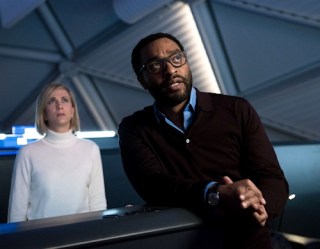
While Damon is stuck on Mars by himself, a starry supporting cast actually get to interact with each other. This is a quality ensemble and, short of writing an epic essay of a review where I just praise them all one by one, there’s little to do but list their names. That said, Jessica Chastain gets the most brazenly emotional beats as the commander who chose to leave Watney behind and has to face the consequences of her decision; Jeff Daniels treads a line between being an evil bureaucrat and just a regular bureaucrat (apparently consideration was given to turning him into a full-blown villain; thank goodness they swerved that bullet); Chiwetel Ejiofor brings easy gravitas to NASA’s director of Mars missions; Michael Peña provides some additional comic relief, if not as strikingly as he did in Ant-Man then at least as effectively; and Sean Bean doesn’t die. No offence to Sean Bean, but let’s be honest, at this point in his career that is the most notable facet of his appearance here. That and the Lord of the Rings reference.

It would be too damning to describe Ridley Scott’s direction as unremarkable, but at the same time it feels lacking in distinctiveness. Apparently there was some interview where he commented on how easy he found directing The Martian, I think with intended reference to the use of digital photography, but I think you get a sense of that from the film as a whole. That stops it from being over-directed, at least, and it’s certainly not poorly made, but if you didn’t know then you wouldn’t be nodding along going, “oh yes, this is definitely a Ridley Scott movie.” I’m not sure that’s a bad thing. Considering his fiddling is what scuppered the promising screenplays that initiated both Robin Hood and Prometheus, and his other works this decade (The Counsellor and Exodus: Gods and Kings) haven’t exactly met with great acclaim, maybe his dropping in almost as a director-for-hire (screenwriter Drew Goddard was attached to direct, but got sidetracked into the now-cancelled Sinister Six Amazing Spider-Man spin-off), and helming the film in a kind of directorial autopilot, is part of what saved it from a similar fate.

I’ve read at least one review that described The Martian as “an instant sci-fi classic”, and at least one other that described it as “no sci-fi classic”. I’m going to sit on the fence of that debate for the time being. What I will say is that it is undoubtedly an accomplished piece of entertainment. For a film that primarily concerns itself with a man applying scientific principles to tasks like “growing potatoes”, that’s surely some kind of achievement. In our current climate (both in society in general and in the “more explosions less talking, please” state of blockbuster cinema), to make space travel — and science in general — seem fun and appealing to the masses is no bad thing whatsoever.
5 out of 5

As mentioned, The Martian is released on DVD and Blu-ray in the UK today.

It placed 17th on my list of The 20 Best Films I Saw For the First Time in 2016, which can be read in full here.

Prisoners (2013)

2016 #22
Denis Villeneuve | 153 mins | Blu-ray | 1.78:1 | USA / English | 15 / R

Yesterday I wrote about Predestination, a twisty sci-fi thriller in which I guessed all the twists long before the end, but it didn’t matter because the film had more to offer. Today I find myself in the same situation: Prisoners is a thriller (though not of the sci-fi variety) centred around some mysteries that lead to big twists, all of which I guessed with complete accuracy about one-third of the way through.* I don’t say this to boast — well, I do a little — but my other point is this: while it proved a bit of a distraction, occasionally feeling like I was sitting through aimless red herrings as I waited to be proved right, there’s more to Prisoners than just OMG moments.

We set our scene on Thanksgiving in the small, slightly rundown Pennsylvania city of Conyers, where the Dover and Birch families gather for the traditional lunch at the latter’s house. As things transpire, they can’t find their two little girls, and a suspicious RV parked down the street has disappeared. Fearing the worst, they call the police, who track down the RV and its driver, an adult with the mental capacity of a ten-year-old. The girls are nowhere to be found. He’s the obvious suspect, but he couldn’t’ve taken them… could he? As Detective Loki (Jake Gyllenhaal) pursues an increasingly complex investigation, unsatisfied Dover patriarch Keller (Hugh Jackman) thinks he might need to take matters into his own hands…

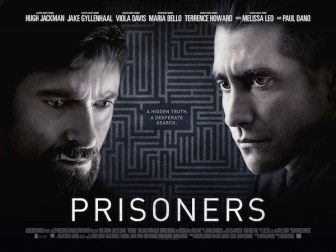
There’s a lot going on in Prisoners. While the basic format is straightforward, it’s realised in the form of a multi-stranded narrative full of well-drawn characters with complications of their own. Jackman and Gyllenhaal may be top billed and on the poster (well, an air-brushed waxwork vague approximation of Jackman was on the poster), but there’s actually a powerful ensemble cast here, and it’s their performances that help the film to stand out from the thriller crowd — as well as to overcome the fact I guessed all the twists.
So we have: Maria Bello as Grace Dover, who begins to crack under the mental pressure of her daughter’s disappearance. Terrence Howard as Franklin Birch, who, based on their houses, is clearly in a better financial situation than Keller, but is he man enough to help Keller do what he feels needs doing? His wife, Nancy, played by Viola Davis, may at first suggest a fragility to match Grace’s, but it soon becomes clear she wears the trousers in this marriage. As mentally stunted suspect Alex Jones, Paul Dano gives a well-managed dialogue-light performance, not straying into caricature. The aunt who raised him, Holly, played by Melissa Leo, is protective, but also doesn’t seem all that shocked by the accusations levelled against him.

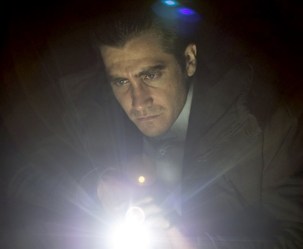
Then we do have our two leads. I think Gyllenhaal’s Det. Loki may be supposed to come across as a first-rate cop — he’s certainly so good that he can tear his Captain a new one about not doing stuff properly and not get a dressing-down for it — but he struck me as a little less than ideal. I mean, he’s effectively a small-town cop suddenly stuck in a child-kidnapping (and possibly murder) case — of course he should be out of his depth. He’s not a bad detective, just not the usual genius-level investigator you normally find in thrillers, and at times you feel he’s muddling his way through the investigation as best he can. Aside from giving Loki the slightly-affected tic of blinking too much, Gyllenhaal offers a reasonably restrained performance. (I’d love to know what the blinking was in aid of, but the film is woefully understocked with special features.)
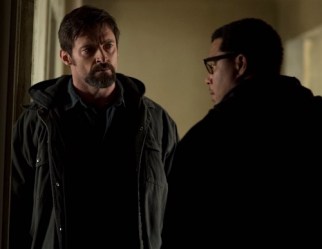
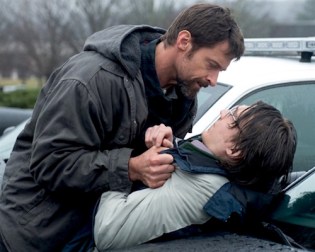
Jackman gets a showier turn as Keller Dover, the dad who prides himself on being a strong, capable, prepared-for-anything kinda guy. This is partly a value his father instilled in him, he tells his son, but you have to think there’s an element of it being a response to the emasculation of not being able to fully provide for his family — there’s not much work around, he mentions, and their home environment clearly isn’t as well-appointed as the Birches’. He does have a basement full of survivalist gear, though, and we first meet him coaxing his son into shooting his first deer. This is a man ready to do what he feels is necessary, and what he feels is necessary takes him — and, by association, several of the other characters, and indeed the whole film — to some dark places.

Not that the film needs any help accessing dark places. The truth behind what’s happened to the girls is very dark indeed… though that would be spoiler territory. I thought it was a good solution, even if I did guess it so early on, but I’ve seen others suggest it’s too neat. I dunno, but I think it’s come to something when a film answering all its questions and explaining all its threads is seen as a bad thing.

Denis Villeneuve’s direction gives the sense of a non-Hollywood background with the occasional arty shot choice or composition, though not to a distracting extent. He’s aided by serial Oscar loser Roger Deakins on DP duty, who once again demonstrates why he shouldn’t have a golden man already, he should have a cupboard full. The photography here doesn’t flaunt itself with hyper-grading or endless visual trickery, but is consistently rich and varied. Deakins may also be the best action cinematographer working — pair what he brought to Skyfall with a climactic car dash here and you have a more impressive action demo reel than you’d expect from the kind of guy who has multiple Oscar nominations to his name.

In the end, I find it a little hard to succinctly assess Prisoners. We have a film of complex characters brought to life with vivid performances, though the latter are not adverse to an element of grandstanding, and some of their actions slip into genre familiarity. So too the narrative, which for all its twists and turns isn’t a world away from any number of airport-bookstore doorstop thrillers — and that length is certainly mirrored in the two-and-a-half-hour running time. The fact that I was waiting for my predictions to be confirmed also colours my perception somewhat, because while I don’t think the film completely leans on its twists, it was a bit of a distraction. Nonetheless, you can’t deny the quality of the moviemaking, particularly Villeneuve’s sweeping direction and Deakins’ rich cinematography.

As a thriller that is also a drama about people caught up in those events, and the lengths to which some of them may be prepared to go, Prisoners is a must-see for anyone with the stomach for some dark material (though don’t let me overemphasise that point — it’s not as bleak as, say, Se7en). Is it a classic in its own right, though? Not sure. But it is very, very good.

4 out of 5

The UK network premiere of Prisoners is on Channel 4 tonight at 9pm.

* For those playing along at home: the precise moment I got it (explained in non-spoilery terms) was when Det. Loki visits an old lady and watches a VHS. ^

Predestination (2014)

2016 #21
The Spierig Brothers | 98 mins | Blu-ray | 2.40:1 | Australia / English | 15 / R

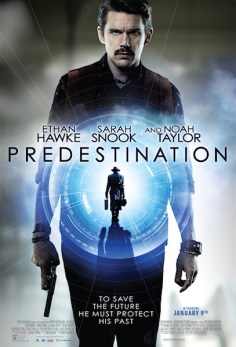
A man walks into a bar in ’70s New York. The bartender strikes up a conversation, which leads to a wager: if the man’s story is the most incredible the bartender has ever heard, he’ll give him a free bottle of whiskey. It had better be pretty good, because what we know that the man doesn’t is that the bartender, played by Ethan Hawke, is an agent for the Temporal Agency, travelling through time to stop crime before it happens; and he’s just had his face burnt off and completely rebuilt while failing to stop a notorious terrorist known as the Fizzle Bomber. Beat that.

That said, the man’s story is pretty incredible too — but as the telling of it makes up over half the movie, and it’s full of its own twists, I shan’t get into spoiler territory. Predestination is a film that rewards knowing as little as possible, especially as the seasoned sci-fi viewer/reader has a fair chance of guessing a good number of its twists (possibly all of them) long before they’re revealed by the film. Fortunately that doesn’t really matter, because the tale remains an engaging and thought-provoking one, with many thematic points to consider, and not just of a science-fictional nature — there are human and historical issues in play here too, which is undoubtedly a rarity in modern screen SF.

We’re guided through this by a laid-back performance from Hawke, which turns intense when needed, but even more so by an affecting, transformative, award-winning turn from Australian actress Sarah Snook. She really should be much in demand after this. Chunks of the film are just a two-hander between Hawke and Snook, yet it effortlessly captivates throughout these stretches. That’s in part thanks to the fascinating nature of the narrative, adapted faithfully from Robert A. Heinlein’s short story All You Zombies (it has nothing to do with zombies — the story’s from the ’50s, before our modern conception of a zombie was formulated), as well as the direction of the Spierig brothers.

I don’t know how many people will remember, but the pair got a bit of attention back in the early ’00s with their debut feature Undead, because they not only wrote and directed it, but also edited it and created the CG effects at home on their laptops. That’s more commonplace nowadays (well, Gareth Edwards did it for Monsters, anyway), but was A Big Thing in certain circles back then. (I bought Undead on DVD at the time but have never got round to watching it. Plus ça change.) I thought they’d disappeared after that, but they were responsible for vampire thriller (and Channel 5 staple) Daybreakers in 2009. This is their third feature. Working from a low budget once again, they take us to alternate-history versions of the ’40s, ’50s, ’60s, ’70s and ’80s, from bars to orphanages to universities to training for the space programme to the headquarters of a time travelling police organisation and more. To my eyes, it never looked cheap. Sure, it’s not overloaded with CGI, but it doesn’t need to be. I never got the sense anyone was having to hold back because of the low budget. Others may disagree, because I have seen people express the opposite opinion, but I think they’re wrong, so there.

Predestination is the latest reminder that “sci-fi” is not a byword for “action-adventure”. It certainly won’t satisfy the needs of the action-hungry fan (it’s not devoid of the odd punch-up or explosion, but they’re far from the point). For anyone interested in something a bit more intellectual, a bit more thought-provoking, particularly if you like the (potential) complications of time travel, or issues of gender and identity, then Predestination has a lot to offer, even if you guess the twists.

5 out of 5

Predestination placed 5th on my list of The 20 Best Films I Saw For the First Time in 2016, which can be read in full here.

It is available on Sky Movies on demand and Now TV from today. It debuts on Sky Movies Premiere next Friday, February 12th, at 11:30am and 10:20pm.

Purists be aware: existing British releases completely muffed up the aspect ratio (reportedly it’s both open matte and cropped), so there’s every chance Sky’s copy will be similarly afflicted.

The Vigesimal Monthly Update for January 2016

A new year means the monthly update format is… exactly the same as last year, because it works. (Well, I think it does.)

For any newcomers, or people in need of a refresher, here you’ll find: everything I watched in January 2016, with some observations and analysis too; all the reviews and 100 Favourites entries I posted last month; and The Arbies, my monthly awards. Plus, this month, a few snippets of site news.

Without further ado:


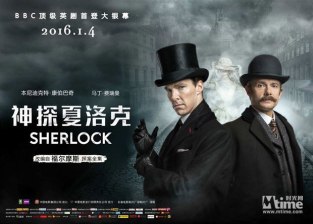
#1 Sherlock: The Abominable Bride (2016)
#2 Snatch. (2000)
#3 12 Years a Slave (2013)
#4 Funny Games (1997)
#5 Lady of Burlesque (1943)
#6 The 36th Chamber of Shaolin (1978), aka Shao Lin san shi liu fang
#7 Super 8 (2011)
#8 The Man from U.N.C.L.E. (2015)
#9 The Five Venoms (1978), aka Five Deadly Venoms
#10 Hercules (Extended Cut) (2014)
#11 White God (2014), aka Fehér Isten
#12 King Boxer (1972), aka Five Fingers of Death
#13 Return to the 36th Chamber (1980), aka Shao Lin da peng da shi
#14 Starman (1984)
#15 The Two Faces of January (2014)
#16 Amistad (1997)
#17 The Last Temptation of Christ (1988)
#18 47 Ronin (2013)
#19 A Boy and His Dog (1975)
#20 Adam (2009)


  • For the first time, I’ve opened up my What Do You Mean You Haven’t Seen selections beyond my DVD and Blu-ray collection to include stuff I have access to on streaming services, etc. Due to my inattentiveness, I included a film that was to be removed the day after I posted that list. Fortunately I did notice, and 12 Years a Slave was squeezed in on its last evening on Amazon Prime.
  • I also caught Snatch before I cancelled my Netflix subscription (I hadn’t meant to keep it so long, what with also having Amazon Prime, but golly, there’s so much to watch!) That’s two checked off already, meaning WDYMYHS 2016 is off to a flying start. Considering I usually end up playing catch up (and, two times out of three, failing), that’s a Good Thing.
  • A few other instances of pairs and repetitions this month:
  • 2x Guy Ritchie movies. As mentioned, one was the first check off WDYMYHS 2016; the other was the first check off my list of 50 Unseen from 2015.
  • 2x slavery-related movies. The aforementioned 12 Years a Slave, and Steven Spielberg’s Amistad. Both feature Chiwetel Ejiofor, donchaknow.
  • Lots of kung fu movies! Two reasons: Film4’s first Martial Arts Gold season (there’s another in March/April), and that loads are available on Netflix UK, including several well-regarded ones.


January is always the most awkward month to analyse. In so many ways the start of a new year is a false new start — it’s an arbitrary marker imposed on Time by humanity, not any kind of empirical new beginning. (Sorry to get glumly philosophical.) A goal like watching 100 films is different though, because January bumps you right back to #1; and this year, that was from the lofty heights of #200. My point being: here, January is a new beginning, not just “the next month”, and can set a tone or pace for the year to come.

Probably not this year though, because — in spite of my stated aim to watch fewer films in 2016 — I made it to 20 in January. That makes it only the fourth month to pass into the 20s, and also my fourth-highest month ever — and as I’ve been doing this for 109 months now, being fourth is (in relative terms) an achievement. It’s the best January ever too, exceeding last year’s tally of 16, and the 20th month in a row with a double-figure total. That is something I aim to maintain this year. If I achieve it, it will see me reach 10+ films per month for two consecutive years, and a total of 31 consecutive months. Just 11 months to go…

So what else can we forecast for 2016? If I keep this up, it’s looking at another record-obliterating final total, this time of 240. I won’t keep it up, though. Historically, January averages 8.08% of a year’s final tally (the actual percentages ranging from 2008’s 5% to 2011’s 12%), which would peg 2016’s total at an even higher level: 248. Which, I say again, it won’t be. What it should be, though, is over 130 — which would still position it as my third best year ever. Considering I intend to spend February and/or March getting value-for-money out of a streaming service or two (as I did in January), besting 2014’s 136 is certainly not out of the question.


A new series for 2016, tracking my 100 favourite movies (that I saw before starting 100 Films). This month: a fuller introduction than that one-sentence summary (though that is the gist of it) and the first seven entries. The full list of all 100 will continue to be updated here throughout the year.


The 8th Monthly Arbitrary Awards

Favourite Film of the Month
Looking back over this month’s viewing, it feels a bit “good but not great” — a lot of films I liked very much, but nothing that really jumps out at me as a dead-cert contender for this category. While it’s more of a Quality movie than a favourite per se, then, the best film this month was its only five-stars-er, 12 Years a Slave.

Least Favourite Film of the Month
Conversely, not many films I didn’t enjoy this month either. However, for disappointment value — expecting the greatest martial arts movie ever made and getting a mess — the loser is The Five Venoms.

Best Opening Sequence of the Month
If you haven’t seen White God then it can be a tough experience (especially for dog lovers), but the opening is fantastic: our young heroine cycles through deserted city streets, percussion-heavy classical music dramatic on the soundtrack, pursued by a pack of hundreds of dogs. There’s a reason they used it for the poster.

Most Surprising #1 at the Chinese Box Office
I know I’m meant to choose these awards, rather than let the Chinese public do it for me, but surely it’s worthy of note that the cinema release of Sherlock: The Abominable Bride saw it top the box office in China, as well as post strong figures in South Korea and other countries. No, really. And that was just the start of it: according to Box Office Mojo, it wound up taking $20.5 million in China and $7.5 million in South Korea, where it bested The Force Awakens (seriously), while other reports peg it as earning $2.7 million in the US. Full figures aren’t easy to come by, but it seems to have a worldwide gross somewhere north of $34 million. Not bad for a TV episode produced for a couple of million quid.

The Audience Award for Most-Viewed New Post of the Month
Outpacing popular posts from just inside the New Year, like Sherlock and my statisticstastic 2015 list, was fun backstage murder mystery — and, significant to its success in this category, blogathon entry — Lady of Burlesque.


Normally I refresh my directors page header image somewhere around August to October, but I was busy watching a shedload of films back then, so it’s been pushed to now. January’s a better time for it anyway, after a full year of film viewing — and next January could make a big change, with my 100 Favourites factored in. The header features the 20 directors who have the most films reviewed on here, and some will get multiple additions thanks to that favourites list. For now, it’s based on how things were on January 1st. I completely rebuilt it, so it’s all spiffy.

Also, I’ve modified the “list of reviews” header. I think that’s the first time I’ve changed it since it went live a couple of years ago. Of the 27 pictures, ten were replaced and four refreshed with higher-quality versions, so it looks a lot spiffier too.

Finally, I decided to re-write the “About” page, for the first time in 3½ years. I re-read the old one and found myself intensely irritating, so hopefully the new version is… less bad.


My viewing selections will be mainly dictated by “what’s on Sky Movies”, in the run up to the Oscars…

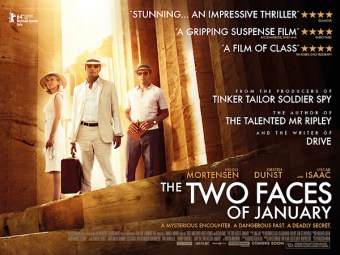
The Two Faces of January (2014)

2016 #15
Hossein Amini | 97 mins | streaming (HD) | 2.35:1 | UK, France & USA / English, Greek & Turkish | 12 / PG-13

The writer of Drive (and co-writer of Snow White and the Huntsman and 47 Ronin, but maybe he’d prefer we didn’t mention those) moves into the director’s chair with this Patricia Highsmith adaptation. Best know for her Ripley (as in Talented Mr.) tales, this is instead the story of a young American man, Rydal (Oscar Isaac), who, while working as a tour guide in Greece, falls in with middle-aged American couple Chester (Viggo Mortensen) and Colette (Kirsten Dunst). Apparently on holiday, they look like an easy mark for Rydal’s somewhat-con-ish moneymaking practices, but events soon transpire to reveal the pair’s secrets, and Rydal’s greed draws him deeper into their affairs.

Amini has picked some quality material for his directorial debut. The storyline is pretty straightforward, but it’s driven by some interesting characters with complex motivations. You’re never entirely sure what’s driving Rydal and Chester, even if it may appear obvious; and sometimes it can be as much of a twist that a character didn’t have a better plan as it is when their implausibly-intricate machinations are unveiled. It helps that the film has a pair of quality actors in these roles, who effortlessly bring believability to even the slightly-far-fetched elements of the narrative. This is only the second thing I’ve seen where Isaac has made an impression (the other being The Force Awakens; I’d forgotten he was in Robin Hood and Sucker Punch), but I can see why everyone’s calling him one to watch.

If Dunst doesn’t leave as much of a mark as the two chaps, it’s only because Colette is a subtler-still character. Some people reckon The Two Faces of January has a thin story and no development of its characters, but I can’t help but feel it was too subtle for such critics. On the surface it might just seem like Colette is the dim-blonde wife, going along with her husband whatever happens and flirting with their sexy tour guide, but there’s clearly more going on under the surface. How much does she really know about Chester’s actions? Is she an innocent bystander, or is she involved? Is it harmless flirting with Rydal, or are Chester’s drunken suspicions on the money?
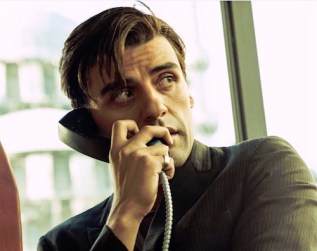
By choosing to set the film in the novel’s original 1960s timeframe, Amini adds instant style and class to the whole picture. Didn’t everything look classier back then? I mean, Chester wears linen suits and Panama hats, not T-shirts, shorts, and a baseball cap. It just wouldn’t be the same set today. Even the locations look straight out of the ’60s, even though they’re hundreds or thousands of years old and the film was shot this decade. Marcel Zyskind’s attractive cinematography is surely to thank for that. Again, it’s an element I’ve heard some criticise as boring or plain, which (much like the above views on plot and character) I just don’t understand. It’s not showy or show-off-y, but that’s part of what works. It lets the natural beauty of the locations speak for themselves, with classical compositions and rich lighting.

The era of the setting also helps emphasise the film’s Hitchcockian overtones, which given Highsmith’s other most-famous work is Strangers on a Train (filmed by Hitch, of course) is perhaps an obvious point of comparison, but by no means an inappropriate or negative one. As the narrative twists and turns, tightening the tension ever more, you think the Master of Suspense would’ve been quite pleased if this had been one of his pictures.

Filming this particular Highsmith novel was a long-held ambition for Amini (he first tried to acquire the rights after his big-screen writing debut, Jude, back in 1996). Such much-awaited dreams can sometimes lead to poor results, thanks to a rose-tinted perspective or close-minded obsession, but on other occasions the lengthy preparation pays off. The Two Faces of January is most certainly a case of the latter, a ceaselessly classy, subtly complex thriller that’s very rewarding for those open to its numerous charms.
4 out of 5

The UK TV premiere of The Two Faces of January is on Film4 tomorrow, Sunday 31st, at 9pm.

Lady of Burlesque (1943)

2016 #5
William A. Wellman | 89 mins | streaming | 4:3 | USA / English | PG

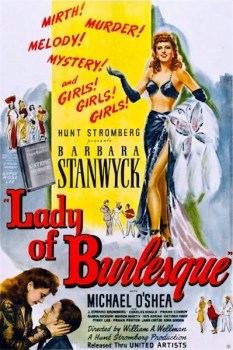
Based on the novel The G-String Murders by Gypsy Rose Lee (as in Gypsy), Lady of Burlesque stars Barbara Stanwyck as Gypsy surrogate Dixie Daisy, a performer in a burlesque show in New York where the backstage arguments turn murderous.

The story unfurls in the traditional Christie-esque shape of a murder mystery: we find out all the different reasons why everyone hates a particular character, then that person dies and they all have motive. For set dressing, instead of the English country houses and other upper-middle-class establishments of Christie, we have the slightly seedy, slightly risqué world of ’40s burlesque… tempered by the strictures of the production code, of course. Stanwyck may get out on stage and wiggle around, but she’s largely shot from the waist up; and it may’ve been released as Striptease Lady in the UK (allegedly), but the clothes remain on (I can’t imagine anyone expected anything else, then or now).

Nonetheless, the world of the story adds some sparkle to proceedings. The investigations are largely confined to a couple of lengthy scenes when the cops turn up, led by Charles Dingle’s meticulous Inspector Harrigan (“This is my first experience with burlesque. It’s a surprising profession.”), and question everyone in one room. These bits have their moments, but feel a little heavy-handed. Around them, the world of burlesque, and the relationships between its performers, rolls on.

Stanwyck carries the film, both on stage and off. Her “will they/won’t they (of course they will)” romance with Michael O’Shea’s comic is kept aloft by her biting ripostes to his advances, and when a comedy sketch is interrupted by backstage noises she saves the day by breaking into song, doing the splits, a cartwheel, and the Cossack dance in quick succession. Not bad for a 36-year-old!
Ostensibly a murder mystery, in practice Lady of Burlesque plays as all-round entertainment with a bit of everything: comedy, romance, songs, shoot-outs, and, yes, both mystery and murders. It’s not the kind of film that will linger long in the memory (apart from Stanwyck’s gymnastics, that is), but it’s entertaining while it lasts.

3 out of 5

This review is part of the Remembering Barbara Stanwyck Blogathon. Be sure to check out the many other fantastic contributions collated by host In the Good Old Days of Classic Hollywood.

The 36th Chamber of Shaolin (1978)

aka Shao Lin san shi liu fang / Master Killer

2016 #6
Liu Chia-liang | 111 mins | streaming (HD) | 2.35:1 | Hong Kong / Mandarin | 15 / R

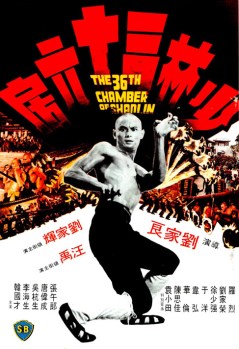
Widely regard as one of (if not the) greatest kung fu movies ever made, The 36th Chamber of Shaolin introduces us to San Te (Gordon Liu), a student whose hometown is oppressed by forces of the ruling Qing dynasty. He and his classmates join the underground resistance run by his teacher, only to wind up witnessing his friends and mentors be hunted, tortured, and killed. Faced with a similar fate, San Te escapes to the Shaolin Temple, widely known for being home to the best kung fu around. The temple’s monks refuse to teach martial arts to normal folk, nor help by joining the fight — they’re Buddhists, after all. Nonetheless, San Te manages to inveigle his way in to their company, and years of training begin.
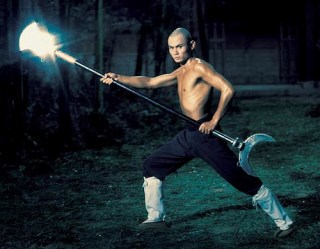
Said training — where San Te must progress through the Shaolin Temple’s 35 (not 36) chambers one by one — makes up the bulk of the film, though there are lengthy bookends dealing with the reason he goes there in the first place and what he later does with that training. If the notion of watching chamber after chamber after chamber (times 35) sounds dull, don’t worry, we only actually see ten of them, and several of those via an extended montage. The chambers take the form of challenges, which San Te must overcome by either puzzling them out or developing some kind of physical or mental acuity. Their content is varied and innovative, which makes them engrossing to watch even as they make the film episodic, but the nature of the challenges makes the movie different from the usual fight-after-fight-after-fight structure of kung fu flicks.

If it’s combat you want, though, never fear: everybody is kung fu fighting at regular intervals. Displays of physical skill and speed are de rigueur for these kind of films, but the combat here is as impressive as any. While the initial training takes the form of tangentially-related skills tests, San Te is eventually learning how to use weapons, and when he finally graduates from the 35th chamber he has to prove himself in combat, first against the temple’s justice, then when he returns to the outside world and seeks vengeance. Fights both with and without weapons are imaginatively choreographed and executed with the customary speed and precision.

Much as you won’t enjoy many a musical if you can’t accept people just bursting into song, you won’t enjoy many a kung fu movie if you can’t accept a story told primarily through back-to-back action sequences. The 36th Chamber of Shaolin is more-or-less that kind of movie, though the differing styles of the chambers’ challenges bring pleasing variety. Is it the greatest kung fu film of all time? I’m no expert, but it’s certainly inventive, masterfully performed, and suitably different from any such movie I’ve yet seen.

4 out of 5

The 36th Chamber of Shaolin is on Film4 tonight at 10:55pm. It kicks off a short season of martial arts movies — more details here.

Alan Rickman, 1946—2016

I rarely break from reviewing on this blog, but I think I can afford such a courtesy to Alan Rickman.

In part this is because, after I heard the news, I realised he’s been a constant presence throughout my film-loving life. I adored Robin Hood: Prince of Thieves as a kid, when the American accents didn’t matter and it was a glossy big-budget extravaganza. I watched it a few years ago, and it no longer looks glossy, big budget, or particularly extravaganza-y, but Alan Rickman shines as arguably the best Sheriff of Nottingham ever to grace the screen.

Then there’s the role that has obviously defined him for a generation: Professor Severus Snape in the Harry Potter series. I’m sure casting the Potter films must’ve been a tricky business, but Rickman as Snape was one of those choices where you just think, “well, obviously.” A pretty one-dimensional character to begin with (The Mean Teacher), Snape has a significant and complicated role as the series goes on, and is probably the most nuanced character in it by the end. Having an actor of Rickman’s ability involved was obviously beneficial.

And as I got older still, there was Die Hard. His film debut at age 42, and the film that will always define him for many, but (again) it’s a magnificent performance, a definitive villain. Pretty much every action-thriller villain for the next, what, decade? more? is really a rip-off of Hans Gruber, however all portrayed by whichever British actor was currently available.

Those are just three keystones in a sea (mixed metaphor much) of fantastic movies and excellent performances that have been scattered throughout my viewing life: the Spock-ish thespian in Galaxy Quest; the punk-y angel in Dogma; the voice of Marvin the Paranoid Android in The Hitchhiker’s Guide to the Galaxy film (another spot of perfect casting); the adulterous(?) husband in one of Love Actually’s strongest yet most divisive stories. Several of these films are to come on my 100 Favourites; several more were in contention; and, in every case, a significant reason for their presence was Alan Rickman’s performance.

And if you ever forget that life isn’t fair, remember this:

So we've lost 69-year-olds Bowie, Lemmy (ok 70-year-old) and now Alan Rickman – but Donald Trump is still with us.