aka Moriarty
2014 #106
Albert Parker | 85 mins | streaming | 1.33:1 | USA / silent (English)
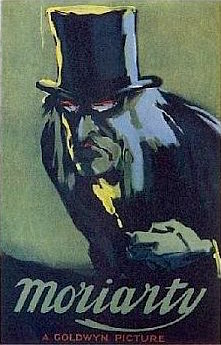 American actor William Gillette was the most iconic portrayer of Sherlock Holmes on stage, penning his own play (with permission from Conan Doyle) that he performed 1,300 times between 1899 and 1923. It was filmed in 1916, a feature long thought lost but announced as found in October 2014 (and to be released on disc by Flicker Alley this coming October — expect a review eventually). Before then, the only thing approaching a filmed record of that iconic interpretation of the Great Detective was this: a 1922 remake starring John Barrymore as the famed sleuth, originally released in the UK as Moriarty (possibly for legal reasons, possibly (according to David Stuart Davies in Holmes of the Movies) due to “the mediocrity of so many of the earlier Holmes films”).
This film was also considered lost, until elements were discovered in the ’70s — not the film itself, but original negatives “in which every take — not every sequence, but every take — were jumbled out of order” (as per William K. Everson’s programme notes for the Theodore Huff Memorial Film Society, via Wikipedia). These were painstakingly reassembled into something resembling the original film, although around 26 minutes are still missing. Nonetheless, the film remains completely followable: nothing important to our comprehension is missing, with some storytelling rough edges the only vague sign that anything may be amiss.
Said story diverges from the canon so much it’s liable to give any particularly canon-focused Sherlockians a conniption. It begins in Cambridge, with what many reviews call a “prologue”, usually preceded by an adjective such as “overlong”. I think it would be more accurate to describe it as the first act. There, a student, Prince Alexis (Reginald Denny), third in line to the throne of somewhere-or-other-in-Europe, has been accused of stealing from the university, but he claims innocence. His friend John Watson (Roland Young) recommends he seeks the assistance of a chap in his year, one Sherlock Holmes (Barrymore). 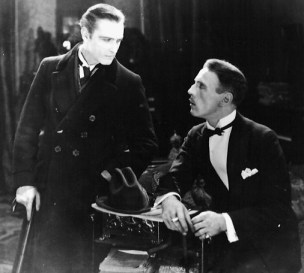 Yes, shades of 1985’s Young Sherlock Holmes. I’m sure you’ll be surprised to learn there are fewer CGI stained glass window knights here, though.
Holmes quickly uncovers the real culprit, another student by the name of Forman Wells (the screen debut of William “The Thin Man” Powell, looking ever so young). However, Wells is acting under duress, forced to commit the theft by Moriarty (Gustav von Seyffertitz), an obviously evil-looking fellow who sits at the centre of a spider’s web of criminal activity. Holmes confronts Moriarty in Wells’ stead, to little effect, the criminal genius swatting the student away as one would a fly. Undeterred, our young sleuth commits to stopping Moriarty as his life’s very purpose.
That and finding a girl he saw once and instantly fell in love with.
Meanwhile, Prince Alexis is informed that his two brothers have died in a car accident, making him heir to the throne, and so he can no longer marry Rose Faulkner, a British commoner he’d been courting. Rose is the sister of Alice Faulkner (Carol Dempster), who just so happens to be the girl Sherlock fell for. When she learns of the split, Rose commits suicide.
And that’s just the so-called prologue. I’m loath to explain the whole plot of a movie, but the tale spun here is actually somewhat intricate. Personally, I thought it was quite a good yarn. It’s flawed in the telling — it’s not particularly Holmesian, and there are far too many overlong title cards (Everson calls it “one of the ‘talkiest’ silents”) — but I don’t hold with criticisms that it’s slow paced, or that the lack of any real mystery is a problem. Sherlock Holmes tales are remembered as “detective stories” because that was his profession, 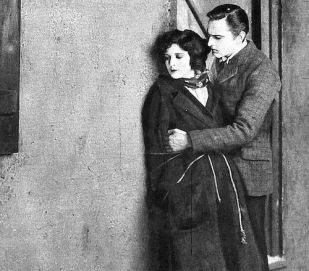 and in many respects they led to the abundance of crime-solving fiction that fills bookstores and TV schedules to this day, but there’s a reason most of Conan Doyle’s stories are prefixed with “The Adventure of” rather than “The Fiendishly Difficult to Solve Mystery of”.
Anyway, after the Cambridge to-do the film jumps forward some years, to find Holmes a respected detective residing at 221 Baker Street (I guess he also acquired 221a and knocked through or something). Moriarty has still eluded him, but the revival of some matters from his student days are about to change that. Turns out Alice has in her possession some letters from Alexis to Rose, which she intends to publish to ruin him in revenge for her sister’s death. Goodness knows what’s in these letters; the ’20s equivalent of sexting, presumably. Alexis attempts to hire Holmes to retrieve the letters, but Holmes isn’t particularly inclined to do so because he rather agrees with the position of the love of his life (not that he’s seen her since that one time they bumped into each other years earlier). However, Moriarty also wants the letters, in order to blackmail Alexis, so Holmes takes the case so as to get closer to his nemesis.
You’ll notice a lack of Watson in most of this outline. He’s rather sidelined, unfortunately. Some would prefer this to the comical treatment he suffered at the hands of Nigel Bruce, but your mileage may vary. I think Watson’s often one of the most undervalued characters in literature, a very capable fellow who’s usually overshadowed by his grandstanding friend. There’s nothing wrong with Young’s performance, there’s just not much of it.
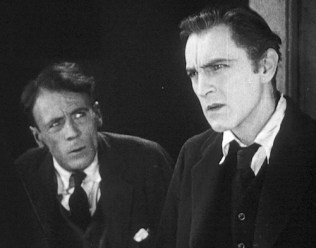 Barrymore makes for a solid, if perhaps unremarkable, Holmes. He has the right look for the role, and makes good use of the same staring-contemplatively-into-the-distance furrowed-brow expression that Basil Rathbone would employ a couple of decades later. He has down the precociousness of student Holmes, which develops into a kind of righteousness when older. He’s not as stand-offish and borderline unlikeable as some interpretations of the character, nor as affable as others. As I say, he sits in the middle, doing nothing wrong but not getting a chance to mark himself out either.
The thing that does go terribly wrong, however, is the romantic subplot. Even if you set aside that such palaver doesn’t fit with the traditional Holmes character, this version is unconvincingly handled. Not only has Holmes apparently spent years pining after a girl he met once (it’s unclear why the Great Detective hasn’t been able to find her in all that time), but when he does meet her there’s no chemistry whatsoever. According to Fritzi at Movies Silently in her review, we should attribute the fault here to Dempster. I see no reason to disagree. Apparently Barrymore so disliked his co-star that he refused to perform the final scene with her, which would certainly explain the none-too-subtle way the actress’ face goes unseen at that point.
Young Mr Powell probably gets the best part, in particular a scene in a cab on the way to Moriarty’s lair where we learn his tragic backstory.  He crops up in the years-later narrative too, used by Holmes to go undercover in the house where Alice is being held hostage by some of Moriarty’s many villainous associates. A major part of Holmes’ plan hinges on him turning up at these villains’ house, telling them what to do, and them obeying him. That this method succeeds is not due to Holmes’ considerable skill, but more due to the screenwriters’ lack of it.
Von Seyffertitz gives a very good Moriarty, though does err on the side of OTT. In part this is his look: I thought they had perhaps gone a little far with the make-up, turning him almost into a caricature of a villain, but having Googled the actor I think that it may mainly be his face… Still, what a perfect face for playing villains! Naming the film after him for the UK isn’t wholly inappropriate, especially as his role is expanded from Gillette’s play (the prologue confrontation being the main addition) and one of the throughlines is Holmes’ focus on apprehending him. It would certainly differentiate it from all of the other films called simply Sherlock Holmes.
The 1922 version isn’t the best film to bear that moniker, but nor is it the worst. I don’t think it’s a great interpretation of Holmes, but I found it to be a pretty entertaining adventure in its own right. I’d even quite like to see the plot rejigged (and the holes ironed out) to make it more truly Holmesian. Even having enjoyed the film, I must say how entertainingly dismissive I found Everson’s notes: he thinks that “one of the most painstaking recovery jobs ever […] quite overshadows the fact that the film itself 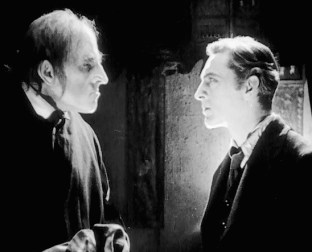 hardly seems worth such devotion except on a purely academic level.” He goes on to say that “it must be one of the blandest misuses of potentially exciting material ever,” that “it literally has no highlights,” that it “has no pictorial style of its own,” that Barrymore “clearly lends his profile to Holmes, and not much more,” that “if it is a major find, it is also a major disappointment.” Ooh, burn. (The whole thing is worth a read.)
Now, with the discovery of the Gillette film, one wonders if this Sherlock Holmes is destined to become even more of a curio than it already is. It’s not wholly undeserving of such a fate: it’s not bad and I found it solidly entertaining, but one for Barrymore fans and Holmes completists only.
Sherlock Holmes, aka Moriarty, is available on YouTube here.
This review is part of The Barrymore Trilogy Blogathon. Be sure to check out the many other fantastic contributions collated by host In the Good Old Days of Classic Hollywood.

 Paul Thomas Anderson — the fêted writer-director of Boogie Nights, Magnolia, There Will Be Blood, The Master, et al — here turns his hand to adapting reclusive novelist Thomas Pynchon’s 2009 opus. It met with notably less success than most of his previous works. The Alliance of Women Film Journalists were one of few organisations to recognise it come awards season, with a gong for “Movie You Wanted to Love, But Just Couldn’t”. Apt.
 Anderson chooses to realise the movie mostly in long, unbroken takes, which not only lets the photography shine, but also allows his cast free rein to construct their own performances. I’m not sure how much that pays off, but it’s certainly not a hindrance. Turns from the likes of Josh Brolin and Martin Short border on the memorable, though your mileage will vary on if anyone truly achieves it, with the possible exception of Katherine Waterston, who surely deserves more — and more prominent — roles. Other recognisable faces (Jena Malone, Eric Roberts, Reese Witherspoon) are wasted in one- or two-scene appearances, which I suppose we could kindly call cameos.
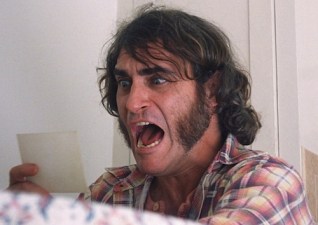 I am in neither of those groups, however. The aforementioned fleeting aspects of quality weren’t enough to swing it for me either. Sadly, I’ll be chalking this up alongside Killing Them Softly and Seven Psychopaths as “neo-noirs from previously-excellent directors that seriously disappointed me this year”.
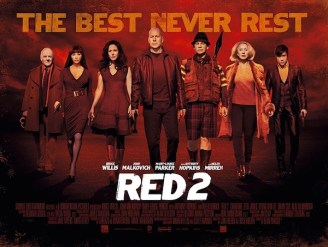 The “retired, extremely dangerous” agents return for more of the same.
 Jon Schnepp’s widely-reviewed documentary about the batshit-crazy Nic Cage-starring Tim Burton-directed Superman movie that almost happened in 1999. If all you’ve seen are the photos of a stoned-looking Cage in a light-up abomination of a Superman costume that leaked onto the internet a few years ago, prepare to be amazed. Indeed, those infamous photos and footage are an aberration that this documentary explains.
 There seem to be an increasing number of “making-of documentaries about films that didn’t get made”, to the extent where it’s almost turning into a sub-genre. The highly-praised
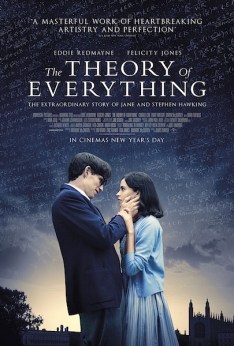 Biopic of genius cosmologist Stephen Hawking and his wife/caregiver Jane, on whose memoir the film is based.
 Louis Leterrier, helmer of the
 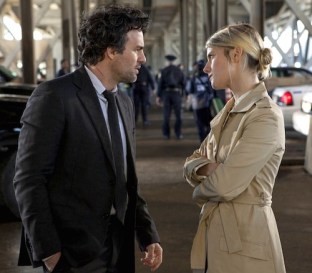 Their criticisms aren’t wholly unfounded: the characters are thin; at times it’s unclear which side we’re meant to be following or most invested in; the use of CGI in the magic somewhat undermines it; a good deal of the plot stretches credibility. Conversely, the credibility is questionable from very early on, so the counterargument goes that it’s the whole MO of the film — you don’t complain about Iron Man not being possible in real life, do you?
 Such a style certainly fits the magic world. I guess it’s just not to everyone’s taste.
 Nine months on from its theatrical debut, I’ve managed to remain remarkably spoiler-free about Interstellar, the ninth feature from director Christopher Nolan. “Matthew McConaughey lives on a farm and somehow ends up in space with Anne Hathaway,” is about all I knew going in. That and the somewhat divisive critical reception it had received, leaving what many had assumed could be an Oscar favourite with a disappointing tally of nominations (and its studio to have backed the wrong horse, resulting in
  More plot happens. Interstellar is the kind of film where you could get an awful long way through the story just trying to explain the setup. That’s a certain style of storytelling, and in its own way a positive one — a plot that is constantly moving and updating, rather than one that presents a basic setup, runs on the spot with it for a while, then wraps it up. The latter is how most narratives unfold, which is why reviews can so often summarise said setup and that’s fine. Nonetheless, Interstellar’s first act goes on too long, and could do with a good trim. (For an alternative view on why the first act is in some respects the best part of the film and needed more development, read
  Based on a skim through online reaction, some viewers would indeed love even more, while others would despise it. One thing I find interesting about this apparently diverse reaction is that you can find an abundance of negative/semi-negative comments and reviews by people who write such things, but nonetheless the average user scores on the likes of
 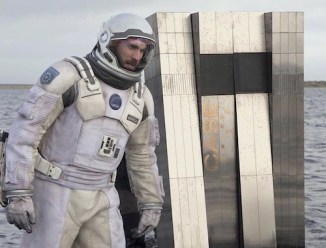 From a filmmaking perspective, there is surely nothing to fault. The visuals are incredible. As you’d expect, the IMAX footage looks absolutely stunning. Every time the Blu-ray reverted back to 2.40:1 I was a little disappointed. A sneaky part of me thinks Warner deliberately make these sequences look less good to ramp up the quality of the IMAX footage (I felt the same about
  Anne Hathaway is largely understated, but slivers of emotion seep through when appropriate; and Michael Caine actually gets to do a bit of Acting in a Nolan film for a change, rather than just turning up as a wise old dispenser of exposition — though don’t worry, he does that too. One of the stand-outs for me was David Gyasi, getting a role that was subtly stronger and more thought-provoking than several of his more famous colleagues, and executing it with aplomb too. Similarly, the voices of semi-sentient robots TARS and CASE — Bill Irwin and Josh “he’ll always be ‘that guy from

 The kids’ phenomenon of the ’80s/’90s has never quite gone away, and this film is one thing that kept it ticking over in the ’00s. I watched out of nostalgia, which may’ve been a mistake.
 100Films.co.uk