aka Live. Die. Repeat.
2014 #102
Doug Liman | 113 mins | Blu-ray | 2.40:1 | USA & Australia / English | 12 / PG-13
 Of late there seems to have been a glut of sci-fi films with highly generic, near-meaningless titles — Oblivion, Elysium, Source Code, even Gravity, and so on. The latest of these is Edge of Tomorrow, based on the novel All You Need is Kill (you can see why they wanted a change), which the distributor had so little confidence in that even during its theatrical ad campaign they tried to sell it as simply Edge, and for the home ent release have mounted a semi-successful campaign to rebrand it as Live. Die. Repeat. — ironically, the most memorable and appropriate title of the lot.
Tom Cruise’s second sci-fi action film about alien invasion and a form of repetition in as many years (after 2013’s Oblivion, which I watched earlier this year), this one sees him cast as a coward in a multi-national defence force set up to combat an alien menace that has conquered mainland Europe. Following a hard-won victory against the aliens at Verdun, the force are planning a D-Day-style mass attack, and Cruise gets co-opted into fighting on the frontline against his will. During the assault, something happens that causes the day to ‘reboot’, and Cruise finds himself living the same day over and over again.
Or, to put it another way, it’s Groundhog Day with shoot-the-aliens bits.
It’s easy to be cynical about Edge of Tomorrow — it’s a mega-budgeted Tom Cruise actioner that sounds like a semi-rip-off of several other movies and was perceived as a flop (it wasn’t, at all) that no one knew how to sell. In fact, it’s a very entertaining movie — 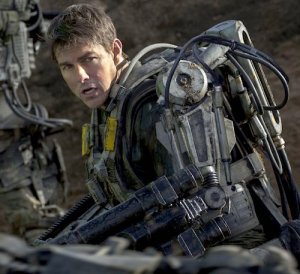 suitably exciting, surprisingly funny, and actually quite clever. It’s also boldly standalone. OK, so it’s an adaptation, but the book is hardly a Hunger Games-style huge literary hit. Producing the film surely isn’t an attempt to turn a print success into a cinematic one, nor is it trying to launch a new franchise — indeed, it’d have to really jump through hoops to even attempt a sequel. No, this is that quite-rare thing now: an original, one-off, blockbuster.
That key ‘original’ element, the repetition (‘original’ in quotes because, yes, it’s from Groundhog Day), is used to good effect, playing variations on things we know but also keeping others secret so as to afford surprises later on. Then, just when you’re beginning to think, “oh God, here we go again”, it moves the story along — after all, just because a day’s repeating doesn’t mean you have to keep going to the same places during it. This leads to the filmmakers sort of playing a clever game with the viewers: just because we’re seeing something happen for the first time doesn’t mean the characters are. Neat.
Are there logic holes? Undoubtedly — it’s a time travel movie. How fundamental are they? Depending on your level of sensitivity, you’ll be bothered by somewhere between “hardly any” and “none” during the film itself. It’s made as blockbuster entertainment, and it works as such.  Reflect too heavily and some bits may begin to crumble more but, for me, not too severely.
The weakest part, sadly, is the climax. It’s alright in itself, but (as Andrew Ellard’s Tweetnotes cover so eloquently), it doesn’t feel quite right. (Vague spoilers follow.) Abandoning your movie’s defining high concept in order to up the stakes for the finale is a cop-out. Instead, it needs a new twist on the concept that also ups the stakes. That’s harder to come up with, which is probably why they haven’t bothered, but what we do get reduces a clever and borderline-innovative movie to a rote race-against-time overwhelming-odds shoot-out.
As for the post-climax ending, which some have complained isn’t dark or gritty enough… Were those people watching the same movie as me? “Dark and gritty” has its place, and there’s certainly a few ‘nasty’ bits earlier in the film, but the overall level of action and humour is more mass-market. That’s not a criticism, just an observation — this is not actually a dark-and-gritty movie that demands a dark-and-gritty ending. The final scenes fit tonally with the rest of the film. I liked that.
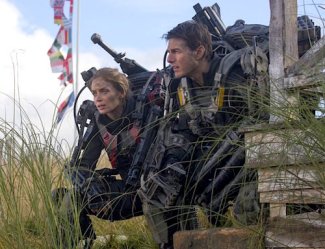 Edge of Tomorrow isn’t an unqualified success, but more than enough of it works to make for a well-above-average modern blockbuster. Excellent action sequences, plenty of amusing asides, and a couple of solid sci-fi concepts to chew on combine to render it quality entertainment. Bonus points for being a true original in a sea of remakes, sequels and spin-offs.
This review is part of the 100 Films Advent Calendar 2014. Read more here.

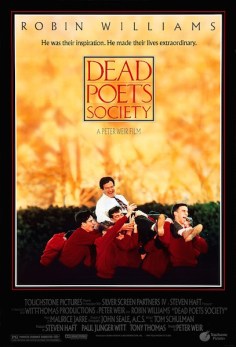 At an oppressive private school (is there another kind?), a gaggle of disenchanted students are invigorated by teacher Robin Williams; until his methods, and the independent thought they inspire, attract the ire of parents and faculty.
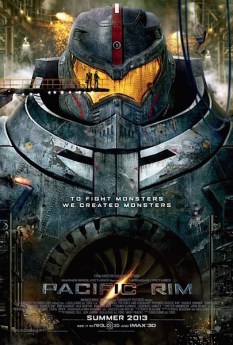 The names writers choose for their characters can sometimes tell you a lot about a movie. Pacific Rim is the kind of film that has characters called Raleigh Becket, Stacker Pentecost, and Hannibal Chau.
 — it was the 3D that added depth and height, and without that (or, as I said, an adjustment of focus to compensate) it’s all a bit… not flat, but not big either. That aside, it is beautifully shot, with excellent lighting.
 Westerns don’t come more renowned than this Ford-Wayne collaboration about the years-long hunt for a girl kidnapped by Native Americans.
 Tom Hanks is Walt Disney and Emma Thompson is author P.L. Travers in “The Making of Mary Poppins: The Movie”. Disney has been desperate to turn Travers’ fictional nanny into a movie for years after he made a promise to his daughter; Travers has resisted, but now needs the money. She’s brought to LA to consult on the script, and proceeds to make life miserable for screenwriter Don DaGradi (Bradley Whitford) and songsmiths Robert and Richard Sherman (B.J. Novak and Jason Schwartzman). At the same time, we see the story of a family in Australia from the eyes of a little girl Ginty (Annie Rose Buckley), as they struggle with the whims of her father (Colin Farrell), a bank manager who’s a little too fond of the bottle. Guess what the connection is!
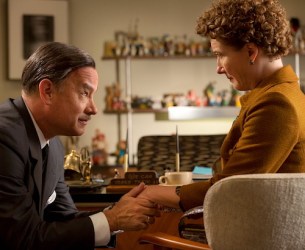 Similarly, Hanks’ part seems to be little more than a cameo at first, but he steadily appears often enough to make it a supporting role. Reportedly he has perfectly captured many of Disney’s real traits and idiosyncrasies, and who are we to doubt the word of people who knew the man? His performance is not just a shallow, simple impersonation, but there’s not that much meat to Disney’s character arc either.
 Some will find the story lacking in dirt, particularly when it comes to the portrayal of Disney. But it’s not whitewashed either, and do you really think the Disney Corporation would have allowed a movie to go ahead that depicts their founding father in a negative light? For that, I don’t think it’s as twee as it could have been — there’s definite conflict over what’s being done with Poppins, and, even with the film having turned out to be a solid-gold classic, we often find ourselves sympathising with Travers.
 1988: due to international pressure, Chile’s dictator, General Pinochet, has acquiesced to a vote on whether he should continue ruling the country. Despite the violent takeover he orchestrated, and subsequent murders and ‘disappearances’, the country has prospered under his rule, and many — especially influential affluent people — are keen for him to stay. The anti-Pinochet “no” campaign are allowed a daily slot on state-controlled television in the run up to the election, and they hire advertising exec René Saavedra (Gael García Bernal) to mastermind the campaign. Cue internal conflict — the politicos want dour films highlighting Pinochet’s evil; René wants to use the language of advertising to sell the promise of a happy future — before the campaign itself finally gets underway, and the “no” campaigners become targets of the ruling regime’s evil tactics…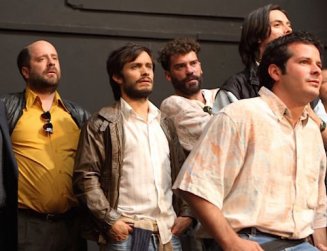
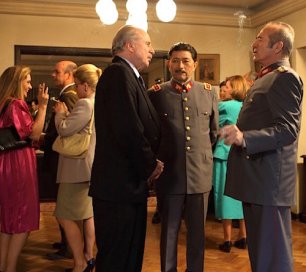 But seriously, there’s not really a comparison between the brutal military regime that ruled Chile — which nonetheless many were happy with because it had brought modernisation and prosperousness for some — and the voluntary union between the rest of the UK and Scotland. I’m sure some of “the 45”, as they now call themselves, would identify with those battling for freedom in this film, but I think that might be taking it a bit far.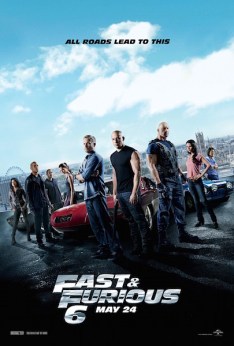
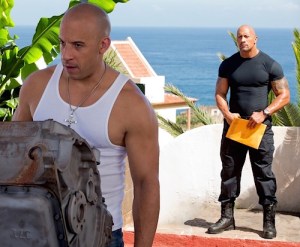 For all the intent of this being “Part 2 of 2”, there’s a post-credits tease which sets up
  There’s plenty of backstreet, underground, grim-and-gritty bits on display here — entirely appropriate given the characters’ street-racing roots and criminal know-how. Still, these are little more than cosmetic bonuses.
 Despite the fact that
  Then we have the much-maligned backstory about just what Peter Parker’s parents did all those years ago, before they abandoned him with Uncle Ben and Aunt May. There are pros and cons to this: it’s all new, which at least makes it interesting and unpredictable because it has no forebear in comics or films; but it’s also a pretty stock set of circumstances. Worse still, it robs Spidey of a major defining trait: Peter Parker is bitten by a spider by accident — it could’ve been anyone. In this version, it could only have been him. Boo. Sony clearly want an arc plot they can run across a trilogy (or more), so presumably this thread will rumble on… though whisperings that they’re considering some kind of soft-reboot may see it cut short. I wouldn’t complain.
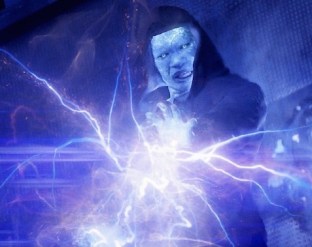 but it’s more textured, at least. Then there’s Electro, who (as mentioned) may have a familiar story, but is nonetheless perfectly pitched by Foxx. His powers lead to some excellent sequences, including but not limited to the aforementioned Times Square duel. He also contributes to the music, in a way, as Electro’s whispered/sung thoughts ‘bleed out’ into the score. It’s creepy, especially as it’s so subtle in the mix — I wondered what the hell was going on at first. I thought it was a fantastic score all round, in fact, bringing in a modern music element that fits the notion of Spidey as a young character perfectly.
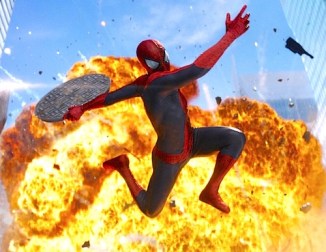 It lacks the confidence, heart and flair that mark out Spider-Man 2, and the bold originality and clarity of purpose that define
  The film that technically won
 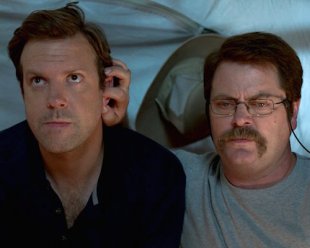 Reviews for We’re the Millers are resoundingly average across the board, remarkably so (which is why I’m remarking on it). The funny thing is, some critics begrudgingly admit they liked it while giving it half marks, and others are very down on it… while still giving it half marks. It’s the same story for user reviews on
  Perhaps most discussed for the way it was released — at the same time as the film’s festival premiere, writer-producer Joss Whedon made it available to rent online — In Your Eyes is worthy of note on its own merits as a movie, too.
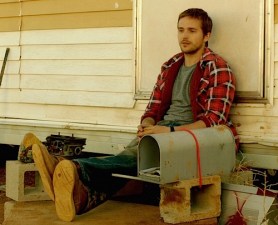 Secondly, their emotional connection means they begin to spend a lot of time in each other’s heads, distancing themselves from the world and, when they begin to be overheard talking to each other — or, as everyone else sees it, talking to themselves — people begin to get suspicious. And when you’ve got a controlling doctor for a husband, who knows about your history of mental health issues… well…
 A character-driven romance that will likely bore some, In Your Eyes weaved a spell on me. It’s beautifully, simply directed by Brin Hill, the focus lying heavily on the characters and performances of Stahl-David and Kazan. If you warm to them — and I think many will — then they’re a pleasure to spend time with, and you become invested in where events will take them. More magical realist than hard fantasy, this isn’t one for serious genre fans. Romantics, however, may fall in love.
 100Films.co.uk