
That title is massively simplified (and therefore technically wrong), but still seems long, doesn’t it? Yeah, wait ’til you see the proper name of that subsection.
Oh, also, I watched some films and stuff. Y’know, what this blog is actually about.
What Do You Mean You Haven’t Seen…?
Continuing apace, this month’s WDYMYHS film is quirky French comedy Amélie.
 July’s films in full
#56 Transformers: Dark of the Moon (2011)
#57 A Late Quartet (2012)
#58 The Raid (2011), aka Serbuan maut
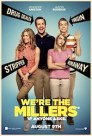
#59 We’re the Millers (2013)
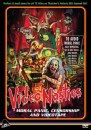
 #60 Video Nasties: Moral Panic, Censorship and Videotape (2010)
#61 Ghost Rider: Spirit of Vengeance (2011)
#62 Pacific Rim (2013)
#63 Cloudy with a Chance of Meatballs 2 (2013)
#64 Frozen (2013)
#65 Amélie (2001), aka Le Fabuleux Destin d’Amélie Poulain
I’ve come over all Modern this month, with all but one film being from the 2010s — to put it another way, that means that all but one come from the last five years; and 40% are from last year alone, too. Well, I do have a lot of catching up to do. And the only film from outside this decade is still from this millennium. Ah well.
In terms of the history of Julys, I’m forming a new pattern: this year I watched ten new films, year before it was four, year before that it was ten, year before that it was four… Funny how these things happen, ain’t it? Year-to-date, ten films puts July precisely in the middle of things: it’s both my fourth-best and fourth-worst month of 2014.
As for having reached #65, that finally puts me ahead of last year, when I’d ‘only’ reached #62 by this point. I say ‘only’ because the goal for the end of July is 58, so both years remain ahead of expectations — indeed, I only need to watch one film next month to reach August’s target.
100 Films has changed home multiple times (deviantART, Blogger, FilmJournal, WordPress), and each time I’ve brought all my old content along with me. The move to WordPress has proven the most awkward in that regard: by the time I made the shift, I’d accumulated something like 700 posts. I’ve been here a couple of years now, regularly reposting old reviews as and when, but still fewer than half of those have made the transition. It’s time for a change… which is why early this month I began a concerted effort to repost at least one archive review every day. I don’t imagine I’ll keep it up full time (I think I’ve missed a day or two already), but it remains an overall goal; one that should see me fully transferred in a year or so — finally!
Each month I’m going to highlight the mass of reposts in this round-up, just in case you missed them. So, the inaugural selection of 24 are…


















My Ranking of the 5 Hugo Best Dramatic Presentation (Long Form) Nominees
The Hugos are the prestigious science fiction and fantasy awards handed out by the World Science Fiction Society at whichever convention is Worldcon that year (this year, it’s LonCon 3), voted for by attendees and members of that convention. This year, I’ll be among those voters… well, by the time this has been posted the deadline will have passed, so I am among those voters. I signed up for two reasons, really: the “voter packet” of free ebooks, which this year included the complete Wheel of Time series (price of membership vs. value of the ebooks more than covered itself); and the chance to give everything Doctor Who-related a boost, as of course these awards are for last year, i.e. Who’s big 50th anniversary. Biased, me? Um…
The Hugos are primarily a literary award, with a dozen categories related to the writing and editing of fiction at various lengths; but in addition to those there are two Dramatic Presentation awards: Short Form (mainly, TV) and Long Form (mainly, films). As a good voter, I’ve made an effort to see all of the latter (and all but one of the former), and as two of them are amongst this month’s viewing, and (as I mentioned) the deadline for voting has just passed, I thought I’d share my final ranking. From best to worst, then…
- Gravity
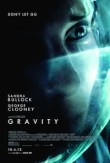 Set in the immediate future using technology that largely exists or is about to exist, some contend that Gravity isn’t a science fiction film at all — it’s a present-day thriller, just one that happens to be set in space. And they’re right, really — there are plenty of “real-world present-day” type thrillers that have more science fictional happenings than Gravity. But it’s on the ballot and it’s an incredible film, so pish, it wins.
 - The Hunger Games: Catching Fire
 The decision between second and third was a tough one for me — I’d’ve tied them if I could. However, I haven’t posted a review yet for Catching Fire and am still debating my score — does it stretch to a 5? It still could — not only did I really enjoy it, but I think it has a lot more thematic/dramatic heft than your average blockbuster. Anyway, the next film’s locked at 4 stars, so Catching Fire wins the toss.
 - Iron Man 3
 Some people seem to really, really dislike Iron Man 3. Not sure why — it may well be the best entry in what’s an all-round enjoyable trilogy (I still maintain Iron Man 2 isn’t so bad), a different-from-the-norm superhero tale that excites and entertains. It works as a trilogy-capper too (it’s almost a shame he’ll just be back in Avengers 2.) I’d quite like to rank it first… but, sadly, not in this year.
 - Frozen
 Disney’s all-conquering version of The Snow Queen is the only fantasy film on this year’s ballot (seems to me the Hugos skew more SF than F. I suppose they are awarded by a Science Fiction society). I didn’t find it as incredible as the audiences who made it the fifth highest grossing film of all time, but it’s a fine film, whose initially-bland songs improve with re-listening (he says, listening to Let It Go as he writes).
 - Pacific Rim
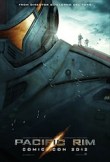 Guillermo del Toro’s Westernised riff on a very Japanese subgenre flopped Stateside — it just crossed $100m, which once would’ve been remarkable, but on a budget of $190m is poor. Internationally, however, it stormed past $300m and so will be sequelised. Del Toro apparently aimed it at 11-year-old boys, and it’s better than most other super-budgeted movies aimed at that demographic.
And the one thing I reviewed as a film but the Hugos count as Short Form…
- Doctor Who: The Day of the Doctor
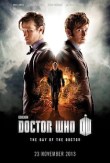 Well, of course they do — it’s a TV episode really, isn’t it? But it is feature-length (long enough to qualify for Long Form) and was released in cinemas, so I maintain you could count it as a film. Still, in Short Form it stands a strong chance of winning — I ranked it #1. My #2 and 3 was another tough decision, but I put Peter Davison’s hilarious spoof The Five(ish) Doctors Reboot in second and, in third, Mark Gatiss’ incredible An Adventure in Space and Time (another feature-length production that could hold it’s own against movies). Neither of those are strictly SF/F, but I guess as they’re Dramatic Presentations rather than books it was felt they belonged here rather than in the Related Works category. In fourth was Game of Thrones episode The Rains of Castamere. It is great as an entire episode, but let’s face it, it’s here because of the Red Wedding, which is the last, what, 10 minutes? Any other year it would probably win, but against four Doctor Who nominees (it’s a transferable vote, so more nominees means a better chance of one winning) at a convention held in Britain? We love Thrones here (more than the US, according to some stats I saw), but Hugo voters everywhere love Who. Finally, unranked by me, were Doctor Who finale The Name of the Doctor (it underwhelmed me — I won’t advocate “no award” above it, but I don’t feel it deserves to beat any of the above nominees), and Orphan Black mid-season ep Variations Under Domestication, which I’ve simply not seen.
Have I been a crazy person and put these in all kinds of the wrong order? And what about the Hugo nominators — are there any science-fiction/fantasy films (or TV programmes) from 2013 that they were fools to leave out? Lemme know.
Next month on 100 Films in a Year…
It’s the summer! Though blockbuster season is almost over already, isn’t it? Never mind. Perfect time of year to stay inside where it’s cool, anyway.
Oh, and watch some films. Which I shall list next time. But you knew that.
 A sequel to the suprisingly-good-in-spite-of-its-name animated comedy, Cloudy with a Chance of Meatballs 2 (innovative title; though better than its original moniker, Revenge of the Leftovers) begins mere minutes after
 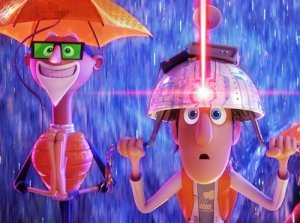 The villain this time is a thinly-veiled riff on Apple and its messianic founder, Steve Jobs. Here they become the aforementioned Life Corp, whose logo (and headquarters) is a giant lightbulb, and the equally-aforementioned Chester V, Flint’s childhood hero. As with almost all hero-since-childhood characters, you can guess where that’s going from the moment he appears at the start of the opening montage. Nonetheless, his storyline and relationship with Flint mostly works — it does take Flint a long time to reach the point of realising The Truth, but for viewers the reveal comes earlier and isn’t treated as an inappropriately big shock. Again, kids less familiar with movie tropes will be even more accepting of it. Plus there’s a Moral Message there for said kiddies (naturally), this time about trusting in your friends. It’s all familiar fare to an adult viewer, but doesn’t dominate to the point of boredom.
 In the end, Cloudy 2 isn’t quite as good as the first film, but not in a “notably inferior” way. It remains relentlessly entertaining, with an admirable energy and drive, which is in part a desperation to not be boring, but not in a shallow way. It may lack the extra little something that the first one has, but if that was an 8-out-of-10 then this is a 7 — which, because it’s fun rather than disappointing, rounds up to:
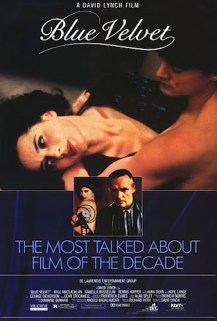 Before he brought the disquieting underbelly of small-town America to television audiences with
  But… is it, really? The white-picket-fence-dwellers are pretty clean; it’s the people inhabiting the scuzzy apartment blocks and industrial estates nearby who are the problem. Those characters are as corrupt and degenerate as their abodes might lead those with regular prejudices to suspect. It’s a less subversive point of view, and I don’t think it’s what Lynch was actually going for. Anyway, the entirety of his moviemaking technique is so outré that you can’t help but find the whole twisted nonetheless.
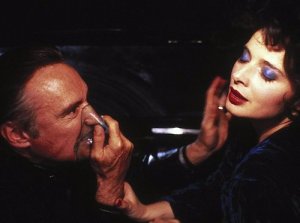 “It’s not a movie for everybody,” Lynch himself said (to Chris Rodley for the book
 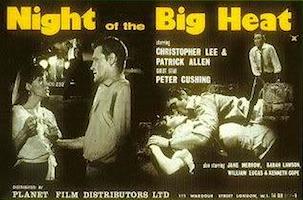 These days largely sold as a horror movie (the old Collector’s Edition DVD is branded as part of a “Masters of Horror” series), probably thanks to its cast (Christopher Lee and Peter Cushing), director (Terence Fisher, of many a Hammer Horror, including five with Cushing and Lee), and rating (an X originally, a 15 now), Night of the Big Heat is not really anything of the sort. Well, maybe a little; but you’re more likely to get scared by a contemporaneous episode of
 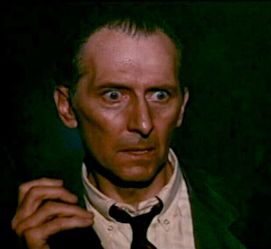 the pair were brought in to redraft because the original screenplay’s dialogue was “unsayable”. Anyone familiar with their ’80s work on Doctor Who, and their associated reputation, will find that highly ironic.) However, when the sci-fi stuff does roll in it’s a bit of a damp squib, leaving the scenes relating to the affair, whether it will be discovered, and what various characters do about their various feelings, as some of the more unique and interesting elements.
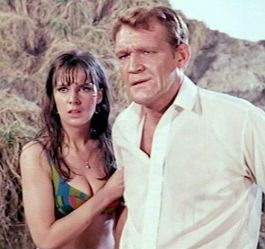 which considering it was shot in February and March is a real achievement. During night shoots the cast had to suck ice to stop their breath being visible, while running around in wet clothing to look like they were drenched in sweat. Poor sods. Said night scenes are a mess of genuine and atmospheric nighttime shooting, alongside the kind of day-for-night filming where everything’s extremely dark except for the sky, and also the kind of day-for-night filming where it’s day and… um… shh!
 Originally produced for the 2010 FrightFest film festival, horror director Jake West’s feature-length documentary with the unwieldy title explores the ‘video nasty’ scare that gripped early-VHS-era Britain. Starting with a primer on the birth of home video, and what it was like to watch movies in those days (because, ladies and gents, we’ve now reached a point where even fans of that (second-)most adults-only of genres, the gory horror flick, are young enough to not recall a time before DVD), West uses archive news clips and a wide array of new talking head interviews to take the story from the UK’s first video recorders in 1978, through a newspaper-led panic, up to the infamous Video Recordings Act of 1984, which irrevocably (thus far, anyway) changed the face of home entertainment releasing in the UK.
 Focusing on the scare rather than the films embroiled in it makes this less a “horror documentary” and more a social history/pop culture one, though the liberal use of extreme clips from the movies in question shuts out anyone without a hardened stomach. (If you did want more on the films themselves, the DVD set that contains the documentary — Video Nasties: The Definitive Guide — includes 7½ hours of special features discussing all 72 ‘official’ video nasties alongside their trailers.) There’s room for little asides amongst the main narrative, though. One of the highlights is the story of an interviewee who was invited on to Sky News in the wake of the James Bulger murder and asked if the film many were holding responsible,
  There was some counterargument, however, which leads us to the film’s best interviewee, and surely a new hero to many: Martin Baker. Baker was one of a few (certainly the first, and for a time the only) critical/intellectual-type voices to speak out in defence of the films that were outraging so many. He’s to be commended not only for his valiant defence of, essentially, free speech at a time when his views were immensely unpopular; but also because he remains one of the most lucid and fascinating commenters in the documentary. He makes the clearest points about the need to not forget both what happened and how it was allowed to happen, lest it occur again.
 that force ISPs to attempt to censor what we can and can’t see on the internet, and just yesterday rushed through anti-privacy legislation without proper debate. Sad to say, many of the valuable lessons of the ‘video nasties’ brouhaha — lessons made explicit with superb clarity in Jake West’s excellent documentary — have not been heeded.
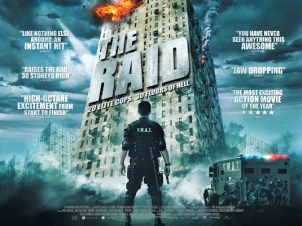 “20 Elite Cops. 30 Floors of Hell.”
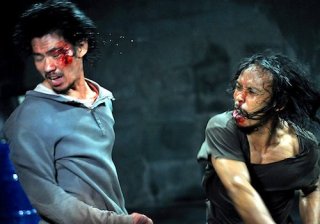 instead of ending with our hero duelling our villain, a fight with the top henchman is followed by a bit of plot clean-up between the villain and a supporting character. It’s the very definition of anti-climactic.
 Another way it’s pleasingly unlike its current American counterparts is the lack of focus on gore. There are plenty of stabbings (of a blood-stain-on-shirt variety), and a couple of sliced necks, but none are lingered on. Things like a hammer beating or repeated machete strikes take place either just off screen or just after we cut away. It’s unquestionably a violent film, but it doesn’t revel in the gory aftermath of that violence in the way many US films increasingly seem to.
 to make for a much more rounded experience. The fights in The Raid may have blown the minds of people who haven’t seen enough Asian action flicks, but I’d argue Dredd is the better film as a whole. And if you still insist on accusing one of plagiarising the other… well, let’s put it this way: Dredd had finished shooting, and its screenplay had leaked online, before The Raid even entered production.
 Remembered largely thanks to the involvement of Orson Welles (he has a supporting role, produced it, co-wrote it, and reportedly directed a fair bit too, though he denied that), Journey into Fear is an adequate if unsuspenseful World War 2 espionage thriller, redeemed by a strikingly-shot climax. The latter — a rain-drenched shoot-out between opponents edging their way around the outside of a hotel’s upper storey — was surely conducted by Welles; so too several striking compositions earlier in the movie.
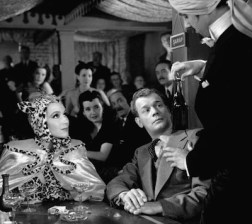 all added by Welles after the studio had their way, which seems to be the one US viewers know. The version without those seems to be the only one shown on UK TV, however.)
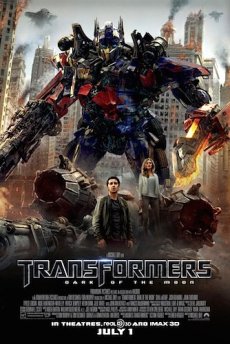 In an era where sequels seem to improve on their predecessors more often than not — building on established characters and mythology for a deeper experience, rather than rehashing the same plot/jokes/action sequences for a second-go-round money-grab — this Michael Bay-helmed series based on ’80s action figures is a throwback to… well, the ’80s. It’s almost appropriate.
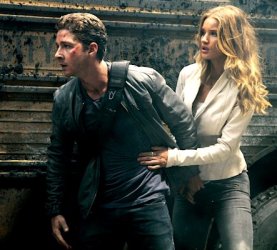 There are impressive visuals, it’s true, but that’s all they are: dramatic pictures. The characters, their motivations and actions that lead to these visuals often make no sense. And to say they “lead” there at all is generous, because just as often things begin to happen for no apparent reason. I swear no one’s thought any of it through — like the moment when the big honourable hero is offered a truce by the villain and, instead of accepting it, immediately executes him. Stay classy, Optimus Prime.
 #45
#45  #49
#49  The General
 The Gold Rush
 The Passion of Joan of Arc
 Intolerance
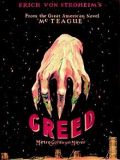 Empire readers considered this the 399th best film ever. TSPDT treated it more kindly, slipping into the top 100 at #94; the Top 300 Silents rank it among their top ten, however, at #10. The original (now lost) cut ran eight hours; the version released was merely two. In 1999 a four-hour version was created using stills from the deleted scenes, which seems to be the only one readily available, though I’ve heard the shorter cut is superior.
 Krister Henriksson returns as the Swedish detective for a third and final series of mysteries, starting with this final theatrically-released episode, based on the final Wallander novel. Yes, there is a sense of finality here — albeit one not reached just yet.
 It’s here that Henriksson gets to show off his acting chops the most. At a dinner party with his family, Wallander largely sits quietly with a drink rather than interact with others, occasionally staring aimlessly into the distance, or only remotely engaging with what the others are doing. He witters about a painting of a goat. Later, he has a disproportionately angry response when his friend brings news that he’s been suspended. He dotes on his granddaughter, but one day loses her and her buggy when he pops into a shop — but finds her quickly enough that no one will be any the wiser. Little signs like this are scattered around, clueing us in to where Wallander will presumably end up: retired from the force, and possibly retired from his life. Whether Mankell brought the issues to a head in his novel or not, I don’t know, but here I can only imagine it will build throughout the series.
 The one thing that really cuts through Kurt’s newfound confusedness is when he gets a nose for a case. Quietly, by himself, he sets about digging in to what’s going on, unearthing evidence that’s been missed by others, piecing it together to complete a picture of long-kept secrets and new crimes committed in the name of keeping them. It resolves into a complex conspiracy, one that touches the lives of altogether innocent people. Is there justice at the end of it? Of a sort, but how satisfying that justice is… well…
 100Films.co.uk