
Lewis Gilbert | 104 mins | TV | 1.85:1 | USA / English | PG / PG
 Lewis Gilbert is the director of You Only Live Twice, The Spy Who Loved Me, Moonraker, Alfie, Educating Rita and Shirley Valentine — eclectic is an understatement! Here he works more in line with the latter two, telling the tale of a small amateur dance glass, mostly populated by middle-aged women, trained by a former big-stage wannabe (Liza Minnelli), who are invited to perform at a large local dance revue.
Adapted from his own play by Richard Harris (not that one), it’s easy to imagine how this had theatrical origins: it’s all about performance and the stage, for one thing, and there’s a focus on character and dialogues that feels vaguely stage-derived. Which is in no way to say they’ve failed in translating it to the screen — if you didn’t know its roots, I don’t think you’d be tempted to guess. The action is expanded, with many scenes taking place outside of the group’s rehearsal room (where I believe the entirety of the play took place), and Lewis knows his way behind a camera, so we’re not stuck with stagey blocking.
Obviously the film has an overarching plot, but it’s not really where the focus lies; it’s more an occasionally-vague long-term goal, the preparations for which are spotlighted in a couple of rehearsal scenes. Though Minnelli is ostensibly the star and lead, many of the others are given a not-unfair chunk of screen time too. So with a moderately large cast and the throughline almost a subplot itself, the film occasionally feels like a collection of subplots bolted together. It’s a form that can work, and here it passes well enough.
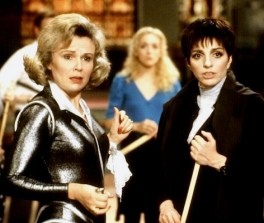 The standout from the cast is probably Julie Walters, in a relatively early big-screen role. Considering how well-known she is now she seems quite lowly billed and little-featured, but bearing in mind this is a US production from the early ’90s, it’s less surprising. She’s very good (isn’t she always?) as the group’s newest member, a posh English lady who sticks her oar in and is a bit too blunt with her comments. I seem to remember her generating most of the laughs in this comedy-drama, although that’s not to disparage anyone else’s work.
Stepping Out is what some people would call a Woman’s Film, exactly as patronisingly as that sounds. It’s not entirely female — there’s a male member of the group (though one might argue he’s a little camp), and a git of a boyfriend — but, without meaning to come over as patronising myself, you can tell they were aiming for a female audience. Which doesn’t mean men can’t enjoy it, obviously.
For either gender, I think it remains a fairly lightweight but entertaining little tale. It’s not likely to illuminate you in any way, or make you roar with laughter, and it’s not even a shining light in the group-of-underdogs-who-think-they-can’t-prove-they-can sub-genre, but it’s a pleasant way to spend a couple of hours for those who like this kind of thing.

 After decades telling tales from the Second World War, Spielberg moves back a conflict. That said, the BD’s special features make sure to point out this “is not his First World War movie” — it’s just a good tale about a boy and his horse.
 It can’t be denied that there’s factual inaccuracy here (the climax takes place at the Somme in the lead up to Armistice Day in 1918, but that battle was actually fought in 1916), or the occasional heavy dose of sentimentality (it’s directed by Spielberg and co-penned by Richard Curtis — what did you expect?), but I think it carries through these with a scale and heart that is, primarily, entertaining. It is based on a children’s novel and I think aims to be a family film (it should by rights be a PG; my twitter rant on that subject is
  Aiding the sense of the epic is Janusz Kaminski’s cinematography, which is regularly stunning and definitely one of the film’s standout achievements. The beauty of some shots is immediately obvious — he lenses the countryside idyll of Dartmoor in a sweeping fashion, bathed in summer sunlight — but there are striking compositions to be found throughout, be they in close-ups, cavalry charges, horse auctions, battlefield hospitals… There’s often a lovely texture to things too, from the likes of drifting snow or chaff, or the way light streaks across a room. The final scene, fully tinted orange, calls to mind the likes of
  one that isn’t afraid to depict some of the nastier realities of the world, but in a way that makes them relatable for a younger audience. I think that’s important; but this isn’t a Worthy Film for that, it’s just something it does well. I think it also nails sensations of adventure and, yes, sentimentality.
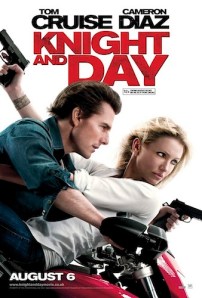 James Mangold is one of those filmmakers with a thoroughly eclectic CV, taking in crime thriller
  Knight and Day is nothing deep or revelatory or groundbreaking, but if you were expecting it to be then more fool you. If you can’t abide Cruise or Diaz (and I know some people really can’t) then it should certainly be avoided, but those caveats aside I thought it was good fun. No classic, and far from destined to be a standout on Mangold’s multi-Oscar-winning filmography, but an appropriately entertaining couple of hours.
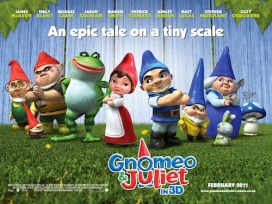 Gnomeo & Juliet is the latest British attempt to crack the lucrative CGI animated kids’ movie market, after the lack of success (or, alternatively, failure) from the likes of
  My only other note is that it ends with a truly awful cover of Crocodile Rock by Nelly Furtado. A storyboarded “all’s well that ends well” ending (included on the BD, and the DVD for all I know) looks much better.
 Following the surprise success of
  Hitler (aka Bruno Ganz) and a cool exit; a really good car chase; and a couple of solid punch-ups, including a particularly good one at the climax.
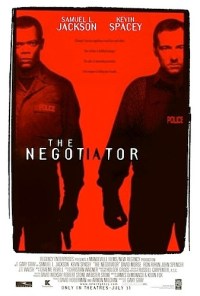 As premises go, “hostage negotiator turns hostage taker” is a doozy. You can immediately imagine all the drama to be had from pitting The Best Negotiator In The World (because it’s a movie — it’s going to be the best one that goes rogue, isn’t it) against The Second Best Negotiator In The World — he’ll know all the techniques! He’ll… well, mainly the techniques one. But also his colleagues will be working against him — will they be on his side? Or against him? It practically writes itself.
 but before that it sets up the characters and gets them on the bus, and the third act goes off-bus for a climax. Similarly, The Negotiator‘s first act gives us a day-in-the-life case for maverick negotiator Jackson, before putting him in his predicament; it toddles along, extending the hostage situation part with some tense and/or exciting sequences; and then the third act sees our hero set off to find the proof he needs.

 #78 Avengers Assemble, aka Marvel’s The Avengers (2012)
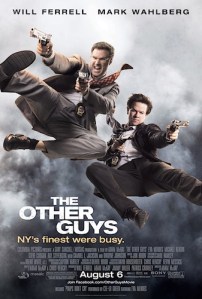 The Other Guys sounded like a great concept; so great I overlooked the fact it’s from the director of the massively over-rated
 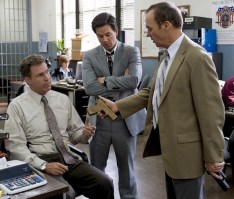 Everyone loves The Rock and Jackson; no one likes Ferrell and Wahlberg; and they’re not assigned the case, they stumble upon it. Wouldn’t it have been more fun if everyone actually hated The Big Damn Heroes who make it hard for the regular guys to do their job? If a pair of normal detectives were assigned The Big Case and had to prove themselves worthy? Maybe even put the Super Pair in the shade, rather than killing them off in the first act?
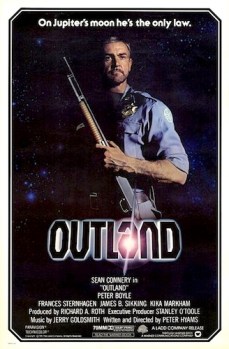 I first encountered Outland in a similar context to a lot of people, I think, based on reviews and whatnot I’ve read; that is, as “
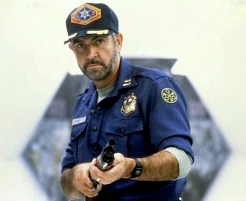 It works as well in space as it does anywhere else.




 100Films.co.uk