
The Hughes Brothers | 118 mins | Blu-ray | 2.40:1 | USA / English | 15 / R
After last week’s reviews of Priest and Legion, here’s another disappointingly religious action blockbuster…
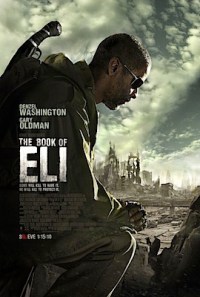 The directors of From Hell (what did they do for nine years? Struggle to find work perhaps) helm the tale of Denzel Washington being a sunglasses-wearing loner mofo in a post-apocalyptic America. I really enjoyed it… for maybe 50 minutes, before it gradually slid away, ultimately degenerating to a Christianity circle jerk ending.
I warn you now, this review contains spoilers, because I don’t care if I ruin the crap bits for you. Indeed, I’d say less “ruin” and more “prepare”.
Much like the film, let’s start with the good stuff. It has a slow, almost elegiac pace early on, punctuated by bursts of violence and action. This section is very good. Then it begins to slip into more typical action blockbuster territory. A fake-single-take shoot-out might’ve seemed virtuoso filmmaking in the right film, but here it seems like director willy-waggling in preference to serving the mood and tone thus far created. Same goes for other independently cool things that follow, like the explosive destruction of a truck.
Ironically, one of the earlier good action sequences (a bar brawl… to sell it short!) is included in a beautifully-choreographed single-take form in the deleted & alternate scenes. That should’ve been left in the film. The final version isn’t bad — the Hughes brothers use a variety of static and wide shots to lens all the film’s fights in a way that reminds you that all handheld close-up shaky-jumpy super-fast-cut modern action sequences are inferior to an old-style well-staged, well-shot sequence — but if they’d had the restraint not to intercut some sequence-extending close-ups they would have had a massively more memorable sequence.
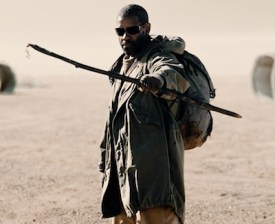 The music is by Atticus Ross, which was interesting because I’d thought it was reminiscent of The Social Network. So that’s nice.
There are nice, subtle CG effects (I presume) for much of the film, making the world brown-grey and bleak with green-tinged clouds… but all that is ditched for the digitally stitched together ‘single take’ gunfight and, even more so, a vision of a desolate San Francisco during the closing minutes. It’s decent enough in itself — I’ve seen worse — but like, say, the ‘vampires’ in I Am Legend, it’s jarring and awkward because it doesn’t fit with the tone and style established elsewhere.
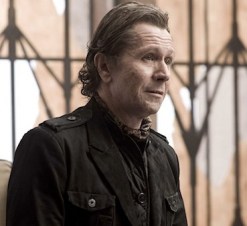
A bit like Mila Kunis, who is kinda fine but also an acting weak link. Washington and Gary Oldman (especially) are as great as ever. After years of Harry Potter, Batman and recently Tinker Tailor, it’s quite nice to see Oldman back as a villain! He knows how to pitch it perfectly, and while the lack of out-and-out crazy means this one isn’t as memorable as Leon’s Stansfield (well, who is?), it fits the film like a glove. It can’t withstand the blockbusterised let’s-go-get-’em second half, but then not much can. Certainly not the directors’ skills. The oft-underrated Ray Stevenson even offers a cut-above-average lead henchman figure. But there’s something about Kunis… something too present-day and preppy for someone who’s supposed to have been born and raised in a deeply post-apocalyptic back-of-beyond world. She’s nowhere near rough enough.
 Late on the film pulls out surprise appearances from Michael Gambon and Frances de la Tour. Their roles aren’t even close to needing thesps of such calibre though — they appear fleetingly, the actors underused. Particularly Gambon, who really has nothing to do except fire a gun. I know it’s usually a joke to comment that a usually-better cast member must have needed the money, but that’s the only reason I can imagine he’s here.
Worst of all is a pat ending, which doesn’t make a lot of sense in various ways. They really destroyed every Bible? He really memorised all of it? He wasn’t blind all along, surely? Because you assume he is and then no one says so you think maybe you’ve read it wrong but then it’s meant to be a twist that he’s blind — what?! Why is that facility on Alcatraz? Why have they just been collecting for 30 years? For 30 years?! I could go on.
As well as being religiousified to extremes, these attempts at giving surprising twists just don’t wash. To quote Kim Newman in Empire,
Given that the leather-bound tome Eli treasures is embossed with a crucifix, it’s not much of a surprise when we find out what it is…
Eli’s literary devotion is more giggly than inspirational. Frankly, it would be more affecting if humanity’s last hope rested in almost any other book than the one chosen here – Tristram Shandy, David Copperfield, the Empire Movie Almanac.
So, so true. This must be why American reviewers seem to have loved the film, but our more secular nature sees it as Just Daft. Thank God for that.
 Newman concludes that “you can’t help feel you were invited to a party with fizzy pop and cream cake and got suckered into a sermon instead.” I couldn’t have put it better. Eli starts off with the potential for an arty 5; slips slightly to a solid 4 when the standard post-apocalyptic trope of a gang fighting for local power comes in to play; unsteadies that 4 with an increasingly atonal second half; and quite frankly borders a 1 with its sickening ending.
I land on a generous 3, because anything less would be unfair to the good stuff it achieves early on. What a shame it couldn’t continue in that vein.

The Book of Eli featured on my list of The Five Worst Films I Saw in 2012, which can be read in full here.
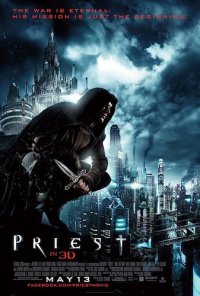 In a dystopian church-ruled future (could there be any other kind of church-ruled world), in which a war between men and vampires raged for centuries but has recently been settled (in man’s favour), no-longer-needed warrior-priest Paul Bettany is called upon to go against his vows and leave the city to rescue his niece after her parents are murdered and she is kidnapped in a vampire attack. I could go on, but it’s the kind of plot that sounds far more complicated in a short summary than it is to watch on screen.
 And after all that meandering, the story is a bit rushed. It tries to generate character and tension, but hasn’t spent enough time building them to earn it. There’s lots of awful dialogue, flooded with clichés… as is a lot of the plot, and the stock dystopian future setting, and the overuse of slow-mo. There’s some ideas with promise, but they’re largely shunted aside in favour of something from The Big Book of Standard Character Arcs. And I say “promising” — you know exactly how they’d play if the filmmakers had bothered to make more out of them.
 None of this is helped by weak acting, which considering the largely quality cast is probably down to the script and direction. How unlikely is Paul Bettany as an action leading man, eh? I thought Jason Statham was odd enough… And if you want a preview of
  Priest isn’t bad per se — well, depending on your tolerance levels. It’s no
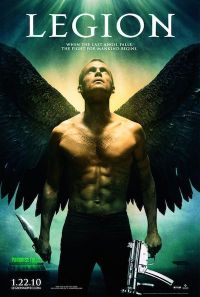 The first of two Christian-themed action movies directed by former visual effects man Scott Stewart (this his first feature as director) and starring British thesp Paul Bettany (here he plays a gun-toting angel,
  Even the action sequences not up to much, just guns firing and things exploding in the dark with almost no choreography. As an action movie you might forgive it some of the plot and character points if it could manage that, but it can’t.
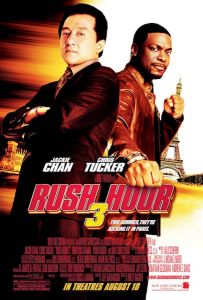 Belated sequels are often the worst kind, an actor/director/studio returning to past glories in the hope of creating new success. Even when they work, they’re not a patch on the original. (I’m sure there must be exceptions, but nothing comes to mind.) The third entry in the
 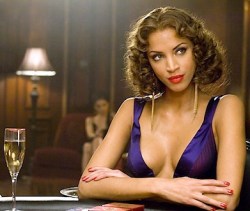 It’s ostensibly a thriller (albeit a comedy-action-thriller) and so there are plot twists, but they’re wholly predictable. It also lacks clarity in its villain, I felt — who it is, what they’re doing, why they’re doing it, and so on. It weakens the film, especially the ending: there’s the usual big action climax, followed by a little bit of business that dilutes the impact of the ending. It’s just badly structured.
 plus some sparing atop the Eiffel Tower (or, I presume, a surprisingly good set thereof) — is occasionally spectacular and single-handedly almost justifies the entire film’s existence. A car chase/fight through the streets of Paris is the other best bit, buoyed by both unusual choreography and Yvan Attal’s French taxi driver George, who’s probably the film’s best character.
 If 2009’s
  though perhaps not always as memorably, and Ritchie crafts an array of interesting action sequences. Some still accuse it of being a sub-
 Yet for all that, that climax is a game of chess: Sherlock and Moriarty come face to face while in the room next door Watson and gypsy Simza try to spot an assassin. It’s one of a couple of scenes where Downey Jr.’s hero comes face to face with his nemesis, played by Jared Harris, and these scenes are definitely some of the film’s high points. Harris makes a perfect addition to the cast, the only disappointment being that we don’t get to see even more of him. Downey Jr.’s become such a Movie Star recently that it’s easy to forget he’s a multiple Oscar-nominee, and he and Harris give as good a hero-villain act-off as you’re likely to find in a blockbuster.
 Better served is Stephen Fry as Mycroft, a role normally rendered as a brief cameo. And indeed it’s little more than that, but there’s more of him than I was expecting (certainly so in one (pointless aside of a) scene that I’m sure you’ve heard about), and Fry of course excels — it’s the kind of role he was made for. Meanwhile the award for best agent goes to Eddie Marsan’s: Lestrade appears late on for all of two shots, but Marsan is still billed high enough to be on the poster, above most of the cast.
 A Game of Shadows comes out as a fun ride with several stand-out moments, but not as a particularly exceptional version of Sherlock Holmes. It’s very enjoyable as a comedy-action movie with amusing characters and entertainingly-staged action sequences, but while my affection for the first has grown to make it one of my favourite movies, this is just an entertaining follow-up.
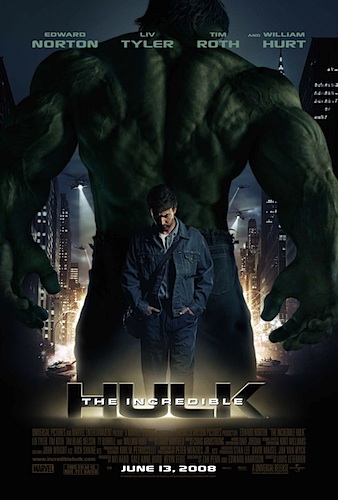
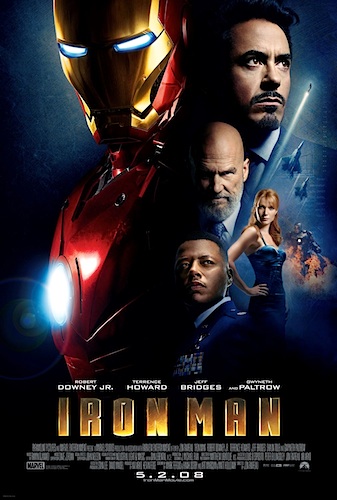
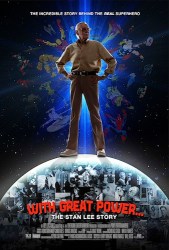 Stan “The Man” Lee is indeed The Man when it comes to the world of comic books. In the 1960s he revolutionised the medium in the US, introducing complex and realistic characters to a world that had previously focused on perfect super-humans like Superman, Batman and Captain America. In a period of just two years he co-created the Fantastic Four, Hulk, Spider-Man, Thor, Iron Man and the X-Men, and after that rejuvenated Captain America (cancelled a decade earlier) for a modern audience. If there’s anyone in the comic world deserving of a dedicated feature-length documentary, it’s Stan Lee.
 both in his Marvel heyday in the ’60s as well as before and since. It also really digs in to his personal life at time, getting very emotional. That Lee and his family appear and tell these tales mean it doesn’t feel intrusive.
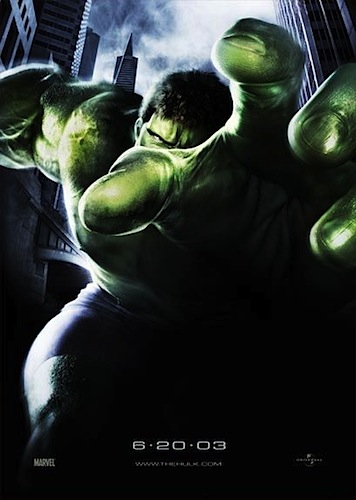

 The first
  Thirdly, it has Gary Oldman as a villain. That should be wondrous, but it isn’t. He’s fine. Gary Oldman villains aren’t fine, they’re classic characters. But no, this one’s just fine. I guess he needed some cash.
 Hopefully the inevitable third entry (this ends with a very obvious setup for where the series will go next) can regain some more of the first film’s magic. As things stand, I found Panda 2 to be a fairly decent 90 minutes — though, saying that, a slightly slow one — but not one that came close to the numerous joys of its forebear. Disappointing.
 #38
#38  100Films.co.uk