
Daniel Alfredson | 130 mins | Blu-ray | 15 / R
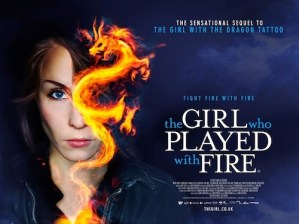 Creating any kind of sequel is hard — the endless array of failed attempts is testament to that — but I think creating a direct sequel to a successful crime thriller may be the hardest.
With action movies or superheroes or what have you, the same formula can be rehashed; it’s better if the concept or story is pushed forward, of course, but as most movies in those genres have the same plot regardless of the hero, it stands to reason the sequels can survive it too. With a straight drama you can continue the lives of the characters, throw some new, plausible (preferably), dramatic hurdle in their path and show how it affects their lives. But with a crime thriller…
Almost by definition a good portion of your cast are wiped out: if you didn’t kill them for the sake of a twist, they’re gone because they were tied to the first case. Drag every survivor back at your peril: their mystery’s been solved, and the chance of them all being involved in a new one is too improbable to consider. So you’re left with only the one or two or three investigators, 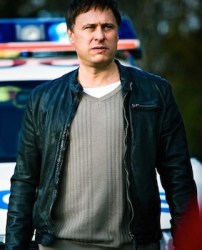 and they need a brand new case to become embroiled in. And it’s got to be as good as the last one, but it can’t be the same because we’ve had that mystery solved. You could have a different solution, of course; you could change some of the details, naturally; but police dramas on TV vary their types of murders every week for a reason. So in your new tale, the new characters have to be just as interesting as the first batch, the new mystery has to be just as intriguing too, and it really ought to be a notably different crime being investigated.
Stieg Larsson’s Millennium trilogy has an advantage here: with Lisbeth Salander as a break-out character, you can take a certain degree of the drama tactic and just throw something new in her path. Plus there’s the only story thread left hanging from The Girl with the Dragon Tattoo, the handful of hints at Lisbeth’s past, to feed off as well. On the other hand, there’s the problem of having sent Salander off to a new rich life at the end of the first book/film. Not only do you have to get her back, you have to re-team her with the investigative driving force of the first tale, journalist Mikael Blomkvist. Unlike a cop and his partner, say, these two have no shorthand way they would have to be reunited. There are other ways — the fact they had developed some kind of sex-based intimacy for starters — though for goodness knows what reason that’s ignored here in favour of some plot-engineered improbabilities of fate.
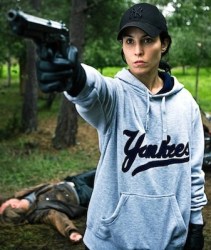 One solution to the sequel problem is to “make it personal”, and that’s exactly what we get in The Girl Who Played with Fire. A journalist and his girlfriend working for Mikael are murdered and Lisbeth is suspected of the crime. It’s somewhere around here that the coincidences begin to pile up. It makes perfect sense as a plot in itself, but in bringing Mikael and Lisbeth back together it doesn’t work — it’s not related to their previous encounter, so it’s entirely coincidental. Coincidence is a dangerous thing in fiction; it asks your audience to accept something that doesn’t fit our logic of how stories work. It happens all the time in real life of course, but in real life a flipped coin with a 50/50 chance of being heads or tails could turn up heads twenty times in a row, but a person asked to estimate twenty results of a flipped coin will never put more than two or three of one side in a row (unless they know to subvert it… look, this isn’t the point).
That said, if you want to be kind (and why not?), time has passed since they last met — it’s not as if Mikael ran into Lisbeth while pursuing his very next article. (We’ll overlook that the time passed is the nice round period of a year.)
What about the case itself, then? Sadly it’s not as engrossing or unique as the one in Dragon Tattoo. It seems based in sex trafficking, but that’s just window dressing: 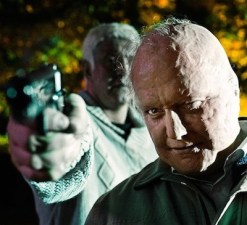 it’s never seriously looked into and, consequently, other dramas have tackled the issue with greater depth, sensitivity and insight. What Mikael and Lisbeth are actually looking into is a conspiracy of sorts around some murders. The way the trail is followed isn’t as clever as it was in Dragon Tattoo and, consequently, isn’t as interesting. The two protagonists go about their investigations independently. This is a long-held technique in novel writing — multiple strands allows the author to alternate which is followed from chapter to chapter, almost by itself providing momentum and the must-keep-reading factor as the reader has to race through the next chapter to rejoin the thread of the previous one (it’s not that simple or we’d all be churning them out… but look, I’m getting off the point again). The problem here is that Dragon Tattoo was largely at its best when the two were together, so keeping them apart is less satisfying. To top that off, they’re each finding out different things, which means as the audience we can feel a few steps ahead of the characters as we have the benefit of both sides of the case. That’s not always a bad thing, but it can be slightly disconcerting when you know the answers your hero is still searching for.
 Despite Lisbeth being the focus of much of the attention laden on these books/films/remakes, she’s a less engaging character when by herself. Here she shuffles around silently, digging up files that she and we stare at to reveal information. There are only a few moments for her (and, consequently, Noomi Rapace) to show off what endeared her to viewers before — her confrontation with a pair of arson-bent bikers, for instance.
Revelations at the end of the second act give things a kick up the rear, both for the characters and the plot, but it still has an undue reliance on coincidence, varying degrees of improbability, and the middling conspiracy plotting. This felt underscored by a henchman who’s essentially a Bond villain. In fact, as a white-blond (half-)German who feels no pain, he’s a specific Bond henchman (see: Tomorrow Never Dies).
The ending isn’t close to being conclusive. The mysteries where this particular tale began are solved, but numerous questions thrown up along the way are only just beginning to be answered. Whereas Dragon Tattoo works perfectly as a standalone thriller, even though it hinted at elements of Lisbeth’s backstory, this builds on them and leaves plenty hanging. In this respect it seems to be very much Part Two of a series (I’d say “trilogy”, but considering Larsson had (depending on which report you believe) five to ten books planned, that seems inherently inaccurate).
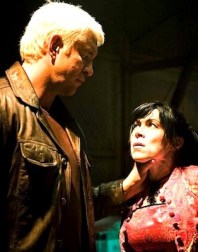 It also feels less filmic than the first film. Is it poor direction? Is it just the opened-up 1.78:1 ratio? I’ve read that all three films were shot like this, as they were intended for Swedish TV, meaning Dragon Tattoo’s Blu-ray is cropped to 2.35:1. You hardly ever see 2.35:1 on TV (Red Riding is the only made-for-TV example I can think of; most channels even crop films) so it automatically lends a filmic aspect, and therefore might explain the discrepancy. Conversely, I’ve also read that Dragon Tattoo was produced as a cinema film then later the two sequels were shot to serve as episodes three to six of a TV miniseries (with Tattoo extended using deleted scenes to make the first two episodes). Perhaps that explains it.
That’s besides the point anyway, because it’s not the direction or cinematography that lets The Girl Who Played with Fire down in comparison to its predecessor. In summary: the case isn’t as unique or enthralling, and by splitting up the protagonists we don’t get the full benefit of either. It’s not a bad tale, it’s just not a patch on the first.

This time next week, The Girl Who Kicked the Hornets’ Nest. Hopefully.
 #26
#26  #33
#33 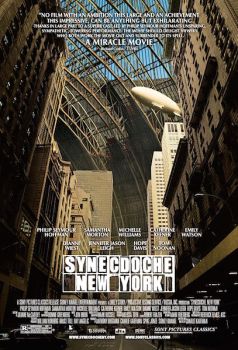 Despite its unpronounceable title, Synecdoche, New York starts out like a relatively normal comedy/drama… but then weird touches begin to creep in. A house that’s on fire when a character buys it and continues to be on fire for the next several decades, for instance. No one in the film bats an eyelid. Then the really weird bit arrives; the bit you all probably know; what the film’s about (except, of course, not what it’s About), as Philip Seymour Hoffman’s theatre director begins to construct a life-size New York within a warehouse.
 and I haven’t begun to care in the months since I watched it. It’s the kind of film where, as it gets on, you feel it’s a rich experience that you’ll have to ponder for a bit once it’s done, even if there’s something you quite fancy watching on the same channel immediately afterwards. But by the end it became the kind of film I was fed up with pondering, and I bloody well watched what was on the same channel immediately afterwards. Kaufman’s weirdness can wear you down to the point where characters who were interesting and ideas (both plausible and of Kaufman-logic) that had potential cease to be worth caring about; where you go from the point of “I’ll look up an explanation on the internet once it’s finished” to “…meh”.
 From the same production company that brought us the
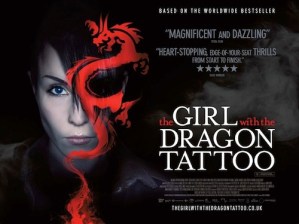
 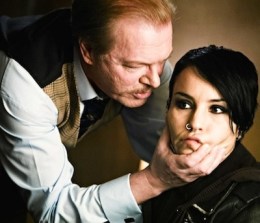 The original title translates as Men Who Hate Women, which is certainly very apt. The subject matter is grim and dark; horribly plausible, in fact. It’s unwaveringly depicted with some brutal, hard-to-watch scenes. They’re not exploitative though, as a lesser film merrily would be, and that makes them appropriate to the tale being told. Subplots about the two leads support the themes underpinning the main investigation — both about abuses of power, in different ways — justifying their apparent tangentiality, and consequently the film’s length.
 Despite the modern stylings, dark themes and attention-grabbing characters, much of the film unfolds as a procedural whodunnit like, for instance, the Wallanders, complete with piles of red herrings and last-minute twists. This is probably why the book has sold so well and the film has taken over $100 million worldwide: it tickles the same nerves as all those ever-popular TV police dramas. Indeed, this adaptation is rooted in a television miniseries (an extended version exists as two 90-minute TV episodes) but it doesn’t look like it: it’s quite beautifully shot; not showy or stylised, but there are some lovely shots of scenery in particular.
 With Dragon Tattoo featuring material that seems ideally suited to the director who gave us
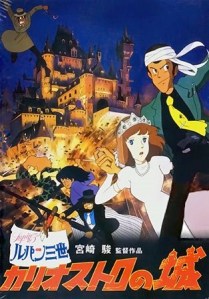 The Castle of Cagliostro, the second animated big-screen spin-off from manga-inspired anime TV series
 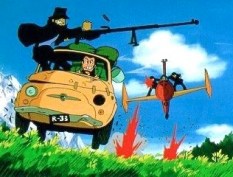 As I mentioned, this is the second spin-off film from a TV series, and at times it does feel like it: characters turn up under the impression the audience already knows who they are and what their connection is to the others. It’s not a major problem — most are introduced well enough within the context of the film that it can still be easily followed — but it’s there.
 Um, where was I? Oh yes: Indiana Jones; Roger Moore-era James Bond — it’s that kind of tone, more or less, and if you enjoy that kind of film then I don’t see why you wouldn’t enjoy this. Unless you think cartoons are for kiddies only (in which case, see the long sentence at the end of the last paragraph).
 Bolt is the 48th film in Disney’s animated canon (whatever the official name for that is these days), from their CG-only era that filled most of the ’00s. It’s a period already remembered as When Disney Lost Its Way, after the second (or is it third? I forget) ‘golden era’ of the early ’90s; the time that produced flops like
 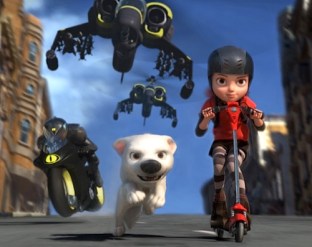 Also noteworthy are the action sequences. Far from being perfunctory attempts at liveliness, these are properly exciting, making full use of 3D CGI to create exciting and dynamic sequences. I’m not just talking about the couple we get from the TV-series-within-the-film either, but also the ‘real world’ ones as Bolt, Mittens and Rhino jump onto trains, out of moving vans, escape from a pound, etc. Of course, the TV-series-within-the-film is completely implausible — like you could film a TV show with massive action sequences in such a way that you only ever do a single take, never mind achieve all those effects on a TV budget. But then this is a film where a talking dog, cat and hamster work together to travel from New York to Hollywood entirely of their own volition — I think it’s safe to say no one’s aiming for documentary levels of realism.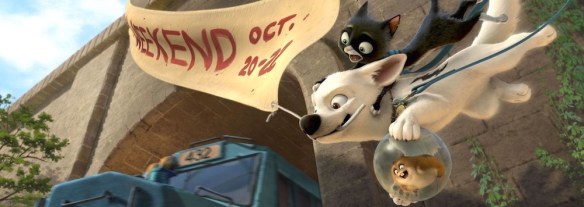
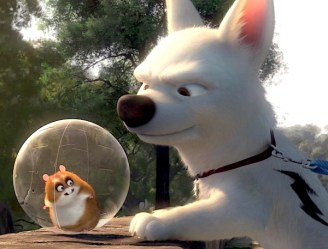 It would be easy to dismiss Bolt as part of Disney’s CG folly, especially as it stars Miley Cyrus and is immediately followed by their return to 2D animation, but I think that would be a mistake. It’s a fast-paced and fun adventure, with accurately-captured animals meaning it’s especially likely to appeal to dog lovers. Disney’s next golden era just might begin here.
 four for
  I have a good deal of affection for — and, therefore, expectation for its films. The same could be said of other favourite genres — action, thriller, etc.
 I’ve never seen films reviewed with a percentage. Theoretically, this method allows for 100 different scores — much more precise. In practice, of course, the lower ones are rarely used and the tippity-top ones are seldom (if ever) reached. Partly this is because you find your ‘average’ review score sitting less at 50% and more at 70% or higher. I believe this is because (like almost any reviewed art form) the bulk of what one encounters has been polished enough to earn a higher score — the average quality of work is of above-average quality, if you will. It also makes the system more liable to awkward questions: give one thing 95% and another 96% and you provoke “is the second definitely superior” arguments you wouldn’t get if they both just had 5 out of 5. Arguments aren’t necessarily a bad thing, of course, but it does require one to be frighteningly precise when scoring.
 but I don’t think there are many of them about. Giving something a score stamps your opinion nice and clearly: there have been a good few reviews where I’ve mainly discussed the negative points of a film I’ve primarily liked, for whatever reason, and without the score at the end readers might get the wrong impression; I may even have penned a review or two where I’ve tried to draw out the positives from something I was giving a low score to. I’d wager this is true of most reviewers — it’s always possible for your text to be misinterpreted; for a reader to see a positive (or negative) bias, however balanced or actually-the-other you thought you were being.
 Roman Holiday is the kind of film where its list of achievements don’t quite precede it — Best Picture nominee (it lost to
 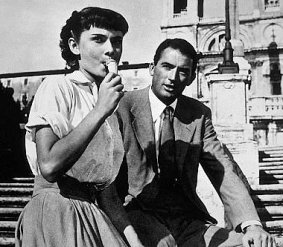 the Princess as they take her on a day messing about in Rome.
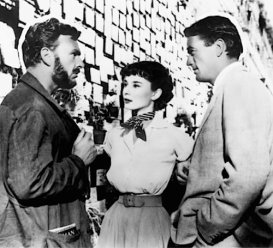 If, instead, you remember that he’s Fundamentally Kind, it might be less troubling that he has a secret plan most of the time.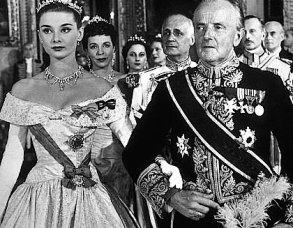
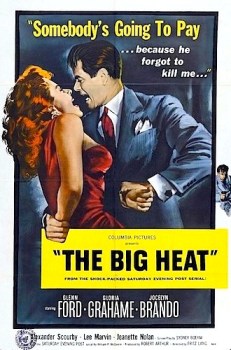 Fritz Lang is probably best remembered for the films he made in Germany; medium-defining classics like
 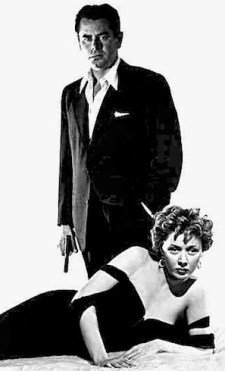 but it does manage what might be described as twists in how far it’s willing to go — mainly, who gets killed and how.
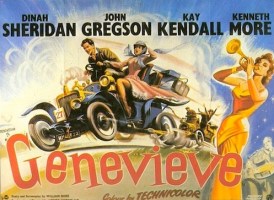 The further behind one gets on reviews, the easier it becomes to forget a film. Or not so much forget the film itself, but when one watched it. Or, to put it another way, I was a little surprised when I looked back over the 20 films I had left to review and saw Genevieve still there. At least I had a hundred or so words of notes for this one.
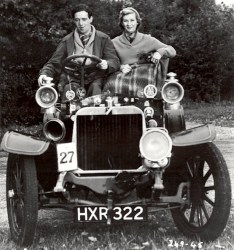 heightened by an evening of irritations and revelations, tipping the second half’s journey-back into an out-and-out race. It’s the second half that contains the more overt comedy as the rivals compete to scupper each other’s chances. That’s not to do down the more gentle style of the opening half, which has its moments. That said, depending on one’s perspective, the realistic sparring of the married couple during the opening scenes might be seen to give the film a bit of an edge of reality, making it not just the staged, (relatively) high-concept comedy it could have been.
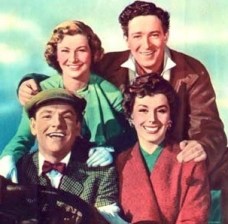 Director Henry Cornelius was vetoed on most of his first [casting] choices… and he was forced to make it at studios he didn’t want to work at. Cornelius’ displeasure was acutely felt by cast and crew as he didn’t hide how unhappy he was. He was also seemingly highly lecherous. Consequently both Dinah Sheridan and Kay Kendall carried whistles on them at all times… Olive Dodds, Rank’s head of contract artists, later testified that every leading cast member came to her at one point and said they wanted off the film.”
 100Films.co.uk