Hannah Montana/Miley Cyrus: Best of Both Worlds Concert [3D] (2008)

2009 #78
Bruce Hendricks | 72 mins | TV | U / G

Hannah Montana and Miley Cyrus: Best of Both Worlds Concert UK posterRubbish. In almost every way possible.

I could expand on that in numerous ways, but what would be the point? The only real exception is the 3D — being a very recent production, that was flawless.

Take solace in the fact that one day — hopefully, one day soon — Cyrus, Montana, this ‘movie’, and all the rest, will be completely forgotten.

1 out of 5

This was shown as part of Channel 4’s 3D Week. That’s why.

Hannah Montana/Miley Cyrus: Best of Both Worlds Concert featured on my list of The Five Worst Films I Saw in 2009, which can be read in full here.

Ripley’s Game (2002)

2009 #67
Liliana Cavani | 106 mins | TV | 15 / R

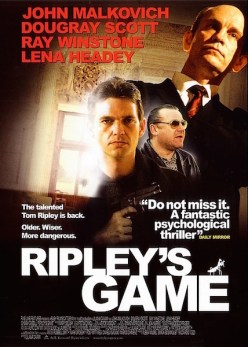
Ripley's GameMatt Damon is back as… Oh, wait, no he isn’t — he’s turned into John Malkovich.

Not quite — there’s no reasonable way Ripley’s Game can be considered a sequel to Anthony Minghella’s The Talented Mr Ripley. Though it’s adapted from a later novel in Patricia Highsmith’s Ripley series (previously filmed as the Dennis Hopper-starring The American Friend, incidentally), the action is relocated to the present day, and it’d be a pretty hard sell to believe Matt Damon would grow up to be John Malkovich.

Despite the acclaim of Minghella’s effort just three years earlier, and a cast that includes recognisable faces such as a Ray Winstone, Dougray Scott and Lena Headey alongside Malkovich, Ripley’s Game snuck out with barely anyone noticing, including going straight to TV in the US. There are surely reasons for this, reports of a problematic shoot probably among them, but the neglect is undeserved. In 2006, Roger Ebert saw fit to include it in his Great Movies list, though other critics are less favourable (the Radio Times, for one handy example, rate it just three out of five). While Ebert is in my opinion overselling the film by including it in a list of the best films ever made ever, it’s certainly an above average, consummately made, and constantly entertaining Euro-thriller.

Perhaps the difference in opinion about the film stems from one, arguably crucial, sticking point: the Radio Times criticises the humour included in the murders and thriller sections, viewing it as a failure of director Liliana Cavani; conversely, Ebert approves of it, praising them as appearing somewhere “between a massacre and the Marx Brothers”. There’s undoubtedly more to the diverging opinions than this, but it’s at least emblematic. I’m inclined to agree with Ebert: these sequences do have tension — not the most one’s ever experienced in a thriller, but enough — but they marry the humour to it, leaving you chuckling on the edge of your seat.

For the most part the story keeps moving, twisting and turning in sometimes unexpected directions. Other films would happily take the first half-hour or so of this and stretch it to a whole feature, but screenwriters Charles McKeown and Cavani — adapting from Highsmith’s novel, of course, so the credit lies with her — take the premise further and in new directions. It’s not flawless, with the climax by far the biggest let down: Ripley and Trevanny hole up in the former’s villa, preparing for a veritable war as Ripley anticipates goodness-knows how many men to turn up. When it’s only two, it seems more believable than a whole army of mafia goons descending on the relatively insignificant pair, but it’s also distinctly anticlimactic after the hype. Still, at least the story has a final twist up its sleeve.

Malkovich may be a fairly respected actor, but to me he’s always seemed detached, flat, or mannered — often all three. Here, he’s still all three, but it suits Ripley’s unusual character down to the ground. His dry wit and incessant matter-of-fact delivery craft a quietly sinister, stalking nature, aiding the character’s believable unpredictability — that is to say, you’re never certain what he’s going to do next, but when he does it’s not surprising. I’ve never read a Ripley novel (there are five) nor seen another Ripley film (there are four), but Malkovich’s performance fits so perfectly I have little doubt this is precisely how Ripley should be played.

Among the rest of the cast, Ray Winstone is landed with a role he could play in his sleep, Lena Headey is perfectly fine as an unremarkable wife, and Scot Dougray Scott plays a none-more-plummy Brit. Unfortunately this accent sometimes seems to be the main focus of his performance, and it occasionally falters when he gets highly emotional, but it’s not really a problem… though it is rather odd to hear if you’re familiar with how he normally sounds. His character, Trevanny, is primarily a pawn in Ripley’s titular amusement, leaving Scott with only a passing hint of the character arc with which the role could have been gifted.

As noted earlier, there are numerous tales of problems on set, not least the multinational cast coping with a multinational crew in multiple nations, culminating in Cavani leaving towards the end of shooting and directorial duties being fulfilled by Malkovich. But as many have noted before, happy sets can produce dreadful movies and unhappy sets masterpieces, and while I don’t quite share the view that Ripley’s Game is entirely the latter, it certainly errs more in that direction than the other.

4 out of 5

Wallander: Before the Frost (2005)

aka Mankell’s Wallander: Innan Frosten

2009 #74
Kjell-Åke Andersson | 93 mins | TV | 15

You’re likely familiar with Swedish police detective Kurt Wallander — in passing if not in detail — from the Kenneth Branagh-starring BBC series broadcast at the end of last year (a second series has just finished filming). For the sake of omitting excusatory clauses from the next paragraph, I’ll assume that’s all you know (not that I mean to sound like an expert, because, well, I’m not).

Wallander is adapted from a series of novels by Swedish author Henning Mankell, previously filmed in their original language, between 1994 and 2007, as a series of TV movies starring Rolf Lassgård. A different series of Swedish Wallander films began in 2005 — so, concurrent with the TV adaptations — featuring Krister Henriksson as the titular detective in original stories based on plots by Mankell. Three of these thirteen films received a theatrical release, the remainder going direct to DVD. It’s this latter series that BBC Four are currently halfway through showing, and it’s their theatrical releases that will see three of them reviewed as part of 100 Films 2009.

Before the Frost is the first of this series, and is actually an exception: where the others are original stories, this is adapted from a spin-off novel starring Wallander’s daughter, newly-qualified policewoman Linda Wallander. This leaves Kurt as something of a guest star in the first episode of his own series, but we still see enough of Henriksson to get a feel for his Wallander. Where Branagh is soul-searching, constantly staring silently into the distance, occasionally with a few tears for company, Henriksson is just a guy trying to do his job; struggling to be a good dad and maybe struggling with his health, but still a regular guy. Maybe the introspection and crying come later.

As the de facto lead, Johanna Sällström gets the best of the material. Linda’s troubled relationship with her father, including her decision to work in the same station as him when she could’ve gone anywhere but, are major threads. Sällström plays this central contradiction well, only occasionally (and, thankfully, briefly) slipping down into stroppy teenager histrionics, such as when she storms away from a crime scene early on. As Linda’s friend Anna, Ellen Mattsson also has daddy issues to contend with, though sadly they’re underwritten by comparison. Nonetheless, her significant role is finely portrayed.

Sadly, the majority of the detective story isn’t up to the personal relationships. The villains turn out to be Evil Christians — always a good enemy in my book — with a variety of nefarious plans that lead the story to touch (briefly) on hot-topic issues like abortion, single-parent artificial insemination, and same-sex marriage. While a British or American drama might feel the need to include more of a debate about the morals of such acts, here they seem accepted as a right that the Evil Christians want to steal. Though this arguably leaves them under-considered, it’s a refreshing change of pace.

More problematic is that the villains are never properly introduced or explored. Some events are undersold — a woman is murdered for no decent reason, a case of wrong-place-wrong-time, but once her body is discovered no thought or mention is given to her unfortunate luck or her family’s grief. Obvious deductions stare Wallander and his team in the face yet they fail to make them — the length of time it takes anyone to twig that the fundamental Christians might intend to attack the high-profile gay wedding is astounding. All of these faults rob a few plot twists of their full potential, though at least one still left me surprised and feeling like I should have spotted it (which, of course, is what a competent twist ought to do). Arguably, however, there’s too great a reliance on coincidence to connect all the dots.

Visually this Wallander is as different from the BBC’s as Henriksson is from Branagh. Where the British one seems to attempt an emulation of what our idea of Sweden might be — all cold, desaturated blues and greys, lingering shots of vast empty countryside, and so on — the Swedish version is more, well, normal. (That said, early on it contains a perversely beautiful shot of two swans in flight while engulfed in flames.) No doubt the differences between series are the product of the British version trying to create a Foreign Culture while the Swedish one is just content with filming it as-is, much the same as British-set British dramas do with Britain. On a broadly related note (in that they’re visual), the subtitles are mostly fine, though some jokes and language tricks are unfortunately lost in translation.

Before the Frost is, sadly, not all it could be. Whether this is the fault of Mankell’s novel or Stefan Ahnhem and Pelle Berglund’s adaptation I don’t know (I’ve never read a Mankell), but while it seems fine as it goes along a bit of reflection reveals all these niggling gaps. That might be a little harsh though, as there’s still much to admire and enjoy in the first of what could be a fine series.

4 out of 5

The second theatrical release, Mastermind, was on BBC Four last week and is available on iPlayer for another 24 hours. The third, The Secret (aka Hemligheten), is episode thirteen and will air later this year.

Ashes of Time Redux (1994/2008)

aka Dung che sai duk redux / Dong xie xi du zhongji ban

2009 #71
Wong Kar-wai | 90 mins | TV | 15 / R

Ashes of Time ReduxA wandering man with magic wine and no memory; a clan prince who’s also his beloved sister; a master swordsman who’s almost blind; his wife, who loves his best friend; a persistent peasant girl after revenge for her little brother, with only eggs for payment; a young swordsman with no shoes and a camel; a large gang of bandits with a left-handed member; and a desert-dwelling problem solver who connects them all. Oh if only Ashes of Time were as simple as that sounds.
Despite apparently being an Eastern action movie — it’s in the wuxia genre, which, for the uninitiated, also covers the likes of Crouching Tiger, Hidden Dragon and House of Flying DaggersAshes of Time isn’t what one would typically expect from such a billing. Reviews talk about it being a confusingly-plotted art film — and those are the positive ones — which, coupled with my relative dislike of Chungking Express, meant I didn’t really expect to like it a great deal. But I found myself surprised, because I really enjoyed it.

For one thing, I followed the plot right to the end, though the final fifteen minutes throw up a series of twists to rival any thriller. I don’t claim to understand every nuance of every character, the meaning of every event, exactly how everything is connected (assuming it is), or what it’s really all about… but based on what I’ve read, even following it is an achievement on a first viewing. I felt more or less the same way at the end of The Big Sleep, and the trick here is the same: pay attention. Yes, this requires some effort on the part of the viewer — I was aware of myself paying close attention throughout in order to follow and comprehend the story, more so than in most films (even discounting easily-followed mainstream-aimed efforts). An awareness of this need for hyper-attentiveness from the get-go (which, as I say, I had thanks to perusing a couple of reviews) is likely to aid the viewer (which, as I say, it did me).

The story itself, then, is quite episodic. There’s some overlap, but in general characters come and go from the problem solver’s home in a parade, rarely interacting with one another. Each individual piece explores a different facet of a similar theme — “anecdotes about chivalric swordsmen”, as the Radio Times puts it — which serves to tie them together, alongside other plot elements and character points — several have wives in love with others, for example, while others have left their wives at home and one has been followed by his.

Wong (again, so I read) broke ground within the genre by prioritising emotion over action. Therefore potential viewers shouldn’t expect the abundant martial arts/swordplay the genre often provides. If Hero was too arty for you (as it was for me first time round), then this will almost certainly be beyond the pale. Despite the paucity of action — despite several stories concerning assassination and death, the actual act isn’t the point in the slightest — when it does turn up (the first significant sequence is halfway through) it’s excellent; effectively, if differently, done.

Indeed, the film is beautifully shot; perhaps not as obviously as Hero’s colour-coded vibrancy, but there are frequent moments that dazzle and I can’t recall a single weak visual. Wong mucked about with the colours as part of his reduxing, to the reported distaste of cinematography Christopher Doyle, but it still looks stunning throughout.

Wong’s 2008 redux included not only these tweaks to the visuals, but also modifications to the audio and losing seven minutes from the original cut. I’ve never seen it so can’t compare, though some reports claim the changes helped clarify the plot. For the curious, a catalogue of differences can be found here. Equally, those after better-informed reviews might like to read DVD Times’ coverage, with Noel Megahey on the DVD and John White on the BD, and Heroes of the East’s review of both cuts.

Having pointed you toward those wise reviewers, let me just say that Ashes of Time Redux is not your typical wuxia film and not for everyone. My enjoyment of it came as something of a surprise, which is always nice.

4 out of 5

Film4 are showing Ashes of Time Redux tonight at 1:05am.

High Anxiety (1977)

2009 #65
Mel Brooks | 94 mins | TV | 15 / PG

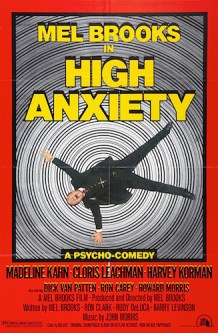
High AnxietyMel Brooks pays comedic tribute to Alfred Hitchcock — in case you can’t tell, the second credit is a prominent dedication — but those unfamiliar with the Master of Suspense’s output need not apply.

Brooks presents a largely Hitchcockian plot, though the clearest references come in a couple of sketches and one-liners. To be fair, there are several significant Hitchcock films I’ve still not seen, leaving the nagging sensation that some allusions and gags simply passed me by. On the other hand, maybe they just weren’t funny — I can’t remember many laughs that didn’t spring from a Hitchcock reference of some kind.

Indeed, whole chunks pass by without a laugh. At other times, bits that are clearly meant to be funny just don’t hit home (though I’m aware that, inevitably, they will for some people), while some gags are almost reassuringly familiar: a dramatic piece of music kicks in, causing characters to look around until they see a band in full swing has appeared nearby, for just one example.

Things pick up considerably in the second half, which is also more obviously Hitchcockian to my mind. Some scenes offer very good, though specific, riffs on famous Hitchcock moments — a version of Psycho’s shower scene is particularly memorable, though a scatological take on The Birds will please some — but these are almost exclusively asides to the story, little sketches inserted wherever Brooks can find space to squeeze them in. They provide welcome amusement, but are far from integrated into the plot.

At this point I’m beginning to suspect Brooks’ humour just doesn’t gel with me. I enjoyed Spaceballs when I was younger, but watching it a couple of years ago I found it more embarrassing than entertaining. Even the widely praised Blazing Saddles raised little more than the occasional smile. High Anxiety, unfortunately, now joins this line-up.

2 out of 5

Alone in the Dark (2005)

2009 #69
Uwe Boll | 94 mins | TV | 18 / R

Alone in the DarkI’ve never played an Alone in the Dark game. I wanted to, when I was young and they were a widely-known cutting-edge franchise, but it was deemed too scary or adult or something like that and I wasn’t allowed. (By the time someone’s nostalgia revived the series nearly a decade later, I didn’t care.) I’ve also never seen an Uwe Boll film, though his reputation obviously precedes him. Considering the latter, having no attachment to the former is probably a benefit to assessing this — I understand that, story-wise, it bears virtually no relation — but I can’t say it helps much.

Right from the off, things don’t look good: it opens with an essay’s worth of backstory in scrolling text… which, just to rub it in, is also read out. It takes about a minute and a half. There are any number of screenwriting rules this not so much breaks as slowly and methodically grinds into sand. Some rules can be bent or broken to good effect if the writer knows what they’re doing, but others exist for damn fine reasons and breaking them just results in a lesser film. This is unquestionably the latter. There’s an almost-excuse: the text was added after test audiences said they didn’t understand the plot. But it’s not much of one. The relevant information is all revealed later in the film too, and neither manage to explain what the hell is going on. It’s not the audience’s fault they couldn’t understand the plot, it just doesn’t make sense.

Quickly, the poor quality opening is cemented with the addition of a dire voiceover narration from Christian Slater’s lead character. He addresses the audience in a chatty style that’s both irritating and incongruous, and primarily exists to continuously dump more useless info. That it disappears without a trace fairly early on is a relief, but proves how pointless and cheap it was in the first place.

And then there’s an action sequence, which defies logic in every respect. The editing mucks up continuity, the good guys turn into a dead-end marketplace for no reason — other than it provides a handily enclosed location for the ensuing fist fight — the bad guy rams cars, scales buildings and jumps through windows, also for no reason, and the fight seems to consist of a punch followed by some slow motion standing around (yes, it’s the standing around that’s in slow motion) repeated too often, interspersed with the occasional ‘cool’ move or shot. On the bright side, there’s one sub-Matrix, Wanted-esque shot of a bullet-time close-up as Carnby fires at the bad guy through a block of ice, which in itself is passably entertaining. You’ll note, of course, that that’s one good shot. One. Shot.

I could go through every scene in the film describing what’s wrong in this way, but no one wants to suffer that. Suffice to say it only gets worse — none of the initial flaws improve, but are compounded by more weak performances (Tara Reid as some kind of scientist?) and the story entirely vacating proceedings. Before halfway I gave up following the plot — after all, why try to follow something that makes no sense in the first place — and just hoped it could pull out some interesting or exciting sequences. But the horror sequences have no tension and the fights no coherence. One action sequence, which begins entirely out of the blue, sees soldiers shooting at beast-thingies in the dark, lit only by muzzle flashes, set to a thumping metal soundtrack. It probably seemed innovative when conceived, but instead is laughable for all the wrong reasons. Like the rest of the film.

Sadly, none of it’s laughable in a charming way — this is not So Bad It’s Good territory. Take the moment where the good guys arrive at an abandoned gold mine that’s actually the villain’s Super Secret Lair. They bring a whole army’s worth of heavily armed marines. Commander blokey insists it’s nothing like enough men… and then proceeds to enter the mine with just half a dozen of them. If there was no budget for more it might be funny, but the rest stay up top to be slaughtered by some Primeval-quality CGI. Even the ending, supposed to be ambiguous apparently, is just a meaningless cop-out that makes absolutely no sense. Like the rest of the film.

Sometimes I feel sorry for Christian Slater. He always seems a nice guy in interviews, yet this kind of drivel is all the work he can get. At the time of writing it’s the 82nd worst film of all time on IMDb (according to its own page, though not that chart). While this is the kind of status that’s often an overreaction (the number of people on IMDb declaring various films are “the worst film ever” suggests most of them have been fortunate enough to never see a truly bad movie), for once it’s justified: Alone in the Dark is irredeemably atrocious.

1 out of 5

If you want to subject yourself to Alone in the Dark, ITV4 are showing it tonight at 11pm.

Alone in the Dark featured on my list of The Five Worst Films I Saw in 2009, which can be read in full here.

The Apartment (1960)

2009 #36
Billy Wilder | 125 mins | download | PG

The ApartmentAn article I once read (but have long since misplaced, unfortunately) asserted that Billy Wilder once said (and I paraphrase heavily here, I’m sure) that, contrary to expectations, when he was feeling happy he’d make a serious picture, and when feeling down he’d make a comedy. Goodness only knows what kind of mood he was in when he chose to make The Apartment, then, because it flits between the two with gay abandon.
It begins almost as a farce, with Jack Lemmon playing up the near-misses inherent in lending your apartment to adulterous men; and though this comedic vein never goes away, the film also develops a dark side. Alongside the affairs and underhand dealings — in which our hero is closely involved — there’s an attempted overdose, discussion of other suicide methods, and respectable men getting divorced. It all seems quite shocking for a film made under the Hays Code, though that was on its last legs (Wilder’s own Some Like It Hot had been released without code approval the year before and still been a huge hit), and Mad Men and its ilk suggest such goings-on by businessmen may not have been so surprising to contemporary viewers either.

On the technical side, Wilder employs long scenes and long takes, but Lemmon never stops bustling through them, always doing something, keeping the film active and moving even when Wilder declines to follow. It’s the latter that makes the former so effective, rendering Lemmon’s character the odd one in an otherwise static world, the one still turning to humour in the face of all life’s bleakness.

Real life always serves up humour alongside tragedy, yet despite that it takes skilled filmmakers to do the same without one lessening the other. Wilder and Lemmon are, of course, among them, and one can imagine few finer examples of such a blend than The Apartment.

5 out of 5

Stranger on the Third Floor (1940)

2009 #55
Boris Ingster | 64 mins | TV

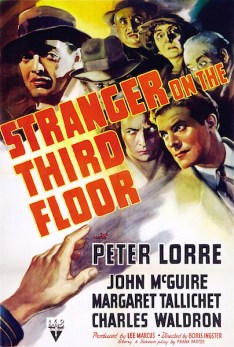
Stranger on the Third FloorDespite being “released the same month as Raoul Walsh’s They Drive By Night, and four months after Alfred Hitchcock’s Gothic Noir Rebecca,” says Paul Duncan in The Pocket Essential Film Noir, “this is often listed as the first Film Noir”. Not often enough to earn the treatment you’d expect such an accolade to afford, it would seem, as I hear it’s rarely screened and only available on DVD in Spain. That’s a shame, because it’s an entertaining — if brief — example of the genre.

The story is a morality tale of sorts. A journalist is the key witness to convict a man of murder, albeit on fairly circumstantial evidence; the journalist’s fiancee disagrees with what he did, though he tries to persuade her round to his way of thinking; but then the journalist finds himself in virtually the same situation, and it’s up to the fiancee to prove his innocence. And that’s most of the plot I’m afraid, though to be frank it’s fairly ancillary anyway.

The screenplay is a little slight and stretches its credibility — would a man really be convicted on such circumstantial evidence, for example? It plays structural tricks too: at one point the lead character is arrested off screen and the focus switches to his fiancee for the remainder of the film. Perhaps they didn’t have the money left for a cell set. Such leaps suggest an underdeveloped story, but on the bright side it certainly keeps things moving.

Despite these faults, many individual scenes are rather good. The journalist spends half the film pacing his room, for example, contemplating whether his irritating neighbour is dead or not, but it remains gripping. When he sleeps he has a nightmare, a showcase not only for the expressionist-influenced cinematography, but also the writing: the opening trial scene features a humourously inattentive judge and sleepy jury, but the exact same elements return to haunt our hero when he dreams he’s in the dock.

The climax is virtually the only scene to feature top-billed Peter Lorre to any significant degree, here fulfilling a couple of days left on his RKO contract with a small role. Nonetheless, in this one scene he out-acts the rest of the cast put together, using just a few lines of backstory to really flesh out his underwritten character. The sequence where the fiancee tries to escape him is suitably sinister. Still, the scene is over quickly and without the fullest logic in its execution — much like the film as a whole.

Stranger on the Third Floor is so imbued with the recognisable calling cards of noir in its cinematography, characters and plot points that it feels more like an entry in a well-established genre than a formative inclusion. At only just over an hour it is, on the one hand, too brief to dig into its characters or complicate its story, but on the other, it rattles past quickly enough that the good bits impress, the weak bits are only briefly registered, and it’s over long before anyone might even consider considering it a waste of time.

4 out of 5

Babel (2006)

2009 #41
Alejandro González Iñárritu | 138 mins | TV (HD) | 15 / R

BabelMulti Oscar nominated and one of Ebert’s Great Movies, Babel is one of those films that comes with a lot of expectation riding on it. The fact that the only Iñárritu film I’ve previously seen is 21 Grams, which I thought was distinctly overrated, takes the shine off those expectations. Probably for the best.

The quickest way to assess Babel is to say that it is about something — or, About Something. The plots, such as they are, aren’t really the point; nor is how they connect, or what chronology they actually occurred in — this isn’t a Memento or a Rashomon, a narrative in odd pieces designed to be reconstructed by the viewer. Naturally, because it is About Something, the Something it is About isn’t made blindingly clear, though there are many contenders — loneliness, miscommunication, culture clashes, the ripple effect, children, and on. Perhaps this means it isn’t as focused as it could (or should?) be; perhaps Iñárritu revels in ambiguity, which isn’t necessarily a problem.

On a relatively surface level, then: the Japanese story barely connects to the others, which are all more directly woven together. Even if their connectedness isn’t the point, when the others are so clearly and directly related it leaves the Japanese thread feeling the odd one out, almost tacked on to the others. It’s probably a coincidence that it’s also the film’s best story, containing about as much incident and interest as the other three put together.

The central character in that particular thread is portrayed by Rinko Kikuchi, who justly earnt a Best Supporting Actress Oscar nomination for her work. The film’s only other Oscar acting nomination went to Adriana Barraza, in the same category, for her role as a Mexican nanny. Again, a deserved nod, as these are easily the two most compelling performances in Babel. (They lost to Jennifer Hudson in Dreamgirls. I’ve not seen Dreamgirls, but as the other nominees were Abigail Breslin (for Little Miss Sunshine) and Cate Blanchett (for Notes on a Scandal), I’m willing to bet she was the least deserving of all five.)

If the Japanese thread is the best then Brad Pitt and Cate Blanchett’s story is the weakest of the bunch, managing to underuse both those leads and a host of British talent too. The other two stories are equally slight, but at least muster up some genuine emotion.

Babel is the kind of film that it’s easy to overrate because, ooh, doesn’t it seem clever. Conversely, it’s easy to underrate because, ooh, doesn’t it seem pretentious. Naturally, therefore, I’m going to come down right in the middle (but note that the Japanese story on its lonesome would earn a 4).

3 out of 5

Eastern Promises (2007)

2009 #32
David Cronenberg | 97 mins | DVD | 18 / R

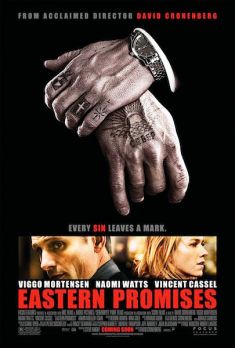
Eastern PromisesArguably most famous for his horror films of the ’80s (though a couple of his ’90s efforts could stake a claim), director David Cronenberg widened his appeal somewhat with the excellent crime thriller A History of Violence. Here he reunites with star Viggo Mortensen for another grim tale, switching the bright searing heat of the American Midwest for the rain-drenched nighttime streets of our fair capital.

Despite some similarities in plot and theme, Eastern Promises failed to engage me in the same way as the earlier effort. Perhaps this is because it plays tag with its central character, beginning with Naomi Watts’ do-gooder nurse before shifting focus to Mortensen’s mafia chauffeur with nary a blink. It’s an unusual transition, and consequently it’s hard to tell whether it’s skillful writing or a fortuitous accident that it comes off seamlessly. One theoretical screenwriting argument would have it that the film is actually all about Christine, the baby, and that’s why it works, but that feels a little too pretentious to engage with now.

Tied around the baby’s fate, screenwriter Steven Knight factors in some appropriately dark elements, like white slavery or the relocated criminal underworld that currently operates in the UK. Though these are handled with a certain amount of care, they’ve been covered in greater depth elsewhere (the excellent miniseries Sex Traffic, for example) and here are reduced to pawns in a different tale. This isn’t necessarily inappropriate, but remembering the detail from other such dramas can leave the topics’ inclusion here feeling lightweight.

Elsewhere, the screenplay suffers from some awkward dialogue exchanges and barely credible logic contrivances being used to jump-start the plot. Most of these come from Watts’ character, who seems too competent for much of the film to pass off as a naïve fool at its start. This may be Watts’ fault, playing her as intelligent when a naïve approach might render her actions more believable, but it seems cruel to lay the blame with her as she’s very strong all round. Armin Mueller-Stahl also gives his typically accomplished turn in his typically key supporting role.

Mortensen’s Oscar-nominated performance is the focus, however. Apparently thoroughly immersed in the role, he gives a distinguished performance throughout and is central to what are by far the film’s most memorable moments: a nude steam baths fight, which has become justifiably infamous (I suspect for the “nude” part, but it’s the “fight” that deserves it), and a game-changing twist, that I sadly had ruined in advance, though there are plenty of clues scattered along the way.

By its end, Eastern Promises has the feel of the first part of something bigger: while the story of the baby is resolved, many others are left open. Unresolved threads aren’t always a problem, but it feels like Cronenberg has more to say in this world. So it’s nice to know a sequel is possibly in the works, because Eastern Promises has the potential to be a Hobbit to some Russian mafia epic’s Lord of the Rings. On the other hand, a similarly low-key follow-up would be just as appropriate.

Though it failed to capture me as much as A History of Violence, possibly due to too-raised expectations, Eastern Promises has the potential to grow with repeated viewings. And either type of continuation would be most welcome.

4 out of 5

Unfortunately, plans for a sequel ultimately fell apart in 2012. Some more details can be read here.