Ultimate Avengers (2006)

2008 #82
Curt Geda & Steven E. Gordon | 68 mins | DVD | PG / PG-13
Ultimate AvengersWith the big-screen live-action Avengers movie on its way in just two-and-a-half years — once we’ve had a variety of tie-ins to lead into it, of course — now seemed as good a time as any to check out this direct-to-DVD animated version (and its sequel).

I won’t say too much about the plot because, if the rumours are true, the live action film may follow it fairly closely — indeed, the first 15 minutes of Ultimate Avengers presents a roll call of elements already introduced in this summer’s Iron Man and The Incredible Hulk: the Avengers Initiative, a super solider serum, a black Nick Fury, Captain America frozen in ice (OK, so that was only in a deleted scene…) But to follow this story wouldn’t necessarily be a bad thing… as long as there were some tweaks.

The primary problem is balance. Ultimate Avengers spends the entire first half assembling the team, the story crawling along at a snail’s pace; consequently, there’s nothing like enough time to do the remaining plot justice, leaving much of it to feel rushed. However, the tale itself retains an appropriately comic-book feel — no surprise considering it’s adapted from a specific storyline — while still containing just about enough information to keep newcomers covered. Were it properly paced, and bolstered by the main characters being introduced in their own films, there’s no real reason this wouldn’t suffice in live action.

On the other hand, in its current incarnation it’s very much Captain America’s story — possibly a problem for the 2011 version, as it will follow Cap’s debut feature by just two months. If his solo outing isn’t a success — particularly if whoever plays him is no good — it would likely sink an Avengers movie that was as focused on him as this. Not encumbered with such problems here it works fine, though it’s disappointing how little we see of other major players — Tony Stark/Iron Man barely features and there’s even less of Thor. That said, Bruce Banner/Hulk gets a key subplot which could be even better if fully developed.

Dodging further predictive comparisons for a moment, the animation quality is variable. Some is very good — mainly the opening World War II-set action sequence — but most is no better than you’d expect from a kid’s TV cartoon (unless they’ve got even worse recently). It does the job adequately, but there’s little exemplary. If there’s a theme emerging it’s this: promise is shown, but not fully realised. That’s not the fault of the medium of course, but rather the brief running time and unbalanced structure.

When the live-action Avengers reaches our screens, I suspect this animated outing will be of greater interest — an intriguing point of comparison between a direct-to-DVD fan-aimed version and a Summer Blockbuster mass audience version of (possibly) the same story. Of course, by that point, Ultimate Avengers will be half a decade old and no longer such a contemporary — or memorable — example.

3 out of 5

Ultimate Avengers II will be reviewed tomorrow, Tuesday 21st April 2015. Live-action sequel Avengers: Age of Ultron is in UK cinemas from Thursday 23rd.

Scenes of a Sexual Nature (2006)

2008 #88
Ed Blum | 88 mins | DVD | 15 / R

Scenes of a Sexual NatureScenes of a Sexual Nature is a half-accurate and half-misleading title for this low-budget British comedy drama. The first half is spot on — the film’s made up of seven unconnected scenes — while the second implies it’s ruder than it is.
Effectively, Scenes is seven short two-hand plays stuck together, occasionally intercut for no good reason (only one runs throughout), all on a similar theme — which, despite the title, is really “relationships” rather than “sex”. And “plays” is the right word: the styles of dialogue and acting, plus the sparsity of locations and cast members, not to mention the thematic construction, all suggest theatrical roots. In fact, so much does it seem grounded in the stage that I was thoroughly surprised to discover it wasn’t an adaptation. One wonders if writer Aschlin Ditta has perhaps launched his work into the wrong medium then; on the other hand, a stage production would never have attracted such attention or such a high number of recognisable names and faces.

Most of the scenes can be simply labelled — the Gay Couple, the Old Couple, and so on — and, unsurprisingly, some are better than others. The Gay Couple is a textbook example of how to write conflicting motivations both between a loving couple and within a single character, nicely performed by Ewan McGregor and Douglas Hodge. Consequently, it’s probably the film’s best sequence. Elsewhere, the Old Couple are quite sweet, Ditta pleasingly taking their story beyond an obvious, clichéd end point, though it is lumbered with a bench metaphor that’s a touch heavy-handed. Similarly, the Blind Date Couple is initially hilarious but doesn’t seem to know where to go, a problem that afflicts most of the film as every scene is distinctly inconclusive.

Worst is the one starring Mark Strong and Polly Walker, in which nothing at all happens in the name of a closing twist. It’s like the antithesis of the Old Couple bits. The one that stretches credibility the most, however, is the Divorcing Couple. Amicable divorces surely exist, but not that amicable — it’s very hard to believably see why they’re not still together. On the bright side, at least they’re not reunited by the scene’s end; but then, like much of the film, they’re not definitely apart either — it’s inconclusive.

Scenes of a Sexual Nature isn’t a bad film, but it is a bit of a mixed bag. Some stories work, others don’t. It’s not badly directed, but the writing and acting is all very stagey. It’s more like a collection of thematically and stylistically linked shorts than a feature in its own right. Some will no doubt take more from it than others, but I can only fall down the middle.

3 out of 5

24: Redemption (2008)

Extended Edition

2008 #86
Jon Cassar | 98 mins | DVD | 15

24: RedemptionRemember the ubiquitous Writer’s Strike in the US? It must be about a year ago now, but its effects are still being felt — Dr Horrible’s Sing-Along Blog, Joss Whedon’s rule-breaing internet musical, made during the strike, is about to hit region-free DVD in the US (albeit on DVD-R and only from Amazon.com); plenty of second-year shows are getting canned, probably because their truncated first years didn’t allow time to get decent audiences (that’s one excuse anyway); and 24’s seventh season, kicking off in January 2009, is a year late. Which allowed them to make this in the meantime.

The setup is simple: Jack Bauer’s trekking round the world, currently holed up with an ex-army buddy (played by the ever-excellent Robert Carlyle) in the African nation of Sangal where said buddy has set up a school. Yes, Jack Bauer is living a life of peace. But then Bad Men turn up wanting the kids for child soldiers, and within the hour they’re attempting a military coup — this is still 24 remember, the action all takes place “in real time”. What’s Jack to do? Why, return to his old One Man Army self, of course — if he can’t stop the coup, he sure as hell can save those kids! Meanwhile, it’s inauguration day for America’s new female (black? 24’s been there and done that — twice) President…

For a Fox action series, off screens for almost 18 months and undoubtedly designed as a starting point for new viewers, Redemption (not that that title’s seen on screen) has a surprisingly slow build up. That’s no bad thing — this is a story after all, not a 90-minute shoot-out — but there are times when one feels it should get a wriggle on. This is likely where most, if not all, of this extended version’s new material was added. There’s almost 15 minutes added to the running time here, though some is surely due to a 5-minute credit crawl that must be much longer than the TV version’s. Having not seen the broadcast edit I can’t comment on what new scenes, shots or lines are added, but there’s no greater violence or thematic density than 24 usually produces so I imagine what was cut was cut for time alone.

That said, Redemption certainly tackles its fair share of issues — primarily, the use of child soldiers, and the US involvement (or lack of) in African genocides. It’s certainly admirable and worthwhile for such a popular series to bring these important issues to the attention of a mass audience who might otherwise ignore, or at least not be aware, of them, but they’re still included in a “mainstream American action series” way — that’s to say, they’re ultimately a reason for a shoot-out. There’s also some subtle political commentary, such as the UN Peacekeeper stationed at the school being a coward who runs away at the first sign of violence… and then betrays them to boot! Of course, just because it’s unsubtle doesn’t make it wrong, but Blood Diamond this is not. Whatever the politics, the action sequences — and, once things get going, there are a few — are all carried out with 24’s usual panache.

Is this a suitable jumping-on point for newcomers? Yes, quite simply. It’s several years since the last season and Jack’s in a very new part of this life. Some old faces crop up and there are some backstory references, but these are more nods for returning fans than anything important. Everything you need to know for this story is contained herein, and fortunately that doesn’t involve great slabs of exposition about previous seasons. On the other hand, it fails as a standalone movie. While the main plot — Jack defends school — is kicked off and wrapped up in the space between the title and the credits, there are several US-based plot threads that aren’t even close to being resolved. These are clearly designed to flow on into season seven — presumably they’re either elements bumped from the early episodes up into the movie, or a fleshing out of information that would’ve just been exposition before.

It’s hard not to conclude that Redemption would’ve been better without the US scenes. They add nothing to the main action in Africa and they’re all quite flatly directed, forcibly reminding you that this is just a TV movie by being worse than most TV these days. Their one true benefit is an ending that juxtaposes the new President’s inauguration speech with the civil war beginning in Sangal, which, consciously or not, underlines the hypocrisy at the heart of America.

As a standard season-opening episode of 24, coming on the back of the weakest-yet sixth season, it may well have earned itself an extra star. Judged as a standalone film, however, I fear it has to be just

3 out of 5

Thinking “but that’s not a film”? Then please have a read of this.

The Cube Trilogy

Introduction

I watched the entire Cube trilogy in one night — boy was it a long’un.

“Three ninety minute films?”, some of you might think, “I’ve seen single films longer than that!” Yes indeed, this is true, and I’ve watched all of the extended Lord of the Rings in one day — but those are good, and the Cube sequels just aren’t.

Anyway, I’ve posted all three reviews at once — partly because things are lagging review-wise here and I want to get a wriggle on (17 days ’til 2009!) — and so here is a little summary of the trilogy, with a brief note on my thoughts on it as a whole at the end.

This is probably obvious, but in case not: click on each film’s title for the full review.


#83a
Cube
1997 | Vincenzo Natali | 87 mins | DVD | 15 / R

Cube manages to effectively juggle gruesome horror deaths, sci-fi mysteries, an awful lot of maths, and character-based drama. It’s a brilliant, low-budget, understated film [that] everyone interested in the more intelligent end of the sci-fi spectrum should see.”

5 out of 5


#84
Cube²: Hypercube
2002 | Andrzej Sekula | 90 mins | DVD | 15 / R

“The new cube set is bigger, shinier, simpler, emptier, always one plain colour, and devoid of traps. Consequently, but perhaps inadvertently, it seems to symbolise the film itself… Hypercube feels like expensive tosh based on a faux-intellectual idea.”

2 out of 5


#85
Cube Zero
2004 | Ernie Barbarash | 93 mins | DVD | 15 / R

“an entirely different setup: the people who observe the cube!… until one of them goes inside, and then we’re right back in familiar territory… Derivative and, worst of all, quite irritating.”

2 out of 5


Final Thoughts

I first saw Cube many years ago, certainly before it had any sequels, and have always thought it excellent. I picked up the trilogy DVD set a few years back, despite hearing advice that went, roughly, “never ever watch the sequels. Ever.” My God was that good advice.

The first remains a masterpiece, provided you can ignore the two sequels and their weak additions to the mythos. Try to integrate all three into the same fictional universe and you’re just going to wreck much of what’s great about the original. Watch that, love that, and pretend that was all there ever was.

Cube Zero (2004)

2008 #85
Ernie Barbarash | 93 mins | DVD | 15 / R

Cube ZeroI presume, from the title, that Cube Zero is meant to be one of them prequel things, going back before the original film to reveal more of the backstory and answer questions that probably didn’t need answering. It does some of this — there are unwelcome answers and an ending that explicitly links back round to the first film — but undermines it by apparently being set in some fantasy-future retro-industrial universe that doesn’t gel with the everydayness of the preceding entries. This design work is almost nice, reminiscent of films such as Brazil, The City of Lost Children, and even Blade Runner; but it’s all on a direct-to-DVD scale that feels oddly familiar from things I’m sure I haven’t seen. Derivative? Yes indeed.
One thing it isn’t especially derivative of — initially, anyway — is its two prequels. After the requisite gory opening, the camera pulls back to reveal an entirely different setup: the people who observe the cube! Except they’re still a small group (just two), confined to one room, with no idea about the people behind all this. They are, very literally, only one step removed… until one of them goes inside, and then we’re right back in familiar territory, except with an added outside perspective that sinks to new depths so low I don’t even want to explain them.

In the cube itself, we have the most gory deaths yet. Barbarash — here adding “director” to his list of crimes after producing and co-writing Cube² — lingers on the gruesome details, seeming to make the series bridge the gap between relatively old-style horror films and the new trend for sickening weirdness that Saw would kick off the same year. I’m sure gore-hounds will love it but, for me, Cube was never about how vile the deaths could be.

You have to admire them (albeit begrudgingly) for trying to do something different with the concept and give it some fresh spins. But, as ever, the series didn’t need those additions, and consequently it doesn’t need this sequel. It answers too many questions, which might be acceptable if the answers were remotely original or satisfying, but, of course, they aren’t: they’re derivative and, worst of all, quite irritating.

And that goes for the film too.

2 out of 5

For a brief overview of the Cube trilogy, please look here.

Cube Zero featured on my list of The Five Worst Films I Saw in 2008, which can be read in full here.

Cube²: Hypercube (2002)

2008 #84
Andrzej Sekula | 90 mins | DVD | 15 / R

Cube²: HypercubeThe new cube set is bigger, shinier, simpler, emptier, always one plain colour, and devoid of traps. Consequently, but perhaps inadvertently, it seems to symbolise the film itself.

Despite this simplified set, the concept behind the new cube — or ‘hypercube’, so we’re told — and the plot that results from it is incredibly complex. In fact, it seems to be too complex for the writers to grasp, so the viewer doesn’t stand a chance. It’s not the only overdone element either: Sekula’s direction is frequently as inappropriately elaborate as possible, twisting the camera round for no reason other than some misguided attempt at (inaccurately) conveying this cube’s mixed gravity. He also feels the need to illustrate characters’ backstories, something the original left to the dialogue, which is probably because the ragtag selection of flat stereotypes here are far more generic than the lot in the first film.

And there’s loads of them too, though it’s hard to tell if this is to cover for them all being one-dimensional, or a transparent attempt to keep things moving by constantly chucking more people into the mix. As if to underline the point, several are cloned from the first film, but with much weaker acting, and almost none of them are granted a plot thread that actually gets resolved. In fact, nearly every character is entirely pointless. Eventually some of them do get killed off, but every death is too reliant on some middling CGI and abstract ideas. Not a single one is as properly inventive or scary as those found in the original.

Hypercube should at least be applauded for trying something new, when it might have been easier to bung a new group of people into the same cube and come up with new ways of killing them or new puzzles to solve. It dives further into SF territory, dragging in parallel universes and varying timelines, and largely avoids rehashing the first film’s mysteries. In fact, it more picks up where that left off, drawing out questions and providing some answers about the reasons for, origins of, and people behind the cube. Unfortunately, these questions don’t need re-posing and the answers certainly aren’t required. Like other elements of the first film not carried over — the clever deaths, the claustrophobia — it’s nice that they’ve not been duplicated, but equally they didn’t need changing, expanding or explaining.

Even worse, the writers seem to have spent more time mulling over the behind-the-scenes complexities of constructing the cube — and put in all their characters and ideas about this — and not enough time actually crafting a plot. The more the clock ticks by the more obvious this becomes, to the extent that they don’t even seem to have an ending. What minimal logic there was is thrown out the window in favour of some crazy different-timeline horror that barely resolves anything and certainly cops out of almost everything.

Where the original Cube felt like the smart little sci-fi indie it was, Hypercube feels like expensive tosh based on a faux-intellectual idea. Much of the original’s brilliance lay in its simplicity, but the sequel is more complex from the off — and not in a way that rewards the attentive viewer, or even in a way the writers seem to understand. Bigger and shinier, but simpler and emptier, it’s consequently less engaging, less interesting, and far less enjoyable.

2 out of 5

For a brief overview of the Cube trilogy, please look here.

Cube²: Hypercube featured on my list of The Five Worst Films I Saw in 2008, which can be read in full here.

Cube (1997)

2008 #83a
Vincenzo Natali | 87 mins | DVD | 15 / R

CubeI’ve seen Cube a couple of times before, but, as I’ve watched it again immediately before taking on the two heavily-criticised sequels, I thought it might be worth throwing in my opinion on the original too.
Cube has a deceptively simple concept — a sci-fi/horror/mystery in which six strangers are trapped together trying to escape a series of cube-shaped rooms, some of which contain deadly traps — but within that it pulls a lot together. The major element, arguably, is the mystery of what the cube is — where is it, who built it, how does it work, why are those people there, is there a way out? Some of these questions are answered but, crucially, not all of them, and it’s partly due to this, ironically, that it’s a satisfying experience. In its series of careful, measured, necessary reveals, the film strikes a perfect balance between what it lets the viewer know — and the revelations are expertly paced throughout — and what it keeps hidden, either for the viewer to deduce or interpret for themselves, or simply because one doesn’t need to know.

Within the cube and its mystery there are the characters. Depending on your point of view they’re either well-drawn sketches interacting realistically in an unrealistic situation, or archetypes representing different facets of humanity, or simply chess pieces to move the clever construction — of both plot and setting — forward. At times the movie does work like a slasher-horror, picking off characters one by one, but after a few grisly deaths it rather transcends that. The scenes where characters debate and argue aren’t quite as engrossing as when they’re puzzling over the cube, but nor do they drag. Not all the performances are good — Maurice Dean Wint in particular lets the side down for much of the film — but the character arcs are never less than believable and well considered.

Cube manages to effectively juggle gruesome horror deaths, sci-fi mysteries, an awful lot of maths (don’t worry, you don’t need to understand it) and character-based drama. It’s a brilliant low-budget (not that it shows) understated film, which seems to have been somewhat forgotten these days, probably under the weight of the two widely derided and unnecessary follow-ups. But that remains for me to see. Whatever they may be like, everyone interested in the more intelligent end of the sci-fi spectrum should see Cube.

5 out of 5

For a brief overview of the Cube trilogy, please look here.

What makes a film a film?

What makes a film a film? I don’t mean “as opposed to a book”, or “as opposed to a pile of rubbish”; but rather, “as opposed to a TV special”, or different to a direct-to-DVD movie — indeed, is there a difference?

This is the sort of thing that’s bothered me for a while, mainly thanks to the Radio Times. The Radio Times’ film section frequently features reviews for things they label as “US TVM” — translation: an American TV Movie. Not everything falls into this category. The 1996 Doctor Who TV Movie (the clue’s in the title) was just listed as a TV special, as was the recent one-off episode of 24, Redemption. Why are these different to other feature-length made-for-TV one-off dramas? The former was a British co-production, perhaps, but the latter wasn’t. The latter is part of an on-going series, made between seasons, however. But then, one-off editions of other (older) series have been reviewed as “US TVM”s, so why are they different? It’s not even a hard rule in that instance, as some old series have their feature-length episodes screened as a matter of course among other repeats.

On a different tack, what about Paul Greengrass’ excellent Bloody Sunday, simultaneously screened on Channel 4 and released in cinemas? Or more recently, Ballet Shoes — just part of last year’s Christmas schedule in the UK, but it received a limited late-summer theatrical release in the US. So is that a film, or ‘just’ a TV special? Is a cinema release the key? Well, no — at least as far as the Radio Times are concerned — because Ballet Shoes wouldn’t now feature in their film review section were it repeated, while those other “US TVM”s will continue their circulation. [2015 note: A few years after I wrote this, Ballet Shoes was indeed repeated, and not listed as a film. Whenever Bloody Sunday is on, the Radio Times list it as a film.]

Is length the issue? Clearly not — look at the Basil Rathbone Sherlock Holmeses, some of which struggle to make the hour mark, a running time that Midsomer Murders or Poirot tops with every new episode.

And all this without even considering direct-to-DVD movies!

Perhaps it’s not a scientific rule-driven process, but just a “feel”? But that’s rubbish too — I’d wager 24: Redemption is at least twice as cinematic as most of the ’80s “US TVM”s awarded a proper film section review. Maybe it’s production method, then? But Redemption was produced as an individual piece, outside of the series’ production — much as a ‘proper’ 24 movie would’ve been, though surely with a smaller budget. So too was the Doctor Who TV movie, and obviously all one-off UK productions are made in a similar vein. And many of them, like Ballet Shoes, are surely just a theatrical release away from being a ‘film’ rather than a one-off TV drama, aren’t they? Perhaps it’s stylistic conventions — production company logos at the start, for example. But that seems a tad arbitrary to me, and plenty of independent films dispense with such.

Or perhaps, in this modern world, IMDb is the decider — whether it has that little “(TV)” after the title or not (it does for Ballet Shoes and 24, but not for Bloody Sunday). But then, why are the people at IMDb — and, we should remember, most of their content is user-generated anyway — any more qualified to decide than you or I?

It’s all down to the individual then, is it? Perhaps. If I declare 24: Redemption a film and review it as a numbered entry in 2008, would anyone care? But would it mean that, ‘morally’, I should go back and review Ballet Shoes as part of 2007? Or last month’s Einstein and Eddington as part of 2008? Or afford any of the countless other feature-length TV specials I’ve seen in the past two years the same treatment?

I don’t have any answers here, just more questions. I’m not going to go back and review Ballet Shoes though. Nor am I going to add Einstein and Eddington, or this Christmas’ The 39 Steps when it comes around. I may well count 24: Redemption, though [I did]. I don’t have Sky, so as far as I’m concerned it may as well be direct-to-DVD, especially in its extended DVD-exclusive form.

And direct-to-DVD movies definitely still count… don’t they?

Gasman (1997)

2008 #76a
Lynne Ramsay | 15 mins | DVD | 15

“Gritty”, “realist” and “indie” are just some of the stock terms that immediately jump to mind when watching this short, which directly enabled Ramsay to make her first feature, Ratcatcher.

Films with such words attached are not automatically to my liking, but Gasman succeeds in using the associated techniques to tell a simple story of complex emotions and meaning for the characters involved. There are times when its documentary-like style is indulgent — the opening goes on too long, for example, and some shots seem deliberately obscure — but it also relates the story effectively and produces a few beautiful views too.

Even cleverer is the use of sound: there’s virtually no dialogue, so the occasional half-heard splashes, often amongst background chatter, are all the more telling. Mostly this is in a subtle fashion, though the key phrase that reveals all is both pretty blunt (though not inordinately so) and repeated an awful lot in a very short space of time.

Gasman is not wholly successful, then, though it does have an interesting story with a strong ending, dialogue-free, that both completes the plot and leaves you wondering what happens next.

4 out of 5

This short is available on the DVD Cinema16: British Short Films, as well as the Criterion Collection and Pathe/Fox releases of Ratcatcher.

Mamma Mia! (2008)

2008 #81
Phyllida Lloyd | 104 mins | DVD | PG / PG-13

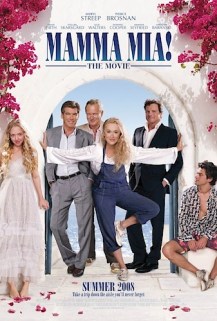
Mamma Mia!If you listen to the critics, no one liked Mamma Mia. If you listen to the public, everyone loved it. It’s the highest grossing British film of all time at the UK box office — at last count, just over £400,000 away from being the highest ever* — and was still playing on the big screen at hundreds of locations the weekend before its DVD release.

Mamma Mia! is the first feature from director Lloyd, who also directed the original stage production — and sometimes both facts show. She doesn’t always quite know what to do with the camera, the choreography is often aimed at a theoretical audience rather than the camera position (a pet peeve of mine), some shots are over-simplistic, others over-done, and there’s a bit of “point and shoot” too, missing opportunities that would be obvious to more experienced film directors. It’s never atrociously directed — at the very least, the scenery looks stunning, and is put to much good use — but it does the job and little more.

The songs themselves don’t need discussion (everyone knows what they think of Abba) but it’s worth mentioning how they’re choreographed and how they come about in story terms. Some have been brilliantly staged (Mamma Mia itself, but especially Does Your Mother Know), though others are flat and awkward (The Winner Takes It All doesn’t win anything as far as I’m concerned). Equally, some emerge naturally from the story (Chiquitita, Money Money Money), while others feel shoehorned in (again, The Winner Takes It All). For others still they seem to have just given up forcing them into the plot, leaving them to be performed by a musical act: Super Trouper, which at least is vaguely appropriate to the juncture it appears; and Waterloo, which is tacked on during the end credits, though at least is amusingly done.

The majority of the cast were clearly chosen for acting skills rather than singing ability, not that it’s done the film many favours. Pierce Brosnan was unfairly singled out by critics for poor vocals, but he’s no worse than several others. On the other hand, Julie Walters is as much of a riot as you’d expect, right from her first line, and earns the lion’s share of the laughs. For any bored male viewers, there’s always Amanda Seyfried, with her often bouncy pair of friends — played by newcomers Rachel McDowall and Ashley Lilley (why, what did you think I meant?) Every cast member is clearly having a ball, so much so that some forget to do more than read lines aloud; but it’s occasionally infectious, the frequency of infection being directly proportional to how susceptible the viewer is to this genre of music and this genre of film.

It may go without saying, but the more you like Abba the more you’ll like Mamma Mia. Conversely, the more you hate them the more you’ll hate it. (Extra stars can be added or subtracted at the end depending on which side of the fence you fall.) It’s therefore easy to see why audiences — especially British audiences — have lapped it up, while the critics have been fairly damning. On the other hand, the often clichéd first-draft-level script and occasionally ungainly first-readthrough-level performances don’t help things any. Luckily it very rarely takes itself too seriously, and consequently is often hilariously funny. Though it attempts both, it clearly works best when being a camp and cheesy comedy rather than a serious romance/family drama. One especially weak note, in my opinion, is the subplot awarded to Colin Firth’s character, who turns gay almost out of nowhere. It’s not a bad idea for a subplot, especially in a film based on Abba music (not that I’m applying any stereotypes here), but it’s poorly executed.

Mamma Mia! never aimed to please the critics, or even your regular movie-goer. Instead it sets its sights firmly on Women Of A Certain Age who can remember Abba from first time round, and students who perhaps listen to them in a more ironic way nowadays. In that sense, it’s clearly an unmitigated success. As camp as a row of tents, disliked by critics, loved by audiences: Mamma Mia! is everything you’d expect from Abba.

3 out of 5

* In the interests of fully-correct information, I feel I should point out that Mamma Mia! has now [December 28th, 2008] overtaken Titanic at the UK box office. (BBC News) ^