Did you know The Exorcist was based on a true story? I didn’t, until I watched some of the special features on the Blu-ray release. “Based on” is a bit of a stretch, to be honest. “Inspired by” would be more accurate. But you get the sense from author and screenwriter William Peter Blatty that he believes all this stuff so much that he thinks “based on” would be fine.
The Exorcist does start out very plausibly. It’s about Regan MacNeil (Linda Blair), a sweet 12-year-old kid living with her mother Chris (Ellen Burstyn) in Washington, D.C. But one day Regan begins to act oddly: delivering insults and soiling herself at a party; yelling obscenities; slapping her beloved mother; somehow causing her bed to shake uncontrollably… Doctors run tests, but they reveal nothing. The only suggestion they’ve left to give is that Regan may believe she’s possessed by an evil spirit, and that she might be tricked into believing she’s cured if the church will perform a little-known procedure called an exorcism.
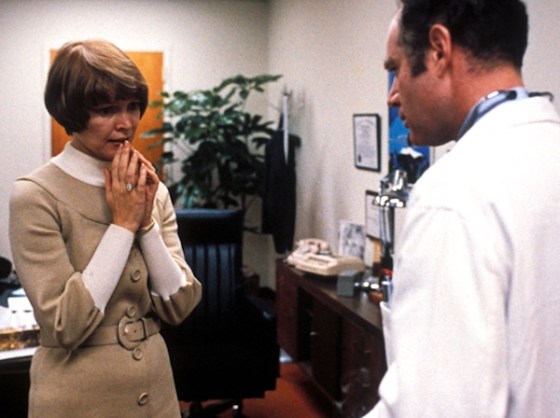
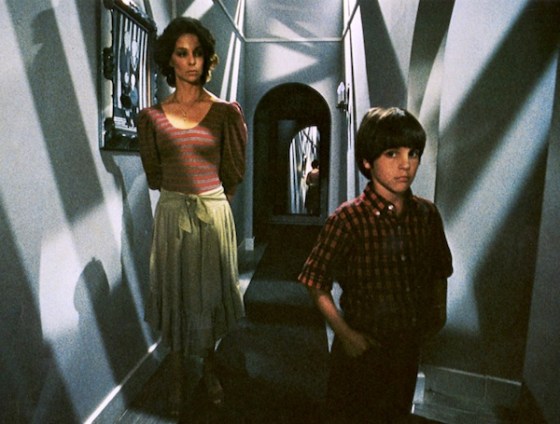
Everyone’s so busy talking about The Scary Stuff when it comes to The Exorcist, no one ever tells you how low-key and grounded a lot of it is. Okay, the talking in voices and spinning heads and vomiting green gunk and bloody crucifix masturbation are pretty memorable, so fair enough. Before that, though, it’s more of a character drama, about a single mother struggling to handle what appears to be her daughter’s out-of-control mental health problems. Meanwhile, a priest, Father Karras (Jason Miller), struggles with a crisis of faith brought on in part by his ailing mother. Naturally these two threads align when Chris calls on Karras to investigate Regan’s condition.
Another thing I’ve never heard about The Exorcist is how good Miller is. This is his film debut, before which he was a stage actor, but he delivers a very naturalistic performance as a man of the cloth who also has his head screwed on — his training in psychology keeps him suitably skeptical of what’s going on with Regan. Events conspire to challenge his point of view, of course. Karras has the clearest arc of anyone in the film, giving Miller the most scope to develop his role. I’d venture he’s the film’s most interesting character.
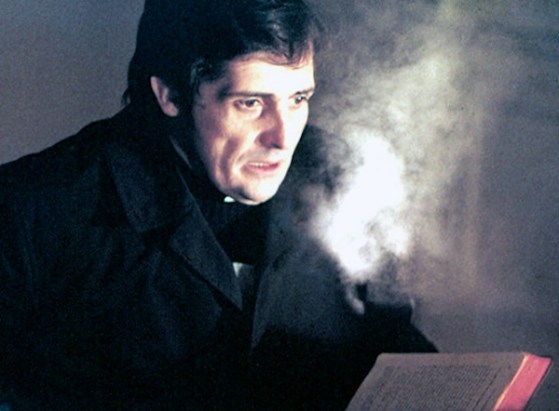
That’s not to dismiss Burstyn, who’s also excellent as the very together mom who begins to crack under the increasing strain of her daughter’s worsening, inexplicable condition. As said daughter, Blair’s performance is certainly memorable, though the potency of Regan is aided by special effects and voice work from another actress. Although second billed, Max von Sydow only pops in at the beginning and end in the titular role of Father Merrin. It’s no wonder someone later thought Merrin’s past was ripe for a prequel, because there’s a backstory there that’s only hinted at.
And no one ever says how little Tubular Bells is in it, either.
The thing people do say about The Exorcist is how scary it is. Tales of audiences fainting and running out during its initial theatrical run are the stuff of movie legend. Today its releases are branded as “the scariest film ever made”, with the justification of several polls that have named it thus. I can well believe that, in the early ’70s, it was indeed the most shocking film most people had ever seen, certainly from a major studio. The extreme bad language, the gruesome special effects, the morally depraved acts, and all of it happening to a child…
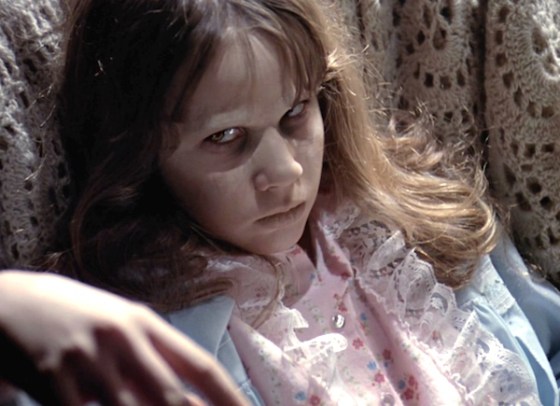
It was surely an element of sensibilities being offended (especially in America), as much as it was actual horror, that provoked such radical reactions from audiences back in the day. Nowadays we’re a bit more deadened to those things — the last 40+ years have served up plenty of elaborate gore, and potty-mouthed pre-teen girls are more likely to be found in comedies (Hit-Girl is even younger than Regan when she utters the C word in Kick-Ass, for example). I also thought it frequently undermined its own intensity by cutting away from the scary scenes to more mundane stuff. Maybe the goal was to never give those scenes an ‘out’ — we always seem to leave them when supernatural stuff is still going on — but for me it killed the momentum that was building.
That’s not to say the horrific and shocking stuff is no longer powerful. What really works in its favour is how long the film spends being grounded and plausible — most of the first hour is a ’70s social drama about a child with a mental health problem. That level of realism helps the later horror scenes be all the more effective. They quite quickly transcend the realms of the plausible (unless you’re some kind of religious fanatic, I guess), but the grounded setup lends weight to them nonetheless. The climax in particular — the actual exorcism — might just be silly without the realistic world it’s been placed in. Instead, it’s a suitably tense climax.
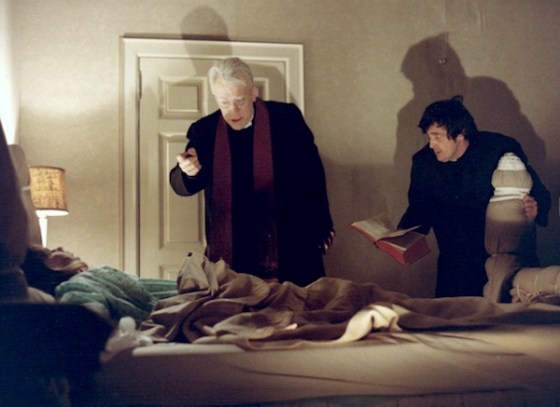
Obviously it was the extreme stuff that caught people’s attention and earnt The Exorcist a reputation that it still trades off to this day. However, I’d say it’s best regarded, not as a fright-fest, but as a film about characters: the mother who’ll do anything for her child; the priest battling with a crisis of faith. It’s a drama about real people in extreme circumstances, it’s just that these extreme circumstances happen to be horror movie fodder. In this respect it’s such a film of the ‘70s, which I mean in the best possible way.

The Exorcist was viewed as part of my Blindspot 2017 project, which you can read more about here.
* IMDb lists half a dozen other languages, but Arabic’s the only one I remember being significant enough to earn subtitles. ^




 Everyone was a bit surprised when they announced a second series of Doctor Foster. The
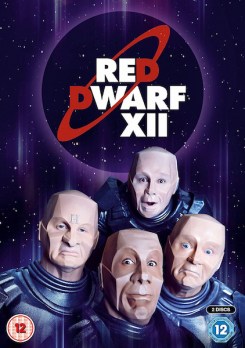 I still think of Red Dwarf as a programme that’s popped back for a bit of a revival, but I guess at this point it counts as just an ongoing show: since Dave brought it back in 2009 they’ve produced four series, half as many as the entire original run on the BBC. Give it another five or six years and they may equal, or perhaps even surpass, that number. It’s been a long time since I actually watched any of those old episodes that made the show’s name, so I can’t offer an opinion on whether the new runs are of the same quality — some say they are, some say they aren’t. Personally, I still think it’s funny overall, and (as I often say) that’s really all you need from a comedy. That said, one thing Dwarf has always done, and continues to do, is draw from actual science and science-fiction concepts to drive its plots and many of its gags. That makes it a proper sci-fi-comedy, rather than just a regular sitcom that happens to be set on a spaceship. Hurrah for that.
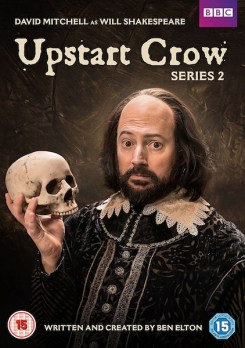 Talking of funny sitcoms, this series of Upstart Crow has been hilarious. Okay, I could do without Harry Enfield turning up as Shakespeare’s dad — almost every scene featuring him sees the humour take a turn towards the puerility of the toilet — but the rest of it is often pretty clever, riffing on Shakespearean plots and trivia. There was even a screenwriting joke in one episode that I guess would pass most people by. It also has a nice line in almost anachronistic humour, where characters comment on a fact of the day that is actually a commentary on modern life. It’s not subtle, and perhaps writer Ben Elton returns to that comedy well too often, but it’s always funny. And as I often say…
 It’s funny coming to The Thick of It for the first time now. It was so cutting-edge when it aired, and yet politics has got so much barmier since — these specials debuted a whole decade ago now, when the idea that Trump might be President was the kind of thing no one but sitcom gag writers thought about. That’s not to say the show’s lost any of its bite, just that it’s not as timely as it once was. These two hour-long specials, The Rise of the Nutters and Spinners and Losers (plus 15-minute bonus episode Opposition Extra, which follows some characters from Rise of the Nutters during the events of Spinners and Losers), set their satirical sights on the transition of power from Tony Blair to Gordon Brown. Don’t worry if you don’t remember that — there’s no reading up required, because The Thick of It is a fiction loosely inspired by real political events, rather than a straight riff on reality. It’s every inch the 21st century’s answer to Yes Minister in that respect. Although there’s an ensemble cast, all of whom are very amusing, the unmistakable star is Peter Capaldi’s Malcolm Tucker. With a regime change in the offing, Tucker risks being thrown out as part of the old guard, and so is on the back foot trying to manipulate things to his advantage. After three seasons of Capaldi as the Doctor, witnessing him here use his brain to run rings around other people to get the result he desires now feels like watching a somewhat evil — and much swearier — version of everyone’s favourite Time Lord.
 This month, I have mostly been missing The Gifted, the new TV show set definitively in the X-Men universe — unlike the last one, Legion, which apparently wasn’t. As you might infer from that use of “apparently”, I still haven’t got round to Legion either. I also haven’t seen the other new Marvel Comics-related show, Inhumans, which is part of the MCU. After the terrible reviews it’s received, I’m not sure I’ll bother.