2009 #81
Sally Potter | 98 mins | streaming | 15
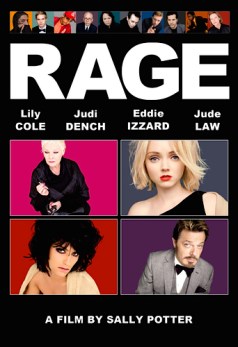 I really didn’t expect to like this: a series of straight-to-camera monologues, performed in front of just plain-coloured backgrounds, about the fashion industry, written and directed by the writer/director of Orlando, which I thoroughly disliked. But I watched because it was going free and, despite the concept’s innate pretentiousness, it’s an intriguing one. Once Rage settled into its stride (or, perhaps, I settled into its stride), however, I loved it.
The group of fourteen people who appear before the camera are almost entirely self-centred and/or not very nice, which you may guess from the outset considering their industry, though almost all still have something to reveal as the film progresses. It’s surprisingly funny too. The off-screen action is conveyed by a very effective sound mix — we see nothing but talking heads (until an incongruous final shot, at least), but there’s always background noise, however subtle, and the key action in the wider world is revealed to the viewer through this, plus comments from some of the talking heads. But time isn’t wasted spelling out what we can’t see; instead, a bit of the viewer’s own imagination is required in addition to the sound and dialogue clues to create a version of events.
A starry cast (Steve Buscemi, Lily Cole, Judi Dench, Eddie Izzard, Jude Law, John Leguizamo, David Oyelowo, Dianne Wiest… plus recognisable (depending on what you’ve seen, of course) faces like Simon Abkarian, Bob Balaban and Babel’s Adriana Barraza.) provide exemplary acting across the board, even if some of the accents (mainly Brits playing at yanks) are frequently dubious. It seems unfair to pick anyone out, but Lily Cole is perhaps the most surprising, her fragile character aided by her Pipling-esque eyes and pale skin, but it’s her actual performance that ultimately delivers more than her autobiographical-seeming first appearance would suggest. And one can’t ignore Jude Law playing a Russian/American female(?) fashion model — for once I actually thought he was quite good. Maybe this is his niche. The majority of the performances err toward the theatrical — something certain film viewers seem to struggle with — though the intercutting and passage of time, reflected in intertitles and costume changes, make the whole experience more suited to film; indeed, with the cameraperson being such a major character (as it turns out), it is technically unstageable. (It could be staged, of course, but it belongs as a film.)
And, talking of how things turns out, the most intriguing character of all is Michelangelo, the cameraman and only main character we never see on screen — indeed, it’s a considerable amount of time before we realise he’s a character at all and not just a filmmaking conceit. His presence and the filming style (supposedly shot on a mobile phone (or, I suppose, ‘cell phone’) camera) is not just a gimmick, but, as it turns out, vital to the story. It’s probably the only film ever made that perhaps works better viewed streaming online. All the characters are in some way unveiled throughout the film, but, almost without the viewer releasing it, so too is our supposedly-inconspicuous cameraman. By the end, what seemed to be a critique of the fashion industry — and a well-worn one at that — has something else to say too.
At least, one hopes this ‘critique’ of the fashion industry isn’t the main point, because it may be the film’s biggest problem. There’s very little, if anything, new to be found in the comments and criticisms made — we well know it’s a business filled with too-thin weight-obsessed diva-ish models, self-obsessed pretentious designers, money-grabbing moral-less Murdoch-alikes and no-hope fame-hungry wannabes, and Rage doesn’t have much more to say about it than this. Sure, no one sits around pontificating on why it’s all so evil, but it doesn’t take much to see the subtext. At least it’s often funny about it; though based on comments I’ve read online, it seems this humour may be too subtle for some. Perhaps they can’t see the inherent ludicrousness of it all, with the performances flying closer to realist than the My Family-level bluntness some require from their comedy.
It’s hard going at times, even if one is enjoying it — after all, it’s still just a succession of people talking to camera. Obviously what they say — and, indeed, don’t say — reveals things about themselves, others, and events off screen, but while I was never bored there were several occasions when my eyes strayed to the clock out of curiosity over how long was left. I’ve still seen much duller films.
I don’t doubt that Rage isn’t for everyone. Indeed, you only have to look at IMDb to see how many people loathe it with near-religious fervour. (Prepare yourself if you do, because some of the criticism is irritatingly brain dead. But hey, that’s IMDb!) Some people just won’t get on with its style, or find it too slow, and with 14 characters in 98 minutes, awarding them an average of under seven minutes each, you’re not going to get Alan Bennett-level character deconstruction. But Rage unapologetically is what it is, and I liked it.
If you’re interested in an in-depth (and spoiler-filled) review of Rage which features phrases like “extraordinary testament to the mindbrain”, “Mugel and Potter use sound to build an entire lifeworld”, and “it enlivens, emboldens and enriches the film, engaging ear, heart, mind, memory, intelligence, even skin and senses as a brilliant texture”, try this one from Little White Lies.
Rage placed 10th on my list of The Ten Best Films I Saw For the First Time in 2009, which can be read in full here.


 Before Sky Captain, there was this: a six-minute reel, shot, edited and, er, special-effects-ed, by Conran on an amateur basis over four years, demonstrating the production techniques and storyline he had in mind for a feature-length homage / reimagining of ’40s cinema serials.
 Of late I’ve posted
  abound, from the comic asides with Didier to Will’s fertile imagination realised through animation, or the post-credits snippet of dialogue.
 but realise the error of their ways to come back together in the nick of time) and the lessons learnt are hardly new (true friendship can conquer all), but it’s all put together with immense joy and skill, built around a charming concept, that it becomes far more than the sum of its parts.
 When I saw No Country for Old Men, a new round of films were vying for the Best Picture Oscar. Now, as I finally post my review, a whole new load have been nominated, voted on, and await the final result. Sometimes I feel decidedly behind the times.
 I used to consider myself a fan of Paul Thomas Anderson; however, I’ve come to the conclusion that I’m merely a fan of the film
 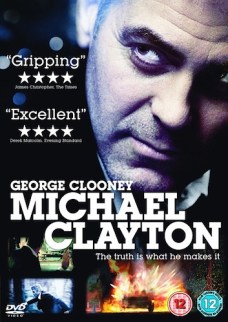 When Michael Clayton turned up among the contenders for 2008’s Best Picture Oscar I was a little surprised, because as far as I could recall I’d never heard of it. Then as I read about it a memory came floating back… a memory of a half-page (at best) review in Empire, of a George Clooney film that sounded like it should be good but was, they asserted, only worthy of three stars. As you’ve surely guessed, when I dug out this review it was indeed of Michael Clayton.
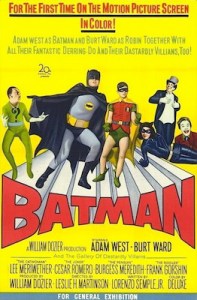 Having only recently subjected myself to the full horror of
  “The paths of glory lead but to the grave,” wrote Thomas Gray, and Stanley Kubrick — adapting from the novel by Humphrey Cobb — sets about proving him right.
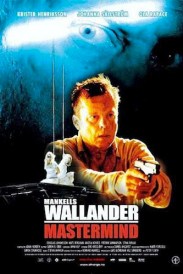 Sixth in the series of Wallander films starring Krister Henriksson as the titular Swedish detective, though only the second to be released theatrically.
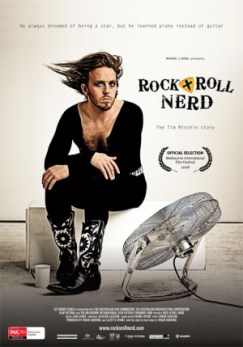 I don’t usually bother with plot summaries at the start of my reviews, working on the assumption most readers will know (or know of) the film and so don’t really need one. My assumption here is that most won’t have even heard of this film, though.
 TV appearances, offers from Hollywood and the West End, the best management in the business and a gig at Albert Hall.” Not what either Minchin or Skirving had expected, that’s for certain!
 aren’t boastful or immodest, the viewer privy to how his hopes were unrealistically raised in spite of himself.
 and it may be they wouldn’t engage with this film because of it. However, some stories are capable of transcending one’s feelings about the subject covered, and Rock n Roll Nerd may just be one of those: even if you don’t enjoy Minchin’s songs, or indeed comedy music in general, the tale of his success — and what it’s like for an ordinary person to live through such a thing — is a story whose unique interest extends beyond fans-only territory.
 100Films.co.uk