

Andrei Tarkovsky | 159 mins | TV | PG / PG
 I don’t know if you’re aware of a website, dear reader, called iCheckMovies.com? It’s one of those (many, I believe) sites where you can tick off which movies you’ve seen — in this case, not just any movie (though that’s changing ‘soon’), but movies from certain well-known lists. Well, it used to be just well-known(-ish) lists, but it’s constantly broadening its horizons and… Anyway. My point is this: some movies only crop up on one list (lots of the Shorts, for instance), while others manage two or three or four, but (as you’d no doubt expect) some crop up on loads. It’s a handy way to see that, too.
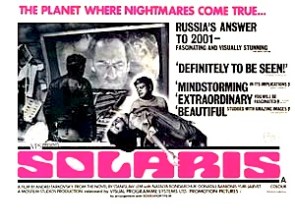
Solaris, for instance, is on IMDb’s list of the best sci-fi films (#39) and films from the ’70s (#43); it’s on They Shoot Pictures…’s 1,000 Greatest Films (#227), Empire’s 500 Greatest Movies (#285), 10th on Total Sci-Fi’s 100 Greatest Sci-Fi Movies, 53rd on Arts and Faith’s 100 Spiritually Significant Films, and included in Roger Ebert’s Great Movies; not to mention half a dozen other general greatest/must-see lists featured on iCheckMovies.
What does all that matter? Not a great deal, I suppose — film appreciation is subjective ‘n’ all — but it does leave it with a weight of expectation. 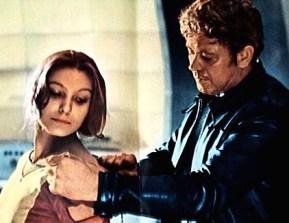 The fact that it’s the better part of three hours long, in Russian, and notoriously slow-paced, adds a different kind of weight. It’s quite easy to see how Soderbergh felt able to remake it into just 90 minutes (and he still made a slow-paced film).
And it’s true, parts are like an endurance test — Berton’s seemingly endless drive through a future cityscape (actually just ’70s Tokyo), for instance — but, though still glacially paced, most of the film has some discernibly relevant content. Provided you’re not expecting Star Wars, that is, but who in their right mind would be? Talking of things being discernibly relevant, the film occasionally switches into black & white for no reason I can readily discern. Explanations welcome in the comments.
Though ostensibly science fiction — it’s set on a space station orbiting a possibly sentient planet that’s doing Funny Things to the crew — Solaris isn’t concerned with the scientific implications of any of its concepts. While I’m going to come up short on providing detailed analysis, it seems to me Tarkovsky’s adaptation is more concerned with memory, loss, grief and what it means to be human/alive. The planet, which somehow creates tangible people — not mere shared hallucinations — from the memories of the crew, is used as a way in to these things Tarkovsky clearly wishes to consider. The sentient(?) planet is not an end in itself; the film spends no time considering what this different kind of consciousness (if it is a consciousness) means, 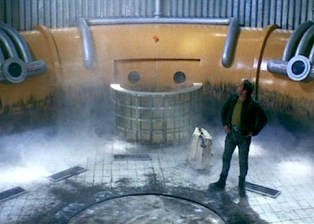 how it might work, or any other scientifically-bent notions that other films or filmmakers might choose to focus on. It also doesn’t centre on the romantic side of events, the route Soderbergh chose to pursue; or, if it does, it does so coldly and clinically and doesn’t feel romantic in the slightest. Alternatively, that could be the point.
Solaris is one of those films I think we can safely say is Not For Everyone. There’s much to ponder for the so inclined, not least the intriguing ending. I feel certain I, much like the scientists in the film itself, have barely scratched the surface.

Read my considerably more thoughtful (if I do say so myself) review of Steven Soderbergh’s remake here.
 Robin Williams surprised everyone when he started appearing in films as a serious actor in the early ’00s. Previously — and, if you’ve seen him on chat show in recent years, still — an outrageous funnyman, Williams turned in excellent straight performances in the likes of
  Still, Robin Williams is excellent, once again displaying his recently-found gift for serious acting. His character’s homosexuality is nicely handled too. It seems to have overshadowed the rest of the film for some viewers, but I’m confused as to why. Perhaps precisely because it doesn’t come out screaming “look, look, he’s gay! Isn’t that edgy!”, leaving it as just a fact of his character — and one that’s only important because his personal life is part of the story — means some viewers are so shocked by their own realisation of his sexual orientation that it gets in the way for them.
 this “but it happened!” logic seems to allow the filmmakers to get away with not offering adequate explanation. Then again (not sure how many “other hand”s I’m on now), it’s just like real-life: sometimes things can’t be explained in a rational way. Some people will have a problem with that from their films; sometimes I’m among them, but in this instance I think there are enough explanations and ambiguities. My problem was more that getting to them seemed to provide nothing, particularly as, being twist-free, they only confirmed one of the options that had been supposed an hour earlier.
 Do you need me to tell you how great Beauty and the Beast is? I imagine not. If you’ve seen it, you’ll know. If you haven’t, you really should, and then you’ll know.
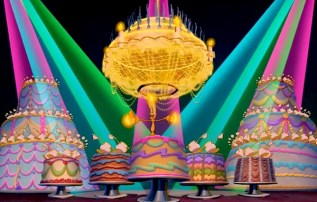 It’s not a bad song — not at all — but it’s a notch below the others. (There are a few more changes to the film than just adding the song, listed
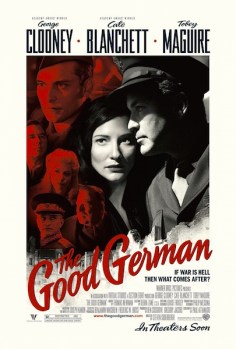
 the visual, audio, acting and plot styles of the era, why not ensure the dialogue and action follow suit? There’s no need for the violence, sex and swearing in this particular tale; at least, no need for it in a way that couldn’t be conveyed as effectively using Production Code-friendly methods. I’m uncertain if I like the film less for failing on this measure, but it does add to its inherent oddness.
 But how much do we get to know them, really? It’s easy to see why critics said “not very well”, because they’re too busy uncovering the conspiracies and revealing their part to actually show us much about themselves. But then why should that be a problem? It’s a noir thriller, not a character drama. Surely it’s about the mysteries and, if you like, the themes, rather than letting us understand the people caught up in them?
 production intentions rather than being invented to slot into them — provides meat on the stylistic bones.
 Nicholas Hytner’s film of Alan Bennett’s play, about a group of unlikely ’80s grammar school boys trying out for Oxbridge, sticks with a Bennett screenplay and the original West End/Broadway cast. However, it succeeds in not being very stagey — to the credit of Bennett’s screen adaptation and Hytner’s direction, I should imagine.
 I said it wasn’t stagey. That’s not entirely true: the exception is the finale, which in both execution and dialogue feels incredibly Theatrical. But it’s a nice idea — much better than a half dozen “what happened next” screens of text — and I wouldn’t want to lose something so effective. It also succinctly reminds us that, though this story is over, lives go on.
 Post
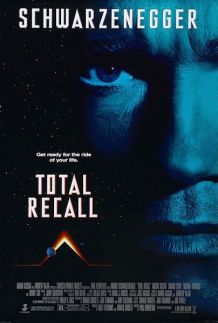
Post  depending on your point of view, either supports the “it was all a dream” reading or is just a case of artistic licence, hardly uncommon in SF cinema.
 Perhaps it’s ultimately destined for an afterlife as a film representative of its era; the kind of thing that comes up as a footnote or personal favourite in texts & documentaries specifically discussing things like The Sci-fi Cinema of the ’90s. Or perhaps I’m doing it a disservice. We shouldn’t really try to predict these things too much, it’ll only lead to embarrassment when the opposite happens.
 #112
#112 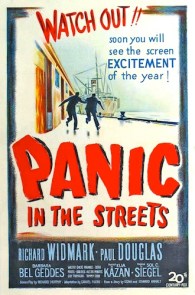 Film noir is a pretty unspecific genre, or unconscious movement, only really defined (however loosely) once it was already over. So to say a film noir isn’t particularly film noir-y might seem a tad daft, but, Panic in the Streets isn’t a particularly film noir-y film noir.
 has a beautifully bad-guy-friendly skull-like face, with his jutting cheek bones and flat-ended nose. (I imagine I’m far from the first to make this observation, but hush.)
 The world, so they say (and by “they” I mean “absolutely no one” — I’m making this up), is divided into three sorts of people: those who love
 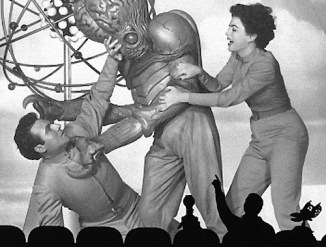 Anyway, the gang set their sights on one film per episode — or, in this feature film, one film per film. They’re being forced to watch these movies, for various unimportant reasons, and every once in a while we get comedic ‘host segments’, where they get up to hijinks on their space station (I forgot to mention, they live on a space station). These bits are well-meaning and quite funny — and in this big screen outing have been shot with a suitably filmic gloss that the video-shot TV episodes lack, which adds a surprising magnitude to the still-small-and-cheap sets and props — but the real meat of the humour is in the riffing over the film.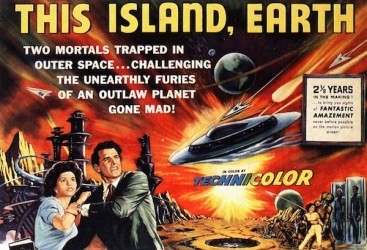
 when you’re in the mindset to take the piss out of the film. That is, if you get on with the characters (as it were) and sync with their sense of humour; if you dislike them or their humour, or like whatever they’re watching too much, then it’s probably more like some irritating yobs nattering away over something you’d quite like to watch thank you very much. (Equally, if you embark on this intending to watch This Island Earth, more fool you.)
 Alternate histories are always fun, and nothing seems to have provoked more than the Second World War. Which, as a defining event in modern history for a good chunk of the world, is understandable. It Happened Here is perhaps one of the earliest examples, depicting a 1940s Britain under Nazi occupation.
 namely, the quiet but methodical enacting of The Final Solution in an occupied territory. The whole film builds to this point, gradually showing the darker and deeper levels of cooperation — which starts out almost harmless and ends with organised mass murder — meaning it never feels like Brownlow and Mollo are pushing an agenda too hard, but still confront us with the reality: that we’d probably succumb too, and this is where we’d end up.
 Another controversy arose over the villains being British collaborators — few German Nazis are seen — and the ease with which many agreed. But this is based in the facts of what occurred in other occupied territories; maybe Britain’s plucky spirit would’ve shown through, as many like to believe, or maybe many would have caved for the easier life — or, indeed, life at all. The film is examining several perspectives of occupation, and using the fictional context to good effect: this could have happened, the film says, however much we like to believe we wouldn’t have collaborated like (and/or resisted better than), say, the French.
 Nonetheless, It Happened Here is more anti-Nazi than pro-Nazi propaganda, in my opinion, though it’s easy to see why any material critical of the Allies could have outweighed the overall bias when the film was first released, just 20 years after victory in Europe. Generally, and viewed from a much more removed perspective, Brownlow and Mollo do a good job of offering conflicting perspectives with minimal comment, allowing the viewer to decide how ridiculous certain newsreels or opinions are, or how weak or misguided characters may or may not be — on both sides.
 100Films.co.uk