

Pete Michels | 85 mins | DVD | 15
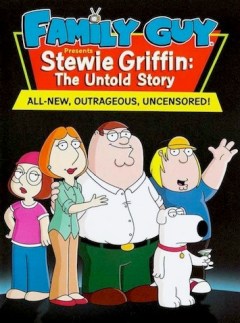 Following Family Guy’s cancellation after three seasons, it somehow found a new lease of life on DVD, posting surprising sales in what was, I suppose, the early years of the format’s mass take-off. This led to a rethink by Fox and a belated (as in, several years later) renewal for the animated sitcom. This story was originally intended to form a three-part opener to the first season back, but Fox wanted a direct-to-DVD movie too — presumably to capitalise financially on that previous success — and so those three episodes were retooled into a feature.
We know how this can turn out.
And it does feel like three Family Guy episodes stitched together. Much like that other stitched-together-from-three-animated-TV-episodes movie, Star Wars: The Clone Wars, the events of part one (or the first twenty-odd minutes) seem entirely separated from the two-parter that makes up the back hour. Fortunately the Family Guy team seem to have more common sense than their Lucasfilm counterparts, choosing to link back round to the start for their film’s climax, tying it all together after all. Nice work.
The plot is more or less suitably movieised — despite that first-part almost-disjoint, it’s a more-epic-than-usual tale of Stewie’s origins (sort of) — though it seems slightly held back by its genesis as three TV episodes and the need for it ultimately to be split back up (it was broadcast, censored, as a three-parter at the end of the comeback season). With subplots that begin and end within each half-hour(-ish) segment, it plays about as well as watching a three-parter back to back… which is more than can be said for that Star Wars film. Consequently, it also feels just like regular Family Guy — the same level of humour, basically — though it seemed to me like there were more scatological jokes than normal, some of them going on too long as well. If you’re not a regular viewer of the series, references to running jokes will pass you by; equally, the nature of its humour, often based in cultural references, means that some bits that are obviously jokes will elicit no more than bafflement from a non-versed viewer. Still, there’s plenty of more universal humour too. It relies on the usual style of numerous non sequitur flashbacks and asides. Which, again, is fine — that’s their style; it would be wrong to be anything else.
The need to turn three TV-aimed episodes into a movie — and, somewhat ironically, back again afterwards — does have a few effects on proceedings. Various bits had to be cut for the broadcast version, most for the silly technicalities of US TV rules — the fact the DVD is rated 15 over here, 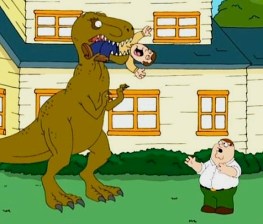 the same as the series normally is, shows how arbitrary US regulations are. It feels like there are a few more jokes that are slightly dirtier than normal and there are a few extra swear words, but they consciously didn’t go OTT with them and, thankfully, it shows. But actually, most of the stuff that’s cut (as detailed on the commentary or in full here) is for those daft US rules; so, stuff that just steps over a certain line; stuff that, to be honest, most Americans wouldn’t even notice.
Also, contractually the film had to make a certain length, so there’s some conscious padding in there — though, as they note on the commentary, they did their best to make the padding funny too. Take the intermission, for instance, which features just voices over a black “Intermission” screen: dirt cheap to animate (what with there being no animation) but it both adds a bit to the running time and smoothes the jump between parts two and three.
I don’t know how much I’ve reviewed the film and how much shared some behind-the-scenes tidbits here, but if you like Family Guy… well, you’ve probably already seen this (it’s been out, what, six years? I’m behind here), and if you don’t like it there’s nothing to change your mind.  And if you’ve always been curious but never given it a go, don’t start here — I don’t think it would be incomprehensible to first-time viewers, but I don’t think it’s the best introduction to the series either, and it probably makes more sense if you know the characters a bit.
This score reflects that lack of universal appeal; for regular viewers, I’d say it’s good quality and probably four stars.

 John Carpenter’s rough-and-ready ’70s exploitation B-movie is remade as a slick ’00s action B-movie dressed up as an A-movie by director Jean-François Richet (who would go on to find far greater critical acclaim with his two-part French crime epic
 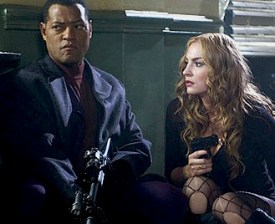 I don’t have hard timings to back this up, but I think the siege starts earlier and lasts longer here. It certainly felt that way, in part because the character of the father (whose act of revenge leads the gang to the precinct in the original) is gone. Of course, the film is about the titular assault on the titular station, so I think this refocussing is more than fair enough. It, naturally, emphasises the siege element of a film about a siege, something the original almost reneged on with its lengthy setup.
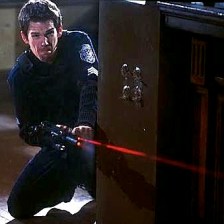 The only reason the prologue is necessary is if you want to begin your movie with an action sequence… so that’s why it there then. It’s also set in a sun-drenched summery atmosphere, totally at odds with the well-evoked wintery New Year that pervades post-titlecard. Consequently, looking back on the prologue, it feels even more out of place. I think it’s also designed to set a Gritty tone, with its rundown apartment and drugs deal and all that palaver; probably because the rest of the film is too far-fetched, if you were hoping viewers were going to be in mind of
  criminals inside the precinct are black or (in one case) hispanic. Ouch. You could try to argue we’ve developed past the need to force anti-stereotyping in casting; or you could argue this is a mainstream studio remake that felt the need to fall back on the familiar. It might not be a noticeable point were it not for it being so markedly different to the original.
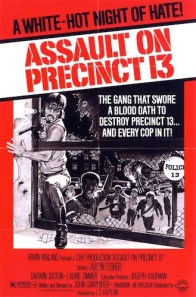 Assault on Precinct 13, it has always seemed to me, is an acclaimed cult classic of the action genre. I could probably find some references to support this — I know it’s on Tarantino’s list of the top seven exploitation movies, for starters — but for speed let’s just assume I’m right. Thing is, on initial impressions at least, I didn’t quite get that. It felt like an unexceptional low-budget ’70s exploitation B-picture to me.
 a huge gang who lay siege to the cut-off station. So the cops and the prisoners must work together to fend them off.
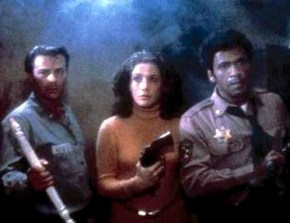
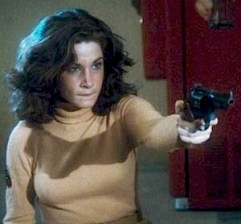 performing voodoo-esque rituals, coming and going as if by magic, doing things our heroes can’t necessarily explain, attacking in almost random waves… They feel almost supernatural; one might go so far as to say they play more like zombies than an organised criminal force. It’s no surprise that Carpenter would next helm
  And another says that, “like
 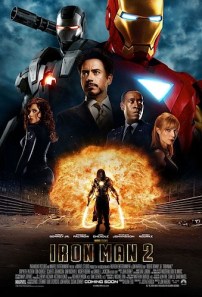 I’ve always contended that the first
  For starters, it relies on the story rather than the action. There are certainly some good sequences of the latter (more about those later), but there’s also a lot of story in between them — it’s not wall-to-wall explosions and punch-ups. Neither was the first, if you remember, and so it fits in that respect. It’s helped along by the ending of the first film, in which Tony Stark revealed he was Iron Man. That’s not something you do in superhero movies, which immediately lends this one a few new plot devices to play around with. Considering the burgeoning critical assessment that all superhero movies ever only tell the same two or three stories (an argument I think has a lot of validity), it’s nice to see anything to challenge the norm.
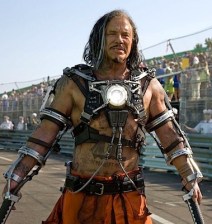 it’s the Penguin and whover-Christopher-Walken’s-character-was rather than Mr Freeze and Poison Ivy, if you will. They play to different sides of the hero: one is fighting Stark, one Iron Man (though there is naturally crossover); though they’re both intelligent, one functions as the brains and the other as the brawn. Mickey Rourke may go slightly underused, but it’s also part of the character, a quiet, thoughtful, intelligent hulk partnered with Sam Rockwell’s jabbering wannabe-Stark.
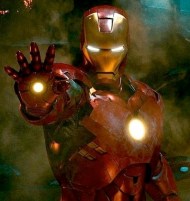 watched again later on Blu-ray, I enjoyed it a lot more. With Iron Man 2 I’m obviously distanced from trailers by a good year or so, and though one of their best moments is missing from the final cut, and the suitcase-suit is unavoidably spoilt by being so thoroughly screened during the promotion, watching now doesn’t have all the trailer-generated expectation to live up to. That famous Onion spoof about the first film’s trailer is, perhaps, even more applicable to the sequel.
 Aside from one unnecessary scene featuring Captain America’s shield and Agent Coulson leaving for New Mexico, and the fact that the film assumes everyone will know who Nick Fury is despite him being introduced fleetingly after the credits of the last film, the whole S.H.I.E.L.D./Avengers Initiative thing is worked into the plot well. If we didn’t know it was the beginning of the build-up to The Avengers, I think it would have sat much better with viewers. Even if it does end up blatantly laying the foundation for further stories, that’s hardly uncommon in franchise films of all kinds these days — at least we know this series will definitely pay it off, unlike so many franchise-wannabes that don’t make it past their first film. Plus, the film’s primary plot has its own villains and comes complete with a resolution; Fury, S.H.I.E.L.D. and co are a subplot that feed other subplots.
 Sometimes, I wonder what I’m playing at. The list of films I haven’t seen but really should is quite extraordinary, from enduring classics like
 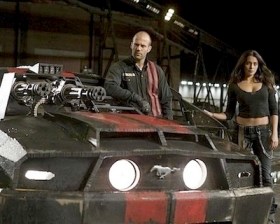 And I expect it says something about that intended audience that the end credits begin with a “do not attempt this at home” notice.
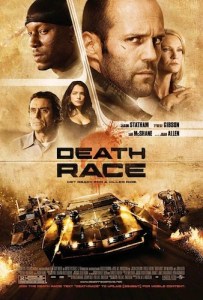
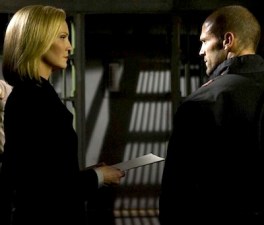 Even if it’s all about the action, it could be worse: I’ve seen plenty of films featuring weaker dialogue, weaker acting and an even less relevant story. Death Race does everything it sets out to do competently, delivering a couple of decent action sequences and even a couple of laughs along the way. Not exceptional enough to be particularly memorable, but it is fun — if you like this kind of thing — while it lasts.
 I may have mentioned
  Of course, being a website, the user-base skews younger, and that’s reflected in the list: the top 10 spans 1994 to 2008. Widen that to the top 25 and you can only add two films from the ’80s and one from the ’70s — and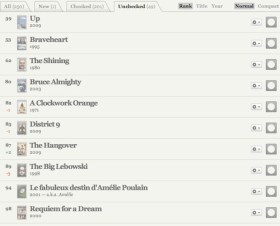
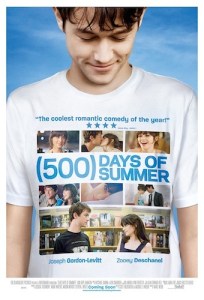 Directed by Marc Webb (
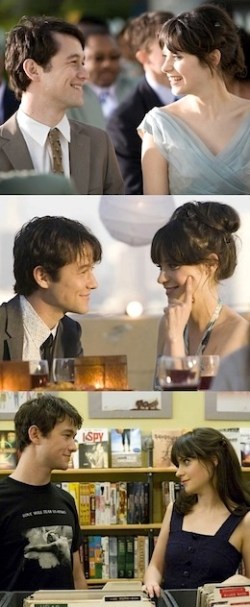 They all sit surprisingly well within the story though — yes, some (perhaps all) are showing off a bit, but in a way that, by and large, works. And I’m a little bit glad I can’t quite list them all, because half the fun of (500) Days of Summer is watching what looks like a borderline-mainstream indie rom-com that suddenly throws these curveballs at you.
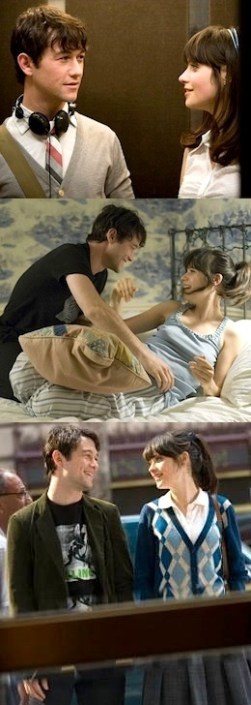 Not that those three roles are identical by any means, but you can see how one led to the other.
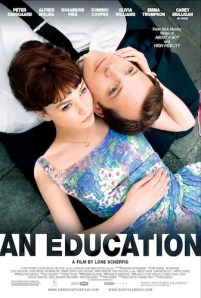 It seems that every year, come Oscar season, there’s a British-made film we’re led to back so thoroughly that it gains nothing but incessant praise from every (British) quarter. Just to look at recent years, from the 2006 selection it was
  Based on a true story, the film tracks 1960s schoolgirl Jenny (Carey Mulligan) as she falls for an older man (Peter Sarsgaard) who represents a culture- and glamour-filled escape from her drab suburban life and its focus on getting a place at Oxford. It’s a romance and a coming-of-age tale, albeit one with a more naturalistic bent than your regular offering; more down-to-Earth and British than either something Hollywoodised or American-indie-fied. There are, perhaps, few massive surprises in the plot — anyone who doesn’t guess this won’t end well has somehow failed to encounter a “schoolgirl falls for glamorous older man” story before — but Nick Hornby’s screenplay and Scherfig’s direction execute it all with admirable conviction. You don’t feel like you’re watching something familiar.
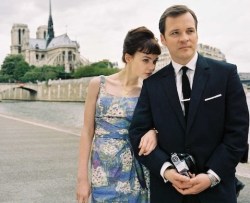 I’ve read some complain there’s no ending. I can only presume they walked out of the cinema or stopped their DVD before the film reached, y’know, the end. Sometimes I appreciate how people can criticise the lack of an ending, even when I disagree (see:
 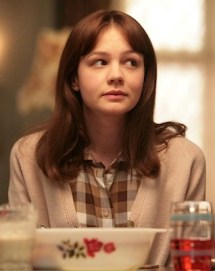 The film hangs on Carey Mulligan, justly nominated for her performance. Quite aside from whether the performance is awards-worthy or not, it’s effortlessly watchable. Mulligan is exceptionally easy to fall in love with — if you haven’t already when she was Ada Clare or Sally Sparrow, I’m sure Jenny Mellor will enchant you. On the other hand, some have found her character too pretentious or naïve — maybe your own background will dictate if you see these negative traits. Jenny is probably a little of both, but I wouldn’t say she’s wholly naïve and I wouldn’t say she’s pretentious, exactly — she’s clever, and she wants to experience the world. What’s wrong with that?
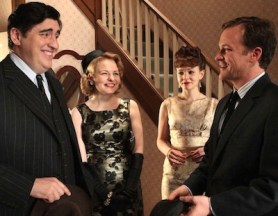 It’s slightly remiss of me not to mention Peter Sarsgaard, what with him being the other half of the film’s romantic relationship. He’s good, his Colin Firth-esque accent pitch-perfect, but while he’s spot on in the part — absolutely no complaints — I can’t think of any scenes where there isn’t someone else (usually Mulligan or Molina) grabbing the spotlight.
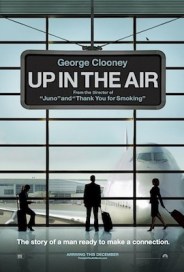 Sometimes, it’s best to just come clean: I don’t have much to say about Up in the Air.
 Cowriter-director Jason Reitman has created a surprisingly likeable film. It’s easy to see how Clooney’s character — very much the centre of the piece — could be irritating or vapid or any number of other negative adjectives, but instead he’s… well, he’s George Clooney, isn’t he? He’s all charm. If you were going to be fired, you’d probably want George Clooney to be doing it. For a character who is essentially an expansion of the
  Up in the Air got its Best Picture nom in the first year the Oscars went back to 10 nominations for the big prize. I’m not sure many would disagree that it’s one of The Other Ones — one of the ones that quite probably wouldn’t’ve been there if it hadn’t been for the category doubling in size. And if it was, it’d be The Other One — the token indie/comedy nomination that everyone knows isn’t going to win but was quite good all the same.
 100Films.co.uk