That title is massively simplified (and therefore technically wrong), but still seems long, doesn’t it? Yeah, wait ’til you see the proper name of that subsection.
Oh, also, I watched some films and stuff. Y’know, what this blog is actually about.
What Do You Mean You Haven’t Seen…?
Continuing apace, this month’s WDYMYHS film is quirky French comedy Amélie.
 July’s films in full
#56 Transformers: Dark of the Moon (2011)
#57 A Late Quartet (2012)
#58 The Raid (2011), aka Serbuan maut
#59 We’re the Millers (2013)
 #60 Video Nasties: Moral Panic, Censorship and Videotape (2010)
#61 Ghost Rider: Spirit of Vengeance (2011)
#62 Pacific Rim (2013)
#63 Cloudy with a Chance of Meatballs 2 (2013)
#64 Frozen (2013)
#65 Amélie (2001), aka Le Fabuleux Destin d’Amélie Poulain
Analysis
I’ve come over all Modern this month, with all but one film being from the 2010s — to put it another way, that means that all but one come from the last five years; and 40% are from last year alone, too. Well, I do have a lot of catching up to do. And the only film from outside this decade is still from this millennium. Ah well.
In terms of the history of Julys, I’m forming a new pattern: this year I watched ten new films, year before it was four, year before that it was ten, year before that it was four… Funny how these things happen, ain’t it? Year-to-date, ten films puts July precisely in the middle of things: it’s both my fourth-best and fourth-worst month of 2014.
As for having reached #65, that finally puts me ahead of last year, when I’d ‘only’ reached #62 by this point. I say ‘only’ because the goal for the end of July is 58, so both years remain ahead of expectations — indeed, I only need to watch one film next month to reach August’s target.
This month’s archive reviews
100 Films has changed home multiple times (deviantART, Blogger, FilmJournal, WordPress), and each time I’ve brought all my old content along with me. The move to WordPress has proven the most awkward in that regard: by the time I made the shift, I’d accumulated something like 700 posts. I’ve been here a couple of years now, regularly reposting old reviews as and when, but still fewer than half of those have made the transition. It’s time for a change… which is why early this month I began a concerted effort to repost at least one archive review every day. I don’t imagine I’ll keep it up full time (I think I’ve missed a day or two already), but it remains an overall goal; one that should see me fully transferred in a year or so — finally!
Each month I’m going to highlight the mass of reposts in this round-up, just in case you missed them. So, the inaugural selection of 24 are…
My Ranking of the 5 Hugo Best Dramatic Presentation (Long Form) Nominees
The Hugos are the prestigious science fiction and fantasy awards handed out by the World Science Fiction Society at whichever convention is Worldcon that year (this year, it’s LonCon 3), voted for by attendees and members of that convention. This year, I’ll be among those voters… well, by the time this has been posted the deadline will have passed, so I am among those voters. I signed up for two reasons, really: the “voter packet” of free ebooks, which this year included the complete Wheel of Time series (price of membership vs. value of the ebooks more than covered itself); and the chance to give everything Doctor Who-related a boost, as of course these awards are for last year, i.e. Who’s big 50th anniversary. Biased, me? Um…
The Hugos are primarily a literary award, with a dozen categories related to the writing and editing of fiction at various lengths; but in addition to those there are two Dramatic Presentation awards: Short Form (mainly, TV) and Long Form (mainly, films). As a good voter, I’ve made an effort to see all of the latter (and all but one of the former), and as two of them are amongst this month’s viewing, and (as I mentioned) the deadline for voting has just passed, I thought I’d share my final ranking. From best to worst, then…
- Gravity
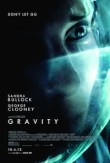 Set in the immediate future using technology that largely exists or is about to exist, some contend that Gravity isn’t a science fiction film at all — it’s a present-day thriller, just one that happens to be set in space. And they’re right, really — there are plenty of “real-world present-day” type thrillers that have more science fictional happenings than Gravity. But it’s on the ballot and it’s an incredible film, so pish, it wins.
- The Hunger Games: Catching Fire
 The decision between second and third was a tough one for me — I’d’ve tied them if I could. However, I haven’t posted a review yet for Catching Fire and am still debating my score — does it stretch to a 5? It still could — not only did I really enjoy it, but I think it has a lot more thematic/dramatic heft than your average blockbuster. Anyway, the next film’s locked at 4 stars, so Catching Fire wins the toss.
- Iron Man 3
 Some people seem to really, really dislike Iron Man 3. Not sure why — it may well be the best entry in what’s an all-round enjoyable trilogy (I still maintain Iron Man 2 isn’t so bad), a different-from-the-norm superhero tale that excites and entertains. It works as a trilogy-capper too (it’s almost a shame he’ll just be back in Avengers 2.) I’d quite like to rank it first… but, sadly, not in this year.
- Frozen
 Disney’s all-conquering version of The Snow Queen is the only fantasy film on this year’s ballot (seems to me the Hugos skew more SF than F. I suppose they are awarded by a Science Fiction society). I didn’t find it as incredible as the audiences who made it the fifth highest grossing film of all time, but it’s a fine film, whose initially-bland songs improve with re-listening (he says, listening to Let It Go as he writes).
- Pacific Rim
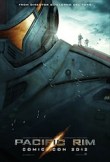 Guillermo del Toro’s Westernised riff on a very Japanese subgenre flopped Stateside — it just crossed $100m, which once would’ve been remarkable, but on a budget of $190m is poor. Internationally, however, it stormed past $300m and so will be sequelised. Del Toro apparently aimed it at 11-year-old boys, and it’s better than most other super-budgeted movies aimed at that demographic.
And the one thing I reviewed as a film but the Hugos count as Short Form…
Doctor Who: The Day of the Doctor
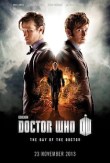 Well, of course they do — it’s a TV episode really, isn’t it? But it is feature-length (long enough to qualify for Long Form) and was released in cinemas, so I maintain you could count it as a film. Still, in Short Form it stands a strong chance of winning — I ranked it #1. My #2 and 3 was another tough decision, but I put Peter Davison’s hilarious spoof The Five(ish) Doctors Reboot in second and, in third, Mark Gatiss’ incredible An Adventure in Space and Time (another feature-length production that could hold it’s own against movies). Neither of those are strictly SF/F, but I guess as they’re Dramatic Presentations rather than books it was felt they belonged here rather than in the Related Works category. In fourth was Game of Thrones episode The Rains of Castamere. It is great as an entire episode, but let’s face it, it’s here because of the Red Wedding, which is the last, what, 10 minutes? Any other year it would probably win, but against four Doctor Who nominees (it’s a transferable vote, so more nominees means a better chance of one winning) at a convention held in Britain? We love Thrones here (more than the US, according to some stats I saw), but Hugo voters everywhere love Who. Finally, unranked by me, were Doctor Who finale The Name of the Doctor (it underwhelmed me — I won’t advocate “no award” above it, but I don’t feel it deserves to beat any of the above nominees), and Orphan Black mid-season ep Variations Under Domestication, which I’ve simply not seen.
Have I been a crazy person and put these in all kinds of the wrong order? And what about the Hugo nominators — are there any science-fiction/fantasy films (or TV programmes) from 2013 that they were fools to leave out? Lemme know.
Next month on 100 Films in a Year…
It’s the summer! Though blockbuster season is almost over already, isn’t it? Never mind. Perfect time of year to stay inside where it’s cool, anyway.
Oh, and watch some films. Which I shall list next time. But you knew that.


 The follow-up to 2009’s Team America-esque toy adaptation G.I. Joe: The Rise of Cobra seemed to be better received than the first. Presumably that’s just by comparison, because this is not a good movie.
 indeed, a band of outré ninjas are introduced almost as soon as our heroes, and they set off on an OTT plotline simultaneously. As the film wears on, it disappears further and further into fantasy; and not “version of our world” fantasy, but “kids’ Saturday morning cartoon” fantasy. The plot suggests the violence etc should be slightly toned down and the whole affair should have a PG, or even a U. Much like the first film, then.
 Elsewhere in that making-of, the guys from Hasbro talk about how they wanted to ensure the characters were distinct, not just Generic Soldiers. Failed that, then. It’s fortunate that most of the Joes are massacred because the only stand-outs are The Rock (because he’s The Rock), Channing Tatum (because he was in the first one), and Adrianne Palicki (because she’s the only girl). Even once D.J. Cotrona’s Flint (and I had to IMDb both of those names) is one of just three Joes left, his only distinguishing features are that he’s Not The Rock and Not The Girl. He is, to use a phrase borrowed from the Hasbro guys, a Generic Soldier. “Oops.”
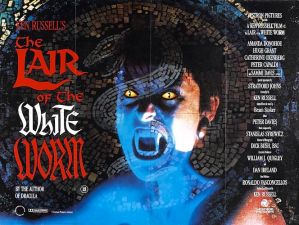 The Lair of the White Worm looks cheap, has a ridiculous story, overacted characters and overcooked dialogue, and by all rights should be a disaster. And maybe it is… but I don’t think so. In the right frame of mind, at any rate, it’s a whale of a time.

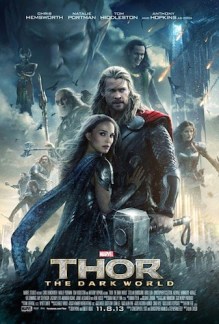
 Good will towards the participants counts for a lot, though. Tom Hiddleston’s Loki steals pretty much any scene he’s in, but Chris Hemsworth’s Thor is not an unlikeable hero, building further on the responsibility-and-honour story arc of the first film. Idris Elba also benefits from an expanded role, but others are less lucky: one of the Warriors Three is ditched as soon as we’re reacquainted with him; more criminally, Christopher Eccleston’s villain has nought to do but stomp around spouting exposition in a made-up language. Anyone could play that role, you don’t need an actor of Eccleston’s ability. Maybe something got cut (though it’s not in the Blu-ray’s deleted scenes), because I don’t see why else he’d’ve taken the part. Well, possibly the payday.
 Despite the title, there’s much fun to be had with The Dark World. It can’t deliver on all of its aims — the equally-promised expansion of Thor and Jane’s relationship is equally sidelined — but there’s enough entertainment value to make it a worthwhile proposition. Perhaps the longer lead-in that the third film seems to be getting (there’s no announced slot for it among Marvel’s numerous future release dates, meaning it’s unlikely to arrive before 2017) will allow them to round everything out a little better.
 Residents of a condemned high-rise witness a gang-related murder, but don’t intervene and deny all to the police. Months later, a sniper begins to pick them off. Can they band together and survive?
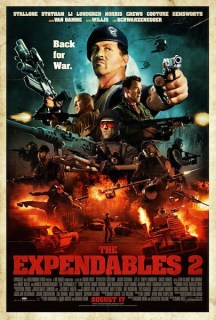 Sylvester Stallone’s ragtag collection of former action stars (and some current ones) reassemble for another throwback fight-fest, this time upping the daftness factor, to mixed results.
 So is it better? Sometimes. The whole thing is inherently silly — these are (mostly) grandfather-aged chaps kicking ass with the best of ’em — and it plays up to that with sly winks to the audience and implausibly-grand combat choreography. But at times the nudge-nudge factor goes a little far, and the disregard for building a wholly plausible story, especially towards the end, is a shame.
 But you didn’t come for that. You came for classic action stars fighting each other. In that regard, it’s pretty much the definition of brain-off brawny fun. If you don’t care for ridiculous action and cheesy dialogue, both of which are laughable in a way that’s hard to tell if it was intended or not, then this is not a film for you. If that sounds up your street, however, then The Expendables 2 is no classic, but it is a fun time.
 On Blu-ray,
  The best of the bunch is Super Manny, because Manny’s always fun and it’s the most inventively zany. Worst is Earl Scouts, because it’s just a poor Tom & Jerry / Itchy & Scratchy riff — Sky viewers won’t be missing much by not seeing it. Attack of the 50ft. Gummi Bear! falls somewhere between those two stools, as I suppose does Steve’s First Bath, though slightly less objectionably so — there’s fun to be had in how it sets up Flint’s grand uber-romantic date, then how it’s trashed by Steve and the robot built to wash him.
 On the whole, the shorts are passably entertaining if you like slapstick-y 2D animation and want to kill quarter-of-an-hour (or 22 minutes with Earl Scouts thrown in). But there’s nothing particularly innovative or original about any of them — certainly not worth going out of your way for.
 Quirky director Jeunet uses quirky cinematography and quirky special effects to tell the quirky story of a quirky girl, who had a quirky upbringing by quirky parents, and now lives a quirky life with quirky friends. A quirky coincidence leads her into the quirky hobby of cheering up strangers in quirky ways, during which she meets more quirky people who do quirky things, and she quirkily falls for the quirkiest.





















 A sequel to the suprisingly-good-in-spite-of-its-name animated comedy, Cloudy with a Chance of Meatballs 2 (innovative title; though better than its original moniker, Revenge of the Leftovers) begins mere minutes after
 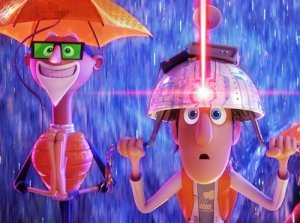 The villain this time is a thinly-veiled riff on Apple and its messianic founder, Steve Jobs. Here they become the aforementioned Life Corp, whose logo (and headquarters) is a giant lightbulb, and the equally-aforementioned Chester V, Flint’s childhood hero. As with almost all hero-since-childhood characters, you can guess where that’s going from the moment he appears at the start of the opening montage. Nonetheless, his storyline and relationship with Flint mostly works — it does take Flint a long time to reach the point of realising The Truth, but for viewers the reveal comes earlier and isn’t treated as an inappropriately big shock. Again, kids less familiar with movie tropes will be even more accepting of it. Plus there’s a Moral Message there for said kiddies (naturally), this time about trusting in your friends. It’s all familiar fare to an adult viewer, but doesn’t dominate to the point of boredom.
 In the end, Cloudy 2 isn’t quite as good as the first film, but not in a “notably inferior” way. It remains relentlessly entertaining, with an admirable energy and drive, which is in part a desperation to not be boring, but not in a shallow way. It may lack the extra little something that the first one has, but if that was an 8-out-of-10 then this is a 7 — which, because it’s fun rather than disappointing, rounds up to:
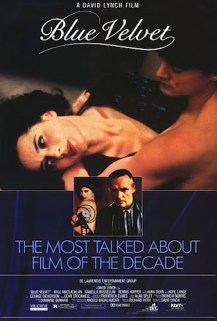 Before he brought the disquieting underbelly of small-town America to television audiences with
  But… is it, really? The white-picket-fence-dwellers are pretty clean; it’s the people inhabiting the scuzzy apartment blocks and industrial estates nearby who are the problem. Those characters are as corrupt and degenerate as their abodes might lead those with regular prejudices to suspect. It’s a less subversive point of view, and I don’t think it’s what Lynch was actually going for. Anyway, the entirety of his moviemaking technique is so outré that you can’t help but find the whole twisted nonetheless.
 “It’s not a movie for everybody,” Lynch himself said (to Chris Rodley for the book
