

Chad Stahelski (& David Leitch)* | 101 mins | Blu-ray | 2.40:1 | USA / English & Russian | 15 / R
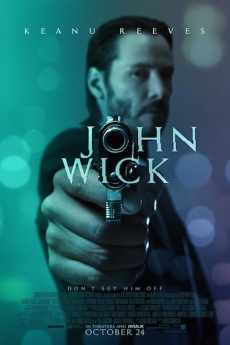 Keanu Reeves is John Wick, a nice guy whose wife sadly died. Now he lives alone with a puppy. Then he accidentally annoys a thug (Game of Thrones’ Alfie Allen) at a gas station, so he and his mates break into Wick’s house to teach him a lesson. The thug is the son of a big-time gangster (the Millennium trilogy’s Michael Nyqvist), so he does that kind of thing. They kill the puppy, but leave Wick alive. However, turns out Wick used to be an awesome assassin, renowned throughout the underworld — to everyone except this kid, it seems — and so he quite rightly sets out to execute their dog-murdering asses, consequences be damned.
John Wick is an action movie. I know you know that, but what I mean is, that’s kind of all it is. There’s no transcendent deeper meaning here; no attempt to explore the real life of a hired killer. If anything, this is an ultra-heightened universe, where the criminal underworld has an entire society and set of rules unto itself, including a raft of familiar faces in cameo-sized roles. It feels like it’s adapted from a comic book — they usually put that level of extra detail in more than films do — but it isn’t. There’s a rich world hinted at here; one that teases at more, but also supports the film. That is to say, there’s fan-driven talk of sequels and spin-offs set in this ‘universe’, but in and of itself it functions within the film, rather than simply being setup for more. It’s a better way to potentially start a “shared universe” franchise than the forceful way other studios are going about it with DC heroes / King Arthur / Robin Hood / et al, anyway.
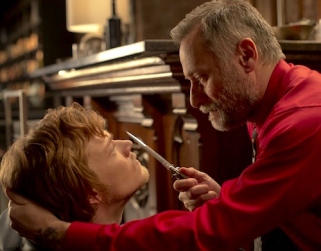 A decade and a half on from The Matrix, Reeves (and presumably an army of stuntmen) remains as capable an action hero as ever. Co-directors Stahelski and Leitch have an extensive background in that field (they first worked with Reeves on The Matrix and its sequels) and so they know what they’re doing when it comes to the shoot-outs, fist-fights and car duels. Unfortunately for John Wick I watched it soon after The Guest, whose singular style ultimately made more of an impression on me, but there’s no denying the virtuoso fight work on display here. This is a film for action movie fans to revel in — it has little to offer anyone else.
That said, this isn’t a straight-up Statham-style blockhead fight-fest. That unique, unusual world it sets itself up in sees to that. It has an almost mystical, fairytale quality to it. There’s no sci-fi or fantasy element, but it does feel like Wick descends into an alternate world, one hidden alongside our own. Tonally, at times it reminded me of Neil Gaiman’s Neverwhere (or the TV series it comes from, as I’ve never read the book). I suppose it’s because this criminal underworld has its own special rules, its own special locales, and an occasionally mannered way of talking and behaving. As I said, there’s no fantasy element, but it has a left-of-centre alternate-reality feel.
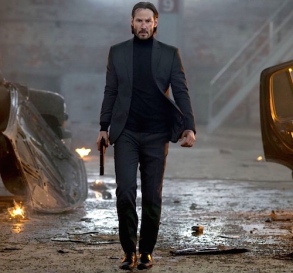 Combine that with the exciting, innovative, technically faultless action sequences and you have a distinctive, memorable movie. It seems to have gone down a storm with action movie fans, anyhow, and so those hoped-for sequels and/or spin-offs are most definitely in development. It’ll be interesting to see if it does what-I-call “a Bourne”, spiralling from a well-liked almost-sleeper-hit first film into an everyone-knows-it major franchise, or, well, not.

John Wick is released on DVD and Blu-ray in the UK on Monday.
* Leitch is uncredited as a director due to those DGA rules that meant Robert Rodriguez had to resign his membership to give Frank Miller his due on Sin City; that meant the Coen Brothers used to just be credited as “Joel Coen”. It’s pretty clear (especially if you watch the special features) that Stahelski and Leitch worked as a team, so for once I’ve ignored my rule of only crediting the credited director. ^
 If you’re not au fait with the
  as both sides attempt to rally ordinary people to their cause through the power of the media. It’s a tale that’s as timely as ever, surely.
 I must say that (as someone who hasn’t read the book) it didn’t feel overly like the first half of something longer to me. Of course there’s a cliffhanger and stuff, but there was at the end of the last film as well. This is no worse than that. If anything, I felt Mockingjay Part 1 built to its ending more successfully — I was quite surprised when
 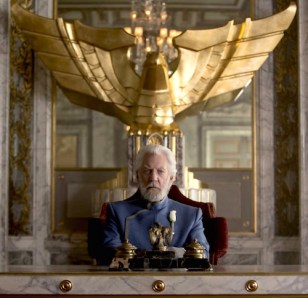 it may be your favourite instalment so far (and you wouldn’t be alone in that view). For me, Catching Fire is the best of the three because it crystallises both of those constituent elements; and if the first film was purely the action side (with a bit of the politics), then here we find its mirror image: purely politics (with a bit of action). Either way, perhaps the ultimate fate of all these films rests on how well
 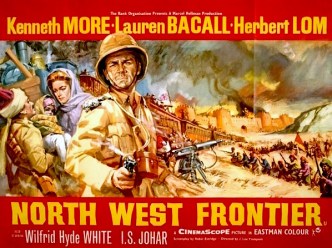 British Army Captain Scott (Kenneth More) is charged with getting an Indian child prince and his American governess (Lauren Bacall) to safety as rebels attempt to murder him. With the palace under siege, their only hope is a barely-ready rust-bucket train engine, a single passenger carriage, and a long journey through enemy territory joined by a motley group of diplomats and hangers-on who’ve bargained their way on to this last train.
 on the train by her governor husband, and Eugene Deckers is an arms dealer, who consequently no one likes but who remains unashamed of his trade. Through this prism there’s some discussion of the merits or otherwise of the British Empire and Indian independence, which some will judge to be extolling old-fashioned values, and others will take as little more than a (probably unnecessary) hat-tip in the direction of real politics.
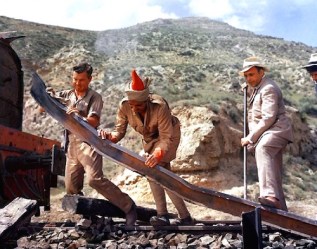 North West Frontier, on the other hand, sounds like a Western — which was perhaps the intention: the film’s structure and story style is fundamentally a fit for that genre, albeit British-made and geographically relocated. The storyline immediately brings to mind John Ford’s
 Four years ago, DreamWorks’
  Tonally, DeBlois has been productively inspired by
  If there’s a flaw, it’s in some of the new characters. The primary villain is underused, introduced too late in the game to become a palpable threat. More time spent building him up, seeing his evil on screen rather than just being told about it, would’ve been appreciated. So too for the mysterious vigilante dragon-rider, who turns out to have a very significant role. The deleted scenes include a prologue that would have introduced the character at the start, which would have better established the mystery and import of their role. It’s clear why it was deleted (to focus on Berk and keep the initial tone light), but I still think it would’ve worked better in the film. In the final cut, the vigilante is mentioned all of once, then turns up and is unmasked about two minutes later. Really, though, these are niggles — even for them, the cumulative consistency is certainly better than, say, its Oscar conquerer
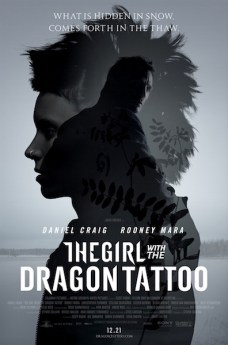 Stieg Larsson’s much-hyped novel comes to the screen for the second time in David Fincher’s much-hyped English-language re-adaptation. Somewhere between the pre-release build-up (do you remember the fuss over the trailer’s release? And all those magazine covers and articles?) and now, something clearly went awry: its UK TV premiere back in March was buried mid-week on ITV2.
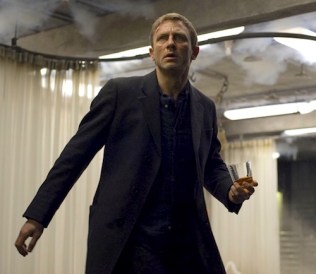 There are certainly changes, but nothing especially major. For example, the ending has been tweaked — not “completely changed”, as some reports had it, but just streamlined slightly. Some will struggle to even remember the difference if their experience of a previous version was long enough ago. Die hard fans, however, seem to regard it as a massive re-visioning of events. It isn’t.
 in particular, it’s beautifully shot, and there’s a vein of interest to be mined in discussing the fact it was consciously made using a five-act (as opposed to the usual three-act) structure (but not here today, sorry) — it feels unable to innovate or hone the genre in quite the way Se7en or
 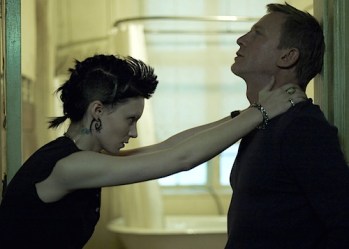 So my rating may come as a bit of a surprise given the focus of this review, which is primarily my fault for finding it so tough to shrug off all those contexts and comparisons. But hey, that’s something the film itself struggles with in many people’s eyes, too. If the viewer can divorce it from those ties, however, I think it’s still an exceptionally good thriller.
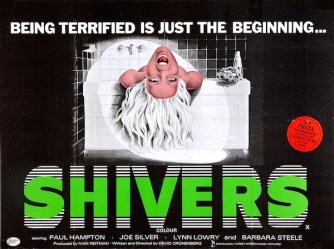 The first commercial (i.e. non-student) feature by horror maestro-to-be David Cronenberg, Shivers depicts the sexually-charged chaos that erupts after the spread of a man-made sexually-transmitted parasite in an isolated hyper-modern tower block.
 Director Steven Soderbergh takes the methodology he used to depict the drug trade in
 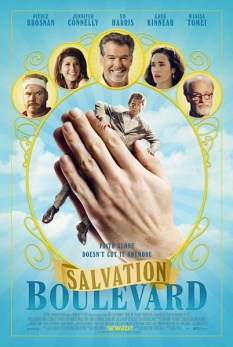 Reuniting Pierce Brosnan and Greg Kinnear, stars of comedy-thriller
  This is not the Salvation Boulevard that has ended up on film. I tried to hunt down an explanation for why co-writer/director George Ratliff had deviated so, but the best I could unearth was
  I shouldn’t have expected much given the poor reviews, but I like the cast (which also includes Ciarán Hinds and Marisa Tomei), I really enjoyed The Matador, and the trailer was suitably promising, all of which encouraged me to seek it out. I wouldn’t say Salvation Boulevard was an entire waste of time, but I couldn’t help but feel there was potential for a funnier, more cutting movie hidden in the material. Shame.
 Contagion
 End of Watch
 Inherent Vice [
 Interstellar [
 Justice League: The New Frontier
 Life of Pi [
 Monsters: Dark Continent [
 Seeking a Friend for the End of the World
 Shallow Grave
 Sherlock Holmes (1922) [
 Shivers
 Space Station 76 [
 The Story of Film: An Odyssey
 Stranger by the Lake
 The Theory of Everything [
 The Thing (2011) [
 100Films.co.uk