
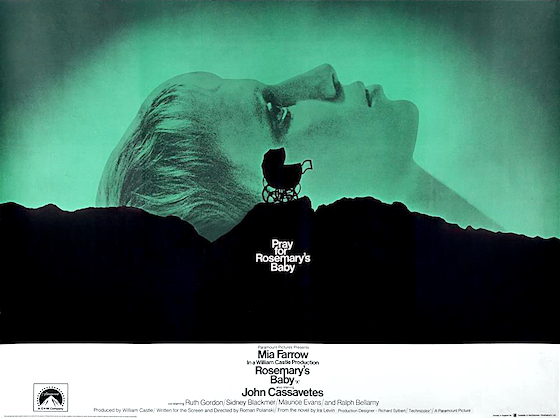
If you came to Rosemary’s Baby without any kind of context about its place in film history, you might well conclude it had been made in the last few years. Well, if you learnt about it on paper — visually, it’s obviously a film of the’60s thanks to its cinematography and production design (not a criticism; indeed, if anything, that’s praise). But in terms of its plot, its themes, its characters and their relationships, and what they might be signifying, that all feels quite ‘of the moment’. Maybe it did in the ’60s too. Maybe it has in every time period since — maybe that’s why the film has endured so well for over 50 years. (Plenty of other films have endured just as long — and longer — without feeling pressingly relevant to the present day, so I don’t want to overemphasise that point too much.) If it had been made more recently, the usual blowhards would be decrying it as “woke” and that it debases the traditional family unit, or something. The fact you can apply such ‘arguments’ as readily to something made over half a century ago as you can to something produced today is just one reason they’re absolute bollocks. But I digress.
To dig deeper into what the film is saying about such things, and how and why, necessitates some spoilers. I know some people think it’s ridiculous to consider spoilers in the context of a film as old as this, but there are always new generations and more people coming afresh to any film decades later — heck, I’ve only just watched it; that’s the whole point of this. That said, Rosemary’s Baby is sort of a self-spoiling film. We all know it’s a horror movie, so when it starts out like a pleasant slice-of-life domestic drama about a young couple moving into a new apartment building, making friends with their quirky neighbours, and deciding to start a family… well, we already know that’s not all it’s going to be, and the hints at more sinister goings-on are easy to spot.
This is another way one might argue it feels modern, as it’s close to the “elevated horror” sub-genre that’s sprung up in the past few years. Again, the fact works like this have existed since at least the ’60s — and I’m sure there are other horror movies that could be similarly classified — shows that so many “new” things have actually been around before, we’ve just forgotten them, or not bothered to label them. Basically, rather than being an outright schlocky genre movie, it’s restrained and dramatic and realistic (in tone, at least). There’s not even an early fake-out jump scare to reassure you you’re watching a genre piece, a trick employed by so many films where the real frights only come in later. There’s a conceivable version of this film where the big reveal is that everyone’s normal, Rosemary was paranoid, and you’ve been watching a mental health drama, and literally all you’d have to change for that to work is the events of the final few minutes.
Indeed, it’s interesting to sort of take a step back and almost-objectively consider this as “a horror movie”. There are very few (if any) scares, and it doesn’t create the same kind of uneasy irrepressible mood as something like The Shining; although I would wager it can have a different effect on women, especially women of childbearing age, than it does on me, because the horrors are that much closer to home. I don’t think it’s failing in those respects — it’s not setting out to terrify you and then failing to achieve it — I just think it’s going for a different kind of horror. It’s the slow realisation that something is not just ‘not right’ but definitely very wrong; and by the time you grasp the scale of it, it’s too late to do anything; and too insidious to convince anyone else that it’s real. In that sense, it really is a good analogy for things like toxic relationships that look fine to the outside world.
And that’s the way in which the film is most modern, as I was saying at the start. Its central concerns seem to be issues of women’s bodily autonomy, controlling relationships, the way they isolate their victims and lead to abuse. If you want to close your senses to such unmissable subtext, I guess you could still see the film as no more than a genre piece about (spoilers!) a cult trying to birth the Antichrist, but I think you’d be burying your head in the sand to do so. Sure, the film doesn’t expressly call those elements out — doesn’t underscore them, or bluntly explain that’s what’s going on in modern terminology — but they’re inescapably in the mix. I do think that’s a difference between the film having been made in the late ’60s vs today: now, it would be hard to resist thoroughly leaning into those themes and making them more overt, because they’re things we’re much more aware of as a society, and much more concerned with combating. Again, it’s not that they’re exactly subtle here, but you get the sense some of the psychology involved was still not widely understood; that there perhaps wasn’t yet the agreed-upon terminology to explicitly call it out, other than to present it and show how negative it was.

All of which said, the timeliness or otherwise of the film’s concerns is irrelevant to its overall quality. As much as it would be a key point of interest to some, I’m sure it’s of no matter to others. Either way, though, Rosemary’s Baby remains a compelling story because of how it grounds its supernatural goings-on in day-to-day life. Without playing the “is it or isn’t it” angle, it nonetheless renders them almost mundane — these devil-worshippers aren’t wearing robes, enacting elaborate arcane rituals in ancient stone circles in the British countryside: they’re modern-day Americans, living pretty typical lives in a New York apartment block. Horror can exist everywhere and anywhere; it is everyday. Oops, maybe we’ve come back round to making a sociological point again…

Rosemary’s Baby is the 82nd film in my 100 Films in a Year Challenge 2024. It was viewed as part of Blindspot 2024. It was my Favourite Film of the Month in October 2024.


 Favourite Film of the Month


 100Films.co.uk