Portrait of a Lady on Fire (2019)

aka Portrait de la jeune fille en feu

2019 #137
Céline Sciamma | 122 mins | cinema | 1.85:1 | France / French & Italian | 15 / R

Portrait of a Lady on Fire

Now, here’s a film I really need to see again. Not to affirm whether I liked it or not — in fact, I loved it; enough to rank it the #1 film I saw in 2019 — but to fully assess and analyse and process it. This admission is not the best way to begin a review — reviews are meant to be assessment and/or analysis, after all — but, nonetheless, it indicates the kind of effect I felt from the film.

What is that effect? In my best-of-year piece I said it was “the kind of film that casts a spell”, by which I’m referring to how it sweeps you in; how it engages you in such a way that you’re just experiencing it, almost with analytical functions switched off; or if not “switched off”, turned down low enough so as not to be a distraction. Maybe this is how ‘normal people’ see all films, but as someone who actively studied cinema for six years and has spent nearly a decade-and-a-half reviewing every new thing he sees, it’s rare to find something so engrossing that the mental deconstruction while viewing stops almost entirely. That — in its own, somewhat ephemeral way — is as good a testament to the film’s power and quality as any.

Of course, to say it turned off my analytical brain entirely is not completely truthful — this is a long way from a Michael Bay-esque “leave your brain at the door” kind of entertainment. What I mean, I suppose, is that I was engaged more purely by the characters and their story, rather than becoming distracted by pondering the filmmaking choices or structural decisions or acting ability or what have you. (The difference here is perhaps a fine line to quantify, I grant you. If you’ve ever studied film in an academic context, I hope you’ll know what I mean. If you haven’t, I’ve done my best to convey some of the difference.) In this instance, I’m thinking specifically of the film’s leanings towards a sense of Gothic. This element isn’t overt — as it is in, say, Crimson Peak — but it is there, and so my analytical brain was ‘on’ enough to spot that and think it through. while watching. I mean, I’m not claiming that I’m some genius for getting it — there’s a bloody great apparition that’s presented like a key to unlock this facet of the film — but, even with that pointer in hand, it’s not an out-and-out traditionally Gothic tale.
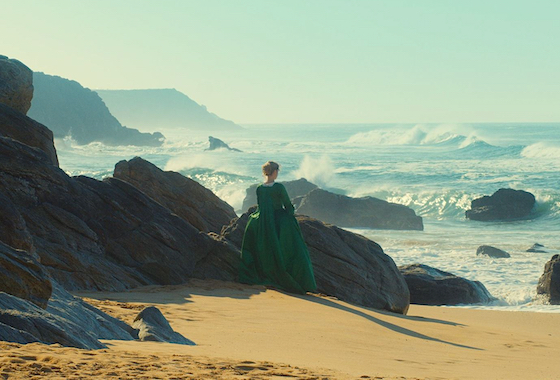
Oh I do like to be beside the seaside

Here I’m not talking about Hammer-like ‘Gothic horror’ but ‘Gothic Romance’ (see my Crimson Peak review if you need a refresher on the difference), and ‘romance’ is an even more operative word for Portrait of a Lady on Fire as it’s about two women who realise they’re in love. That realisation takes a while to manifest, so if you’re a total spoilerphobe then you might argue I’ve just ‘ruined’ the movie; but eh, it’s kind of the point (just look at all the publicity materials!) Much has been made of the fact that it’s a lesbian love story told with the female gaze, as writer-director Céline Sciamma is, indeed, a woman. This is not an insignificant factor, but also not one I feel massively qualified to discuss in depth. I do think the way the relationship is handled and depicted comes with a different perspective than you’d expect if there was a man in the director’s chair, though. It’s not so simplistic as the attitude to sex and nudity, though that is part of it (such scenes are not shot with the same lasciviousness you might expect from a male hand on the tiller) — it’s the overall attitude and focus. Plus subplots, including a significant one with a maid, the delve into Women’s Issues with a level of understanding that, again, might be different under a male director.

The notes I made for myself when I saw the film back in November are frustratingly brief. They include “the music!” and “the sound!”, so let’s take a moment to acknowledge that they are clearly striking elements, while also damning my memory for embarrassing me by not remembering many specifics. That said, the film’s use of music is deliberately sparse, for reasons connected to the story, and so when it is used it’s all the more effective. For some reason my notes don’t mention the cinematography, but maybe I thought that went without saying. It looks gorgeous, with cinematographer Claire Mathon enacting a painterly regard for composition and colour that is wholly appropriate. The rest of my notes conclude with a request: “all the awards for Adèle Haenel please”. Which is to do no disservice to her co-star Noémie Merlant — the film is about their relationship, and so its quality rests on both their shoulders — but in some respects Haenel has the more obvious journey and change.
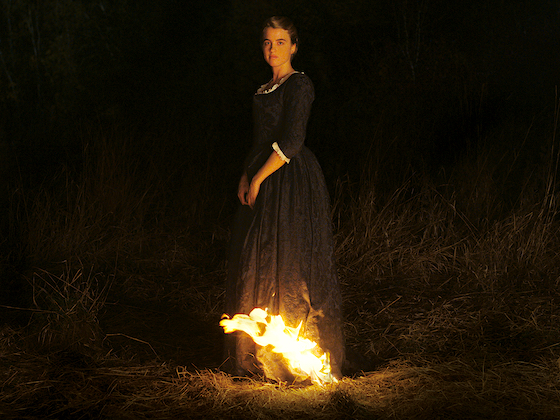
This girl is on fire

The story comes to a head in a moment near the end which made me well up inside. It’s a visual clue that I spotted just ahead of most of the audience I saw it with — I don’t wish to sound boastful here, because I certainly wasn’t the only one even just in that room to spot it ‘early’, but it meant I could also enjoy the audible gasps when the remainder saw it a moment later. My point being: it’s the kind of moment that can provoke an involuntary vocalisation of surprise and delight, and it’s not just me it worked for that way.

I appreciate that this is another vague kind of appraisal. I feel like I want to abandon a lot of this review and just scream “see it, then you’ll know everything I want to say and everything I feel!” But, of course, art and criticism don’t work like that. You won’t experience the film the exact same way I did, even if I could tell you exactly what I experienced and thereby influence your own experience. And there are even people who dislike this movie, which couldn’t be more opposite to my experience (one of the specific criticisms I’ve seen is that it’s slow, and while it’s true that it moves at a very particular pace, I thought it was just right). But, in the end, that is what this review is for: to urge you to see it, because it is a beautiful, absorbing, moving piece of art.

5 out of 5

Portrait of a Lady on Fire is in UK cinemas and on Curzon Home Cinema from today.

It placed 1st on my list of The 15 Best Films I Saw For the First Time in 2019.
Emma. (2020)

2020 #20
Autumn de Wilde | 125 mins | cinema | 1.85:1 | UK & USA / English | U / PG

Emma.

According to IMDb, Jane Austen’s Emma has only been adapted for the big screen twice before — and one of those was Clueless. There have been multiple TV movie and miniseries takes on the novel, though, but as the most recent was over a decade ago I guess someone felt it was about time to trot it out again (after all, every major Dickens and Austen must be adapted for the screen at least once a decade or so, right?)

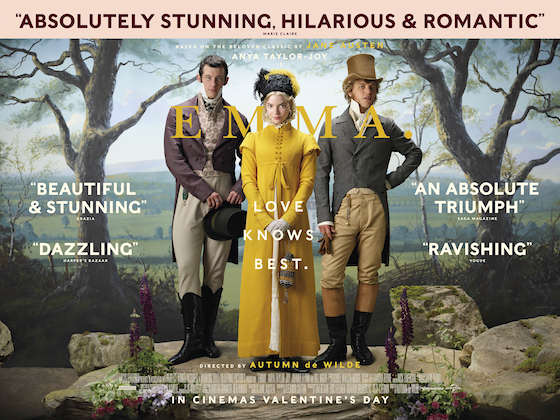
Following in the footsteps of the likes of Gwyneth Paltrow, Kate Beckinsale, and Romola Garai — and, I guess, Alicia Silverstone — in the title role is Anya Taylor-Joy. With her wide eyes, blonde ringleted hair, and silent, still demeanour, Emma is the very vision of loveliness. But, like so many stereotypical outer appearances, her sweet visage masks a manipulative schemer, obsessed with her own matchmaking ability; and, in private, her opinions of others are often not so kind. She is, in short, a bit of a bitch. Taylor-Joy is perfect in the role, doing an awful lot with subtle changes of expression in reaction shots — her Emma may often be silent and still, but she still conveys so much. Some have labelled Taylor-Joy a “scream queen” after her breakthrough roles in the likes of The Witch and Split, but she’s got a lot more range than that label implies.

Reader, I confess, I am jealous of that strawberry

Around her is a cast mixed of well-known faces and up-and-comers. For the latter, the standout is Josh O’Connor, who you may recognise from The Durrells, or The Crown, or God’s Own Country, or one of several other roles — he’s been an up-and-comer for a while and is about due a full-on breakthrough, which I guess all of these things combined have or will provide. Anyway, here he’s an obsequious vicar whose manner changes entirely once his true intentions and character are exposed, and O’Connor tackles both sides with the right amount of humour and churlishness. Johnny Flynn brings a rugged edge to Mr Knightley, Emma’s neighbour and lifelong friend, who disapproves of her meddling ways even as he clearly approves of her. Mia Goth brings a convincing wide-eyed innocence to Harriet Smith, a young girl of unknown parentage who Emma takes under her wing with the real motive of once again showing off her matchmaking skills, which is quite at odds with her previous roles in the likes of Nymphomaniac and The Survivalist.

As to the better-known cast members, Bill Nighy is reliably drily hilarious as Emma’s father, while Miranda Hart injects a lot of her familiar persona into the babbling Mrs Bates, before hitting you with an almost gut-punch of emotion (there were gasps at my screening, dear reader — gasps). Fans of the book / other adaptations will surely know which moment provokes such a response, so there’s the quality of Austen’s original storytelling at work there, and also that of the filmmakers and the rest of the cast — the reactions of the other characters; the way they hastily try to cover up the faux pas; and the exposure of Emma’s true character contrasting with the overall sugariness of the way this world has been presented.

Confectionary

This is director Autumn de Wilde’s most striking contribution to the story. The colour palette evokes confectionary; the manner of framing and camera moves is sometimes Wes Anderson-esque. If this Austen adaptation lacks the pure satirical bite of, say, Love & Friendship, it counterbalances with a contrast between the prettiness of the design work and the true thoughts, feelings, and schemes of the protagonist.

Of course, at the end of the day, Emma is a romance, and all’s well that ends well, earned via a flurry of apologies and plotting that lands everyone just where they always ought to have been. I suppose such narrative tidiness is anathema to some, just as are the delightful visuals, the witty dialogue, or the fundamental triviality of a bunch of rich people fussing over each other’s love lives. Well, that’s Jane Austen, people. And, like the elaborate confectionary it so resembles, Emma may not be nutritional, but it is delicious.

4 out of 5

Emma. is released in the US today, and is in UK cinemas already.

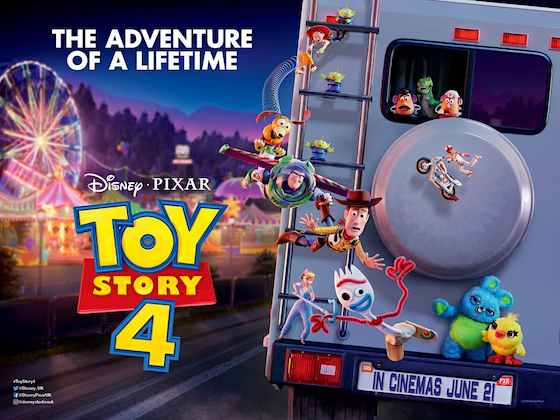
Toy Story 4 (2019)

2019 #101
Josh Cooley | 100 mins | cinema | 2.39:1 | USA / English | U / G

Toy Story 4

Last weekend, with dull inevitability, Toy Story 4 won Best Animated Feature at the Oscars. Of course it did — in the last decade, the award has gone to a Disney or Pixar movie eight times out of ten. I’ve not seen any of the four other nominees, but I strongly suspect at least one of them deserved it more, because Toy Story 4 is… fine. Heck, it’s good, even. But when the three films that precede it are all-time classics that formed a perfectly complete trilogy, just being “good” is not enough.

Its first mistake is that it doesn’t need to exist. The filmmakers have self-mythologised that Woody’s story wasn’t complete and so needed this final chapter, or some such gumph, but anyone who’s actually seen Toy Story 3 knows that’s not true. No, this is someone at Disney or Pixar hoping they can mine one of their most popular franchises for more gold. Whether or not they also believed lightning could strike for a fourth time, or they didn’t care so long as it made bank, I’ll leave up to your own levels of cynicism.

So rather than feeling like an equal part of a four-film series, Toy Story 4 feels like an afterthought; an addendum; a “here’s another one because you liked the others”. And at times it delivers on that — we like these characters, so they’re fun to be with; some of their antics are amusing or exciting; there’s a positive moral message or two about acceptance and seeing worth in yourself. There are attempts at emotional resonance too, particularly when the film tries to feel like an ending and a farewell; but 3 already did that, and did it extremely well. 4 has an uphill climb trying to match that, and even if it did (which it doesn’t), why should we believe it? It’ll only last until someone decides there’s a narrative for Toy Story 5 that simply has to be told (see you for that c.2026, I guess).

In search of a new story

Of course, there’s no doubting the film is well made. It’s easy to disregard that as just Pixar being Pixar, but there’s an ever-impressive technical skill on display here. Maybe on that level it does deserve award wins — although, while Pixar are undoubtedly frontrunners in such a race, there are other animation houses who can and do produce work that’s just as beautiful. (Besides, the Best Animation category is a funny one in that regard — is it rewarding the artistic/technical accomplishment of the animation itself, or is it “best film that happens to be animated”? A debate for another time.)

Toy Story 4 is the kind of film I enjoyed well enough while it was on. Whenever I get round to rewatching the series, I’ll happily include it. But, while it doesn’t tarnish the series’ legacy, it does blight its unbroken record. If it had never existed, I’d’ve been fine with that.

4 out of 5

Toy Story 4 is available on Sky Cinema as of this weekend.

The Random Mid-Monthly Review for Valentine’s Day 2020

Roses are red,
Violets are blue,
I’m a blogger not a poet,
Though I did do a Creative Writing degree with a poetry component, which I don’t think I was the greatest at, but, you know, not all poetry has to rhyme…
But it’s better when it do.

Hello, dear readers. It’s been a while since my last post, but I don’t have any reviews banked ready to go, so here’s a random mid-month update. (Normally the 14th would be right smack in the middle of February, but of course I would end up doing this on a leap year. Still, it’s near enough.)

How you doing? You good? Awesome.

Me? Well, after the back half of last year was sent into relative disarray by house moves and whatnot (just look at this graph from my 2019 statistics to see how up-and-down the year was from June onwards), 2020 is off to a similarly bumpy beginning as I spend my time hunting around for a new job. Also, more directly related to film viewing, much of my DVD/Blu-ray collection remains in boxes as we shelve out The Library. Oh yes, I’m going to have a DVD/Blu-ray library. (Photos when it’s done, I’m sure.) Not that there’s a shortage of stuff I could be watching, what with Netflix and Amazon Prime; plus I currently have Now TV (for the Oscars); and there’s always new releases, both at home and at the cinema (my local is finally screening Parasite from today (hurrah for its Oscar win!), so I really ought to make the effort to see that).

A normal monthly review would have a list of things I’d been watching, of course, but I’ll save that for the proper one. But, talking of Oscar-y recent films I still haven’t seen, the Joker Blu-ray has been sat right next to me all week, waiting (I’ve been focusing on trying to get value for money out of that month of Now TV. I don’t think I have, yet). But, as mooted in my last TV review, I have finally got round to Good Omens. Gotta be honest, I’m not enjoying it as much as I thought I would. I think that might be a case of too high expectations on my part, though. It’s still good, mind — I’d recommend it. Anyway, there’ll be more about that in the next TV column.

Overall, my film viewing tally currently places this February as my worst month since April 2010. That’s very nearly an entire decade ago, people! Fortunately, there’s still half (and a bit) of the month to go yet…

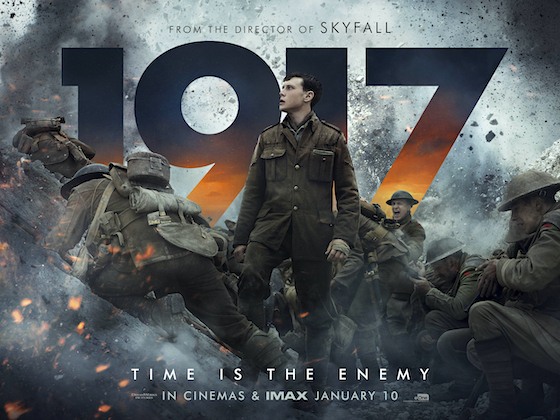
1917 (2019)

2020 #6
Sam Mendes | 119 mins | cinema | 2.39:1 | UK & USA / English & French | 15 / R

1917

BAFTABritish Academy Film Awards 2020
9 nominations

Nominated: Best Film; Outstanding British Film; Best Director; Best Cinematography; Original Music; Best Production Design; Best Make Up/Hair; Best Sound; Best Special Visual Effects.

I haven’t been following awards season too closely this year, but from the snippets I have picked up here and there it seems to be quite a variable race — every time a frontrunner emerges, something else wins some other award and suddenly the field is open again. 1917 was one of the early tips, and now has several wins under its belt to back that up. It may not be a lock at the Oscars, where the latest works by American auteurs like Martin Scorsese and Quentin Tarantino will give it a robust run for its money (plus the six other contenders, several in with a shot), but tonight it’s BAFTA’s turn. The British Academy may seem to be more focused on being counted among the major Oscar forerunners than anything else, but they do still have a penchant for rewarding British films — and 1917 isn’t just “a British film”, it’s a British film about a key event in British history with an all-star cast of cameos from great British actors. So, as it’s a season-wide contender anyhow, if 1917 doesn’t win the big prize this evening it’ll be a genuine surprise.

Does it deserve it? Take a sample of social media and you’ll get different answers. As with any big, much-discussed film nowadays the initial reception has been followed by waves of backlash — or maybe that’s too grand a term for it; maybe it’s just been different ‘sides’ expressing their opinion in turn. If it wins, there’ll be a vocal contingent about how it didn’t deserve it. As someone observed the other day, literally the only way to avoid such a negative reaction nowadays is to literally take the award out of the incorrectly-named winner’s hands. (If you think that’s facetious, think about it for a second: do you remember any significant backlash to Moonlight winning? I don’t. Every other winner in recent years? Yep. I’m not saying it should’ve had one — it’s a great film — but it is unique in avoiding it.)

Personally, having seen 60% of this year’s BAFTA Best Film nominees, 1917 would be my pick (the others I’ve seen are Once Upon a Time in Hollywood and The Irishman; the remainder are Joker and Parasite, which is only out in UK cinemas next week so probably doesn’t stand a chance). My view may very well change once I’ve ticked all the boxes (Parasite is supposedly the greatest film ever made, after all), but that doesn’t lessen 1917 as an achievement.

War, huh? What is it good for? Winning BAFTAs, probably.

Famously, the film is a single take… sort of. That caveat comes for two reasons. First, because it isn’t a single take, because there’s a fade-to-black in the middle. It’s an effective, well-timed event — basic filmmaking technique as narrative twist, because this is so famous as “a single-take film” and, by that point (it comes fairly late in), we’re so embedded in the technique that the sudden blackness comes as quite a surprise. Second, because it isn’t a pair of single takes, because there’s no way you could shoot a film of this scale and complexity in a genuine single shot. Rumours abound of how many hidden cuts are in the movie. One said there were as many as five. Editor Lee Smith refuses to confirm the exact number, but makes a very sensible point: the film was shot over 65 days — you can’t put together 65 days’ worth of footage with only five cuts. But that shows how well it was achieved: people thought that, gasp, there could be as many as five, when actually there are far more.

“Wait, this film had an editor? That must’ve been a quick job!” Yeah, there’s been a lot of that on social media. People have been quick to dismiss it — people who should know better, quite frankly. As with so many things in life, just because it looks easy doesn’t mean that it was. There’s more to editing than just “sticking shots together”, and planning a film as complicated as this involved Smith’s input throughout shooting, not just in post-production. Plus, they didn’t just do one take that worked for each setup and call it quits — the job still involves choosing which take has the best performances, the right lighting, making sure it matches exactly enough for the transition to the next shot, and so on. The least number of takes for any individual shot was “five or six”, the most 39, so there’s plenty for an editor to do with choosing. I’m getting this info from an interview with Smith by Catherine Springer at AwardsWatch, which is worth a read if you’re interested in getting some insight into why there is actually a lot of difficult, impressive editing work going on here. One further titbit: some of the cuts were ‘improvised’, in that there are some cuts where a cut hadn’t been planned. You can’t do that kind of thing without a skilled editor, surely.

Deakins!

And it makes it all the more impressive that the end result is so seamless — you can buy that you’re watching a single take (okay, two single takes) rather than dozens strung together in pretend. Well, I say it’s seamless — yeah, sure, any Tom, Dick, or Harry can spot places where there are surely cuts (they walk through a dark doorway; someone/thing passes in front of the camera, blocking the view for a split second; etc). But unlike other faked single cuts I’ve seen, where the action doesn’t flow perfectly across a hidden cut, it’s at least conceivable that some of 1917’s hidden-cut-opportunities don’t actually mask a cut at all. Plus, as that interview suggests, there are actually dozens of cuts in the movie, and there aren’t that many glaring opportunities (which is probably how whoever it was arrived at their total of five).

The fact I’ve spent most of this review so far talking about the film’s single-take-ness is some people’s problem with 1917 — that it’s a filmmaking stunt and nothing more; that it’s a technical achievement at the sacrifice of character or narrative or anything but “look what we can do”. I don’t agree with that assessment. I think the single take serves a purpose beyond showing off. At the most basic level, it puts us on this mission with the characters, attaching us to them and their fate in a very intimate way. The camera rarely strays far from their side, choosing to remain at eye level and near to them when it could float off to give us a godly overview. Some have taken to describing it as “like watching a video game” for that reason, but I bet those people also refer to CG effects as “graphics” and, basically, spend too much time watching/thinking about computer games and conflating them with films (I’ll move on before I get distracted into a wholly different argument…) There are plenty of other ways for filmmakers to attach you to characters, of course, but that doesn’t invalidate this method.

The other thing it brings is a tangible sense of time. Our heroes are on a time-sensitive mission, and we’re with them every step of the way — they don’t get to jump from one side of a field to the other with the magic of editing, we must walk across it with them. (The film is certainly not as boring as “watching characters walk across a field” makes it sound — there’s plenty of action and incident.) Again, you don’t need a single take to create real-time — 24 proved that over ten seasons and a movie (not that all of those seasons take their real-time conceit wholly seriously, in my opinion) — but it does emphasise and enhance it.

Walking (running) across a field (a battlefield)

Regular readers will know I love a bit of real-time, so that was right up my street. I have similar feelings about single takes (fake or not), so I loved that aspect too. Plus I’ve got a long-standing interest in World War One, which I don’t feel is represented well enough on film (at least, not as well as its sequel), so getting a big-budget high-profile movie about it is something else I welcome. And I love the work of cinematographer Roger Deakins, who is absolutely on fine form here (when isn’t he?) The long and the short of it is, 1917 was always a movie almost tailored to things that interest me. Fortunately, it lives up to them. Is it the very best picture of 2019? I dunno, I’ve not seen Parasite yet. Will it be a worthy winner nonetheless? I think so.

5 out of 5

1917 placed 6th on my list of The Best Films I Saw in 2020.

The British Academy Film Awards are on BBC One tonight at 9pm.

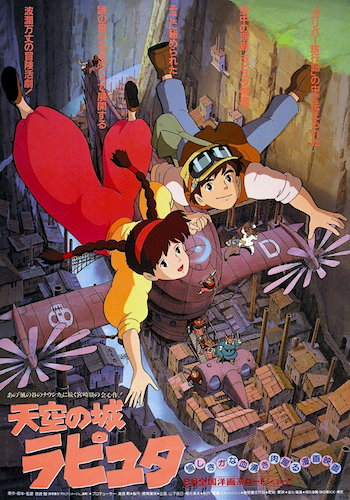
Laputa: Castle in the Sky (1986)

aka Tenkû no shiro Rapyuta

2020 #12
Hayao Miyazaki | 125 mins | Blu-ray | 1.85:1 | Japan / English | PG / PG

Laputa: Castle in the Sky

The names Hayao Miyazaki and Studio Ghibli go hand-in-hand (I wouldn’t be a bit surprised if quite a few people think they’re synonymous, i.e. that all Ghibli films are directed by Miyazaki), but his first two features (The Castle of Cagliostro and Nausicaä of the Valley of the Wind) were produced before Ghibli’s formation. So it’s Laputa, his third film, that is actually Ghibli’s first — which makes it appropriate to look at today, as it’s also one of the first titles being made available under Netflix’s new deal with Ghibli.* (Though if you search Netflix for “Laputa”, you won’t find it.)

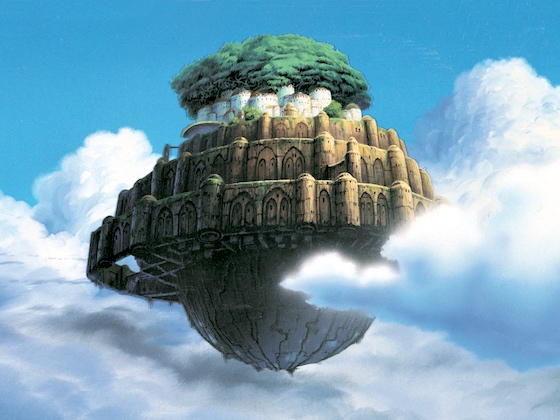
Acclaimed as one of the first major works in the steampunk subgenre, Laputa takes place in a Mitteleuropean alternate past — the architecture is inspired by Welsh mining villages; the uniforms and hardware by historical German military; there are steam-powered automobiles and flying machines; but there’s also magic-like stuff, so it’s not just tech-based. In this world we meet Sheeta (voiced in Disney’s English dub by Anna Paquin, retaining her New Zealand accent), a young girl wanted by both the military and sky pirates for a necklace she wears. When she falls from an aircraft, the necklace glows and lowers her gently to the ground — and into the life of Pazu (James “Dawson’s Creek” Van Der Beek), a young orphan who immediately resolves to help her. And so off they go on an adventure to find out just what’s so desirable about Sheeta’s necklace, and what it has to do with the legendary flying city of Laputa.

If you watched Miyazaki’s first three movies ignorant of the knowledge they came from the same writer-director, I’m sure you’d work it out for yourself. It’s an action-packed adventure laced with humour and morally grey characters, like Cagliostro, with a well-imagined fantasy world populated by flying machines and brave young heroines, like Nausicaä. But it’s no act of self-plagiarism — Miyazaki is too inventive for that. His world-building is first rate, sketching in the details of this alternate reality in between character building scenes and thrilling action sequences. If this were live-action, it would make an exemplary action/adventure blockbuster, so well paced and structured is it.

The castle in the sky

That’s why it immediately clicked with me as an instant favourite among both Miyazaki’s and Ghibli’s oeuvre. It’s unquestionably an adventure movie, so it lacks the heartfelt depths of something like My Neighbour Totoro, but it’s at least the equal of Cagliostro in terms of how wildly exciting the set pieces are. And it’s not as if it’s totally empty headed, touching on longstanding universal themes like the corruption of power, and with a minor-key ecological message too (another Miyazaki staple).

I always feel like I should watch anime in Japanese, and I often do, but when the English voice cast includes Mark Hamill, well, that’s good enough for me. He’s the villain, channeling a certain amount of his Joker (but not too much) into a government secret agent in pursuit of Sheeta and in search of Laputa. He’s just one of a memorable cast of characters — I mean, did I mention there were sky pirates? They’re as awesome as they sound, bringing both broad humour and fuelling several action scenes (you’d expect nothing less of frickin’ sky pirates, right?) One of the most memorable characters transcends the language barrier: a giant speechless robot, questionably friend or foe, who leaves a mark almost as great as the Iron Giant’s but in considerably less screen time. (Considering how much Pixar are renowned fans of Miyazaki, and that Brad Bird made Iron Giant over a decade after Laputa’s debut, I wouldn’t be surprised if there was at least a little cross-pollination.)

Like any good blockbuster, Laputa has it all: thrills, humour, emotion, wonder… It’s the complete package. Plus, that level of broad familiarity (it wouldn’t take too many steps to imagine this remade as a Hollywood blockbuster, although they’d inevitably mess it up somehow) probably makes it the perfect starting point for any newbies to anime or Ghibli.

5 out of 5

Laputa: Castle in the Sky is available on Netflix from today. It placed 11th on my list of The Best Films I Saw in 2020.

* If the news passed you by: Netflix have acquired the rights to 21 Studio Ghibli films (that is, their whole back catalogue of features except Grave of the Fireflies, which has separate rights issues, plus Nausicaä) for most of the world (the USA, Canada, and Japan are excluded). They’re being released in three batches of seven — the first lot today, the next on March 1st, and the final ones on April 1st. As well as Laputa, today’s selection includes My Neighbour Totoro, which I reviewed here, plus Kiki’s Delivery Service, Only Yesterday, Porco Rosso, Ocean Waves, and Tales from Earthsea. ^

The Personal History of January 2020

We’re a whole month in — 2020 is properly underway!

The less said about yesterday’s biggest news the better, so I’m just gonna plow on into some films…


#1 Crooked House (2017)
#2 Evil Under the Sun (1982)
#3 Rocketman (2019)
#4 Little Women (2019)
#5 Dial M for Murder 3D (1954)
#6 1917 (2019)
#7 The Dead Don’t Die (2019)
#8 Dolemite Is My Name (2019)
#8a What Did Jack Do? (2017)
#9 Bait (2019)
#10 Ad Astra (2019)
#11 (1963)
#12 Laputa: Castle in the Sky (1986), aka Tenkû no shiro Rapyuta
Rocketman

Laputa: Castle in the Sky

.


  • As should be self-evident, I watched 12 new feature films in January.
  • I watched my first film on New Year’s Day — the first time that’s happened since 2016.
  • I watched my second film on January 2nd — the first time that’s happened since 2012.
  • I watched my third film on January 3rd — the first time that’s ever happened.
  • I watched my fourth film on January 8th — which doesn’t sound as remarkable, but it’s earlier than I watched last year’s #1.
  • By #8, I was ahead of every previous year. By #12, I was ahead of just 54% of them.
  • In terms of averages, 12 slightly beats the January average (previously 11.42, now 11.46), but is slightly behind the average for 2019 (12.6).
  • Dial M for Murder is the first 3D film I’ve watched since last May, eight months ago.
  • This month’s Blindspot film was Federico Fellini’s semi-autobiographical search engine / hashtag nightmare of a title, .
  • From last month’s “failures” I watched just Little Women.


The 56th Monthly Arbitrary Awards

Favourite Film of the Month
I’m always wary of picking the last film I watched as my favourite of the month — I worry it’s just recency bias giving it a boost. And there are certainly other films I liked a lot this month — when I’ve settled on my final ratings, up to 50% of them will be getting full marks. But, eh, it’s just an opinion. So, for now, this month’s victor is a Miyazaki classic (of which there are so many!), Laputa: Castle in the Sky.

Least Favourite Film of the Month
This is a very straightforward choice, though. I’d heard only terrible things about The Dead Don’t Die, but the trailer had looked such fun that I went ahead and rented it anyway. Sadly, it was the word of mouth that was accurate — it’s a dud.

Most Quotable Film of the Month
You might not expect a black-and-white hand-developed art-house-y drama about the plight of locals in a Cornish fishing village to be full of zingers, but there are loads of such memorable bits in Bait. My favourite? A barmaid watching a local bloke chat up a bit of posh totty from out of town: “He’s wasting his time with her… ‘ow’s she gonna suck his dick with that plum in ‘er mouth?

Least Hashtag-Friendly Film of the Month
Continuing the theme of “recycling stuff I already put on Instagram”, you try and come up with a workable hashtag for .

The Audience Award for Most-Viewed New Post of the Month
This month’s winner slayed all before it to become, not just my most-read new post, but my most read post overall for last month (that happens quite rarely — just thrice last year, or 25% of the time). The post in question was my Christmas TV review. It received more than double the number of views as the post in second place (which was the previous TV review), a lot of that powered by referrals from IMDb for people wanting to read about Dracula. I hope I switched them on to The Goes Wrong Show while they were here… (The highest new film-related post was my review of The Personal History of David Copperfield.)


Last year’s Rewatchathon limped to an ignominious end (only just over half of my 50-film goal), but 2020’s is off to a solid start…

#1 Zatoichi at Large (1972)
#2 The Hound of the Baskervilles (1939)
#3 The Adventures of Sherlock Holmes (1939)
#4 Monty Python’s Life of Brian (1979)
#5 Twin Peaks (1990), aka Twin Peaks: Pilot

Starting at the end, Twin Peaks — the original pilot, which I watched in UHD courtesy of the From Z to A box set. I was counting it as a film as part of a long-term setup for eventually including it on a list of my favourite films (oops, given the game away!)… but I feel less sure after watching it again. Not of its greatness — I still reckon it’s one of the very best episodes of TV ever made, with at least one sequence that’s among my favourites in the entire history of visual storytelling — but it’s so obviously a pilot; so made to set wheels in motion for a series to run with them over many more hours. Yeah, there’s the close-ended International Version, but that’s a bit of a mess. This is something I’ll continue to ponder on.

As for the picture quality of this UHD version, it’s unfortunately a mixed bag. Lynch chose not to use HDR here, apparently… though I don’t know if that’s been confirmed or if it’s accepted wisdom from the disc not playing with HDR. I say that because when I turned Dolby Vision on, it kicked in. So is the disc encoded for Dolby Vision but not normal HDR? Is that possible? Or was my player ‘faking it’? I don’t know enough about how HDR/DV works to answer that. Normally I have Dolby Vision switched off because I don’t like it (I don’t know if I just consider it inaccurate or if it’s my TV’s fault, not displaying it properly for some reason), and Twin Peaks did nothing to convince me I should change that. Mainly it just seemed to make things too dark, erasing detail in the shadows (I tried fiddling with my settings in case I’d set it up poorly, but that didn’t help). With or without DV, the pilot doesn’t look right. The resolution is good, with improved fine detail compared to the Blu-ray, so that’s nice; but the colours look far too pale. Considering classic Twin Peaks is renowned for its warm look, this is especially jarring. Some scenes — outdoor ones, mainly, where the colours are cooler anyway — look just fine, but others look thoroughly wrong. What’s really baffling is that Lynch supposedly supervised this new version, so it should be bang on; but I’m pretty sure he supervised the previous one too, so what’s gone awry? Whenever I next watch the pilot, I’m going to have a difficult choice on my hands: 4K for the base-level image quality, or 1080p for (what I think is) the correct colour balance. Argh!

As anyone au fait with the news has likely guessed, I watched Life of Brian in honour of Terry Jones. Plus, I’d been meaning to rewatch it ever since I watched Holy Grail last September. Like that film, it’s now down to get the “Guide To” treatment at some point.

Rather than regurgitate comments about my other rewatches, I’ll point you towards Letterboxd for my thoughts on The Hound of the Baskervilles, The Adventures of Sherlock Holmes, and why I rewatched Zatoichi at Large when there are still several original Zatoichi films I’ve not seen.


2020 got off to a solid start, but there were still plenty of things I failed to see. On the big screen, I saw most of the stuff I really intended to — I’m happy to leave both Guy Ritchie’s latest, The Gentlemen, and belated trilogy-maker Bad Boys for Life until they reach rental. Speaking of which, I’ve got both Jennifer Kent’s The Nightingale and Danny Boyle’s Yesterday sitting on my Amazon Prime Video account with the days ticking down — definites for next month, those.

In terms of new disc acquisitions, I watched a few as soon as they landed on my mat, but I went on a bit of a spending spree this month — a mix of new releases, random bargains, and having some vouchers to use up. In the former camp, the BFI’s new Blu-ray of Judgment at Nuremberg rubs shoulders with Arrow’s release of Black Angel, a film noir directed by Roy William “director of 11 Basil Rathbone Sherlock Holmes films” Neill (which was recommended to me almost eight years ago by an esteemed fellow blogger, so it’s about time I got round to it).

The random bargains pile, meanwhile, is mostly made up of horror: the 101 Films Black Label edition of David Cronenberg’s Rabid; 88 Films’ box set of Hollow Man and Hollow Man II; and an import of Dario Argento’s Dracula 3D, which is meant to be absolutely terrible but, eh, I’m curious (it’s also only available in the UK on DVD or digital, neither of which are 3D, so I got the German one. The extras aren’t English-friendly, but I don’t reckon I’m ever likely to watch an hour-long making-of on this particular film). And in the “I had a voucher” camp, Don’t Look Now in its 4K limited edition form. Frankly, I’d’ve snaffled that up even without the voucher — it’s sold out online and so the price is beginning to rise on eBay and the like, but I happened across a single copy in a branch of HMV, where they were still charging the original price. The voucher comes into play because I wouldn’t even have been looking were it not for having an HMV voucher that expired the next day. So, that was nice.

And finally, the ever-burgeoning ranks of what’s available on streaming. Headliners this past month include In the Mood for Love cropping up on Prime Video — it’s one of the most acclaimed films of this century, but it never seems to be available in the UK, apart from an old DVD. It’s on my Blindspot list this year too, but I’d already got hold of it by, er, other means for that purpose. Other additions that drew my attention on Prime included Booksmart (particularly as I previously rented it but accidentally let the clock run out), Samuel Fuller’s The Naked Kiss, The Boondock Saints (one of those films I’ve heard of but don’t know much more about), and Jason Statham vehicle Wild Card — it’s been a while since I watched a run-of-the-mill Stath flick, so I feel overdue. Also overdue is a rewatch for Brokeback Mountain, which is also now on Prime here. Back in 2006 I was one of that rare breed who thought Crash was better. I didn’t hate Brokeback, but I didn’t like it much either. So, it’s long overdue that I revisit it and form a new opinion, now that I’m older and wiser.

Over on Netflix, the biggest hitter is probably Uncut Gems, which is one of this year’s many “should’ve had Oscar noms” films. But that only came out yesterday, so it’s not much of a “failure”… yet. Also catching my eye were Won’t You Be My Neighbor? (not to be confused with A Beautiful Day in the Neighborhood, which is only just reaching UK cinemas) and Zhang Yimou’s Shadow. Plus they now have Phantom Thread, which I personally don’t intend to rewatch in anything less than 4K, but I mention its presence nonetheless because I highly recommend it.


Ghibli comes to Netflix! Well, not if you’re in North America, but for the rest of us: hooray!

…although I own Blu-rays of most of the ones I’m interested in seeing, I’ve just not got round to watching them yet, so their presence on Netflix isn’t likely to affect my viewing much at all. Hey-ho.