Rocky V (1990)

2018 #206
John G. Avildsen | 104 mins | Blu-ray | 1.85:1 | USA / English | PG / PG-13
Rocky V

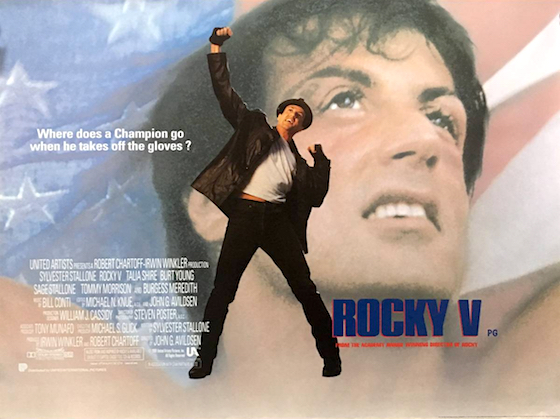
With his career apparently on the wane, the promise of a payday tempted writer and star Sylvester Stallone to reignite the Rocky franchise for one final round (as it’s turned out, this was far from the end, but more on that another time). After the cartoonish excess of Rocky IV, Stallone tried to shepherd this film back towards the series’ roots as a gritty drama, going so far as to rehire the Oscar-winning director of the first film, John G. Avildsen. It didn’t work: Rocky V was met with poor reviews and poor box office. Stallone himself has admitted its failure in the decades since: when he was asked to rate each of the Rocky films out of ten, he gave this one zero. In spite of all that, I thought it was… fine.

The plot picks up immediately after the end of Rocky IV, with the eponymous pugilist learning that the beating he took from Drago has left him with serious brain damage — one more fight could kill him. At the same time, a bad financial decision by Rocky’s brother-in-law Paulie (Burt Young) leaves the Balboa family in ruins, forced to move back to their old neighbourhood. Despite lucrative fight offers, Adrian (Talia Shire) insists Rocky remained retired, which leads to him encountering Tommy Gunn (Tommy Morrison), a wannabe boxer keen to be trained by the great Rocky. As Rocky begins to live vicariously through the increasingly successful Tommy, his son, Rocky Jr (played by Stallone’s own kid, Sage Stallone) is feeling neglected, especially as he’s struggling with bullies at his rough new school.
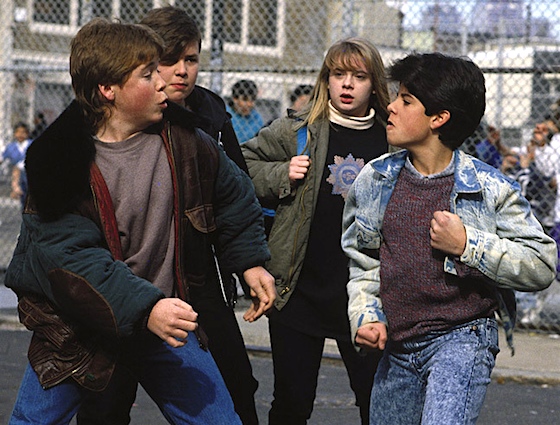
Rocky Jr

So, you can see how the film is trying to be more grounded — gone are the flag-waving ultra-patriotic theatrics of the last film, replaced with a grim story of financial ruin, inner city hardship, and what life is like after your dreams are over. It’s all a bit much. Indeed, it’s probably too much, because Stallone’s attempt to course-correct the franchise overshoots, sailing past gritty realism and into melodrama territory. There’s a lot of shouting and emotional theatrics, and the subplots are all a bit pat. I mean, Rocky neglecting his son because he’s training a fighter who he treats like a son is a solid enough plot, but it’s kinda obvious and we’ve seen its ilk before, and the way it plays doesn’t offer an original perspective on the material. So while it does work as a story, it’s part of what I mean about it being a melodrama — it’s not realism, it’s a heightened Movie story.

The rest of the film is similarly afflicted — there are plenty of cheesy parts, but it wouldn’t be a Rocky movie if there weren’t — though some behind-the-scenes choices don’t help. For example, Tommy Morrison was a real-life boxer, which probably seemed like a clever casting decision, but, given his limited acting ability, was possibly a mistake. That said, while he’s hardly a spectacular actor, I didn’t think he’s as bad as some people say. One thing that definitely doesn’t work is the soundtrack. The film is often scored with rap songs, which don’t fit the character at all. I don’t know whose decision it was, but presumably not Avildsen’s: in 2002 he snuck a workprint version of the film out online, dubbing it the “director’s cut”, and apparently it includes a lot more of Bill Conti’s original score. There were various other changes as well (you can read a review here). I don’t know how easy that version is to find nowadays, or what kind of quality it’s available in — in the 16 years since, it’s not been granted an official release.
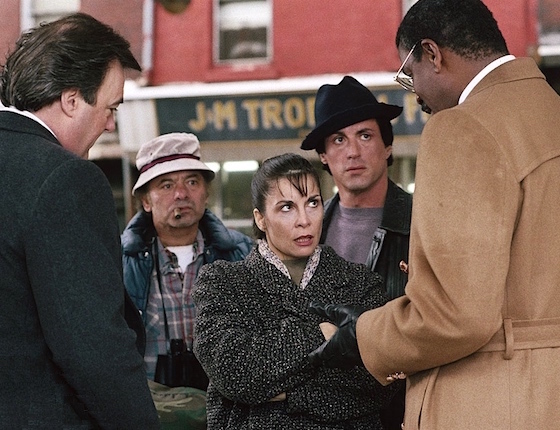
Balboa family values

The originally planned ending for the film had Rocky dying after the final fight, but Stallone and/or the studio thought that didn’t really fit the tone and themes of the series. Quite right, too. It also left the door open for the series to eventually continue and redeem itself: there’s the revival movie, Rocky Balboa; the spin-off with Rocky as a trainer, Creed; and the spin-off where Rocky got turned into a squirrel or a moose or something, The Adventures of Rocky and Bullwinkle. I can’t wait to see how that came about. (I jest — I know he’s the squirrel.*)

Altogether, I don’t quite see why Rocky V gets so reviled. It’s certainly not the best movie in the series — indeed, it’s probably the lowest point, lacking the realism of the early films, the entertaining ridiculousness of its immediate predecessors, and the feel-good zero-to-hero arc seen in all of those — but it’s a passable-enough drama in its own right.

3 out of 5

* I did not know this — I had to Google it. Never let it be said I don’t commit to a joke. ^
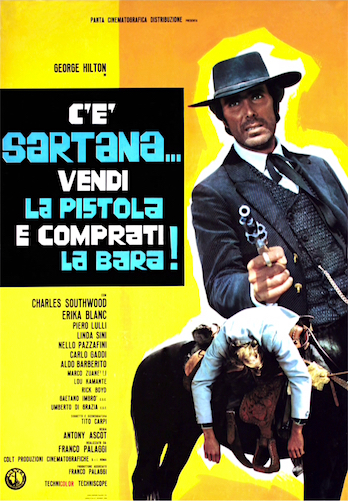
Sartana’s Here… Trade Your Pistol for a Coffin (1970)

aka C’è Sartana… vendi la pistola e comprati la bara!

2018 #188
Giuliano Carnimeo* | 92 mins | Blu-ray | 2.35:1 | Italy / English | 15

Sartana's Here… Trade Your Pistol for a Coffin

The third official Sartana movie is to this series what On Her Majesty’s Secret Service is to the Bond films: its one-shot leading man isn’t as good as the regular fella, but the film around him is a cut above.

Sartana’s just settling down to a nice picnic when he witnesses the robbery of a wagon by, apparently, a gang of horse thieves. The wagon was transporting gold… except it wasn’t: the bags are filled with sand. It’s all part of a scheme by the local rep of the mining company to rip off the hardworking miners and keep their earnings for himself. Naturally, Sartana embroils himself in the plotting, which also features a local impoverished saloon owner and several other gunslingers with competing interests in the gold.

The blurb for Arrow’s Blu-ray release states that Trade Your Pistol for a Coffin “finds the series taking a more tongue-in-cheek turn while retaining […] the usual blend of inventive gunplay, plot twists aplenty and a playful sense of humour.” It’s a pretty fair summation, to be brief: the film features quite a few fun bits of dialogue and a smattering of inventive shoot-outs. The plot isn’t bad either, at least for a while. The first half-hour or so sees Sartana follow things from one situation to the next, which keeps the story moving nicely and the narrative varied. After that, I’m not sure the villains’ plans all make 100% sense, and it only gets worse once the whole cast have been introduced and there are shifting alliances and double crosses galore. As it dove into the third act, I don’t know if I lost track of what the plan was meant to be or if the film just never explained it. That seems to be par for the course in these movies, though.

Playing games

New boy George Hilton is fine as Sartana, selling the character’s ingeniousness, and here gifted with a particularly nice line in magicking his trademark pistol up out of nowhere. Much like Lazenby in OHMSS, he lacks the cool iconicity of the guy who originated the role, but he makes a fair fist of it.

More of a standout is Charles Southwood as Sabbath (aka Sabata, depending which language you’re watching in), a rival gunslinger who makes for a fun addition to the film. He doesn’t turn up until halfway through, but from then he steals the show. It starts with a great introduction: he rides into town in a crisp white suit, sporting a straw boater and a girly parasol, before kicking the arses of some tough guys in the saloon. And then, to cap it off, he shares some amusing banter with Sartana over the card table. As the film goes on, the English-accented gent trades bons mots, reads Shakespeare and Tennyson, and reveals himself to be as quick-witted and gadget-stacked as the title character. Naturally it can only end one way: a Sartana vs Sabbath shoot-out. Their duel, saved for the film’s climax, is absolutely fantastic, as they take playful potshots at each other’s clothing before the victor executes an all-timer final move.

The film’s entertainment value is bolstered further by more good direction from Giuliano Carnimeo. There’s plenty of the usual Leone influence in shootouts and whatnot, but every once in a while there’s a delightful flourish — most memorably, the use of split-screen to show three adversaries dying together, and a split-focus shot that shows Sabbath watching as Sartana’s arrival is reflected in a teaspoon.

This often happened to the other fella

Trade Your Pistol for a Coffin isn’t the quintessential Sartana movie, owing to the absence of regular star Gianni Garko — Hilton’s a solid stand-in, but lacks the regular’s roguish charm. But the rest of the movie packs enough value that it’s my favourite in the series so far. Nonetheless, it’s still a bit too much of a B-movie to really transcend those roots; but, for the sake of differentiation from the other two if nothing else, I’m going to generously round my score up to a 4.

4 out of 5

* Credited as Anthony Ascott. ^

Behind-the-Scenes Comedy Review Roundup

A lot of people seem to enjoy spending October watching and reviewing horror movies all month, just because of one day at the end. Well, fair enough, if that’s your bag. But for now, let’s lighten the mood with a handful of pretty good comedies, all of which are related to the making of film and television… in one way or another…

In today’s roundup:

  • Mindhorn (2016)
  • In & Out (1997)
  • Zack and Miri Make a Porno (2008)


    Mindhorn
    (2016)

    2018 #34
    Sean Foley | 88 mins | streaming (HD) | 2.35:1 | UK / English | 15

    Mindhorn

    Back in the ’80s, actor Richard Thorncroft (Julian Barratt) starred in Mindhorn, a successful TV show about a detective on the Isle of Man who has a cybernetic eye that can see the truth — think Bergerac meets The Six Million Dollar Man. When an escaped lunatic insists he will only speak to Mindhorn, a washed-up Thorncroft sees an opportunity to revive his career by solving a real crime.

    Produced by and co-starring Steve Coogan, there’s definitely something a little bit Alan Partridge about Mindhorn — the blustering nobody who thinks he’s a star, rubbing people up the wrong way but carrying on regardless. It’s just one of several things Mindhorn is likely to vaguely remind you of. Even if it feels somewhat derivative, it’s still pretty funny, with some of the best bits coming from throwaway cameos. The whole supporting cast is very good indeed, actually, full of strong British actors having some fun. The film seems to derail a bit when it pretends to wrap the case up after half-an-hour, but it gets funny again once it has the common sense to restart it.

    So, not the greatest Brit-com ever — heck, it’s not even the greatest action-movie-spoofing Brit-com ever (*coughHotFuzzcough*) — but it’s mostly pretty amusing.

    3 out of 5

    In & Out
    (1997)

    2018 #39
    Frank Oz | 87 mins | streaming (HD) | 16:9 | USA / English | 12 / PG-13

    In & Out

    Inspired by Tom Hanks’ acceptance speech at the 1994 Oscars — when, after winning for Philadelphia, he thanked a gay teacher — In & Out is about a teacher whose former pupil wins an Oscar and, during his acceptance speech, outs the teacher as gay. The twist is, the teacher in question (Kevin Kline) didn’t know he was gay, and nor did anyone else — including his fiancée (Joan Cusack). As the media descends on the quiet little old-fashioned town and whips up a frenzy, the whole thing turns into a bit of a farce, albeit with a positive underlying message about sexuality and, ultimately, community. The premise barely sustains even this brief running time, but it’s all quite good-natured and likeable.

    3 out of 5

    Zack and Miri Make a Porno
    (2008)

    2018 #179
    Kevin Smith | 98 mins | streaming (HD) | 16:9 | USA / English | 18 / R

    Zack and Miri Make a Porno

    It’s funny how some movies cause a stir on release and then get kinda forgotten. The very concept of Zack and Miri Make a Porno (it’s in the title) was enough to give some people palpitations a decade ago, and the poster that alluded to oral sex (less a visual double entendre, more a single one) did nothing to help. And yet, does anyone really talk about it now? It’s only stuck in my mind because it’s on my 50 Unseen list from 2008, and I’ve not been able to cross it off because for a very long time it was never available to watch anywhere (it finally popped up on Netflix a couple of months ago). Well, I’m glad it did, because I really enjoyed it.

    As I said, the pitch is in the title. Zack (Seth Rogen) and Miri (Elizabeth Banks) are two old friends and housemates struggling to make ends meet, and who (through various plot machinations) decide to make a porn film together. As you do. Despite that risqué theme, the main relationship follows all your typical romcom beats; but those work because they work, and the edgy subject matter covers them up somewhat. Most surprisingly, their romance turns out to be actually quite sweet — even if major turning points hinge on things like them fucking for the first time in front of an audience. Aside from that, the film is full of the rude, crude, gross-out style humour that you’d expect, but I found it very funny nonetheless.

    4 out of 5

  • The “Oh My God, I Can’t Believe It” Monthly Update for September 2018

    Oh my god, I can’t believe it —
    I’ve never seen this many films before!

    For only the second time, 100 Films in a Year has reached 200 films in a year…

    …and — for the first time ever — beyond!


    #188 Sartana’s Here… Trade Your Pistol for a Coffin (1970), aka C’è Sartana… vendi la pistola e comprati la bara!
    #189 Lost in Space (1998)
    #190 Skyline (2010)
    #191 April and the Extraordinary World (2015), aka Avril et le monde truqué
    #192 The Tree of Life (2011)
    #193 I Kill Giants (2018)
    #194 Compulsion (1959)
    #195 The Hunt (2012), aka Jagten
    #196 Heathers (1988)
    #197 Courage Under Fire (1996)
    #198 Gods of Egypt 3D (2016)
    #199 Zatoichi’s Vengeance (1966), aka Zatôichi no uta ga kikoeru
    #200 Sholay (1975)
    #201 Network (1976)
    #202 Mary and Max (2009)
    #203 Ran (1985)
    #204 Step Brothers (2008)
    #205 Before Midnight (2013)
    #206 Rocky V (1990)
    April and the Extraordinary World

    Heathers

    Before Midnight

    .


    • September adds 19 films to 2018’s tally, in the process taking it past the final totals of both 2016 (195) and 2015 (200) to make it my biggest year ever!

    *ahem*

    So, back in 2015, after I reached my highest ever final total, I felt fairly certain that would never be beaten. It had been a push to get there, and I was determined to spend more time on things besides watching new films. Well, I haven’t done nearly as much other stuff as I’d hoped, but my film tally did drop slightly over the next few years (195 in 2016; 174 in 2017), plus starting my side goal of the Rewatchathon would surely steal numbers from the main tally.

    And yet here we are: at the end of September — with a whole 25% of the year left to go — and I’ve already surpassed that 200 total. Oh, and I’ve watched 38 films towards this year’s Rewatchathon, too.

    How has this happened? Goodness only knows. Whether the remainder of the year will keep up this pace, which would land me with a final tally in excess of 270 films… well, I don’t know that either. It seems unlikely, given that both August and September have had totals well down on the giddy heights of April and May (my two biggest months of all time). Nonetheless, a total in the 230s is a likely minimum, with 250+ not improbable — both far in excess of what I once thought possible (considering that, in two of this blog’s first six years, I failed to even make 100). What I will predict is that I won’t achieve these kinds of numbers ever again. But then, I said that last time…

    Anyway, back to notes about this month in particular:

    • As I said, I watched 19 new films this month, which surpasses the September average (previously 11.6, now 12.3), but falls just short of the rolling average of the last 12 months (previously 20.3, now 21), as well as 2018’s average to date (previously 23.4, now 22.9).
    • Rewinding to the start of the month for a moment, I watched a film on September 2nd, crossing another date off my list of “never seen a film on”s. That just leaves three to complete: January 5th, May 23rd, and December 22nd.
    • This month’s Blindspot film: Danish wrongfully-accused drama The Hunt, a film whose story will surely induce righteous anger in any viewer — which is not a criticism.
    • This month’s WDYMYHS film: Akira Kurosawa’s feudal Japan-set adaptation of King Lear, and his final samurai epic, Ran. It’s testament to Kurosawa’s magnificence that he made a movie this great but I wouldn’t even put it in his top five.
    • One film I didn’t watch this month was The Shape of Water. Having to wait so long for a chance to see it (it disappeared from cinemas near me in a flash, and the UK Blu-ray release came over three months after the US) seems to have accidentally put it on my back burner: it’s been on disc here since the end of June and I’ve still not got round to it. Maybe next month — after all, it is a monster movie.


    The 40th Monthly Arbitrary Awards

    Favourite Film of the Month

    I watched six or seven five-star films this month (one’s still wavering between a four and a five), which makes this a tricky proposition, especially as I really enjoyed some of the four-star ones too. Heck, I had a lot of fun watching Gods of Egypt, and I gave that three stars! It’s not my favourite film of the month, though. I’m going to bestow that honour on Heathers, which I finally got round to seeing thanks to Arrow’s 4K-restored Blu-ray release. Not only does it look fantastic, it’s a great black comedy too.

    Least Favourite Film of the Month

    Now, here’s a toughie: I watched two of the worst films I’ve seen all year back-to-back at the start of the month. I won’t be surprised if they both make the year-end bottom five. But, of the two, the one I liked least was Lost in Space, because at least Skyline is trying to do something interesting, whereas Lost in Space just squanders its blockbuster budget on being shit.

    Best Fight of the Month
    Tussles galore between giants, gods, and armies of Japanese warriors this month, but none were so gruelling as Celine and Jesse verbally slugging it out in Before Midnight.

    Old Film That’s Still Pertinent Today of the Month
    Media satire Network is 42 years old now, but I’m pretty sure you could take its screenplay, change only a couple of minor words, and film it as being set today.

    The Audience Award for Most-Viewed New Post of the Month
    For the fifth time this year, my monthly TV review was victorious in this category. I usually attribute this to referrals from IMDb, and the biggest contributor for this month’s column appears to have been Bodyguard. (The most-viewed new film review was Jack Reacher: Never Go Back.)


    A massive six rewatches this month, both catching up on the shortfall left after last month and surging ahead into next month’s ‘allowance’.

    #33 Darkman (1990)
    #34 Avengers: Infinity War 3D (2018)
    #35 Solo: A Star Wars Story 3D (2018)
    #36 Before Sunrise (1995)
    #37 Before Sunset (2004)
    #38 Kingsman: The Golden Circle (2017)

    I feel like someday I need to coalesce into words why I love Darkman — I only wrote a drabble after my first viewing, and I don’t feel like expounding on it right now, but it’s a really good fun pulp sci-fi/horror/superhero noir.

    Avengers: Infinity War is a slightly less mind-blowing experience when you know all the twists and developments — it’s one of those films where the first viewing may always be the best thanks to the surprises and reveals having a tangible impact — but it still holds up as a one-of-a-kind epic, full of excitement, humour, and even emotion. I’m miffed they didn’t put the IMAX ratio on Blu-ray (and always will be — I’m still cross with Brad Bird about Ghost Protocol), but at least the 3D was fantastic.

    Conversely, I definitely enjoyed Solo more on a second viewing, in part thanks to the better-managed expectations of having already seen it. It’s nowhere near the greatest Star Wars movie, but it’s a solid space adventure with many likeable touches. The 3D isn’t bad, but in terms of Fancy Modern Formats, I suspect Bradford Young’s notoriously dark photography would benefit more from UHD’s high dynamic range.

    I’ve been meaning to (re)watch Richard Linklater’s Before trilogy since the third one came out on DVD (no Blu-ray on this side of the pond) five years ago. And I’ve been really meaning to do it since Criterion released them in a lovely Blu-ray box set a little over 18 months ago (that doesn’t sound so bad — I thought it was longer). Well, obviously, I’ve finally done it.

    When I first watched the Before films in 2007 (only a duology back then), I was 21. I admired them both, but definitely preferred the first, Before Sunrise. Indeed, I was a little startled to realise I only gave it four stars in my original review. Now, it’s a firm five, and I’d say one of my favourite films of all time (it did place 28th in my 100 Favourites, but it would be higher now). However, consensus often seems to favour the second film, Before Sunset. I’ve always wondered if this is an age thing: when I first watched them, I was close to the age of the characters in the first film, whereas many critics contributing to said consensus would’ve been closer to the characters’ age in the sequel. Well, now I’m 32, and I certainly identified with the sequel a lot more this time than I did back then. I probably still prefer the first, on balance — it now comes loaded with nostalgia for being in your early 20s — but I consider the sequel to be more-or-less its equal.

    And what of the third film, Before Midnight? Well, I’ll publish a full review at some point…


    It’s October, which means only one thing here at 100 Films: the sheer terror of The Twilight Saga!