Rocky IV (1985)

2018 #152
Sylvester Stallone | 92 mins | Blu-ray | 1.85:1 | USA / English & Russian | PG / PG

Rocky IV

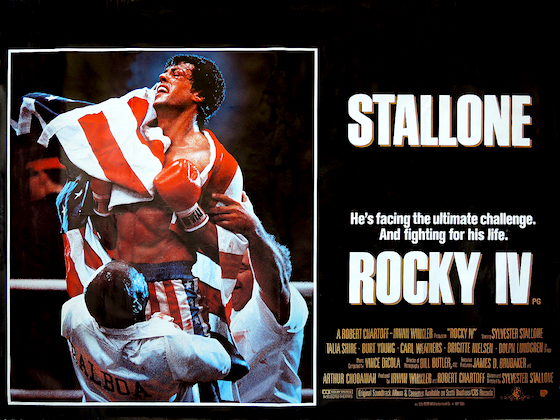
Rocky goes a bit Rambo for an instalment that abandons the series’ early gritty social realism roots in favour of an anti-Soviet propaganda cartoon tone. And, in fact, it was released the same year as First Blood Part II, which actually marked Rambo’s shift from being about a vet with PTSD to an “America, fuck yeah!” action series. What was up with Stallone in ’85?

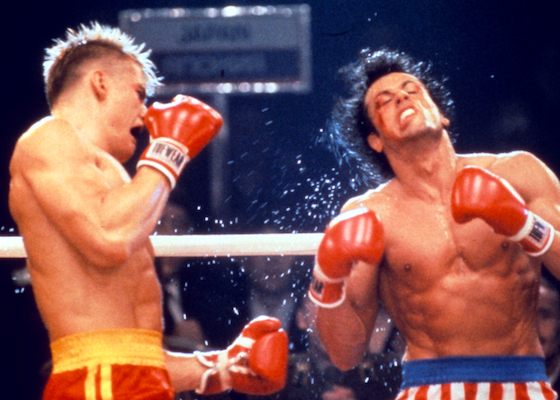
Anyway, back to Rocky. This time, his opponent in the ring is Ivan Drago (Dolph Lundgren), a poster boy for Soviet superiority and their advanced training methods. With Drago’s team harping about his brilliance, Rocky’s friend Apollo Creed (Carl Weathers) elects to come out of retirement to fight him and prove America’s supremacy. But the fight goes sideways, setting up a grudge match between Drago and Rocky.

Interpreting a sports movie as really being about the conflict between the USA and the Soviet Union might normally be considered subtextual analysis, but that’s not the case here — it couldn’t be more blatant. Sometimes this is as hilariously preposterous as you’d expect (Rocky’s victory speech is greeted by a standing ovation from the Soviet politburo!), but other bits actually work quite well. Take the sequence before the Creed-Drago fight: on one hand it’s a ludicrously OTT musical number; on the other, that’s the point, as shown by Drago’s confusion at the flashy spectacle going on around him, intercut with his wife’s exasperated sighs. It’s the mentality of the USA vs. the USSR encapsulated in a glitzy floorshow vs. a heavy frown.

USSR in the back

This isn’t the only bit of music in Rocky IV, though. Oh no. Far from it. Halfway through, the film basically stops dead for the sake of a music video montage of scenes from all four movies. It’s meant to signify a moment of introspection for Rocky, but it goes on for the length of an entire song. And that’s certainly not the only montage. Oh no. Far from it. At one point there’s a training montage… followed by another training montage. It’s like a spoof of itself.

And I haven’t even mentioned the robot that Paulie receives as a gift, which seems to have an AI. No, seriously. Later, he gives it a woman’s voice and refers to it as “his girl” while it delivers him beer and plays its favourite song. No, seriously.

Some people were trying a bit harder than writer-director Stallone, though. There’s a good supporting turn from Brigitte Nielsen, giving off Lady Macbeth vibes as Drago’s wife — she’s like his voice, doing all the talking in America while he just glowers around as a silent hulk of muscle. Carl Weathers is also given some good material as a Creed who’s miserable when out of the limelight, jumping at the chance to revive his fame — he revels in the renewed attention, even if it might mean his death.

Rocky IV is not a good film, but between the so-ridiculous-it’s-fun bulk and the genuinely good flashes, it’s certainly entertaining.

3 out of 5


And now, a special bonus review…

Rocky VI
(1986)

aka Rock’y

2018 #152a
Aki Kaurismäki | 8 mins | streaming | 1.85:1 | Finland / English & Finnish

Rocky VI

An early work from Finnish director Aki Kaurismäki (one of those world cinema names I recognise but couldn’t tell you a single film by), Rocky VI is not, in fact, the sixth entry in the Rocky franchise, but a short parody of the fourth one (the Roman numerals in the title being an inversion of the real film’s IV, obv.). Kaurismäki described the short as “my revenge on Mr. Stallone, who I think is an asshole.” Don’t hold back, Aki, tell us what you really think!

The film is basically all a music montage — so that’s quite accurate, then. In it, weedy little American Rock’y fights burly bushy-browed Russian fatso Igor. Rock’y spends several rounds getting absolutely pummelled, eventually falling over dead without Igor having to throw a punch. And that’s the end.

It’s too slight to be especially funny, with nothing to say other than “hey, wasn’t Rocky IV just pro-American propaganda?”, which I think we all knew. Really, Rocky IV is a better parody of Rocky IV than Rocky VI is.

2 out of 5

My Life as a Courgette (2016)

aka Ma vie de Courgette / My Life as a Zucchini

2018 #3
Claude Barras | 66 mins | streaming (HD) | 1.85:1 | France & Switzerland / English | PG / PG-13

My Life as a Courgette

My Life as a Courgette (or, to use the American name for the vegetable, Zucchini) is the story of young lad Icare — who prefers to be called “Courgette”, his mother’s nickname for him — and his life after he is taken into an orphanage. If you’ve heard of it, it’s most likely because it was nominated for Best Animated Feature at the 2017 Oscars.

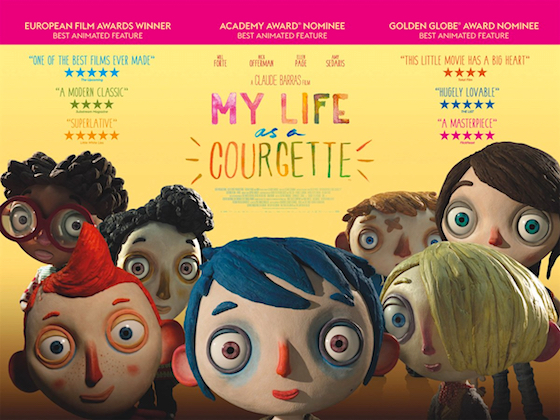
It’s adapted from the novel Autobiographie d’une Courgette by Gilles Paris, which was apparently a realistic portrayal of the lives of orphans in France. As you can see, the film takes a more cartoonish style, at least on the surface. In fact, the whimsical production design belies the very serious nature of the story — it’s not as monumentally grim as it could be, given the subject matter, but it doesn’t shy away from some very dark areas. It handles these with an understated, calm maturity that is both befitting and refreshing. The animation itself is equally sophisticated, with innumerable little touches that add finesse and richness to the work.

Orphaned

I watched the English dubbed version, because Amazon Prime gave me no choice (the original French version is available on Amazon Video, but for some reason not also included with Prime). Fortunately, despite having a US voice cast, they stuck with “Courgette”, meaning there’s no constant annoyance of the main character being called the wrong thing. (I do wonder, though: did they have to record it all twice, or did the American release rename the film My Life as a Zucchini but then call the kid Courgette anyway?) Fortunately, the dubbing wasn’t at all bad. Of particular note is Nick Offerman, giving a remarkable restrained performance as the gentle and kindly cop Raymond. As for Courgette and his fellow orphans, I don’t know if they cast actual kids or used adult soundalikes, but they also provided uniformly strong voice work.

My Life as a Courgette is one of those “weird foreign animations” that often manages an Oscar nod but doesn’t stand a snowball’s chance in Hell of winning thanks to the conservativeness of Oscar voters — there’s no way a mature, restrained animation with a quirky visual style is going to beat the latest shiny-CGI fun-time from Pixar or Disney. For those with broader tastes, however, it’s definitely worth a look.

4 out of 5

Film Noir Review Roundup

I’ve made a conscious effort to watch more film noirs this year, and today’s roundup contains a few results of that:

  • The Narrow Margin (1952)
  • Accomplice (1946)
  • Shockproof (1949)


    The Narrow Margin
    (1952)

    2018 #2
    Richard Fleischer | 68 mins | TV | 4:3 | USA / English | PG

    The Narrow Margin

    Recognised as a classic noir, The Narrow Margin follows a detective (Charles McGraw) who must protect a mob boss’ widow (Marie Windsor) as she travels by train from Chicago to LA to give vital evidence. As the ‘tec finds himself getting involved with an attractive fellow passenger (Jacqueline White), the assassins on his trail mistake her for their actual target…

    What unfurls is an exciting plot with some solid twists and some great dialogue (enough that it earnt a Best Writing Oscar nomination, in fact), all told in a snappy running time that ensures the film powers forward like, well, a locomotive. Director Richard Fleischer makes very effective use of handheld camerawork and the train setting to create a confined, claustrophobic atmosphere that emphasises the tension and peril of the characters. It all blends into a very fine thriller.

    4 out of 5

    Accomplice
    (1946)

    2018 #16
    Walter Colmes | 66 mins | streaming | 4:3 | USA / English

    Accomplice

    Described by Paul Duncan’s Pocket Essential Film Noir as “hardboiled fun”, and by the few other people online who’ve seen it with phrases like “one of the worst assembled detective movies I’ve had the occasion to watch in a long time”, Accomplice graces my eyeballs before many no doubt finer examples of film noir by virtue of the fact it was available to stream on Amazon Prime and I thought I’d catch it while it was there.

    Adapted by Frank Gruber from his novel Simon Lash, Private Detective, it sees private detective Simon Lash (Richard Arlen) being hired to track down a missing bank executive by his concerned wife (Veda Ann Borg), but the bank insists he’s merely on vacation. As Lash digs deeper, he begins to suspect the wife may have other motives — as does, well, everyone else.

    Running little more than an hour, Accomplice’s plot races past, giving you no time to stop and consider it. Maybe that’s for the best. Conversely, it makes it feel like it doesn’t hang together, even if it actually does. But it rushes along at a scene level, too: Lash seems to figure things out as quickly as it takes the actors to say their lines. It’d be Sherlockian, if you actually believed he had the necessary information and wherewithal to make the deductions.

    There is some fun to be had in a speedy car chase and the film’s occasionally kooky location choices, like the climax being set at a castle in the middle of the desert that’s pitching itself as some kind of hotel for mid-getaway crooks (I think that was the owner’s business plan, anyway). There are other surprising flashes of entertainment, though some of them were likely unintentional, but Accomplice is not really a good film.

    2 out of 5

    Shockproof
    (1949)

    2018 #68
    Douglas Sirk | 76 mins | TV | 4:3 | USA / English | PG

    Shockproof

    When you hear “film noir” you don’t immediately think of director Douglas Sirk (nor vice versa), better known for his colourful ’50s melodramas. Well, according to They Shoot Pictures, Don’t They’s list of most-cited noir films, he helmed three, of which this is the second. The plot has plenty of noir elements, but the film actually feels more like a romantic melodrama. It’s quite an effective mix.

    So, the noir: it’s about a female murder parolee (Patricia Knight) and her parole officer (Cornel Wilde), who begins to fall in love with her. But is she still attached to the crook she took the fall for (John Baragrey)? Is she just pulling the wool over the eyes of the parole officer? That’s kind of a love triangle, hence we’re back in melodrama territory. But the advantage of it being billed as a noir rather than a romantic drama is you’re not sure where it will go. Will she fall for the good honest parole officer with his sweet younger brother and blind mother? Or will she be tempted back to the criminal love of her life? Or will it have a more tragic ending altogether?

    Well, no spoilers, but it definitely takes a turn I wasn’t expecting — the third act spins off in a whole different direction. To be honest, I didn’t really like it, but at least it was unusual, a big departure from the earlier part of the film, and it kind of worked because of that. Again, no explicit spoilers, but it comes to a neatly ironic conclusion… before there’s one extra scene, which feels tacked-on and undermines where the film had got to tonally. And that’s exactly what happened: co-producer Helen Deutsch rewrote Samuel Fuller’s screenplay and added a cop-out ending that Sirk felt ruined the film.

    Fatal femme

    At least until that point there’s stuff to enjoy. Knight’s performance is the real star: although her true nature seems to have been revealed at the start (she’s a parolee, i.e. a no-good criminal), the film adds more nuances to her than that — primarily, you can’t be sure if what she’s doing is genuine, or if she’s playing the parole officer for her own ends. There’s also an interesting turn from Baragrey: I couldn’t be sure if his acting was a bit flat, or if he was deliberately being cool, cold, calculated, thinking he’s always in control, the smartest guy in the deal. Well, even if it’s the former, it functions well as the latter.

    So, Shockproof (a title that has no relevance whatsoever, incidentally) isn’t a total disaster, with some surprising turns that are to be commended even when they don’t work. It was clearly a compromised production, but an interesting one.

    3 out of 5

  • I Am Sartana, Your Angel of Death (1969)

    aka Sono Sartana, il vostro becchino / Sartana the Gravedigger

    2018 #169
    Giuliano Carnimeo* | 103 mins | Blu-ray | 2.35:1 | Italy / English | 15

    I Am Sartana, Your Angel of Death

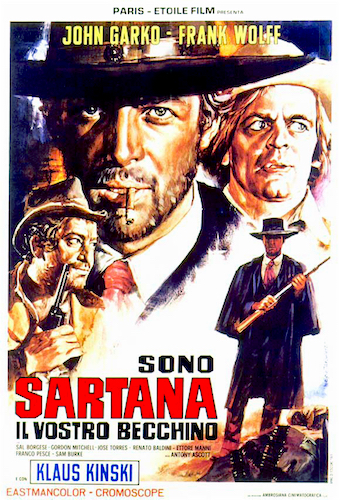
    The second official movie to star Western antihero Sartana is, according to the blurb on Arrow’s Blu-ray release, “a more playful film than its predecessor, possessing an inventive visual style and developing its central character into a more creative and resourceful figure.” That’s bang on — and it’s a better film for it.

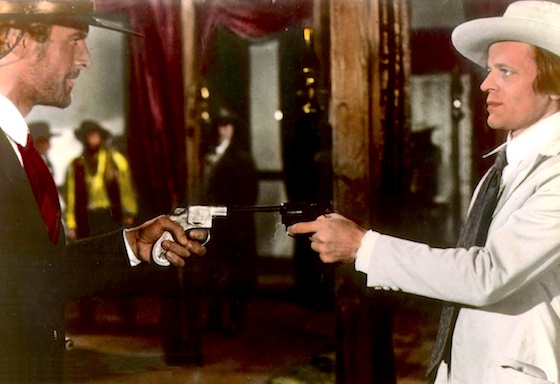
    It starts with a bang, too: a bank robbery that turns into an action-packed shoot-out. The leader of the gang is posing as Sartana, which puts a price on our hero’s head. He sets about trying to prove his innocence and get his revenge, while three fellow bounty hunters set about trying to kill him.

    Your Angel of Death is a lot slower paced than the non-stop action-fest of the first film, but that has its benefits: the plot is a lot clearer, and there’s more time invested in characters and non-violent set pieces (like Sartana’s card tricks), which I thought made for a more enjoyable watch overall. The storyline gives the film a “whodunnit” element, as the guy who framed Sartana is as much a mystery to us as it is to him. The film develops Sartana into a more interesting character, too, because his resourcefulness really comes out here. He doesn’t just shoot fast — he plans his strategy, uses objects as weapons in cunning ways, sometimes coming up with such things on the fly.

    Sartana takes aim

    Of the three men after Sartana, only the one played by Klaus Kinski gets any serious screen time. Kinski was a bankable actor in these kind of movies at the time, and so after his cameo-sized appearance in the first film he’s back here with a bigger role, as a somewhat camp bounty hunter. There’s a sort of running gag where he’s terrible at cards, and knows it, but can’t help playing anyway, which is quite fun. As for the other two hunters, one is used for a decent shootout-cum-chase sequence early on, but the third is introduced alongside the other two only to disappear entirely until the final duel, which makes the finale somewhat anticlimactic. One nice touch, though: Sartana clearly has a longstanding professional relationship with all three men — comrades in the bounty hunter game, or something like that — which adds an extra dimension to their encounters.

    The other standout in the supporting cast is Frank Wolff as Buddy Ben. Sartana initially thinks Ben might’ve set him up, but he was in prison at the time. From there he takes on the role of Sartana’s sidekick, kinda — we’re still not quite sure if he’s to be trusted, which is a nice dynamic.

    Barrel to barrel

    Giuliano Carnimeo’s direction is less remarkable than Gianfranco Parolini’s work on the first film… or so I’m told: every review seems to mention it, as does Arrow’s booklet. There are some nice flourishes, however, with the most obvious being that almost anytime someone is shot the camera dramatically tips over sideways, mimicking their death. Apparently the film’s more humorous and ironic tone is in keeping with Carnimeo’s style, in contrast to the more straightforward action of Parolini, and that’s a positive in my book.

    Your Angel of Death was a more enjoyable experience than the previous film, which was very welcome because (as I mentioned in my previous review) I’d been slightly concerned that taking a punt on this box set would turn out to be a mistake. (Well, there are still three more films to go, so we’ll see!) That said, although there’s a lot of inventiveness and fun, it’s to the film’s detriment that it often feels a little slow. My score errs on the harsh side, then, but to go the other way would be generous.

    3 out of 5

    * Credited as Anthony Ascott. ^

    Jack Reacher: Never Go Back (2016)

    2018 #38
    Edward Zwick | 113 mins | streaming (HD) | 2.35:1 | USA & China / English | 12 / PG-13

    Jack Reacher: Never Go Back

    It’d take a braver man than me to name a sequel Never Go Back; doubly so a sequel to a film that garnered an at-best mixed reception; triply so a sequel to an adaptation whose star was vocally and unrelentingly regarded as being terribly miscast by the book’s own fans. But Jack Reacher star — and, more importantly, producer — Tom Cruise is the kind of man who jumps out of planes all day every day for weeks on end merely to capture one relatively minor sequence in a film, so I think we can safely say he’s a much braver man than me.

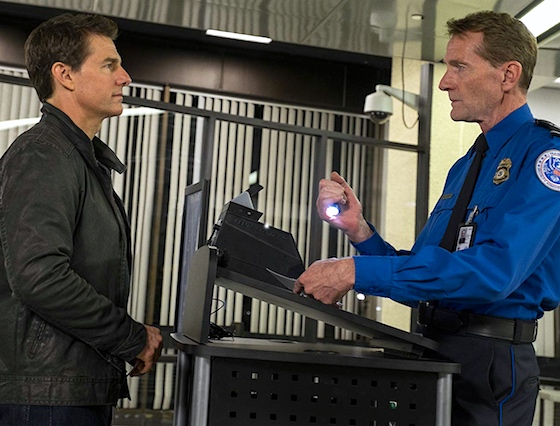
    For those unfamiliar with the character, Jack Reacher (Tom Cruise) is a former military police officer turned drifter — why he quit and why he hasn’t settled down like a normal person is probably explained somewhere, but I can’t remember. Naturally, as he drifts around the US he keeps finding himself involved in escapades — there wouldn’t be stories worth telling otherwise, would there? In this one, one of Reacher’s friends, Major Susan Turner (Cobie Smulders), is arrested for espionage. Reacher is certain she’s being framed, and his investigations lead to him being set up too. As the pair go on the run to uncover a conspiracy and clear their names, there’s the added complication of having to protect teenager Samantha Dutton (Danika Yarosh), who may be Reacher’s daughter.

    What plays out is a solid plot, smattered with decent action sequences. Frankly, it’s nothing incredible, and you’d have reason to expect more distinctive work from a director of the calibre of Edward Zwick (helmer of well-regarded films like Glory, The Last Samurai, and Blood Diamond), but it’s still a good action-thriller.

    Cruise in for a bruisin'

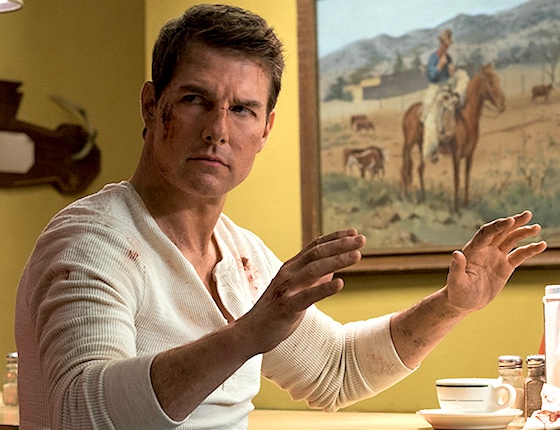
    In the title role, Cruise is good. It’s different to his usual routine — the familiar grinning charm is dialled way down, in order to facilitate Reacher’s trademark stoicism — but he’s got a charismatic enough presence that he remains an engaging lead even without it. Smulders and Yarosh also acquit themselves well. Together, the trio make for a neat de facto family. Once they’ve been brought together, the way they move through the narrative as a unit gives the film a different vibe from the “lone hero” thing you’d expect. Unfortunately, the bad guys are as bland as anything. It lacks even one really good villain, which is an especially noticeable problem after the first film had Werner bleedin’ Herzog to chew up the scenery.

    The title Never Go Back became a truism for some observers, because the film was not a success, either with critics (38% on Rotten Tomatoes) or at the box office (just $58.7 million in the US, though it drummed up a solid $162 million worldwide). Part of that is Reacher fans’ enduring dislike for Cruise’s casting. When they were bemoaning it before the first film’s release, I thought it was probably a storm in a teacup; that they’d get used to him over time. I mean, their sole objection seemed to be that he was too short, and how important was that, really? Incredibly important, apparently, because six years and two films later they still really, really hate him in the role. (Personally, I think him being a bit of a short-arse suits the characterisation better. Reacher seems to be a guy who gets underestimated; you don’t underestimate someone who walks in with the bulk of, say, Arnie. But then I’ve never read the books, so I may be wrong about this somehow.)

    A woman's place is in the kitchen

    Fans are one thing, but what put wider audiences off? Maybe it was just the poor reviews. Producer Christopher McQuarrie (who directed the first one, but was too busy on Mission: Impossible to return for the sequel) thinks one problem was they adapted the wrong book. I believe I saw him talk about this on Twitter, which means his comments can’t be referenced (because his tweets self-destruct), but if I remember correctly he didn’t say it was a bad novel, just that it didn’t work when placed as the second in the series. He speculated that more films were needed to establish Reacher’s character and world before they told this particular story. I tend to agree. For one thing, the film has to resort to an early montage to show Reacher and Turner’s friendship growing, which could’ve been more naturally handled by spreading it over a film or two. I think the possibility of Reacher having a kid would also carry greater weight if we were more familiar with the character from multiple adventures.

    Well, it’s all academic now, given the film series is most likely over: just this week, creator Lee Child announced he intends to take the rights to TV, primarily to cast a more faithful actor after those continuing complaints about Cruise. It’ll be interesting to see if it really does make a difference having a taller actor in the role. Somehow, I suspect not. Child also said he’s aiming for the mooted series to adapt one book per 10-12 episode season. Considering he’s written 22 books already, I wonder if he believes they’ll ever get through them all…

    “Sorry son, you just don't measure up.”

    Hopefully whatever they do works, because I’ve enjoyed these Reacher films so far. Never Go Back may not be all it could be, but it’s not so poor as to merit abandoning the film series entirely — it’s above average rather than exceptional (my score errs on the harsh side, in part to differentiate it from the superior first movie). It’d be a shame to see the films tossed aside for something lesser.

    3 out of 5

    The UK TV premiere of Jack Reacher: Never Go Back is on Channel 4 tonight at 9pm. It’s also available on Netflix UK as of yesterday.

    The 100th Monthly Update for August 2018

    It’s been over eight years now since I started charting my progress via monthly updates — the first was in May 2010. And that, as you may’ve guessed, makes this the 100th such monthly update. (Although this was the 140th month I’ve been doing 100 Films, so, er, it’s kind of meaningless and arbitrary, really…)

    Anyway, to mark this special occasion I’ve… named this blog post after it. And… that’s it.

    So, on to this month’s viewing!


    #174 Beneath the Planet of the Apes (1970)
    #175 Pride and Prejudice and Zombies (2016)
    #176 Strangers on a Train (1951)
    #177 A Quiet Place (2018)
    #178 The Quiet Earth (1985)
    #179 Zack and Miri Make a Porno (2008)
    #180 Christopher Robin (2018)
    #181 Zatoichi and the Chess Expert (1965), aka Zatōichi jigoku-tabi
    #182 Darkest Hour (2017)
    #183 Ready Player One 3D (2018)
    #184 Seoul Station (2016), aka Seoulyeok
    #185 The Most Unknown (2018)
    #186 Zorro (1975)
    #187 The Elephant Man (1980)
    Christopher Robin

    Zorro

    .


    • With 14 new films watched, August is the lowest month of 2018 so far.
    • Nonetheless, it beats the August average (previously 11.7, now 11.9). And though it falls short of the rolling average of the last 12 months (20.0), last August was even lower, so it still increases it (slightly) to 20.3. No such luck with my average for 2018 to date, though, which was previously 24.7 and is now 23.4.
    • But it’s only by recent standards that a total of 14 looks in any way poor. There’s no other year in which it would be the smallest month, and three years where it would’ve been the biggest. Plus, it would be an above-average tally for any month of the year except May, where it’d be bang on average. So, on an all-time scale, 14 is still good going.
    • In other good news, this month I passed 2017’s total to make 2018 my third best year ever. It will almost certainly reach second place next month. And I’d have to average just three films a month for the rest of the year for it not to become my best year ever. Well, let’s not jinx it…
    • It wasn’t a deliberate choice to watch A Quiet Place and The Quiet Earth back to back (though possibly a subconscious one, I guess). They’re the first (and second) films beginning with Q in this year’s viewing, and only the fifth and sixth in this blog’s lifetime.
    • And then I immediately followed those with a film beginning with “Z”, which would normally be quite rare (it was only my 13th ever “Z” film), but this year it really isn’t: it was my 7th this year alone, and by the end of the month I was up to my 9th.
    • While we’re on the topic, The Elephant Man is my first “E” film this year. It may be the most commonly used letter in the English language, but it’s a surprisingly rare one at the start of film titles.
    • This month’s Blindspot film: Alfred Hitchcock’s murderous thriller Strangers on a Train.
    • This month’s WDYMYHS film: the aforementioned The Elephant Man. Disappointed to discover it wasn’t David Lynch’s attempt at superheroes. (Not really.)


    The 39th Monthly Arbitrary Awards

    Favourite Film of the Month
    There are some well-regarded films in the list above, including a couple of Best Picture nominees, but nothing leaps out at me as a huge favourite — my short list for this award encompassed nine of the fourteen titles. On balance, I’m going to pick Christopher Robin. It’s definitely not the “best” film up there, but I love Pooh, and he’s on particularly good form in this film.

    Least Favourite Film of the Month
    There were no films I outright disliked this month, but two flicks battle it out for the title of least whelming — both starring zombies. I expected very little of Pride and Prejudice and Zombies, so I was surprised to find parts of it rather enjoyable. I still don’t think it was all it could’ve been, though. On the other end of the spectrum, there was a weight of expectation on a prequel to the magnificent Train to Busan, one which Seoul Station couldn’t live up to. It’s by no means a “bad film” though, and is certainly the best least-favourite film this year.

    Podcast of the Month
    Your mission, should you choose to accept it, is to listen to journalist Chris Hewitt chat with writer-director Christopher McQuarrie about Mission: Impossible – Fallout for 5 hours and 52 minutes on the two-part Empire Film Podcast Mission: Impossible – Fallout Spoiler Special. No, that’s not a typo: the interview (actually two interviews) lasts almost 6 hours. If that sounds like an OTT amount of time to discuss one film… well, I guess it would be for some. But McQuarrie is an intelligent, articulate, thoughtful, and honest interviewee, and the insights he shares about the process of making Fallout, a big-budget entertainment-focused summer blockbuster, are fascinating for die hard Mission fans, or, indeed, anyone interested in behind-the-scenes details of filmmaking. He gets pretty candid at times too. I guess Paramount okayed it, but it feels more revealing than you normally hear during a film’s press cycle — including what really went on during the saga of Henry Cavill’s moustache and the Justice League reshoots. (If you just want to hear that, it’s in the final 15 minutes of part one.)

    Best Swashing of Buckles of the Month
    Really, this is just an excuse to highlight the 1975 version of Zorro starring Alain Delon. It’s a Spaghetti Western cum swashbuckler, an actioner cum comedy, with very much the same kind of tone as Richard Lester’s Three Musketeers. It’s a lot of fun, and I think rather underrated. If you’re interested, it’s currently streaming on Amazon Prime in the UK (but not in the US, I’m afraid. Don’t know about elsewhere, or other providers).

    The Audience Award for Most-Viewed New Post of the Month
    Despite only appearing on Thursday, my 37th TV column stormed up the charts, taking under 36 hours to pass presumed victor Christopher Robin (which had two whole weeks to amass its hit count) to bag this month’s crown. I thought this would be due to referrals from IMDb seeking my Disenchantment review, but the stats show it’s more thanks to referrals seeking Magic for Humans. Well, there you go.



    Sadly, I fell slightly behind target with my Rewatchathon viewing this month. I only missed one, though, so that should be easily caught up.

    This month, by coincidence, they’re all spy thrillers in long-running series…

    #30 Skyfall (2012)
    #31 Mission: Impossible – Fallout (2018)
    #32 The Hunt for Red October (1990)

    The big news here is Mission: Impossible – Fallout, because it’s the first film I’ve seen twice at the cinema since Watchmen back in 2009. It’s a superb film that I would’ve considered seeing twice anyway, but it was sealed by getting the chance to see it in IMAX, where it did look incredible. (For the record, and for anyone who cares, it was only “LieMAX”, but still, looked great.) I would have quite liked the chance to see it in 3D too, especially as there doesn’t seem to be a Blu-ray release scheduled for that, but hey-ho.

    Much like Never Say Never Again last month, I only watched Skyfall because I happened to see it was on ITV2. This time I was flicking and came upon it a little way in. Normally I wouldn’t watch a film under those circumstances, but I had nothing better to do and it’s so good that I became engrossed, eventually watching it through to the end. So, technically, this isn’t a full viewing, but I did watch the vast majority of it. According to my records, I’ve only seen it twice before, the last time being five-and-a-half years ago in February 2013. Even though I’m counting this, I feel like I should do it again properly sometime soon.

    Finally, The Hunt for Red October is a film I remembered liking but, well, that’s about all I remembered. I’ve been meaning to re-watch it for many years, and I recently bought the Blu-ray so I could do just that — and, having checked my records, it turns out “recently” here means “three-and-a-half years ago”. I’m a lost cause, people… And I didn’t decide to finally get round to it because the latest reboot of the character came out yesterday. Well, not consciously, but I do keep seeing posters for the series around, and I have been quite looking forward to it, so that may have exerted a subconscious pull.


    So, August was quite a slow month, both in viewing and review-posting, because I was away from home for a fair chunk of time in the middle. I’d hoped to catch up some on my ludicrous review backlog during that time, but that didn’t happen. Not even a little bit. And the reason I’m mentioning this now, in the “next month” section, is that the rest of my year is shaping up to be pretty busy with non-film stuff too, which is likely to mean a continued reduction in viewing and blog-writing. Only time will tell just how that pans out.