Superman (1978)

The 100 Films Guide to…

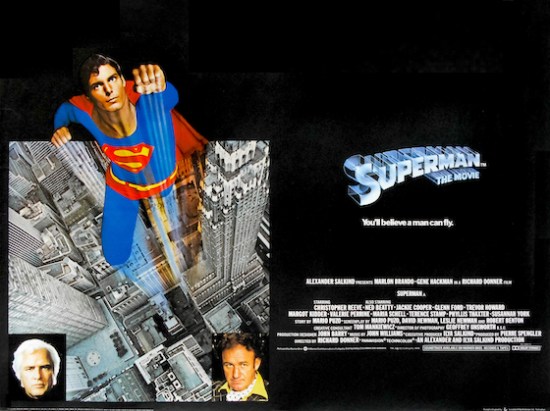
Superman: The Movie

You’ll believe a man can fly.

Also Known As: Superman: The Movie

Country: USA, UK, Panama, Switzerland & Canada
Language: English
Runtime: 143 minutes | 151 minutes (Expanded Edition) | 188 minutes (TV version)
BBFC: A (1978) | PG (1986)
MPAA: PG

Original Release: 11th December 1978 (New York City)
UK Release: 14th December 1978
Budget: $55 million
Worldwide Gross: $300.2 million

Stars
Christopher Reeve (The Remains of the Day, Village of the Damned)
Margot Kidder (Black Christmas, The Amityville Horror)
Gene Hackman (The French Connection, Unforgiven)
Marlon Brando (The Godfather, Apocalypse Now)

Director
Richard Donner (The Omen, Lethal Weapon)

Screenwriters
Mario Puzo (The Godfather, Superman II)
David Newman (Bonnie and Clyde, Moonwalker)
Leslie Newman (Superman III, Santa Claus: The Movie)
Robert Benton (What’s Up, Doc?, Kramer vs. Kramer)

Story by
Mario Puzo (Earthquake, The Godfather Part II)

Based on
Superman, a DC Comics superhero created by Jerry Siegel and Joe Shuster.

The Story
The only survivor of the destruction of his home world, Kal-El is raised on Earth realising he has extraordinary abilities. When he comes of age and comes to understand where he came from, he resolves to use his powers to help mankind — which is handy, because criminal genius Lex Luthor is planning a destructive scheme that only a superman could prevent.

Our Hero
Is it a bird? Is it a plane? No, it’s Superman! He can fly, he can withstand bullets, he can see what colour underwear Lois Lane is wearing…

Our Villain
Lex Luthor, criminal mastermind and possessor of a suspiciously varied hairstyle, whose latest real estate-based plot is put at risk when Superman emerges.

Best Supporting Character
Super-journalist Lois Lane. She may be a strong-willed highly-capable modern woman, but she still swoons at the sight of a muscly superhero.

Memorable Quote
Superman: “Easy, miss. I’ve got you.”
Lois: “You’ve got me? Who’s got you?!”

Memorable Scene
As Lois Lane takes off in a helicopter from the roof of the Daily Planet, it snags on a wire, crashing into the rooftop and ending up dangling over the edge. As a crowd gathers below to watch the unfolding tragedy, Lois struggles to climb out, but slips and falls. As she plummets to certain death, in swoops Superman to catch her. Cue: Memorable Quote. And then, with his free arm, he rescues the helicopter too.

Memorable Music
John Williams at the height of his powers, composing another of the most iconic main themes of all time, plus an equally epic score to go with it. What more do you need to say?

Technical Wizardry
The sets are magnificent, particularly the several huge constructions, like Luthor’s underground lair, or the icy Fortress of Solitude. Reportedly, director Richard Donner was disgusted that designer John Barry didn’t get Oscar recognition for his work, especially as one of the actual nominees for Best Art Direction merely duplicated an existing hotel.

Truly Special Effect
You’ll believe a man can fly! Obviously some of the late-’70s special effects have dated 40 years on, but, actually, many of them hold up surprisingly well today.

Letting the Side Down
In case you haven’t seen the film, spoilers. If you have seen it, surely you know what this is: when Superman flies around the Earth to reverse its rotation, thereby turning back time. It’s possibly the most scientifically implausible thing to ever appear in a major motion picture, and I’ve seen Geostorm. What’s most disappointing is how it threatens to ruin a near-perfect film right in its closing minutes. Surely they knew that was stupid even in the ’70s? (I say “nearly perfect” because there’s also Lois’ terrible poem/song when Superman takes her flying. But that’s as nothing compared to the sodding time travel.)

Making of
There’s lots of great making-of trivia about the film, but one I didn’t even notice: for the sake of continuity, they had Christopher Reeve dub all of young Clark Kent’s dialogue — the voice of the actor who played young Clark, Jeff East, is never heard.

Previously on…
As the first superhero, Superman has a long history on screen, starting with the 17 Fleischer Studios and Famous Studios cartoons produced between 1941 and 1943. The first live-action iteration was a 15-part serial in 1948, with a sequel in 1950. The first Superman feature followed in 1951: Superman and the Mole Men, which was designed to promote the TV series Adventures of Superman, which ran from 1952 to 1958. The character returned to animation for The New Adventures of Superman series in 1966, and he was one of the Super Friends from 1973. So it’s no wonder the character was well-established enough that Donner’s film even includes some in-jokes.

Next time…
Christopher Reeve went on to star in three more films over the next nine years, with diminishing results. A 19-year wait ensued until the hero’s next big screen outing, with Bryan Singer’s Superman Returns attempting to continue the Reeves series as if III and IV had never existed. It didn’t work. The character was rebooted in 2013’s Man of Steel, with that iteration continuing in Batman v Superman and Justice League, with more expected to follow. Around these there have been several TV series, both live-action (most notably Lois & Clark, aka The New Adventures of Superman, and the long-running Smallville) and animated (including a follow-up to the acclaimed Batman: The Animated Series, the imaginatively titled Superman: The Animated Series, and dozens of direct-to-DVD animated movies). There’s a full list of all this stuff here.

Awards
1 Oscar (Special Achievement for Visual Effects)
3 Oscar nominations (Sound, Editing, Original Score)
1 BAFTA (Most Promising Newcomer (Christopher Reeve))
4 BAFTA nominations (Supporting Actor (Gene Hackman), Cinematography, Production Design/Art Direction, Sound)
5 Saturn Awards (Science Fiction Film, Actress (Margot Kidder), Music, Special Effects, Production Design)
4 Saturn Award nominations (Actor (Christopher Reeve), Supporting Actress (Valerie Perrine), Director, Costumes)
Winner of the Hugo for Best Dramatic Presentation
2 Grammys (Best Album of Original Score Written for a Motion Picture, Best Instrumental Composition (“Prelude and Main Title March”))
1 Grammy nomination (Best Pop Instrumental Performance (“Prelude and Main Title March”))
1 WGA Award nomination (Comedy Adapted from Another Medium — it is quite funny, but still…)

Verdict

Superman is virtually perfect. Every member of the cast is excellent, though none more so than Christopher Reeve in the dual role of Clark Kent / Superman — he makes them feel like two different people, each equally believable. Richard Donner’s direction is first-rate, keeping our interest through a long storyline that could be slow but in fact never drags. There’s a pure heart here, a childlike sense of wonder and excitement that shines off the screen. Superman’s “boy scout” image could be a barrier in our modern, cynical world, coming across as twee and old-fashioned, but instead the film somehow makes it triumphant and magical. And then the time travel ending is so bloody stupid, it nearly undermines the whole movie. But, when everything else is so great, it’d be churlish to let it get in the way.

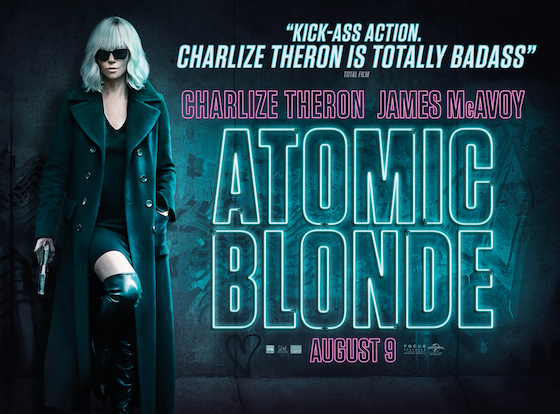
Atomic Blonde (2017)

2017 #166
David Leitch | 115 mins | Blu-ray | 2.40:1 | USA, Germany & Sweden / English, German, Russian & Swedish | 15 / R

Atomic Blonde

The uncredited co-director of John Wick takes sole charge for this action thriller set at the tail-end of the Cold War, which sees Charlize Theron’s British spy dispatched to Berlin to find “The List”, a document naming all the active intelligence agents in the city, which has fallen into the hands of the KGB.

It’s based on The Coldest City, a graphic novel that came out during my relatively brief flirtation with being a proper comic book reader a few years ago. Back then it caught my eye (though I never got round to buying it) because I got the impression it was a Le Carré-style thriller, so I was very surprised to eventually learn it was the basis for this film, the trailers for which promised a hyper-stylised actioner from the director of combat-focused John Wick. Watching the film, however, it’s easier to see how I might not’ve been wrong about the novel after all — take out the elaborate fight scenes and shoot it more like Tinker Tailor Solider Spy than The Guest, and this could indeed be a Le Carré-esque Cold War thriller.

Lots of style, little substance

Or maybe that should be “Le Carré wannabe”. The filmmakers were probably right to shift the focus in that way, because the plotting here isn’t up to that standard, particularly in a bevy of last-minute twists that bog down the final ten minutes, especially with their burst of misplaced patriotism (though I won’t say for which country lest it spoil something). Le Carré’s plots feel almost like the definition of substance being more important style (I’ve never actually read one of his books so certainly don’t mean that to be an insult), whereas Atomic Blonde is good ol’ style over substance. The best stuff here lies not in the intricacies of its spy-vs-spy storyline, but in the starkly coloured visuals, the cool ‘80s soundtrack, and (as you’d expect from the stuntman-turned-director behind 50% of John Wick) the expertly realised fight scenes.

Chief among these is an incredible single-take action sequence that goes from a sniper-beset protest march, into a building, up in the elevator, back down the stairwell — all in a series of bruising hand-to-hand fights — and then, for good measure, continues back outside and into a car chase shootout. Obviously the single take aspect must be as faked as Birdman (according to IMDb, it actually includes almost 40 different shots, many stitched together with the aid of CGI — I’d wager mostly during the car chase, which feels less smooth than the rest), but it’s still impressively crafted. The choreography of it all — both the fight moves and the camerawork — really is something else.

Fight!

Despite the flashiness of that one long section, what’s really effective about all the fight scenes is the level of groundedness. I’m sure they’re not what a real fight is like — they’re still choreographed brawls between trained combatants — but Theron doesn’t take down an army singlehanded, she fights a couple of guys, it’s hard work, and she ends up battered, bruised, and exhausted.

Sadly, between the confused plot and the irritating ending, Atomic Blonde ultimately rubbed me up the wrong way. Still, it’s worth watching for the style and the impressive action scenes. If only they’d managed to combine those with a better story, then this would’ve been something really special.

3 out of 5

Atomic Blonde is available on Sky Cinema from today.
David Leitch’s new film,
Deadpool 2, is in cinemas everywhere now.

The Past Month on TV #33

There’s much to see in this month’s packed overview, including a pair of BBC miniseries (as promised last month), a couple of comedies, the camp joy of Eurovision, and the return of Westworld. Plus, a word about the bloodbath that was the recent US renewal/cancellation season.

The City and the City
The City and the CityThe first screen adaptation of a novel by acclaimed British sci-fi/fantasy author China Miéville, The City & the City is a police procedural set in the unique location of twin cities Besźel and Ul Qoma, which occupy the same geographical space but inhabitants (and visitors) are forbidden from seeing the city they’re not in. When I first heard the pitch I assumed it was a Doctor Who-y sci-fi thing — that the cities were slightly out of step in time or something, and literally existed in the exact same space. Instead, they’re side by side, sometimes overlapping — there are places where the left-hand side of a road is in Besźel, the right-hand side in Ul Qoma. Residents are trained from birth not to see the other city. Apparently it’s partly an analogy for how we mentally block out unsavoury things in our own cities, but that doesn’t really come across in the screen adaptation, which is more focused on the murder mystery and its implications — it’s connected to a mythical third city, Orciny. In this respect it reminded me of Thomas Pynchon’s The Crying of Lot 49: our hero ends up investigating a very-secret, potentially dangerous organisation that may or may not exist, and whether or not they find it… well…

This production makes for a dense, demanding drama, throwing you in at the deep end with all sorts of terms and jargon that treats the world as real, challenging you to keep up and work it all out as it goes. There’s no hand-holding here. I guess that explains its low ratings on IMDb and the raft of “people were, like, totes confused by David Morrissey’s new drama!” articles that accompanied its airing. In terms of what it is “about”, the visual style very much evokes ’80s Soviet countries in Besźel, with secret police and dated, rundown cars and gloomy yellow-brown palette; while Ul Qoma is characterised by blues, glass and steel, LCD screens — a modern metropolis, but with different kinds of oppression. It’s very timely in its depiction of far-right nationalist groups being ascendent vs those seeking unification and tolerance being crushed — I wonder if that’s why it got made now, or if it’s just a fortunate coincidence.

Not everyone’s going to get on with The City and the City’s challenges, but there’s something here for those prepared to attempt the trip. Put it this way: after it finished, I popped on Amazon and ordered the book.

Ordeal by Innocence
Ordeal by InnocenceThe BBC’s latest Agatha Christie adaptation finally reached our screens after a delay for extensive reshoots (to remove a cast member accused of sexual misconduct, not on this production). It’s a grim tale of abuse and, of course, murder, but classy work by director Sandra Goldbacher kept it more in the tone of the Beeb’s excellent And Then There Were None and away from the dirge of their Witness for the Prosecution. It’s buoyed further by strong work from a star-studded ensemble cast — there are many names here who could (and, indeed, do) headline their own series or movie. (Nothing against Luke Treadaway, who’s very good, but why he’s in the key art (pictured right) when they could’ve included, say, Alice Eve, Eleanor Tomlinson, or Matthew Goode, I don’t know.)

I’m only really familiar with Christie from screen adaptations, but it seems to me her rep for writing fundamentally-lightweight game-like murder mysteries comes from her ‘series’ — the books starring Poirot, Miss Marple, and Tommy and Tuppence — because her other work seems to be serious and quite dark. Maybe that’s just the route these recent adaptations have gone down, I don’t know, but it certainly differentiates them from the jolly tone of the next-most-recent Christie adaptations (2015’s Partners in Crime and ITV’s Marple, which ended in 2013). Though they also adapted Ordeal by Innocence as an episode of Marple back in 2007, so what do I know?

Westworld  Season 2 Episodes 1-4
Westworld season 2Last month I wrote a mostly praise-filled review of Westworld’s first season, but if I’d been reviewing it in smaller chunks then my comments on the first four episodes would’ve been very, very different — I know, because after episode four I happened to draft a paragraph about how, while it wasn’t bad, it was kind of a slog (most of that paragraph survived into my published review, actually). I’ve been trying to bear that in mind as season two gets underway, because once again it exhibits flashes of greatness amid a feeling that it’s really going nowhere fast. But in season one this was the setup phase, introducing characters and places and concepts and threads that would begin to come together and pay dividends as their purpose was revealed in the season’s second half. Hopefully they’re playing a similar game here. Equally, I hope they haven’t overcooked it — Westworld became notorious for the it-was-under-your-nose-the-whole-time reveals it pulled in the final few episodes, and if they’re trying to do that again but without as good a set of ideas, well, we’re all just going to be disappointed.

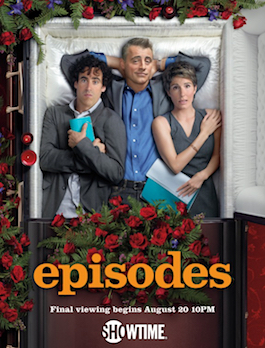
Episodes  Season 5
Episodes season 5A whole seven months after its US airing (and nearly three years since we saw the last series), the final run of this UK-made UK/US-coproduced sitcom finally reached British screens (a far cry from the days when that took less than 24 hours). Originally about a pair of UK sitcom writers struggling to remake their successful British series for the US market, Episodes is fairly removed from that format at this point — it’s just about the characters now, and mainly their trials and tribulations with each other rather than the whims of the US network TV system.

I’m not sure that this was the funniest season, but at this point it seemed mainly concerned with wrapping up the lives of its characters, at least as far as we’re concerned (I mean, it didn’t kill them all off or something). So, unsurprisingly, the final season isn’t a great jumping-on point, as it mainly continues and resolves storylines and relationships hanging over from previous seasons. The final instalment even indulges in a series of time jumps to get us to an endpoint that is so predictable (but not unpleasant) that I reckon writers David Crane and Jeffrey Klarik probably had it planned from the outset. Whether all that time-hopping was economical storytelling or because they didn’t leave themselves enough episodes to let it play out in full, you be the judge. Anyway, Episodes at its best was almost sneakily great, and remains very good to the end.

Eurovision Song Contest  Lisbon 2018
Eurovision 2018There was drama to spare at this year’s Eurovision. Firstly, China were banned from showing it due to messing around with the semi-final broadcast (they censored tattoos, homosexual dancing, and Pride flags); then, on the big night itself, the jury voting was neck-and-neck right to the final country… before being completely upended when the public votes were added.

But most talked about of all was a stage invasion halfway through the UK’s performance. In case you didn’t see it, a protestor ran on stage, grabbed the mic off the singer, tried to blurt out a message of some kind, before being hustled off stage, and then our act carried on with the rest of the song. Everyone was duly impressed by her fortitude, the UK’s odds of winning surged… and then we did crap in the voting anyway, because the rest of Europe still hates us. They also hate Russia, as evidenced by the crowd once again booing the nation for merely appearing during the voting. Apparently they’ve no such problems with Israel, though — their song may’ve had a popular feminist message, but it was also mired in accusations of cultural appropriation, and then there’s the whole Palestine thing too. We’ll see how much handwringing there is about that this time next year…

Across it all was Graham Norton’s sassy commentary, which is the one benefit of being a UK Eurovision fan. Here are some of his best bits from this year — my favourite was #27.

Also watched…
  • Brooklyn Nine-Nine Season 3 Episodes 18-20 — First it was cancelled, and I thought, “well, at least being two seasons behind means I’ve got plenty of episodes left for now.” Then it was uncancelled, and I thought, “noice.”
  • Car Share Unscripted — A special all-improvised edition of the commuting-based sitcom, which proves that, if your characters are likeable enough, just hanging out with them for half-an-hour is all you need. Next month: the series finale.
  • Friday Night Dinner Series 5 Episode 1 — Another great sitcom! I’m a couple of episodes behind, though. I was reading the other day about someone who caught up by bingeing nine episodes in one go. I can believe that.
  • Lucifer Season 2 Episodes 11-18 — Well, at least being a season behind means I’ve got a fair few episodes left for now, but I’m still disappointed it’s been nixed.
  • Not Going Out Series 9 Episodes 5-7 — I still like Not Going Out, but I feel like it’s not as funny as it used to be, too often getting involved in over-complicated plots rather than just being the gag machine it once was. Maybe that’s rose-tinted glasses for earlier episodes; maybe Lee Mack’s struggling for ideas after nine whole series — who can say?

    Cancellation season
    Brooklyn Nine-Nine — the most important cop show. Ever.Cancellation season has been and, I think, gone in the US, and this year was a particularly bloody one. The big news as far as Twitter was concerned was Brooklyn Nine-Nine, which caused such a ruckus that multiple other networks were interested and it found a new home within 24 hours. Lucifer also caused a bit of a stir, though there’s no sign of hope for that yet. Similarly afflicted were Designated Survivor (which was decently addictive enough that I binged through season one in just ten days and have been holding back on season two to do the same; apparently Netflix, who have the rights outside of the US and Canada, are contemplating a continuation) and The Expanse (which I haven’t started yet but has been on my radar thanks to Ghost of 82’s review), as well as a couple of other moderately-high-profile shows that I don’t personally watch. I guess the networks must have some really good pilots in the offing for next season… or, more likely, not. Well, you never know.
    Next month… time to say do svidaniya to The Americans.

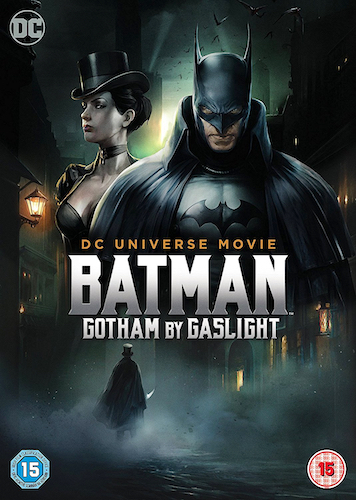
  • Batman: Gotham by Gaslight (2018)

    2018 #105
    Sam Liu | 77 mins | Blu-ray | 1.78:1 | USA / English | 15 / R

    Batman: Gotham by Gaslight

    I was all up for this adaptation of Gotham by Gaslight when it was first announced — I’m a fan of the original book, as well as the sequel (which they’ve also used parts of); and, I thought, even if they chose to deviate from it then I like the basic concept of “Batman meets steampunk”. But then the last few DC animations I’ve seen have been subpar, and the trailer for this one looked rather bland, so I decided to opt for a rental instead of purchase. Well, I never got round to doing that, and then Amazon slashed the price of the Blu-ray, so I ended up buying it — it still cost more than a rental, but if I liked it I’d save money in the long run. Fortunately, that turned out to be the case.

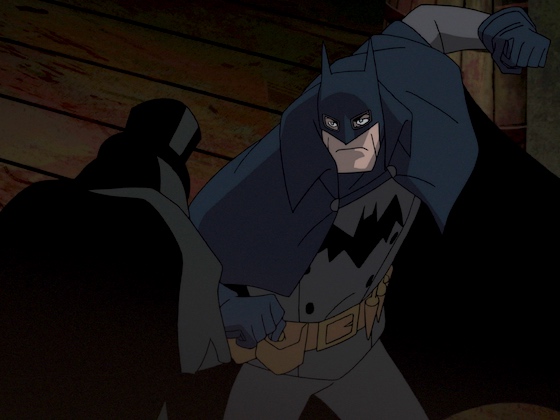
    If you’re not familiar with Brian Augustyn and Mike Mignola’s original tale, it involves Batman battling Jack the Ripper in late 19th Century Gotham City. It’s regarded as the first Elseworlds story, which is DC’s branding for stories that take place in different times, places, or “what if” scenarios — “what if Superman had landed in Russia?”, for example. This animation is a rather loose adaptation, which takes the basic concept from Augustyn and Mignola’s work but otherwise almost completely rebuilds it, mixing in a lot of ‘Easter egg’ stuff (like appearances from many more well-known Bat-characters) and some elements of the sequel comic, Master of the Future.

    Fisticuffs!

    So anyone expecting a straight-up adaptation may be disappointed, but taken as a film in its own right, for the most part it works. Having all the different familiar characters pop up makes it feel like a proper Batman tale, rather than a Ripper story that happens to have a costumed vigilante in it. Most prominent is Selina Kyle, aka Catwoman, although she isn’t really the latter here — Batman gets fully suited up, but the most Miss Kyle gets is a whip. The relationship between Bruce Wayne and Selina is one of the film’s best aspects, in fact, with the Elseworld setting seeming to allow a different focus than the usual antagonism that pairing has in screen adaptations — as one of the filmmakers says in the audio commentary, “it’s not a movie about Batman and Catwoman, it’s about Bruce and Selina.” Jim Krieg’s screenplay is good across the board, with several nice passages and scenes, even if at times it rests too heavily on exposition and speachifying.

    The one change that didn’t work for me is that it glosses over the bit about Bruce have recently returned from Europe, his return to Gotham coinciding with the Ripper’s arrival, thus making Bruce Wayne a suspect. Perhaps this isn’t a major point, but it’s a grace note that helps sell the whole concept for me. This wasn’t an oversight, however: they consciously decided to make Jack the Ripper a Gotham serial killer in this universe, so his London crimes never happened. But surely the point of using Jack the Ripper is the crimes he’s famous for? I think everyone knows he was a London serial killer, but the film does nothing to dispel this prior knowledge, nothing to establish that this version emerged for the first time in Gotham.

    The idea behind the change was to widen the suspect pool for the “whodunnit” element — if the Ripper had just come from London, his identity has to be someone who’s just arrived in Gotham. I can see where they’re coming from, but there are other ways round the problem — for example, the Gotham Ripper could’ve turned out to be a copycat, which would’ve added to the twist. As it stands, the identity of the Ripper (which has been changed from the book) is a huge twist, and, fair play to them, they pull it off. I’ll say no more because of spoilers, but I’m surprised it didn’t seem to cause outcry online. Maybe after the furore around The Killing Joke people just stopped paying attention.

    Miss Selina Kyle

    As with most of these DC animations, the quality of the visual is more TV than feature film, but they make the most of what they’ve got. There’s a squareness to the character designs, using few and simple lines, that is almost appealing. Perhaps it was inspired by Mignola’s artwork, though it does still feel sanitised compared to his exaggerated style. Also, a lot of effort is put into establishing this version of Gotham, with plenty of wide shots and scenes set in many different locations. Those were both deliberate choices to help make the city a major part of the film, and to give it life and texture as a Victorian metropolis. It’s an admirable effort considering the new era was a bit of a production headache: on their other movies, things like generic background characters and props can be recycled from film to film, but here every single element had to be designed and created from scratch.

    Voice casting is mostly spot on. Again, effort was put into evoking the period without wanting to go overboard — they didn’t want the voices to sound modern, but they didn’t want everyone doing English accents or something either. Bruce Greenwood makes for a dependable Batman and Anthony Head is perfectly dry as Alfred, but the foremost performance is perhaps Jennifer Carpenter as Selina. She’s most famous for Dexter, where she’s such a tomboy, but here she conveys a kind of Victorian elegance, with a hefty dash of feminism, very well. Inspired casting. Just as good is Scott Patterson as Commissioner Gordon. Best known for his modern, working-class character in Gilmore Girls, I didn’t even realise it was him until the credits rolled. Well, partly this is a problem with billing — only Greenwood and Carpenter get it. They’re the leads, so of course they’d get top billing, but Head and Patterson have sizeable roles and are surely just as famous? I guess it doesn’t matter, but it was a bit of a surprise to hear a recognisable voice crop up when they hadn’t been announced (as it were) by the opening credits.

    The Ripper approaches...

    In other merits, there are some surprisingly decent action sequences — a mid-way one atop an airship is the highlight — plus a nice music score by Frederik Wiedmann, which was partly influenced by Hans Zimmer’s work on the Guy Ritchie Sherlock Holmes films, but I swear I heard some overtones of Danny Elfman’s Batman in there also. In all the film is only an hour-and-a-quarter long, but it doesn’t feel like too much of a quickie — there’s enough incident here to fuel a ‘proper’ movie. I mean that in a positive way.

    As I said at the start, I expected very little of Gotham by Gaslight, for various reasons. I came away pleasantly surprised. In the commentary they talk about how much they enjoyed making it — how everyone involved, from the executives down to the storyboarders, all thought it was a particularly special project — and how they’d like to make a sequel, and they’ve got an idea for one involving the Joker. I’ve no idea how this has performed commercially, but I hope they get the chance.

    4 out of 5

    Another Elseworlds-y Batman animation, Batman Ninja, is released on DVD and Blu-ray in the UK this week, and will be reviewed in due course.

    The Hangover Parts II & III

    In today’s roundup:

  • The Hangover Part II (2011)
  • The Hangover Part III (2013)


    The Hangover Part II
    (2011)

    2018 #56
    Todd Phillips | 102 mins | streaming (HD) | 2.35:1 | USA / English | 15* / R

    The Hangover Part II

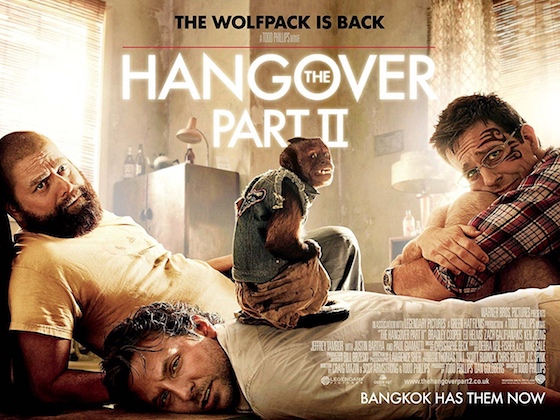
    The Hangover was a surprisingly big hit back in 2009 (was it really so long ago?), so naturally it spawned a sequel. That went down less well, mired in criticisms of just being a rehash of the original. I don’t know what people expected, really — The Hangover was sold on its high-concept setup, so naturally they repeat that for the sequel.

    For those who don’t remember said setup, it’s a bunch of mates gathering for a bachelor party, only they wake up the next morning with no memories of the night before, surrounded by evidence that a bunch of crazy random stuff has happened, and one of their party missing — in the first film it’s the groom, which naturally has potential to upend the wedding; in this one it’s the bride’s brother, which is almost as bad. So they must retrace their steps to find the missing person, along the way learning what the hell they got up to the night before.

    The devil, then, is in the detail. The big change is that the first film was set in Las Vegas and this one is in Bangkok. Other than that… look, I’m not going to list specifics, because what would be the point? But as I say, it’s the same broad outline, only with different specific events. I suppose I can see why some might feel they’d seen all that before, but when so many movies have the same plot without even meaning to, can we really begrudge a sequel for sticking to the same shape and structure as its forebear?

    Monk-eying around

    I wonder if part of the reason some people were so disappointed was their heightened expectations. The first was a very popular film, so I guess its fans expected a lot of a sequel. Receiving something that was almost a copy must’ve felt inferior. Personally, I only thought the original was okay — quite amusing, for what it was. I thought the sequel was at least equally as good. If anything, being free of expectations, I enjoyed Part II more. Thinking back on it, I didn’t actually laugh that often… but, somehow, I didn’t mind. So I guess I… kind of like the characters? And so hanging out with them for another couple of hours… was enough? Well, I didn’t expect to have that reaction.

    Anyway, clearly fans of The Hangover need to approach this rehash sequel with caution; and if you hated Part I then Part II is samey enough that you don’t want to bother. But if, like me, you enjoyed the original well enough but that was all, this follow-up might surprise you.

    3 out of 5

    The Hangover Part III
    (2013)

    2018 #102
    Todd Phillips | 100 mins | streaming (HD) | 2.35:1 | USA / English | 15 / R

    The Hangover Part III

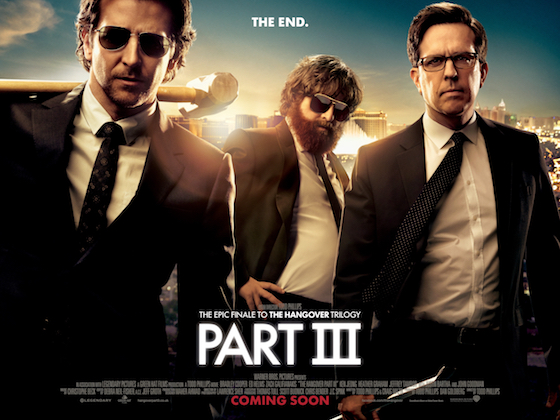
    Clearly the people in charge of the Hangover series took on board criticism that Part II just rehashed Part I’s plot, because Part III takes the same characters and spins them off onto a wholly different narrative. There isn’t even a hangover involved. Unfortunately, that didn’t work either: based on ratings found across the web, it’s the least popular of the trilogy.

    Picking up after the events of the second film, it begins with Chow escaping from prison, leading a former criminal rival to force the Wolf Pack to track him down. Cue the gang finding themselves involved in a heist in Tijuana, before events take them back to Vegas to bring the series full circle. In the most fundamental change to the series’ MO, these events unfold linearly, meaning it ditches the piecing-the-night-together element of the previous two films. You can see why they tried to put the same characters through a new crazy adventure, but it’s missing something without that mystery structure.

    Even worse, it’s just not as funny and the story isn’t as engaging. Some people say it’s completely humourless, which I think is a bit harsh, but it’s also a more serious film than it should be. The stakes are too high, and the need to construct a story that progresses sequentially leads to a focus on plot. Say what you will about the repeated structure in the first two films, but it allowed for the insertion of almost any random situation that seemed funny — what occurred the night before only has to just about hang together, because the guys are re-encountering their adventures out of order and without all the facts. Here, with the characters sober and the story unfurling in chronological order, there must be clear cause-and-effect from one scene to the next. That seems to have hampered the writers’ funny-bones. It almost becomes a comedic crime thriller rather than just a comedy — albeit a ludicrous, derivative one — which feels like it’s missing the point.

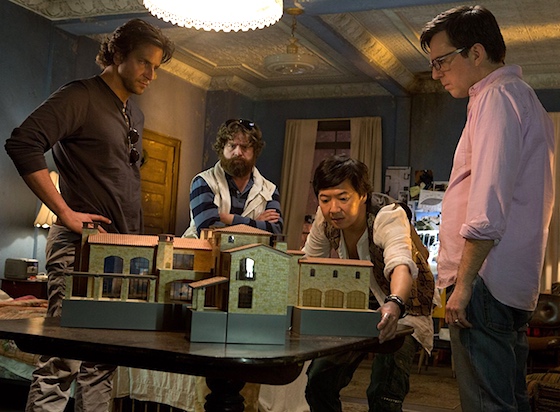
    A model heist

    It’s also too long, especially when it moves onto an epilogue that seems to keep reaching an endpoint only for there to be another scene. Eventually there’s a montage of clips from all the previous films, which seems to be under the impression this was some epic saga and something more significant than it actually is. And then, to rub salt in the wound, there’s a mid-credits scene that suggests a better Hangover movie than the one we just watched.

    Apparently the lead cast members all took convincing to return for this film, eventually being swayed by a $15 million payday (plus gross points). I mean, fair play, I’d appear in worse movies than this if I was being offered $15 million. At least it’s kind of alright, depending on how forgiving you’re feeling, with a few funny lines and bits; but it is also definitely the weakest and least memorable of the trilogy.

    2 out of 5

    * Just as with the first film, the BBFC took issue with some of the photographs shown during the end credits, and so they were cropped to secure a 15. The version streaming on Amazon is unedited, however, meaning that technically what I watched hasn’t been passed by the BBFC. But there’s nothing there that your average fifteen-year-old hasn’t already seen on the internet anyway. ^

  • Anon (2018)

    2018 #95
    Andrew Niccol | 100 mins | download (HD) | 2.39:1 + 1.78:1 | Germany / English | 15

    Anon

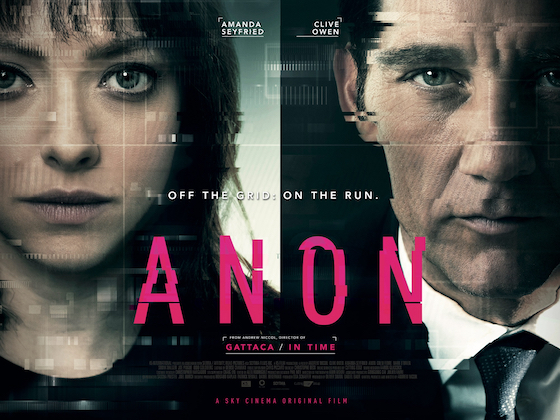
    Sky Cinema’s latest acquisition in their attempt to establish a “Netflix original”-style brand is, ironically, also a Netflix ‘original’… just not in the UK (in the US, it was released on Netflix last week). It’s also probably their most promising grab yet… although when its forerunners are Monster Family and The Hurricane Heist, that’s not saying much. But this is a new sci-fi/thriller from the writer-director of Gattaca, so that’s gotta be worth a look… even if he has spent most of the intervening two decades making some, shall we say, less-well-regarded movies.

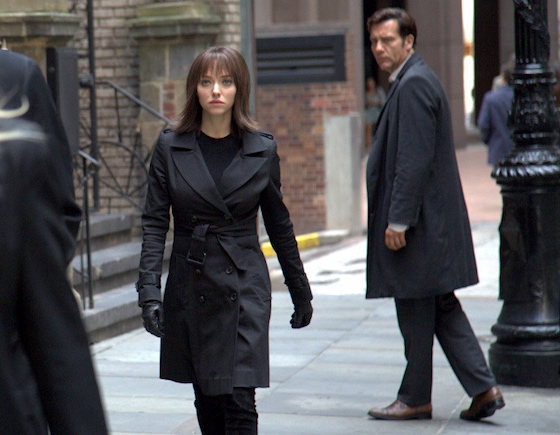
    It’s set in a near future where everyone has ocular implants that feed a constant stream of data, like non-stop augmented reality, identifying people and places, putting digital adverts on the side of buildings, and so on. These devices are connected up to a central network that allows what everyone sees to be monitored and played back when needed — for example, if a crime is committed. It’s the ultimate eyewitness, literally. When someone’s murdered, the police can just play back the last few moments of the victim’s life to see the killer. But when bodies start turning up whose final moments have been tampered with, detective Sal Frieland (Clive Owen) finds himself on the trail of an off-the-grid hacker (Amanda Seyfried) with the ability to alter records — and when the entire system is based on the notion that what’s recorded is unequivocal truth, her skills are a massive potential threat.

    Mad skillz

    Many a lazy review has described Anon as “like a Black Mirror episode”, which is not wholly inaccurate but is getting to be a stale descriptor — Charlie Brooker didn’t invent high-concept dystopian sci-fi about the dangers of future technology, so why wheel out the comparison every time anyone else dares venture into the same ballpark nowadays? Nonetheless, that is the ballpark Anon is playing in, but mixing speculative sci-fi with an equal dose of hardboiled noir to keep things spicy.

    That’s not my only problem with other reviews, though, many of which have put forth low scores and negative reactions. I saw some of them in advance of my viewing, so while watching I kept thinking, “it must go badly wrong later, because so far it’s great.” Well, that moment never came. I wouldn’t say the film is perfect — some parts, especially later on, are a tad hurried, meaning more clarity of motive would be nice — but, for me, the whole worked. There are some interesting sci-fi ideas (all the stuff about being able to trust what you see, including a standout extended sequence where the hacker messes with Sal’s head), plus it feeds some ever-relevant commentary on privacy and surveillance, with the added texture of a noir-shaped plot and atmosphere for good measure.

    In fairness, there’s clichéd stuff too, though I’m not sure how much it should bother us. For one example, it’s not much of a spoiler to say that Sal has a “dead kid” backstory, something which is a bit overdone at this point, but your mileage will vary on how much that stuff bothers you — while some of us just think it’s a tired trope, for others it seems to completely ruin the film. Conversely, I read someone criticise it for using “noir clichés” and just thought “that’s called genre, kid”. I also saw a review which decided the film was worth 1-out-of-10 just because there was a scene where they were smoking indoors, so there’s no accounting for what different people will consider important in their assessment of artistic quality.

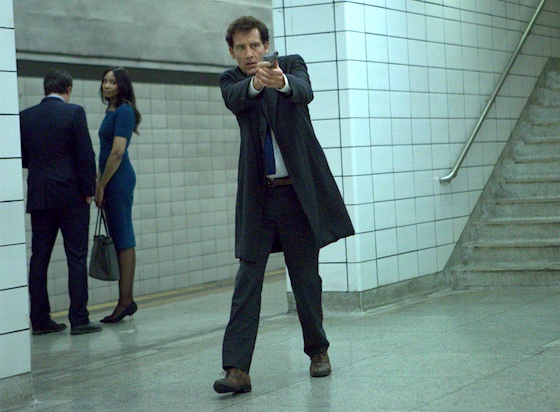
    Gunning for other reviewers

    In my opinion, Niccol and co have offered up a well-realised near-future world — not necessarily fully imagined (it’s never explained how we got to a point where everyone has these implants, seemingly enforced by law, but that doesn’t really matter), but the way the tech is depicted and how it affects everyday life is very believable. We’re thrown into the deep-end of this environment, with just enough exposition to keep up, before the film quickly moves onto the intriguing mystery that challenges the rules of this world — and considering we’ve only just learnt the rules, being able to get straight to how they’re being circumvented is impressively economical storytelling. It’s also a neat setup for having to go back to old-fashioned cloak-and-dagger-type detective work in a modern setting — this future is so high-tech, the only way to stop the criminal from detecting the operation against her is to put Sal undercover using no-tech communication.

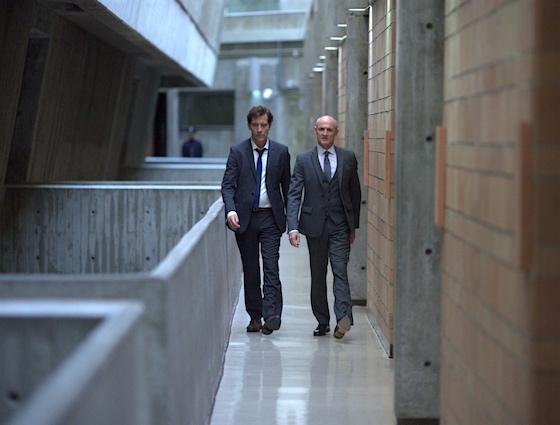
    It’s a really well made film, too. The locations are suitably evocative — the police buildings are defined by huge brutalist concrete slabs — which have been attentively framed and shot, without show-off-y camerawork. Then there’s the on-screen graphics during the point-of-view shots, which are detailed and thorough in their content, design, and execution. Their plausibility lends an automatic verisimilitude to the whole situation. And the POV shots had another nice surprise in store…

    Brutal

    Regular readers may recall that I’m a fan of a good variable aspect ratio, so it was a pleasant surprise to find that Anon features that technique — it’s unusual to see it outside of huge-budget films that have been shot/formatted for IMAX, and even then there’s no guarantee the multi-ratio version will be widely available (cf. Marvel only including them on 3D Blu-rays; Brad Bird not allowing Ghost Protocol to be released with it at all). In Anon, the ‘drama’ scenes are presented in your movie-standard 2.35:1, but it expands to a screen-filling 16:9 every time we see through someone’s eyes. These changes are very effective. The film employs the technique early and then often, so it doesn’t have the “wow” factor that some IMAX films achieve even when viewed at home, but it’s suitably immersive. Indeed, this would probably play really well on a vision-filling IMAX screen. The fact I wouldn’t have a chance to see it even if it did get IMAX showings means I’m not too sad it’s a direct-to-streaming release.

    That said, it’s kind of a shame Sky snapped it up over here. This is anecdotal evidence I know, but I know far more people with Netflix (like, pretty much everyone nowadays) than with Sky Cinema (I’m not sure I know anyone but me, actually, and I only subscribe occasionally), and I’d like to be able to recommend this to people, especially so as to go against the grain of the criticisms that I feel have been unwarrantedly negative. Well, obviously I can still recommend it, but how useful is that if people aren’t going to get the chance to see it on the basis of that recommendation?

    Who's that girl?

    Nonetheless, recommend it I shall. Perhaps Anon can’t equal other works at the top-tier of its genre, but I feel some have been unfair in writing it off. Any familiarities in the shape of its plot are in aid of creating that noir atmosphere, while the sci-fi concepts are reasonably considered and executed. For fans of the genres involved, it’s definitely worth a look.

    4 out of 5

    Anon is available on Sky Cinema from today.

    The Cabinet of Dr. Caligari (1920)

    aka Das Cabinet des Dr. Caligari

    2017 #163
    Robert Wiene | 77 mins | Blu-ray | 1.33:1 | Germany / silent (German) | U

    The Cabinet of Dr. Caligari

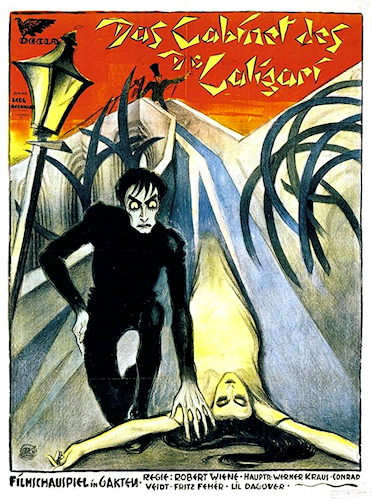
    The poster child for German Expressionist cinema, as well as featuring “cinema’s first true mad doctor” and “cinema’s first unreliable narrator” (at least according to David Cairns on the Masters of Cinema Blu-ray — I haven’t verified those statements for myself), The Cabinet of Dr. Caligari certainly has a lot to unpack for a film that’s barely an hour-and-a-quarter long. Or does it? Because one has to wonder if there’s an element of style over substance here.

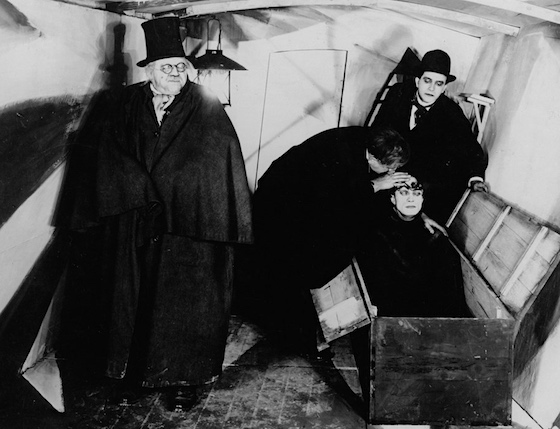
    “A mystery story told in the Poe manner,” according to the original Variety review, the titular Dr Caligari (Werner Krauss) is the host of a fairground attraction, and his eponymous cabinet contains Cesare (Conrad Veidt), a somnambulist who Caligari controls — at the fair, to answer questions from the audience; and at night, to do his evil bidding, including murder. Caligari’s activities come to the attention of young Franzis (Friedrich Feher), who attempts to uncover the truth about the doctor and expose him.

    But the most famous thing about Caligari by far is not the storyline or the characters, but the visual style. Painted backdrops evoke a landscape straight out of a nightmare: jagged lines and stark monochromatic shapes (this isn’t just a film that happens to be filmed without colour, it feels black and white), they give the impression of the winding streets of a town and its locales without actually being one. The implied structures tower over the characters, leaning in above, creating an oppressive and unnerving atmosphere, while their total lack of reality evoke theatre more than the literalism we’re now used to from film. The make-up and performances are the same: heightened; dreamlike — or nightmarish.

    Impractical architecture

    Which may be entirely appropriate given the film’s framing narrative, which (spoilers!) introduce an ending that’s a little bit “and it was all a dream”. Or was it? Well, that depends how you interpret what happens. The bookends were apparently added to help sell the film to the public, framing its fantastical narrative in something more grounded. The screenwriters weren’t happy — as Lotte H. Eisner writes (in the MoC booklet), “the result of these modifications was to falsify the action and ultimately to reduce it to the ravings of a madman. The film’s [screenwriters], Carl Mayer and Hans Janowitz, had had the very different intention of unmasking the absurdity of asocial authority, represented by Dr. Caligari.” Well, the tacked-on ending doesn’t necessarily negate such an interpretation, you just need to fill in the blanks to get there yourself.

    For example, there’s what Cairns calls his “Mulholland Drive theory”: that what we witness is all true, until the point that Franzis sees the asylum director is Caligari; from there until the reveal that Franzis is an asylum patient is a fantasy. Evidence in favour of this: everything goes implausibly swimmingly for our hero in that section, from easily recruiting the asylum staff to finding (as Cairns puts it) “Caligari’s second cabinet, in which he keeps his entire backstory.” It’s a fun reading, even though it’s clearly a case of projecting an interpretation onto the film that wasn’t intended by the makers.

    One that fits better, perhaps, is that Franzis’ flashbacks aren’t merely “the ravings of a madman”, but he’s telling the truth, and that somehow between the end of his flashbacks (which see Caligari locked up in his own asylum) and where we join the framing narrative (with Franzis locked in the asylum and Caligari in charge), the evil doctor has reasserted his authority and captured his accuser. Of course, that requires a leap — how does Caligari regain control? Why don’t we see it happen? Well, we don’t see it happen because that wasn’t what the makers intended.

    Suspicious activity

    And so we come back to “it was all a dream”. Maybe that’s the best explanation — the writers may’ve hated it, but in some respects it saves them from themselves: Cairns’ visual essay highlights a bunch of plot holes, inconsistencies, and confusions, not to mention issues of character motivations and actions (“in a way it makes no sense to speak of character motivation in a mad man’s fantasy”), all of which you can hand-wave away if “it was all a dream”. This is why I wondered if it was style over substance. The sets, the make-up, the performances — all fantastically atmospheric. The story, the characters, their actions — not such great shakes.

    But maybe that’s okay. After all, why not? Director Robert Wiene and his crew did a fantastic job of bringing a surreal nightmare to life, and nightmares seldom feature plausible storylines.

    4 out of 5

    The Cabinet of Dr. Caligari was viewed as part of my Blindspot 2017 project, which you can read more about here.

    Drew: The Man Behind the Poster (2013)

    2017 #127
    Erik Sharkey | 97 mins | streaming (HD) | 16:9 | USA / English

    Drew: The Man Behind the Poster

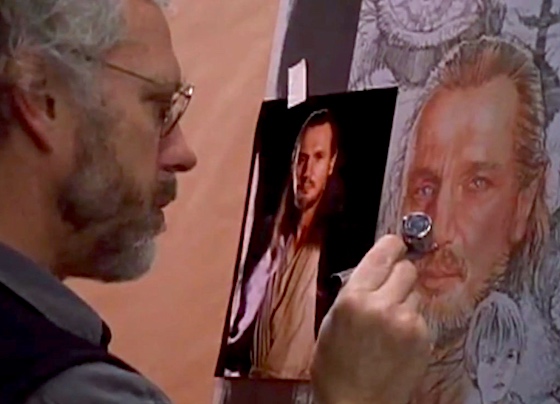
    If you don’t know the name Drew Struzan, there’s a fair chance you know his work: he’s the poster artist behind the likes of the Back to the Future trilogy, almost everything Indiana Jones related, many iconic Star Wars posters (including the primary art for the prequel trilogy), and so many more. Even when not painted by Drew himself, his style has been a major influence on blockbuster posters across the board, even in today’s era of Photoshopped collages. Nonetheless, you may wonder if the topic can really support a feature-length documentary. How much is there to say? Turns out, plenty.

    It starts out, as the title might suggest, in the form of a biography — rather than just looking at Struzan’s famous posters, it talks about his days as a struggling artist; literally starving, choosing to spend his limited money on paint rather than food. Once it reaches his move into film posters it goes more topically, covering a series at a time. He started on B-movies, which led to doing a poster for Star Wars’ 1978 re-release, which led to Indiana Jones, which was his big breakthrough: his poster for Temple of Doom established him as the Indy artist, and he went on to do video covers, book covers, and the rest.

    Painting Menace

    Despite the biographical start, the film is really an appreciation, if that were a genre, but a well-deserved one. There are stories about how the posters were commissioned, or designed, or painted, or whatever, but also about their impact, effect, and significance, and what it’s like for filmmakers to work with Struzan. In that regard the list of interviewees is impressive, including the likes of Steven Spielberg, George Lucas, Frank Darabont, Guillermo del Toro, and more. Their presence speaks not only to the awe-inspiring people Struzan has done posters for, but also how much they admire him. As Spielberg says, he was trying to make a movie that would live up to the art they’d later commission from Drew.

    Movie posters are just advertisements, really; certainly in the minds of executives — I mean, why else are the Marvel ones overloaded with every possible character and location featured in the movie? But to the public they’re more than that. Michael J. Fox makes the point very well right at the start of this film: the poster is the first part of the story; it’s where the film begins for the audience. There’s definite truth to that — the ad creates an expectation, and the resultant film has to match it. With Struzan’s work, the bar was never set higher.

    4 out of 5

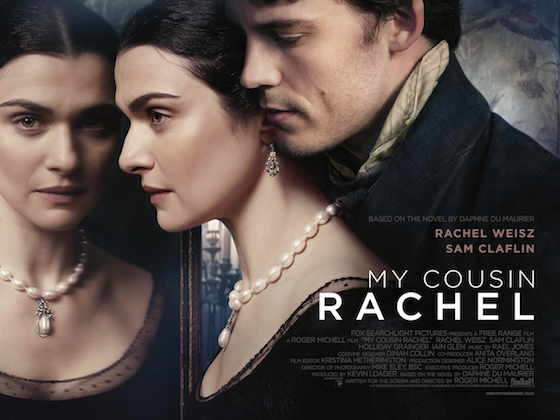
    My Cousin Rachel (2017)

    2018 #33
    Roger Michell | 106 mins | streaming (HD) | 2.35:1 | UK & USA / English | 12 / PG-13

    My Cousin Rachel

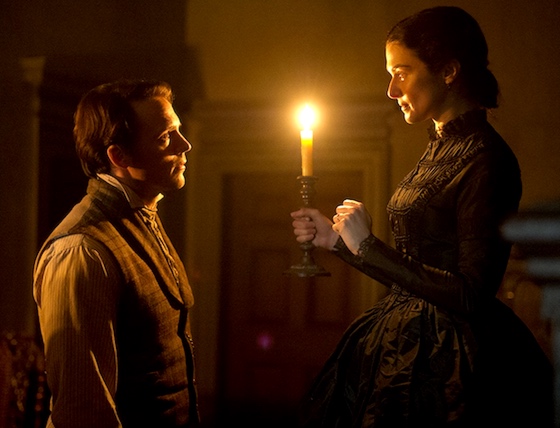
    Adapted from a lesser-known Daphne Du Maurier novel (previously filmed in 1952 with Olivia de Havilland, and here relocated from Cornwall to Devon to avoid comparisons to Poldark (really)), My Cousin Rachel is the story of an orphaned young man, Philip (Sam Claflin), who’s raised by his older cousin Ambrose until the latter’s health forces him to leave for Florence. There Ambrose falls in love with their cousin Rachel (Rachel Weisz) and marries her, but shortly after dies. His final letter to Philip implies Rachel may’ve had a part in his demise. When she arrives at their estate in England, Philip is determined to confront her, but soon finds himself entranced by her, as does everyone. Is she a scheming murderess intent on using her wiles to acquire the family’s estate, or did Philip’s imagination get the better of him?

    That mystery is really the heart of My Cousin Rachel, which unfurls as a classy, lightly Gothic melodrama. It’s a puzzle that’s not so much investigated as gradually hinted at, leaving the audience to make up their own mind. It certainly was successful in having me change my opinion on where it was headed multiple times. The pace is fairly leisurely, which some reviewers have found to be trying; but while it’s certainly a slow burner, for me that was part of why it worked. The passage of time and the opportunity it grants for overthinking sways Philip’s mind hither and thither, and so the film gives the viewer similar space to think, for their opinion to shift, back and forth. It makes you a part of his paranoia.

    Who's playing who?

    Rachel Weisz is typically excellent, delivering a finely balanced performance that is at once charming and suspicious — is Rachel simply quietly enigmatic, or she hiding a scheming and deadly nature? Sam Claflin is very effective as the hot-headed, easily-led young man at the centre of the story, exhibiting these characteristics which sell Philip’s flip-flopping opinions, which could otherwise have come across as inconsistent. You can believe their passion of each other — or, certainly, his for her — which leads to some earthy bits that might surprise anyone expecting a quaint Heritage melodrama. Thrusting among the flowers aside, the overall style does evoke those Sunday evening costume dramas (you can see why they were wary of a Poldark comparison), as does the pretty photography by DP Mike Eley — it’s not the most outright gorgeous film you’ve ever seen, but it’s a bit of a looker.

    My Cousin Rachel’s unhurried storytelling may put off some viewers, but if you settle into its rhythm then it’s a paranoia-fuelled guessing game that will keep you rethinking the truth up until its closing moments.

    4 out of 5

    My Cousin Rachel is available on Sky Cinema from today.

    ManHunt (2017)

    2018 #94
    John Woo | 109 mins | streaming (HD) | 2.35:1 | China & Hong Kong / Japanese, English & Mandarin | 15

    ManHunt

    John Woo’s latest movie is now “A Netflix Film” in the UK, US, and presumably some other territories too. After almost 15 years spent making period dramas, it’s a return to the contemporary action-thriller genre that made his name. Whether it represents a return to his previous quality… well…

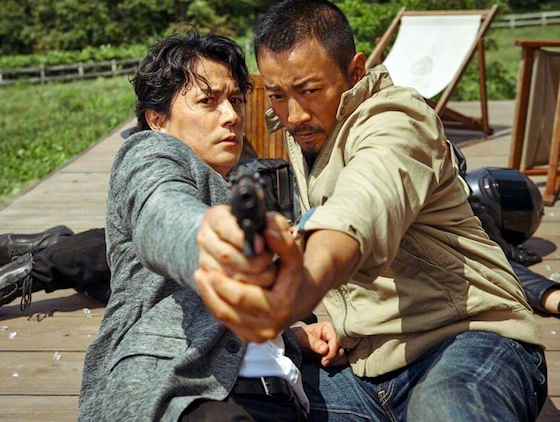
    ManHunt introduces us to Du Qiu (Hanyu Zhang), a Chinese lawyer for a Japanese pharmaceutical firm, credited with saving the company when he won a court case three years ago. Now he’s leaving to head to America, but the company’s president tries to persuade him to stay by sending a sexy lady to wait at his house. Unfortunately for Du, when he wakes up the next morning she’s dead and he’s the prime suspect. Soon he’s on the run to clear his name, with hot-shot cop Yamura (Masaharu Fukuyama) on his tail, though he’s not convinced of his target’s guilt. That’s just the start of it — why would someone want to frame Du for murder? Well, it gets complicated…

    For the first half of its running time, ManHunt is a baffling experience. Not so much because of the plot — though that sets so many wheels in motion that one must pay attention — but because of how it’s put together. One major problems is the way it casually mixes together multiple languages, leading to some flat translations (that’s being kind — maybe the screenplay, which comes courtesy of seven screenwriters, was unexciting to begin with) and clunky line delivery. But hey, this is an action movie, so we can forgive some iffy performances. A greater barrier to enjoyment comes in the form of Taro Iwashiro’s underpowered, plinky-plonky score. That might be fine during chatty scenes, but it continues into the early action sequences, robbing them of pace, dynamism, and excitement. It’s a thoroughly bizarre choice that undermines the film’s raison d’être.

    Not chuffed to be cuffed

    With its unoriginal innocent-man-on-the-run story and disengaging production quirks, it’s tempting to give up on ManHunt before the half-hour mark. However, director John Woo does begin to sneak in some of his trademark flair. One particularly good bit sees Yamura and his new partner visit the crime scene to go over what they think happened. Woo mixes together their reenactment with flashbacks in interesting, increasingly overlapping ways… until the sequence ends with the female officer getting hysterical, the old-fashioned-ness of which undercuts the sequence a little right at the end.

    As the various plot strands kicked off at the start begin to come together, the film becomes increasingly worth watching. If you can make it through the first half, the second begins to revel in its own silliness. It stops mattering that everyone has to deliver dialogue in at least two languages but none of them can actually act in more than one. It stops mattering that the plot barely makes sense — in fact, it actually improves the crazier it gets. A framed man on the run? Yawn. A pharmaceutical company searching for a secret formula to perfect the currently-lethal super-soldier drug it’s testing on homeless people, which is in the possession of the widow of a former employee they killed for alleged corporate espionage, and using drug-enhanced hitwomen to do its dirty work while corrupt addict cops cover up the indiscretions of its president’s son? Awesome. And the action finally kicks into gear too, gradually shifting first into having some good moments, then into whole sequences that are worth your time. Is it all too little too late? Kinda. But at least it rewards those prepared to stick with it.

    Sharing is caring

    In many ways I should give ManHunt just 2 stars, but that would be to ignore the fact that I’m glad I watched it. But if a 3-star rating is any kind of recommendation, here it’s a very cautious one.

    3 out of 5

    ManHunt is available on Netflix now.