All Your Film Are Belong To Blog: 1,337 Films in a Decade

Today is 100 Films in a Year’s 10th birthday.

Back when this started it was just a challenge to myself, inspired by “50 books in a year” efforts that other people were doing. I covered it on my DeviantArt blog because that’s where I’d seen the idea (look, it’s still there!) After that first year went rather well I decided to continue the challenge, but moved my coverage to a dedicated blog on Blogger (look, it’s still there!) That didn’t last long: less than two months later I moved on to the film blogging community at FilmJournal (look, it’s still there!) After several happy years, the FilmJournal community began to die off as the site fell into a kind of disrepair (if you follow that link you can see what a mess the formatting became), prompting a final move to WordPress in 2012 (look, I’m still here!)

When I started this whole shebang the world was a different place: Tony Blair was still Prime Minister and George W. Bush was still President. Apple had only just announced the iPhone; the iPad and the tablet revolution were still several years away. Facebook had only been open to everyone for five months. The hashtag hadn’t been invented yet. The final Harry Potter book hadn’t been published, most people hadn’t heard of Twilight, and Fifty Shades of Grey didn’t even exist. Britain’s Got Talent hadn’t aired, never mind spawned the ubiquitous Got Talent franchise. The format war between Blu-ray and HD DVD was still raging.

I suspect the “all your base are belong to us” meme had already had its day by then too, but I’m using it now nonetheless.

On a personal level, I was still an undergraduate, had never owned a dog (it was a couple of years before we’d meet Rory at a rescue — I wonder what he was up to then?), and still had all those dreams and ambitions of youth that end up going unrealised. But hey, at least I’ve still got my blog!

During the past decade said blog has certainly grown, from writing a couple of sentences about each film in updates posted every few weeks, to the almost-daily and often-far-too-long dedicated reviews I post nowadays, along with my monthly updates and TV reviews. The number of people reading my ramblings seems to have continually increased as well, which is rewarding in its way — I guess I’m doing something right; have something interesting to say.


Two months in, 2017 is already over halfway to 2013’s total.

Commensurately, the blog has taken up an increasing amount of my time: it feels like when I’m not watching films and TV I’m writing about them; especially last year, when adding my 100 Favourites series into the mix took up far more time than I’d anticipated. Sometimes it feels like I’m making a rod for my own back, doing all this, but at the end of the day it’s enjoyable — why else keep doing it? But after the monomaniacal focus I’ve given this thing for the past couple of years, I do need to find more time to broaden my activities.

Not just yet, though! For two reasons: starting on Thursday (after tomorrow’s February monthly update) I’ll be diving into 100 Favourites II! No, not another 52-week marathon project — it’ll all be over by Sunday. More on that then.

For now, the thing everyone loves (right?): statistics!

As the title of this post reveals, in the past decade I’ve watched 1,337 films expressly for this blog — which, as anyone familiar with internet-y slang will know, is code for “elite”, as in “very good”. Probably a bit old fashioned to use nowadays (or it should be), which is connected to why I revived the whole “all your base” thing. See, there’s method to my madness.

Those 1,337 films include all the alternate cuts and other films I reviewed. The actual total of brand-new films I’ve seen is 1,283 (which is a less entertaining number, hence why it’s not inspired the theme of this post). The total running time of that many movies was 136,154 minutes, and if you factor in everything else I’ve watched and reviewed it comes to 144,118 minutes — back to back, that’s 3 months, 2 weeks, 2 days, 1 hour, and 58 minutes of solid viewing. Whew!

Regular readers of my annual statistics posts may have noticed that the graph of each year’s running time always shows “no data” for 2007. That’s because when I first posted my 2007 reviews I didn’t include that information, so I couldn’t tally them up for my stats that year either. However, when I re-posted all those reviews to one of my new blogs I added the times… but still didn’t bother to total them up — it is a lot of films, after all. But this is a special occasion, so I’ve finally gone back over the lot and done it. So here, for the first time, is a complete running time graph:

If you’re curious, that makes the average running time of a film 106 minutes. I don’t think that really signifies anything, but there it is.

Down the years I’ve regularly noted my predilection for newer films — more recent decades always come out on top year-by-year, and my 100 Favourites showed a definite bias towards the past couple of decades (there are stats on that here). Naturally, that’s borne out when I look back at the last ten years in totality. The only possible element of ‘tension’ is: what will come out on top between the 2000s and the 2010s? On the one hand, about 70% of my blog’s life has been in the latter decade; on the other, that means there are more years (and therefore more films) for the former. Drama!

As it is, things go as you might expect: the 2010s come out on top with 458 films, which is 34.3% of the 1,337; and then of course the 2000s are second, with 388 (29%). The only other decade to make triple figures was the ’90s, its total of 114 representing a mere 8.5%. In order of size, the next decade is the ’80s with 91 (6.8%), followed by the ’40s with 79 (5.9%) — all those classic detective series add up. The countdown continues as follows: the ’60s with 57 (4.3%), the ’50s right behind with 56 (4.2%), the ’70s with 50 (3.7%), the ’30s with 21 (1.6%), the 1920s with 15 (1.1%), and finally the 1910s with 8 (0.6%). And the 1900s are actually represented too, by a single short.

As we’re talking about my tastes skewing newer, I thought I’d take a look at something I’ve never considered before. Every year I post a list of my top ten films selected from my personal viewing that year, meaning that films from any time period are eligible. Despite that, I’m aware I still have a tendency to declare newer stuff my #1 of the year. Just how new? Well, this graph shows the ages (in years) of my #1 picks at the time I picked them…
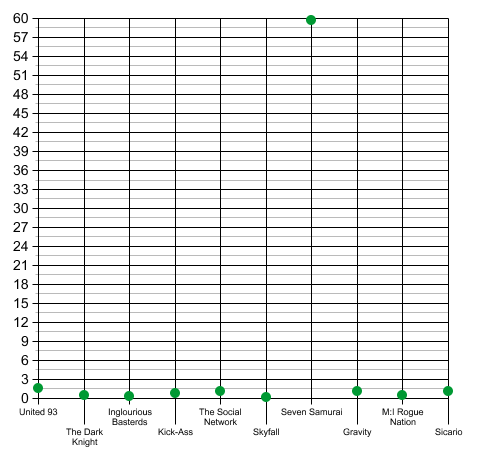
The average age of a #1 (ignoring the outlier) is just over 9 months old. Sticking out is, of course, Seven Samurai, which was 716 months old when it became 2013’s #1. The second oldest was United 93 at a piddling 18 months, while the youngest of all was Skyfall at just 2 months. So, yeah, pretty new.

Similar to running times, I’ve not kept track of all my stats for all ten years — I can’t list languages, or countries of production, or a couple of other things I cover at the end of each year nowadays. It would’ve been interesting, but there you go. There are a couple more things I can pick out, though.

Firstly, the formats I’ve watched all these movies on. This is an interesting one (well, it is to me) because these have regularly fluctuated down the years. Back in 2007 DVD was at the height of its dominance and was the clear frontrunner, but since then it’s slipped far back. Blu-ray has taken its place to an extent (maybe not in the wider population, but in the hearts of people like me), but in terms of my own viewing I know that watching films on TV topped the pile for a number of years. Recently, however, streaming has taken charge, with Now TV making Sky Movies Cinema more affordable and the increasing rise of Netflix, not to mention Amazon’s wannabe-competition. But what comes out best from the decade as a whole?

A little to my surprise, the winner is television, with 367 films (27.4%). I know it was once the #1 format for my viewing, but it’s been slipping for four years now. I guess it’s because it’s been a constant, whereas DVD has faded, streaming has only recently risen, and I’ve never watched as many of my Blu-rays as I should. That said, Blu-ray is second, gradually amassing 318 films (23.8%) over the past nine of the ten years. DVD has clung on in third, with 291 (21.8%). I guess that’s a slow accumulation — it’s one of only three formats to be represented in all ten years (along with television and another that we’ll come to in a bit). New champion streaming (it’s been #1 the past two years) ends up fourth with 243 (18.2%). Considering its numbers over the last couple of years, if I re-ran this all-time chart this time next year it’d likely be second, with the number one spot in its sights not long after. Unless I finally buck up my ideas and get better stuck in to my DVD and Blu-ray collection, anyway.

There’s a big drop to the rest of the figures, which are rounded out by the third and final format to crop up in all ten years, downloads, on 68 (5.1%); my poor record of trips to the cinema on 42 (3.14% — so it’s both the answer to life, the universe and everything and pi); good old VHS on 7 (0.5%); and a lonely little film watched in-flight, that 1 being just 0.07%. Sadly, it wasn’t a Bond film. Even more sadly, it was the risible Superhero Movie.

Finally, as always, a word on quality, or at least my perception thereof. In the past ten years I’ve handed out 223 5-star ratings. That’s 16.7% of the films I’ve watched, which also happens to be one-sixth. I guess that’d sound neater if it was one-fifth, but then I’d be an even more generous marker than I already am. This is definitely borne out by the 615 4-star ratings, which at 46% is not that far off half. (Well, I’d have to have given out 53½ more of them to make it actually half, but still.) Sitting between those two in quantity were the 350 3-stars, which at 26.2% is only a little over a quarter (certainly closer to a quarter than 46% was to half). That leaves the two ‘bad’ ratings to share just 11.1% of films between them — which is just over a tenth, of course. That splits as 130 2-star ratings (9.7%), leaving just 19 films (1.4%) in the highly exclusive 1-star club.
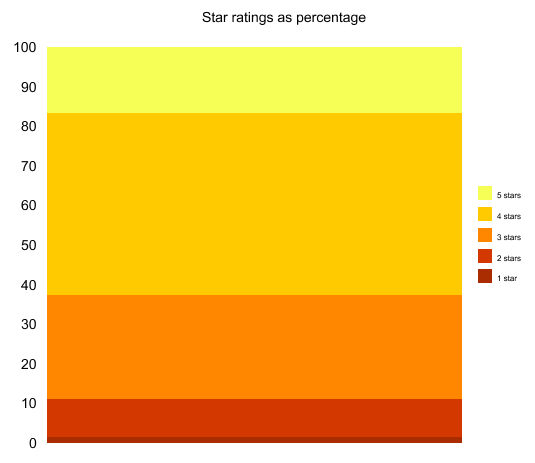
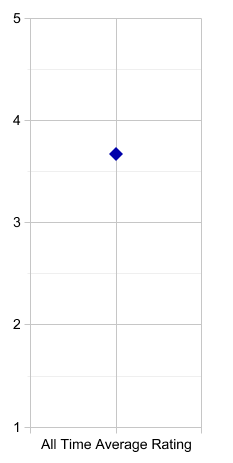
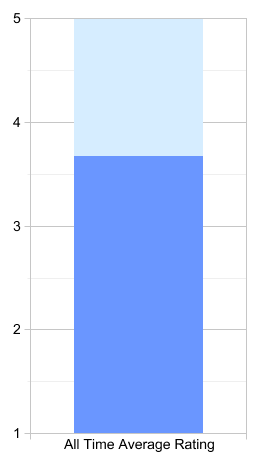
From all that, we can deduce that the average rating earnt by these 1,337 films is 3.6679, which as a percentage would be 73.358%.
And that, I’m afraid, is the end of that.

Tomorrow: putting my birthday celebrations aside for a moment, the February update.

On Wednesday… 100 Favourites II: Eclectic Boogaloo.
100 Films @ 10: Short Films

For the final in my series of ten top tens (yes, we’ve reached the end already / finally (delete as appropriate)), I’ve decided to take a look at one of the less-discussed aspects of the film world: shorts.

In the past ten years I’ve watched and reviewed just 51 short films, but as I’ve never ranked them before it seemed overdue that I create some kind of quality-sorted list. Here, then, are my ten favourite short films that I watched in the last decade.

10
Pixels

Don’t worry, there’s no Adam Sandler in sight — this Pixels is the three-minute short that went down so well online someone bought the rights and turned it into a feature. A fun idea, it works better as a narrative-less couple of minutes than it did forced into the shape of a blockbuster.

9
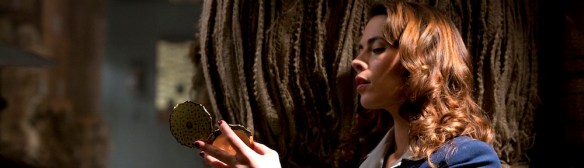
Marvel One-Shot: Agent Carter

Easily the best of Marvel’s now-defunct series of short films, Agent Carter was so good — exciting, characterful, funny — that it was later expanded into a two-season TV series (which I still haven’t watched. Oops.)

8
Telling Lies

A simple idea, very well executed: as we listen to a series of phone conversations, the speakers’ dialogue appears on screen… except instead of transcribing their exact words, it reveals their true thoughts. At only a few minutes long Telling Lies doesn’t outstay its welcome, instead maintaining the basic idea well and crafting a neat and amusing little story with it.

7
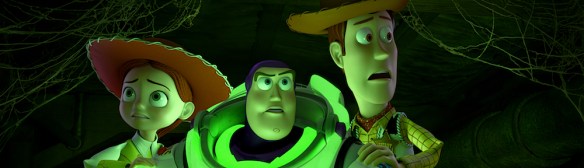
Toy Story of Terror!

Having managed to beat the odds and create three great Toy Story movies, Pixar seemed foolish trying to extend it further as a franchise. Toy Story of Terror justifies that decision, however, with a story, style, and message that would’ve been strong enough to be a whole feature (with some expansions, of course) but plays equally well in just 20 minutes.

6
Wallace and Gromit in A Matter of Loaf and Death

As with #7, this was a seasonal special for old animated favourites that would’ve worked just as well (perhaps even better) expanded out to a full feature. A Matter of Loaf and Death is the first Wallace & Gromit film since the very first not to win an Oscar, but it’s every bit as good as its forebears — I can’t think of much higher praise than that.

5
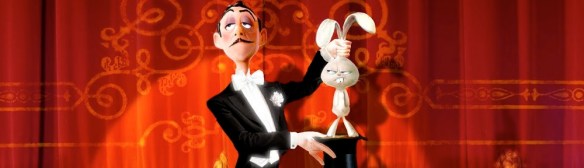
Presto

The Pixar short that accompanied WALL-E, Presto is a perfectly-executed piece of near-silent slapstick tomfoolery. Surprisingly, this also lost out on an Oscar. Its director went on to co-direct last year’s Storks, which… didn’t go down so well.

4
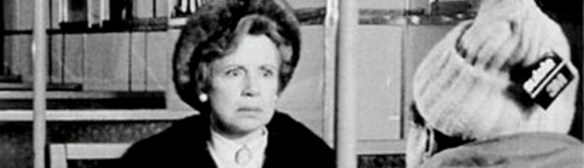
The Lunch Date

Winner of the short Palme d’Or and an Oscar, The Lunch Date is a clever little tale with a well-disguised twist. I imagine if it was made today people would talk about its social relevance, which is a little depressing nearly 30 years on, but there you go. The first work by director Adam Davidson, he’s since gone on to helm episodes of shows like Six Feet Under, Lost, Deadwood, Dexter, Rome, True Blood, Fringe, Fear the Walking Dead, and many, many more.

3
The Present

As with most of the best shorts, The Present presents a simple but effective idea quickly and with a strong emotional hit. A cute tale of a boy and his dog, it also has a message about positivity and overcoming adversity. No Oscar here, but its director has since worked for Disney on Zootropolis and Moana, as well as on The Secret Life of Pets and Revolting Rhymes.

2
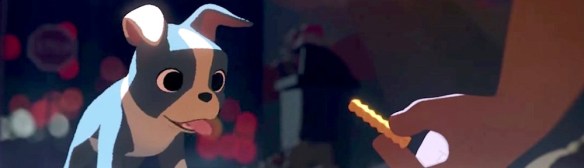
Feast

Another lovely short, also told economically and without dialogue, about a friendly little dog who helps out his owner. Yeah, I’m a sucker for cute dogs. But Oscar-winner Feast is also beautifully animated: nicely stylised and executed as essentially one long montage, proving again that exceptional filmmaking can create an emotional experience in the briefest of times.

1
Commentary! The Musical

Unlike the previous films on this list, it’s the very opposite of silent — it is, in many ways, all about sound. There’s also no big emotional hit and no sniff of awards recognition either. So why does Commentary! The Musical top my list? Because it so impressively made. It’s the commentary track on Dr. Horrible’s Sing-Along Blog, but rather than just the production team chatting about how they made the show, it’s sung through. And it’s not just a collection of new songs played over the original production — it’s frequently scene specific, sometimes even shot specific. It’s an incredible feat of writing and planning; not only that, but it’s hilariously funny too.
Tomorrow: birthday day.

100 Films @ 10: Best Picture Winners of the Past Decade

It’s moviedom’s glitziest night of the year this evening, as the best and brightest of Hollywood and the wider movie world (well, some of it) gather in L.A. for the 89th Academy Awards — aka the Oscars! How many awards will La La Land win? How many anti-Trump speeches will there be? It’s all to play for!

To mark the auspicious occasion, today’s celebratory top ten looks back over the last decade of Best Picture winners and asks, “which is the best Best Picture?” And ranks all the others too, because it wouldn’t be much of a top ten otherwise, would it?

10
No Country for Old Men

I’ve long ago lost the source to cite it, but I once read a critic describe No Country as the only worthy Best Picture winner of that decade. Well, obviously I disagree. I have mixed feelings about the Coen brothers’ work most of the time, and this is no exception. I just find it a deeply unsatisfying film.
What should have won? The Assassination of Jesse James by the Coward Robert Ford is better than either of the so-called Westerns that were nominated. But of the actual nominees? Maybe Atonement.

9
Birdman

At least I found Birdman less expressly irritating than No Country, but it does frequently feel like it’s more concerned with showing off than… well, anything else. It’s obviously tailor-made to appeal to Oscar voters, particularly the dominant acting branch, so from that point of view it’s no surprise it won. Kind of sad the Oscars can be reduced to such observations, isn’t it?
What should have won? A lot of people thought it should be Boyhood, which is a worthy pick, and Whiplash remains very popular, though my favourite of the nominees was The Grand Budapest Hotel.

8
The King’s Speech

There’s an element of heritage drama to The King’s Speech that mean some will always find it inherently objectionable — generally cinephile types, while wider audiences love that kind of thing. I mean, how else to you explain Downton Abbey’s phenomenal success? King’s Speech works in spite of that thanks to its trio of lead performances, not least Colin Firth as the can-very-much-wait-to-be-King struggling with a stammer.
What should have won? The Social Network. Fincher 4eva.

7
Slumdog Millionaire

Maybe it’s rich of me to berate No Country for its reliance on fate and chance while elevating Slumdog up the list, but in the former it feels intrinsic while here it’s just a structural choice. I did object to its regular branding as “feel-good” though, because it’s a pretty grim film on the whole, but a strong cast of child actors and Danny Boyle’s lively direction keep it compelling.
What should have won? Okay, I retract that “Fincher 4eva” — not Benjamin Button. I actually still haven’t seen any of the other nominees from 2008, so I guess Slumdog deserves it.

6
The Departed

It must be almost ten whole years since I watched The Departed, and for most of that time I’ve been meaning to revisit it (and to see the original Hong Kong film that inspired it). I confess that my overriding memory isn’t really to do with the film itself and more to do with the fact I thought United 93 was better and more deserving of honours. But it was not to be — the stars had finally aligned for Scorsese. Anyway, The Departed should be my kind of movie, so maybe one day I’ll get round to re-watching it and it can escape that shadow. That’s why it’s only in the middle of this list.
What should have won? United 93 wasn’t actually nominated for Picture, so… maybe Little Miss Sunshine?

5
Spotlight

The most recent winner rejects filmmaking flash in favour of unfussy storytelling to relate the powerful tale of a group of journalists uncovering a huge cover-up and the wide-reaching conspiracy that maintained it — and it’s all true! Criticisms that Spotlight didn’t focus enough on the victims are probably misplaced: this isn’t a film about what the journalists uncovered, it’s about the act of the journalists uncovering it. In the era of so-called ‘fake news’, it’s more relevant than ever.
What should have won? Either Mad Max: Fury Road or The Revenant would’ve been very worthy choices in my view.

4
Argo

Ben Affleck’s spy thriller is an oddity in modern Oscar winners, what with it being an entertaining genre-ish movie rather than a worthy dramatic picture. It is a true story, though, so it ticks that box. Argo lacks the heft of most Great Movies, but makes up for it with some amusing Hollywood satire and tense undercover thrills.
What should have won? From 2012’s nominees I’m torn between Django Unchained and Lincoln. The latter is more Oscar-y.

3
The Hurt Locker

If we’re talking about tension, The Hurt Locker knocks Argo into a cocked hat. Well, what better situation to elicit nail-biting nervousness than a bomb disposal unit in a fraught war zone? What makes it more than just a series of exciting vignettes is the character throughline, where it meditates on the idea that some people can find war to be as addictive as a drug.
What should have won? I was a big fan of Inglourious Basterds. This was the year District 9 was nominated, which I’ve still not seen, so maybe that?

2
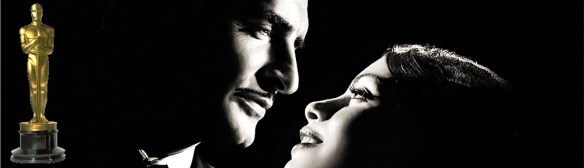
The Artist

A rare foreign winner at the Oscars… though it was backed by the Weinsteins and the brief bits of dialogue are in English, so it’s not that foreign (so that’s OK then!) The Artist is part tribute to the wonder of the silent era, part charming romantic comedy, and all an ode to the brilliance of Uggie the dog. I think it’s the most readily likeable winner of the last decade.
What should have won? Well, I liked War Horse, but otherwise The Artist looks a pretty fair pick.

1
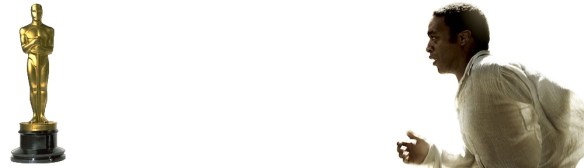
12 Years a Slave

The powerful true story of an educated, respected, free black man who was abducted into slavery, 12 Years a Slave is obviously a tough movie in theme, but what makes it bearable is the quality of the filmmaking — particularly the great performances from the likes of Chiwetel Ejiofor, Lupita Nyong’o, and Michael Fassbender, and the classical but effective direction of Steve McQueen. I don’t think it’s the best movie made in the last decade, but I think it’s probably the best one that won Best Picture.
What should have won? 12 Years a Slave is great ‘n’ all, but, c’mon, Gravity.

How many of those have found a spot on one of my year-end top tens?

None.

Tomorrow: great shorts.

100 Films @ 10: Films I Shouldn’t Have Wasted My Precious Time On This Earth By Watching

A pause from celebrating great things today to look at the flipside of movie watching: the crap.

However hard we may try, we’re always going to watch stuff we don’t like (and some of us don’t try that hard, let’s be honest — I swear the world is full of people who flock to all the new blockbusters even though they probably couldn’t remember the last time they actually enjoyed one). Whether it’s something that was recommended that we don’t like, or a poor entry in a franchise we used to enjoy, or by a director we once admired, or just morbid curiosity, the chances of going a significant period of time without seeing something bad are slim.

So in the “significant period of time” that was the last ten years, here are the worst films I saw.

10
Hannah Montana/Miley Cyrus: Best of Both Worlds Concert

I only watched this because it was part of Channel 4’s 3D Week (back when people thought home 3D was going to be a big thing), during which they only showed three films and this was one of them. Frankly, I don’t really remember it, other than that the 3D worked well because it was a modern production. I’m pretty sure I’ve blanked it from my memory for a reason. (Review.)

9
The Baskerville Curse

It feels almost cruel to pick on a made-for-TV kids’ animation from the ’80s when there are so many big-budget movies I could name here. The reason I’ve included it nonetheless is because of its thorough misunderstanding of the tone of Sherlock Holmes’ most famous adventure. I know you can’t properly do Gothic horror in a kids’ cartoon, but the bright and sunny colours, plus stretches devoted to telegram writing and train journeys, really take things to the opposite extreme. (Review.)

8
Chicken Little

As computer animated kids’ movies took off in the wake of Pixar’s arrival, Disney’s traditional 2D animations began to falter at the box office. They clearly put this down to the visual style, resulting in this being their first 3D computer animated movie… and it’s bloody terrible, proving their failure was nothing to do with the animation method and everything to do with their godawful content. This is the real nadir of Disney’s so-called Animated Classics. (Review.)

7
Sharknado

Cynical in the extreme, Sharknado is not a movie that’s so bad it’s good, it’s a movie that’s been made deliberately badly so people will think it’s so bad it’s good. But it’s not — it’s so bad it’s bad. But it worked, as they’re now up to four sequels, I believe. Ugh. (Review.)

6
The Final Destination

The best thing about the fourth movie in the Final Destination series is its title: it was to be the last movie, so they added a definitive article. Then they went and made a fifth one and ruined even that. It’s a shallow gore-fest with very little entertainment value. (Review.)

5
AVPR – Aliens vs Predator: Requiem

Alien vs. Predator wasn’t a very good movie; a weak PG-13 blockbuster that… didn’t really ruin either franchise, let’s be honest, because Alien had already done it to itself and Predator was never classy in the first place. Nonetheless, this sequel tried to put more nails in the coffin. It’s so bad, it actually makes the first AVP look good. Conversely, AVPR doesn’t look like much at all — it’s so dark you can’t see most of it. (Review.)

4
The Last Airbender

As M. Night Shyamalan’s popularity continued to sink, he turned his hand to director-for-hire style work, adapting the popular animated series Avatar (with a name change forced by a certain big-budget 3D movie). Unfortunately this wasn’t any better, with bizarrely forced storytelling (the result of a studio after a quick 3D conversion, to the extent they couldn’t afford to have the whole film done) and poor performances by controversially miscast actors. It’s definitely Shyamalan’s worst work. I mean, at least The Happening had some comedy value. (Review.)

3
Alone in the Dark

Remember Uwe Boll? I don’t know what he’s up to these days. I don’t care. Neither does the industry, fortunately, having seemed to finally realise that the best way to make his terrible movies go away was to stop talking about them. This is the only one I’ve ever seen and I don’t imagine I’ll waste time on another. Though I am a little curious about seeing Jason Statham in a fantasy movie… (Review.)

2
Parabellum

I summarised this as well as I can think in my review, so I’ll just quote myself: “Alfred Hitchcock once said that ‘movies are real life with the boring parts cut out.’ Valenta Rinner’s movie is the opposite of this in every respect: it isn’t real life, which is fine, but he only left the boring parts in, which isn’t.” (Review.)

1
Flight 93

It’s been ten years since I watched this so it’s entirely possible I’ve hyped up its terribleness in my memory, but I have no desire to revisit it to find out. So, I remember it as being an offensively bad treatment of events from 9/11, its awfulness thrown into sharp relief by how well Paul Greengrass’ United 93 handled the same story. (Review.)

Tomorrow: it’s the Oscars!

100 Films @ 10: Favourite TV Series of the Last 10 Years

This may be a film blog, but you’d be a fool to deny the rise in quality and significance of TV series in the past couple of decades, to the point where a lot of mainstream TV is arguably of higher quality than mainstream movies. So it seemed only appropriate to include it in my celebration of the last ten years.

We’ve all heard about how we’ve reached ‘peak TV’, and with so much television we’ve all missed something we should’ve caught — many things, probably (my list of “stuff I haven’t seen any/enough of” would probably be longer than this one). Nonetheless, here are ten of my favourite TV series that were on at some point during the last decade.

10
The Great British Bake Off

There are all sorts of prestigious dramas I could’ve put in this position — things I’m much more likely to revisit, too — but there’s more to TV than that. Just because we’re not going to buy something in a box set and critically (re)analyse it for years to come doesn’t necessarily mean it has no value. Of course, if you don’t get the appeal of Bake Off then I’m not sure anyone can explain it to you. I mean, who could’ve predicted that a bunch of people in a tent baking cakes while a pair of comediennes make gently naughty puns would become the biggest thing on British TV? If that makes it sound undramatic… it is. Well, apart from bingate. But that’s actually why it works so well (and why so many people actually hated all the fuss provoked by the aforementioned dumping of a baked Alaska) — it’s just lovely. And surprisingly entertaining with it. Or it was until the producers got greedy and shuffled off to Channel 4, potentially shattering the alchemical mix that made the show work. Oh well.

9
Detectorists

This understated BBC Four sitcom about the lives of a group of people who enjoy metal detecting (a hobby whose participants are not “detectors”, they’re detectorists) is quietly one of the best comedies on TV in recent times, both very funny and rather touching. Starring, written, and directed by Mackenzie “Gareth from The Office” Crook, it’s nothing like that series and all the better for it. It also includes a great performance from co-star Toby Jones, whose Lance starts as a somewhat-pathetic supporting turn but reveals many layers by the end.

8
Mad Men

The critically-acclaimed story of ad men in ’60s New York, Mad Men is a rich and frequently abstruse drama that on the surface looks almost soapy but quite clearly is nothing so shallow. It works best in the long run, slowly accumulating character moments and events in ways that pay off down the line, resulting in some stunning scenes and episodes. It’s only so low on this list because it seemed to waver a bit in later years, and I’m still not sure how I feel about its ending. (On the bright side, it didn’t go thoroughly off the rails like, say, Dexter.)

7
Outnumbered

At the risk of sounding like one of those music groupies who are all “I liked their early stuff, before they got famous,” I remember when Outnumbered was buried late at night and it seemed like no one watched it, but those of us who did hoped against hope for a second series because it worked so well. It later morphed into a mainstream staple, but deservedly so — its semi-improvised “kids say the funniest things” format created a veracity that even the best scripted sitcoms fail to match. As the kids have grown it’s become more traditional, I suppose, but retained a smart eye for the absurdism of real life.

6
Romanzo Criminale

Little seen in the UK (or anywhere outside Italy, perhaps) because it was buried on Sky Arts just as the craze for European crime TV was taking off, this Italian gangster saga is consequently an underrated specimen of quality continental drama. Telling one epic story across two seasons and 22 episodes, like many of the best series its effectiveness comes less from individual episodes and more from the way events and complexities build over time. Fortunately Arrow have released it on DVD, so anyone with curiosity (and a spare £30) can see what they’ve been missing.

5
Sherlock

Apparently Benedict Cumberbatch’s interpretation of the Great Detective is the most popular British TV character in the world now. I guess that’s in spite of the criticism the series has regularly attracted across its last two runs. Of course, the ratings continue to be massive, so it must be doing something right. The idea of updating Holmes and Watson to the present day seemed foolhardy at first, but with a clever attention to the canon, a raft of cinematic visual tricks, and a top-drawer cast, they made something that worked really rather well. There are a couple of duff episodes, true, but I think they’re more than outweighed by the successes. Hopefully said success — which has helped propel the leads into the realm of movie stardom — won’t prevent us getting more in the future.

4
Torchwood: Children of Earth

Doctor Who’s ‘adult’ spin-off had a rocky start when it first launched in 2006, with a series that had been rushed into and through production and resulted in a few… iffy decisions. The second season improved its consistency, and those two original runs certainly have their fans, but it really got good when it changed its format for this third run. Children of Earth is an almost-standalone five-episode miniseries about an alien race coming to Earth and demanding we hand over all our children, with a fantastic performance from future Doctor Peter Capaldi as a politician embroiled in the discussions about whether to appease them. Torchwood would return to its muddled quality with the attempt at a follow-up miniseries, US co-production Miracle Day, but for five nights in the middle of 2009 it was one of the very best sci-fi miniseries ever produced.

3
Doctor Who

Every era of Doctor Who has its ups and its downs, its fans and its detractors. For example, every five-or-so years Doctor Who Magazine runs a reader survey to rate every story in the show’s history out of 10, and every single story gets at least some 10s, and all but one or two get some 1s as well. Nowhere are these extremities better exemplified than season 21, which ends with The Caves of Androzani (the #1 story in DWM’s 2009 poll) followed by The Twin Dilemma (perpetually placed last in pretty much every poll ever). But for the purposes of this list we’re talking about the revived show’s third series (the first one without Billie Piper) through to the most recent Christmas special (the one with a superhero). That encompasses the beloved and divisive second half of the David Tennant/Russell T. Davies era, as well as most of the divisive and beloved Matt Smith/Peter Capaldi/Steven Moffat era. For my money, any series that can produce the likes of Human Nature/The Family of Blood, Blink, the climax of Utopia, Time Crash, Voyage of the Damned, Midnight, Turn Left, The Waters of Mars, The Eleventh Hour, The Time of Angels/Flesh and Stone, Amy’s Choice, Vincent and the Doctor, A Christmas Carol, The Doctor’s Wife, The Girl Who Waited, Hide, The Crimson Horror, The Day of the Doctor, Listen, Mummy on the Orient Express, Flatline, The Zygon Invasion/The Zygon Inversion, and Heaven Sent deserves a spot in my top ten.

2
The Americans

A couple of weeks ago, US network FX released a trailer for The Americans’ forthcoming fifth season that unashamedly celebrated its increased critical standing, with quotes from half-a-dozen or so media outlets expressing the same fundamental sentiment: it’s “the best show on television”. It’s about a pair of Russian spies operating undercover in the US in the ’80s, who also try to maintain some kind of normal family life with their two teenage kids — who don’t know their parents are spies. Oh, and the FBI agent who’s hunting for them has just moved in over the road. Sounds kind of hokey put like that, but in practice it’s anything but. And like several other shows on this list, it works best in the long term, as things build, echo, and characters have to deal with long-brewing consequences. It works as a spy thriller, but also as a character-driven exploration of what makes people tick. There are just two seasons left to go, both commissioned (thank goodness), and if they can just stick the landing it’s surely destined for a place in lists of all-time greats. So why isn’t it my #1? Well…

1
Game of Thrones

Here’s another show whose place in the all-time pantheon is sure to be claimed or dashed by how it ends, a point which is also exactly two seasons away — what are the odds? Of course, even if it ballses it up, Thrones’ legacy is assured in some ways: it’s basically the biggest TV show in the world right now, certain to be remembered as a cultural touchstone of the 2010s. I’ve given it the edge on my beloved Americans primarily for two reasons: the penultimate episode of the last season, and the last episode of the last season (which I wrote about at greater length here). To summarise, they’re two of the greatest individual episodes of TV ever made. Thrones does all the long-brewing cumulative stuff too, but there’s nothing else on TV that can pull off a satisfying Big Moment in quite the same way.

Tomorrow: back to the movies… the bad, bad movies…

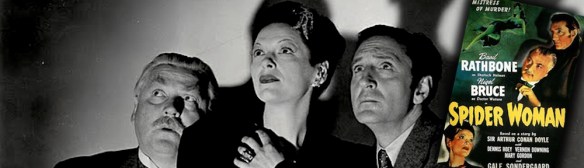
100 Films @ 10: Basil Rathbone Sherlock Holmes Films

Yesterday I ranked the film series that have been a part of 100 Films down the years. The Sherlock Holmes films starring Basil Rathbone as the Great Detective and Nigel Bruce as his trusty sidekick Dr Watson may only have placed 6th on that list, but they have been a regular presence on my blog for most of its life as I slowly worked my way through all 14, from The Hound of the Baskervilles in Year 2 to Dressed to Kill as the record-breaking #200 in Year 9.

It seemed only fitting to include the series in my tenth birthday celebrations, therefore, so for today’s top ten I’ve gone back over all my reviews (and memories) and used them as a guide to rank my ten favourite instalments.

10
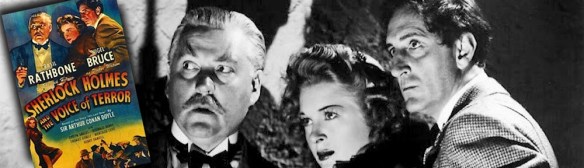
Sherlock Holmes and the Voice of Terror

“The basic concept is a nice idea for a war-set spy-thriller, but not really for a Sherlock Holmes mystery. […] The consensus seems to be against me, but by the end I was quite enjoying Voice of Terror. It may be a Sherlock Holmes film in name only, but taken instead as a cheap spy thriller it makes for passable entertainment.” Full review.

9
The Hound of the Baskervilles

“One of the novel’s strong points is its occasional Gothic styling, and this is something the film version does very well. Dartmoor looks fantastic, like something Tim Burton would have created were he working in the ’30s. It’s clearly a set, but it’s dramatic and moody and completely effective.” Full review.

8
Terror by Night

“a contained, almost claustrophobic version of a Holmes tale. There are definite pros to this: it’s effectively a locked room mystery, with an element of howdunnit closely tied to the whodunnit. […] That it’s one of the series’ lesser instalments but still so enjoyable is simply testament to their overall quality.” Full review.

7
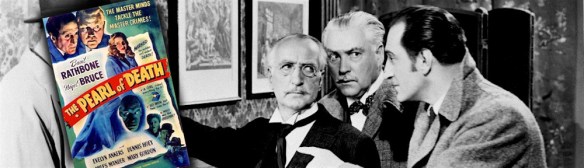
The Pearl of Death

“Holmes first rescues the priceless Borgia Pearl, but then quite spectacularly loses it. The notion of Holmes being doubted, of having to prove himself to reassert his reputation, is a good one — one recently borrowed by avowed Rathbone fans Moffat & Gatiss for their modern-day Sherlock, in fact.” Full review.

6
Sherlock Holmes and the Secret Weapon

“The name’s Holmes, Sherlock Holmes, as Universal’s loose adaptations of Britain’s Greatest Detective deliver a low-key proto-Bond, 22 years before Goldfinger applied the same tricks to Britain’s Greatest Spy. […] As with Voice of Terror, I enjoyed a lot of Secret Weapon in spite of its distinct un-Holmes-ness — it’s another pacey, exciting World War Two spy thriller.” Full review.

5
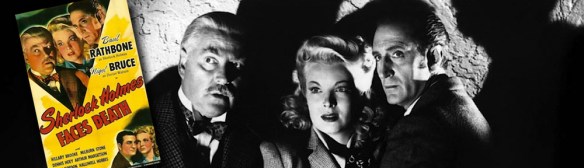
Sherlock Holmes Faces Death

Faces Death leaves behind the proto-Bond WW2 spying of the last three films (“it can almost be viewed as the starting point of a completely new Holmes series” asserts one review I’ve read) to involve Holmes in a genuine detective mystery […] packed with proper deduction, which is excellent.” Full review.

4
The Adventures of Sherlock Holmes

“There’s rain-lashed, fog-drenched Victorian London streets! Brutal murders by foul foreigners! Dastardly plots against the crown! Galloping carriages! Romantic subplots! A smattering of comedy! A song-and-dance number! (No, really, there is.) And a final shoot out… in the Tower of London! You can’t escape the joyous feeling that this was designed as pure entertainment, literally including something for everyone.” Full review.

3
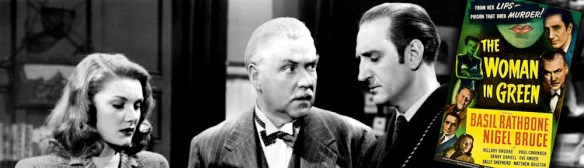
The Woman in Green

“Starting with a particularly vile series of murders that mask an even more detestable scheme and genuine peril for our hero, I can imagine some fans would find The Woman in Green to be too big a step outside the Rathbone Holmes comfort zone. For me, however, these elements mark it out as one of the series’ best instalments.” Full review.

2
The Spider Woman

“Screenwriter Bertram Millhauser skillfully mixes elements from various Conan Doyle tales [including] The Sign of Four, The Final Problem, The Adventure of the Empty House, The Adventure of the Devil’s Foot and The Adventure of the Speckled Band. […] Several of these borrowed elements — the faked death and The Woman — lead to some delicious scenes, such as when Holmes reveals he’s alive to Dr Watson, offering one of those occasions where Bruce’s comedic rendition of the role actually works.” Full review.

1
The Scarlet Claw

“[Roy William Neill’s] direction is incredibly atmospheric, from a wonderful mist-covered opening scene, replete with an incessantly tolling bell, to regular instances of shadow-drenched photography afterwards; not to mention various pleasing camera angles and moves. The story — in which townsfolk believe a mythical beast has returned to murder its residents — presents a well-constructed mystery all round, though as it moves into the second half some of its twists become all too guessable. [Such] little niggles may stop the film from being perfect but, like the similarities to The Hound of the Baskervilles, while they’re certainly there, they’re easy to overlook in the name of a rollicking good horror-mystery-adventure.” Full review.

Tomorrow: as seen on TV.

100 Films @ 10: Favourite Film Series

Once upon a time, sequels were very much a lesser thing, and making more of them only made things worse. Nowadays we’re almost at the opposite extreme: first movies are routinely designed as setup for the better sequel, and never-ending franchises are all the rage.

Today’s top ten ranks some of my favourite movie series that have been part of 100 Films. Here that means a series with four or more movies (three would just be a trilogy, wouldn’t it?) where I’ve watched at least a couple of them during 100 Films’ life, as well as having seen a significant proportion overall. For instance, I’ve seen the two most recent Planet of the Apes films but none of the original five, so I can’t really judge that as a series.

A big factor herein is acknowledging consistency — one or two great films and a bunch of duds should mean exclusion. For example, the Star Wars series has two unimpeachable classics, and at least two more pretty great movies… but that’s only 57% of the Saga, or just 44% if you count the two theatrically-released spin-offs. Considering the lowly quality of the prequels, how much do they drag down the series as a whole?

You may disagree. Let’s take a look…

10
Marvel Cinematic Universe

If we’re talking about consistency here then the MCU has it in spades: consistently underwhelming villains, consistently bland cinematography, consistently unmemorable music… Ah, but they also have consistently likeable heroes, a consistently light tone, and a consistent ability to be pretty entertaining. None of them are really bad (except the first Captain America, which has its fans anyway), a couple of them even push towards a certain degree of greatness, and overall they are — to paraphrase the description of The Avengers by its writer-director, Joss Whedon — not great movies, but they are each a great time.

Best film: Captain America: Civil War
Weak link: Captain America: The First Avenger
Other reviews: Iron Man | The Incredible Hulk | Iron Man 2 | Thor | Avengers Assemble | Iron Man 3 | Thor: The Dark World | Captain America: The Winter Soldier | Guardians of the Galaxy | Avengers: Age of Ultron | Ant-Man | Doctor Strange | + 5 Marvel One-Shots (take a look under ‘shorts’ on my reviews page) and various TV series, including Daredevil season two and Luke Cage season one


9
The Hunger Games

The shortest series in my top ten, this is very much a borderline on my rules — if they’d done the third book as one film, it wouldn’t count. That gives The Hunger Games a certain advantage over the other films here, in that it has one long story to tell across just a handful of movies, rather than trying to refresh itself in some way with each new film. About a group of young people fighting against an oppressive autocratic regime in a future version of America, it’s a future-history of, like, next week. For all the fun of its action theatrics, a series aimed at younger viewers with themes about the dangers of dictators and the potential benefits of and need for a resistance — what some might call “terrorism” — has rarely been more pertinent.

Best film: The Hunger Games: Catching Fire
Weak link: The Hunger Games: Mockingjay – Part 1
Other reviews: The Hunger Games | The Hunger Games: Mockingjay – Part 2


8
The Thin Man

Ostensibly a series of murder mysteries, the reason the Thin Man series is such a joy is that the films are more concerned with the screwball-ish relationship between the leads, married detective duo Nick and Nora Charles, played with a certain rakish aplomb by William Powell and Myrna Loy. The mysteries themselves are Christie-esque parlour games and there’s a major role for the pair’s adorable dog. Mix all that together like one of the Charles’ favoured cocktails and they make for similarly splendid entertainment.

Best film: After the Thin Man
Weak link: The Thin Man Goes Home
Other reviews: The Thin Man | Another Thin Man | Shadow of the Thin Man | Song of the Thin Man


7
George A. Romero’s ‘Dead’ Films

With his low-budget horror film Night of the Living Dead, co-writer/director George A. Romero single-handedly created a whole sub-genre: the zombie movie. Although the form eventually degenerated into a miasma of excessive gore, what makes Romero’s films timeless is the way they use the zombies to reflect something else, whether it be basic humanity or wider sections of society. The first two movies (Night and Dawn) are genre-transcending classics, but if we’re talking consistency then I even have a fondness for the underrated fourth instalment, Land of the Dead, and the rush-produced but not meritless sixth, Survival of the Dead. Even the weakest, Diary of the Dead, has more of interest to say than many of its genre stablemates.

Best film: Night of the Living Dead
Weak link: Diary of the Dead
Other reviews: Dawn of the Dead | Day of the Dead | Land of the Dead | Survival of the Dead


6
Sherlock Holmes starring Basil Rathbone

Between 1939 and 1946 Basil Rathbone and Nigel Bruce starred in 14 Sherlock Holmes films, cementing themselves as the definitive screen interpretation of Holmes and Watson for decades to come — some would say forever. Rather than faithful adaptations of Sir Arthur Conan Doyle’s original stories, these liberally remix the best bits into exciting new mysteries and adventures. If that sounds familiar from more modern times, it’s because Sherlock creators Steven Moffat and Mark Gatiss are massive fans of the Rathbone/Bruce films, and have never been shy about admitting their influence on how Sherlock adapts the canon. Maybe not one for literary purists, then, but otherwise there’s barely a dud to be found in this entertaining series.

Best film: The Scarlet Claw
Weak link: Pursuit to Algiers
Other reviews: The Hound of the Baskervilles | The Adventures of Sherlock Holmes | Sherlock Holmes and the Voice of Terror | Sherlock Holmes and the Secret Weapon | Sherlock Holmes in Washington | Sherlock Holmes Faces Death | The Spider Woman | The Pearl of Death | The House of Fear | The Woman in Green | Terror by Night | Dressed to Kill


5
Batman

You could, not unreasonably, split the Batman movies into multiple sub-series at this point: the four movies from 1989 to 1997, Christopher Nolan’s Dark Knight trilogy, Batman’s role in the DCEU; plus the ’66 Batman, animated cinema release Mask of the Phantasm, and, now, the LEGO movies. This ranking encompasses them all… more or less. Certainly the live-action ones since ’89, anyway. Yes, that run of movies contains one of the poorest blockbusters of all time (Batman & Robin), but it’s counterbalanced by one of the greatest blockbusters of all time (The Dark Knight), and several others I’d place in the form’s upper echelons (Batman Returns, Batman Begins, maybe one or two more). I’m one of those people who likes Batman v Superman and sees promise in Justice League and The Batman, too, so long may it continue.

Best film: The Dark Knight
Weak link: Batman & Robin
Other reviews: Batman (1966) | Batman (1989) | Batman Returns | Batman Forever | Batman Begins | The Dark Knight Rises | Batman v Superman: Dawn of Justice (and its Ultimate Edition) | + 8 animated movie reviews (take a look under ‘B’ on my reviews page)


4
Harry Potter

I rarely classify myself as “a Harry Potter fan” because I know the full extent of obsessiveness you get from die-hard Potheads (as I like to call them. I don’t think anyone else does, but I think we should.) It’s no worse than any other dedicated fandom, I’m sure, but I’m not that extreme. Nonetheless, I’m of the right age to have read the books during my childhood (albeit right at the end of my childhood) and do have a fondness for them, as well as for the film adaptations. This is the perfect list for those, because I definitely feel like they’re more than the sum of their parts: each film is at least ‘good’, but few of them stray toward the territory of ‘really great’ — not individually, anyway. As a whole eight-film saga, though, I think they make for an impressive piece of work.

Best film: Harry Potter and the Goblet of Fire
Weak link: Harry Potter and the Chamber of Secrets
Other reviews: Harry Potter and the Philosopher’s Stone | Harry Potter and the Prisoner of Azkaban | Harry Potter and the Order of the Phoenix | Harry Potter and the Half-Blood Prince | Harry Potter and the Deathly Hallows: Part 1 | Harry Potter and the Deathly Hallows: Part 2 | + an overview of the Harry Potter films of David Yates, and also fan edit Wizardhood


3
Mission: Impossible

It’s the second-shortest series on this list, making my following statement comparatively less of an achievement, but still: in my view, there are no bad Mission: Impossible films. They’ve sometimes been given a rough ride down the years, with the first two especially meeting with more than their fair share of criticism, but I’ve enjoyed every one. The most recent is the best, in my opinion, but I don’t think I’d begrudge anyone naming any of the others as their favourite.

Best film: Mission: Impossible – Rogue Nation
Weak link: Mission: Impossible III
Other reviews: Mission: Impossible II | Mission: Impossible – Ghost Protocol


2
X-Men

I feel like I’ve written plenty of introductory overviews to the X-Men at this point in my blogging career — about my near-lifelong love for the series; about its relevance to the modern superhero movie landscape; and so on. As with most of these series, not every entry is perfect, but very few of them are outright bad. Even the black sheep of the series, The Last Stand, isn’t all it could’ve been had director Bryan Singer stuck around, but it often gets an unfair rap — it’s not a bad piece of blockbuster entertainment. On the other end of the spectrum, I think the series’ high points are among the very best superhero movies. By the sounds of things the imminent third Wolverine movie, Logan, only continues that tradition.

Best film: X-Men: First Class
Weak link: X-Men Origins: Wolverine
Other reviews: X-Men | X2 | The Wolverine | X-Men: Days of Future Past (and The Rogue Cut) | Deadpool | X-Men: Apocalypse


1
James Bond

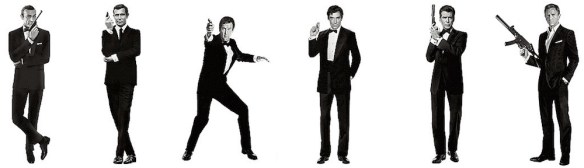
With 24 films to date, produced across 53 years, the James Bond films are a series like no other (though, in terms of number of films, the MCU will likely surpass it within the next five years). If we’re talking consistency of quality, then there are probably more underachievers here than in any other series in this top ten… but then there are more films full-stop, so what do you expect? Conversely, there are probably more high points too, be it the era-defining action of the Connery films, the lightness of the better Moore movies, the grit of Dalton, the polished blockbusterdom of Brosnan, or the series’ reinvention as prestige pictures with Craig. Indeed, there’s pretty much a Bond movie for every taste (unless you fundamentally object to enjoying the adventures of a government-sponsored killer, of course). At this point the series seems to be inoculated against any obstacle — they are critic proof, box office proof, almost audience proof. Whatever else happens in this crazy, crazy world, you can be sure of one thing: James Bond will return.

Best film: Casino Royale
Weak link: A View to a Kill
Other reviews: Dr. No | From Russia with Love | Goldfinger | Thunderball | You Only Live Twice | On Her Majesty’s Secret Service | For Your Eyes Only | Octopussy | GoldenEye | Tomorrow Never Dies | Quantum of Solace | Skyfall | Spectre

Tomorrow: an elementary list.

100 Films @ 10: Most-Played Soundtracks

For today’s top ten I’ve opened up iTunes, sorted all my songs by play count, and seen which are my most-listened-to cues from film & TV soundtracks. I’m not a great musical connoisseur, really, so because of that and this just being a statistical most-played list, expect lots of exciting action music — especially as this includes plays from when I wrote a blockbuster-style screenplay for one of my university dissertations, so I listened to an awful lot of that kinda stuff then.

Couple of other points: These are all score cues rather than songs that are on soundtracks, because, well, that’s what I chose to do. However, I have included trailer music, but only when it was composed especially for the trailer — nothing from those generic “music for trailers”-type albums. Finally, I’ve ditched repeats from the same album, because I thought this would basically be the track list for Pirates of the Caribbean otherwise. Turns out that wouldn’t’ve been the case, and instead it removed a track from, of all things, Torchwood.

10
Suite from X2

from X-Men 2

I’ve written before of my fondness for John Ottman’s X-Men theme. As this was the only version of it for years, I listened to it plenty. I guess it’ll be supplanted by the version from X-Men: Apocalypse eventually, because the tracks on that album are less ‘cluttered’ with other bits of the score. (As the confusion about X2’s title continues, let me note this: the UK soundtrack album is called X-Men 2 and this track on it is called Suite from X2; the US soundtrack album is called X2 and this track on it is called Suite from X-Men 2.)

9
Wheel of Fortune

from Pirates of the Caribbean: Dead Man’s Chest

From the second Pirates movie, this is the cue from the big sword fight climax — which, as you may remember, includes a runaway water wheel, hence the title. For all his production-line type methods, Hans Zimmer can deliver a very effective action cue.

8
Closing Credits: “Bolero”

from Moulin Rouge

As with much of the music in Baz Luhrmann’s musical, this is a track that suggests a lot of drama, even if it ‘only’ plays over the end credits. I can’t really explain why I like it so much, but I do. For whatever reason I listened to it every day on my way to work when I interned for a summer in New York, which (a) didn’t do its play count any harm, and (b) means I always associate it with riding the Subway, weirdly. As to who wrote it, I’ve got it down as being by the film’s composer, Craig Armstrong, but Wikipedia says Steve Sharples and Allmusic says Simon Standage, so I dunno.

7
This is Gallifrey: Our Childhood, Our Home

from Doctor Who: Series 3

Murray Gold has been composing all of Doctor Who’s music for over a decade now, which is quite an achievement, especially for a show that so regularly changes its style — week to week, in many respects. My favourite piece of his work is probably his theme for the 11th Doctor, created for series five, but I’ve most listened to this elegiac piece for the Doctor’s home planet from the series three finale.

6
Mind Heist

from the Inception trailer

Braaaam! Christopher Nolan’s film is perhaps most famous for defining trailer music for the next… well, it’s still kinda ongoing, isn’t it? Yet that recognisable cue used in the trailers isn’t actually from the film itself. Heck, it’s not even by the film’s composer, Hans Zimmer (him again!) The story behind it is a mite more complicated, but Zack Hemsey was one of the main people involved in the final trailer, and it was he who put out a track with his version of that work, so here it is.

5
The James Bond Theme

from the Casino Royale trailer

Monty Norman’s James Bond Theme has been re-worked countless times down the years, but this version struck me as soon as I first heard it for one key reason: voices. The final part of the track has the familiar tune accompanied by a choir, I believe for the first time, and it sounds fantastic. It was created by trailer music outfit Pfeifer Broz. Music specifically for the Casino Royale trailer, so you won’t find it on the soundtrack CD, but, of course, it’s still out there to be found…

4
Can You Dig It (Iron Man 3 Main Titles)

from Iron Man 3

Despite their continued success, there are criticisms regularly raised against Marvel’s shared universe movies. One is the weak villains. Another is the painfully generic music. That’s precisely why Brian Tyler’s title theme from the third Iron Man stands out so: it accompanies the ’70s-action-show-style credit sequence with a ’70s-action-show-style reworking of the film’s main theme (which I also quite like, but is much more standard “modern blockbuster music” in sound).

3
Drink Up Me Hearties

from Pirates of the Caribbean: At World’s End

More Zimmer Pirates. This is the final cue, accompanying the end credits of the film, and as such is something of a summation of the series’ music. It’s kind of the epitome of modern blockbuster scores, for good or ill.

2
The Chase

from Torchwood

More Murray Gold, here composing with his Doctor Who orchestrator, Ben Foster. This ticks many of the boxes I mentioned at the start: an action cue from my screenwriting playlist. Gold’s Whoniverse music has most often been in the style of modern blockbuster movies, because that’s the feel the show has gone for, but by distilling the essence of that style he has on occasion produced tracks that exceed its big-budget counterparts for effectiveness. This is one such occasion: as fast-paced action tracks go, this is often one of the fastest and actioniest.

1
He’s a Pirate

from Pirates of the Caribbean: The Curse of the Black Pearl

The creation of Pirates of the Caribbean’s soundtrack is a notorious clusterfuck of composers literally competing against each other to produce something for the Disney movie. Reports vary on what exactly went on, but I believe the long and the short of it is Klaus Badelt wrote the most music that was actually used and so got the credit on the CD. Presumably Hans Zimmer didn’t think the film would be all that big and didn’t care — he certainly took the credit for the sequels’ scores, though. Anyway, this recognisable main theme actually has its roots in another Zimmer score, Drop Zone, as you can hear here. Shocking self-plagiarism, ain’t it? Still, this improved version is the one everyone knows now, and it’s wound up my most-played soundtrack track.

Tomorrow: never-ending stories.

100 Films @ 10: Great Scenes

Howard Hawks famously said that a good movie was simply “three good scenes and no bad ones”. For today’s list, I’m focusing on examples of the former.

There’s no set average for the number of scenes in a feature film, but a good rule of thumb is that a typical movie scene lasts two or three minutes — which means I’ve probably seen in excess of 48,000 scenes as part of this blog. That’s rather a lot to recall, so I’m not presuming to say these ten are the very greatest from that lot. What they are is ten that stuck in my memory particularly, for one reason or another. Even if they’re not the greatest, they are great.

10
The Swimming Pool

from Let the Right One In

The bullies that have plagued young Oskar throughout the film corner him in a public swimming pool and, brandishing a knife, inform him that if he can’t hold his breath for three minutes he’ll lose an eye. They push Oskar under the water. The seconds tick by. Then, we reach the real reason this scene is here: as the shot holds on Oskar underwater, we hear the muffled sounds of breaking glass, then screams. Feet run backwards across the water. Heads and limbs drop into the pool. The water begins to turn red. This could’ve been a brutal action climax like any other, but by staging it in a brightly-lit swimming pool, by not showing us the meat of the action, and by achieving it all in one shot, director Tomas Alfredson creates a sequence of supernatural force that is eerily grounded.

9
The Opening Shot

from Touch of Evil

Long takes are all the rage nowadays, made even easier by advances in digital cinematography and editing, but this hails from a time when they were a bit more special. It remains one of the most famous because of its content: we see a bomb planted on a car, then follow it as its unsuspecting owners drive through the streets. When will it go off? And, beyond that, Welles’ preferred soundtrack — overlapping snippets from multiple sources as the camera moves through the town — helps establish the melting-pot world of the film about to follow.

8
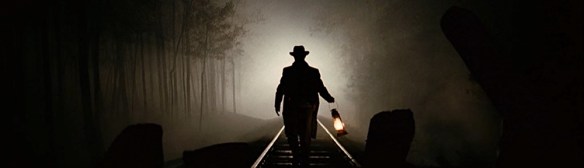
The Train Robbery

from The Assassination of Jesse James by the Coward Robert Ford

Another opening scene where the photography is the star. This time, it’s the work of the great Roger Deakins, as a gang of crooks await a train in a forest at night, lit only by the orange glow of lanterns. Then the train itself arrives, its stark headlight throwing sharp relief on the shadowy trees. Deakins himself has said it’s his best work, and who are we to disagree? The effectiveness is only heightened by the slow, deliberate, tension-mounting pace maintained by director Andrew Dominik.

7
The Superfreak Dance

from Little Miss Sunshine

After all the trials and tribulations of the movie, the Hoover family finally make it to the Little Miss Sunshine pageant and little seven-year-old Olive gets up on stage… where she dances a striptease-style routine to Superfreak. It neatly satirises and pillories the ludicrous sexualisation of these beauty pageants. Then the sequence only gains in stature when the officials try to pull Olive off stage early, which ends up with the whole family throwing dignity to the wind and dancing with her — the previously disjointed family finally united.

6
The Tanker Chase

from Mad Max 2

I already discussed this at length in my review, so to quote myself, it’s “an almighty action sequence […] a speeding battle through the outback. It feels wrong to just call it ‘an action sequence’, like that’s selling it short. You get the sense that this is why the movie exists; that co-writer/director George Miller’s goal with the entire rest of the film has been to get us to this point. It’s not just ‘the climax’, it’s ‘the third act’, and it’s stunning — the choreography of it, the editing, the stunts, as dozens of vehicles chase each other, people run around on top of them, jump between them… I don’t think it’s hyperbolic to say it must be one of the greatest action sequences ever committed to film.” It’s so good, they later remade it as an entire movie. And if you want to see something equally awesome, here’s the Mad Max 2 scene re-scored with music from Fury Road.

5
The Henley Royal Regatta Boat Race

from The Social Network

You could cut this 100-second sequence out of The Social Network and it would have no impact on the film’s plot, but it would also rob us of one of the most striking sequences in the CV of director David Fincher — and considering his continued visual mastery, that’s saying something. The tilt-shift-style photography came out of necessity, as the sequence was shot just months before the film’s release and they had to shoot the close-ups somewhere else entirely, but it gives the whole thing a unique visual style that, particularly when combined with a version of In the Hall of the Mountain King from composers Trent Reznor and Atticus Ross, is something very special.

4
The Poem

from Skyfall

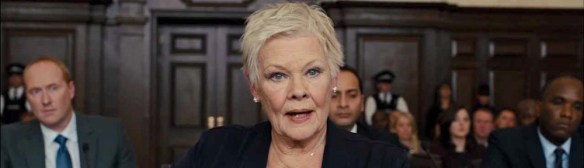
Whoever thought we’d one day find moviemaking artistry in the James Bond series? Skyfall isn’t even the first time that happened (see: the opera escape from Quantum of Solace), but the reason this sequence is even better is the way it sums up the film’s themes. As I described it in my review: “Bond races to an inquiry where M is giving evidence, in pursuit of Silva who is intending to finalise his revenge, with the soundtrack sharing only Judi Dench’s voice delivering a reading from Tennyson: ‘though we are not now that strength which in old days moved earth and heaven,’ she says, cementing [the] themes of what the role of the secret service (and, indeed, Britain) is in the modern world; and continues, ‘heroic hearts, made weak by time and fate, but strong in will to strive, to seek, to find, and not to yield,’ as a weakened, past-it Bond races to her rescue. It’s so perfect it could have been written for the film especially.”

3
The Truck Flip

from The Dark Knight

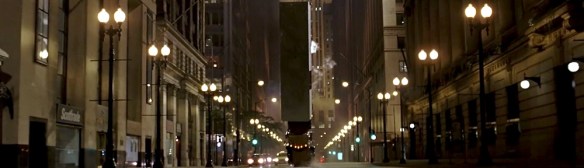
Pure spectacle seems hard to come across in movies post-CGI, where anything that can be imagined can be created on screen by even relatively small-scale movies. But when you combine the first time a narrative feature film had been shot in IMAX with an incredible stunt performed for real, you’re reminded of the magic of cinema. It’s the most memorable part of a car chase sequence that is exceptionally well executed on the whole, too.

2
The Montage

from Requiem for a Dream

To quote my review: “I’m not sure you can quite be prepared for what comes [at the end]. Even if you were told what happens, or see some of the imagery, or feel like you can see worse stuff on the internet without even looking too hard (which, of course, you can)… that’s not the point. It’s the editing, the sound design, the sheer filmmaking, which renders the film’s final few minutes — a frenzied montage that crosscuts the climaxes of all four characters’ stories — as some of the most powerful in cinema. It’s horrendous. It’s brilliant.”

1
The Basement

from Zodiac

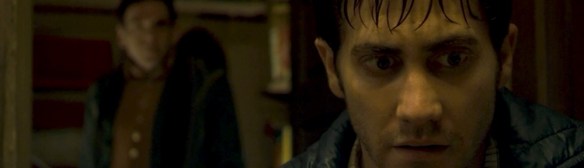
When I first thought of this idea for a top ten, this was the first thing that came to mind. In it, Jake Gyllenhaal’s obsessive investigator Robert Graysmith visits the home of a suspect’s friend. The pair are alone in the house, and they both go down into the basement to see something… when Robert hears someone upstairs. Describing this scene does it no justice — it’s one of the most hair-raisingly chilling in screen history.

Tomorrow: New York, London, Paris, Munich, everybody talk about… film music.

100 Films @ 10: Most Effective Director’s Cuts

Whether they be director’s, extended, ultimate, or any number of strung-together adjectives someone in marketing thought sounded exciting, direct-to-home-media alternate cuts of movies are all the rage nowadays. They have been for quite a while, actually — thanks no doubt to the booming sales of the DVD era — so for today’s top ten I thought I’d run down some of the most effective. I don’t necessarily mean the best (these aren’t “the ten best films that happen to have extended editions”), but rather the ones that have the biggest positive impact on the end result — which is sometimes the same thing, of course.

I know the initially stated point of these top tens was to look back over the last ten years, but this time I’ve widened the remit to include all extended cuts, mainly because that only added one title. Losing out because of that is X-Men: Days of Future Past – The Rogue Cut, which does contain significant changes, especially to the climax, but didn’t really belong because I actually think the theatrical cut is smoother.

10
Léon
Version Intégrale

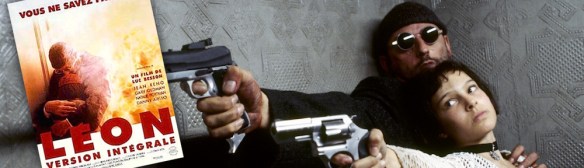
To undermine my introduction right away, the extended version of Léon doesn’t actually make massive changes to the movie. Some of the additions bolster character development, but the film wasn’t shortchanged on that in the first place. It is great though, but it’s also just more greatness. Does that mean it shouldn’t be here? Well, if you’re watching the US Blu-ray, it’s the longer version that has the proper title card, which is reason enough to prefer it in itself.

9
Watchmen
Director’s Cut

There are three cuts of Watchmen, but it’s the middle one that is director Zack Snyder’s preferred version of the film (aptly, given its subtitle). I’ve still not got round to the semi-experimental Ultimate Cut so can’t truthfully comment on whether Snyder’s right, but when I reviewed the Director’s Cut I asserted that, thanks to “a little extra room to breathe and a few worthwhile extensions, and in spite of the odd tweak that doesn’t work, this is the superior cut of the film.”

8
I Am Legend
Alternate Theatrical Version

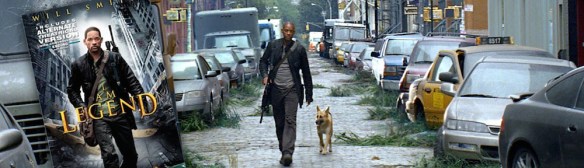
The extended cut of I Am Legend has one of the most meaningless subtitles of all — it wasn’t released theatrically, so how is it an “alternate theatrical version”? That said, “alternate” is definitely a more apt descriptor than “extended”: although this version is longer, the biggest change is a completely different ending. That makes a difference to the film’s tone, as well as paying off some subplots. But it only changes the movie so much — those misguided CGI creatures are still there, after all.

7
Salt
Director’s Cut

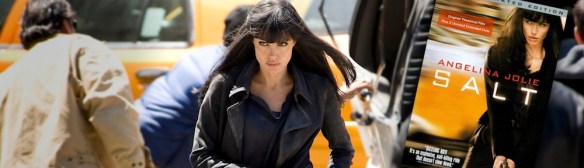
This middling action-thriller starring Angelina Jolie is not the first film that’s going to come to mind to most people (for any reason, ever), but it exists in three different cuts that make some striking differences. I discussed them in depth in my review, but on balance the one they labelled the Director’s Cut is best.

6
Alien³
Assembly Cut

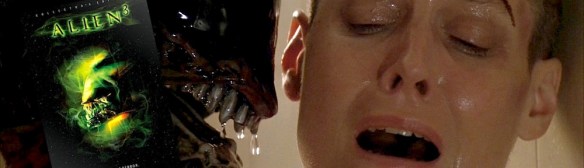
The second Alien sequel was a fraught production for a number of reasons, which wound up in an obviously-compromised theatrical version. A little over a decade later (doesn’t sound so long with hindsight, does it?) the original “assembly cut” was released — not a director’s cut because, understandably, David Fincher wants nothing to do with the movie. The different version doesn’t save the film entirely, but it does clarify some of it, thereby improving it.

5
The Lord of the Rings
Extended Edition

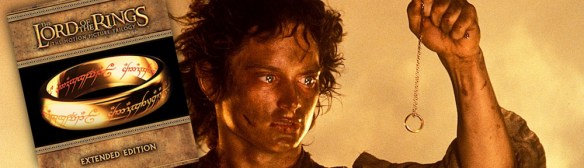
From Fellowship onwards, the extended versions of Peter Jackson’s adaptation of J.R.R. Tolkien’s epic are the preferred versions, deepening characters and expanding the rich world of the story. But by the time of the third and final movie, they’re essential: in a rare misstep, Jackson chose to completely excise one of the trilogy’s primary villains, Christopher Lee’s Saruman, from the theatrical version of Return of the King, so only in the extended version is the storyline of a major character actually resolved. That film won Best Picture nonetheless, which is why these aren’t ranked higher: the extended cuts are better, yes, but the theatrical versions are an incredible cinematic achievement regardless.

4
Sucker Punch
Extended Cut

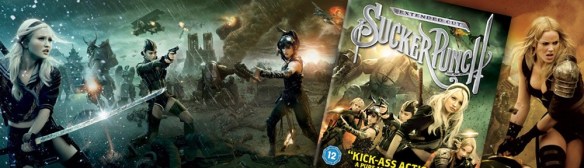
Zack Snyder again, with another director’s preferred cut only debuting on the home release. This time he had to cut the film for censorship, revising it multiple times until the MPAA gave it the necessary PG-13. In the process, he removed several lines and scenes that helped to clarify what the hell was going on, which is rather helpful in such a crazy-ass movie. I’ve never bothered with the theatrical cut, but — in its extended form if no other — I think it’s something of an underrated movie.

3
Blade Runner
The Final Cut

Arguably the daddy of all alternate cuts, Blade Runner’s so-called Director’s Cut wasn’t really anything of the sort — Ridley Scott was busy and couldn’t be properly involved, merely providing notes for a studio after a fast buck. Years later, he was able to do it properly, resulting in the aptly named Final Cut… which is kinda just a polished version of the earlier Director’s Cut, but there you go. (Incidentally, there are some people who prefer the theatrical version. I’ve still not got round to it myself, but… well, there are also some people who prefer the theatrical cuts of Lord of the Rings. What I’m saying is, there’s no accounting for taste.)

2
Batman v Superman: Dawn of Justice
Ultimate Edition

Guess who’s back? Zack Snyder’s third entry on this list is his most effective revised cut he’s yet done. There are aspects of Batman v Superman that mean some people will never like it, but it’s hard to argue that the Ultimate Edition isn’t an improvement, clarifying plot details and character motivations left, right, and centre. Seriously, though, what is it with Zack Snyder and cutting scenes that explain the plot?! At least when he does a director’s cut (which is most of the time) he really makes use of it.

1
Kingdom of Heaven
Director’s Cut

Guess who’s also back? The other great proponent of the director’s cut, Ridley Scott — though he’s more prone to using and abusing the term than Mr Snyder (the director’s cut of Alien is, famously, nothing of the sort). I’ve never seen the theatrical version of Kingdom of Heaven so can’t actually vouch for this myself, but, by adding a massive 45 minutes of material, Scott’s lengthier cut turned a theatrical dog into a film some regard as a masterpiece. I can’t think of another director’s cut that has ever instigated such a thorough reappraisal of a film’s critical standing.

Tomorrow: ten good scenes and no bad ones.