
Brad Bird | 83 mins | DVD | 2.35:1 | USA / English | U / PG
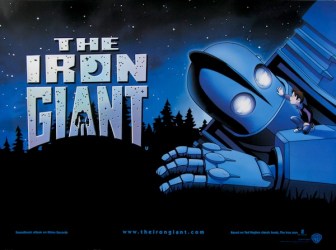 Adapted (loosely) from Ted Hughes’ children’s novel The Iron Man, the feature debut of director Brad Bird (The Incredibles, Ratatouille, now live-action stuff) relocates the book’s story to ’50s America and mixes in some Cold War elements. The film was somewhat verboten in our household when it came out, because the book was beloved and the film looked so different, but its reputation has only grown in the ensuing decade-and-a-half — and Hughes approved of it anyway.
This version sees the titular robot (voiced by Vin Diesel) crash to Earth near Maine in late 1957, the home of nine-year-old Hogarth Hughes (Eli Marienthal) and his mom Annie (Jennifer Aniston). After the giant eats the Hughes’ TV aerial, Hogarth tracks it to take a photo, and ends up saving it from electrocution when it tries to eat a power station. As the giant sneaks around the countryside eating cars and causing train crashes, it attracts the attention of government agent Fox Mulder from the FBI’s X Files Kent Mansley from the Bureau of Unexplained Phenomena (Christopher McDonald), who’s intent on uncovering and destroying the giant. Hogarth tries to hide the friendly creature with the help of artist Dean (Harry Connick Jr.), but could it be Mansley isn’t so wrong about the threat it poses?
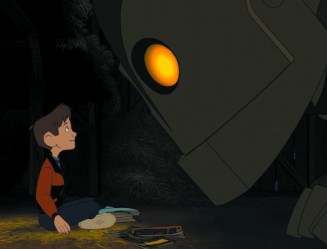 The story, as reconstructed by Bird and screenwriter Tim McCanlies, integrates influences from ’50s B-movies (very apt for a giant robot ‘monster’) and Cold War/Space Race paranoia for a potent storyline that has a different emphasis from the novel’s “world peace” finale, but nonetheless is promoting understanding of alien/foreign powers and, y’know, deep stuff like that. Alternatively — or, rather, concurrently — it’s an E.T.-esque tale of a boy and his quirky alien friend. Bird was keen to emphasise character over action and mindless spectacle, and that’s really where the film’s strengths lie.
Well, that and the technical aspects. The animation is stunningly well done, exhibiting exceptional fluidity and detail in its character animation, in particular. That’s in spite of the film having a reduced budget and time schedule thanks to the box office failure of previous animations by the studio — in Bird’s words, they had “one-third of the money of a Disney or DreamWorks film, and half of the production schedule”, but that meant greater production freedom (so long as they managed that budget). I guess that’s why the film’s ended up only growing in stature since its first release — because it’s able to be committed to its creators’ vision, rather than being battered into homogeneity by a studio desperate for a return on considerable investment.
Beautifully animated and affectingly told, with a style that nicely homages classic sci-fi movies, The Iron Giant is a film that deserves the  reputation it has gradually amassed — and which only continues to grow, I think. Last year saw the release of an extended Signature Edition, with a couple of short scenes added, which comes to US Blu-ray (alongside the original version) later this year. Just from reading about those new scenes, I’m not convinced they’ll improve the experience, but it’ll certainly be worth finding out.

The Iron Giant was viewed as part of my What Do You Mean You Haven’t Seen…? 2016 project, which you can read more about here.
This review is also part of 1999 Week.
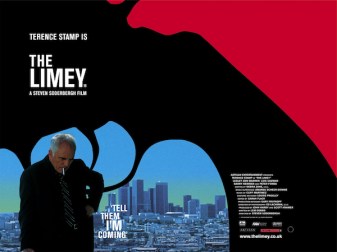 There’s an argument to be made that, from a cinematic perspective, mainstream US cinema these days is boring. Look at the kind of films American auteurs were producing in and around the studio system in the ’90s and early ’00s:
  This isn’t a conceit Soderbergh uses for one scene, or wheels out now and then, but an overall approach. Some sequences are more thick with it than others, but it’s always right around the corner. It creates a unique sensation. Not disconcerting, exactly, but mysterious and querying. It has you constantly question what you’re watching — is it a memory? A plan? A fantasy? A delusion? It draws connections back and forth across the timeline of the story, bringing out thematic angles. At its most key, it helps explain what happens at the end (too bluntly for some reviewers, I should add). This collage-like style — which unlike, say, Memento’s back-to-front narrative has no obvious in-story point — will certainly not be to everyone’s taste, but it presents an interesting challenge to our usual ideas of how a film should be constructed.
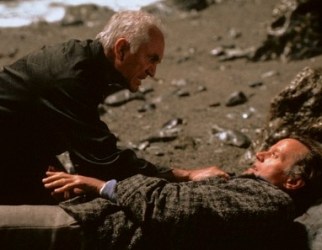 Despite the visual trickery, The Limey still works pretty well as a straightforward thriller. You have to be prepared to accept the slippery editing, because there’s no avoiding it, but the throughline of Stamp tracking down bad men and how he deals with them is still here. Personally, I’ve never much rated Stamp as an actor, but somehow he fits here. He’s a fish out of water, a man out of place — way out of place — and possibly out of time, too, seeming like a ’60s or ’70s British gangster transported to turn-of-the-millennium L.A. It’s no discredit to the supporting cast that they mainly exist to bob around in his wake.
 The third feature (but first you’re likely to have heard of) by writer-director Alexander Payne (


 Score:



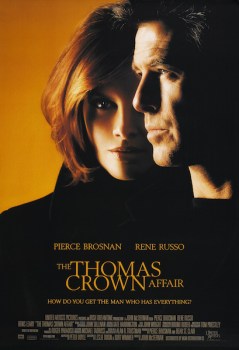 Once upon a time, John McTiernan was an action auteur, known for films that sat comfortably on the “mainstream modern classics” scale, like
 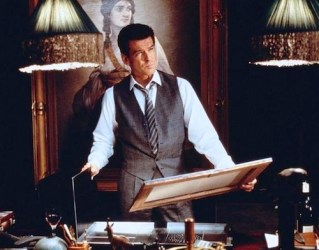 McTiernan’s action background comes to the fore in a pair of extended heist scenes at either end of the movie, which are surely the standout parts. The seductions and plot twists in between these bookends are certainly entertaining and may even keep you guessing, but it’s the heists that pack the most entertainment. They’re the kind of thing we don’t see so much nowadays, at least not in mainstream movies, because any sequence designed to provide excitement is a fight of some kind, and most of those are shot in the shaky-cam style. There’s none of that palaver here, just perfectly choreographed cutting between the various players in each heist, and some well-chosen music — as if being ably to do awesome stuff accompanied by the James Bond Theme wasn’t cool enough, here Brosnan gets to do the same to Nina Simone’s Sinnerman.
 The Thomas Crown Affair may not be the best film on any of its principals’ CVs (well, except perhaps for Russo’s), but it’s a consistently enjoyable light thriller with a couple of particularly memorable sequences and a fun central dynamic. Apparently it’s better than the original, too. There’s long been talk of a sequel, but it seems to have gone the way of McTiernan’s career, which is a shame.
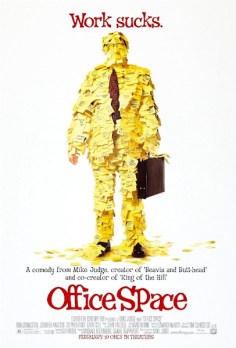 “From the creator of Beavis and Butt-Head” is not a designation that’s going to help sell a film to many people anymore. That the same fella also went on to write and direct the mediocre
 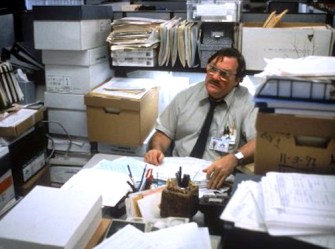 In truth, the plot doesn’t quite fill the slight running time, and Judge doesn’t seem to quite know how to end it — clearly he doesn’t want his hero figure getting caught out, but it can’t just go on forever. Fortunately, this is a comedy, and so plot matters only so much if the rest is funny. In some respects it’s a story of “first world problems” — these guys have decent jobs, making decent money, but it’s boring — but at least it finds the humour in this. Little vignettes of office life, a mix of light satire and gentle surrealism, keep the amusement ticking over too.

 If you hadn’t heard of Veronica Mars before 13th March 2013, you almost certainly did soon after. That’s the date Rob Thomas, creator of the six-years-dead
  There’s no denying that this is primarily a film for fans of the TV series — well, they did fund it, after all. The best way to get the most out of the film is to have watched all 64 episodes of the show first; preferably soon before, in fact, so you can remember who all the minor characters are. However, creator-cowriter-director Rob Thomas is no fool: you don’t produce a successful movie that continues a little-watched TV show by making it a requirement that you’ve watched 64 hours of TV first. (I mean, Joss Whedon knew that with
 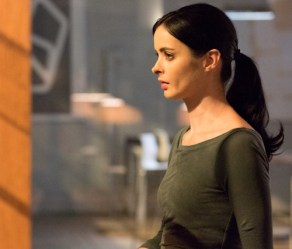 school who weren’t actually in the TV series, which might give you a flavour of how it works both for fans and newcomers. The case itself isn’t a bad mystery, but at the same time it’s a little subservient to the other goings-on. I suppose you could argue this is really a comedy-drama about a woman reconnecting with her past life and past friends, and she just happens to have a murder to investigate at the same time.
 To bring up Firefly/Serenity again, I think there’s a reasonable parallel between how those relate to each other, and how they can work for newbies, and how Veronica Mars the TV series and Veronica Mars the movie relate. To wit: in an ideal world, you’d watch all of the series and then the film; but TV series can be long commitments, and for a spot of ‘dipping your toe in the water’, you can also start with the movie and go back to the series for the full picture. Sure, some things are going to be spoiled doing it that way round — but hey, not everyone who’s in the series but not the film ends up dead, I promise.
 More than just a nostalgia trip for people who were there first time round, the movie is a strong addition to the Veronica Mars canon — as someone who didn’t discover the series until the Kickstarter campaign, I thought the film was a heck of a lot of fun, and a wonderful capstone to a mostly-great series. That said, there’s plenty of room for further cases… someday… hopefully…
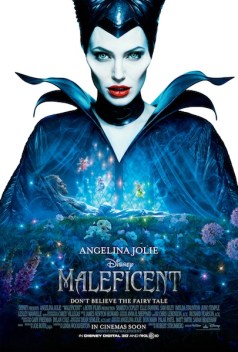 Disney seem to be embarking on a project to remake all of their most beloved animated movies in live action,
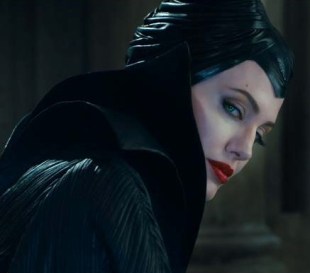 However, this is a Disney movie — you don’t get to turn a villain into the central character and have her be evil throughout. This is where the film gets really revisionist, because Maleficent keeps an eye on cursed Princess Aurora (Elle Fanning) as she grows, doing more to keep her alive than the trio of fairies she’s supposedly in the care of, and her heart is gradually warmed to the girl. Unfortunately, Maleficent was too good at the cursing malarkey: unable to lift her own spell, it plays out regardless, and the film serves us new renditions of the impassable thorns, giant dragon, and true love’s first kiss. It’s in the last where Maleficent is thematically revisionist rather than just a massive rewrite. Your mileage may vary on whether this version is obvious and cheesy, or actually more meaningful and (for the primary audience of little kiddies) more thought-provoking than the original’s — I’d go with the latter.
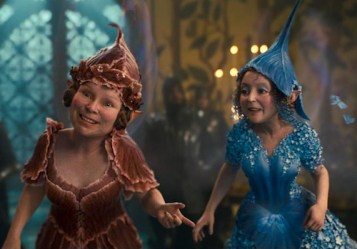 Parts of the film test-screened poorly — mainly the first act, with audiences wondering why it took so long for Jolie to turn up. Consequently, the whole thing was thrown out and reshot; in the process, Peter Capaldi and Miranda Richardson were deleted (and after they’d had to endure hours of transformative prosthetics for their roles, too), and Maleficent was given a new backstory. How far this extended into the rest of the movie, I’m not sure, but at times it feels like stuff has been cut or rearranged. Certainly the story flies past — if it wasn’t trimmed down in the edit, it needed expanding back at the screenplay stage.
 and even
 100Films.co.uk