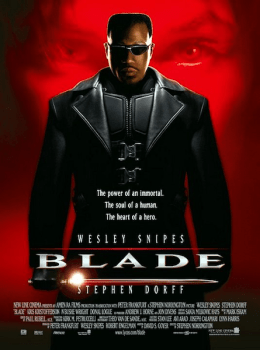
Blade (1998)

100 Films’ 100 Favourites #12

The power of an immortal.
The soul of a human.
The heart of a hero.

Country: USA
Language: English
Runtime: 120 minutes
BBFC: 18
MPAA: R

Original Release: 21st August 1998 (USA)
UK Release: 13th November 1998
First Seen: TV, c.2001

Stars
Wesley Snipes (White Men Can’t Jump, Demolition Man)
Stephen Dorff (Backbeat, Immortals)
Kris Kristofferson (Pat Garrett & Billy the Kid, Heaven’s Gate)
N’Bushe Wright (Zebrahead, Dead Presidents)

Director
Stephen Norrington (Death Machine, The League of Extraordinary Gentlemen)

Screenwriter
David S. Goyer (Dark City, Batman Begins)

Based on
Blade, a Marvel comic book character created by Marv Wolfman & Gene Colan.

The Story
When hospital haematologist Dr. Karen Jenson is bitten by a living corpse — actually a vampire — she encounters Blade, leather-clad badass vampire hunter. He mercifully takes her to his lair, where she hopes to create a cure for her impending vampirism. Meanwhile, mid-ranking vampire Deacon Frost aims to take over the world, for which he needs Blade’s unique blood…

Our Hero
The Daywalker — half-human half-vampire Blade, who can go out in sunlight (hence the nickname) and controls his bloodlust with injections. Passes his time helpfully killing vampires.

Our Villain
Being born human, turned vampire, and consequently looked down on by the purebred elders, probably gave Deacon Frost a chip on his shoulder, which may be why he believes vampires should enslave humanity. Which, despite his betters’ disapproval, he sets about doing.

Best Supporting Character
Blade’s mentor and Q-like gadgetmaster, Whistler. According to Wikipedia he was created for the film, but made his debut two years earlier in the Spider-Man animated series (voiced by Malcolm McDowell, no less). 20 years hence, apparently he still hasn’t appeared in any comics, which is very unlike Marvel.

Memorable Quote
Blade: “There are worse things out tonight than vampires.”
Karen: “Like what?”
Blade: “Like me.”

Memorable Scene
The opening action sequence sets the tone: a vampire nightclub, where the music pounds and blood pours from sprinklers, as the Daywalker slaughters everyone inside in a display of gleeful ultra-violence. Hard R indeed.

Letting the Side Down
Computer-generated liquid is still hard to do, so in 1998 it must’ve been a nightmare. Some CGI blood plays a key role in the climax — it looked terrible then, and I bet it looks worse now.

Next time…
Two direct sequels, the first directed by Guillermo del Toro, the second designed to launch a spin-off (it failed). A semi-related live-action TV series lasted one season in 2006, and an unconnected animated series was part of the Marvel Anime project in 2011. The rights have since reverted to Marvel, so there’s talk (largely from fans) of Blade joining their Cinematic Universe, with or without Snipes and possibly on the Netflix side of things.

Awards
2 Saturn nominations (Horror Film, Make-Up)
1 MTV Movie Award (Best Villain, tied with… There’s Something About Mary.)
1 MTV Movie Awards nomination (Best Fight, for “the fight against vampires”. Oh, that one!)

What the Critics Said
“Sure, the story is pretty standard, and the dialogue is laughable or worse. But creative cinematography and non-stop, decently choreographed gratuitous violence make watching this comic-book movie — Blade is a minor, almost-forgotten Marvel comic — entertaining. In fact, it’s arguably the best comic-book movie of the year” — John Krewson, A.V. Club

Score: 54%

What the Public Say
“Stephen Norrington’s direction is superb here, and he handles most of the action scenes very well, mixing some beautiful establishing shot with tighter, jumpier shots during the film’s immersive fight scenes. Fight scenes are well-choreographed and never feel like they are going on for too long, and thanks to the superb stunt work, feel thoroughly brutal.” — thatfilmbloguk

Verdict

Before comic book movies were the all-conquering box office behemoth they are today, Blade was a Marvel Comics adaptation in technicality only. A violent, dark, appropriately bloody (’cause, y’know, vampires) horror-tinged late-’90s actioner, Blade isn’t big or clever, but it has style and a glorious commitment to its extremeness. Some say the Guillermo del Toro-directed sequel is even better, but for me that came a little too far into the era of CGI dominance and comic book movie popularity — the original has a kind of analogue purity that can’t be beat.

#13 will have… moments lost in time, like tears in rain.

The Hobbit: The Battle of the Five Armies – Extended Edition (2014/2015)

2015 #180a
Peter Jackson | 164 mins | Blu-ray | 2.40:1 | USA & New Zealand / English | 15 / R

I just started shooting the movie with most of it not prepped at all. You’re going on to a set and you’re winging it. You’ve got these massively complicated scenes, no storyboards, and you’re making it up there and then on the spot […] I went to our producers and the studio and said […] ‘I don’t know what the hell I’m doing now.’

The Hobbit: The Battle of the Five Armies - Extended EditionSo says Peter Jackson in the special features accompanying this extended cut of his trilogy-closing saga-ending sixth Middle-earth movie, as widely reported on the set’s release back in November. Similar comments are echoed repeatedly throughout the special features, like how on Lord of the Rings they had racks and racks of metal orc helmets finished a whole year before they were needed for filming, whereas on The Hobbit they were delivering such props to set on the morning they were required for the shoot.

Another revelation: by making the late-in-the-day decision to split the intended two Hobbit movies into three, Jackson gained a whole year to prep and shoot the gigantic (sub)titular battle scene that forms the climax to his telling of Tolkien’s story. Various reasons have been suggested for Jackson and/or the producers’ trilogy-making decision, from genuine artistic intent, to poorly managed storytelling, to pure greed. In the wake of those special features, this new one — that everyone was making it up as they went along, too deep in to see the bigger picture, and desperate for a way to gain some time to get a handle on what they were doing — seems the most plausible of them all.

In the end, The Hobbit films are what they are. What, if anything, does extending the last one by 19½ minutes bring to the table? Well, as with The Desolation of Smaug, the third film counterintuitively doesn’t feel as overlong (note: as overlong) in the extended cut as it did in the theatrical, but I’d attribute that more to the re-watch factor than the extra scenes and moments making it magically quicker. The new material isn’t scattered about as freely as it is in the Lord of the Rings extensions, but instead is largely confined to three or four wholly-new scenes and some short additions throughout the battle, plus largely-immaterial alterations to the effects in existing footage. Anyone interested in a six-page account of every little change can find those details here.

War, huh, what is it good for? Chariots.Most obvious, and most discussed, is the dwarves’ war chariot action scene, whose bloody decapitations saw the film earn an R in the US and 15 over here. A seven-minute action sequence in the middle of the battle, it’s by far the largest single addition, and is mainly notable for all that blood and its use of the word “jambags”. Somewhat ironically, the sequence was a last-minute addition (the physical chariot was the last thing built for the films), which even as they’re shooting it Jackson acknowledges is an indulgence, and then of course it got bumped to the extended edition for being just that.
Elsewhere: the brief funeral scene at the end is good; more Billy Connolly is more Billy Connolly; an extended fight at Dol Guldur proves you didn’t need the Smaug confrontation to provide some up-front adrenaline; some extra comedy is uncomfortably, inappropriately silly; I don’t think there’s more of Ryan Gage’s over-featured Alfrid, thank goodness, other than that he’s treated to a death scene — hurrah! Fans who had hoped for more of Beorn fighting in the final battle get their wish… for all of ten seconds (literally). No wonder they weren’t best pleased.

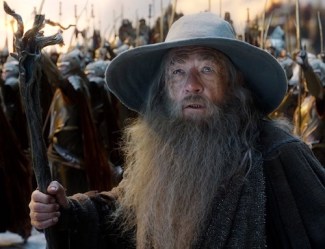
In the comments on my review of the extended second film, I assessed that film’s new scenes between Gandalf and Thorin’s mentally-fractured father Thrain should pay off in the third film when Gandalf re-encountered a gold-mad Thorin. And… they don’t. At all. Gandalf the warriorNot a sausage, unless I missed something. It didn’t bother me too much because, quite frankly, I can’t quite remember what it was all about; but when I inevitably watch the extended trilogy back to back one day, it may do then. That said, I can’t imagine it’s a major fault, but again highlights the built-on-the-fly, ill-thought-through state of expanding The Hobbit 2 into The Hobbit 2 and 3.
That The Battle of the Five Armies feels less overlong on a second viewing demonstrates how draggy films come about in the first place: sat in an edit suite for weeks or months, watching a film over and over (and over) again, the material must become so familiar that you lose any sense of perspective about its length or pace. Nonetheless, I still feel The Hobbit would’ve been best served in two films, or by allowing Parts 2 and 3 to run considerably shorter than your usual Middle-earth excursion. Fans have already cut together book-faithful edits of the entire trilogy, which I believe run something like four hours. Maybe that would’ve been best of all.

4 out of 5

In case you missed it, my review of the theatrical cut can be read here.

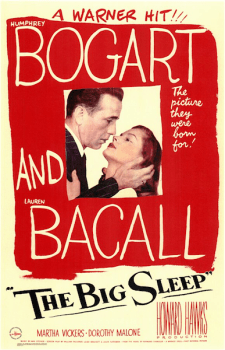
The Big Sleep (1946)

100 Films’ 100 Favourites #11

The Violence-Screen’s
All-Time Rocker-Shocker!

(Yes, that is a real tagline.)

Country: USA
Language: English
Runtime: 114 minutes
BBFC: A (pre-release, 1945) | A (1946) | PG (1988)

Original Release: 31st August 1946 (USA)
UK Release: June 1946 (BBFC)
First Seen: DVD (maybe), c.2004 (possibly)

Stars
Humphrey Bogart (Casablanca, The Treasure of the Sierra Madre)
Lauren Bacall (To Have and Have Not, North West Frontier)
Martha Vickers (The Falcon in Mexico, The Big Bluff)
Dorothy Malone (The Fast and the Furious (not that one), Basic Instinct (yes, that one))

Director
Howard Hawks (His Girl Friday, Gentlemen Prefer Blondes)

Screenwriters
Leigh Brackett (Rio Bravo, The Empire Strikes Back)
Jules Furthman (The Outlaw, Nightmare Alley)
William Faulkner (To Have and Have Not, Land of the Pharaohs)

Based on
The Big Sleep, a novel by Raymond Chandler.

The Story
Private detective Philip Marlowe is hired by General Sternwood to settle the gambling debts his daughter, Carmen, owes to a man named Geiger. Sternwood’s other daughter, Vivian, suspects Marlowe has actually been hired to find Sean Reagan, the General’s friend who has disappeared. Arriving at Geiger’s home, Marlowe hears a shot, and inside finds Geiger dead, Carmen drugged, and a hidden camera with the film gone. So begins a complex web of blackmail and murder. Very complex. Very, very complex.

Our Hero
The archetypal downtrodden PI, Philip Marlowe makes up what he lacks in good fortune with a fast mouth and sharp mind. Has bad manners though, which he grieves over on long winter evenings.

Our Villain
It’s a mystery, let’s not give it away. The film certainly does its best not to.

Best Supporting Character
Lauren Bacall as headstrong Vivian Sternwood, a character who benefitted from the behind-the-scenes situation at the time: Bogie and Bacall’s chemistry in To Have and Have Not led the studio to want more of the same, and her agent was only too keen after the poor reviews of Confidential Agent threatened to sink her career before it had really begun. New sparky dialogue scenes took the place of exposition ones in the final cut, essentially creating the film’s reputation for confusion.

Memorable Quote
“She tried to sit in my lap while I was standing up.” — Philip Marlowe

Memorable Scene
Bogie and Bacall discuss horse racing.
— “I like to see them work out a little first… You like to get out in front, open up a lead, take a little breather in the back stretch, and then come home free.”
Just horse racing.
— “I don’t know how far you can go.” “A lot depends on who’s in the saddle.”
Just horse racing.

Making of
Another part in the Bacall situation described above was supposedly played by original author Raymond Chandler. He reportedly observed that Martha Vickers was so good as Carmen that she overshadowed Bacall, and consequently much of Vickers’ material was removed.

Previously on…
The Big Sleep is the fourth screen adaptation of a Philip Marlowe story, though only the second to star the detective: 1942’s Time to Kill adapted The High Window into the Michael Shayne series, and the same year Farewell My Lovely was filmed as The Falcon Takes Over. The same novel was adapted again in 1944 as Murder, My Sweet (though, famously, retained the novel’s title for its UK release), starring Dick Powell as Marlowe.

Next time…
Bogart never played Marlowe again, but multiple film, TV and radio adaptations of Chandler’s novels have followed, with the lead role being occupied by the likes of James Garner, Elliott Gould, Robert Mitchum, Powers Boothe, Danny Glover, James Caan, and Toby Stephens. A remake of The Big Sleep, relocated to ’70s London and directed by Michael “calm down dear” Winner, was Marlowe’s final big screen outing to date.

Awards
Not a sausage.

What the Critics Said
“one of those pictures in which so many cryptic things occur amid so much involved and devious plotting that the mind becomes utterly confused. And, to make it more aggravating, the brilliant detective in the case is continuously making shrewd deductions which he stubbornly keeps to himself. What with two interlocking mysteries and a great many characters involved, the complex of blackmail and murder soon becomes a web of utter bafflement. Unfortunately, the cunning script-writers have done little to clear it at the end.” — Bosley Crowther, The New York Times

Score: 96%

What the Public Say
“you don’t watch The Big Sleep just to find out who did what to whom, when and for what reason. This is truly one of those movies where the journey is far more important than the destination. As we follow Marlowe around a moody and threatening Los Angeles, we go on a tour of the seedy underbelly of the city. Even though the time is spent in the company of high rollers and the glamorous set, it’s all merely a glittering veneer for a world of pornography, drugs, deviance, betrayal and violence.” — Colin, Riding the High Country

Verdict

Famed for having a plot so complicated even author Raymond Chandler doesn’t know who committed at least one of its murders, I’ve always found The Big Sleep very followable if you pay attention… just don’t expect me to be able to explain it after it’s finished. The film’s popularity in spite of its impenetrability confirmed director Howard Hawks’ theory that audiences didn’t care if a plot made sense as long as they had a good time, and he’s kinda right — the joys here are Bogie and Bacall’s verbal sparring, the exposure of LA’s seedy underbelly (albeit in a Production Code-friendly way), and the film’s whole noir-ish atmosphere.

The Big Sleep is finally released on US Blu-ray on Tuesday 23rd February.

#12 will be… a Marvellous vampire.

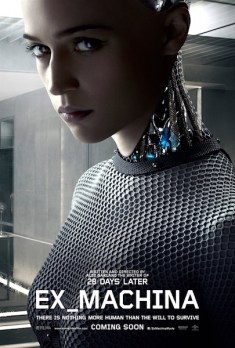
Ex Machina (2015)

2016 #26
Alex Garland | 108 mins | Blu-ray | 2.40:1 | UK / English | 15 / R

BAFTABritish Academy Film Awards 2016
5 nominations

Nominated: Best British Film; Best Supporting Actress (Alicia Vikander); Best Original Screenplay; Best Special Visual Effects; Outstanding Debut by a British Writer, Director or Producer.

A British sci-fi movie from a first-time director will tomorrow take a place at the table (well, in the auditorium) alongside 2015’s biggest awards contenders, as it vies for multiple gongs at this year’s BAFTAs — and it stands a very plausible chance of walking away with several of them, too. I hope it does, because, after a year that brought us awards-quality sci-fi bombast (Mad Max, Star Wars), it’s fantastic that a small film about three people sat in rooms talking can stand toe-to-toe with them as one of the year’s best.

The increasingly ubiquitous (and deservedly so) Domhnall Gleeson stars as Caleb, a programmer at search engine giant Google Bluebook who wins a staff lottery to spend a week with the company’s reclusive founder, Nathan, played by the increasingly ubiquitous (and deservedly so) Oscar Isaac. However, on his arrival he learns he’s not just there to hang out: Nathan wants him to perform a Turing test on an AI he’s built. The point of the Turing test (as I’m sure you know) is for a human to interact with an AI but not realise it’s an AI, so Caleb’s surprised when said AI — Ava, played by the increasingly ubiquitous (and deservedly so) Alicia Vikander — comes in the form of a robot that’s obviously a robot. The real test is whether Caleb can know he’s talking to something non-human and still come to be convinced it’s human. As Caleb begins his interviews with Ava, it becomes apparent that there’s something else going on at this remote facility, where regular power cuts mean they’re all locked in…

As is probably clear, Ex Machina is a sci-fi movie of the thoughtful variety. It’s a film that considers ideas of artificial life, how we test it and what it means to create it, and only gradually builds in thriller elements that pay off in its final twenty-or-so minutes. In truth, it’s not the most thorough deconstruction of what it means to be human and whether artificial intelligence can have that right, but it does touch on these issues and, in so doing, leaves them open for the viewer to mull over for themselves, or debate with friends, or however else one likes to consider their movies post-viewing (like, I dunno, writing about them on the internet or something).
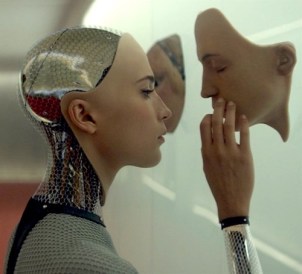
There are thematic similarities to Blade Runner, which (in case you’ve not seen it) also deals with the humanity or otherwise of man-made intelligence. Mulling on that comparison, I’m tempted to say Ex Machina is almost the inverse of Blade Runner, in this regard: Ridley Scott’s classic is ostensibly an SF-noir thriller (Harrison Ford is a cop hunting down some rogue robots), but by its end has revealed a considered exploration of what it means to be human, and whether these artificial creatures can lay claim to that. Conversely, Alex Garland’s film seems like it’s sitting us down to consider those same issues, but is actually laying the groundwork for revelations and twists that build to an edge-of-your-seat climax. I’m not saying one’s better than the other in this respect, just that they’re approaching the same topics almost from opposite ends.

Also like Blade Runner, Ex Machina is an exceptionally well made and performed film. Not in the same way as Blade Runner — it’s bright and clean and modern, in a Google-y, Apple-y kind of way — but to a similar level of internal consistency and accomplishment. Gleeson’s Caleb may seem a little plain, a blank page for the other characters to write on, but as his insecurities begin to come to the fore you realise that’s almost the point. Isaac is suitably overbearing as the alcohol-dependent genius behind Bluebook and Ava, an initially affable but quickly disquieting presence — he may be a threat, or may just be a bit odd. And his dance scene is surely one of 2015’s highlights (there’s an extended version hidden on the US Blu-ray, which is a treat). Garnering the most praise (and awards) is Alicia Vikander’s take on an AI. It’s a tricky role to tackle, because she’s not just a robot — that would defeat the point of Nathan’s exercise — but nor is she fully human. It’s a tightrope of a role, a fine line to walk, and Vikander negotiates it with aplomb. To say too much more would be to spoil it.

Aside from the acting, the film’s most striking element is surely the design of Ava. Her face and hands appear to be human, but everything else is robotic, and much of it transparent. This isn’t a case of slipping an actor into a suit painted with circuitboards — you can see the metal limbs and motors in her arms and legs, the metal spine in her back, the various computers or power sources or whatever glowing and spinning inside her. Occasionally she dresses in clothes and her workings are covered, but she spends most of the film with them on display. The CGI is literally flawless, which for a relatively-low-budget little British sci-fi-drama is all the more remarkable. I guess the visual effects awards are going to go to the big films, Star Wars or Mad Max or The Revenant (the bear seems to be very popular), but I do wonder if the work here is more deserving. You know how it must’ve been done — mo-cap suits and CGI — but there’s still a feeling of “how did they do that?”, because it’s so faultless. In fact, you don’t even wonder how they did it, because you just accept it; it’s only if you actively stop to consider it that you realise it’s physically impossible and must be CGI.

Those after a dissertation-like hard-science deconstruction of the meaning and possibilities of AI will likely find Ex Machina slightly lacking, as will anyone after the crash-bang thrills most mainstream sci-fi provides. Viewers prepared for a decently thought-provoking dramatic thriller about near-future tech, however, should be both engrossed, and grateful that movies like this are (for the time being) still getting made.
5 out of 5

The British Academy Film Awards are tomorrow night, televised on BBC One from 9pm.

Ex Machina placed 20th on my list of The 20 Best Films I Saw For the First Time in 2016, which can be read in full here.

Dressed to Kill (1946)

aka Sherlock Holmes and the Secret Code / Prelude to Murder

2015 #200
Roy William Neill | 69 mins | DVD | 4:3 | USA / English | U

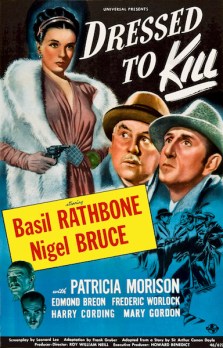
Dressed to KillIn the seven-and-a-bit years between 31st March 1939 and 7th June 1946, there were a total of 14 films released starring Basil Rathbone and Nigel Bruce as Sherlock Holmes and Dr Watson. By coincidence rather than design, I’ve spent nearly eight years viewing and reviewing them all for this blog — so yes, it’s taken me a little longer to watch them than it did to make them, which is ridiculous, but there you go.
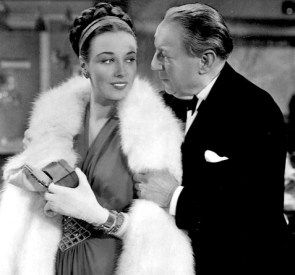
This final film in the series sees Holmes in pursuit of a criminal gang who are on the trail of three music boxes, and are prepared to kill to acquire them. The boxes were all made by a prisoner and contain coded messages which, when combined and decoded, will reveal the location of stolen Bank of England printing plates — a literal licence to print money. Well, apart from the licence bit, because it would be illegal. But you get what I mean.

The Rathbone Holmes series was only sporadically adapted from the writings of Sir Arthur Conan Doyle, but this entry takes loose inspiration from several tales. The use of secret codes is reminiscent of The Dancing Men (previously the basis for The Secret Weapon), while the plot device of having to track down multiple identical items that hide something comes from The Six Napoleons (previously the basis for The Pearl of Death). I don’t know if that suggests there are only a few Doyle tales actually worth adapting, or if the makers of the series were running out of fresh ideas by this point.

There are also elements of A Scandal in Bohemia, the story most famous for featuring Irene Adler, aka The Woman, but screenwriters Frank Gruber and Leonard Lee have an unusual method of including it: Dressed for the occasionthe story is explicitly referenced in the film, Watson having just had it published; then the film’s villainess turns up, played by Patricia Morison, functioning effectively as an Adler stand-in — and using some tricks she learnt from reading Watson’s story! The series hasn’t featured Adler before, so why not just name this character Irene Adler, have her devise those tricks from her own imagination, and be done with? Who knows.
Dressed to Kill is an ending to the Rathbone/Bruce films only in the sense that it’s the last one, this not being an era of “series finales” or what have you. It isn’t among the top tier of Holmes adventures starring the pair, but it’s still an entertaining mystery. In some respects that’s a good summation of the series, and why they’ve endured in popularity for over 75 years: even when not at their very best, they remain enjoyable.

3 out of 5

Funny Games (1997)

2016 #4
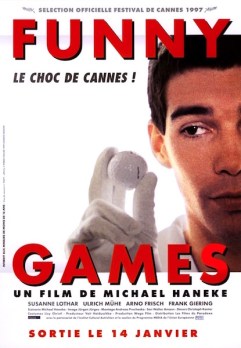
Michael Haneke | 104 mins | TV | 16:9 | Austria / German | 18

Arthouse favourite Michael Haneke criticises audience’s enjoyment of screen violence. It certainly achieves its aim of being a grim, brutal depiction of violence in real-life, creating a situation that feels inescapable not only for the characters but the audience too. Some cinematic trickery is also deployed to striking, if divisive, effect.

However, it’s more shocking that, as recently as the mid-’90s, Austria doesn’t seem to have a universal emergency services phone number.

The entire message is, “real-life violence is bad and you shouldn’t enjoy it in fiction, okay?” You don’t need to sit through a tough hour-and-a-half to know that.

3 out of 5

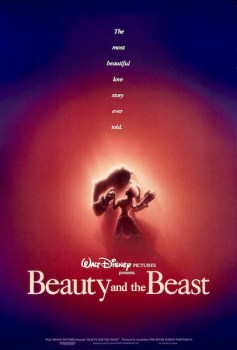
Beauty and the Beast (1991)

100 Films’ 100 Favourites #10

The most beautiful love story ever told.

Country: USA
Language: English
Runtime: 84 minutes | 92 minutes (special edition)
BBFC: U
MPAA: G

Original Release: 15th November 1991 (USA)
UK Release: 9th October 1992
First Seen: VHS, c.1993

Stars
Paige O’Hara (Beauty and the Beast: The Enchanted Christmas, Enchanted)
Robby Benson (Ice Castles, Dragonheart: A New Beginning)
Angela Lansbury (The Manchurian Candidate, Bedknobs and Broomsticks)

Directors
Gary Trousdale (The Hunchback of Notre Dame, Atlantis: The Lost Empire)
Kirk Wise (The Hunchback of Notre Dame, Atlantis: The Lost Empire)

Screenwriter
Linda Woolverton (Alice in Wonderland, Maleficent)

Story by
Deep breath… Roger Allers, Brenda Chapman, Burny Mattinson, Brian Pimental, Joe Ranft, Kelly Asbury, Christopher Sanders, Kevin Harkey, Bruce Woodside & Robert Lence.

Based on
La Belle et la Bête, a French fairy tale originally by Gabrielle-Suzanne Barbot de Villeneuve, but in this case (and most others) adapted from the retelling by Jeanne-Marie Leprince de Beaumont.

Music
Alan Menken (Aladdin, Hercules)

Lyrics
Howard Ashman (Little Shop of Horrors, Aladdin)

The Story
An arrogant prince is transformed into a beast, with one hope of redemption: someone must fall in love with him before his 21st birthday; if not, the curse’s effects become permanent. When elderly inventor Maurice is imprisoned by this Beast, his bookworm daughter Belle offers to take his place. Spying a chance to alleviate the curse, the Beast agrees. With only a short time until his 21st birthday, could a girl ever learn to love a beast?

Our Hero
A girl who’s strange but special — a most peculiar mademoiselle. With a dreamy far-off look, and her nose stuck in a book, she really is a funny girl, a beauty but a funny girl, that Belle.

Our Villain?
The Beast’s got fangs, razor sharp ones; massive paws, killer claws, for the feast. He was mean and he was coarse and unrefined, but now he’s dear and so unsure. Perhaps there’s something there that wasn’t there before…

Our Villain!
No one’s slick as Gaston, no one’s quick as Gaston, no one’s got a swell cleft in his chin like Gaston. Uses antlers in all of his decorating, my what a guy, that Gaston.

Best Supporting Character
The comedy double act of French candlestick Lumiere and English clock Cogsworth, voiced (respectively) by Law & Order’s Jerry Orbach and M*A*S*H’s David Ogden Stiers. Funny old business, acting.

Memorable Quote
“Try the grey stuff, it’s delicious / Don’t believe me? Ask the dishes / They can sing, they can dance / After all, miss, this is France / And a dinner here is never second best.” — Be Our Guest

Quote Most Likely To Be Used in Everyday Conversation
“It’s not right for a woman to read. Soon she starts getting ideas, and thinking…” — Gaston. (I didn’t say it should be used.)

Memorable Scene
The film’s prologue tells the story of how the Prince became the Beast through the medium of stained glass windows. It’s a beautifully realised fairy tale within a fairy tale.

Best Song
Titular Beauty and the Beast may’ve won the Oscar (“Tale as old as time, song as old as rhyme” — that one), but the actual best song is clearly Be Our Guest. A toe-tapping tune married with fun lyrics, fantastic choreography and superb animation combine to make it, for me, one of the greatest numbers in any musical, animated or otherwise.

Making of
Be Our Guest was originally to be sung to Belle’s father, Maurice, when he’s trapped in the castle. It was writer Bruce Woodside who pointed out that it was in the wrong place because such a key song shouldn’t be performed to a secondary character, so it was moved later to be sung to Belle. This is why you should always listen to writers.

Previously on…
Beauty and the Beast is Disney’s 30th Animated Classic, their official canon of animated movies. It’s the third film in the “Disney Renaissance”, the decade-long period (starting with The Little Mermaid and ending with Tarzan) when the studio enjoyed revived creative and financial success. In terms of this particular retelling of the tale, it owes a clear debt to Jean Cocteau’s La Belle et la Bête.

Next time…
Two direct-to-video animated sequels and a spin-off educational live-action TV series. In 1994, it was the first Disney animated film to become a Broadway musical. In 2002, it was extended with a new song, and in 2012 was re-released in 3D. An all-star live-action remake is out next year.

Awards
2 Oscars (Original Song (Beauty and the Beast), Original Score)
4 Oscar nominations (Picture, Sound, Original Song (both Belle and Be Our Guest))
2 BAFTA nominations (Original Score, Special Effects)
2 Saturn nominations (Fantasy Film, Music)
2 Annie Awards (Animated Feature, Individual Achievement in the Field of Animation)
Nominated for the Hugo for Best Dramatic Presentation.

What the Critics Said
“A lovely film that ranks with the best of Disney’s animated classics, Beauty and the Beast is a tale freshly retold. Darker-hued than the usual animated feature, with a predominant brownish-gray color scheme balanced by Belle’s blue dress and radiant features, Beauty engages the emotions with an unabashed sincerity.” — Variety

Score: 93%

What the Public Say
“The voice cast are perfectly suited to their roles and imbue them with dexterity and flair. Paige O’Hara splendidly combines strength and touching bravery as Belle. Her singing voice is a marvel as well, singing with clarity and loving kindness. Robby Benson’s deep but engaging voice is ideally suited to the Beast, and gives him depth and mournful sorrow that subsides into happiness as he develops feelings for Belle.” — vinnieh

Elsewhere on 100 Films
Back in 2010 I reviewed The Special Edition of Beauty and the Beast (to give its full on-screen title), describing it as “impossible to fault in any significant way. The design and animation are beautiful, the voice acting spot-on, the score exquisite, the story fast-paced and enthralling […] It’s hilariously funny, remarkably exciting, surprisingly scary, relentlessly romantic […] Every [song] bursts with memorable tunes, witty rhymes, genuine emotion — even the Soppy Girly Song is a good one!” Beat that, verdict section…

Verdict

Beauty and the Beast was, famously, the first (and, for a long time, only) animated movie to be nominated for Best Picture at the Oscars, and you could hardly think of a more deserving candidate. Every element of it displays artistry, from the the witty dialogue and lyrics, to the likeable and engaging characters, to the fluid and detailed animation, to the songs which help the film to run the gamut of emotions. In the field of Broadway-style Disney musicals, Beauty and the Beast is animation perfection.

#11 will be… a long nap.

Morning Glory (2010)

2015 #194
Roger Michell | 107 mins | streaming (HD) | 16:9 | USA / English | 12 / PG-13

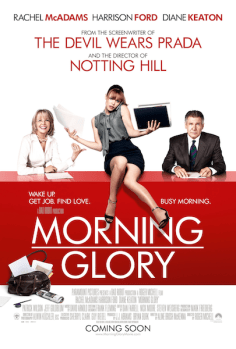
Rachel McAdams takes a break from time-jumping rom-coms to lead a film where the romantic subplot is merely tacked on, presumably for marketing purposes. Really, it’s about a woman in love with her job.

McAdams plays the producer of TV’s worst-rated breakfast show, but her dream career faces ruin when it’s scheduled for cancellation. If only she can persuade her hero, investigative reporter turned disgruntled host Harrison Ford, to toe the line…

Overlong, predictable, and not the sharpest newsroom-based comedy, Morning Glory’s likeable cast nonetheless carry it to a level of entertaining amusement. Not the disaster it’s been painted as.

4 out of 5

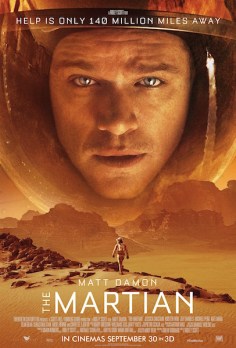
The Martian (2015)

2016 #25
Ridley Scott | 142 mins | Blu-ray | 2.40:1 | USA & UK / English | 12 / PG-13

Oscar statue2016 Academy Awards
7 nominations

Nominated: Best Picture, Best Actor (Matt Damon), Best Adapted Screenplay, Best Sound Mixing, Best Sound Editing, Best Visual Effects, Best Production Design.


Ridley Scott’s latest arrives on Blu-ray in the UK today, with a disappointing dearth of special features (disliked Exodus gets a 2½-hour making-of, four hours of additional features, plus a commentary; award-winning The Martian gets 24 minutes plus a few in-universe documentaries — what?!) Never mind that, though: how good is the film deemed the best comedy or musical of 2015? (If you somehow missed that news, you’ll appreciate the addition of a “seriously” here.)

In the relatively near future, mankind is on its third manned mission to Mars. When a colossal storm rolls in, the decision to made to evacuate the Mars base. During the escape, biologist Mark Watney (Matt Damon) is struck by debris and apparently killed, and his crew mates are forced to leave him for dead. He isn’t dead, though, but he is injured and alone on a planet 140 million miles from home, with no way to communicate with Earth, and not enough energy, oxygen, or food to see him through the four years until the next Mars mission is scheduled to arrive. Refusing to give in to inevitable death, Watney only has one choice: science the shit out of this.

That sounds like a laugh-a-minute premise, right? And there’s a major subplot about disco music, so it’s practically a musical too!

No, the HFPA are just idiots — The Martian is neither a comedy nor a musical. It is the latest in a growing subgenre of serious-minded near-future sci-fi adventures, though, following in the footsteps of 2013 Oscar winner Gravity and 2014 Oscar washout Interstellar. Where The Martian differs is in the element that tricked Golden Globes voters into thinking they could get away with giving it a comedy nomination (and win): rather than being stuffed to bursting with po-faced peril, it has a lightness of touch and regular doses of humour, making it probably the most feel-good serious sci-fi movie since ever.

Whether that’s appropriate or not is another matter. A well-argued review by the ghost of 82 assesses that the film has none of the darkness or loneliness you should expect of a man stranded alone on an alien world with a slim chance of survival or rescue. I don’t disagree that the film doesn’t contain much of that feeling, nor would I argue that such a tone isn’t a viable way to frame this narrative, but I don’t think that’s what Scott was aiming to convey. This telling of the story (I haven’t read the original novel, so can’t say how it compares tonally) is an adventure; a feel-good tale of hope and survival against the odds. The film doesn’t offer us despair because Watney doesn’t despair — he just gets on with trying to fix it. On the couple of occasions when his fixes go wrong, his chirpiness breaks down, his frustration comes out, and in some respects it’s all the more effective for being limited to those handful of occasions — we’re suddenly reminded that, in spite of his optimism and his success and all the fun we’re having watching it, he’s stranded 140 million miles away and even the slightest mistake can spell total disaster.
Matt Damon is a talented enough actor to lead us through all of this. Best remembered in recent years for serious fare like the Bourne films (“serious” in the sense of “not comedic” as opposed to “realistic”), Damon has done his fair share of comedies before now, and skits for TV shows and the like too. This is perhaps his first film to bring those two sides together as equally necessary parts of the whole — serious when he’s struggling with science problems or facing the reality of his situation, funny when he’s taking it all as light-heartedly as he can. Sometimes, such as in emotional conversations with friends or colleagues stuck millions of miles away, he even has to do both at once.

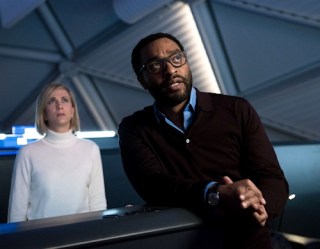
While Damon is stuck on Mars by himself, a starry supporting cast actually get to interact with each other. This is a quality ensemble and, short of writing an epic essay of a review where I just praise them all one by one, there’s little to do but list their names. That said, Jessica Chastain gets the most brazenly emotional beats as the commander who chose to leave Watney behind and has to face the consequences of her decision; Jeff Daniels treads a line between being an evil bureaucrat and just a regular bureaucrat (apparently consideration was given to turning him into a full-blown villain; thank goodness they swerved that bullet); Chiwetel Ejiofor brings easy gravitas to NASA’s director of Mars missions; Michael Peña provides some additional comic relief, if not as strikingly as he did in Ant-Man then at least as effectively; and Sean Bean doesn’t die. No offence to Sean Bean, but let’s be honest, at this point in his career that is the most notable facet of his appearance here. That and the Lord of the Rings reference.

It would be too damning to describe Ridley Scott’s direction as unremarkable, but at the same time it feels lacking in distinctiveness. Apparently there was some interview where he commented on how easy he found directing The Martian, I think with intended reference to the use of digital photography, but I think you get a sense of that from the film as a whole. That stops it from being over-directed, at least, and it’s certainly not poorly made, but if you didn’t know then you wouldn’t be nodding along going, “oh yes, this is definitely a Ridley Scott movie.” I’m not sure that’s a bad thing. Considering his fiddling is what scuppered the promising screenplays that initiated both Robin Hood and Prometheus, and his other works this decade (The Counsellor and Exodus: Gods and Kings) haven’t exactly met with great acclaim, maybe his dropping in almost as a director-for-hire (screenwriter Drew Goddard was attached to direct, but got sidetracked into the now-cancelled Sinister Six Amazing Spider-Man spin-off), and helming the film in a kind of directorial autopilot, is part of what saved it from a similar fate.

I’ve read at least one review that described The Martian as “an instant sci-fi classic”, and at least one other that described it as “no sci-fi classic”. I’m going to sit on the fence of that debate for the time being. What I will say is that it is undoubtedly an accomplished piece of entertainment. For a film that primarily concerns itself with a man applying scientific principles to tasks like “growing potatoes”, that’s surely some kind of achievement. In our current climate (both in society in general and in the “more explosions less talking, please” state of blockbuster cinema), to make space travel — and science in general — seem fun and appealing to the masses is no bad thing whatsoever.

5 out of 5

As mentioned, The Martian is released on DVD and Blu-ray in the UK today.

It placed 17th on my list of The 20 Best Films I Saw For the First Time in 2016, which can be read in full here.

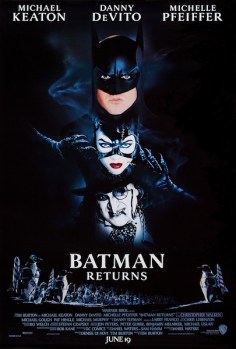
Batman Returns (1992)

100 Films’ 100 Favourites #9

The Bat
The Cat
The Penguin

Country: USA & UK
Language: English
Runtime: 126 minutes
BBFC: 12 (cut, 1992) | 15 (cut, 1992) | 15 (uncut, 2009)
MPAA: PG-13 for “brooding, dark violence”

Original Release: 19th June 1992 (USA)
UK Release: 10th July 1992
First Seen: VHS, c,1993

Stars
Michael Keaton (Beetlejuice, Birdman)
Danny DeVito (Twins, The Rainmaker)
Michelle Pfeiffer (Ladyhawke, Hairspray)
Christopher Walken (The Dead Zone, Seven Psychopaths)

Director
Tim Burton (Edward Scissorhands, Dark Shadows)

Screenwriters
Daniel Waters (Heathers, Demolition Man)

Story by
Daniel Waters (see above)
Sam Hamm (Batman, Monkeybone)

Based on
Batman, a comic book superhero created by Bob Kane and Bill Finger.

The Story
Batman has a lot on his hands when abandoned Oswald Cobblepot, aka the Penguin, emerges from the shadows seeking acceptance by running for mayor, backed by corrupt businessman Max Shreck. Meanwhile, a newly-created Catwoman has an axe to grind with Shreck, and won’t let Batman stand in her way…

Our Hero
Nana-nana-nana-nana nana-nana-nana-nana Batman! But, y’know, with a kind of ’30s Gothic edge.

Our Villains
A triumvirate of terror! Danny DeVito is the Penguin, deformed, abandoned as a child, and out for revenge against the city. Michelle Pfeiffer is Catwoman, PVC-clad, kinky, and also out for revenge. Christopher Walken is Max Shreck, a morally corrupt businessman with political needs, who clashes with Bruce Wayne as much as Batman.

Best Supporting Character
The one significant constant through the four ’80s/’90s Bat-movies, Michael Gough is a near-peerless Alfred.

Memorable Quote
Batman: “Mistletoe can be deadly if you eat it.”
Catwoman: “But a kiss can be even deadlier if you mean it.”

Memorable Scene
Batman and the Penguin are having an argument. Suddenly, a figure comes backflipping towards them — Catwoman. They stare. “Meow.” The building behind her explodes. It’s not actually her first appearance, but it’s quite an introduction.

Technical Wizardry
The whole design of the film, and Gotham City in particular, is fantastic; a kind of ’30s-but-also-modern art deco style. It’s all quite Burtonesque too, though not too much so for my taste.

Truly Special Effect
The Penguin’s army of penguins, an effective mix of real birds, animatronics, and actors in suits.

Making of
The first draft of the screenplay was intended to be more of a direct sequel to Batman: subplots included gift shops selling fragments of the destroyed Bat-Wing, revelations about the past of the Joker, and Bruce Wayne proposing to Vicki Vale by the end of the film. However, Tim Burton was uncomfortable with making a direct sequel, so the script was rewritten. Ah, the days when people wanted sequels to be less connected…

Previously on…
Tim Burton’s first Batman film brought the dark ‘n’ gritty ’70s/’80s evolution of the character from the comic books to the big screen for the first time. It was a huge success, though I think it feels notably more dated today than Returns does.

Next time…
Two semi-direct sequels — though with Burton and Keaton both abandoning the series, they took a distinct downward turn in quality. The 2005 reboot has so far led to three more Bat-movies, and now another new series dawns starring Ben Affleck.

Awards
2 Oscar nominations (Visual Effects, Makeup)
2 BAFTA nominations (Special Effects, Make Up Artist)
1 Saturn Award (Make-Up)
4 Saturn nominations (Fantasy Film, Supporting Actor (Danny DeVito), Director, Costumes)
1 Razzie nomination (Worst Supporting Actor (Danny DeVito))
3 MTV Movie Awards nominations (including Most Desirable Female (Michelle Pfeiffer))
Nominated for the Hugo for Best Dramatic Presentation.

What the Critics Said
“Burton couldn’t play it safe if he wanted to, and he doesn’t want to. Entrusted with one of the most valuable franchises in movie history, he’s made a moody, grotesque, perversely funny $50 million art film. […] Something about the filmmaker’s eccentric, surreal, childlike images seems to strike a deep chord in the mass psyche: he makes nightmares that taste like candy.” — David Ansen, Newsweek

Score: 80%

What the Public Say
“unmissable in Batman Returns, Burton tends to employ the film noir style in his movies. […] a visual sensation from start to finish, nearly all to the credit of Tim Burton, and all of the other elements of the film noir style come together quite brilliantly to reintroduce Batman, as flawed antihero, back into popular culture.” — Kate Bellmore, Reel Club

Elsewhere on 100 Films
Just before the release of The Dark Knight Rises I went back over all the live-action Bat-films of the ‘modern era’. Of Returns, I wrote that “Tim Burton’s first Batman film is great, no doubt, but Returns is a much better film in so many ways. The direction, writing, acting, action and effects are all slicker. They spent over twice as much money on it and it really shows.”

Verdict

Controversial on release — and since — but for me, Batman Returns holds up best out of the four ’80s/’90s Batman movies. Tim Burton brings his own stamp to the Bat-universe, crafting a darkly Gothic fantasy world that’s both striking and effective, populated by grotesques (in different senses) like the Penguin, Catwoman, Shreck, and perhaps even Batman himself. There’s chemistry between the entire cast, memorable scenes and set pieces, and the sense of an entire artistic vision that the Bat-series wouldn’t have again for over a decade.

#10 will be… a tale as old as time.