
The Wachowskis | 127 mins | streaming (HD) | 2.35:1 | USA, UK & Australia / English & Russian | 12 / PG-13
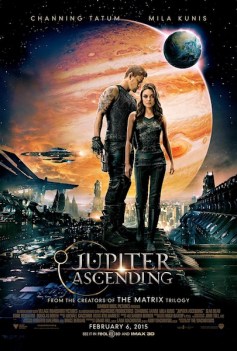 Ah, the Wachowskis. They made Bound, and no one much cared. Then they made The Matrix, and they were the biggest thing in blockbusterdom since George Lucas took us to a galaxy far, far away. Then they made the Matrix sequels, and no one cared again. Following a period when I don’t think I was alone in wondering if they were ever going to make anything else, they managed to return to the realm of mega-budgeted sci-fi action (I guess the Matrix sequels cleaned up at the box office and that’s all that matters). First there was Speed Racer (which I called “a candy-coloured masterpiece”), then Cloud Atlas (which I haven’t got round to still), and most recently Sense8 (which I certainly haven’t got time for — there’s way too much promising telly to spend time on a show I haven’t heard anyone talk about since its release day).
And earlier this year there was Jupiter Ascending, best known (as far as I’m aware) for provoking speculation it would cost Eddie Redmayne the Oscar for Theory of Everything because it came out during voting season and he was so gosh darn bad in it. And it’s also known for being just generally dreadful and universally disdained.
But, hey, look — Channing Tatum! 2015 is (as mentioned) the year of Channing Tatum for me. And this is a big sci-fi blockbuster, so chances are it would cross my visual cortex eventually regardless (though there are so many sci-fi blockbusters these days that they don’t feel nearly as precious as they did even ten years ago). And the universal disdain wasn’t actually universal — I have actually seen some people praise this film. I know, right?
Sadly, I still thought Jupiter Ascending was awful.
 The plot… oh, do I have to explain the plot? It’s some rubbish about a cleaner (Mila Kunis) getting attacked by aliens and some alien crossbreed in magic flying shoes (Channing Tatum) coming to her rescue, and taking her to a half-bee man (Sean Bean — there has to be a “Sean Bee-n” joke here…), and then into space, because she’s… nope, not the Chosen One (makes a change, at least) but a reincarnation of someone important, and her surviving family members (Douglas Booth, Tuppence Middleton, Eddie Redmayne) have a vested interest in her — which may or not be that they want her dead (again).
You might thank me for clarifying that, because it’s mindbogglingly messy in the telling. A sheen of originality, partially aided by world-building so dense it’s conveyed in massive infodumps that blur into incomprehensibility, tries to mask the fact that Jupiter Ascending is immensely derivative, including of the Wachowskis’ own work. One of the best bits, a gently satirical sequence of red tape and bureaucracy, is all but lifted wholesale from Hitchhikers or the films of Terry Gilliam — who turns up in a cameo as if to underline the point. Elsewhere you might recall David Lynch’s Dune or The Fifth Element — the latter in particular, although there the campiness was deliberate.
Some praise the visuals, claiming the film at least looks fabulous. Parts of the film carry a level of extravagance and detail thus far found exclusively in a certain genre of sci-fi novel cover art, presumably because CGI has finally reached a point where it can replicate all that on screen in motion. 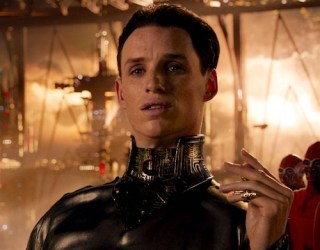 I guess it works for some people, but while it’s not bad, it also didn’t do much for me. And every time something almost works, something else undermines it, like Tatum’s make-up, or his flying boots, or Redmayne’s bizarre, affected performance. Though, to be honest, I think he’s so bad he’s good, a phrase you often hear bandied around but rarely see actually happen.
All things considered, the worst part of Jupiter Ascending is its first half-hour or so. Once it gets past that dreadfully messy first act, it settles down into something that works as passable entertainment. Sure, you might spend the rest of the time (and it does feel like a long time) playing “spot the influence”, or wondering just how exactly Redmayne’s performance came about, or, if you’re versed in British TV, going, “oh, it’s them, from… um… that other thing!” (Eventually there’s a whole spaceship full of “people off British TV”.)
But hey, at least it’s not dull.

Jupiter Ascending debuts on Sky Movies Premiere tonight at 4pm and 8pm.
 A gaggle of famed detectives are summoned to a remote mansion to solve a murder in this detective spoof by playwright Neil Simon. The twist is, all the characters are spoofs of famous literary/film/TV ‘tecs. Also, that the murder hasn’t happened yet. And also, that the person inviting them is Truman Capote. Not “someone playing Truman Capote”, but “Truman Capote playing someone”.
 James Coco as the film’s version of Poirot. There are some neat send-ups of the genre — the literally-impossible mysteries and all that — as well as some good old-fashioned wordplay and silliness. The only downside is it loses its way a bit by the end. I suppose it doesn’t strictly need a satisfactory conclusion to the mystery, because it’s only a spoof ‘n’ all, but I feel like it would’ve benefitted from a stronger finale nonetheless.
 In this ‘sequel’ to Inside Out, Riley is going to hang out with a friend… who turns out to be a boy, which sends her mum and dad — and their anthropomorphised emotions — into paroxysms of worry. Is this the 12-year-old’s first date?
 The short that accompanied Inside Out in cinemas is essentially a music video for a folksy ballad about a pair of volcanoes who are in ‘lava’ (read: love) with each other.
 Pixar haven’t had the greatest start to the second decade of the 21st Century. After somehow managing to get lightning to strike thrice with
 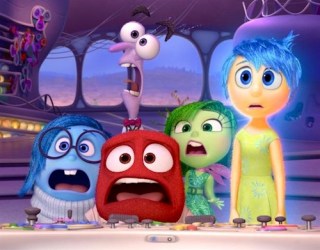 It surprises me not a jot that a Pixar film has been over-praised by critics and initial viewers. That’s pretty much my view of the their last couple of efforts before the recent doldrums, too. Those were, specifically,
 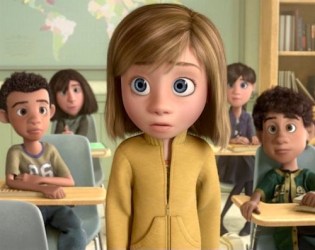 It certainly isn’t as clever or meaningful as some people have tried to make it out to be. For example, a whole internet discussion was sparked by the fact that Riley (an 11-year-old girl, remember) has emotions that are personified as a mix of male and female. When we get a glimpse inside other characters’ heads, their emotions are all of a single gender. ‘What is this saying?’, the internet wonders. Is it to do with the fact that all gender is fluid? That gender is fluid pre-puberty? As Riley is the only one with these mixed genders, are we meant to infer she’s transgender? Fertile ground for discussion. In fact, the answers are: no, no, and no. Director Pete Docter has said he just felt some emotions were more masculine (Anger in particular) and so that’s why they’re male in Riley’s head. Why the single genders in other characters? Shorthand. We only meet them briefly, after all.
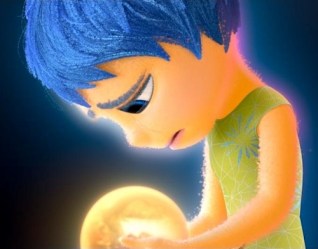 other than that the loose, floating, ‘bubbly’ edges of the emotion characters are quite neat. Apparently the effect was originally meant only for Joy and was immensely difficult to animate, but just as it was to be scrapped John Lasseter commented on how great it was and asked for it to be added to all the characters. Well done Mr Lasseter, though apparently it was an absolute headache for the technical team.
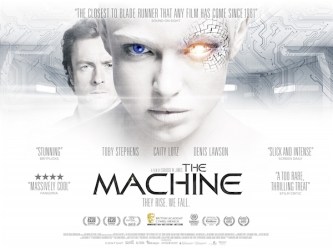 In a near future where Britain is part of a Cold War against China, a scientist (Toby Stephens) has been trying and failing to perfect artificial intelligence at a government research facility. When he hires a new associate (
 This may explain why the performances are a mixed bag. Toby Stephens can’t seem to find much to work with in his lead role, despite supposedly having a couple of emotional arcs. Lawson sleepwalks through his turn as a shady government higher-up. Lotz is unremarkable as a human, but fantastic as the AI-driven machine. Her performance as the latter is the primary reason to consider watching the film.
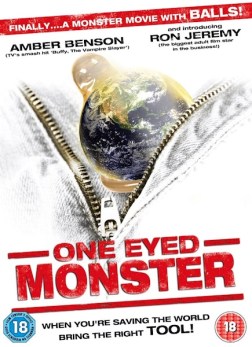 Sometimes, I swear off consciously watching any more likely-to-be-bad movies. And sometimes, I just feel like attempting something like One-Eyed Monster. And this is why: it’s actually pretty fun.
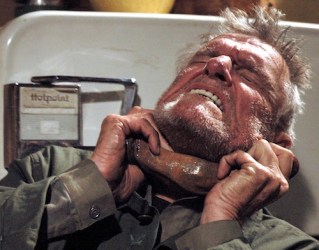 hide it behind an age barrier in the euphemistically-titled “adult” section of their website. Anyone looking for those kind of kicks is going to be disappointed, although there’s still plenty of vulgar and crude dialogue to justify its 18 certificate. In actuality, it’s mostly above using “we said a rude word!” as a ‘joke’, which is one positive it has over many more mainstream ‘comedies’.
 This informative documentary uses interviews with all the key players to tell the story of how a small indie comic, created incidentally and published almost on a whim, became a true cultural phenomenon.
 As for this documentary, it nonetheless finds an almost emotional conclusion with Eastman and Laird today talking about the chain of chance and coincidence that brought them together three decades ago to accidentally create something that transformed their lives, and which continues to endure in all kinds of media (no one liked
 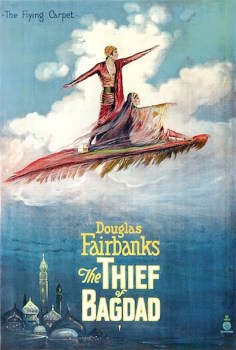 Douglas Fairbanks started out in comedies, where he was so popular he was quickly established as “the King of Hollywood”, which allowed him to attempt something different: an historical adventure film.
 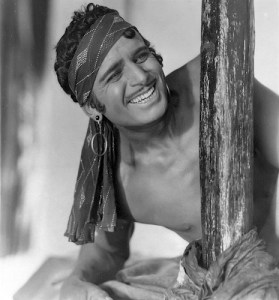 of course, which alerts the Mongol Prince to the attempted deception — though as he’s “the Governor of Wah Hoo and the Island of Wak”, he’s a fine one to talk. The thief manages to make it to see the princess anyway. She instantly falls in love with him, and he realises he loves her too, so can’t just kidnap her. His whole value system is undermined! But now he’ll have to win her hand by more honest means. Well, she already loves him, so he’s halfway there; but he’s an imposter, so there’s that to sort out yet.
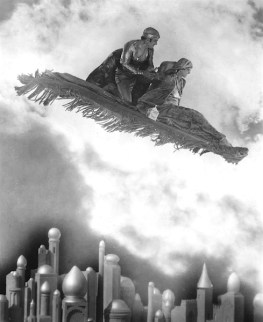 Even more impressive are the sets. The work of famed Hollywood designer William Cameron Menzies, at the time Fairbanks felt Menzies was too inexperienced to work on such a big project. Undeterred, he created a collection of detailed drawings and convinced the star/producer. No surprise that worked, because Menzies’ designs are extraordinary. His complex, detailed, unreal drawings are recreated accurately on screen (examples of this can be seen in the ‘video essay’ included on the film’s Blu-ray releases, for instance), using numerous techniques to create truly fantastical scenes: ginormous sets (they covered six-and-a-half acres), built on a reflective enamel floor (which had to be constantly re-enamelled throughout the shoot) and painted in certain ways to make them appear floaty; or glass matte paintings used to seamlessly extended or enhance shots. Reportedly 20,000 feet of film — that’s hours and hours worth — were shot just to test the lighting and painting of the sets.
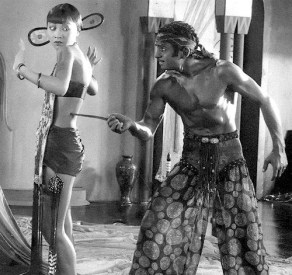 In a star-making supporting role, Anna May Wong is indeed memorable as a traitorous handmaiden. That’s more than can be said of her employer: Johnston is a bit of a non-starter as the princess, which I guess is what happens when you have to re-cast because your original choice departs part way through production. Comedian Snitz Edwards was also a mid-production replacement, drafted in to provide comic relief. It wasn’t necessary: he doesn’t add much, and Fairbanks had it covered.
 The BBC’s long-running spy thriller series
 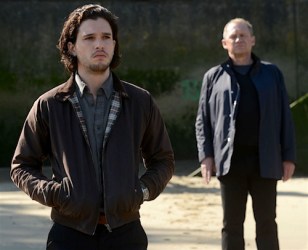 Early seasons focused at least as much on things like the mundanity of spycraft, or how one went about having a personal life while also being a sometimes-undercover agent, as they did on the exciting action of counterespionage — as evoked in the memorable tagline “MI5 not 9 to 5”, of course. As the years rolled on, things got increasingly outlandish and grandiose, just as almost every spy series that starts out “grounded” is wont to do. In season three, an entire episode was spent on the moral dilemma of whether it was acceptable to assassinate someone; a couple of years later, assassinations would just be a halfway-through-an-episode plot development. The one constant through all this was section chief Harry Pearce (Peter Firth), the M figure to a rotating roster of “James Bond”s, including Matthew “
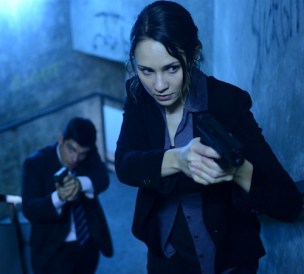 But I’m getting ahead of myself. The story begins with Harry running an op that goes wrong, during which terrorist Adam Qasim (Elyes Gabel) is sprung from custody just before being handed over to the CIA. Cue international incident. Naturally the blame is pinned on Harry, who consequently throws himself off a bridge. Except no one buys that, so they drag in Will Holloway (Kit Harington), a disenchanted one-time protégé of Harry’s (i.e. the series’ latest “younger man who can do the running around”). He knows nothing about it (
 The trailers attempt to promise some of that kind of action, but they’re a bit of a cheat: what adrenaline the film has is mostly released in tiny bursts, scattered throughout. That strategy is fine if you’ve got the money to make each little burst a solid sequence, but when the entirety of some sequences is “jumping through a window” or “climbing a wall to get into a flat”, well… Sure, it looks good in the trailer — it promises lots of action in different places at different times — but that’s also a promise the movie can’t fulfil. The Greater Good certainly isn’t just a low-rent action movie — it’s driven by its plot — but if they’d saved up the filmmaking time, effort, and expense afforded to those single-dose action moments and poured it all into one sequence (in addition to the two or three fully-realised action sequences that the film does have), it might’ve paid dividends.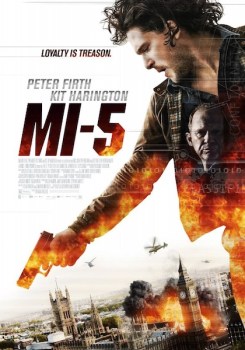
 The second release in Warner Premiere’s series of direct-to-video DC Universe Animated Original Movies (which now stretches to
 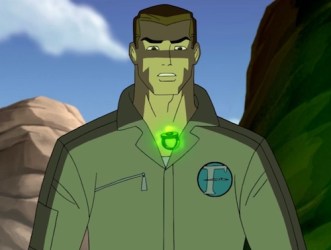 However, there are definitely bits that could’ve been sacrificed or abridged further (the Flash’s two early action sequences, for instance) to make more room to tell the story in full.
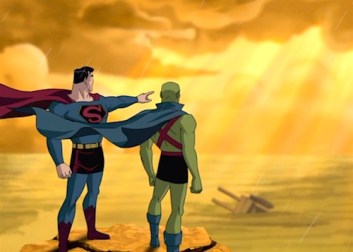 I really wanted to like The New Frontier, for all sorts of reasons. It does start well, with moments of promise sparkling here and there, but the longer it spends juggling so many balls, the fewer it can keep flying smoothly. (Do balls “fly” when juggled? Anyway, you get my point.) Considered as a whole, the overall result is fairly disappointing.
 100Films.co.uk