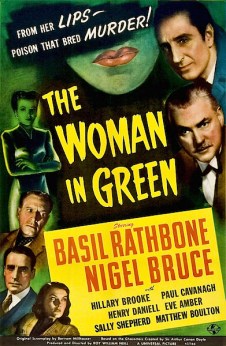
The Woman in Green (1945)

2014 #111
Roy William Neill | 65 mins | DVD | 4:3 | USA / English | PG

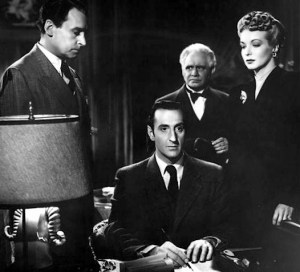
The Woman in GreenBasil Rathbone’s Sherlock Holmes starred in films which, although they typically involve murder, are best described as “adventures”. The series’ 11th film, The Woman in Green, is one of the few — perhaps the only one — that could genuinely be described as dark and grim.

In a case with overtones of Jack the Ripper, a serial killer is murdering young woman and severing their forefinger as a trophy. The police are baffled — and even the Great Detective can’t offer much help. A lead emerges when the daughter of a widower catches him burying a forefinger. However, it soon becomes apparent that Moriarty (Henry Daniell) is involved, running a cruel moneymaking scheme.

Using elements from multiple Conan Doyle stories, including The Adventure of the Empty House, screenwriter Bertram Millhauser weaves a tale where it seems Moriarty may have finally outwitted our hero, leading to a remarkably effective climax with a hypnotised Holmes at the villains’ mercy. Moriarty’s plan is genuinely despicable, with the initial murders being entirely incidental to his end goal. It gives the film a subtly different tone to the rest of the series. Holmes still exhibits ingenious methods of detection, and there’s a comedy bit for Nigel Bruce’s Watson too, but behind it sits an odious undercurrent of contemptible crime. Indeed, put Moriarty’s plan in a drama today and I think people would still consider it particularly abhorrent. It’s occasionally startling for a ’40s production.

Hypnotised HolmesThe evil is carried off with aplomb by Daniell. Reportedly a cold actor to work with, he chills on the screen too. This is a man you can believe would carry out such a scheme without a single twang to his conscience. His comeuppance, even with its surprising finality, is welcomed. The titular woman, played by Hillary Brooke, is one of Moriarty’s cohorts, posing as the ‘girlfriend’ of the aforementioned widower in order to set him up. The film is of course in black & white, so we can’t see what colour she’s wearing, and no one ever refers to it — even when they’re hunting for her based on looks alone. I guess someone thought it was an evocative title nonetheless.

Starting with a particularly vile series of murders that mask an even more detestable scheme and genuine peril for our hero, I can imagine some fans would find The Woman in Green to be too big a step outside the Rathbone Holmes comfort zone. For me, however, these elements mark it out as one of the series’ best instalments.

4 out of 5

Always (1989)

2014 #92
Steven Spielberg | 117 mins | TV | 16:9 | USA / English | PG / PG

AlwaysReleased the same year as Indiana Jones and the Last Crusade and followed by Hook, Jurassic Park and Schindler’s List in his filmography, Steven Spielberg’s remake of 1943 fantasy drama A Guy Named Joe is sandwiched between several all-time classics (and Hook), which probably explains why it’s been widely overlooked and, consequently, underrated.

Switching WW2 bombers for ’80s aerial firefighters, cocky pilot Pete Sandich (Richard Dreyfuss) is killed in the line of duty, leaving behind girlfriend Dorinda Durston (Holly Hunter, with a character name retained from the ’40s). Greeted in the afterlife by an angelic Audrey Hepburn (in her final role), Pete is sent back to Earth to be a spiritual guide to trainee pilot Ted (Brad Johnson). But when Ted runs into Dorinda, and romantic feelings begin to blossom between them, Pete has to decide if he can let go.

There’s a “something for everyone” feel to parts of Always: a soppy romantic storyline, a fantasy twist, hefty doses of humour, and some thrilling action sequences in the firefighting. There’s some wonderful aerial photography and special effects — not what the film’s about, but they’re excellent nonetheless. I guess that’s what you get when a director and crew who specialise in effects-filled blockbusters make a fantasy rom-com. Of course, Spielberg’s renowned sentimentality means he’s equally well suited to a sweet romantic movie. Three's a crowdEven with the undercurrents of grief and the difficulties of moving on, this is fundamentally a light, amiable romance.

An enjoyable little movie, Always was never destined to sit among the highlights of a career as exceptional as Spielberg’s. Nonetheless, it’s a pleasant aside from both his grander and heavier works.

4 out of 5

Always is on ITV tonight at 11:30pm.

Snake in the Eagle’s Shadow (1978)

aka Se ying diu sau

2014 #98
Yuen Woo-ping | 92 mins | TV | 2.35:1 | Hong Kong / Cantonese | 18 / PG*

Snake in the Eagle's ShadowJackie Chan’s breakout hit sees him as Chien Fu, the floor-scrubber-cum-punch-bag at a martial arts school where he bumps into Pai Cheng Tien (Yuen Siu Tien), one of the last two proponents of the Snake Fist style after its other students were murdered by their old enemies, the Eagle Claw clan. The old man trains Chan so he can overcome his bullying schoolmasters, while the Eagle Claw grand master (Hwang Jang Lee) hunts for his last remaining rival…

The first film from director Yuen Woo-ping (he went on to helm Jackie Chan’s other defining film, Drunken Master, later the same year, and is best known to us Westerners for his action choreography work on The Matrix, Crouching Tiger, and Kill Bill) presents quite a slight story, but that’s OK: we’re here for the action, and it delivers that in droves. There are more fights than you can shake a stick at; and not just minor skirmishes littered between two or three headline bouts: regular highly-choreographed duels make up the bulk of the running time. The skill on display is as high as you’d expect, and while I know nothing of the technicalities of martial arts, the speed and dexterity of the performers has to be admired.

There’s some of the comedy Chan would become known for, but it’s not outright comedic most of the time; more straight kung fu with a regularly-displayed wry edge. Those who prefer their action po-faced may still find it palatable, though the campiness of the era that has been much parodied since is present and correct.

Snake Fist styleAlso striking is the music score, a strange mix of weird, cheap, dated, electronic stuff… and yet, it’s so odd I kind of warmed to it. It’s all poached from elsewhere, which was apparently the way things were done in Hong Kong at the time. Stand-out tracks are Magic Fly by Space and Oxygene Part II by Jean Michel Jarre, though bits of famous scores are in there too, most recognisably (for me) You Only Live Twice. I don’t really know what this bizarre juke-box-esque system adds for the viewer, other than some spot-the-tune fun and an appreciable level of bizarreness.

Not the most “Jackie Chan” of Jackie Chan films, and dated in a way that will put some off, Snake in the Eagle’s Shadow is nonetheless good fun for those who like their action movies to be properly action-centric.

4 out of 5

* Seems unlikely, doesn’t it? But that’s what IMDb and filmRatings.com say. I suppose the US do have silly-lax views on violence in film… ^

American Movie (1999)

2014 #73
Chris Smith | 100 mins | TV | 4:3 | USA / English | 15 / R

American MovieA behind-the-scenes making-of with a difference, American Movie: The Making of Northwestern (to give its full title) is a documentary about wannabe-filmmaker Mark Borchardt attempting to produce a horror feature film with little more than some mates and good intentions, battling against a lack of money, interest, and dedication. It descends, quickly, into the kind of farcicality that leads some to assume it’s a This is Spinal Tap-style spoof. But it isn’t. It’s real.

It’s hard to know if you should laugh at it all, in fact. These are individuals whose lives are so quietly, subtly absurd that you can genuinely think they’ve been scripted or improvised by comedians — it’s funny, yes, but it’s also kind of sad. It’s a combination that could make for uncomfortable viewing, but for some reason it doesn’t. Maybe it’s the boundless optimism that Mark has; the belief that what he’s doing is worth pursuing and that it’s going to work out. Perhaps that’s less optimism and more naïvety.

I imagine this is actually a story that’s repeated regularly all around America — heck, all around the world: people who’d love to be filmmakers, trying to realise their dream, without really knowing what they’re doing. Hopefully not all those stories are as amusing and lightly-crazed as this one, but the vast majority will be just as unsuccessful. Whether there’s a lesson to take away from that, and what that lesson is, I’m not sure. “Don’t bother,” perhaps (to be pessimistic about it!)

Filming filmingWhatever you take away from it, American Movie feels like a must-see for certain sections of film fandom, particularly anyone who wants to make a movie themselves. Its appeal is broader than that though, an everyday story of adversity that isn’t so much overcome as temporarily averted. It’s not bleak or sad, but it is melancholic. And, whatever the morals of it, often laugh-out-loud funny.

Rarely seen (I hadn’t even heard of it until Film4 bunged on a late-night screening once last year), I recommend catching it if you can.

4 out of 5

Frankenweenie (2012)

2014 #91
Tim Burton | 83 mins | streaming (HD) | 16:9 | USA / English | PG / PG

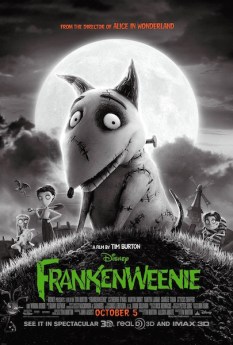
FrankenweenieInspired by two of Burton’s early-’80s shorts (which are most commonly found on Nightmare Before Christmas DVDs), Frankenweenie takes the black-and-white stop-motion visual style from Vincent and the storyline from the live-action Frankenweenie, and expands them out into a feature-length offering.

The story is as simple as one you’d expect from a short: young Victor Frankenstein’s dog dies; for a school science project, he resurrects him. It works surprisingly well stretched to a feature running time, although it goes a little haywire at the climax (what’s the point of all the monsters, really?)

Even if the narrative is no great shakes, there’s plenty of fun to be had along the way. The dog, Sparky (ho ho), is very well observed; indeed, all of the animation is naturally top-notch. It retains an indefinable but desirable stop-motion-ness, something I felt Burton’s previous animation, Corpse Bride, lacked — it was so smooth that while watching I began to wonder if I’d misremembered and it was actually CGI. Frankenweenie is attractively shot on the whole, with gorgeous lighting and classy black-and-white designs. Although US funded, I believe it was actually created in the UK, so hurrah us.

There’s lots of fun references for classic horror aficionados… though, actually, they’re not that obscure: they’ll fly past inexperienced youngsters, but be identifiable to anyone who has a passing familiarity with Universal’s classic horror output. For the kiddies, there’s some good moral messages tossed in the mix, though the best — a brief subplot lambasting America’s attitude to science — should be heeded by all.

Boy's best friendSome say it doesn’t have enough of an edge. Well, maybe; but I thought it was surprisingly dark in places. Not so considering it’s a Tim Burton film based on resurrecting the dead, but for a Disney-branded animation, yes. Those edgier bits are here and there rather than consistent, but still, I’m not sure what those critics were expecting from a PG-rated Disney animation. I guess there’s an argument that Burton should have pushed it further and aimed for an adult audience, but can you imagine an American studio agreeing to finance an animation primarily targeted at anyone who’s entered their teens? Because I can’t.

Even if you have to make some allowances for the kid-friendly necessity of Disney animation, I think Burton and co have taken an idea which showed little promise to sustain a full-length feature, and produced a film that’s beautifully made and a lot of fun.

4 out of 5

What Do You Mean You Haven’t Seen…? 2015

Six of One & Half a Dozen of the Other


My challenge-within-a-challenge (in which I must attempt to watch 12 renowned films within the next 12 months) returns for a third year, this time with a natty subtitle — or for short, WDYMYHS:SoOaHaDotO.

Yeah, let’s not call it that.

Why the unwieldy subtitle? Well, since its inception (in the distant past of two years ago), WDYMYHS has been torn between recommending critically-acclaimed must-sees and widely-popular must-sees — the first year erred towards the former, in reaction the second year skewed to the latter. This year, I had an epiphany: why make a list that tries and fails to serve two masters, when you could just make two lists?

No, I’m not going to try to watch 24 specific films (I know my own limits. Well, I don’t, but that’s one I know is doomed), but rather two lists of six — one of critically-acclaimed films, one of more populist movies. Hence the Clever subtitle.

As with last year, we’ll get straight to the two lists, and follow it up with not-for-everyone analysis of how they compare to previous years and an overlong explanation of how they were devised.

The Critical List

Raging Bull (1980)
Score: 608
TSPDT #21 | Sight & Sound 2012 #29 | featured on 1001 Movies to See | Academy Awards Best Picture nominee

The Passion of Joan of Arc (1928)
Score: 599
TSPDT #15 | Sight & Sound 2012 #12 | featured on 1001 Movies to See

L’Atalante (1934)
Score: 589
TSPDT #17 | Sight & Sound 2012 #14 | featured on 1001 Movies to See

Persona (1966)
Score: 587
TSPDT #24 | Sight & Sound 2012 #16 | featured on 1001 Movies to See

Le Mépris (1963), aka Contempt
Score: 554
TSPDT #38 | Sight & Sound 2012 #27 | featured on 1001 Movies to See

The General (1926)
Score: 553
TSPDT #36 | Sight & Sound 2012 #43 | featured on 1001 Movies to See


The Populist List

A Clockwork Orange (1971)
Score: 1,116
IMDb #75 | Empire 500 #37 | Empire 301 #54 | iCM Most ✓ed #83 | Reddit #50

City of God (2002)
Score: 782
IMDb #22 | Empire 500 #177 | Empire 301 #132 | Reddit #58

To Kill a Mockingbird (1962)
Score: 587
IMDb #81 | Empire 500 #180 | Empire 301 #132 | Reddit #121

The Thing (1982)
Score: 501
IMDb #167 | Empire 500 #289 | Empire 301 #64 | Reddit #118

Brazil (1985)
Score: 483
Empire 500 #83 | Empire 301 #106 | Reddit #154

Princess Mononoke (1997)
Score: 480
IMDb #72 | Empire 500 #488 | Empire 301 #203 | Reddit #91


(All rankings were correct at the time of compiling and may have changed since.)

Good lists? Bad lists? Please do share any and all opinions. As per normal, my progress will be covered as part of the monthly updates.

Now then:

Stats

I’ll come to how all of that was compiled in a minute, but first a few (well, quite a lot, because you know I like these bits) observations.

First, those scores — pretty meaningless without knowing the method, I know (we’ll come to that, jeez!), but you can’t help but notice how high A Clockwork Orange’s is. Here’s the best I can do for perspective: what I’m calling “the theoretical maximum” for the Populist List is 1,636 points (it’s actually possible to score more, but let’s not get into that). Compared to that, A Clockwork Orange scored 68.2%. Sound low? The film in second place, City of God, comes to 47.8%, while the last included film, Princess Mononoke, has just 29.3%. The world really wants me to watch A Clockwork Orange. The Critical List is much closer: the “theoretical maximum” there is 908, from which Raging Bull has 67%, whereas last-place The General has 60.9%.

Long-time readers will surely have remarked on the inclusion of Raging Bull. It was part of 2013’s inaugural list, but I failed to watch it. It was excluded from re-inclusion in 2014’s, but I intended to watch it of my own accord (as it were)… and failed. I decided a year was long enough to hold out — especially as it topped the Critical List and came second on the Populist List — so it’s back in. I think this will be a new rule going forward: if I fail to watch a film, it has to ‘sit out’ the next year, but is eligible for inclusion the year after.

I have to say, the Populist List didn’t really turn out the kind of films I was expecting — I thought it would be an entire list of movies like The Thing and Brazil. I suppose it proves a point I’ve made in the past: despite their reputation among cineastes, lists like the IMDb Top 250 and Empire’s reader polls aren’t completely stuffed with blockbusters. OK, you’re not getting the depths of arthouse on there (i.e. the stuff the Critical List has selected), but A Clockwork Orange and City of God are hardly Transformers 4. Well, I haven’t seen them, so I suppose maybe they are…

I actually tried to make both lists skew ‘newer’ (not because I dislike older films, but because some of these lists tend to be a bit biased against them — TSPDT admits they ‘punish’ newer films), but it barely came out at all in the final 12: the newest film is 2002’s City of God, which is 13 this year; the next is Princess Mononoke, which is 18. I suppose that’s better than 2013, when the most recent film was from 1984. The effects were felt further down the chart, but that’s of little relevance to me now; though if I’d locked out Raging Bull entirely, 2011’s The Tree of Life would have nipped in. (More on this later.)

For what it’s worth, The General and The Passion of Joan of Arc are the two oldest films to have featured in WDYMYHS, and L’Atalante is fourth (third being City Lights from 2013’s lot). That extreme aside, this year’s list are quite spread around: whereas 50% of 2013’s were from the 1950s and 50% of 2014’s were from the last 20 years, no such pithy evaluation can be made this year. The ’60s and ’80s present three films each; there’s the two from the ’20s already mentioned; and then one apiece from the ’30s, ’70s, ’90s and ’00s. The 76 year gap between the oldest and newest pips 2013’s 53 years and 2014’s 73 years.

It’s also worth noting that there’s a greater variety of languages and countries of production included this year. Non-English films made up three in 2013 and two in 2014, but this year it’s six — half the list! That said, The Passion of Joan of Arc is actually silent, and I may well watch the Neil Gaiman-penned English dub of Princess Mononoke, both of which would take the wind out of these sails a bit.

The countries of origin are undeniably spread, though. Ignoring co-production technicalities, last year only offered two non-American movies, and the year before four (the three foreign language ones plus Lawrence of Arabia, which I’ve got down as a US/UK co-production but am counting as British). This year, the US is still highest, but only with four films — there’s France thrice and the UK twice*, as well as Brazil, Sweden, and Japan.

As for directors, Kubrick’s back again, in the form of A Clockwork Orange (obviously). No surprise there, as it was ranked very highly in each previous year but eliminated under the “no repeat directors” rule. Full Metal Jacket and Barry Lyndon also made their way into the Top 6s (the former for Populist, the latter for Critical), but were similarly eliminated. I guess one will end up on 2016’s list (unless I drastically change how I do this… which I might). After sitting out last year, there’s a return for Bergman, in the shape of Persona. For the first time, no Hitchcock or Charlie Chaplin — they both had multiple entries near the top in previous years, but this time Chaplin managed 18th on the Critical list with The Gold Rush, while Hitchcock’s first appearance is on the same but way down at 70th. 70th! On the Popular list, it’s not until 84th. Have I seen all the great Hitchcock movies already? There’s an awful lot of his films I’ve not seen, and I thought some were well-liked (whither The 39 Steps?**), so I’m quite disappointed about that.

Other noteworthy directors included are John Carpenter, Carl Theodor Dreyer, Terry Gilliam, Jean-Luc Godard, Buster Keaton (taking Chaplin’s place?), Hayao Miyazaki, Martin Scorsese (for the second time… with the same film), and Jean Vigo. The list is rounded out by City of God’s Fernando Meirelles, who made the excellent The Constant Gardner before seeming to slip back into obscurity, and To Kill a Mockingbird’s Robert Mulligan, who I don’t know anything about and (to be frank) doesn’t seem to have helmed anything else noteworthy.

The curious among you may be wondering (by which I mean, I wanted to know so thought I may as well tell you) what other films would have been included if I’d taken all 12 from either list? Well, the next six eligible films on the Critical List would have been, in rank order, Barry Lyndon (re-included because of no Clockwork Orange), The Tree of Life (as mentioned), Ugetsu Monogatari, Shoah, The Wild Bunch, and The Magnificent Ambersons. (Fanny and Alexander and Wild Strawberries also scored enough to qualify, but Persona rules them out.) On the Populist List, what I was saying about “films like The Thing and Brazil” would have been borne out: the extra six would have been Raging Bull (having not been blocked by the Critical List), Drive, Rocky, District 9, The Sting, and Black Swan. (I know those films aren’t like the others, per se, but hopefully you see what I’m driving at.)

Process

This year’s scoring system is heavily based in last year’s, with some tweaks and changes, for various reasons.

The most obvious is that there are two lists, using two completely separate sets of contributing lists. The basic principles are the same for both, though: I took the top 250 entries on each contributing list and those films received a score out of 251 for their position — so #1 would score 251 points, #2 would score 250, and so on down to #250 scoring 2 points. Many of the lists go past 250 entries, however, so any film lower than that (but which came to my attention by being in the top 250 of a different list) received a single bonus point just for appearing.

There was a further 50 point bonus for appearing in the top 250 of more than one list. Last year that was an extra 50 points for each additional list; this year it’s a one-time deal. As with last year, there was an additional bonus based on the number of ‘official lists’ a film appears on at iCheckMovies.com — i.e. A Clockwork Orange is on 30 lists, so got 30 points.

With the basics established, let’s get list-specific:

The Critical List was compiled from:

Finally, to help swing the list further in favour of recent films, the top 100 of the 21st Century’s Most Acclaimed received another 25 points. Fat lot of good it did any of them.
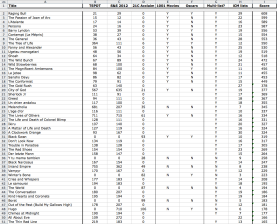
WDYMYHS 2015 Critical Top 50Now, here’s an interesting thing: I very quickly got bored doing the maths on all this. The previous two years, I’ve worked it all out in my head as I went. Year One, very easy (A+B ÷2); Year Two, more complicated, but doable; Year Three, two whole sets of rules and so many films…! So I spent an afternoon learning a bit more about how Excel works and got it to do it all for me. Imagine an evil laugh here.

To work out the scores for the Critical List, then, here’s the code (is it code? It looks like a code. Let’s call it code) that I wrote:

=SUM(IF(B2=0,0,(IF(B2<251,252-B2,1))))+(IF(C2=0,0,(IF(C2<251,252-C2,1))))+(IF(D2=0,0,(IF(D2<251,252-D2,1))))+(IF(E2="Y",50,0))+(IF(F2="Y",25,0))+(IF(G2="Y",50,0))+H2+(IF(D2=0,0,(IF(D2<101,25,0))))

That does everything I just described, automatically, when the correct values are entered in the correct columns — i.e. the ranking for each list, plus Y or N for 1001 Movies and Oscar noms. I’ll be frank, this is one reason there’s only the single multi-list bonus this year — that’s what I wrote into the code, and when I remembered later that it wouldn’t be adding another 50 for the third, fourth, etc, lists, I frankly couldn’t be bothered to work out how to do that. I’d wager it can be done, though.

The Populist List has even more constituent elements — and an even longer (though, technically, less varied) code to work it out. First, the contributing lists were:

  • The IMDb Top 250 — aka the movie list. Well, until TSPDT came along. Now I guess it depends on your personal preference which is more relevant. This changes all the time, so was very much the version hosted by iCM on 5th January 2015.
  • Empire’s The 500 Greatest Movies of All Time, commonly known as the Empire 500. Supposedly “the most ambitious movie poll ever attempted”, it was conducted by Empire magazine in 2008 and features the opinions of “10,000 Empire readers, 150 of Hollywood’s finest and 50 key film critics”.
  • Empire’s The 301 Greatest Movies of All Time, aka the Empire 301. Technically the new version of the above, held last year to mark Empire’s 300th issue. Arguably not as good. As you can see from the numbers up above, some films have moved around a lot.
  • iCheckMovies’ Most Checked, being the movies the greatest number of iCM users have seen. I think one of my most-complete lists, as I’ve seen 209 of the 250.
  • The All-Time Worldwide Box Office chart, not that it had any bearing on the final selection (you’ll note none of them are on it).
  • The Reddit Top 250, in which Reddit users have picked their favourite movies. Constantly updated a la the IMDb version, I believe.

As mentioned before, those were all initially limited to the top 250 entries and weighted equally. Following that, however, there were 25 bonus points to be had for being in IMDb’s top 100, the Empire 301’s top 50, or iCheckMovies Most Checked’s top 50. All of that made the Excel code look like this:

=SUM(IF(B34=0,0,(IF(B34<251,252-B34,1))))+(IF(C34=0,0,(IF(C34<251,252-C34,1))))+(IF(D34=0,0,(IF(D34<251,252-D34,1))))+(IF(E34=0,0,(IF(E34<251,252-E34,1))))+(IF(F34=0,0,(IF(F34<251,252-F34,1))))+(IF(G34=0,0,(IF(G34<251,252-G34,1))))+(IF(H34="Y",50,0))+I34+(IF(B34=0,0,(IF(B34<101,25,0))))+(IF(D34=0,0,(IF(D34<101,25,0))))+(IF(E34=0,0,(IF(E34<101,25,0))))

I don’t expect you to understand or have a use for that, I’m just showing off.
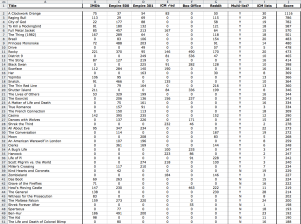
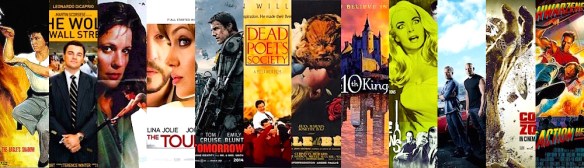
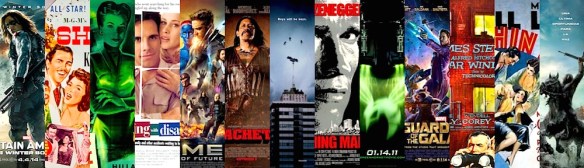
WDYMYHS 2015 Populist Top 50In the end, there were 121 films on the Populist long list and 82 on the Critical one. If you want to have a look at the top 50 of each, as featured in the small pictures earlier and to the right, you can find full-size versions here and here. You’ll note the Critical List isn’t filled out in full. At the end of a long day of list-making and code-writing, I couldn’t be doing with scouring the 1001 Movies and Oscar nominees lists for films that, even with those bonus points, couldn’t make the top 12 (never mind the top 6 that actually mattered). The reason some further down are filled out is because they were done incidentally as I went, for one reason or another. (You’ll also note that the row numbers are out by one from the ranking numbers, which is thanks to the Title row. Sadly I don’t know how to change that, if you even can.)

The End

And so there we have it! It felt less complicated a system than last year to me when I set out, I think because last year I was working out/making up all the rules and this year just tweaking and re-applying them. Making Excel do the heavy lifting for me, though, that was new and tricky, but worth it.

Now all I’ve got to do is actually watch the films…


* These numbers are somewhat debatable. For the record, I’ve counted A Clockwork Orange as British. ^

** I did a quick test to find out, and it should actually be in the mid-50s on the Critical list. Why wasn’t it included? Because the only numbered list it appears on is TSPDT, at 511th, and I only went up to 250th when first compiling from there. Its appearance on 1001 Movies gives it a big points boost after that. This does slightly concern me: how many other films am I missing that would have scored just as well? However, I don’t think it’s possible for anything like that to have cracked the Top 6, so in the end it doesn’t really matter. ^

Modern Times (1936)

2014 #55
Charles Chaplin | 83 mins | DVD | 1.33:1 | USA / English | U / G

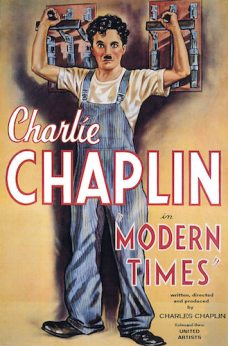
Modern TimesCharlie Chaplin satirises technology and modernisation in arguably the last film of the silent era. It actually has a synchronised soundtrack, primarily for music and effects, but also dialogue — though “we hear spoken voices only when they come from mechanical devices, a symbol of the film’s theme of technology and dehumanization.” The irony is it was that technological progress which rendered Modern Times the last hurrah for the era Chaplin remains most identified with.
Stand-out sequences include Chaplin and co-workers battling a speedy production line, and him being the test subject for a new machine designed to feed workers quickly.

4 out of 5

Modern Times was viewed as part of my What Do You Mean You Haven’t Seen…? 2014 project, which you can read more about here.

In the interests of completing my ever-growing backlog, I decided to post ‘drabble reviews’ of some films. For those unfamiliar with the concept, a drabble is a complete piece of writing exactly 100 words long. You’ve just read one.

2014 In Retrospect

It was 100 Films’ greatest ever year in terms of sheer size, but it was also one of the highest-scoring too, with the most five-star ratings I’ve ever awarded and the second-highest average score to date. Now it’s time to look back over the list and ask: Which were the cream of the crop? Which were the dregs? And which significant new films did I not even see?

To top it off, you can make your voice heard by voting for your favourites (plural) in this year’s top ten poll. Exciting stuff.

So without further ado:


The Five Worst Films I Saw For the First Time in 2014

In alphabetical order…

Chicken Little
Disney are back at the height of their powers of late, at least as far as the box office is concerned, with the phenomenon that is Frozen. Things weren’t so rosy in the early ’00s, though, leading them to abandon traditional 2D animation for the burgeoning world of 3D CGI. Their first effort was this dross, instantly proving it wasn’t the style of animation that was the problem.

G.I. Joe: Retaliation
I only gave this two stars (as opposed to one) for two reasons: 1) the rather cool cliff-swinging fight sequence, which deserves to be in a better movie, and 2) because for some unknown reason I’d given the Team America-esque first one two stars, and this is marginally better. Really, though, it’s awful: messily told, tonally uneven, ridiculous in any number of ways. Even as a daft actioner, it’s no fun.

Ghost Rider
Ghost Rider’s maligned sequel, Spirit of Vengeance, wasn’t particularly good, but at least it embraced the trashier, grimier aspects of the character (even if it was only in a PG-13 way). This first attempt to bring the Marvel anti-hero to the big screen tried to force the concept into the shape of a trad blockbuster, ending up with a Constantine rip-off. As hardly anyone liked Constantine, that wasn’t a very good idea.

Nativity 2: Danger in the Manger!
I liked the first Nativity — it’s not high art, but it’s a perfectly lovely Christmas movie. This follow-up has to switch out Martin Freeman for David Tennant, which isn’t a problem, but the new story is. Not that it’s much of a story, more a series of loosely-connected misadventures. Throw in a climactic concert made up of truly dreadful new songs and you have a disappointingly charmless sequel.

Transformers: Dark of the Moon
Michael Bay can make good movies, but he seems to have forgotten how. There are many things wrong with this third Transformers flick, but what’s most shocking is how ineptly it’s put together. For experienced filmmakers, there’s no excuse. Apparently this year’s fourth instalment is even worse, but it’s tough to imagine how. To quote a character in the movie: “does it suck or what? I mean it’s like a bad sci-fi film.”

Dishonourable Mention
Sin City: Recut & Extended
Not bad enough to actually make the bottom five, this recut took a film I remembered loving and messed about with it so much it made me doubt if I’d ever liked it in the first place. It could be my tastes have changed in the intervening nine years, but I suspect it’s at least as much due to the frustrating and near-pointless rearrangement of the running order. I recommend you stick to the theatrical cut.


The Ten Best Films I Saw For the First Time in 2014

The fascinating story of the outrage provoked in Britain by gory horror movies in the early days of VHS. Excellently constructed from talking-head interviews and archive clips, it not only tells the tale clearly but also presents spot-on juxtapositions. Informative both for those who lived through it and those for who it’s now part of history, the important message is how easily such censorship was allowed — even encouraged — and that we must be on the look out for it again. Unfortunately it is happening again, to the internet this time, and once again is being championed via misinformation from those with a vested interest. I guess more people need to see this film…

The gang’s all here for an all-eras X-Men team-up, the original cast teaming up with the First Class lot, and led by original franchise director Bryan Singer, for a time-travelling adventure inspired by the classic comic book storyline. Some surprisingly deep characterisation, buoyed by strong performances from a first-rate cast (how many of them are Oscar nominees/winners?), rubs shoulders comfortably with witty and inventive action sequences. The series that kicked off the current Hollywood superhero obsession proves it can still hold its own among the big boys that have come since.

Darren Aronofsky’s multi-pronged narrative about the evils of addiction is sometimes cited as one of the bleakest films ever made. Even if you’re prepared for that, the verve of the filmmaking transcends expectations. Finely-tuned editing and attentive sound design gradually position the viewer for the climax, a fast-cut perfectly-scored assault on the senses that almost batters you into submission. It may ultimately be grim and without hope, but it’s so amazingly crafted that you’re left longing to experience it again regardless.

Snatched off the street, locked in a bedsit for 15 years, then inexplicably released and given just days to figure out why it happened — that’s the concept behind this dark South Korean thriller (remade in America to no fanfare and even less acclaim in 2013). Oldboy mixes what could almost be a straightforward revenge thriller with weird, almost surrealistic touches, for a whole that is ready-made to be cultish without the self-conscious Cult-ish-ness that such things are normally saddled with. It ends with twists and revelations so hard-hitting they equal even the famous single-take hammer-featuring corridor scene.

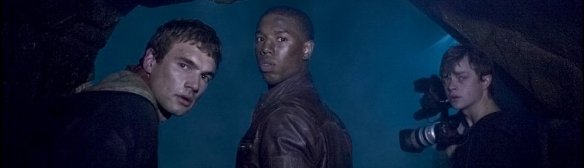
Found-footage and superheroes — two current cinematic obsessions, reviled by some and beloved by others. They had to come together eventually. Director Josh Trank keeps a handle on affairs, so that the film always sticks to concept without becoming samey, while screenwriter Max Landis reveals the true nature of his characters as he leads them from low-key beginnings to a barnstorming citywide climax that’s a bit like the ending of Man of Steel, only really good.

Why aren’t there many thrillers set inside the jury room? I’d wager because 12 Angry Men got there a long time ago and nailed it. A man is on trial for murder; we join the case as the twelve-man jury enter their deliberation room. Eleven of them are absolutely certain; one thinks they ought to discuss it. For the next 90 minutes, twelve men sit in one room and talk to each other… and it’s absolutely gripping, tense and thrilling, with moments that make you virtually punch the air with excitement. It’s a masterclass in constrained filmmaking, from director Sidney Lumet, and acting, from a cast of twelve peerless performers.

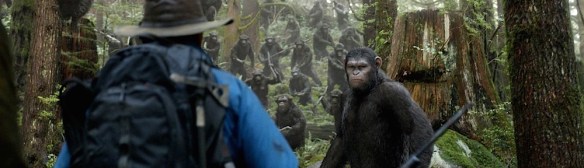
The sequel to the prequel of the Planet of the Apes takes the fad for all-CGI characters and brings it to maturity with a fully-realised ape society, played by mo-capped actors led by Andy Serkis, that is far more interesting than the human portion of the story. This is a story of interspecies relations where everything could be fine if it weren’t for past distrust and people constantly bringing guns along — like the best sci-fi, it reflects our world back at us. They claimed Avatar proved motion-captured performances should be considered alongside ‘the real thing’. Rubbish. Dawn, however, makes that case completely.

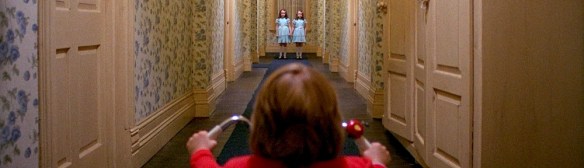
Hated by Stephen King, author of the original novel, and his most die-hard fans, Stanley Kubrick’s adaptation sees Jack Nicholson and family as the caretakers and sole residents of a remote hotel over a snowbound winter, when very creepy things begin to happen… Goodness knows what any of it ultimately means (I know there are plenty of wild theories — I’ve got Room 237 recorded to catch at some point), but as an exercise in eliciting emotions of dread and almost-primal fear, it’s second to none.

The sixth feature film to star Hergé’s boy reporter (yes, really) sees the master of action-adventure cinema, Steven Spielberg, bring us the best Indiana Jones movie in over 20 years — only it’s computer animated and stars a blonde Belgian chap with a posh British accent. Rendered with incredible realism by Weta, with a screenplay that perfectly balances investigation, action and humour, and direction that knows when to maintain verisimilitude and when to cut loose with all the freedom CGI can offer, Tintin is a quality entertainment. Very nearly my film of the year, but for…

Regular readers will know I love a single-location thriller, and this is one — it just happens that the single-location in question is the entire orbit of planet Earth. There may not be much of a plot (“woman gets stranded in space; tries to get to safety”), but it doesn’t matter: director Alfonso Cuarón reminds us of his mastery of the single-take, using it to better connect us to the characters’ experiences. I’m sure people were right that it’s best in 3D on a huge screen, but even in 2D on a telly it’s spectacular. It’s also the third film in my top five that’s only been made possible thanks to advances in computer graphics — that surely says something about how an intelligent use of CGI still allows filmmakers to innovate.


Top 10 Poll

As ever, I welcome your opinion on my top ten — not just in the comments section, but also in the form of a lovely poll. This year you can pick multiple options, so feel free to vote for all your favourites.

And if you feel I’ve made an unforgivable omission, do feel free to berate me below.


Honourable Mentions

Yet another record: for the first time ever, all of my top ten films are ones I awarded a full five stars to. That’s once again testament to the quality of this year’s viewing, because I felt sure at least one four-stars-er would make the list. To be precise, that was The Green Hornet, which I know isn’t widely liked but I rather loved — I called it “one of the best superhero movies of the current generation”, in fact. On the day, though, I couldn’t in good conscience say it was better than any of the films I have included. I guess that confers 11th place on it.

In total, 27 main-list films earned themselves a five-star ratings this year. As well as those in the top ten (for which, see above, obv.), the others were After the Thin Man, All is Lost, La Belle et la Bete, Dead Poets Society, Good Morning Vietnam, Good Will Hunting, The Hunger Games: Catching Fire, In Your Eyes, The Kings of Summer, Rear Window, Saving Mr. Banks, The Searchers, The Secret of Kells, Sightseers, The Thin Man, The World’s End, and Zero Dark Thirty. Additionally, both of the ‘other’ titles I watched and reviewed — The Hobbit: An Unexpected Journey (Extended Edition) and miniseries The 10th Kingdom — also scored full marks.

There are any number of other films I could highlight here — my long-list for the top ten had over 50 movies on it, and at least 25 of those were genuine contenders — but two categories stand out. Firstly, after finishing the Falcon series earlier in the year, towards the end I made a start on The Thin Man, watching the first three out of six films. They’re excellent fun, the tonal inspiration for the likes of the Saint and the Falcon (which I’ve previously covered in full), but on the whole even better. Expect reviews before too long.

Finally, we all know superhero and comic book movies are everywhere right now, and will continue to be so if the announced plans of Marvel Studios, Warner Bros, Fox, Sony, and the rest, come to fruition. It’s felt particularly true for me this year, with not only a few well-received recent releases (Captain America: The Winter Soldier, Guardians of the Galaxy, X-Men: Days of Future Past), but also getting caught up on an array of recent entries (all but two were from the past decade, and one of those is only 11 years old). All told, there were 22 superhero, comic book, or related movies on this year’s list — that’s 16%. For a single subgenre — and not one where I’ve (say) dedicated myself to watching the entirety of one series — that does seem rather a lot…


The Films I Didn’t See

As is my tradition, here’s an alphabetical list of 50 films that were released in 2014 but I’ve not yet seen. They’ve been chosen for a variety of reasons, from box office success to critical acclaim via simple notoriety. It’s biased slightly towards ones I might actually see at some point, though there were a couple of highly-successful or much-discussed ones I felt couldn’t/shouldn’t be left out. Feel free to assume which ones those are.

22 Jump Street
300: Rise of an Empire
’71
American Sniper
Big Eyes
Big Hero 6
Birdman
Boyhood
Calvary
Divergent
The Equalizer
Exodus: Gods and Kings
The Expendables 3
Godzilla
Gone Girl
The Grand Budapest Hotel
The Fault in Our Stars
Foxcatcher
Fury
Hercules
The Hobbit: The Battle of the Five Armies
How to Train Your Dragon 2
The Hunger Games: Mockingjay – Part 1
The Imitation Game
The Inbetweeners 2
Inherent Vice
Interstellar
The Interview
Into the Woods
Locke
Lucy
Maleficent
The Maze Runner
A Million Ways to Die in the West
The Monuments Men
Mr. Turner
Mrs. Brown’s Boys D’Movie
Muppets Most Wanted
Nightcrawler
Noah
Paddington
Pride
The Raid 2
RoboCop
Teenage Mutant Ninja Turtles
The Theory of Everything
Transcendence
Transformers: Age of Extinction
Unbroken
Under the Skin


Party like it’s Nineteen Ninety Nine…

It’s 100 Films’ ninth year — crikey, when’d that happen?

Expect more archive reposts (can I finish them before my 10th anniversary?), a third round of “What Do You Mean You Haven’t Seen” (it’s got a killer new acronym…), and — fingers crossed — both my 1,000th review and the official 100 Films’ #1000!

All that and hoverboards. We were promised hoverboards.

2014: The Full List

So here we are: as revealed in the December update, 2014 has proven to be the biggest year of 100 Films ever! Now it’s time to look back at the whole shebang and analyse and rank it.

Today’s post is The Big One… until I call the next one The Big One. But really, today’s is a long’un, full of information and fun. Yes, fun: good golly gosh, it’s statistics time! Best bit of the year, right there.

In case you’re not interested in reading it all, or in breaking your scroll wheel as you have to whizz past seemingly never-ending lists, here’s a handy clickable contents:

Without further ado:


As It Happened

One of my favourite things since I moved to WordPress is this incidental pleasure: a month-by-month visual representation of my viewing, derived from the header images on my monthly updates. More usefully, each of the twelve images below links to the relevant monthly update, where you’ll find the numbered list of everything I watched this year, and other fun stuff too.


Now, the main event — the full alphabetical list of my 2014 viewing (with links to reviews, where available):

The List

Alternate Cuts
Other Reviews
Shorts

The Statistics

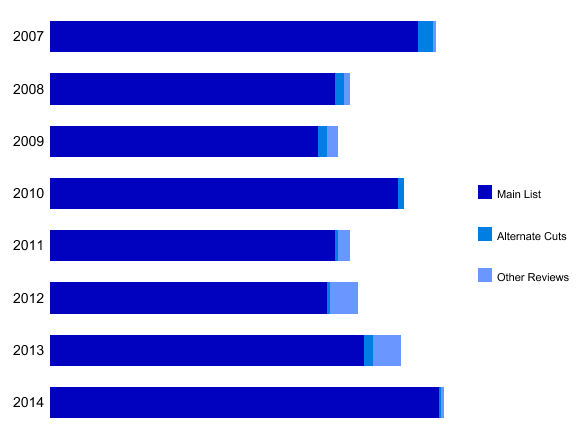
All told, I watched a record-smashing 136 new feature films in 2014. (All are included in the following stats, even if there’s no review yet.) The previous best was my very first year, 2007, with 129. It feels pretty good to finally best that — as five of the intervening six years have finished with 110 or fewer, it’s often felt insurmountable.

I also watched one feature I’d seen before that was extended or altered in some way (well, I watched two, but the other counted on the main list). I also chose to review one other for the fun of it. (All 138 films are included in the statistics that follow, unless otherwise indicated.) It’s worth noting that this tally bests 2007 too, which stood at 135 all-in.

I also watched two shorts… depending on how you count it, because one of those was made up of four shorter-shorts. Either way, none of them shall be counted in any statistics (apart from the one that says it counts them).

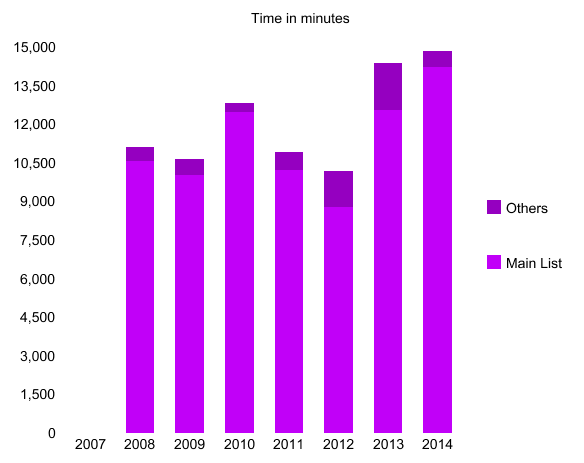
The total running time of new features in 2014 was a stonking 237 hours and 15 minutes. For perspective, last year’s total running time was the highest ever, beating the previous best by 58 minutes. This year now exceeds even that by just over 28 hours.

The total running time of all films (including shorts) was 247 hours and 43 minutes. That’s less of an increase on last year (8 hours and 14 minutes, to be precise), but it still leaves 2014 as the longest year ever. No surprise, really.

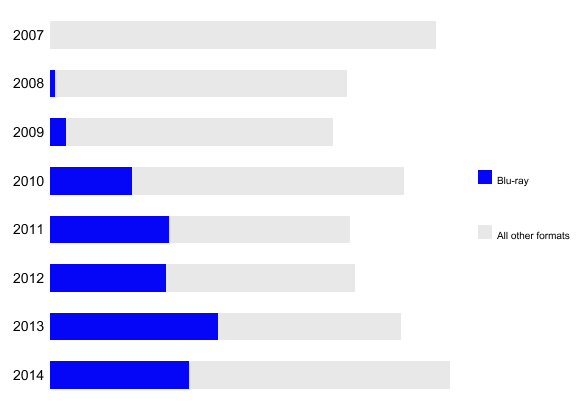
2014’s most prolific format was Blu-ray for the second year in a row, though at 49 films its total is lower than last year. That’s not the first time it’s dropped, but the only other was tiny (from 42 in 2011 to 41 in 2012), so it’s the first significant one. To be honest, that has nothing to say about the state of Blu-ray — I’m still merrily buying lots of them — and more about the fact I cancelled my LOVEFiLM subscription, so there were fewer Blu-ray rentals. That number has been absorbed elsewhere, as we shall see shortly…

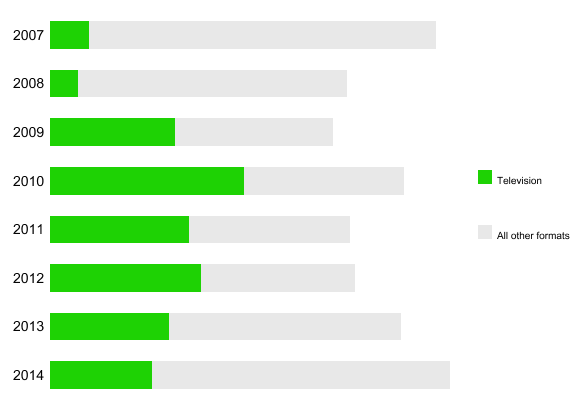
Television came second again, though continued to slide in importance with just 36 watched, none of them in HD. I think I mentioned at the time that my V+ box crashed and had to be reset, creating a shedload of space on its hard drive… which I promptly filled with new, more watchable films (and not in HD, to maximise space). To be frank, were it not for those recordings TV would have disappeared even further — I don’t think I watched a single thing ‘live’ this year.

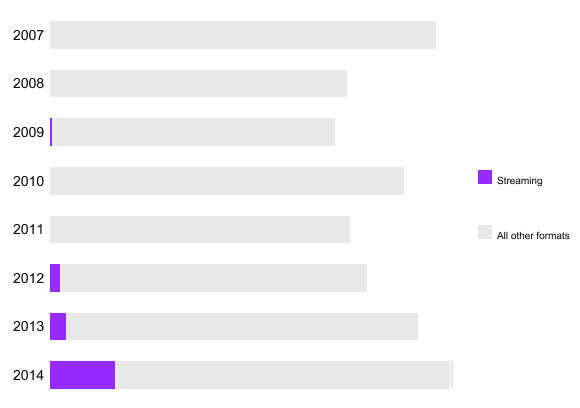
Arguably the biggest news is third place, however. The past two years have seen me increase my use of streaming, with four films in 2012 and six in 2013. This year, it came to 23. A big increase but, mulling on it, still not particularly good value for money: I currently have Now TV, aka Sky Movies, whose service is based around having lots of major recent movies about six months after their DVD release. Dividing the subscription price between what I actually watched works out around the same as it would cost to rent a film in HD from Sky/Virgin/Apple/etc on its DVD/BD release date. That’d be the same spend, same number of films, but they’d be newer. I may need to reconsider my options here…

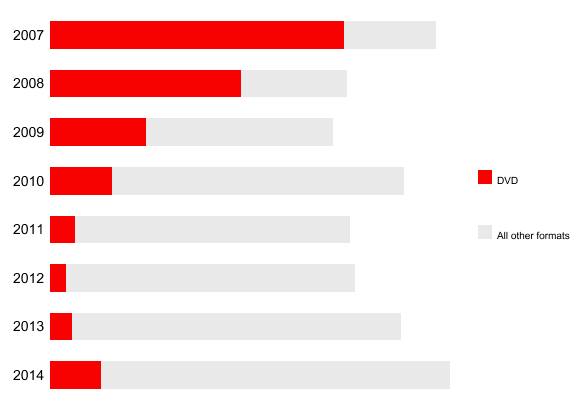
In fourth place was DVD, which reached double figures for the first time since 2010… and then went a bit further, eventually hitting the giddy heights of 18. I still have hundreds of the things unwatched, though.

Finally, downloads accounted for 14 films — another highest-ever total. Not sure why, to be honest. It’s a mix of 99p rentals from iTunes, having to finish films where the LOVEFiLM disc went screwy halfway through (because of that, you’ll find the formats total 140 rather than 138), and just… other stuff, I guess. Hm.

(You may also note that means no films seen at the cinema, for the second year in a row.)

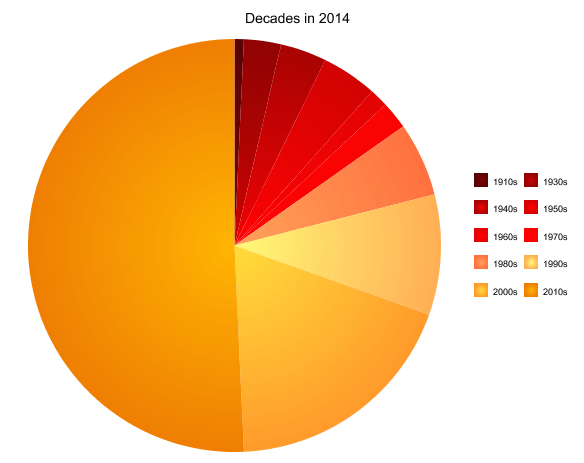
The most-represented decade this year was the 2010s. Only five years old, but it totalled 70 films, or a whopping 50.7%. That’s the first time a single decade has accounted for over half my viewing since 2009 — which makes sense when you think about it. The ’00s are a distant second on 29, which at 18.8% is a slight rise on last year. In third place, there’s a bit of a resurgence for the ’90s. Only 13 films (9.4%), but that’s enough to put it ahead of the pack, whereas last year it was down amongst them.

In fourth place we have the ’80s, with a semi-appropriate eight (5.8%), before the rest descend in size quite neatly: the ’50s are on six (4.3%), the ’40s just behind with five (3.6%), then the ’30s manage four (2.9%), the ’70s clock three (2.2%), the ’60s have two (1.4%), and the 1910s finish us off with one (0.7%). That really just leaves the ’20s, with zero (0.0%).

Moving on from time to space — where were the films I watched in 2014 from? Let’s start with language: as usual, English dominates, with 126 of the 138 films being wholly or significantly in our greatest export. That comes to 91.3% — a continued decrease from last year’s 93.5% and 2012’s 98%. I’m getting gradually Cultured, innit. While no single other language comes close to that (French and Mandarin share second place with three (2.2%) each), the total number of languages heard also continues in the right direction: from four in 2012, to 11 in 2013, to 15 in 2014 (plus one for “silent”). More uncommon ones include Persian (from This is Not a Film) and American Sign Language (from Dawn of the Planet of the Apes).

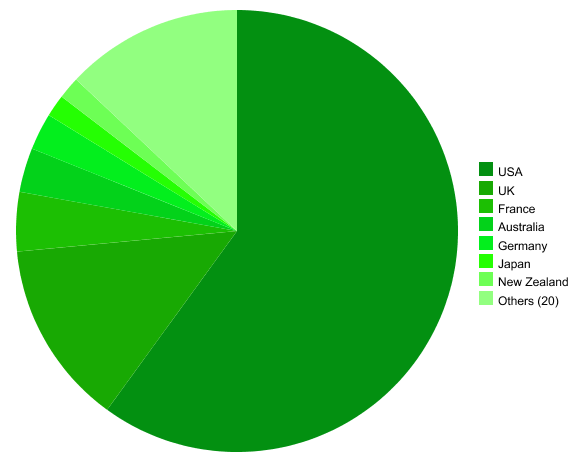
Similar to the English language’s dominance, the USA has a near-stranglehold on my viewing: 111 films were either produced or co-produced in/by the US. Defining a film’s country of origin is always tricky (see: the controversy around Gravity’s Best British Film BAFTA), and in this day and age an awful lot are co-productions anyway — several films you’d define as culturally somewhere-else (e.g. No) contributed to the US’s count; equally, some ‘Hollywood’ blockbusters also give credit to foreign shores (including such uncommon examples as Cyprus and Malta).

Behind the US comes the UK, with 25, which at 18.1% is significantly down on last year’s 29.3%. No idea why. France once again have eight, Australia are a ‘new entry’ with six, right behind them are Germany with five, then on three it’s both New Zealand (all thanks to Peter Jackson) and Japan. A further 20 countries had a hand in one or two films each, with those holding a genuine claim to “country of origin” including (but not necessarily limited to) Chile, Ireland, Hong Kong, and South Korea.

For the second year, I totalled up the BBFC and MPAA certificates of my viewing. Things skew ‘mature’ this year: in 2013, the BBFC’s PG, 12 and 15 certificates were more or less equal, while the MPAA’s meaningless Unrated (not just signifying “too extreme to be classified!” but also “so old it doesn’t need to be reclassified”) came top, closely followed by PG-13. In 2014, however, the 15 certificate (41, 29.7%) edged out the 12 (37, 26.8%), with 18 in third place (21, 15.2%) and PG just behind (18, 13.0%). Technical last place goes to U (15, 10.9%), although six films weren’t BBFC certified at all. “But that’s illegal!” Well, not for internet-distributed films that weren’t specifically released over here.

On the other side of the pond, this year it was R that claimed the top spot (43, 31.2%), pushing Unrated into second place (39, 28.3%) and PG-13 down to third (38, 27.5%). The MPAA’s distaste for lower ratings continued with 14 PGs (10.1%) and just three Gs (2.2%). If you’ve spotted that those add up to 99.3% then… why are you checking my percentages? Don’t you trust me? But also, the 0.7% goes to a sole NC-17 film. As I’ve not posted a review yet, I’ll tell you that’s Requiem for a Dream.

In a stat that’s improved for the second year in a row, 15 of my main list films appear on the IMDb Top 250 at the start of January 2015. Their positions ranges from 7th (12 Angry Men) to 203rd (X-Men: Days of Future Past), and 10 of those 15 are thanks to What Do You Mean You Haven’t Seen (the two not present are The Searchers (yes, really) and Blue Velvet). Ticking off 12 Angry Men also means I’ve finally seen all of the Top 250’s top ten. However, I still have 102 of the Top 250 to see — a lot, but also a nice little improvement from last year’s 114.

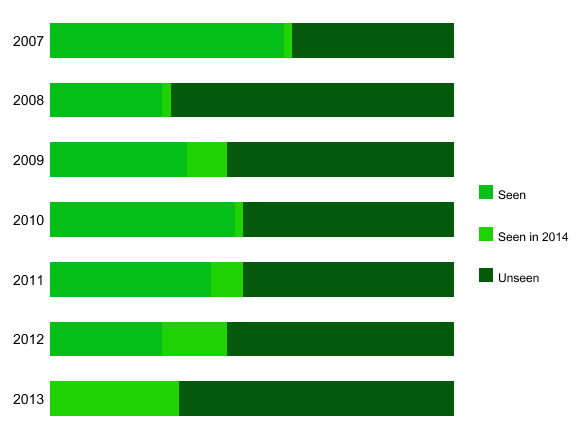
At the end of every previous year-end summary I’ve included a list of 50 notable films I’d missed from that year’s releases, and have since tracked my progress at watching those ‘misses’. In 2014, I’ve seen more movies from every year’s list (worth mentioning because I didn’t last year). Noteworthy points include that, after six years, I’ve still only seen 15 films (30%) from 2008’s list; and although I only watched one apiece from 2007’s, 2008’s, and 2010’s lists, I watched an anomalous five from 2009’s. As with so many things, I’m not sure why that should have happened. Rounding things out, I watched four from 2011’s list and eight from 2012’s. The newcomer is (of course) 2013, and I got off to strong start by catching up on 16 of those 50 — more in one year than I’ve managed in six from 2008. Don’t know what’s wrong with that list (and you can’t find out either, what with FilmJournal being down again. I’ll repost it all someday…)

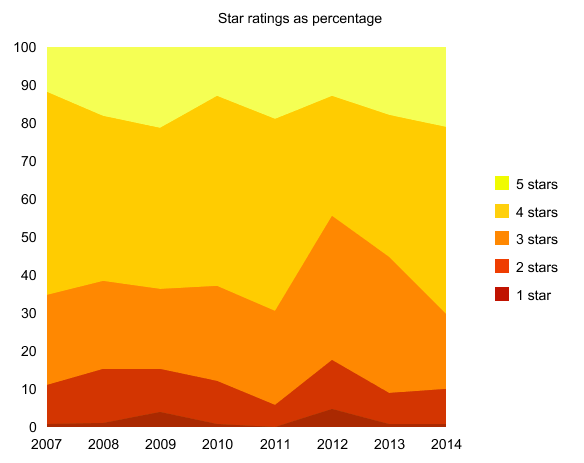
That graph shows my progress year-by-year, but in total I’ve seen 153 out of 350 ‘missed’ movies, or 43.7%. Of the remaining 197, I own or currently have ready access to around 106. Which is ridiculous. I shall chastise myself.

The count of directors on the list this year is complicated by some mix-and-match directing partnerships. So for starters, there are 112 solo directors… but one of those, Frank Miller, also directed a film with Robert Rodriguez, and another with Rodriguez and Quentin Tarantino; and Rodriguez directed another again, with Ethan Maniquis. Counting all the different combinations as unique, there are 129 directing credits this year… although that doesn’t include the one film that didn’t even have a credited director! I despair. Whichever way you cut it up, it comes out as the most directors ever. I don’t know if that’s good or bad, but there it is.

Aside from Miller and Rodriguez, those with multiple films are headlined by David O. Russell and W.S. Van Dyke with three each. There’s two apiece from Tim Burton, Justin Lin, Roy William Neill, Phillip Noyce, and Steven Spielberg, while Peter Jackson has one main list film (The Hobbit 2) and one extra film (The Hobbit 1 Extended).

Finally, as always, we come to the scores:

First up, there were a record-high number of five-star films this year: 29. Of course that’s partly due to the sheer volume of films, but at 21.0% of my viewing it’s only just behind 2009’s 21.2% in terms of highest percentages. That makes five-stars the second most-awarded score this year, which has only happened once before (also in 2009), and even then it was tied for second (with three-stars). Have I become more lenient, or have I been watching a higher standard of films this year? Not sure, to be honest — there may have been a couple of occasions when generosity got the better of me; equally, there were a couple where I’d initially thought of giving full marks but pulled back in the end, so I guess it averages out.

The most populous score is, as usual, four-stars, with 68 films. That’s not the highest total ever (that goes to 2007’s 72), nor the highest percentage (several years best it), but it still comes out at 49.3%, which is pretty good going. See above for my thoughts on leniency vs. quality.

There were 27 three-star films, which works out at 19.6%. That’s the lowest percentage ever for this rating. It comes after the two most three-stars-y years ever (38% in 2012 and 35.8% in 2013) — the more of these stats I trot out, the more you can see why I’ve been wondering if I’m going soft.

The lowest two rankings remain within their usual parameters, however. There were 13 two-star films, which is darn close to the 2007-2013 average of 12. Finally, there was just one one-star films, which is the same as four of the previous seven years. I’ve always been toughest when it comes to rating films just a single star — something has to be pretty irredeemable to get to that point, as proven by the fact that neither G.I. Joe: Retaliation nor Transformers: Dark of the Moon sunk so low. Maybe I am getting lenient…

Last of all, the average score. As you’d expect from those numbers, it’s a high one: 3.8. To be precise, it’s 3.804, just behind 2011’s 3.829 but (in percentage terms) notably above third-place 2009’s 3.657. (If I scored in percentages, that would make this year’s average 76.1%, with 2011’s high as 76.6% and 2009’s third as 73.1%; 2012’s lowest-ever of 3.352 would be 67.0%.)

And that’s your lot!


Coming soon…

(“Soon” as in “soon as I can decide what they are and write up 15 mini-blurbs”, that is.)

My Top 10! And all the other bits that always come in that post!

And then we can finally move on to 2015, I promise.

The Adventures of Tintin: The Secret of the Unicorn (2011)

2014 #134
Steven Spielberg | 107 mins | Blu-ray | 2.35:1 | USA & New Zealand / English | PG / PG

The Adventures of Tintin: The Secret of the Unicorn1981: Steven Spielberg reads a French review of his movie Raiders of the Lost Ark. His high-school-level French serves him well enough, although there’s repeated use of one word he doesn’t know: Tintin.

25 years later: Spielberg has been struggling to make a film version of Hergé’s character for quarter of a century. While developing a live-action version that would feature actors under heavy prosthetics so as to resemble their comic book counterparts, he realises Tintin’s famous dog, Snowy, will need to be computer generated. He reaches out to Peter Jackson and Weta, fresh off their ground-breaking work on The Lord of the Rings. Their test footage is so successful, it gives Spielberg another idea…

2011: after 30 years, Spielberg finally brings the boy reporter to the big screen as a motion-captured animation. Reviews and public reception are mixed, particularly in the US, but they’re all daft because The Adventures of Tintin: The Secret of the Unicorn is bloody brilliant.

Combining events from three of Hergé’s original albums, the story sees Tintin (Jamie Bell) purchase a model ship that is highly desired by the mysterious Sakharine (Daniel Craig). A riddle hidden inside the model sets the ever-inquisitive reporter on a quest to find out what nefarious deeds Sakharine is planning, along the way bumping into drunkard Captain Haddock (Andy Serkis), who holds the key to the entire mystery. Cue a globetrotting adventure that, yes, is very much in the Indiana Jones mould.

Tintin and HaddockApparently some Tintin purists weren’t so keen on the actual adaptation — elements of The Crab with the Golden Claws have been mixed in to a plot primarily taken from The Secret of the Unicorn, the sequel/second half of which, Red Rackham’s Treasure, is reportedly used sparingly. Plus, in the original tale Sakharine is a minor character who wasn’t responsible for much, apparently. As someone who’s only read one of those three volumes, and even then not since I was young, such things didn’t trouble me. What superstar screenwriters Steven “Doctor Who” Moffat, Edgar “Cornetto trilogy” Wright and Joe “Attack the Block” Cornish have captured is the spirit of Tintin: an engrossing mystery-adventure, laced with gentle satire and smidgens of slapstick comedy, but with real stakes and peril too.

A talented cast are up to the task. Bell adopts a posh-ish accent for the titular hero, and while some of the accusations of blandness aren’t wholly misplaced, he’s plucky and determined enough to make for an appealing lead. The king of mo-cap, Serkis, is able support as Haddock, while Craig makes for a very effective villain — I hope his post-Bond career, whenever that arrives, sees him playing villainous roles more often. Interestingly, it was his mannerisms that have survived the animation process the most. I mean it in an entirely non-critical way when I say every other character could have any actor behind the mo-cap baubles, but Sakharine’s face and body move with all the recognisable movements and expressions of his actor.

Of course he can't talk, he's a dogThe slapstick is mainly hoisted by Simon Pegg and Nick Frost as the physically-identical Thomson and Thompson — a true advantage of animation, that. I imagine some find their parts tiresome because of their inherently comic role, but they’re likeable versions of the characters. Even more joyous is Snowy, though. Well, I would like him, wouldn’t I? His internal monologue, such a memorable part of Hergé’s books, is omitted (as it is from every film version to date, I believe), but he’s full of character nonetheless. Some of the best sequences involve Snowy running in to save the day. I don’t think they quite got the animation model right (the one glimpsed in test footage included in behind-the-scenes featurettes looks better, for my money), but his characterisation overcomes that.
Bit of an aside, but I think there’s something notable about almost everyone mentioned so far: Moffat, Wright, Cornish, Bell, Serkis, Craig, Pegg, Frost… All British. I know that’s because we’re awesome ‘n’ all, but I think it’s also indicative of Tintin’s status in the English-speaking world — which more or less boils down to “unknown in America”, but also “pretty darn popular in Britain”. At least Spielberg, the man who wanted to cast an American as Harry Potter, seems to know this (further evidence: they’ve hired another British screenwriter for the sequel). For whatever reason, Tintin has never clicked in America, while the books remain very popular over here. It therefore feels like there’s a better chance for the films’ fidelity by using Brits (who have the correct tone and style almost ingrained) than by using people coming to the stories entirely for the first time, and perhaps bringing a more generic blockbuster sensibility. On the other hand, this might just be a horribly xenophobic way of interpreting a coincidental appearance by so many Brits in key roles — after all, Tintin’s Belgian, so it’s not like using Brits is “true to source”.

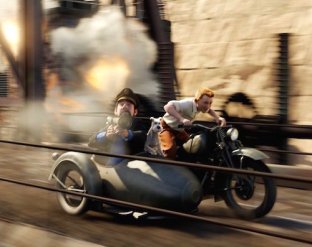
Action directionOf course, one very important person is neither British nor Belgian: Spielberg. The screenplay’s balance between peril and comedy is spotlessly enhanced by his peerless direction. In a world stuffed to the gills with lesser blockbusters that palely imitate the groundwork Spielberg and co laid in the ’70s and ’80s, work like this should remind people why he’s still the master of the form. The film is shot with an eye for realism (so much so that some viewers have been convinced it was filmed on real locations with real actors, with some CG augmentation for the cartoonish faces, of course), which helps lend a sense of plausibility and also genuine jeopardy. It’s easy to get carried away when working in CG animation, but often the most impressive works are ones that behave as if they’ve been shot largely within the limitations of real-world filmmaking technology.

That said, Spielberg isn’t afraid to make use of the freedom afforded by working in a computer-generated realm when appropriate: there are some spectacular individual shots, the most obvious being a single-take chase sequence down a hillside through a town. Even better are some of the transitions, which would be literally impossible to realise in live-action — without resorting to effects work, anyway. They’re hard to accurately describe, especially without ruining them, in part because each instance is different; but they do all look incredible, and, again, serve the story rather than being flashy for the sake of it.

It always went ok on Flight Simulator...The tone on the whole is resolutely PG — actually, like many an action-adventure blockbuster used to be before everything went slightly darker and PG-13. So, for example, Tintin wields a gun on occasion, but never at another human being. The focus is on the story, which happens to lead to some adrenaline-pumping sequences, rather than a lightweight excuse to link together a bunch of punch-ups and chases. Ironically (though, for anyone who knows what they’re talking about, entirely expectedly) this makes the action all the more exciting. It also mean there’s a lighter touch than many current blockbusters offer; a greater presence for humour, including among the action. I guess that’s not fashionable these days, when everyone’s become so po-faced about their big-budget entertainment. However, with the likes of Iron Man and Guardians of the Galaxy proving immensely popular, perhaps the tide is turning, and maybe the still-on-the-cards Jackson-helmed sequel will find itself better received because of that.

I genuinely don’t understand the muted reaction to this first Tintin, though. It perhaps shows where blockbusters have gone awry in the last decade or two, and perhaps the incidental disdain animation is viewed with among some — I wonder: if the same movie had been produced in live-action, would some of those critics have been better disposed to it? I don’t think it would have actually been a better film, and perhaps it would even have been slightly worse (some of the visual impact would be lost), Herge's Adventures of Tintin!but some viewers would have seen it (even subconsciously) as more of a “real movie”.

As I said at the start, those people are Wrong. The Adventures of Tintin is a fantastic adventure movie, and should prove to anyone who doubted Spielberg after Kingdom of the Crystal Skull that, when it comes to globetrotting action-adventures, he’s still the man to beat.

5 out of 5

The UK network TV premiere of The Adventures of Tintin: The Secret of the Unicorn is on BBC One today at 4:25pm.

It placed 2nd on my list of The Ten Best Films I Saw For the First Time in 2014, which can be read in full here.