Edgar Wright | 109 mins | Blu-ray | 2.35:1 | UK, USA & Japan / English | 15 / R
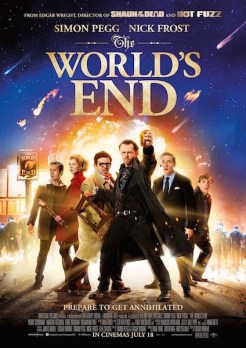 Shaun of the Dead is the favourite of critics and fanboys, and Hot Fuzz seems to have attained widespread popularity, but The World’s End may be the most mature and, in its own way, subtly subversive of the ‘Three Flavours Cornetto’ trilogy. Does that make it the best? Well…
The story sees man-child Simon Pegg gathering his old gang of Sixth Form friends — all now grown-up with proper jobs and lives — to attempt their hometown’s twelve-stop pub crawl, which they failed as teens. Despite lingering tensions within the group, all starts well enough — until they begin to notice there’s something oddly familiar about their old town… almost as if it hasn’t changed at all for a couple of decades… Cue sci-fi hi-jinks with special effects and action galore, mixed with some deft character-derived humour — the Cornetto trilogy’s usual M.O., in other words.
That’s not a criticism. This is a thematic trilogy, and as such you expect certain elements to be there. No one wants a beat-for-beat rehash, because what’s the point, but there are certain stylistic and tonal elements you want to be present. The World’s End largely achieves that, though not enough for some — those after nought but genre spoofery and non-stop humour may be disappointed.
This is a more mature work than its two predecessors. While they were clever genre mash-up/pastiches, this goes lighter on that crowd-pleasing bumf. There are still generous segments of that in the film, but the genre being manipulated is less clearly defined than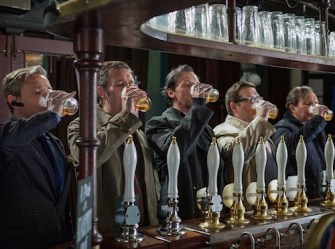 “zombie movie” or “Hollywood action movie”, and occasionally co-writers Pegg and Wright have substituted character development and thematic points for send-up. It may not play to the genre-loving fan-audience that the trio’s previous work has accumulated (demonstrably so, based on many a viewer review), but it does make for a more grown-up film.
I noted that the film is definitely a part of the Cornetto trilogy, but there’s an element of growing up and moving on about it. Shaun of the Dead was made when Pegg and Wright were in their early 30s, but now they’re in their early 40s — a very different time, with different personal concerns. Some people may wish to remain young forever (as per Pegg’s character in the film), but others mature, and it seems Pegg and Wright have more grown-up aims in mind with their filmmaking. In that sense The World’s End may be transitional, from the genre-focussed spoofery of their ‘youth’ to a more considered, perhaps even realistic (at least as far as character and theme are concerned), style of storytelling. Of course, it’s quite meta that the film they’ve made to grow up and move on from the Cornetto trilogy is all about growing up and moving on.
It’s a shame some viewers can’t get on board with this more mature approach. While the consensus appears to be “very good, but definitely the weakest of the trilogy”, there are (normally sane) people who seem to genuinely despise it (what was that I was saying about immaturity again…), and at least a couple who cite it as their favourite of the lot. It’s been a long time since I last watched Shaun or Fuzz so I’m not going to offer my definitive opinion on their relative merits, but I can see that this could be my favourite.
 It will definitely reward multiple viewings: it’s littered with signs, omens and portents (in fairness, a good few can be grasped on an attentive first go). There’s a featurette on the BD (but not the DVD) which helps point out any major ones you may’ve missed; though I have to say, even at seven minutes long, and even with it pointing out some that felt too obvious to be worth mentioning, I swear it left some stuff out. That could be a deliberate decision of course, to leave some things for people to just spot.
Clearly too mature for some viewers (and I don’t mean in the sense of swearing and violence), Wright and Pegg’s trilogy-capper is a thoughtful character movie about growing up and moving on… paired with the usual Cornetto trilogy genre-riffing hi-jinks. The result may just be the trilogy’s pinnacle.

This review is part of the 100 Films Advent Calendar 2014. Read more here.

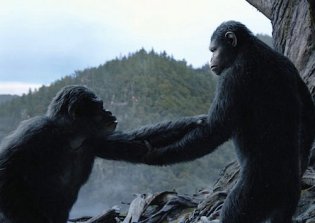 A heady mix of solid writing from Mark Bomback, Rick Jaffa and Amanda Silver, peerless motion-captured performances from the likes of Serkis and Toby Kebbell, and first-rate CG magic from Weta, brings us a set of characters who are compelling and believable. Here is a society trying to define what it wants to be, battling old prejudices in the hope of a peaceful, secure, happy future. If you want to draw analogies to almost any real-world political situation, I’m sure you could.
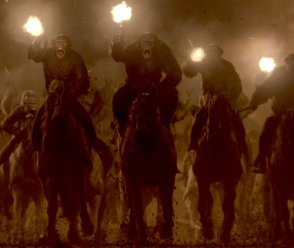 Lest you get the wrong impression, the film isn’t all talk. For various spoiler-y reasons, the fragile relationship between Man and Ape breaks down, and the apes stage an attack on humanity. Here we get perhaps one of the best siege action sequences I can think of, with mankind holed up in a half-constructed skyscraper that sits conveniently at the end of a long street for the apes to charge down. Reeves’ direction is virtuosic here, crafting an epic and exciting sequence even when most of the film’s major players are busy elsewhere. And it’s not even the climax.
 thanks to some surprisingly small-scale narrative choices (the whole thing with the dam doesn’t feel nearly as vital as it should) and Reeves’ direction sometimes being a little straightforward and almost TV-ish. I know I’ve said I hate when people use that as a derogatory comment nowadays, but some repeated locations and shot choices make the film feel cheaper than it was.
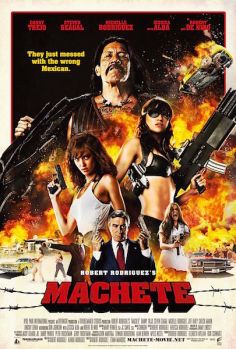 Multi-hyphenate Robert Rodriguez takes his
  to fleetingly include something that ‘needs’ to be there purely because it was in that trailer.
 Comic book creator Frank Miller brings what he learnt co-directing
 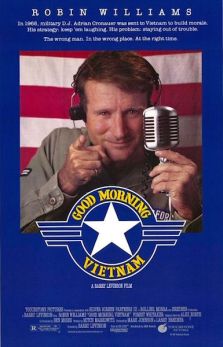 Inspired by the true story of a US Army DJ in Vietnam during the war, the resulting film is a showcase for star Robin Williams — reportedly, his antics aren’t even close to what really happened.
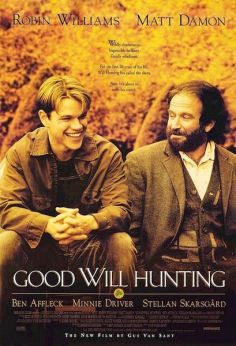 I’d say Good Will Hunting is famous for two things: one, being written by Matt Damon and Ben Affleck when they were young actors after some good roles; and two, Robin Williams’ Oscar-winning supporting actor performance. Such is the power of these two facts that I didn’t even know what it was about until I actually watched it.
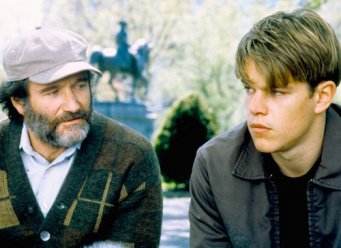 The film is perhaps most enjoyable as an acting showcase. Damon and Williams have numerous incredible scenes together; encounters that feel like genuine slowly-evolving therapy, rather than the simplistic and implausible series of repeated revelations and breakthroughs that such treatment is often reduced to on screen. They run the emotional gamut, too, being not just instances of soul-searching but also moments of wider insight, or intense humour — that’s what you get when you have Robin Williams at your disposal, of course. His Oscar is well earnt.
 Their promising relationship suffers through inexperience and, to be frank, unwarranted daftness, lending it a melancholic air (or is that just me again?)
 Then, slowly, almost imperceptibly, a slight wry grin curls his mouth. Yes, Will has actually done it; and yes, it is what he wanted. It’s all good. Only then does he turn around, and simply announce to his waiting friends that Will isn’t there. It’s a pretty subtle moment, massively over-explained here, but it’s so much more realistic a reaction than the almost-clichéd one we’re expecting to see. In a film full of incredible, powerful performances, speeches and moments, it’s one that stood out to me.
 Besides, it’s the characters and the performances that shine. It’s no surprise that a pair of actors wrote an “actors’ movie”, but it is an achievement that they wrote one that displays genuine people and genuine emotions, rather than just showy performances. Credit to an exceptional cast — and, this once, an exceptional director — for bringing that so beautifully to life.
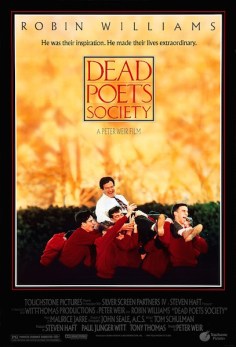 At an oppressive private school (is there another kind?), a gaggle of disenchanted students are invigorated by teacher Robin Williams; until his methods, and the independent thought they inspire, attract the ire of parents and faculty.
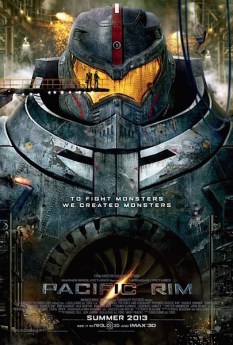 The names writers choose for their characters can sometimes tell you a lot about a movie. Pacific Rim is the kind of film that has characters called Raleigh Becket, Stacker Pentecost, and Hannibal Chau.
 — it was the 3D that added depth and height, and without that (or, as I said, an adjustment of focus to compensate) it’s all a bit… not flat, but not big either. That aside, it is beautifully shot, with excellent lighting.
 Westerns don’t come more renowned than this Ford-Wayne collaboration about the years-long hunt for a girl kidnapped by Native Americans.
 Tom Hanks is Walt Disney and Emma Thompson is author P.L. Travers in “The Making of Mary Poppins: The Movie”. Disney has been desperate to turn Travers’ fictional nanny into a movie for years after he made a promise to his daughter; Travers has resisted, but now needs the money. She’s brought to LA to consult on the script, and proceeds to make life miserable for screenwriter Don DaGradi (Bradley Whitford) and songsmiths Robert and Richard Sherman (B.J. Novak and Jason Schwartzman). At the same time, we see the story of a family in Australia from the eyes of a little girl Ginty (Annie Rose Buckley), as they struggle with the whims of her father (Colin Farrell), a bank manager who’s a little too fond of the bottle. Guess what the connection is!
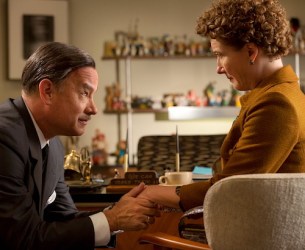 Similarly, Hanks’ part seems to be little more than a cameo at first, but he steadily appears often enough to make it a supporting role. Reportedly he has perfectly captured many of Disney’s real traits and idiosyncrasies, and who are we to doubt the word of people who knew the man? His performance is not just a shallow, simple impersonation, but there’s not that much meat to Disney’s character arc either.
 Some will find the story lacking in dirt, particularly when it comes to the portrayal of Disney. But it’s not whitewashed either, and do you really think the Disney Corporation would have allowed a movie to go ahead that depicts their founding father in a negative light? For that, I don’t think it’s as twee as it could have been — there’s definite conflict over what’s being done with Poppins, and, even with the film having turned out to be a solid-gold classic, we often find ourselves sympathising with Travers.
 100Films.co.uk