2014 #71
Producer:
William F. Jury* | 74 mins | DVD | 1.33:1 | UK / silent (English)
 Arguably the most famous clash of the First World War, the Battle of the Somme lasted four-and-a-half months from July to November 1916 and, with over a million men wounded or killed, is “one of the bloodiest battles in human history.” As the BBC’s History website puts it, although it was “intended to be a decisive breakthrough, the Battle of the Somme instead became a byword for futile and indiscriminate slaughter”. Not that you’d guess it from this contemporary documentary, which is essentially a propaganda piece produced by the British government.
Centred around 1st July 1916, the day of the first British assault on the German trenches, the film mostly covers the build-up and aftermath of the initial fighting — despite the title, there’s very little footage of combat. There’s probably two reasons for that: one, the footage of the battle wasn’t very good and so, infamously, was staged (aka faked) later; and two, the battle was a bloodbath, making it a somewhat inappropriate spectacle to show to the general public, especially when it was their friends and relations being slaughtered on “the worst day in the history of the British Army” (they suffered around 60,000 casualties on that first day alone). Not that we’re spared the sight of dead bodies elsewhere in the film, but the moment of death itself is another matter.
The faked footage of men going ‘over the top’ has dogged the film’s reputation to a degree. As Roger Smither, the keeper of the Imperial War Museum’s film & photograph archives, notes in the booklet accompanying their DVD release, “despite a common perception that The Battle of the Somme is ‘full of fakes’, the staged ‘over the top’ scene is in fact a significant anomaly in a film that is otherwise characterised by nothing worse in the way of fabrication than the kind of ‘photo-opportunity’ arrangement that remains a continuing part of television news and photo-journalism to this day.” It’s also one that lasts only a few minutes, if that; a tiny fraction of the entire film.
 The British press certainly believed they were seeing “the real thing at last” (the Manchester Guardian), feeling it showed “war, grim, red war; the real thing” (the Daily Sketch). The British public agreed, flocking to see the movie en masse: twenty million admissions were sold in the first six weeks of release. At the time, the battle still raged (the film debuted on 10th August 1916) — as Smithers notes, “to its original audience, the film was not history but a despatch from the front”. It is such an historical document now, but at the time it wasn’t even recent-history — it was produced as newsreel, a record of current events, designed to make people at home feel connected to the everyday lives of their family, friends and countrymen serving on the frontline.
It can still serve that role today, to an extent. From much of how World War One is presented in modern fiction, documentary and education, you’d be forgiven for thinking troops were shipped directly into trenches, went over the top and died or, if one of the few lucky enough to survive, then went directly to hospital/home/back to the trench. The Battle of the Somme puts lie to that from the start: we begin with preparations for the battle, lines and lines of troops marching or standing around waiting for something to do, in normal-looking fields and towns, far removed from the cramped, muddy, horrid trenches of our imagination. Smiling faces follow the camera, running around to remain in shot, lifting tarps uninvited to helpfully show off stacks of ammunition. It’s all very jolly.
 Equally striking is the scale of the operation. You know it was a monumental effort, but actually seeing so many men… You never see that scope in dramas because they don’t have the budget for all those extras, I guess, but here the crowds of soldiers just waiting around are remarkably large. And crikey, the heavy artillery! Even though you know these were real weapons, today they look more like some fantastical steampunk creation, so covered are they in rivets, and so damn huge.
Signs of disruption to the happy masses creep in, though: it’s surprising how scruffy the uniforms are — not when the soldiers are at rest, but while performing duties like reloading guns. Hats are at odd angles, some are jacketless — just a general lack of the smartness you’d expect to see in an official documentary about the military. Later, we see a gaggle of smiling and laughing faces as men attach special barbed wire cutters to the end of their rifles. Hindsight lets us know few of those men would’ve got close enough to need them.
But there’s no hindsight here; no mention of the incompetent strategy and the severe loss of life it led to. If anything, it makes even the post-battle front look not-so-bad. We see some of the wounded, but they’re either walking or seem to be enjoying a nice stretcher ride, the intertitles informing us we’re seeing “how quickly the wounded are attended to”. Even the captured enemy look just as chipper as the British soldiers escorting them. When we do see action, any British attack is successful and described with words like “glorious”, while any German counterattack is “one of five unsuccessful” ones. It’s brazenly propagandistic. Towards the end we’re shown — and I quote the intertitle accurately — “some of the booty”! (That being artillery, etc, salvaged from the captured German lines.) The closing section opens with shots of devastation wrought on the landscape by British shellfire, accompanied (in the 1916 musical medley) with triumphant music. The tone is shocking.
 Speaking of the music, the Imperial War Museum DVD release offers up a choice of two scores: a newly-commissioned (in 2008) one by film composer Laura Rossi, and a recreation of the kind of music that would have accompanied the film in 1916. The film’s producer and distributor, William F. Jury, was also the editor of trade paper The Bioscope, and had columnist J Morton Hutcheson draw up a list of suitable pieces to be performed alongside screenings, which was published days before the film’s release. To quote Dr Toby Haggith (the Imperial War Museum’s film programmer), again in the DVD booklet**, “for this reason, it may be fair to describe this medley as the ‘official score’ for the film. Although cinemas were not obliged to use these recommendations, we know that it was used in at least seven of the cinemas where the Somme film was screened and there is other evidence that it was widely adopted. However, the point is not that the Morton Hutcheson medley was used on every occasion The Battle of the Somme was shown, but that it is the kind of selection that was typical for this film”.
Rossi found the “medley was much more positive and light-hearted than I imagined… I think it’s interesting to hear the medley and see how it was watched in 1916… but I think someone watching the film today would watch in a totally different way, as we can now look back in hindsight, and we have a pre-conceived idea of what the war was like”. This is partly why I chose to view the film with the 1916 soundtrack: to get an idea for how the film was originally perceived, rather than the laden retrospective view. Rossi avoided listening to other scores when composing her own, preferring to respond to just the film itself. Admirable, and probably the ‘right’ way to do it; but it also brings all that associated baggage of “this was a terrible thing”, whereas the original film, produced as propaganda-newsreel, is going for more “this is hard but honourable”. The 1916 music selection is indeed quite jovial on the whole, though marginally more somber when the occasion calls. The (very small) sampling I listened to of Rossi’s score was more ominous, rumbling, haunting and haunted — much more in tune with our modern understanding, I’m sure.
 Haggith summarises many of Hutcheson’s choices as “motivated wholly by the needs of propaganda… jaunty, martial and unashamedly heroic. Given the nature of the scenes recorded and the bloody history of this phase of the battle, the selection of such upbeat music seems deeply inappropriate.” However, other selections “reflect Hutcheson’s personal response to scenes that he found distressing on a universal level, and which led him to warn musicians that ‘they must realise the seriousness and awfulness of the scenes’… These contradictions suggest that Hutcheson had difficulty selecting music for the film because he was torn by the contrasting images and messages it conveyed. In this way the medley highlights the tension at the heart of the film.” Musician Stephen Horne, who leads the 1916 medley recreation, agrees that the film is torn “between a sense of propagandist duty and a desire to honour the reality that had not evaded the camera’s gaze.” It’s true that, however positive the final movie wants to be, it can’t completely escape reality. At one point it cuts abruptly from a jauntily-scored scene of men happily receiving post to “German dead on the field of battle”. A deliberate juxtaposition of happiness with the fate that awaits them with near inevitability? Seems a bit radical for a propaganda piece…
As a whole, The Battle of the Somme offers little atmosphere or sense of narrative; just the presentation of a series of broadly-chronological tableaux that the cameramen captured. Even the intertitles only describe what exactly the following shots will be showing us, almost like an onscreen footnote or picture caption. This is formative documentary making, and that apparent simplicity only adds to its veracity: because it seems so determinedly unstaged, we believe it must be real.
 But it can’t avoid drawing parallels: the film ends almost as it began, with artillery being moved up for the next assault and men marching to the front, waving merrily as they go. History repeats — probably not the lesson a propaganda film wants to impart, but one it can’t quite escape. And one that, even a hundred years later, we can’t quite learn.
This review is part of the World War One in Classic Film Blogathon, which you can read more about from hosts Silent-ology and Movies Silently.
In that spirit, you might be interested in my reviews of certified-classic Lawrence of Arabia and Stanley Kubrick’s anti-war diatribe Paths of Glory; or, for World War One in modern film, my pieces on the very good Canadian melodrama Passchendaele, and Steven Spielberg’s exceptional, epic adaptation of War Horse. Plus, if you want to really push the definition of “films about the First World War”, there’s always Sucker Punch.
* There’s no credited director. As well as producer Jury, the full credits include cameraman and editor Geoffrey H. Malins, cameraman J.B. McDowell, and editor Charles Urban. ^
** Believe it or not, I’ve avoided quoting too heavily from the Imperial War Museum’s DVD booklet in this review. It’s filled with insights, into not only the film but also its different musical scores and the in-depth restoration process, that make it an enlightening read for anyone interested. ^

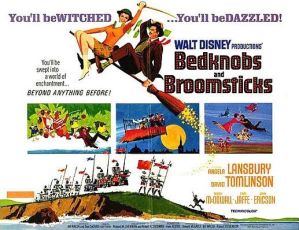 Disney attempted to replicate the success of Mary Poppins with this, another musical adaptation of a fantastical British novel set in Britain with British people in it — including some kids who, based on their accents, must be from the same part of London as Dick Van Dyke’s Bert. A childhood staple for others, it somehow passed me by ’til now.
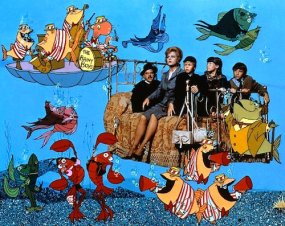 and one that’s mostly animated with our live-action heroes integrated; plus a climax where the good guys defeat one of the world’s great evils, with Poppins’ bankers here switched for the almost-as-bad Nazis. The magical special effects in that final sequence won an Oscar — and well deserved it was too. They look great, definitely holding up today, and it’s actually hard to be sure how they were all achieved.
 There seems to be a certain brand of animated film that I think looks dreadful so avoid, then I hear good things about, so I try it and find that, actually, they are really good. There was
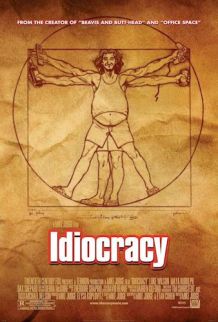 The creator of Beavis and Butthead imagines a future America in which, essentially, everyone has become his once-famous animated creations. I think — I never watched it. Basically, everyone’s a moron.
 It would seem there’s a market in Sweden for series of feature-length crime dramas that begin with a first episode released in cinemas before continuing in regular direct-to-DVD/TV instalments. It’s what happened with the Krister Henriksson
  The specifics of the plot see young university lecturer Puck (Tuva Novotny) invited to spend midsummer on the island home of her supervisor, who’s really asking on behalf of attractive history lecturer Eje (Linus Wahlgren), who Puck has been to a café with three times. A whole gaggle of old chums of Rutger and Eje are also there, including a couple of uninvited guests who arrive out of the blue — and before you know it, Puck finds one of them dead. Eje calls in his chum, detective Christer Wijk (Ola Rapace), and, after the island is cut off from the mainland in a more permanent fashion, the three set about getting to the bottom of things. Cue suspicious actions spied through trees, suspicious conversations partially overheard, suspicious evasion of perfectly reasonable questions, and all the usual suspiciousness you’d expect from a Christie narrative — only subtitled.
 Novotny makes for a likeable lead, though the attempted love triangle between her, Wahlgren and Rapace feels like a non-starter. The biggest surprise is Rapace: previously seen as troubled young copper Stefan Lindman in Wallander and, most famously, as shaven-headed silent assassin Patrice in
 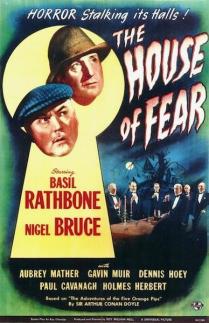 Adapted very loosely from the early Conan Doyle story The Five Orange Pips, this outing for Basil Rathbone’s Sherlock Holmes and Nigel Bruce’s Dr Watson sees them summoned to Scotland to investigate the suspicious deaths of the members of a club, where each killing is preceded by an ominous postal warning.
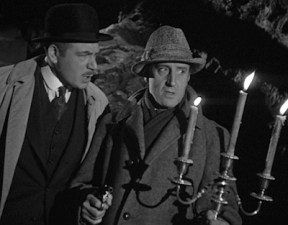 While the club having seven members does mean there’s a fair few suspects, it also means it takes a long time to get through them all being bumped off! It doesn’t sink so low as to be deemed repetitive, but does border it.
 The
The  #66
#66  #73 American Movie (1999)












 100Films.co.uk