
Elia Kazan | 103 mins | DVD | 1.33:1 | USA / English | PG
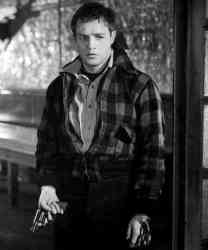
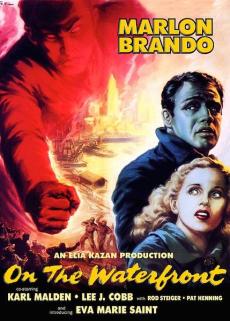 So much more than one famous scene, On the Waterfront is a movie about a magic jacket, which causes anyone who owns it to stand up for what’s morally right even in the face of oppression, but also to suffer badly when they do.
OK, that’s not what it’s about. But you keep your eyes on that jacket and, I tell you, it may as well be.
The story, based on a series of Pulitzer Prize-winning articles, is actually about corruption in the dock worker union of New Jersey, with Marlon Brando witnessing what happens to those who attempt to blow the whistle, but deciding to do so himself anyway. Rather than a hollow issue-driven morality play, it becomes a tense and engrossing character drama in the hands of director Elia Kazan, screenwriter Budd Schulberg, and a capable cast. The latter includes Karl Malden as an initially quiet priest who resolves to stand up and fight the system too, even if he can’t persuade many workers to do the same; Lee J. Cobb as the self-serving man at the top, bitterly clinging to power ’til the last; Rod Steiger as Brando’s brother, part of the corrupt union architecture, but driven to protect his family at the sharp end of the wedge; and Eva Marie Saint, making her screen debut as the potential love interest, whose brothers was murdered doing the right thing but nonetheless persuades Brando to do the same.
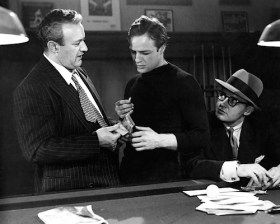 The only potential downside to this comes if you dig behind the scenes. Kazan was one of those who testified before the House Committee on Un-American Activities during its 1940s and ’50s witchhunt for Communists in Hollywood, naming eight men who were later blacklisted. If you consider the film to be Kazan’s answer to critics of his actions (as it “widely” is, according to Wikipedia), then presumably Brando is meant to be Kazan, calling out those who are doing ill to good hardworking Americans. But many a great film has been made with poor motive — just because Kazan thinks what Brando’s character does and what he did are the same thing doesn’t mean we have to. Even then, the issue of Kazan’s testimony is not so straightforward: a former Communist himself, he faced the end of his career if he didn’t testify, and the names he gave up were already known to the committee. The controversy dogged him for the rest of his career, though: when he received an honorary Oscar in 1999, several notable audience members refused to applaud.
 While subtext is undoubtedly a meaningful thing, and using one situation to comment on another is a tried and true way of presenting an argument or criticism, I’m not a proponent of offhandedly dismissing work(s) just because we don’t agree with the actions or beliefs of the person who made it. On the Waterfront is a powerful film, exemplarily made by skilled craftsmen. Whatever Kazan was trying to atone for with its message about standing up to bullies in defence of what’s right, the sentiment is true. And you don’t need a magic coat to do it either.

On the Waterfront is on TCM UK tomorrow at 10:45am.
It was viewed as part of my What Do You Mean You Haven’t Seen…? 12 for 2013 project, which you can read more about here.
 Like a
  The plot is essentially “
 with both this and last year’s sequel proving huge hits, and a
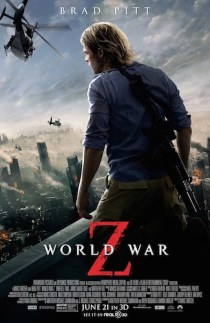 In the weeks leading up to its theatrical release, it was already known that World War Z was going to be an almighty flop. An unscrupulous movie studio had taken a cult novel and thrown away everything but the title, alienating its existing fanbase. They’d spent a fortune making a movie in a traditionally R-rated genre that, if released at R, could never make its money back, and if released at PG-13 would never attract an audience. Then they reshot the entire third act, pushing the budget through the roof and ensuring the resultant film would get critically mauled. A fanbase snubbed, an impossibly huge budget, a genre/rating disconnect, and unavoidably poor reviews to come — World War Z was going to flop, and it was going to flop hard.
 That, at least, is something different. The first half-hour races through stuff we’ve seen time and again: zombie attacks, humans turning on humans as they loot supermarkets, etc. Here the zombies are of the
  It’s a Wales populated by a Londoner, a Scotsman and a Spaniard, but still. I say “more tense” because this is far from the most nail-biting zombie film you could see. The finale is a nice change of pace, and does work as a climax in spite of the bombast that precedes it, but these are zombies as teen-friendly action movie menace, not adult scare-inducers, so don’t except to feel much fear or surprise.
 but I don’t think it was the filmmakers’ aim to make us feel the characters’ plight, but instead to show the scope of a worldwide disaster. It does that pretty well, even if the occasionally-CGI zombies prove to be an
 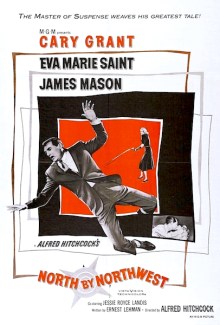 Alfred Hitchcock is famous for a good many movies — I wager most people would jump to
 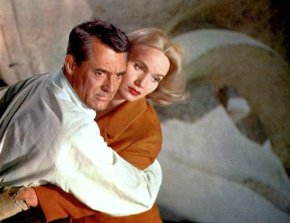 Grant is as wonderful as ever, a perfect ‘everyman’ to guide us through the crazy turns of events, but also finding the appropriate level of humorous edge where it exists. Eva Marie Saint is a textbook ‘Hitchcock Blonde’, attractive but duplicitous — women, eh? James Mason makes for an excellent English-accented villain — today it may be a terrible cliché to use Brits as villains in Hollywood movies, but we’re so damn good at it. That said, Martin Landau makes for a deliciously creepy henchman, so there’s no monopoly. There’s also Leo G. Carroll, who to me will always be best known from
 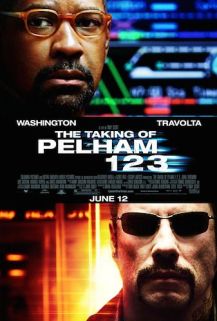 Based on a novel by Morton Freedgood (writing as John Godey), previously adapted into
  None of that here, where the captives are either even more unnoticeable, or heroic off-duty military types. So far so standard.
 Applied here to such a meat-and-potatoes tale, it feels like they’re trying to jazz it up because it can’t sustain itself otherwise.

 Braveheart
 Up
Up Amélie
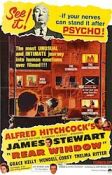 Rear Window
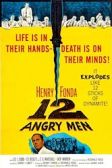 12 Angry Men
 Blue Velvet and Requiem for a Dream
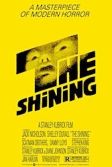 Not only was Kubrick’s acclaimed horror movie not nominated for any Oscars, it found itself in contention for two Razzies. Shelley Duvall was one of the ten Worst Actresses (Brooke Shields in The Blue Lagoon was deemed worst of all), while the sainted Stanley Kubrick was declared one of the year’s Worst Directors (he ‘lost’ to Robert Greenwald for Xanadu). And there you were thinking everyone always loved it.
 100Films.co.uk