
Kathryn Bigelow | 150 mins | streaming (HD) | 1.85:1 | USA / English & Arabic | 15 / R

2013 Academy Awards
5 nominations — 1 win
Nominated: Best Picture, Best Actress, Best Original Screenplay, Best Film Editing.
I was going to, in the run up to this year’s Oscars, post a series of reviews looking back at last year’s Best Picture nominees. Unfortunately the viewing for that didn’t really come off (February’s been dismal all round, as you’ll find out in a few days in the monthly update) — but I did manage one, and here it is:
 The writing and directing team from The Hurt Locker reunite for another perspective on the last decade-and-a-half-(almost)’s ‘War on Terror’. They set out to make a film about the CIA’s decade-long failed search for Osama bin Laden… and then he was found, immediately leading the film to be restructured as the story of the CIA’s decade-long successful search for Osama bin Laden.
The film focuses on Maya (Jessica Chastain), a fresh CIA agent in Pakistan who, in 2003, latches on to a piece of information about a messenger. No one else has much interested in this lead, but she pursues it for the next however-many years, most of the time getting nowhere — until eventually it results in something concrete…
Zero Dark Thirty feels like a dispassionate film, a characteristic that has debatable merits. The goal is clearly to present an objective, fact-driven account of how the CIA eventually found their most-wanted target, but how successfully it does that has been called in to question multiple times: there were those who felt it justified the use of torture, and those who claimed its facts were all wrong. On both these facts, any one viewer’s mileage might vary. I don’t think it defends torture, but nor does it condemn it — just as bad, in some people’s eyes. Do the agents in the film get information from torture? Some — but by no means all, and the quality of what little they did get is queried by other characters. I don’t think the film is pro-torture, but by trying to be objective and not really criticise the torture and torturers either, it doesn’t go in the direction some would wish it did.
 As for the veracity of the facts, I have no idea. Nothing seems implausible. And when condensing eight years of a manhunt into around two hours of screen time, of course some details will be lost, or truncated, or slightly modified to support the flow. I think those who allege the film is poppycock are accusing it of more than minor tweaks, but nonetheless, that’s inevitably part of the process. What’s perhaps most interesting is it hasn’t whitewashed the facts to make a film that feels like A Movie — this isn’t a relentless thriller-shaped eight-year chase, but a more methodical, occasionally messy, real-life-like quest for information.
For me, that worked. It takes a little time to get going, to settle down into its rhythm and to let us identify the important characters, but once it does that, it’s suitably gripping. Not in a nail-you-to-your-seat way like, say, a Bourne film, but in an ever-more-engrossing fashion. It can feel a bit like watching a drama-documentary, however, because there’s very little investment in the characters. There are maybe two or three brief scenes in the entire thing where we’re invited to identify with these people, or even consider them as people, with emotions beyond the methodical drive for information. Some people will hate that, but I don’t think Bigelow and screenwriter Mark Boal really want us to focus on the human toll of this almost-never-ending investigation, they just want us to follow what happened. The focus is on how it was done, not the people who did it.
 This carries through to the final half-hour (or so), which is a near-real-time rendition of the Navy SEAL mission to invade bin Laden’s compound in Pakistan. The unit assigned to the task turn up and get on with it — like the rest of the characters, they are no more than sketches. I read a review that asserted this is where the film’s focus should have been — on who these men were, what their home lives were like, on their training for the mission, and what effect it had on them after. All of which are valid points for a film, but that’s not what Zero Dark Thirty is trying to be.
When we see the mission executed, it feels like a well-researched and detailed recreation of what happened — who moved where and when, how the building was entered, who got shot, etc — rather than asking us to identify with what these characters are thinking or feeling. Nor does it really seek to elicit too much emotion from the audience — it’s not forcing events into a standard action sequence template, with split-second cutting and a thudding soundtrack; it’s not trying to create tension and excitement, or at least no more than is inherent in the real events. I think Bigelow is borderline documentarian in her aims throughout the film, here as much as anywhere else. Clearly some people find that cold, or at least it leaves them cold, but I think it works. Would it be a better film if it came loaded with a greater exploration of the characters as people, or with a depiction of the events in more regular Thriller terms? I’ll let you know when someone makes that film.
 The one other criticism I do agree with is that we don’t see enough of the SEALs’ preparation. They built a full-scale replica of the compound and trained on it — was that not worth putting on screen? I know this is the story of Maya and her investigation, not the SEALs and their assault, but I think a bit of time could have been spent on that fascinating aspect of the raid. On the bright side, there’s a sequence where our characters collect their still-in-development super-top-secret stealth helicopters from Area 51. Yes, really. I guess that must be true, because without the reality-claim of the previous two hours it would come across as Independence Day-level sci-fi!
I imagine debates about the moral stance and veracity of its facts will continue to dog Zero Dark Thirty, as well as the question of whether its too emotionless. For me it nonetheless made for an effectively modern and realistic take on the spy thriller.

In the UK, coverage of the 86th Annual Academy Awards is on Sky Movies Oscars from 11:30pm on Sunday 2nd March 2014.

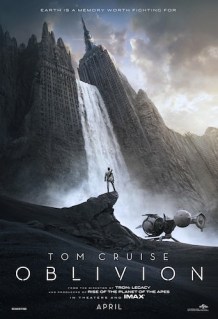 As Oblivion informs us in a hefty chunk of voiceover exposition at the start, the year is 2077, several decades on from a war with aliens that we won but left the Earth in ruins. Humanity fled to a colony on Titan, but the last party to depart remain in orbit aboard a giant space station. Waiting to join them are Tom Cruise and Andrea Riseborough, the last humans on Earth, serving the final few weeks of their mission to watch over the drones that guard giant water-collecting machines, sucking up the oceans for the benefit of the new colony.
 Also, as with many a tale desperate to surprise its audience thus, there are holes in the story and its logic (for a good summary of some of the major sticking points, check out
  I like a good action sequence, and some of the ones Kosinski presents have their moments, but I also found I could have done without most of them. To a degree they seemed to have been slotted in so it could look like an Action Movie in the trailers, the aim (as ever) being to pull in the punters, thereby justifying the budget needed to create such a slick SF world.
 With the aforementioned plot issues, not to mention an ending that some will find too twee (I saw the broad strokes of the epilogue coming from quite a way out, so can’t say I was surprised), Oblivion is not quite all it could have been. But it gets considerably closer than I expected — it’s undoubtedly an A for effort — and that, bolstered by faultless technical aspects, makes for an all-round enjoyable experience.
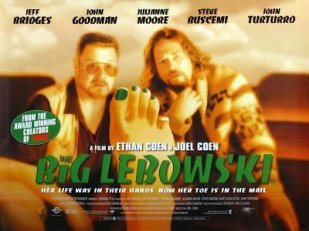 I confess, I’ve never really got on with the Coen brothers. I liked
  I don’t wholly agree, though I didn’t unabashedly love the film as some do. It’s perhaps a bit “of its time” now, and getting a little “you had to be there”; coming to it almost two decades later, it exemplifies a ’90s American mainstream/independent-borderline filmmaking sensibility; the kind of bracket the early works of Tarantino might also fall into, for instance.
 If one did want to look into Lebowski more deeply, the most interesting facet is that noir one. It’s quite lightly of that genre — very much an updating and re-appropriation of certain tropes, rather than a straight-up example of where the modern version(s) of the genre is (are… or were). It feels like the Coens were consciously putting a present-day(-then) character through the paces of a traditional noir plot. Whether that was the deliberate structural conceit or just a side effect of making a noir pastiche, I couldn’t say.
 January’s films
 “Cruise. Spielberg.” So read the poster and/or trailer for this ’00s-set reimagining of H.G. Wells’ classic novel of alien invasion and domination. Despite the updating, and the sickeningly twee ending, it’s actually a damn good film. Post-9/11, US films were more positive than ever about how all Americans would band together in a crisis. Not so here.


 100Films.co.uk