2013 #1
Mårlind & Stein | 89 mins | Blu-ray | 2.35:1 | USA / English | 18 / R
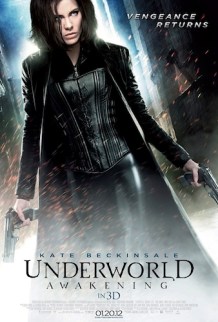 Just when you think the Underworld series is dead, it suddenly lurches back to life with a new instalment. Fitting for a series all about vampires & that, I suppose.
Having diverted to a prequel telling us a story we largely already knew, here we rejoin Selene (Kate Beckinsale), last seen six years ago (real world time) in Underworld Evolution, which was very much Part 2 to the original film’s Part 1. They told a pretty complete tale, actually, so rather than try to find something there, Awakening launches into something new. Following a two minute recap of the first two movies (it’s so long ago that this is actually very handy), a quick-cut prologue-y bit tells us that the long-secret war between vampires and Lycans (aka werewolves) was discovered by humans, who set about wiping them out. Trying to escape, Selene’s crossbreed lover Michael (Scott Speedman) is killed and she gets frozen… only to wake up however-many-years later into a changed world… And so on and so forth. Escapes, shooting, action-y-business all ensues.
Said violence is very bloody and brutal, much more like the second film — I swear the first (especially) and third weren’t anything like as gory. Evolution well earnt its 18 certificate, after a very 15 first film, and quite surprised me at the time. This isn’t as extreme as that, but still. The main drama and attraction in the Underworld series lies in the vampires-vs-werewolves-with-modern-tech concept, not in ripping off limbs or spurting blood or whatever. Or maybe that’s just me.
 By taking such a bold move with the plot, meanwhile, the story pushes the series’ mythology in new and relatively interesting ways. It’s becoming a bit dense and fan-only (unless you let it wash over you and just enjoy the punching), but at least they’re not regurgitating the same old stuff. It manages a few twists along the way too, which is always nice. The plot seems to have been half worked around Speedman’s non-involvement, leading me to wonder why — he’s not too busy, surely? Perhaps he’d just had enough? But no, apparently it was genuinely just written this way. I guess he couldn’t be bothered to turn up for some cameo shots, because the stand-in is really obvious.
Also glaringly obvious is the set-up for a sequel. Not so much as the first film, which had such an End of Part One feel (including a direct cliffhanger) that the sequel picked up mere hours later. But this is still a story obviously incomplete (again, there’s a sort of cliffhanger), but at least it has the courtesy to… actually, no, it’s only as complete as the first film. The main narrative drive is resolved, but other bits are blatantly open.
But it didn’t seem to go down too well, so what are the chances of us seeing it continued? Well, as we’ve learnt, you can never write the Underworld series off. And its niche fanbase, semi-independent production, and relatively long three-year gap between sequels  means the next one will probably turn up out of the blue with little hype, much as Awakening did last year. Plus, though this is the most expensive film to date (double the budget of the preceding one!), it’s also the most financially successful: $160.1 million worldwide, beating number two’s $111.3 million. Assuming Beckinsale still feels up for it, I imagine 2015 will bring us a continuation — and, hopefully, a conclusion.
The higher budget and higher gross I mentioned are surely both down to one thing: 3D. Shooting in proper 3D (as opposed to the ever-so-popular post-conversion) costs a fortune, as a producer reveals in the BD’s bonus features, but it can also net you more money at the box office thanks to that 3D premium. Such a gamble hasn’t paid off for everyone (Dredd), but it clearly did here (how the hell did Underworld 4 make four-and-a-half times as much money as Dredd?!) Watching in 2D, it’s clear that some sequences were designed with 3D in mind — not in the way that, say, Saw 3D or The Final Destination sometimes only make sense with added depth, but in ways where 3D would (I imagine) enhance the visuals. There are some instances of stuff flying at the camera, a popular sticking point for the anti-3D crowd, but that’s actually been part and parcel of Underworld’s style since the start (just watch a trailer for the first film — there was a shot of it used prominently in most of the marketing).
 Also worthy of commendation: new-style ‘evolved’ Lycans; a small role for Charles Dance (always worth seeing); the evocative near-future setting; good quality action sequences; some nice steel-blue cinematography/grading. Some of it was shot at 120fps on brand-new pre-alpha never-used RED cameras — take that Peter Jackson, eh. Plus it’s only a little over 1 hour and 18 minutes long without credits. Some would bemoan such brevity, but it has its positives.
I’ve always quite liked the Underworld series, even if the first one is still clearly the best. Awakening gets most kudos for taking things in a new direction, even if, as a film in itself, it’s only OK.

 The first film I watched as part of my new-this-year What Do You Mean You Haven’t Seen…? initiative is also the oldest, a silent movie (with a synchronised music & effects soundtrack) starring, written and directed by Charlie Chaplin.
 Much of the film’s emotional impact comes courtesy of Cherrill, who gives a suitably pretty and sweet performance. Chaplin wasn’t impressed with her as an actress and attempted re-casting (the film has a remarkably fraught production history), but I think it’s beneficial that never worked out. It’s always possible another actress could have been just as good, of course, but I can’t imagine any playing this role better.
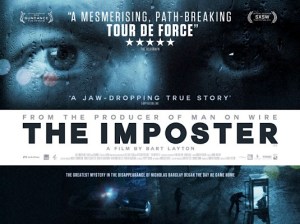 Some films benefit from knowing as little as possible going in; some are at their best when you know nothing at all. But that’s pretty much impossible — unless you go purely on someone’s “you’ll like this, trust me” recommendation about a film you’ve never even heard of, you’ll be aware of something. Normally this comes from a review or blurb, and you just have to trust that the reviewer or copywriter was kind enough to keep it spoiler-free.
 So here’s what the film lets you in on in the opening moments: in 1993, 13-year-old Nicholas Barclay went missing in Texas. In 1997, a boy claiming to be him surfaced… in Spain. He had Nicholas’ tattoos, but he had a French accent and the wrong colour eyes. And yet the first relative to see him, Nicholas’ older sister, gave a positive ID, and upon returning to America he was accepted into the family. Why did they take in such an obvious fraud?
 but, nonetheless, it makes the documentary itself feel untrustworthy, just like its participants. Is that an intended effect? Arguably the film’s main theme is lies — the lies we tell ourselves, the truths we want to believe; confirmation bias, perhaps, though that term is never mentioned — but the documentary itself never lies to us… I don’t think. It just feels like it might be.
 as the poster prominently tells us, this is “from the producer of
 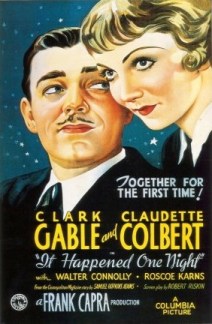 It Happened One Night was the first film to win the Oscar “grand slam” (Best Picture, Actor, Actress, Director, Screenplay), and is still one of the few to have won everything it was nominated for (alongside
 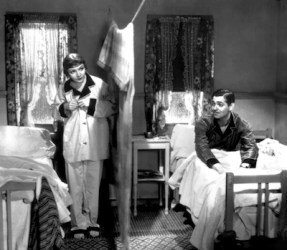 The Walls of Jericho running motif is also nicely executed, leading to perhaps the sauciest final scene not to feature a single shot of human beings that I can think of.
 Like ponderous arthouse fare, but also action-thrillers? Disappointed that these two passions must always be sated independently? Well recent retiree (we’ll see how long that lasts) Steven Soderbergh has come to your rescue.
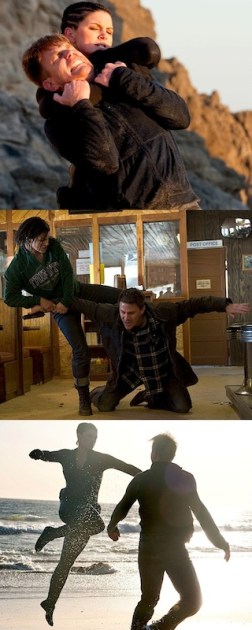 But then the lead isn’t even an actress, but former MMA fighter Gina Carano, presumably cast because she can fight rather than for her acting ability. That’s not a criticism, however — she may not be on a footing to contest an Oscar any time soon, but Carano is more than fine to be an action movie lead. Her undoubted combat skills, meanwhile, lend the fights a bone-crunching realism that is likely to be welcomed by many. They’re very much a showcase for her ability too, because any sense of an equally-matched duel is hampered by pitting her against men who are actually just actors.
 That said, the latter withstood Paul Greengrass’ shakey-cam and jumpy cutting on
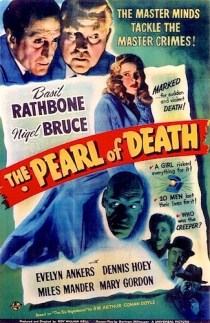 The Pearl of Death is one of the better-regarded films of the Basil Rathbone Sherlock Holmes canon, but somehow it didn’t quite click for me. That doesn’t meant there isn’t a lot to enjoy, however.
 Elsewhere, Nigel Bruce gets to indulge in a slapsticky scene that, as ever, people who dislike this interpretation of Watson would be happy to do without. Also worth noting is the female lead, British actress Evelyn Ankers: she was a regular fixture of Universal’s horror features, terrorised in no less than
 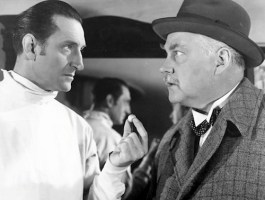 Neill somehow managed to pick one of the least dramatic. Neither of these reveal fudges are ruinous, of course, and are outweighed by the handling of sequences like Holmes setting off the museum’s alarm, the ensuing robbery, the villains stalking round a potential victim’s house, and so on. Still, I was surprised to find them so wanting.
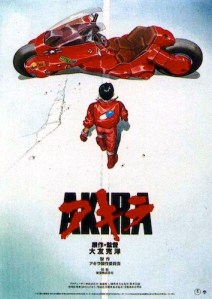 For many Westerners of a certain generation, Akira was their first (conscious) exposure to anime. Not so me: a step or two down,
 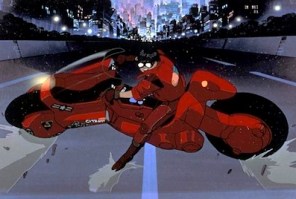 The visuals remain something to be savoured; they’re probably the film’s strongest point, in my opinion. Akira was an expensive production and it pays off on screen. It’s not just the bike chases that I appreciated either, while an extra decade of experience made the ending a bit less freakish! The other strong point is the audio. The BD’s booklet goes on about “hypersonic” sound. I’ve no idea if that worked on my system, but it sounded fantastic regardless.
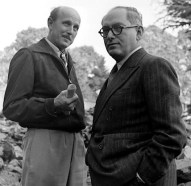
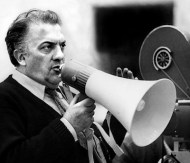 Winner of the highest number of Oscars for Best Foreign Language Film (five), the Italian writer-director is “one of the most influential filmmakers of the 20th century”. He’s the only member of TSPDT’s Top 250’s top 10 (at #4) that I’ve not seen anything by. Significant gaps in my viewing include
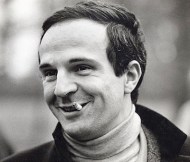 One of the founders of the French Nouvelle Vague (alongside the likes of Jean-Luc Godard, who I have seen films by), Truffaut is still probably best known for his first film,
  Though only at #52 on TSPDT’s Top 250 (there are 11 above him I’ve not mentioned), there’s no denying the notoriety of Herzog, the man who once got shot while being interviewed by Mark Kermode, amongst other bizarre anecdotes. Key works include
 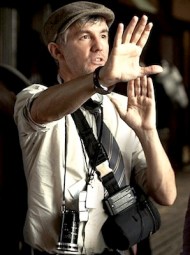 The theatrically-inclined Australian scores just 3 on TSPDT’s ranking, their lowest awarded mark. Only five others suffer this ignominy, and the only one I’ve heard of is Ed Wood. According to TSPDT, none of Luhrmann’s films are Highly Recommended, Recommended, or even Worth a Look. The best he can hope for is
  100Films.co.uk