
Luc Besson | 107 mins | Blu-ray | 2.35:1 | France / French | 12
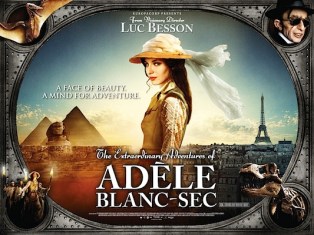 Based on the long-running bande dessinée (aka “comics”) by Jacques Tardi, The Extraordinary Adventures of Adèle Blanc-Sec is occasionally sold to English audiences with a handy quote from Empire: “Amélie meets Indiana Jones”. I’ve never seen Amélie (though, funnily enough, I ordered the Blu-ray in a sale last week), but I still think that’s a pretty fair summing up.
Adapted from two of Tardi’s tales (the first and fourth, fact-fans), Adèle Blanc-Sec is set in 1912 Paris, and concerns the titular adventuress’ quest to resurrect an Egyptian mummy who may be capable of healing her sister, while also having to deal with an escaped pterodactyl. Pretty instantly you can see this isn’t what we Brits typically think of as A French Film… that said, the often farcical tone allies itself with another preconception about the French, so that’s OK.
Indeed, this lightness — fairer to say silliness — might alienate some viewers hoping for more Indiana Jones and less Amélie. There’s a sequence in Egypt that’s very much in the Indy mould, and much of the stuff with the pterodactyl too, but it’s always underscored and surrounded with humour. Caricatures and exaggerations abound.  And if that doesn’t put you off, the introduction-heavy opening minutes might, dense with introductions for disconnected characters and locations. Stick with it, it sorts itself out.
The film finds itself with a 12 certificate in the UK, and that age might be the perfect target audience. There’s dinosaurs and mummies, car chases and fireballs, derring do brushing up against irreverent humour, and even some boobies. Hurrah for the Frenchies’ casual attitude to nudity — its appearance here is in every possible way gratuitous, and yet with a snippet of plot information that means you couldn’t snip it out without creating an obvious jump. It’s only these fleeting nipples that prompt the film to be higher than a simple PG (the BBFC’s explanation is here), though there’s a mildly harsh edge to some of the action too. Should a man being guillotined be funny? Well, it is here.
Star Louise Bourgoin is/was a model, which you can believe from her looks but wouldn’t know from her performance. Her Adèle is quick-witted and funny, terse but likeable, and she’s prepared to don all sorts of daft and occasionally unflattering disguises in service of both story and laughs. An able supporting cast includes Bond villain Mathieu Amalric, unrecognisable under heavy prosthetics, who is unfortunately underused. Some reports say this was planned as a trilogy (whether the sequels are still in the works, I know not), so perhaps he was being established for that purpose.
 Director Luc Besson managed to build up something of a following with a regular output of films through the ’80s and ’90s, perhaps culminating artistically with the exceptional Leon, which he followed with US-styled (but French-produced) sci-fi epic The Fifth Element and an ill-received re-telling of the story of Joan of Arc. For much of the ’00s he moved further behind the scenes, writing and producing a flurry of mainstream-flavoured Euro-produced crossover hits — film series such as District 13, Taken, Taxi, The Transporter, and more can all be attributed to him. Adèle Blanc-Sec isn’t his first time back in the director’s chair since the ’90s, but while there’s nothing wrong with its production, nothing suggests Besson in particular needed to be calling the shots either. Maybe someone more intimately familiar with his previous work would see something I didn’t, but though it’s all competently handled, there’s nothing to remind you this is a man who once helmed some truly great films.
The music is by Éric Serra, who murdered the score for GoldenEye with some electronic modern rubbish instead of the classic John Barry-inspired style David Arnold brought for Tomorrow Never Dies through Quantum of Solace (and, one hopes, he’ll bring to Bond 24, after Thomas Newman’s bland and self-copying effort on Skyfall). Serra has clearly spent the intervening 15 years learning how to copy, however, as there’s a distinct John Williams flavour to the music. I’m not objecting — this is an Indiana Jones-esque tale and Indiana Jones-esque music fits like a glove.
 I suppose Adèle Blanc-Sec won’t be to everyone’s tastes. Comparisons to the Stephen Sommers Mummy have been made, but its tone is sillier still than that and not everyone approved then. That’s before we get on to its occasionally scrappy nature, including a slightly overlong third act. But that’s piffle I say, because in the right frame of mind it’s all rollicking good fun. I sincerely hope those mooted sequels happen.

The UK TV premiere of The Extraordinary Adventures of Adèle Blanc-Sec is on Film4 and Film4 HD tomorrow, Friday 1st February, at 9pm.
It placed 10th on my list of The Ten Best Films I Saw For the First Time in 2013, which can be read in full here.
 The two-part animated adaptation of Frank Miller’s comic, regularly voted among the top three stories ever told in the medium, concludes here. If you’ve not seen
 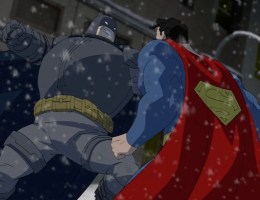 Nonetheless, a pair of big battles form the cruxes around which the story works: Batman vs the Joker, and Batman vs Superman. I won’t spoil the outcomes for those who’ve not read the book, but both are excellently realised on screen. Action can be tricky in comics — you’re stuck with a series of still images to convey fast-paced, often intricate movement. I also generally have the impression that action sequences are not 2D animation’s forte — too many frames need to be drawn, too many different angles to make it quick and exciting enough. The Dark Knight Returns is one of the exceptions, however, and the two big sequences in Part II — as well as a couple of smaller ones — outclass anything in Part I, which was good in the first place. I’d go so far as to say the Superman fight improves on the novel’s version, at least in a visceral sense — Miller delivers Batman’s internal monologue and a certain pleasing disregard of Supes, while Oliva wisely skips any kind of voice over and delivers the entire duel blow for blow. It’s a fantastic climax.
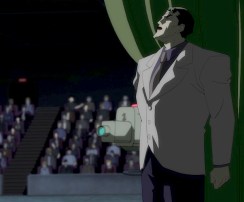 The story may provide some déjà vu for those only acquainted with live-action Batman, because Christopher Nolan borrowed liberally from Miller’s TDKR for his TDKR,
  There were many sceptics when DC first announced they were going to tackle such a sacred Bat-story, and not all were convinced by Part I. I don’t imagine Part II will change their minds, but for those of us who did enjoy the first animated interpretation of Miller’s seminal tale, this is even better. In fact, even without its first half, I’d say it joins the ranks of my very favourite Bat-films.
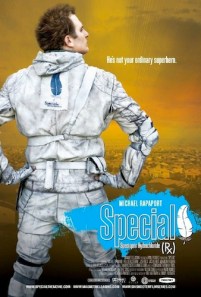 A lot of praise was slung
 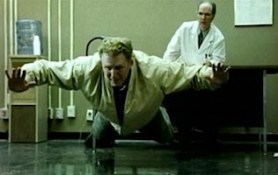 Those after a more genre-aware “real world superhero” movie would do better to stick with Kick-Ass or Super, but those who might embrace something a little different — especially something with an indie sensibility — would do well to take a look. Indeed, being a comic fan is certainly not a prerequisite for enjoyment here.
 From the makers of the successful Christmas TV shorts
 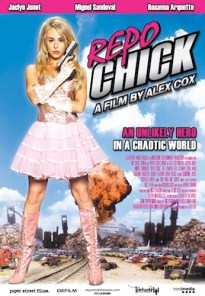 Alex Cox’s belated non-sequel (despite the title, there are apparently no links besides some cast members) to cult favourite (and
  True, the other characters are mostly dim and unlikeable, but is that a problem? We don’t need a film full of characters we like (otherwise we’d never have villains) — do we need there to be any? Or is the problem not that we don’t like them, but that their dimwittedness makes them too-easy targets for humour? I suppose it’s easier to just hate the film than grapple with such questions.
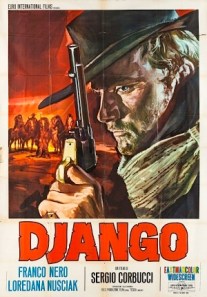 The ’60s were a pretty exciting time for cinema. In France, the Nouvelle Vague were tearing up the rulebook and pushing forward their own techniques; in Britain, the James Bond series was ditching kitchen sink drama in favour of reinventing the action movie, turning itself into a global phenomenon in the process; and in Italy (and Spain) they were pulling a similar trick on that most American of genres, the Western.
 Much of the film plays as an action movie. There’s a lot of atmospheric ponderousness at the start, but once things kick off they rarely let up. In just over 90 minutes the film rattles through a damsel-in-distress rescue; a blink-and-you’ll-miss-it shoot-out; a 40-on-1 massacre; a raid on a fort; a barroom brawl (one of the stand-outs, that — anyone who thinks handheld ShakeyCam fights are a modern invention should take a look); a tense, silent escape; a brutal punishment (or two); a valley ambush; and a graveyard stand-off. I think that’s all, but I may have missed some. It’s practically a definition of bang for your buck, which I’m sure goes a long way to explaining its popularity.
 but it’s like watching something on a not-quite-correctly-tuned analogue TV; like you’ve found the channel, but you’re one or two points off the optimum frequency. Or, to put it another way, it’s really snowy. As I said, I’m no expert in BD quality, but this looks like it needs a sympathetic dose of DNR. No one but fools want a
  Moonfleet is probably what you’d call a curio. It’s a colour CinemaScope Hollywood adventure movie from a director best known for epic German silents or dark film noirs; it’s not been passed by the BBFC since its original release in the ’50s, meaning it’s never been released here on DVD or (presumably) even VHS; I believe it’s also unavailable in the US; yet despite this dearth of attention in both the country that made it and the country in which it’s set, a
 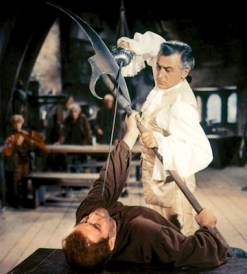 fights and chases of various kinds, a dramatic shoot-out on a beach, midnight escapes, and so on.
 Unveiled at San Diego ComicCon and then released
  The one glaring flaw (unless you hate realistic CGI-aided bloody violence, in which case there’s that too) is its use of music from Hans Zimmer’s
  Samuel L. Jackson and Tommy Lee Jones star in this military courtroom thriller from the director of
  That’s not all that’s bungled. There’s numerous instances of awkward editing by Augie Hess; a screenplay from Stephen Gaghan that clearly wants to be
 100Films.co.uk