2012 #10
Gore Verbinski | 112 mins | Blu-ray | 2.40:1 | USA / English | PG
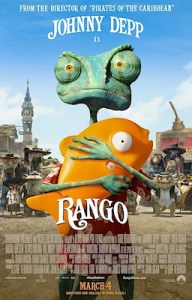 There seem to be an increasing number of live-action directors sticking their oar into animated films; and not just lending their ideas and name, as Tim Burton did with Nightmare Before Christmas, but properly directing them. Robert Zemeckis’ mo-cap obsession has given us that Christmas one, that other Christmas one, and Beowulf; Tim Burton supervised the stop-motion himself in Corpse Bride; then there’s Zack Snyder (Legend of the Guardians*), Steven Spielberg (Tintin), Peter Jackson (Tintin 2), and, here, first-three-Pirates helmer Gore Verbinski.
Perhaps this is because the increasing prevalence of CGI in big-budget movies (which all of these directors have also been responsible for) means the transition to 100% animation is easier — indeed, as I’ve said before, Avatar is classed as live-action but is basically a motion-captured animated film with a few live-action bits. This theory has added weight when you look behind the scenes at Rango: rather than teaming up with an established animation producer like Pixar or Dreamworks, Verbinski assembled his own team of pre-production creatives, wrote and designed the entire film independently for 16 months, then took it to ILM — who had never done an animated movie before — to do the heavy lifting. (The story of how the film was made is pretty much as interesting as the film itself, with Verbinski and ILM bringing their live-action-honed methods and sensibilities to bear on the production of a fully computer animated (not mo-capped) film. I heartily recommend the two documentaries on the Blu-ray. If you’re interested but don’t have the BD, you could do worse than read this article.)
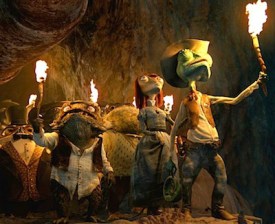 Indeed, perhaps the most striking thing about Rango is ILM’s hallmark, the extraordinary realism. Though some of the characters are rendered cartoonishly (just look at Rango’s face) and all are of course anthropomorphised, the textures and lighting are as true-to-life as any of their work in live-action movies. They consciously went for a photographic look, as if it had been shot with real cameras, including consultation with Oscar-winning cinematographer Roger Deakins, and it paid off because the whole thing looks incredible. I know I only just recommended it in the last paragraph, but the making-ofs are really great for an insight into why the film looks and feels so different to most current computer-animated films. The sequences of them recording performance reference are incredible — they essentially shot some scenes in full, with the entire cast, in costume, with full props, some sets, blocking, marks, camera angles, improvisation… (The only thing lacking on the Blu-ray is a Sin City-style full-length version of the movie using that footage.) Even though it’s not mo-capped (Depp refers to their performance-reference recordings as “emotion capture”), they used a mo-cap studio with virtual sets so Verbinski could find angles and so on — all the tools he’d have on a live-action set.
Is it cheating to make an animated film this way? Some people object to motion-capture; is this as bad, or worse? Some will say so; personally, I don’t care — it’s the final product that matters, not how you got there. Though how you got there can make for a damn fine story. (Watch the making-ofs.)
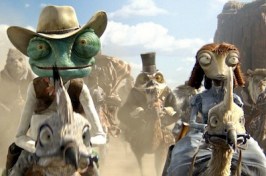 Back to the film itself. I know it’s less interesting, and it is far too slow at the start, but when it eventually gets underway it becomes very entertaining. Somewhere in the middle there’s a five-minute wagon/bat chase that’s a properly exciting action sequence, excellently realised. It was so good I watched it again immediately afterwards. It’s got a clever use of Wagner too, as well as some regular Hans Zimmer action scoring. Zimmer’s score throughout is top quality, referencing Morricone and all the other staples of Westerns.
There’s the quite dark, twisted, alternative designs for characters and locations — not too much (it’s still kid-friendly), but it’s different to what Disney, Pixar and Dreamworks are doing (after early attempts at realism, they seem to be really amping up the cartoonishness now). The cast are great, though there’s much fun to be had spotting voices: some are obvious (Depp, Ray Winstone), others not so much (Isla Fisher, Alfred Molina; Bill Nighy!). There’s a good John Huston impression by Ned Beatty, and Timothy Olyphant’s Clint is so spot on I checked it wasn’t actually him.
For the cinephile viewer, Rango plays as one big homage. The obvious is its deployment of all the cliches and tropes of a Western, including a relatively subtle nod to The Man With No Name (the lead character identifies himself as Rango, but his real name? We never learn). I’ve seen some commentators berate it for this, but it’s clearly paying tribute to the genre, not being a shameful attempt at it.  The plot, however, is clearly borrowed from Chinatown, but it plays out differently and there’s a clear acknowledgement of the similarities in its portrayal of the Mayor. Again, it’s homage, not rip-off. It does enough under it’s own steam on both fronts to avoid accusations of plagiarism, in my opinion.
On the down side, some of the ‘humour’ is a bit too mucky for my taste. The number of toilet-related gags goes way beyond necessary, and it’s slightly depressing that at least as many are aimed at adults as children. This is where a lot of the extended cut’s four-and-a-half-minutes comes in, incidentally, as this comparison shows. In their opinion, while the extended version’s jokes are still PG-level, they may have been cut to make sure it was absolutely family-friendly. (If you have access to the Blu-ray and want to see the added material without trying to spot it in the film itself, try the deleted scenes section — pretty sure that’s just the stuff from the extended cut.) Aside from muck, there’s an extended ending, though I’m not sure what I think of it. There’s a bit about a final sunset shot which is quite good, but I like the theatrical ending’s mirroring of the opening with the mariachi birds. All things considered, the coda was probably a wise excision in cinemas.
 With its detailed references to other films and real-world visual aesthetic, Rango may be more likely to find appreciation among grown-ups than the children who are the typical target for English-language feature animation. Then again, there’s that immature humour I mentioned. A ‘family’ film indeed. Either way, it’s an entertaining addition to — and alternative from — American animation’s usual offerings.
* which has nothing to do with Rise of the Guardians, even though that crazed mash-up looks like a Snyder film. ^


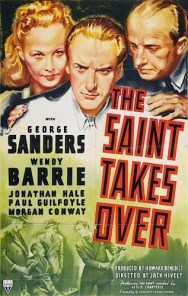
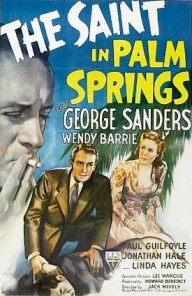 George Sanders is the Saint for the final time in a film that isn’t the series’ best, nor its worst. It also marks the final appearance by Jonathan Hale as Inspector Fernack, and third-and-final turns from both Wendy Barrie and Paul Guilfoyle. For those keeping track (or not), that’s the same four leads as the last picture! Same director too, as Jack Hively helms his third (and, of course, final) Saint adventure.
 Hale isn’t in it nearly enough unfortunately, especially considering this is his last outing. Guilfoyle has the sidekick role and at least his and Sanders’ relationship is a fun substitute. Barrie is, for once, simply the ingénue and not some form of criminal mastermind. Don’t worry, there’s another girl for that: Linda Hayes, who seems a promising match for the Saint but, though prominent early on, is ultimately disregarded. The highlight for both women comes when they get invited along for a horse ride with the Saint and have a good bitch at each other. It’s a pickle quite unlike the ones Templar usually finds himself in! I have nothing against Barrie, but quite why they sought to use her repeatedly I don’t know. And, to be frank, she worked best in
 The first RKO Saint film to not be based on a story by the Saint’s creator, Leslie Charteris, is actually one of the better mysteries in the franchise. Sort of. The downside would be that the solution is glaringly obvious. For a mystery you might imagine that would be a major problem, but the process of investigating is nicely done. A bit more work might’ve been done to obscure the culprit, a character who we meet at the beginning and then more or less disappears and so will inevitably return somehow, but I had so much fun I don’t really care.
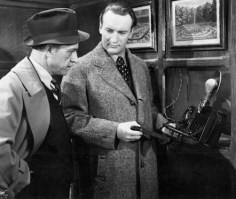 One of the highlights of
 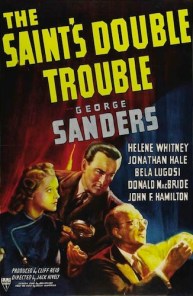 After two fun adventures, here RKO’s series turns in my least favourite film to star George Sanders as the Saint.
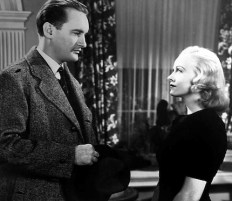 Helene Whitney is fine in this role, but her character’s not a patch on

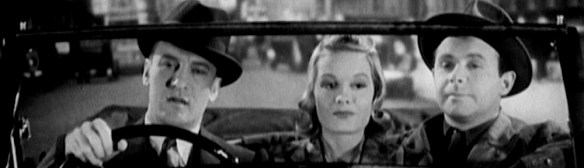
 The third film in RKO’s Saint series is a bit of a mixed bag, from my point of view.
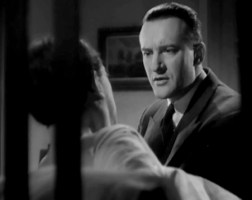 I bring up Bond again because this is perhaps the most proto-Bond of all the Saint films. Within the first few minutes we have a tuxedoed Saint introduce himself as “Templar, Simon Templar”, enter a fancy restaurant where he drinks a martini, and expertly orders a swish meal and the appropriate wine to go with it. Later, villain Bruno Lang (because yes, he is relevant in the end) is a somewhat Bondian villain, a powerful man with a grand plan who thinks he’s smarter than our hero. Which he isn’t, of course. Perhaps there was an abundance of these kind of heroes in the middle decades of the twentieth century, but as Bond is the only one that’s endured while retaining the same iconography, these similarities are striking.
 Best of all is Sally Gray as Penny Parker, a charming girl Templar bumps into — as he’s wont to do — who forcibly strings along for the ride. Every film in the series contains a pretty young thing who falls for the Saint, and who he seems to fall for back before casually disregarding at the end — at least Bond faded to black, leaving the inevitable parting off-screen, whereas Templar is almost callous-with-a-smile. Of all the girls the series offers, though, plucky Penny is the one you’d wish had stuck around. Even with that silly hat.
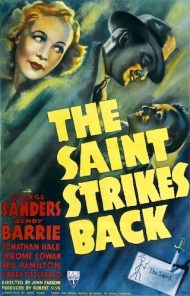 The first film to star the Roger Moore-ish George Sanders as Simon Templar, aka the titular Saint, is also one of the RKO series’ better entries.
 Nonetheless, it’s mostly a fun romp. Sanders’ portrayal of Templar is witty and enjoyably knowing, even more so than Louis Hayward in the previous film. He’s at once more laid-back and less self-certain; by which I mean you can sometimes see him working out his devilishly clever plans as he goes along, rather than floating through with invulnerability. This Saint is the kind of man who’ll bluff that a criminal’s house is surrounded by police so that he can escape, but then can’t resist phoning back to have a little gloat about how his bluff worked. Lighter, jokier — if Hayward was Sean Connery, Sanders is (as noted) Roger Moore. Though I’ve never seen
 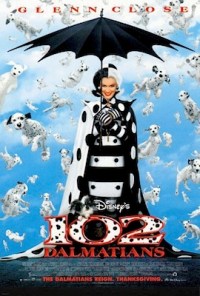 I imagine the live-action re-working of
 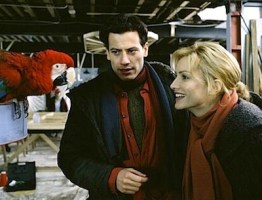 And aside from a race around the streets, ‘Paris’ is mostly a studio set anyway. Obviously they couldn’t keep Cruella in Nice Mode for the entire running time, but there’s call for a bit more originality in what happens after she goes bad.
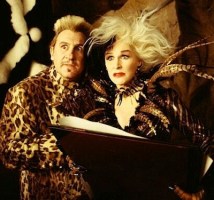 Plus there’s an awful lot of cute dogs. Always a bright side. And it’s a great answer for “name an Oscar-nominated film” trivia questions (it garnered one for, appropriately, costume design).
 Pixar have always attached original short films to their feature releases. As part of what seems to be their increasing franchisation, however, they’re not always wholly original now: Hawaiian Vacation was the short attached to
  Hawaiian Vacation doesn’t exactly allay these fears — its very existence is proof of that — but at least it’s an entertaining piece in its own right. It succeeds partly by not overreaching itself — this isn’t Toy Story 4 and it doesn’t try to be. It reminds us of the characters and gives them each a story beat, while remaining funny, entertaining and sweet, all in under six minutes. Cars 2 can’t manage that in 106.
 100Films.co.uk