
By the end of September 2010 I’d made it to my goal of 100 films.
This year?
Of course I haven’t. I ended last month on 77 — even at my best, 23 films in a month is madness. (Actually, I did manage it once: August 2007, when I watched between 24 and 29 films. (I wish I’d kept more thorough records of exactly when I watched things back then.) But my next highest is 18, and next 17, so…)
In January’s summary I noted that, if I could keep my viewing rate the same, I’d reach 100 in early September (and 144 by the end of the year). In May things were clearly going to that plan, as I passed #50 and noted that I should reach #100 on September 9th (and 145 by the end of the year). As you can see, that rate didn’t continue.
But hey-ho, the first part of the year always seems to go better than the back bit, and I’m not behind my schedule to reach exactly 100 by the end of the year — indeed, even if I hadn’t watched a single new film this month I’d still be three ahead. But I watched four, so that’s… well, it’s better than nothing, eh…
#78 Bringing Up Baby (1938)
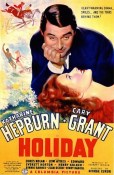
#79 Holiday (1938)
#80 How to Train Your Dragon (2010)
#81 Prince of Persia: The Sands of Time (2010)
Attentive readers may note that I’ve made some changes to the ‘info line’ that starts each of my reviews. I’ve been pondering this for a while now and have finally just taken the plunge. Any suggestions for additions (or removals) from the new set of info are welcome. Changes thus far are as follows:
- I’ve lost the year. It’s in the post title; there was never any need for it to be repeated. Never.
- Added the aspect ratio. This one probably won’t always be available or precise, but I’ll have a go. For DVDs and Blu-rays it’s copied from the packaging (unless that’s obviously wrong), for formats where I don’t have such ‘precise’ information it’ll be my best guess from the standard sizes.
- Added the country-of-production and primary language of the film. I don’t want these to be epic lists of funders and every language spoken on screen, so I intend to limit this to the main country/ies and one language, as far as I possibly can. So, for example, the language for Inglourious Basterds would be “English”, even though a tonne of (subtitled) French and German is spoken throughout. Probably. I may end up changing my mind on this one…
Other than that it’s all stuff that was there before. I’m not going to change all the old reviews to match the new format, though — there’s well over 500 reviews now, I’m not mad.
As I said, feel free to berate me for either including something needless/inaccurate or for leaving out something essential. I’ve tried to keep the list focused on facts that are accepted to be important (e.g. the director) or stuff that can vary depending on the viewing source (length, aspect ratio, language), which obviously might impact my experience and therefore opinion.
Next time on the all-new 100 Films in a Year monthly update…
With just three months to go it’s getting close to the final countdown.
Will I make it to 100 next month? Doubt it. 90? You never know…
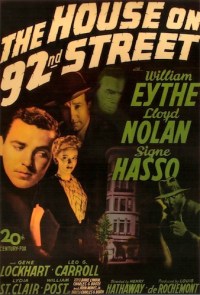 Here’s an unusual one from the pantheon of film noir. These days we’d probably call it a docu-drama, though thankfully there are no talking heads, but there is a factual voiceover narration. The story, we’re told, comes from the FBI’s files and is based on a real case —
  how they really work and investigate a case. At the time I imagine this was a fascinating procedural; now, we’re all a bit more familiar with how such things go, but it still works as an historical document.
 Might be because no one ever knew they were making a film noir, eh? How can you expect something to conform to a set of rules that were only defined after the fact? Hathaway and co didn’t fail at making a noir, they just made a film that doesn’t fit the later-defined template as well as the films used to define said template. I know, four words from some other online critic hardly merit a whole paragraph, but it does bug me when people write daft things like that.
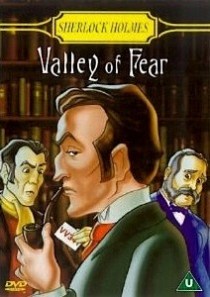 I don’t recall how exactly I came across these animated Sherlock Holmes adaptations starring the voice of Peter O’Toole as the eponymous detective, or how I came to decide to view all of them, but it’s been almost four years since I reviewed the first… and three years since I reviewed the third. Now, finally, I get to the final episode. Such is the erraticism of using LOVEFiLM. (At least I have an excuse for my dawdling here — my incredibly slow viewing of all the Rathbone/Bruce Holmses is entirely my own tardiness.)
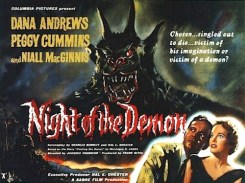 Adapted from an M.R. James story, Night of the Demon sees Dana Andrews as Dr. John Holden, a psychologist arriving in Britain to discredit satanic cult leader Julian Karswell. To cut to the chase, Holden begins to wonder if Karswell has placed a curse on him, and perhaps what he had set out to disprove isn’t such mumbo jumbo after all…
 Tourneur’s film is beloved by some, but I don’t think I quite got it myself. There are some great sequences, but I didn’t always find it hung together in between. Ironically, while many have criticised the actual appearance of the titular beast at the end, I think it works rather well — it’s surprisingly well realised, and you can take it as either a real manifestation or part of one character’s deranged imaginings. It’s an effective climax.
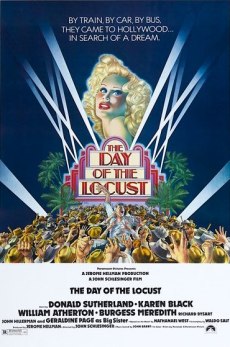 Adapted from the novel by Nathanael West, The Day of the Locust is a slightly scrappy film about the seedy underside of Hollywood’s golden age. The plot is neither here nor there in many respects — the film is about the grotesques who are attracted to Hollywood, and that being exactly what it feeds on. The bizarre, surreal ending definitely makes more sense if you’re already thinking about the film in this way.
 Also brilliantly staged is the collapse of a Waterloo battle set. Appropriate as it’s one of the novel’s most memorable moments.
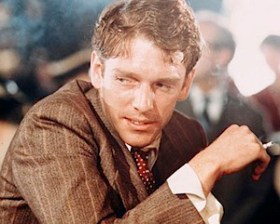 The Day of the Locust may be a mess, or it may be a flawed masterpiece. It may very well be both. For much of it’s running time it pootled along at 3 stars, pushing down toward 2 the more diluted it began to feel. But seeing the completion of Donald Sutherland’s performance in the final scenes, plus the way those scenes seem to draw together the whole film, revealing and fulfilling themes I hadn’t even noticed developing until that point, in a spectacular orgy of apocalyptic violence… well, the stars suddenly ratchet back up.
 A faded action movie star (Burt Reynolds) thinks he’s been signed up to play King Lear with the RSC… but when he arrives in England, he finds it’s just a small village amateur dramatics group. Hilarity, and the odd heart-warming message, ensue.
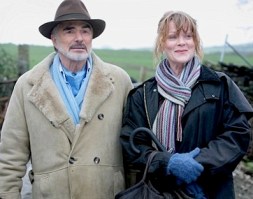 Imelda Staunton and Derek Jacobi, all ceaselessly watchable, plus a supporting cast of faces you’ll likely recognise from British telly.
 Probably the best bit is the series of films Reynolds’ character is known for: Ultimate Finality 4 plays as a nice, subtly-used background gag.
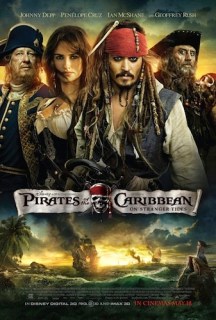 No one had high hopes for
  It still cost $250m, mind, and the fact that’s what’s considered a cutback arguably shows.
 The love story between a missionary and a mermaid barely factors. Word was this pair would be the series’ new Orlando Bloom and Keira Knightley, but whereas Elizabeth Swann and Will Turner were central to the plot of all the previous films (appearing before even Captain Jack in the first, if I recall), these two turn up late in the day and never have a chance to go anywhere. There’s also a surfeit of villains, meaning they either barely appear (the Spanish) or aren’t given close to enough screen time (Ian McShane’s Blackbeard). Every introduction is rushed, every subplot underdeveloped, every ending unsatisfactory. There’s too much, even for a movie that still runs over two hours.
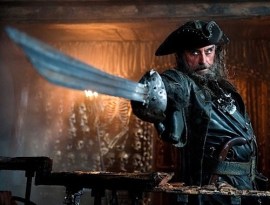 (much-heralded work like
  If The Locket is known for anything, it’s for a plot structure that places flashbacks within flashbacks within flashbacks. There’s always the potential for good fun in that kind of structure, though it’s usually the kind of thing that sounds more complicated than it is — the straightforward ‘concentric circle’ arrangement here makes them a doddle to follow; so straightforward, in fact, that it would be easy to miss how it was so structured.
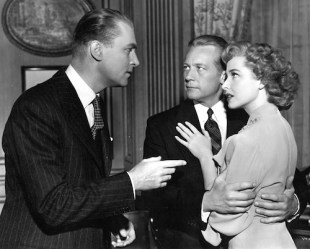 It might have been more interesting if the doctor had been making it all up; or if it had been left open ended, with Nancy set to ruin someone else’s life. That could well have worked, leaving the audience to come to its own conclusions, etc. Considering the film’s age, however, I’m sure there were demands we see this thief and murderess brought to justice.
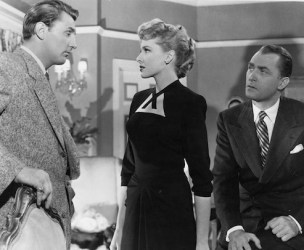 manipulative criminal it seemed all along, but instead a damaged individual doing these things involuntarily. This isn’t the wholly nonsensical part of the film — her apparently-accidental marriage to the son of the house she grew up in would be that bit — but I preferred it when she was just a villain. Psychologically it holds relevance, but at the same time she’s rather taken it to extremes. Or maybe I was just fed up by then.
 100Films.co.uk