
Jason Reitman | 105 mins | TV | 15 / R
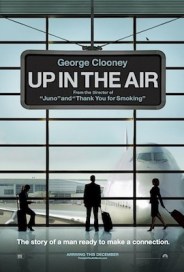 Sometimes, it’s best to just come clean: I don’t have much to say about Up in the Air.
The plot, as you’ll likely know (it was an Oscar Best Picture nominee after all, meaning everyone’s heard of it… for a couple of years, anyway), concerns George Clooney playing someone who flies around America firing people for bosses too chicken to do it themselves. He’s very proud of the air miles he’s accumulated. He meets Vera Farmiga who also does something that involves flying around the country a lot and begins an on-off sex-based relationship with her. Anna Kendrick joins Clooney’s company and creates a plan to do his job via videoconferencing, thereby saving tonnes (sorry, tons — this is an American film) of cash by not having to fly people like Clooney all around the country. Clooney does not like this, so takes her out on the road for a bit to show her the reality of the job.
That’s probably a fair chunk of the film explained, which is not something I usually like to do, but the real point of it — whatever, exactly, that point may be — occurs once all these events are set in motion. And there are a few twists to the plot anyway, which I’m not even close to revealing there.
 Cowriter-director Jason Reitman has created a surprisingly likeable film. It’s easy to see how Clooney’s character — very much the centre of the piece — could be irritating or vapid or any number of other negative adjectives, but instead he’s… well, he’s George Clooney, isn’t he? He’s all charm. If you were going to be fired, you’d probably want George Clooney to be doing it. For a character who is essentially an expansion of the Fight Club Narrator’s “single-serving friend” concept, he gets to become quite rounded and go on quite the journey. (Not just plane journeys either. Ho ho.)
The tone is pitched firmly at comedy-drama (or “dramedy”, if you’re American), which — as we know from experience — means it’s neither the most dramatic nor funniest film you’ll ever see. It does both nicely enough though, eliciting laughs and smiles where appropriate (and sometimes where not, naturally) and providing food for thought on occasion. It might be airplane food, but not everything’s cordon bleu.
 Up in the Air got its Best Picture nom in the first year the Oscars went back to 10 nominations for the big prize. I’m not sure many would disagree that it’s one of The Other Ones — one of the ones that quite probably wouldn’t’ve been there if it hadn’t been for the category doubling in size. And if it was, it’d be The Other One — the token indie/comedy nomination that everyone knows isn’t going to win but was quite good all the same.
So I liked Up in the Air, and I even had more to say about it than I thought, but I didn’t love it. Indeed, while I’m not intending to avoid it as one would a bad film, I feel no particular desire to ever watch it again. It is, if you will, a single-serving film.

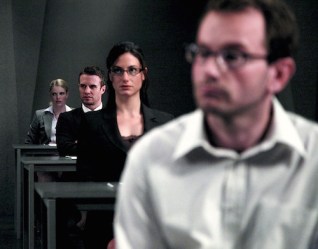
 There’s an argument that the less you know going into any film the better. Naturally there are some films this applies to more than others, and Exam is one such film. Eight young professional types go into a job exam/interview; the next hour-and-a-half is all mysteries and riddles — which is why you wouldn’t want to know too much.
 Such a contained story relies heavily on its characters and the actors’ performances. Largely a cast of un- (or little-) knowns, all are decent — one or two may be subpar, but I’ve seen a lot worse. I don’t quite understand how some viewers can find White, played by Luke Mably, to be a completely likeable character in spite of his obvious flaws — he has his moments, but surely he’s not agreeable overall? Not a jot. That said, his is the standout part, a scene-stealing performance from Mably. There’s no clear-cut audience-favourite, which (from reading a few reviews) seems to be a problem for some viewers. As far as I’m concerned, it’s a good thing: never mind the realism of there being one perfect person every viewer will love, audience-favourites will either predictably win or be shockingly dispatched, so what’s the point?
 it’s quite nice to find a plot that doesn’t feel the need to tie everything in to its reveal; a plot that can wrong-foot you by occasionally focusing on something that’s ultimately irrelevant.
 and films that invite pondering tend to invite repeat viewing; but then again it works equally well (better, ultimately) as a straight-up “what’s going on?” thriller.
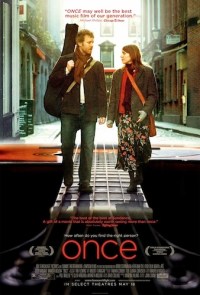 Once is a very modern indie musical. And I mean indie as in “indie film”, not “indie music”. Lord save us from a musical of indie music.
 It’s a testament to the strength of the lead performances and the story they create that it’s not until the end credits roll you realise you never even knew their names.
 100Films.co.uk