
Richard Lester | 103 mins | TV | U / PG
 I like a good swashbuckler. I don’t know exactly what it is about sword fights, but they’re probably my most favourite kind of action sequence. The 1973 Three Musketeers, then, is a film I’m slightly amazed I’ve not seen before. Especially as I absolutely loved it.
Where to begin? The action, I suppose. It’s loaded with the stuff. It puts later movies — from eras when we’re more accustomed to non-stop, regularly-paced action than the ’70s — to shame with its barrage of sword fights. And if you think they’d all be the same and become repetitive, you’re dead wrong. Screenwriter George MacDonald Fraser (yes, he of the Flashman novels) and/or director Richard Lester (yes, he of A Hard Day’s Night, Help! and Superman II and III) and/or the stunt team are constantly inventive in sequence after sequence.
It helps that most have a comedic bent, to one degree or another. This is no po-faced history lesson, but instead pure entertainment. Every scene has a lightness of touch, from screenplay to performance to direction, that never allows anything to take itself too seriously. Spike Milligan may appear as comic relief as a landlord-cum-husband-cum-spy, but he’s more than equalled by… well, pretty much everyone else. The humour might not be subtle — it’s mostly slapstick, often with a bawdy bent — but it is entertaining.
 Thanks to this most of the fights aren’t strictly sword fights, I suppose. Indeed, Oliver Reed seems to dispense with his blade at the earliest opportunity and turn instead to sticks, wet towels, whatever else happens to be at hand. It lends a certain kind of organised chaos to proceedings; the kind that elevates a technically proficient duel into a funny, exciting, memorable segment of cinema. I would list standouts, but instead may I recommend you watch the film and, every time an action sequence starts, count it as one I mentioned. But particularly the one in the laundry and d’Artagnan and Rochefort’s lightbox-lit nighttime duel. And also— Now, this is why I said I wasn’t going to list any.
The star-smattered cast are, as noted, more than up to the task. The titular musketeers — played by Reed, Richard Chamberlain and Frank Finlay — may fade into the background a little while Michael York’s young d’Artagnan and the villainous pairing of Charlton Heston and Christopher Lee drive the story, but each makes an impression even with their limited screentime. The same could be said of the women, Raquel Welch as d’Artagnan’s love interest 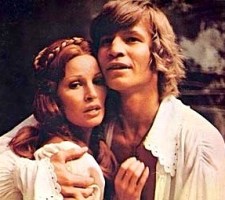 Constance and Faye Dunaway as the conniving Milady de Winter. York earns his place as the lead amongst such company, though, making a d’Artagnan who is by turns athletic, clumsy, hot-headed, loyal, and funny. As I said, everyone pitches the lightness just right, but York perhaps most of all — he doesn’t send up the youngest musketeer, doesn’t make him a pun-dispensing action hero, but finds all the humour in his actions and dialogue.
This film was shot alongside the next year’s sequel, The Four Musketeers — originally intended to be one film, it turned out so long they decided to split it in two. This feels like a wise decision. For one thing, the story seems to wrap up very neatly at this point. The villains may still be free and in power, but the diamond storyline is thoroughly concluded. I don’t know if any major rejigging occurred in the edit, but assuming not, it would surely feel like a film of two halves were it to just continue at the end of this one; the final action sequence is suitably climactic, the following scenes suitably rounded off. Secondly, it means it doesn’t outstay its welcome — while it’s all thoroughly enjoyable, you can have too much of a good thing. 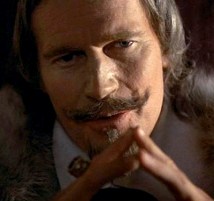 It also means the film ends with a sort of “Next Time” trailer, which feels very bizarre indeed, but is also a tantalising glimpse of what’s still to come.
The Three Musketeers is proper swashbuckling entertainment, with emphasis on… well, both words. It’s certainly swashbuckling and, even more so, it’s entertaining in the truest sense of the word. I loved it.

The Three Musketeers merited an honourable mention on my list of The Best Films I Saw For the First Time in 2011, which can be read in full here.
 100Films.co.uk